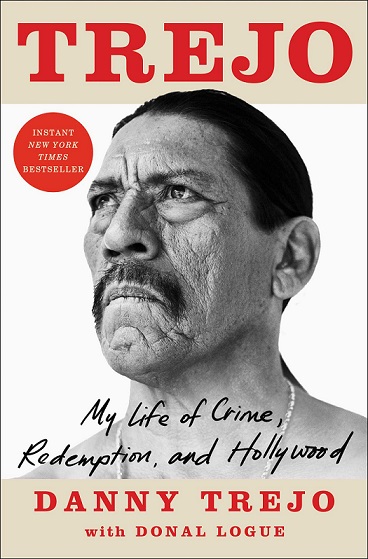
As I sit here, preparing to write a few words about Danny Trejo’s autobiography, I find myself tempted to refer to him as being a “horror star.”
That’s just because it’s October and I’m in a horror mood. The truth of the matter is that Danny Trejo has appeared in all sorts of films. He’s done comedy. He’s done action. He’s done drama. Not surprisingly, given his background, he’s appeared in a ton of crime films. He guest-starred on two episodes of Baywatch. On King of the Hill, he lent his voice to the character of Enrique. He starred as Machete in two movies. And yes, he’s done his share of horror. He was killed by a giant snake in Anaconda. He was killed by Michael Myers (or “Mikey” as Danny’s character called him) in Rob Zombie’s Halloween. He battled both a multi-headed shark and a murderous ghost for SyFy. Danny Trejo has appeared in all sorts of films, to the extent that you never really know where or when he’s going to show up.
That’s something Trejo addresses in his autobiography, which is itself simply called Trejo. He writes about getting asked whether or not he minds appearing in so many B-movie and his reply is that even a B-movie will give people jobs, put food on the table, and perhaps provide some joy to someone who watches it. In another passage, he points out that one bad day on a movie set is still better than the best day in prison. He makes a good point. A lot of movie snobs could learn a lot from Danny Trejo’s attitude.
As for the book, it’s as straight-forward as the actor himself. Trejo talks about his early life of crime, the time he spent in prison, his struggle to get off drugs, his career as a no-nonsense drug counselor, and finally, his current status as a pop cultural icon. Trejo doesn’t hold much back, discussing not only the crimes that he committed when he was young and incarcerated (A lot of the people who love Danny Trejo the character actor would have been terrified of Danny Treo the violent criminal, including myself) but also his subsequent struggles to be a good and responsible father. Maturing is a theme that run through the entire book and Trejo admits that, even as he closes in on his 80th birthday, he’s still learning and growing. What makes the book truly effective is that Trejo never avoids responsibility for his mistakes nor does he attempt to deflect blame. He’s as honest about his sins as he is about his subsequent redemption and it’s that honesty that makes his story so inspiring.
If you’re hoping for a lot of Hollywood gossip, this book might disappoint you. With a few notable exceptions involving Edward James Olmos’s attempts to make a movie about the Mexican Mafia, Trejo focuses on the positive when he discusses his film career. One gets the feeling that he loves his life and he loves his unique place in the entertainment universe. There’s nothing wrong with that. Trejo takes a great deal of joy out of the fact that he’s survived and it’s hard not to share that joy. It’s also hard not to be touched by Trejo’s efforts to keep others from making the same mistakes that he made.
Trejo is a good and inspiring read. Check it out and give thanks for Danny Trejo. He’s a survivor and the world is better for it.
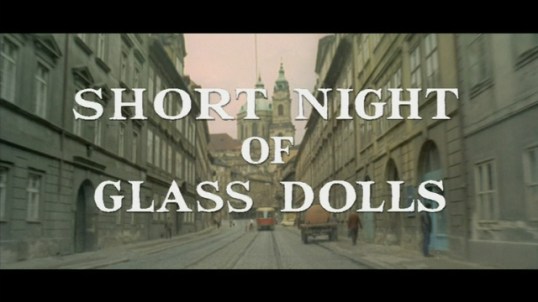
Short Night of Glass Dolls, an Italian thriller from 1971, opens with the discovery of a body in Prague. American journalist Gregory Moore (Jean Sorel) is found lying in a plaza, his blank eyes staring up at the sky. When he is examined by a doctor, we can hear a heartbeat pounding faintly on the soundtrack but Gregory is still declared dead. At the hospital, he is taken down to morgue and left on a slab until a coroner can get around to opening him up….
The only problem is that, as the heartbeat indicated, Gregory Moore is not dead! Instead, he’s paralyzed. He can’t move or speak but he is alive and he can think. As he waits to be dissected, Moore tries to figure out how he came to be in the situation. He searches through his mind and we search with him. He remembers his lover, Mira (Barbara Bach), who begged him to help her defect. He remembers how she mysteriously vanished and how he worked with Jessica (Ingrid Thulin) and Jacques (Mario Adorf) to investigate her disappearance. Moore’s mind is full of disturbing and surreal images but, as he remembers, it slowly starts to make sense. And yet, even if Moore does eventually figure out what happened to Mira and how he came to be paralyzed, the coroner is still making his way over to Moore’s body….
Because it’s an Italian thriller from the 70s, Short Night of Glass Dolls is often mistakenly referred to as being a giallo. Actually, it’s not. Though the film does have the type of convoluted plot and the stylish imagery that is typically associated with the giallo genre, the film also lacks a black-gloved killer and really, it can’t be a giallo unless you have the unknown killer wearing black gloves. Instead, Short Night of Glass Dolls is a deliberately paced paranoia thriller, one in which Moore uncovers not just a single crazed killer but instead a shadowy conspiracy. It’s also an effective horror film, one that makes good use of Prague’s gothic atmosphere and which is full of haunting imagery. Whether it’s the leering gargoyles that seem to be present on every building or the mysterious chandelier that continually shows up randomly in Moore’s mind, Short Night of Glass Dolls plays out like a cinematic dream. Moore finds himself trapped, both physically and mentally. His body is trapped in the morgue while his mind is trapped in the past.
Director Aldo Lado was always one of the more political of the Italian thriller directors and, not surprisingly, there’s a heavy political subtext to Short Night of Glass Dolls. It’s probably not a coincidence that the journalist, who starts out as being cocky just to eventually discover that he doesn’t understand the world as much as he thinks he does, is an American. It’s also not a coincidence that the film takes place in Prague, which was, at that time, a Communist-ruled city. Prague is portrayed as being a city that is controlled by secret police and secret societies, where no one is allowed to fly free. In the end, Short Night of Glass Dolls is full of secrets.
If you had told me, ten years ago, that John Krasinski was destined to go from starring in The Office to being an action star, I would have thought you were crazy.
“John Krasinsi’s going to grow a beard and base his acting career around playing soldiers and CIA analysts? No way! He will always be Jim Halpert,” I would have said, “He smirks at the camera and has an adorable relationship with Pam!”
Of course, I was wrong. After The Office ended, John Krasinki went on to play Jack Ryan for Prime and to star in movies like 13 Hours. And yet, as unexpected as that development may have been, what was even more unexpected was that Krasinski would also direct one of the best horror films of the past five years, 2018’s A Quiet Place. Telling the story of a family trying to survive in a post-apocalyptic world in which the Earth has been invaded by aliens who hunt by sound, A Quiet Place was intense, atmospheric, frightening, and actually rather touching. Though the plot itself may have been a bit familiar (because, seriously, how many movies have there been recently about insect-like aliens destroying civilization?) but Krasinski showed true skill as a director, getting heart-breaking performances out of a cast that included himself and his wife, Emily Blunt.
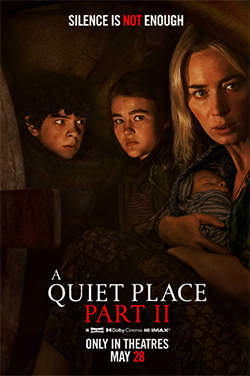
A Quiet Place was such a success that it was was inevitable that it would be followed by a sequel. Though its original release was delayed by the pandemic, A Quiet Place Part II was finally released in May of this year and it became one of the first successful films of 2021. John Krasinki even taped a special greeting for those who saw the film when it was first released, welcoming them back to the theaters. That really is the most John Krasinski thing imaginable.
As for A Quiet Place Part II, it’s actually two films in one. The first part of the film serves as a prequel, showing us the initial attack and following Lee (John Krasinski) and his family as they flee for safety while the aliens decimate their hometown. It’s an exciting sequence, even if one gets the feeling that it was largely included so that Krasinski could make an appearance despite his character having been killed off during the first film. After the flashback, A Quiet Place Part II picks up where the first film ended. Lee is dead and his widow, Evelyn (Emily Blunt), does everything she can to protect her surviving children, Regan (Millicent Simmonds), Marcus (Noah Jupe), and her newborn baby. Though Regan has figured out that the aliens are themselves vulnerable to sound (specifically, a high-pitched tone), that doesn’t make the aliens themselves any less dangerous. After eventually meeting up with Emmett (Cillian Murphy), an embittered friend from the old days, Evelyn and her family search for other survivors.
A Quiet Place Part II is a simple but efficient thriller, one that recaptures all of the first film’s strengths without making the mistake of adding any new weaknesses. Much like the first film, it’s dominated by suspenseful scenes of survivors trying to make their way through the wilderness without so much as stepping on a twig. As anyone who has ever tried to sneak into their house after being out later than they were supposed to can tell you, walking without making a sound is not as easy as it seems. One of the film’s most harrowing scenes features a character getting his foot caught in a bear trap and his family struggling to free him while also trying to keep him from screaming out in pain.
Wisely, the film resists the temptation to tell us too much about the aliens. All we really know about them is that they hunt by sound and they kill anything they pounce on. And really, that’s all we need to know. At a time when far too many film franchises end up drowning in their own overly complicated mythology, the Quiet Place films keep it simple. The aliens hunt and they kill and they’re frightening specifically because there is no way to understand their motivations. They’re pure chaos, a reminder that our lives are not ruled by rhyme and reason. The aliens, like all existential threats, don’t care that the Earth is inhabited by families or people who have tried to create a safe life for themselves. They exist only to destroy.
It can be argued that A Quiet Place Part II tells essentially the same story as A Quiet Place, with Cillian Murphy’s Emmett replacing Lee. That’s a legitimate point but then again, it could also be argued that a part of the film’s strength is that it doesn’t attempt to complicate things. The aliens are going to remain just as frightening the second time Evelyn and her family flees from them as the first time. Clocking in at a brisk 97 minutes, there’s not a wasted moment or a trace of filler to be found in A Quiet Place Part II. Featuring an excellent turn from the awesome Emily Blunt and good performances from Simmonds and Murphy, A Quiet Place Part II is a sequel that’s worthy of the film that came before it.
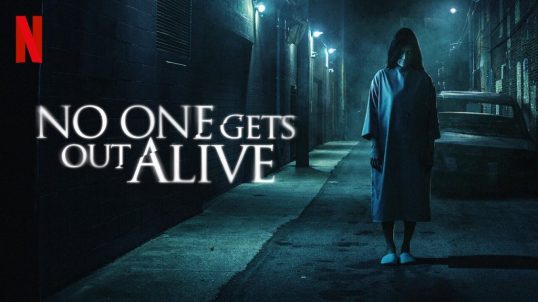
No One Gets Out Alive is a film set in the worst place on Earth. I’m talking, of course, about Cleveland, Ohio.
Still haunted by the death of her mother, Ambar (Cristina Rodlo) has arrived in Cleveland and is looking for a fresh beginning. She hasn’t gotten off to a great start as she’s stuck in a go-nowhere job at a sweatshop. Fortunately, her cousin, Beto (David Barrera), is willing to help Ambar get a better paying job, even though he barely knows her. Unfortunately, Ambar needs a legal ID to get that new job and, as an undocumented immigrant, she doesn’t have one. A co-worker offers to hook her up with a fake ID but it’s going to cost far more money than Ambar has.
As serious as that is, Ambar has an even bigger problem to deal with. She’s recently moved into an apartment. It’s a big apartment in an old building and the only other tenants are two mysterious women from Romania. However, her landlords — Red (Marc Menchaca) and his brother, Becker (David Figiloil) — both seem kind of weird. As Red explains it, Becker is a “little off” but Becker has apparently taken care of Red for his entire life. Personally, I wouldn’t ever rent an apartment from either Red or Becker as they both give off that “sneaking into your apartment and stealing your underwear” vibe but desperate times, I guess.
Even if one could overlook the creepiness of Red and Becker, there’s also the fact that the apartment itself is obviously haunted. Ambar is constantly hearing strange noises and seemingly disembodied conversations. She occasionally sees figures in the shadows. When she takes a shower, a mysterious woman appears on the other side of the shower curtain but promptly vanishes as soon as the curtain is opened. That’s pretty messed up.
But what can Ambar do? She’s in the country illegally so she’s not going to risk calling the police. Beto turns out to be pretty ineffectual. (As a Texan, I appreciated the fact that the movie featured a well-intentioned but thoroughly useless character named Beto.) Maybe in another city, she could find some place better to live but Ambar’s in Cleveland. Haunted pervy death house is as good as anyone can hope for in Cleveland! Ambar is trapped in a place where no one gets out alive.
No One Gets Out Alive is one of those horror films where no one ever seems to turn on the lights. Every single scene in the film is dark and overcast. When Ambar goes outside, the sky is always cloudy. When Ambar returns to her apartment, the lighting is always dim. It creates a properly ominous atmosphere but, at the same time, it also makes it difficult to actually see what’s happening in a few scenes. After a while, the film’s washed-out color scheme and shadowy cinematography goes from being ominous to actually being kind of annoying.
But, if you can overlook or, at least, tolerate the film’s overly drab visual style, No One Gets Out Alive has its effective moments. The apartment building is a nicely creepy location and, even if some of the scares are a bit generic, they still often work. Cristina Rodlo is sympathetic in the role of Ambar and the character’s status as an undocumented immigrant adds an interesting subtext to her being at the mercy of the building’s inhabitants. Without any legal status, there’s nothing she can do once it becomes apparent that Red and Becker have an agenda of their own. Her pursuit of the American dream becomes a nightmare once she realizes that, living in Cleveland without any legal ID, she might as well not exist.
No One Gets Out Alive is one of those films that starts out a bit slow but it improves as it goes. Though I wish someone had turned on the lights, it’s an effective horror film that you can find on Netflix.
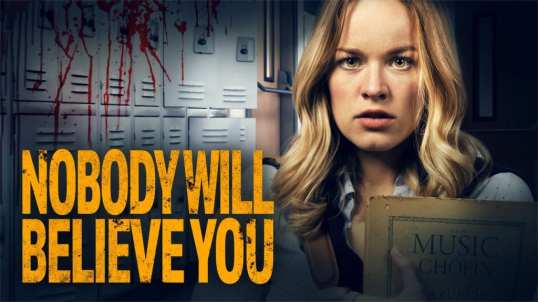
Last night, I turned over to the Lifetime Movie Network and I watched Nobody Will Believe You (a.k.a. Pretty Little Victim).
Why Was I Watching It?
This was actually my second time to watch Nobody Will Believe You. I also watched it back in July but, for whatever reason, I didn’t review it despite the fact that I enjoyed the film. I guess I must have been busy or sick in July, who knows? Anyway, when I saw that it was going to be airing on the Lifetime Movie Network on Thursday night, I decided to rewatch it so that I could finally get around to writing this review!
What Was It About?
Melanie (Jenna Rosenow) and her daughter, Hannah (Emily Topper), have moved to a new town and, for Hannah, that means starting at a new school! From the very first day, it’s obvious that Hannah is going to struggle to fit in. Hannah may be nice but her classmates definitely are not. The cheerleaders are bitchy. The jocks are toxic. Her best friend is alienated. There’s a mysterious man who occasionally shows up and menacingly waves around a taser. The only good news is that the friendly guidance counselor (John William Wright) wants to hire her to teach his daughter how to play the piano! What could possibly go wrong?
What Worked?
I enjoyed Nobody Will Believe You because it did what every good Lifetime film does. It shamelessly and openly embraced the melodrama. Seriously, every possible thing that could happen to Hannah did happen to Hannah. No sooner was Hannah getting rejected by the cheerleaders then she was saving the most popular girl in school from a falling printer. No sooner had Hannah’s phone been hacked than someone was trying to frame her for murder. It was such a nonstop collection of incidents that it quickly became clear to me that the film was self-aware when it came to its status as a Lifetime film. It understood why the audience was watching and it was determined to give us exactly what we wanted. At its best, the film worked as both a tribute to and a parody of the typical Lifetime movie.
What Did Not Work?
Obviously, for the film’s plot to work, Hannah had to be extremely naïve and trusting. And, let’s be honest, it is true that some people are easily tricked. Not everyone has the streetwise instincts of a suburbanite who has watched several hundred Lifetime films. However, even with that in mind, it was sometimes hard to accept that Hannah could be as totally naïve as she often was. Watching the movie, you sometimes got the feeling that, even if Hannah survived, she was destined to grow up to be one of those people who ends up sending their life savings to Aruba because someone contacted them on Facebook, claiming to be Garrett Hedlund.
“Oh my God!” Just Like Me Moments
When I was growing up, my family used to move a lot so I definitely could relate to Hannah’s nervousness about having to start all over again at an entirely new school. And, when I was in high school, I got along famously with our guidance counselor. If I hadn’t broken my ankle, maybe he would have asked me to teach his daughter to dance. Of course, if Lifetime films have taught me anything, it’s that being hired to teach anyone anything is automatically going to lead to tragedy.
And of course, that brings us to….
Lessons Learned
Don’t teach. Don’t offer to help anyone. Reject any and all offers of mentorship. It’s just going to lead to trouble.
No, wait a minute. That’s not right. Let’s try that again.
Half Shark….
Half Octopus….
All Killer!
There, that’s it! That’s our Sharktopus!
Produced by the legendary Roger Corman, Sharktopus originally aired on the SyFy channel in 2010. It tells the story of S-11, a creature that is half-shark and half-octopus. How exactly did S-11 come to exist? Well, blame the government! The government wanted a new weapon and apparently, it didn’t bother them that the weapon would have no practical use beyond going rogue and killing civilians. Dr. Nathan Sands (Eric Roberts, the one and only) created the sharktopus with the help of his daughter, Nicole (Sara Malakul Lane). When S-11 swims off on its own and starts eating human beachgoers, Nicole teams up with mercenary Andy Flynn (Kerem Bursin). Nicole and Andy think that they’ve been sent to destroy S-11 but it turns out that Nathan has other plans.
Let’s just state the obvious. This is the greatest film ever made. Okay, well …. maybe it’s not the greatest. Some people would probably say that it’s not even that good but I think they’re overthinking things. What it comes down to is that there really aren’t as many films out there about shark/octopus hybrids as you might think. When it comes to this very specific genre of horror films, Sharktopus is the best.
This is a film that understands why the audience is watching. We’re watching because we want to see Sharktopus action! So, while the film does contain its fair share of scenes of Nicole and Andy searching the ocean, the majority of the film is still made up of Sharktopus attacks. You don’t really get to know any of the victims, though I did feel bad for the gentleman who shouted, “Oh no! Not like this!” as he was pulled down to the ocean by S-11’s tentacles, but that’s okay. It’s all about the Sharktopus, a creature that is so ludicrous that it’s impossible not to like it.
Another thing that’s impossible not to like is the fact that Eric Roberts is in this film. The last time I checked, Roberts had a total of 641 acting credits listed on the imdb. He’s appeared in every type of films — from Oscar-nominated prestige films to low-budget faith-based films to Lifetime films to …. well, films like Sharktopus. But regardless of the film, Roberts always seems to be trying his best or, at the very least, he comes across like he’s genuinely amused by the absurdity of it all. Roberts has a lot of fun in Sharktopus, playing his mad scientist character with a twinkle in his eye and a barely suppressed evil smile. Dr. Sands takes genuine pride in his creation and it’s kind of hard not to get caught up in his enthusiasm.
Sharktopus is a fun movie. It’s a low-budget and deeply silly epic and it you can’t enjoy the sight of shark/octopus hybrid creeping across the beach than I don’t know what to tell you. In fact, Sharktopus was popular enough with SyFy audiences that it would return for a whole series of films in which it battled hybrid monsters. Go Sharktopus!
On a final note, keep an eye out for Roger Corman while watching this film. He plays a man on the beach who watches as a treasure seeker is dragged off to the ocean. When he realizes that she dropped a valuable coin while being taken away, Corman walks out on the beach and grabs it for himself. Hopefully, he sold that coin and used the money to go on a nice vacation. If anyone’s earned it, it’s Roger Corman!
This 1997 YA novel from R.L. Stine tells the story Tania, Eva, and all of their friends at Shadyside High!
Tania, as we learn in the book’s opening pages, is having the best year of her life! She’s got a hunky stepbrother. She’s got a football player boyfriend. Her movie career is about to be launched because she’s been cast in a high school student film. (Yeah, that didn’t make sense to me either but just go with it.) And, at the big pep rally that starts the book, it’s announced that she’s going to be the homecoming queen! Meanwhile, Eva apparently has psychic abilities that allow her to know if something bad is going to happen. That may sound impressive but the book doesn’t really do much with it.
Of course, life is never as perfect as it seems. Tania may be the most popular girl in school but that doesn’t mean that everyone likes her. In fact, Leslie, one of the defeated homecoming queen finalists, even attempts to push Tania down some stairs! OH MY GOD! Leslie says it was an accident but was it? Later on, when Tania mysteriously disappears, Eva and her friends wonder …. who killed the homecoming queen!? (Of course, that’s assuming Tania is dead. She’s actually just missing so it could be that Eva is getting ahead of herself.) Leslie seems like the obvious suspect but …. OH MY GOD AGAIN, is that Cherise Colby making out with Tania’s boyfriend!? And seriously, why would anyone trust their boyfriend with someone named Cherise Colby?
I love the old R.L. Stine and Christopher Pike books and I’m planning on reading and reviewing a lot of them for October. The main reason I read this particular book was because of the title. I mean, Who Killed The Homecoming Queen is the type of title that you would come up with if you were challenged to come up with the perfect R.L. Stine title. That said, the book itself is pretty anti-climatic. There’s only one death in the book and — surprise! (and spoiler alert, I suppose) — it’s not the homecoming queen! So, as perfect as the title is, it’s kind of a lie. Stine used the title but he didn’t actually use it as the plot of the book, which is strange.
To be honest, though, this book feels like R.L. Stine on autopilot. This is one of the last of the original Fear Street books (though Fear Street itself is not really mentioned in the book) so one gets the feeling that Stine was a bit bored when he wrote it. I was a bit bored when I read it, though I did have to laugh at the obnoxious student filmmakers who insisted on making Eva’s life awkward. Never have a group of supporting characters felt more true to life.
Anyway, fear not! This particular R.L. Stine book may be disappointing but he wrote a lot of books and I’m planning on reading and reviewing a few of the better ones this October!
I mean, who can resist a trip to Fear Street, right?
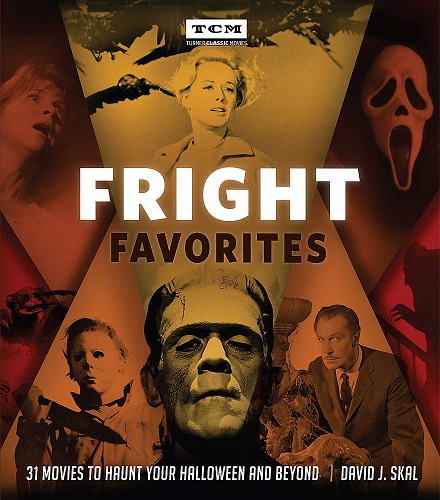
Now, if you’re like those of us here at the Shattered Lens, you’ve already got your list of movies set up to go. You know exactly which horror movies you’re going to watch this year and you’re ready for a great Halloween! Good for you! However, for everyone else, David J. Skal’s Fright Favorites is a good place to start when it comes to making out your list.
The book is subtitled 31 Movies To Haunt Your Halloween and Beyond and that’s pretty much the perfect description. Skal writes about 31 classic horror films, analyzing both their content and discussing their historical importance and making a pretty good case why these should be the films that you watch this Halloween. (Actually, since there’s 31 films, you could easily watch a film a day.) Going in chronological order, Skal starts with silent classics like Nosferatu and The Phantom of the Opera and then goes all the way to modern classics like Get Out. Along the way, Skal discusses Universal classics like Dracula and Frankenstein, the Hammer films, the Corman Poe films, and, of course, films like The Exorcist, The Shining, Halloween, Beetlejucie, Scream, A Nightmare on Elm Street, and many more. He also recommends Hocus Pocus but we won’t hold that against him. He also devotes a chapter to Black Sunday (with a little mini-section about Surpiria) so Italian horror does not go unmentioned!
It’s a fun read, for both horror and non-horror fans. It’s a good starter for those who might not know much about the genre but, at the same time, there’s a lot here for those of us who already love the films. Skal’s appreciation of the genre comes through and, even if you’ve already seen the films that he recommends, it’s still interesting to consider his thoughts on them. This is one of those books that will remind you of why you fell in love with the horror genre in the first place.
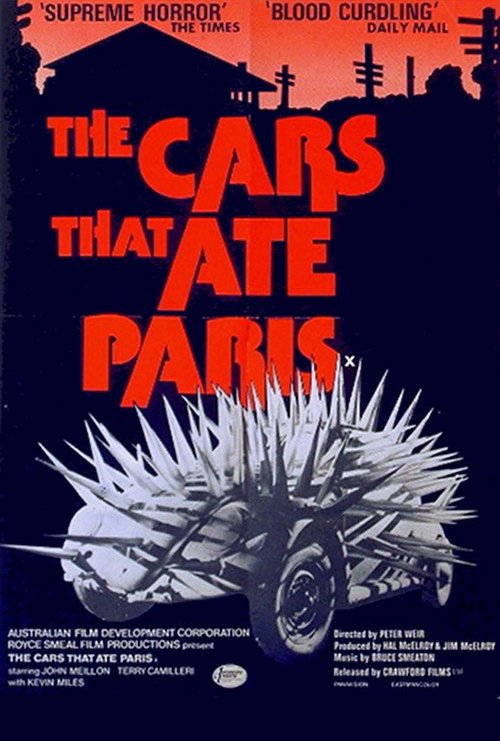
Taking place in a vaguely futuristic world, the 1974 Australian film, The Cars That Ate Paris, opens with an attractive and impossibly happy couple going for a drive in the countryside and getting killed in a truly horrific car accident, one that apparently was deliberately set up.
Meanwhile, two brothers — Arthur (Terry Camilleri) and George (Rick Scully) — are traveling across Australia, in search of work. Everywhere they go, they see long lines of desperate people looking for a way to make money, suggesting that the economy has basically collapsed. George does the driving, largely because Arthur’s license was taken away after he accidentally killed a pedestrian. Arthur is struggling with both the guilt and a phobia of cars in general.
That phobia only gets worse after Arthur and George are involved in a automotive accident of their own. George is killed but Arthur survives. Taken to the small, rural town of Paris, Arthur is adopted as a bit of a mascot by the town’s seemingly friendly mayor, Len Kelly (John Mellion). At first, Arthur is relieved to have survived but he soon comes to realize that the residents of Paris have no intention of ever letting him leave.
Paris, it turns out, is a bit of a strange place. The entire economy is based on collecting scrap metal from the many cars that crash within the city limits. The local hospital is full of car crash victims, the majority of whom end up getting lobotomized and used as test subjects for the local doctor. Indeed, the only thing that kept Arthur from a similar fate was that the mayor assured everyone that Arthur’s phobia of driving has rendered him “harmless.” (And just to make sure that Arthur doesn’t lose that phobia, he’s sent to a psychologist who spends nearly the entire session showing him grotesque pictures of car accident victims.) Though the mayor continually talks about how Paris represents the “pioneer spirit” that made Australia great, the town’s teenagers don’t seem to be too impressed with the place. They spend all of their time driving around in cars that they’ve modified into small tanks. (Their leader drives a compact car that has been covered in metal spikes, transforming it into a motorized porcupine.) Arthur wants to escape the town but can he conquer not only his own fears but also avoid being killed by the citizens who have adopted him?
The Cars That Ate Paris is a rather uneven film. It gets off to a good start and the town is memorably creepy but, once Arthur had been adopted by the mayor, it starts to drag and not much happens until the teens finally get around to turning on their elders during the final fifteen minutes of the film. Arthur is a frustratingly passive character and his car phobia never really feels credible. The film attempts to mix horror, science fiction, and satire but it comes across as being rather disjointed. Thematically, it’s probably most interesting as a precursor to the Mad Max films, having been inspired by the same Australian car culture that inspired George Miller. In fact, The Cars That Ate Paris almost feels like a prequel to the Mad Max films. One half expects a young Mel Gibson to pop up at the end, wearing Max’s patrolman uniform and shaking his head at the madness of it all.
That said, the film features a few striking images and Paris is a memorably desolate town. This really isn’t that surprising, given that The Cars That Ate Paris was directed by Peter Weir. This was Weir’s first feature film, though he had previously directed several shorts, and the film very much comes across as being the work of a talented artist who was still learning how to use those talents to tell a compelling story. In the end, Peter Weir’s involvement is the main reason to watch The Cars That Ate Paris. The film doesn’t really work but it does provide a chance to see an early effort from someone who would eventually become one of the most interesting directors of his time.
In 17th Century France, Louis XIII (Graham Armitage) may be king but it’s the devious Cardinal Richelieu (Christopher Logue) who holds the power. Richelieu has convinced that king that every walled city in France should have its walls blown up, the better to keep track of what’s actually happening within the city. Unfortunately, for Richelieu, Louis XIII promised the Governor of Louden that he would never harm any structure in the city, leaving its walls untouchable. While Louis XIII concentrates on throwing outdoor parties where murdering protestant is the main source of entertainment, Richelieu searches for an excuse to destroy the walls of Loudon.
Along with being frustrated by the fact that Loudon retains its walls, Richelieu is also upset that the unofficial leader of the city is Ubrain Grandier (Oliver Reed), a decadent priest who has not only criticized the discipline of clerical celibacy but who has also publicly opposed the Cardinal’s efforts to increase his own political power. Grandier has made it clear that, as long as he’s in control, the walls of Loudon will never came down and the people of Loudon, fearful of the plague that is ravaging the world outside of the walls, support him.
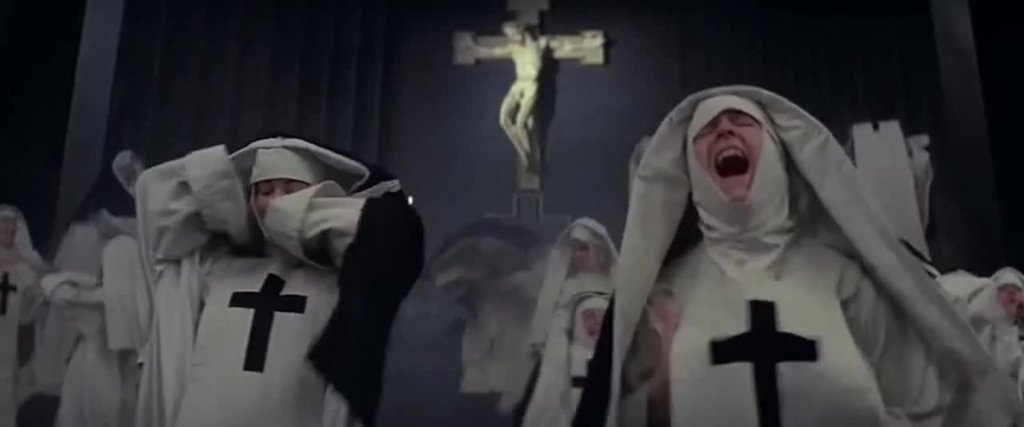
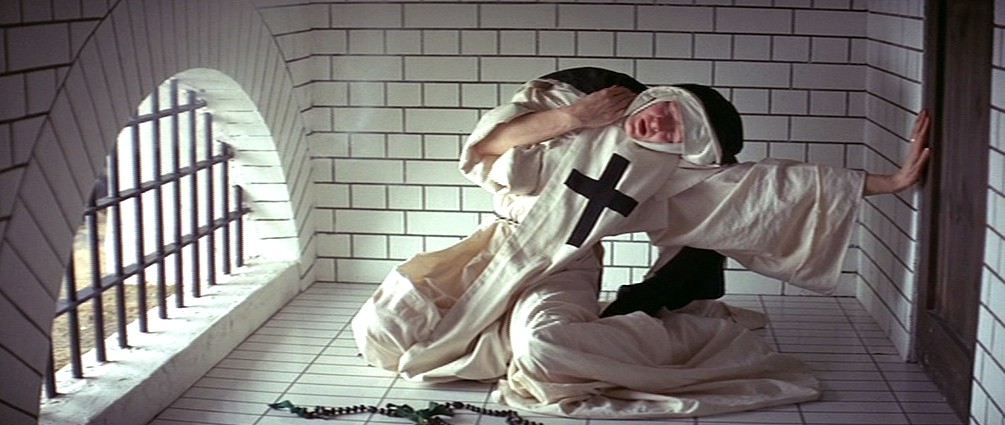
Among Grandier’s many admirers is Sister Jeanne des Agnes (Vanessa Redgrave), a hunchback who is also the abbess of the local convent. Having become sexually obsessed with Grandier, Agnes requests that he become the confessor of the convent. When Grandier refuses, it sets off a chain reaction that eventually leads to Grandier being accused of worshipping the Devil and “bewitching” Sister Agnes and several other nuns. With the arrival of Father Barre (Michael Gothard), a fanatical witch hunter, the city of Loudon descends into darkness and decadence.
Directed by the infamous (and, let’s just admit it, brilliant) Ken Russell and first released in 1971, The Devils is not an easy film to see. When the film was originally released in Britain, it was controversial for its uncompromising depiction of 17th century torture and its combination of religion and sexual imagery. (This, of course, was a recurring theme in almost all of Russell’s work.) The British censors demanded a few minor cuts before agreeing to approve the film for release. While the British censors focused on the scenes of violence, Warner Bros. also removed several sexually explicit scenes, the most infamous of which was a sequence in which a group of naked nuns sexually defiled a statue of Christ. Also removed was a scene of a priest masturbating while watching the nuns and finally, a scene in which Sister Jeanne masturbated with a charred femur bone. Russell was not happy with the changes and, needless to say, he was even more upset when Warner Bros. removed an additional three minutes before releasing the film in the United States.
In the U.S., The Devils was even more controversial than it had been in the United Kingdom and, while many critics praised it as being a powerful attack on hypocrisy, others described it as merely being pornographic. Despite the cuts that were made, the American version of The Devils was slapped with an X rating and Warner Bros. attempted to distance itself from the controversy that had developed around the film. As of this writing, The Devils has never been given a proper Region 1 DVD or Blu-ray release. It’s rare that ever shows up on any streaming platforms. Even YouTube has only a handful of scenes. If you want to watch The Devils in America, you’re going to have to track down a VCR player and watch it on VHS. And, even then, you’ll only be seeing the version that was cut for the U.S.
Will Ken Russell’s original, uncut version ever be seen in America? It’s a question that many film students have asked themselves. In 2002, a 117-minute edition of The Devils played in London, featuring some of the footage that was cut from the film’s original release. However, that version is still considered to be incomplete and it’s certainly not available here in the United States. The Devils does occasionally show up on Shudder, which is how I saw it earlier this year. Of course, the Shudder version was the cut American version, which Russell repeatedly disowned.
Watching the film, I could understand Russell’s anger. It wasn’t just that scenes had been cut out of the film. It was that the scenes were often edited out with such a lack of finesse that it made the film seem disjointed. Russell was a director known for his hallucinatory and deliberately over-the-top style. When the film abruptly cuts away from showing us its most shocking images, it feels antethical to everything that Russell was about as a filmmaker. On the one hand, it’s easy to say, “Who cares if a scene of Vanessa Redgrave masturbating with a charred femur bone has been removed from the film? Who wants to see that?” But if you watch The Devils, it becomes apparent that it’s not about what would be pleasant to see. Indeed, in many ways, The Devils is meant as a deliberate attack on the senses, one in which shocking imagery is used to awaken the audience from their complacency. As such, the controversy about how the film was cut is not about what’s acceptable. Instead, it’s about the fact that Russell has created a world where it somehow makes total sense that Sister Jeanne would pick up the femur and make use of it. By editing the scene so that it abruptly ends with Jeanne merely looking at the bone, Warner Bros. forced The Devils to not be true to itself.
And yet, despite all of that, The Devils remains a powerful and disturbing film, a hallucinatory collection of nightmarish images and haunting scenes. The excessive stylization that was Ken Russell’s trademark is perfect for this story of an entire community caught up in a frenzy of paranoia and repression. Though a period film (and based on a true story), Russell’s Loudon resembles an alien landscape, an almost expressionistic city of pristine walls and dirty streets. Vanessa Redgrave’s twisted nun stalks through the film like an ominous spirit, both wanting and hating Grandier at the same time. When the “possessions” begin, the possessed finally have the excuse to do what they truly want and to live just as wantonly as the men who previously controlled their lives. Because they’ve come to believe that they’re no longer responsible for their own actions, they can indulge in every depravity. But with Louis XIII casually murdering protestants for sport at his estate and Richelieu manipulating church policy to his own ends, the film asks why the people’s actions are more worthy of condemnation than the actions of the people who rule them.
The Devils has reputation for being blasphemous. It is, of course, nothing of the sort. After I watched the film, I did a little research and I was not surprised to discover that Ken Russell was a practicing Catholic because only a Catholic could make a film that both celebrated what the Church could be while also condemning it for so often falling short. While Richelieu represents the people who use religion as a vehicle for their own drive for power and Sister Jeanne and the witch-hunter Father Barre represents the fanatics who use church doctrine to justify their own madness, it is the sinner Father Grandier who represents what the Church should be. It is Grandier who is ultimately forced to put his own life at risk to protect the people of Loudon.
Is The Devils are horror film? Some would probably argue with my claim that it is. They would probably claim that it’s a historical drama with a heavy political subtext, However, for me, the imagery itself is disturbing enough to justify calling The Devils a horror film. The possessed of Loudon eventually prove themselves to be as mad as any of the infected people from George Romero’s The Crazies and the torture that Grandier suffers is frightening specifically because it’s all based on fact. There really was a town named Loudon that had walls. There really was a priest named Grandier who was accused of practicing witchcraft and who suffered the most vile torture as a result.. The Devils is a film about people driven made by a combination of repression and fanaticsm. It’s a horror film because it’s true and, needless to say, the madness that possessed Loudon didn’t die out in the 17th Century. It’s continued into the present day.
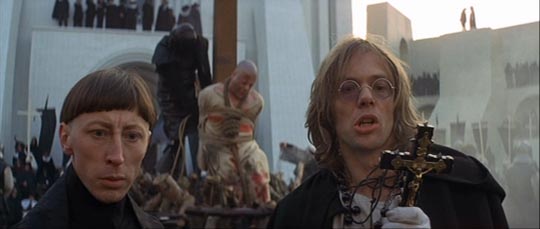
Oliver Reed may seem like an odd choice to play a priest but he gives one of his best performances as the charismatic but foolishly cocky Grandier. Vanessa Redgrave is frightening as the disturbed Sister Jeanne and British actor Murray Melvin is alternatively sympathetic and pathetic as a priest who comes to believe in Grandier’s innocence. For me, though, the film is stolen by Michael Gothard, who plays the fanatical witch hunter, Father Barre. With his long hair and his glasses, Father Barre bears a definite resemblance to John Lennon and the film portrays him as being the 17th century equivalent of a rock star, an arrogant and sensual man who encourages people to indulge in their most secret desires so that he can then declare them to be possessed and in need of an exorcism. Gothard had a magnetic screen presence, allowing him to steal scenes from even formidable talents like Oliver Reed and Vanessa Redgrave. Gothard would go on to play the silent assassin in the James Bond film, For Your Eyes Only and was, again, memorably threatening. Sadly, Gothard took his own life in 1992.
Someday, perhaps the full unedited version of The Devils will be available. Until then, even the edited version retains its power to shock, disturb, and make you think. Today, more than ever, its portrait of hypocrisy and mass madness feels relevant. The modern age is still ruled by hysteria and paranoia and our leaders are still looking for any excuse to take down any walls that might protect us from having to submit to their will. How different is Sister Jeanne from the people who are currently hurling accusations on social media? How different is Father Barre from the the people who were are currently told have all the answers? We may no longer burn people at the stake but we’ve found new ways to silence voices of dissent. The film may have been set in 17th Century France and first released in 1971 but Ken Russell’s masterpiece is all about the modern age. The Devils in not an easy film to watch or find but it is more than worth the effort to track down.




 Through the Shattered Lens