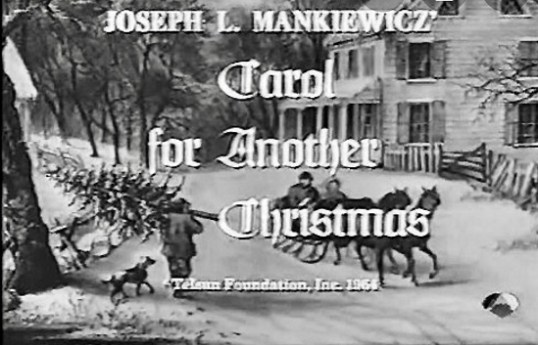
Holiday Film Review: Carol For Another Christmas (dir by Joseph L. Mankiewicz)


Daniel Grudge (Sterling Hayden) is a wealthy American industrialist who served in World War II and who, despite seeing first hand the horrors of Hiroshima, still believes that war is sometimes the only answer.  He spends his Christmas Eve sitting in darkened study, thinking about his dead son (who was killed in combat) and listening to an old record.  When his nephew, Fred (Ben Gazzara), stops by, it leads to an argument about American foreign policy.  (Who stops by their uncle’s house on Christmas Eve to argue politics?)  Fred is do-gooder.  Daniel Grudge hates do-gooders.

So, naturally, it’s time for Daniel Grudge to be visited by three ghosts!  The Ghost of Christmas Past (Steve Lawrence) takes Grudge first to a troop ship that is full of coffins, representing the dead of World War I.  Then he forces Grudge to relive his own callous reaction to Hiroshima.  Grudge sees how his actions upset the nurse (Eva Marie Saint) who was traveling with him.  The Ghost of Christmas Present (Pat Hingle) invites Grudge to eat a feast in front of a camp full of refugees.  The Ghost of Christmas Future (Robert Shaw) takes Grudge to the future where, after a devastating nuclear war, a buffoonish leader (Peter Sellers) encourages his followers to continue to make war and to live only for themselves.  Grudge watches as his former butler (Percy Rodriguez) is murdered for advocating for peace.  Back at his mansion, Fred shows up again and Grudge must now decide …. will he support the work of the United Nations?

YEEEEESH!  What a heavy-handed movie!  Really, I guess I shouldn’t be surprised at how unsubtle the film’s message was.  Originally made for television, A Carol For Another Christmas was actually co-produced by the United Nations.  It was the first of four UN-produced films that aired on ABC between 1964 and 1966.  Seen today, with all that we know about the UN’s signature mix of corruption and incompetence, the film’s message seems almost laughably naïve.   “Only the UN can bring peace,” the film says.  Tell that to Israel, the next time that the UN passes a resolution condemning it for existing and defending itself.  Say that only the UN can make the world a better place when some of the worst dictatorships on the planet are sitting on the Human Rights council.

The heavy-handed message aside, A Carol For Another Christmas was full of talent both behind and in front of the camera.  This was the only TV movie to be directed by Joseph L. Mankiewicz and, whatever else one might say about the film, he was responsible for some intriguingly moody shots.  The script was written by Rod Serling who, unfortunately, allowed his didactic tendencies to get the better of him and wrote a film where characters didn’t have conversations as much as they just gave speeches.  The cast, however, is uniformly strong.  Sterling Hayden, Robert Shaw, and Steve Lawrence are obvious stand-outs.  Pat Hingle does fine until his role is diminished to one long harangue.  Playing the so-called “Imperial Me,” Peter Sellers brings so much needed unpredictability to the film, even if his character is saddled with the film’s most heavy-handed moment.  The Imperial Me teaches his followers that the individual is more important than the state and that everyone should focus on “me” instead of “we.”  Cutting-edge satire this is not and again, there’s something rather offensive about the UN being held up as humanity’s last hope against rampant individualism. 

This is very much a film of its time.  The fear of nuclear war runs through every frame.  The disillusionment that came with the assassination of John F. Kennedy is present in the film’s open-ended conclusion.  What good is convincing one man when the rest of the world continues to think for itself? the film seems to be asking.  Dickens, I think, would probably say that Serling missed the point of A Christmas Carol and it’s hard not to feel that Dickens would be correct.
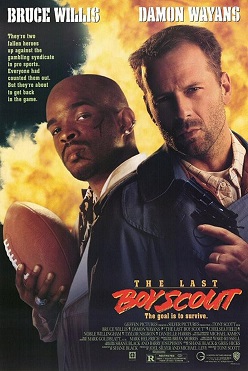
Holiday Film Review: The Last Boy Scout (dir by Tony Scott)


My God, what a violent holiday season!

Like the majority of the films that have been written and/or directed by Shane Black, The Last Boy Scout takes place in December.  It’s not quite as Christmas-y as some of Black’s other films.  I think that I may have spotted a few decorations in the background of some of the scenes.  And there’s a scene where private investigator Joe Hallenbeck (Bruce Willis) discovers that his daughter (played by a very young Danielle Harris) has been drawing pictures of “Satan Claus.”  Otherwise, there’s not a lot of Christmas to be found in this December-set film and perhaps that’s for the best.  Seriously, this movie is violent!  Not even the comedic relief characters are safe from getting a bullet to the head.  This is a film that actually begins with a football player shooting three other players during a game and then saying, “Ain’t life a bitch,” before shooting himself in the head.

The film’s plot isn’t always easy to follow.  Joe is a private investigator who drinks too much and whose partner has just been blown up in front of his house.  (His partner was also sleeping with Joe’s wife so guess who is now a suspect!)  Joe is also hired to act as a bodyguard for a stripper named Cory (Halle Berry).  Cory is dating Jimmy Dix (Damon Wayans), a former quarterback who used to be Joe’s hero.  Then Jimmy got kicked out of the league for gambling and Joe stopped watching football.  Cory says that she has a tape recording that will get Joe back into the NFL.  But then, Cory is brutally gunned down in the middle of the street and the tape is accidentally destroyed by Joe’s crappy tape player.  It’s time for Jimmy and Joe to team up, trade one liners, and uncover the conspiracy.

It all links back to the efforts of football team owner Shelley Marcuse (Noble Willingham) to legalize gambling.  Senator Calvin Baynard (Chelcie Ross) is standing in Marcuse’s way because Marcuse didn’t offer him a big enough bribe.  Marcuse is planning to assassinate the senator and he’s going to frame Joe for the crime because, in an amazing coincidence, Joe used to be a secret service agent until he caught Senator Baynard torturing a sex worker.  Of course, the actual assassination will be carried out by Marcuse’s chief henchman, Milo (Taylor Negron, who is absolutely chilling in the role).  Milo rarely shows emotion and always refers to everyone by their formal name.  (Joe is called Joseph.  Jimmy is called James.)  Milo is also a total sociopath, one who will shoot anyone in the head without a second thought.

Shane Black, who is a genius regardless of what I may think of this particular film, has said that he wrote The Last Boy Scout after he broke up with a longtime girlfriend and he was suffering from depression.  Disillusionment hangs over almost every frame of the movie.  Joe did the right thing and lost his career.  Jimmy lost his family on the same night that he played the best game of his career.  The Senator is opposed to Marcuse’s scheme solely because he’s not getting enough of a cut.  Marcuse is a respected businessman who thinks little of killing strangers.  Jimmy and Joe are heroes not because they’re particularly good but because everyone else around them is just so bad.  This is also very much a movie about guys doing guy things.  I watched it with my brother-in-law and I have to say that I think he got a bit more out of the film than I did.  Then again, I also think my sister Megan also got more out of it than I did so maybe I just wasn’t in the mood to watch so many people get shot in the head.  It happens.

The Last Boy Scout was directed by Tony Scott so, no matter what else you might want to say about it, the movie looks great.  Willis seems a bit bored with the film and Wayans sometimes struggles with the more dramatic moments.  In many ways, the film feels like a precursor to Shane Black’s The New Guys, though Willis and Wayans never have the same chemistry as Russell Crowe and Ryan Gosling did in that underrated film.  However, The Last Boy Scout’s action moves quickly and the screen is always full of neon lights.  It’s a well-made action movie though, unlike Lethal Weapon, Die Hard, and The Nice Guys, it’s not one that really sticks around in your head after the end credits roll.  Personally, I think it needed a little more holiday spirit.

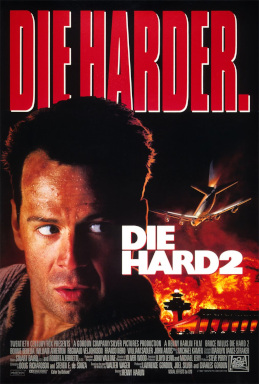
Holiday Film Review: Die Hard 2: Die Harder (dir by Renny Harlin)


During 1990’s Die Hard 2, John McClane (Bruce Willis) asks himself, “How can the same shit happen to the same person twice?” and he does have a point.

I mean, consider the situation.  In 1988, McClane spent his Christmas sneaking around a skyscraper and saving his wife from a group of sadistic mercenaries.  Two years later, John McClane spends his Christmas sneaking around an airport and saving his wife from a group of sadistic mercenaries.

There are a few differences of course.  In 1988, the mercenaries were only interested in stealing as much money as they could and each mercenary had his own properly ghoulish personality.  In 1990, the mercenaries are really more of a cult, led by the fanatical Col. Stuart (William Sadler).  And, along with trying to make some money, they are also trying to free General Ramon Esperanza (Franco Nero), a Central American drug lord and former CIA asset.  Despite the fact that the mercenaries are played by familiar actors (like Robert Patrick, John Leguizamo, Tony Ganois, and Vondie Curtis-Hall), none of them are quite as memorable as the henchmen that Alan Rickman commanded in the first film.  And while Sadler has charisma and makes a big impression during his first scene, his character is nowhere near as interesting or entertaining as Hans Gruber.  Franco Nero, it must be said, is as dashing as ever.  He really seems to be having fun in this movie.

A lot more people die in Die Hard 2 than died in the first Die Hard and the majority of them are innocent bystanders.  This isn’t like the first film, where Harry Ellis died because his coke-addled mind led him to believe that he could outsmart Gruber.  The victims in Die Hard 2 include a friendly church caretaker and over 200 passengers of an airplane that Stuart tricks into crashing on an airport runway.  The scene where the plane crashes remains disturbing no matter how many times that you see it and it truly makes you hate Colonel Stuart.  When the plane crashes, despite McClane’s futile efforts to warn the pilots, McClane sobs and it’s a powerful scene because it’s the first scene in which McClane has not had a quip or a one-liner ready to go.  In this scene, McClane fails to save the day and, for a few minutes, he’s helpless.  I usually end up crying with McClane.  Today, those tears are also a reminder of what a good actor Bruce Willis truly could be whenever he let down his defenses and allowed himself to be vulnerable on screen.

Die Hard 2 is usually dismissed as not being as good as the first movie and …. well, that’s correct.  It’s not as good but then again, few actions films are.  There’s a reason why Die Hard continues to be held in such high regard.  That said, Die Hard 2 is not bad.  The stakes are a bit higher and the action scenes a bit more elaborate, as you would expect from a film directed by Renny Harlin.  Bruce Willis plays McClane with the blue collar swagger that made his such an awesome hero in the first film.  Bonnie Bedelia and William Atherton also return from the first film and Atherton once again gets his comeuppance in a crowd-pleasing moment.  The cast is full of character actors, all of whom get a chance to make an impression.  Dennis Franz is the profane head of security who eventually turns out to be not such a bad guy.  John Amos is the major who eventually turns out to be not such a good guy.  Colm Meaney has a few heart-breaking moments as the pilot of the doomed airplane.  My favorite supporting performance is given by Fred Thompson, bringing his quiet authority to the role of tough but fair-minded Air Traffic Control director.  Watching Die Hard 2, it does feel as if the viewer has been dropped in the middle of these people’s lives.  Everyone seems real.  No one seems like a mere plot device.

Is Die Hard a Christmas movie?  You bet it is!  But so is Die Hard 2 and it’s not a bad one.

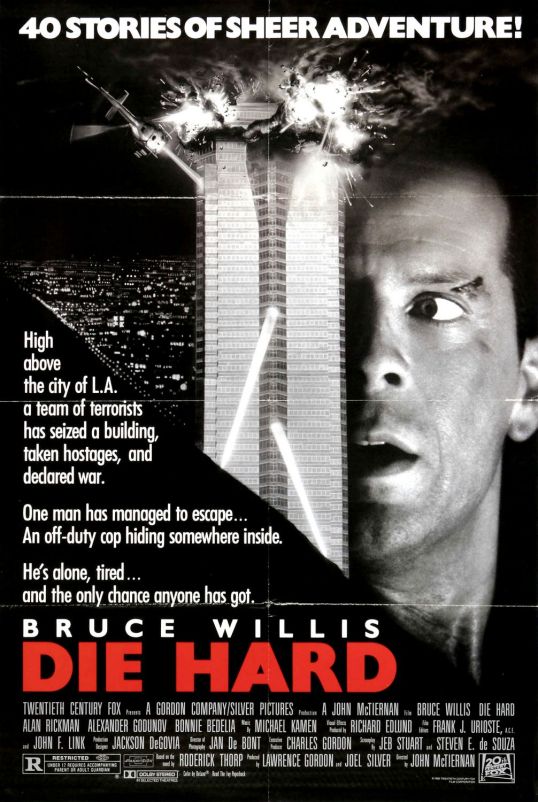
Holiday Film Review: Die Hard (dir by John McTiernan)


Yes, Die Hard is a Christmas movie.

And, in an alternative universe, it was a Frank Sinatra movie.

Released into theaters in 1988, Die Hard was based on a novel called Nothing Lasts Forever.  Nothing Lasts Forever told roughly the same story as Die Hard, with one of the big exceptions being that the cop fighting the terrorists was not the youngish and quippy John McClane but instead was a weary, aging and retired detective named Joe Leland.  Leland previously appeared in another novel called The Detective.  In 1968, The Detective was turned into a film and the role of Leland was played by Frank Sinatra.  As a part of his contract, Sinatra had the right to play Leland in any sequels to The Detective.  When Die Hard was in pre-production, Sinatra could have demanded that the film be a Joe Leland film and that he be allowed to star in it.  Fortunately, Sinatra did not do that and Joe Leland was instead transformed into John McClane.  And, after the role was was turned down by Arnold Schwarzenegger, Sylvester Stallone, Clint Eastwood, Nick Nolte, Mel Gibson, Don Johnson, Harrison Ford, Burt Reynolds, Paul Newman, James Caan, Al Pacino, and Richard Dean Anderson, popular television actor Bruce Willis finally received the role.

Seriously, just consider that.  Bruce Willis was not only not the first choice for John McClane but even Richard Dean Anderson was offered the role before the filmmakers finally went with Willis.  It’s hard to imagine anyone else starring in Die Hard because, to most of us, Bruce Willis is John McClane.  Growing up and watching Die Hard on television every Christmas, it was very easy to assume that Willis probably spent all of his spare time fighting terrorists and coming up with snarky quips.  Definitely, it’s difficult to imagine Stallone and Schwarzenegger in the role.  What made McClane such a compelling hero was that he wasn’t superhuman.  He was just a blue collar guy who hurt his feet, got tired, and had his moments of frustration just like everyone else.  He was the relatable action hero.  It didn’t matter how many stories that one heard about Bruce Willis having an ego or occasionally being difficult to work with.  Bruce Willis was John McClane and, after everything that McClane had been though, he had every right to occasionally be difficult.

You’ll notice that I haven’t really discussed the plot of Die Hard because …. well, everyone knows that plot.  I mean, this is one of those films that has such a permanent place in pop cultural history that even people who somehow haven’t seen the film still know what it’s about.  John McClane is an NYPD cop who flies to Los Angeles to see his estranged wife, Holly, for Christmas.  Holly (Bonnie Bedelia) works for the Nakatomi Corporation.  During the company’s Christmas party, terrorists led by Hans Gruber (Alan Rickman) take over the skyscraper.  The terrorists claim to be politically-motivated but, actually, they just want to break into the building’s vault and make off with a lot of money.  McClane makes his way through the unfinished skyscraper, killing the terrorists one-by-one.  He only has two allies.  Al Powell (Reginald VelJohnson) is an LAPD sergeant who is outside the building and who communicates with McClane via radio.  Argyle (De’Veroux White) is the friendly limo driver who spends almost the entire siege oblivious in the parking garage.  (The first time I ever watched Die Hard, I was so worried something bad would happen to Argyle.)

McClane has a lot of enemies and not all of them are terrorists.  The Deputy Chief of the LAPD (Paul Gleason) thinks that McClane is making the situation worse.  Two FBI agent, both named Johnson (and played by Robert Davi and Grand L. Bush), seem to view the entire siege as being a game with the older Johnson talking about how much it reminds him of Vietnam.  A reporter (William Atherton) makes the situation worse with his on-the-spot reports.  Meanwhile, there’s Harry Ellis (Hart Bochner).  A coke-addled executive, Ellis actually thinks that he’s helping McClane by trying to negotiate with Gruber.  I know that some people can’t stand Ellis but I always feel sorry for him.  In his way, he was trying to help and you could tell that he was so proud of himself for not telling Gruber that McClane was in Los Angeles to see Holly.

Needless to say, there’s a lot of action in Die Hard.  A lot of people die.  One thing that I appreciate the movie is that the bad guys get as upset over their friends and family being killed as McClane gets over Holly being threatening.  No one in the film is one-dimensional and even the bad guys have their own distinct personalities.  Theo (Clarence Gilyard) gets so excited about the idea of opening the vault that you can’t help but relate.  Karl (Alexander Godonuv) appears to be nearly indestructible.  Hans Gruber may be totally evil but he has a quick wit and there’s something intriguing about how confident he is.  Alan Rickman, famously, was not happy that his first role led to him being typecast as an international villain and one can’t blame him.  Still, almost every action movie villain who has followed has owed something to Alan Rickman.  Just as it’s difficult to imagine anyone other than Bruce Willis as John McClane, it’s impossible to imagine anyone other than Alan Rickman as Hans Gruber.

(That said, I’m sure there’s another alternate universe out there, right next to the Sinatra universe, where Blade Runner was not as troubled a production as it was and, as a result, Die Hard was made with Ridley Scott directing, Harrison Ford starring as McClane, and Rutger Hauer playing Hans.)

For all of the action, there’s also a lot of moments that make me laugh out loud and I’m not just talking about McClane’s one liners.  The two FBI agents don’t get much screentime but Davi and Bush make the most of what they have.  Paul Gleason is wonderfully deadpan as the clueless Chief Robinson.  Even Rickman gets his share of laughs.  “I read about them in Time Magazine” indeed.

Die Hard is a Christmas tradition with my family and a lot of other families as well.  Does Die Hard count as a Christmas movie?  I would say yes.  The terrorists may not respect the holiday but John McClane does.  No one ruins McClane’s Christmas!

Retro Television Reviews: California Dreams 3.2 “Follow Your Dreams” and 3.3 “Budget Cuts”


Welcome to Retro Television Reviews, a feature where we review some of our favorite and least favorite shows of the past!  On Saturdays, I will be reviewing California Dreams, which ran on NBC from 1992 to 1996.  The entire show is currently streaming on YouTube!

This week is all about aptitude tests and radio stations!

Episode 3.2 “Follow Your Dreams”

(Dir by Patrick Maloney, originally aired on September 17th, 1994)

The school guidance counselor (Christopher Hewett) gives everyone an aptitude test.  Mark discovers that he should be a guidance counselor.  Tiffani discovers she should be a vet.  Tony discovers that he should be a musician.  (Way to go, Tony!)  Lorena’s ideal career choice is fashion designer.  The same is true of Sly, largely because he copied off of Lorena’s test.  Jake, meanwhile, is told he should go into arranging flowers.

This comes at a bad time for Jake.  He’s been suffering from writer’s block and, when the test says that he has no artistic skills, he considers giving up music.  Fortunately, he changes his mind.  The Dreams already lost Matt, I doubt they could survive losing Jake.

Meanwhile, Sly briefly becomes Lorena’s boyfriend but that only lasts a day before she discovers that he copied her test.  She humiliates Sly by forcing him to dress up like a caveman for a school presentation.  (Sly actually looks good as a caveman so it doesn’t quite work.)  Fear not.  Sly and Lorena will eventually get a second chance in another season or two.

This was a good episode.  Tony turning into a pretentious beatboxer was especially amusing.

Episode 3.3 “Budget Cuts”

(Dir by Patrick Maloney, originally aired on September 24th, 1994)

What was the deal with Peter Engel-produced shows and school radio stations?

Saved By The Bell had a school radio station that was used to help save the Max.  City Guys had a radio station that became a major part of the show after Chris and Jamal abandoned work on the video yearbook.  Did Hang Time have a school radio station?  It honestly would not shock me if they did.

Anyway, California Dreams also has a school radio station and Sly has been named the general manager.  Of course, all of the Dreams get programs of their own.  Mark becomes a drama critic and upsets Tony by ridiculing his performance as Hamlet.  Sam gets a job running an advice show and tells people to go see Mrs. Doubtfire.  Jake gets a show called “Shut Up and Listen!”  And Lorena does a show about fashion.  (“Combats boots are hot but wearing them with tube socks is not.”)

The radio station is a huge success for everyone but Jake.  As Sly points out, people don’t want to be told to shut up and listen.  When Jake refuses to change his format, Sly fires him.  The audience gasps.  One scene later, Principal Blumford (played by character actor Earl Boen), enters the radio station and announces that the school board has decided to cut funding for the radio station!

I’m sure you can guess what happens next.  Lorena, Tiffani, and Sam want to start a petition to save the station.  Jake ridicules them for not being “real rebels” so Lorena proves him wrong by locking herself in the radio station and broadcasting without authorization.  Jake is so impressed that he not only makes out with Lorena (on the air) but he also attends a school board meeting and successfully argues that the station is important. Jake wears a suit to the meeting.  The audience goes crazy.  The episode ends with him and Lorena declaring their love for each other while everyone else celebrates the fact that the radio station has been saved.

This is actually my second time to review this episode.  The first time I reviewed it, I think I was a little bit dismissive but I better appreciated it this time.  Some of that’s because I’ve been watching One World, a show in which the cast had absolutely no chemistry.  After watching something like One World or some of the lesser episodes of City Guys, it’s easier to see just how well the cast of California Dreams played off of each other.  They’re believable as friends and bandmates and that definitely adds something to the show, regardless of how broad some of the humor may be.

The highlight of this episode?  Lorena calling Jake “fake Fonzi.”  What made it work was that Jake responded by saying, “Heeeey.”  A close second would be Principal Blumford announcing, “I’ll be back,” which was a nice shoutout to Earl Boen’s role in The Terminator franchise.

Next week …. more music!

Holiday Film Review: Jack Frost (dir by Michael Cooney)


Tis the season for killing!

One snowy December night, a prison transport drives through the town of Snowmonton.  The prisoner (Scott McDonald) being transported is a serial killer who murdered 38 people over the course of his crime spree.  In fact, he was arrested right in the town of Snowmonton and, since he’s now due to be executed, you can bet that he holds a grudge.  And get this …. the killer’s name is Jack Frost!  I mean, what a weird series of coincidences, no?

What do you think the chances are that the prison transport is going to crash into a genetic research truck?  And what do you think the chances are that Jack Frost is going to get splashed by a lot of chemicals that lead to him merging with the snow?  I mean, I guess it only makes sense that he would turn into a murderous snowman who goes on a rampage in Snowmonton and who stalks everyone that he holds responsible for his capture.

Actually, it doesn’t make any sense at all but so what?  The fact that this 1997 film still has a small cult following is a testament to the fact that sometimes, people don’t want movies that make sense.  Sometimes, they just want a movie about a trash-talking snowman who can shoot icicles.  Jack Frost is also known for being the film debut of actress Shannon Elizabeth who falls victim to the snowman in a scene that is both horrifying and incredibly silly-looking.  Though Jack may have taken on the form of a snowman, he’s actually a liquid.  (Don’t ask.)  So, as Shannon Elizabeth’s character learns, it’s smart to be careful about taking a bath when Jack Frost is dripping around.

(In Thirteen Ghosts, Shannon Elizabeth was attacked by a ghost while looking at a bathroom sink. In Jack Frost, she’s attacked by a snowman while taking a bath. There definitely seems to be a pattern here.)

It’s up to Sheriff Tiller (Christopher Allport) and FBI Agent Manners (Stephen Mendel) to figure out how to defeat the killer snowman.  It won’t be easy.  Manners thinks that the solution to everything is just to fire a gun or set off an explosive.  Sheriff Tiller and his staff likes aerosol cans.  But Jack Frost turns out to be a lot smarter than the average snowman.  He’s also a lot meaner than Frosty.

Jack Frost was apparently shot over the course of the week and screenwriter Michael Cooney only agreed to direct because no one else was willing to do it.  The budget was low and it shows in every scene of the film.  Fortunately, this is one of those cases where the budget was so low that the cheapness of it all eventually becomes rather charming.  You can’t help but respect the fact that, despite having no money, the filmmakers still managed to make a movie.  Jack Frost is smart enough not to take itself seriously.  Instead of wasting the viewer’s time with pointless drama, the film focuses on the snowman making angry expressions and shouting out morbid one-liners.  That’s really the only way to go when you’re making a movie about a killer snowman and the filmmakers deserve some credit for knowing exactly what type of movie they were making.  Jack Frost may not be a good film but it’s definitely an amusing one.

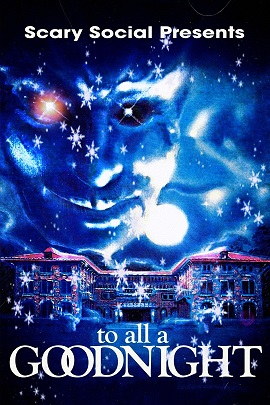
Holiday Film Review: To All A Good Night (dir by David Hess)


To All A Goodnight, a holiday-themed horror film from 1980, opens with a particularly macabre hazing.  One teenage girl runs through a mansion, eventually ending up at the edge of a balcony.  A bunch of other teenage girls surround her, in what I assume is meant to be a sorority initiation.  Over the edge of the balcony the first girl goes, plunging to her death.  AGCK!  Actually, it would perhaps a bit more effective if not for the fact that the shot of the girl plunging to her death was shot with a very obvious dummy.

Two years later, on the Friday before Christmas, none of the students at the Calvin Finishing School For Girls seem to remember or care about the accident that led to the death of one of their classmates.  Instead, they are too busy getting ready for Christmas break.  Most are heading home but a few are planning on staying at the school.  One of the girls explains that her superrich boyfriend is going to be flying his private plane to the school and he’s bringing along a few of his friends.  Yay!  Everyone gets a date!  They just have to make sure that they’re not caught by the housemother (Kiva Lawrence) or Ralph (Buck West), the weirdo handyman who spends a lot of time telling the girls that something evil is going to happen.

The plane lands.  (Viewers will want to keep an eye out for porn star Harry Reems, playing the pilot.)  The boys invade the school.  Guitars are played.  Love is made.  Philosophies are discussed.  And it turns out that Ralph was correct.  Evil things happen.  Someone has dressed up like Santa Claus and is committing murder!  The girls eventually call the police and Detective Polansky (Sam Shamshak) leaves behind two other detectives to keep an eye on the place.  For whatever reason, it never seems to occur to anyone to just leave the school and maybe stay at a hotel or something.  I mean, the plane is right there!

To All A Goodnight is a fairly generic, low-budget slasher.  The acting is stiff.  The lighting is so haphazard that it’s actually a challenge to keep track of whether a scene is taking place during the day or at night.  There are several character but none of them have enough of a personality to really make an impression.  It’s a challenge to keep track of who is who.  More than a few times, I found myself saying, “I thought she was dead.”

There are two things that make this film memorable.

First off, To All A Goodnight was released on January 30th, 1980.  That was a month too late to take advantage of the holiday connection but, at the same time, that also makes it the first slasher of the 80s.  Friday the 13th would not be released until May.  Much like the first Friday the 13th, To All A Goodnight is basically an American version of an Italian giallo film, with the emphasis on the whodunit aspect of the plot.

Secondly, To All A Goodnight was the only film to be directed by David Hess, the songwriter-turned-actor who was best known for playing Krug in the original Last House On The Left.  (Fans of Italian cinema, of course, know him for his turn as the main psycho in The House On The Edge of the Park.)  With the exception of one nicely surreal moment in which one of the students has a nervous breakdown and starts to dance during the film’s final confrontation, there’s nothing particularly memorable about Hess’s direction.  The film was obviously shot quickly and for little money so it’s not easy to say whether Hess would have improved as a filmmaker with more time and a bigger budget.

To All A Goodnight was one of the first of the Santa Claus slasher films but it would certainly not be the last.  Something about jolly old St. Nick just seems to bring out the macabre in certain filmmakers.

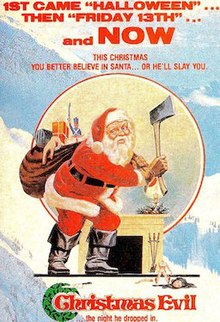
Holiday Film Review: Christmas Evil (dir by Lewis Jackson)


Poor Harry Stradling!

As played by Brandon Maggart in the 1980’s Christmas Evil, Harry is a poor guy who lives alone and spends his days thinking about Christmas.  When Harry was a child, he and his brother, Philip, had an argument about whether or not the Santa they saw in their living room was the real Santa or just their father dressed up as Santa.  Philip claimed that there was no Santa.  Harry insisted that there was.  Later, Harry snuck downstairs and caught his mother doing a lot more than just kissing Santa Claus.  It was enough of a trauma that, 33 years later, Harry is still obsessed with bringing Santa Claus to life.  While Philip (Jeffrey DeMunn) has started a family, Harry is an emotional stunted manchild.

Harry does a lot of creepy things in Christmas Evil, even before the film reaches it’s bizarre denouement.  He starts his day spying on the local children and making a list as to who has been nice and who has been sneaking an adult magazine into his bedroom.  There’s also the scene where he masturbates while secretly watching Philip and his wife.  That’s a bit …. yeah.  Eeek!  And yet, as creepy as Harry can be, it’s hard not to feel bad for him.  His love of Christmas and Santa is just so sincere and earnest.  He’s so obsessed with Christmas that he even has a managerial job at a local toy factory.  The toys are shoddy, his bosses are hypocrites, and his co-workers take advantage of him.  Harry has so many reasons to be miserable but he’s not.  His love for Christmas is the thing that keeps his life going and which gives him hope.

Eventually, Harry decides that maybe he could be the new Santa!  He puts on the beard.  He makes the costume.  He decorates his van with a picture of sleigh and, while he drives it, he gives orders to his imaginary reindeer.  He steals a bunch of toys and tosses them into a bag and, while its snows outside, he joyfully hands out the presents at a children’s hospital.  Later, when he gets dragged into a Christmas Party, he gives out even more toys.  He tells the kids to be good because if they’re bad …. ho ho ho!

Yay for Harry, right?  Well, the problem is that some people aren’t as happy to see Santa as the children are.  Some people make the mistake of mocking Harry, which leads to Harry using his toys to murder them.  Soon, the police are dragging in random Santas and forcing them take part in a lineup.  Meanwhile, Harry drives around town and continues his quest to become the new Santa!

And maybe …. just maybe, he does.  It all depends on how you interpret the ending.  The film’s director, Lewis Jackson, has officially said that most people are not correctly interpreting the ending but I don’t care.  Harry may be a murderer and a weirdo but, dammit, he’s just so earnest!  He deserves a happy ending!

Christmas Evil is often described as being a slasher film but it’s actually more of a character study.  Imagine Taxi Driver if Travis Bickle dressed up Santa.  Harry may be insane and dangerous but he still tries to do some good in the world and, in the end, he wins the hearts and support of the children.  Christmas Evil is an odd mix of mental squalor. gritty grindouse imagery, and holiday earnestness.  Christmas Evil was certainly not the only early 80s “slasher” film to focus more on the killer than his victims but, as opposed to Maniac and Don’t Go Into The House, it’s one of the few to generate some sympathy for its main character.  Everyone deserves a happy Christmas, even (or maybe that should be especially) Harry Stradling.

Retro Television Review: One World 3.7 “Dad Strikes Out” and 3.8 “Sui’s In For Stormy Weather”


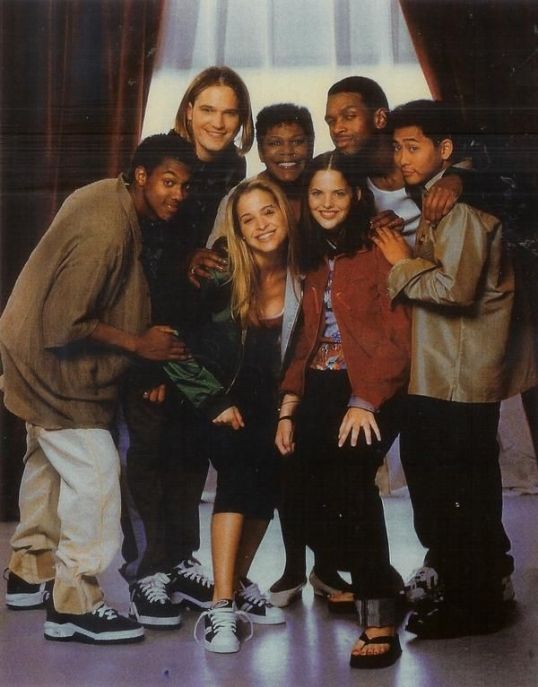
Welcome to Retro Television Reviews, a new feature where we review some of our favorite and least favorite shows of the past!  On Fridays, I will be reviewing One World, which ran on NBC from 1998 to 2001.  The entire show is currently streaming on Tubi!

The Cast of One World

We’re all in this together now!

Episode 3.7 “Dad Strikes Out”

(Directed by Mary Lou Belli, originally aired on November 4th, 2000)

Occasionally, the writers of One World would suddenly remember some otherwise forgotten fact about their characters and build an episode around them.  In this case, they suddenly remembered that Dave is a public high school teacher.  At the start of this episode, Dave announces that the teachers are on strike and the high school is closed until further notice.  Dave says that the strike is going to go on for a long time.  So, I guess the school year is canceled and everyone will have to repeat their senior year.  St. Neal is especially upset about this and who can blame him?  He was supposed to graduate at the end of season 2!  Is he ever going to get out of that school?

At the mall, the kids decide to harass the new guy working at Corn Dog World, just to discover that it’s their Dad.  (This family is the worst!)  Since Dave is humiliating himself by taking on another job while on strike, St. Neal announces that all of the kids will get jobs as well.

Cray, who is 13, gets a job searching for alligators in the sewer.  Do they usually hire 13 year-olds for that type of work?  Jane gets as job as a dog walker.  Sui gets a job as a perfume sprayer at the mall.  Marci keeps her job as the assistant manager of Miami’s “hottest under 21 club,” The Warehouse.  Ben plays guitar on the street.  St. Neal makes money as a tutor.  Considering he’s been a senior for three years now, I imagine he knows all of the answers.

The kids also help their parents save money by doing home repairs.  “Is that roof safe?” St. Neal asks.  “I don’t know,” Jane replies, “that why I sent Cray up there.”  Okay, I will admit that line made me laugh.

Meanwhile, Ben dates a smart girl in order to win a bet with Marci.  But then he falls in love with her for real.  He begs her to forgive him when she finds out the truth and eventually, she does.  (“Awwwwwww!” the audience says.)  I’m sure we’ll never hear from her again.

Episode 3.8 “Sui’s In For Stormy Weather”

(Directed by Mary Lou Belli, originally aired on November 11th, 2000)

This episode starts with Neal and Ben making their debut as film critics on the local cable access channel and …. wait, what!?  Like how the Hell did this happen!?  THEY’RE IN HIGH SCHOOL!  What’s weird is that there’s no backstory that explains how Neal and Ben ended up with this gig.  Instead, Marci says, “I can’t believe you guys get paid to be movie critics” and everyone watching is just supposed to accept it.

To be honest, this is type of thing that would normally make me stop watching after the first few minutes but, because the title promised that this was a Sui episode, I stuck with it.  Considering that she’s both the coolest and the best-dressed of the Blake children, Sui has definitely not gotten enough storylines during season 3.

When Sui learns that there’s an opening for a weather girl at the station, she auditions for it and gets the job.  The manager of the studio is named Randy Gekko, which automatically tells us not to trust him.  No one decent person has ever been named Randy Gekko.  And sure enough, Randy is soon pressuring Sui to wear a bikini while reporting on the weather and telling her that he can make her a star if she cooperates.

To the show’s credit, Sui immediately realizes what Randy is doing and that it’s wrong.  One of the reasons why Sui is the best character on the show is because, while she’s often materialistic and a little flighty, she’s also smarter than people realize and she’s willing to stand up for herself.  (Full disclosure: Of all the characters on this show, Sui is the one to whom I tend to relate.)  In this case, she humiliates Randy on the air by announcing to the channel’s viewers (there must be at least half-a-dozen of them) that her boss is a sleaze.  Way to go, Sui!

In the B-plot, Cray considers piercing his ear to impress a girl.  It was a dumb plot and it had no place in a Sui episode.

Retro Television Reviews: City Guys 3.7 “Ebony & Ivory” and 3.8 “Reluctant Hero”


Welcome to Retro Television Reviews, a feature where we review some of our favorite and least favorite shows of the past!  On Thursdays, I will be reviewing City Guys, which ran on NBC from 1997 to 2001.  The entire show is currently streaming on Tubi!

Last week’s episodes of City Guys were actually pretty good.  Let’s see if it continues this week!

Episode 3.7 “Ebony & Ivory”

(dir by Frank Bonner, originally aired on October 9th, 1999)

Jamal’s dating a white girl!  Kristen Jones (Amy Leland) is the daughter of a deputy mayor who pretends to be all progressive about race but who is actually a racist who doesn’t want Kristen dating a black guy.  But Jamal has asked Kristen to the latest school dance.  Chris agrees to pretend to be Kristen’s date but, when Kristen leaves her purse at the house, her father comes to the dance and catches Chris making out with his actual date, Sarah (Natalie Austin).  Racist old Mr. Jones makes a big deal about the world not being ready for interracial relationships.  Ms. Nobel and the students tell him off.

This episode had a good message but it was somewhat sabotaged by the fact that Kristen appeared to be in her early 30s and seemed to be too old to be dating anyone in high school, regardless of what race they may be.  As well, the actress playing Kristen delivered her lines in a somewhat creepy monotone.  For that matter, so did the actor playing her father and the actress playing Chris’s date.  All of the guest actors were so stiff and unconvincing in their performances that this episode took on an odd Twilight Zone sort of feel.  I found myself wondering if maybe Manny High had been transported to planet full of androids.

Interestingly enough, Chris spent the previous episode talking about how much he loved Cassidy but, even after it was revealed that she still didn’t have a date, Chris never asked her to the dance.  Instead, Cassidy discovered the L-Train also didn’t have a date so she agreed to go with him.  Dawn and Al, meanwhile, also discovered that neither one of them could get a date so they went together.  It fit into the show’s message about interracial relationships and that’s a good thing but, at the same time, it also felt a bit forced.  L-Train is the president of the student body and apparently a pretty popular guy.  Cassidy usually has a new boyfriend every week.  Since when have any of these characters ever had difficulty getting a date? 

Episode 3.8 “Reluctant Hero”

(dir by Frank Bonner, originally aired on October 9th, 1999)

In order to combat crime, Ms. Nobel decides to appoint L-Train, Al, Dawn, and Cassidy as hall monitors.  L-Train and Al end up taking bribes in the form of brownies and Philly cheesesteaks.  Whatever.  It’s stupid.  Let’s move on to the main story.

Along with turning her students into narcs, Ms. Nobel also decides that the school needs a self-defense class.  Coming in to teach the class is Yvonne and …. OH MY GOD!  It’s Lorena from California Dreams!  That’s right, Diana Uribe plays Yvonne and naturally, both Chris and Jamal fall for her.  (“She’s got a black belt in hot!” Chris exclaims.)  Yvonne agrees to go on a date with Jamal but — uh oh! — Jamal’s been grounded.  Jamal goes on the date anyway and, afterwards, he sees a man being mugged.  Using his self-defense training, Jamal knocks the mugger out.  But — oh no! — now his dad will know that he went  out when he was grounded.  Jamal convinces Chris to take credit for knocking out the mugger.

Chris is declared to be a hero.  Jamal gets jealous, especially after the Mayor — THE MAYOR! — shows up at the diner to give Chris an award.  (No one asks the mayor anything about the deputy mayor who is opposed to interracial relationships.)  Jamal gets upset when Chris accepts the award but honestly, I have no sympathy for Jamal.  Jamal’s the one who told Chris to take credit for knocking out the mugger.  Anyway, after Chris has an attack of conscience and declines to accept the award, Jamal confesses that he disobeyed his father.  While he does so, everyone in the diner watches him.  I can only imagine how awkward it would be to witness something like that in real life.

This episode made me yell a lot because it was pretty stupid but, on the plus side, Lorena was always the California Dreams character to whom I most related so it was good to see Diana Uribe beating up the cast of City Guys.  They should have made her a regular.