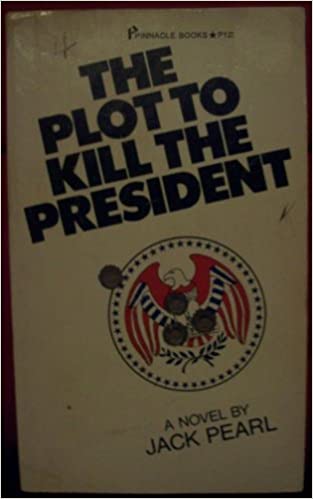
Novel Review: The Plot To Kill The President by Jack Pearl


President Harmon Stevens is a liberal who is looking to reign in the influence of the Military-Industrial complex and the CIA.  So, of course, it’s decided that the President must be taken care of.

Fortunately for the conspirators, back when Stevens was in the army, he took part in the court martial of a soldier named Paul.  Paul was given a dishonorable discharge on account of killing enemy POWs.  The reader is told that Stevens shouted, “You have the Mark of Cain on you!,” which …. okay.  I guess it’s possible that someone outside of 17th century Massachusetts spoke like that.  Now, Paul spends all of his time feeling bitter and watching cartoons.  He’s a Bugs Bunny fan because he believes that Bugs is a sociopath, just like him.  (Personally, I think Bugs is just a force of chaos.  Sociopath is a bit extreme.)  One day, Paul’s cartoon watching is interrupted by the opportunity to take part in a plan to take out Stevens.  However, Paul soon discovers that he’s being set up to be a patsy, much like Lee Harvey Oswald.  Will Paul risk his life to reveal the truth?

The Plot To Kill The President is one of the many paperbacks that I found in my aunt’s collection of old books.  It was originally published in 1972 and it’s very much a book that was inspired by the Kennedy assassination and the conspiracy theories surrounding it.  Paul is a disillusioned American.  It’s not just that he has a personal grudge against the President.  It’s that he no longer believes in the promise of America and, as a result, he has no problem with the idea of betraying it.  It’s not until an awkwardly written date with a recently naturalized citizen that Paul starts to realize that America can be saved.  (How awkward is the encounter?  At one point, Paul’s date recites the pledge of allegiance in the middle of a restaurant.)

Anyway, it’s a fairly silly and overheated book.  It’s written in the first person, so we’re not only subjected to Paul as a character but we’re also forced to spend way too much time in his head.  Paul is one of those people who has a lot of ideas but none of them are particularly interesting.  Before I started writing this review, I looked up the book online and I came across someone speculating that Jack Pearl was a pen name for Jack Ruby!  Actually, Jack Pearl was a journalist who wrote several paperback thrillers.  He also wrote a non-fiction book about the JFK assassination, in which he supported the idea that Oswald was a part of a larger conspiracy.  That’s not surprising.  The Plot To Kill The President was clearly written by a true believer, even if it’s never as convincing as it tries to be.

Probably the most interesting thing about the novel is that the copy that I read had a cigarette advertisement inserted into the middle of it.  It was for Kent cigarettes and featured attractive people laughing while holding cigarettes.  They all had perfectly white teeth, without a hint of nicotine staining.  I’ve noticed that quite a few 70s paperbacks came with cigarette ads.  I always wonder how effective they were.  In 1972, was anyone reading The Plot To Kill The President and thinking to themselves, “Damn, I need a cigarette?”
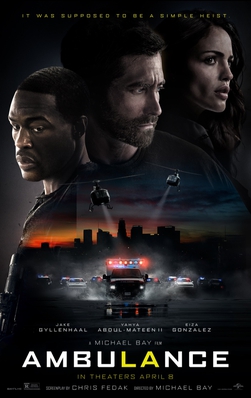
Film Review: Ambulance (dir by Michael Bay)


Ambulance is the ultimate Michael Bay movie.

Obviously, whether or not that’s a good thing for you personally will depend on how you feel about Michael Bay.  As a director, Bay specializes in kinetic thrill rides, the type of films where the camera never stops moving, the characters are attractive but shallow, and every plot development is an excuse for another action sequence.  Michael Bay is hardly the first, only, or last director to put action and spectacle above characterization and a coherent storyline.  However, he might very well be the most shameless about it.  Michael Bay’s approach has not made him a favorite of the critics but it has usually proved successful with audiences.  Personally, I’ve smirked at a lot of scenes in a lot of Michael Bay films.  (I still laugh whenever I remember the slow motion shot of the children playing in front of the faded JFK campaign poster in Armageddon.)  But, in this age of self-important filmmakers, it’s hard not to appreciate a director who just wants to have a good time.

And, make no doubt about it, Ambulance is definitely a good time.  The film’s plot is simple.  Jake Gyllenhaal and Yahya Abdul-Mateen II rob a bank.  When the robbery goes wrong, they hijack an ambulance.  In the back of the ambulance is an EMT played by Eliza Gonzalez, who is desperately trying to keep a wounded cop (Jackson White) from dying.  Gyllenhaal and Abdul-Mateen also want to make sure that the cop doesn’t die because they know that, if they’re captured, the penalty for being a cop killer is considerably worse than the penalty for being a bad bank robber.  With the entire LAPD and the FBI in pursuit, the two men drive the ambulance through Los Angeles, trying to find a way to escape.  Essentially, Michael Bay said, “You know how everyone enjoys a chase scene?  What if we made the chase scene last for 136 minutes?”  And wisely, some people gave him money to do just that.

(Actually, that’s just the way that I like to imagine it.  Ambulance is actually a remake of a Danish film and Michael Bay originally passed on the project.  But, as they put it in The Man Who Shot Liberty Valance, print the legend.)

Jake Gyllenhaal may be top-billed but the star of Ambulance is definitely Michael Bay.  In many ways, there’s not much about Bay’s direction here that’s different from what he’s been doing since The Rock.  The camera moves a lot.  The images are sharp and clear.  The rapid-fire editing captures the chaos of the action scenes, occasionally at the cost of letting the audience know just who exactly is shooting at who.  But what sets apart Ambulance from other Bay films is that Michael Bay finally discovered his greatest collaborator, the drone.  Bay’s camera flies across Los Angeles, zooming over buildings and down streets and essentially making the viewer as much a part of the chase as Gyllenhaal and the cops pursuing him.  Ambulance moves with so much energy and confidence that it doesn’t matter that it’s a bit too long and that Gyllenhaal’s plan often doesn’t make much sense.  Ambulance is a thrill-ride, a film that rewards anyone who is willing to just go with it.  It’s an example of what Lucio Fulci called “pure cinema,” where the story itself is not as important as the way the director puts it all together.  I enjoyed it.  That ambulance barreling through the streets of Los Angeles was the 21st century equivalent of the speeding train that thrilled and terrified audiences during the silent era.

Unfortunately, Ambulance struggled a bit at the box office.  I’m a bit confused as to why, other than it wasn’t a part of a franchise or a sequel (like The Batman, Dr. Strange, and Top Gun: Maverick) and it didn’t have the mix of strong reviews and pop cultural cachet that led audiences to make Everything Everywhere All At Once into a hit.  Along with reviews that were more interested in criticizing Michael Bay in general as opposed to actually considering whether or not the film itslef worked, Ambulance was damaged by the fact that audiences were still getting used to the idea of leaving their homes for a night out.  I get the feeling that a lot of people looked at the commercials for Ambulance and said, “That’s something I can watch at home.”  (Admittedly, that’s what I did.)  It’s a shame that Michael Bay’s ultimate (and, I would say, best) film is also one of the few to be deemed a box office failure.  The film is currently on Peacock.  Try to watch it on the biggest screen you can find.

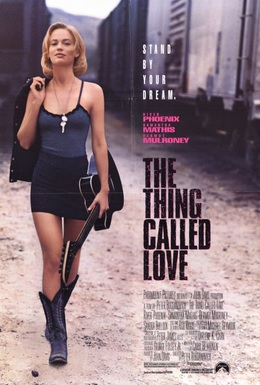
Film Review: The Thing Called Love (dir by Peter Bogdanovich)


First released in 1993 and directed by Peter Bogdanovich, The Thing Called Love takes place in Nashville, the city that, for many people, has come to define Americana.

Of course, for those who actually love movies, it’s difficult to watch any film about Nashville and the country music scene without being reminded of Robert Altman’s American epic, Nashville.  Much like Nashville, The Thing Called Love follows a group of wannabes, stars, writers, and performers.  However, whereas Robert Altman used the city and its residents as a way to paint an acidic portrait of a nation struggling to find its way in an uncertain new world, The Thing Called Love is far less ambitious.

The Thing Called Love centers around Miranda Presley (Samantha Mathis).  Miranda is from New York but she loves country music.  She comes to Nashville to try to sell her songs and become a star.  Instead, she ends up working as a waitress at the “legendary” Bluebird Cafe.  While she waits for her big break, she meets two other aspiring writer/performers, Linda Lu (Sandra Bullock) and Kyle Davidson (Dermot Mulroney).  Kyle falls in love with Miranda but Miranda falls in love with and marries James Wright (River Phoenix, brother of Joaquin).  Unfortunately, while James is talented, he’s also a bit of a jerk.

The Thing Called Love aired on TCM last year and I can still remember checking out the #TCMParty hashtag on twitter while the film was airing.  The majority of the comments were from people who loved TCM and who couldn’t understand why the channel was showing this rather forgettable movie.  The answer, of course, is that the film was directed by Peter Bogdanovich and Bogdanovich was one of the patron saints of TCM.  Along with being responsible for some genuinely good films (Targets, The Last Picture Show, Paper Moon, Saint Jack, Mask, The Cat’s Meow), Bogdanovich was also a very serious student of the history of film.  Up until he passed away in January, Bogdanovich was a familiar and welcome sight on TCM.  Listening to him talk about John Ford, Alfred Hitchcock, and especially Orson Welles was always a delight.

Unfortunately, as Bogdanovich himself often admitted, the majority of his later films failed to reach the heights of his earlier work and that’s certainly the case of The Thing Called Love.  It’s not so much that The Thing Called Love is bad as it’s just really forgettable.  There’s very little about the film that suggests that it was directed by cineaste who was responsible for The Last Picture Show.  Samantha Mathis is likable but a bit bland in the role of Miranda while River Phoenix plays James as being such a jerk that you really don’t care about whether or not he finds success.  From what I’ve read, Phoenix based his performance on watching Bob Dylan in the documentary Don’t Look Back.  Dylan is notably mercurial in that documentary but, it should be noted, that Dylan eventually abandoned that persona once he realized that it was a creative dead end.

To be honest, I think the film would have worked better if Samantha Mathis had switched roles with Sandra Bullock.  This was one of Bullock’s first films and she steals every scene in which she appears, giving an energetic and likable performance as someone who never allows herself a single moment of doubt or despair.  As opposed to the self-loathing Phoenix and the bland Mathis and Mulroney, Sandra Bullock represents the hope and optimism that Nashville is meant to symbolize.  In the end, her performance is the best thing about The Thing Called Love.

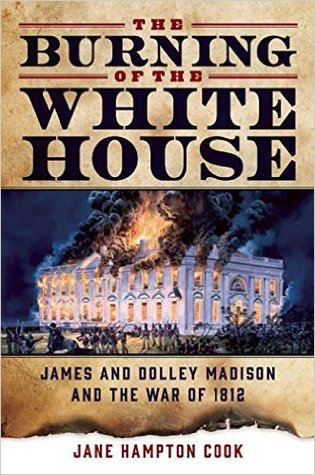
Book Review: The Burning of the White House: James and Dolley Madison And The War of 1812 by Jane Hampton Cook


Despite being a huge history nerd, I did not watch a single episode of Showtime’s recent miniseries, The First Lady.  That’s largely because I think Showtime made a mistake with the three first ladies that they chose to profile.

Eleanor Roosevelt?  Everyone knows that Alice was far more interesting.

Betty Ford?  Look, I think Gerald Ford was a great and underrated President and I think the country would have been better off if he had defeated Jimmy Carter in 1976.  But we all know that Alice Roosevelt is the Republican First Lady who deserves a miniseries.

Michelle Obama?  It’s going to be another few years or so before we can even begin to seriously discuss whether or not the Obamas were successful in the White House.  Meanwhile, the legacy of Alice Roosevelt is right there.

Personally, assuming that there wasn’t a show about Alice Roosevelt airing at the time, I would rather watch a miniseries about Dolley Madison, who served as America’s First Lady from 1809 to 1817.  Madison was the fourth First Lady but she was the first to play an important role in her husband’s success.  Indeed, James Madison was said to be such an introvert that it’s doubtful he would have ever been nominated for or elected President if not for Dolley’s outgoing personality.  Along with furnishing The White House and making it into a proper residence for the head of the executive branch, Dolley also started the tradition of White House receptions and by inviting not only Madison’s allies but also his rivals, it can truly be said that Dolley Madison was the first person to promote bipartisanship in Washington.  Dolley was even the first American to ever receive a telegraph message and then send a response.  Apparently, before Dolley showed up, people would just read their messages and then toss them to the side.

James Madison was also President during the War of 1812.  Now technically, The War of 1812 was not America’s finest moment.  While the British were hardly innocent when it came to the diplomatic tensions between the two countries, the war largely escalated due to the fact that certain Americans had convinced themselves that Canada was eager to both be liberated from British rule and to become a part of the United States.  Indeed, the long tradition of the U.S. invading other countries for their own good began with the 1813 invasion of Canada.  In 1814, the British responded by sacking Washington D.C. and burning down the White House.  It was Dolley who made sure that the famous portrait of George Washington was removed from the White House wall before the building was set on fire.

That Dolley survived the burning of the White House served as a rallyingcry for the U.S. forces and what should have been a blow to morale instead only inspired the Americans to fight harder.  And while one can argue that the war was largely America’s fault, one can also acknowledge that the world was ultimately better off as a result of America’s victory in the War of the 1812.  The British gave up any hopes of reclaiming America and America was finally forced to accept that Canada didn’t necessarily want to be a part of the United States.

In fact, if anyone deserves to have a film made about her, it’s Dolley Madison.  Kate Winslet would be brilliant as Dolley Madison.  Get Sofia Coppola to direct it.  It’ll be great!

And I would suggest basing the film on a book called The Burning of the White House: James and Dolley Madison and the War of 1812.  Well-researched, well-written, and well-paced, this book was written by Jane Hampton Cook and it works as not just a history of the War of 1812 but also as a tribute to the legacy of Dolley Madison.  If you’re into history like I am, this is definitely a book that you should be reading.  It’s so informative and engaging that you really don’t need a movie to appreciate Dolley and James.

Still, someone really should make that movie….

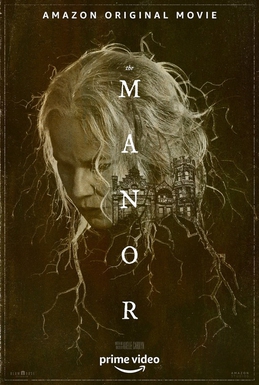
Film Review: The Manor (dir by Axelle Croyon)


In 2021’s The Manor, Barbara Hershey plays Judith Albright.  Once a professional dancer, Judith now works as a dance instructor.  Or, at least, she does until she has a sudden stroke at her 70th birthday party.  Judith survives the stroke but it’s discovered that she has Parkinson’s disease.  Judith decides that it’s time to move into a nursing home.  Her grandson, Josh (Nicholas Alexander), disagrees but the rest of Judith’s family thinks that Judith is making the right decision.

At first, the nursing home seems ideal for Judith.  The nurses seem to be friendly.  The home is actually in a stately old manor and Judith has a nice view of the nearby woods from her room.  It’s true that Judith’s roommate seems to think that there’s something sinister happening but Judith (and everyone else) chalks that up to senility.  Judith moves into the Manor and even befriends some of the other residents, including Roland (Bruce Davison).

However, it’s not long before Judith starts to suspect that something strange is happening at the Manor.  She hears strange noises.  There are mysterious deaths.  It turns out that not all of the nurses are as friendly as the originally seem.  Judith starts to have visions of a strange tree-like creature in her room.  When Judith tries to talk to the nursing home’s staff, they dismiss her concerns and condescendingly tell her that she’s just confused.  Some of them even threaten her to keep her from making too much trouble.  Are they just bad nurses or is there something even worse motivating them?  And can Judith discover the Manor’s secret before she becomes the latest victim?

The Manor was the eighth and the last entry in the Welcome to the Blumhouse horror anthology series.  Each of the films premiered on Prime, with The Manor dropping on October 8th, 2021.  For the most part, the quality of the films featured as a part of Welcome to the Blumhouse were uneven.  However, The Manor actually works fairly well.  What the film lacks in budget, it makes up for in atmosphere.  The nursing home is a truly creepy location and director Axelle Croyon does a good job of creating the feeling that there could be something lurking in every shadow.  The scenes were Judith is woken in the night are well-done and the scenes where Judith is told that she is simply confused because she’s elderly are properly infuriating.  Barbara Hershey is well-cast as Judith, giving a good performance as someone who is at peace with being in her twilight years but who still isn’t quite ready to give up on life.  She is well-matched by Bruce Davison, playing a more ambiguous resident of the nursing home.  The ending of The Manor is also a bit unexpected, with Judith making a choice that’s unexpected but which makes sense if you look back over what we’ve learned about her over the course of the film.

In the end, The Manor feels like a modern version of one of those old episodes of The Twilight Zone or The Outer Limits.  Yes, the film does teach an important lesson about aging and respecting our elders but, even more importantly, it adds a slightly unexpected twist to give the story a properly macabre conclusion.  The Manor is an effective little horror tale and one that gives Barbara Hershey a chance to shine.

Book Review: Less Than Zero by Bret Easton Ellis


After having watched the film version a few hundred times, I figured that it was time for me to sit down and actually read Bret Easton Ellis’s Less Than Zero. 

First published in 1985 (and written when Ellis was only 19 years old and still a college student), Less Than Zero tells the story Clay.  Clay is a rich college student who returns home to Los Angeles for winter break.  It’s his first time to be back home since starting college and he quickly discovers that all of his old friends are, for the most part, hooked on drugs and self-destruction.  Clay’s friend Rip deals drugs and buys underage sex slaves.  Clay’s former best friend, Julian, is now a heroin addict who has sex for money.  Clay’s other best friend, Trent, is a model who watches snuff films.  Meanwhile, Clay’s girlfriend, Blair, isn’t even sure that she likes Clay.  Clay goes to therapy and the therapist tries to sell his screenplay.  Clay struggles to tell apart his two sisters and he rarely speaks to his mother or his father.  He’s haunted by memories of his grandmother slowly dying of cancer.  As winter break progresses, Clay finds himself growing more and more alienated from everyone and everything around him.  He feels less and less.

I had often heard that the film version was dramatically different from the book but nothing could prepare me for just how different.  In the film, Clay is an anti-drug crusader who reacts to everything that he sees in Los Angeles with self-righteous revulsion.  In the book, Clay simply doesn’t care.  Clay’s narration is written in a flat, minimalist style, one that makes Clay into a dispassionate observer.  Over the course of the narrative, there are times that Clay obviously know that he should probably feel something but he just can’t bring himself to do it.  Even when he objects to Rip buying a 12 year-old sex slave, Clay doesn’t do anything to stop Rip or to help his victim.  Clay is the epitome of someone who has everything but feels nothing.  Most of the memorable things that happen in the movie — Julian begging his father for forgiveness and money, Clay and Blair being chased by Rip’s goons, Julian dying in the desert — do not happen in the book.  They couldn’t happen in the book because all of those scenes require the characters to have identifiably human reactions to the things that they’re seeing around them.

It’s not necessarily a happy book but, fortunately, it’s also a frequently (if darkly) funny book.  Bret Easton Ellis has a good ear for the absurdities of everyday conversation and some of the book’s best moments are the ones that contrast Clay’s lack of a reaction to the frequently weird things being discussed around him.  Even more importantly, it’s a short book.  Just when you think you can’t take another page of Clay failing to care that everyone around him will probably be dead before they hit 30, the story ends.  Ellis writes just enough to let the reader understand Clay’s world and then, mercifully, the reader is allowed to escape.

Just as the movie is definitely a product of its time, the same can be said of the original novel.  Reading Less than Zero is a bit like stepping into a time machine.  It’s a way to experience the coke-fueled 80s without actually traveling to them.