Welcome to the parts of the world that aren’t often featured in media. Though I’m a city girl, I’ve got enough family living in the country that some of these places look very familiar to me.
Enjoy!
Welcome to the parts of the world that aren’t often featured in media. Though I’m a city girl, I’ve got enough family living in the country that some of these places look very familiar to me.
Enjoy!
Welcome to Retro Television Reviews, a new feature where we review some of our favorite and least favorite shows of the past! On Fridays, I will be reviewing The Brady Bunch Hour, which ran on ABC from 1976 to 1977. All nine episodes can be found on YouTube!
Oh, we’re doing this again.
*sigh*
Okay….
Episode 1.6
(Dir by Jack Regas, Originally aired on March 28th, 1977)
As always, we open with the Kroftettes doing a kick line and then jumping into the pool as the announcer warns us all that we’re about the spend an hour with The Brady Bunch, Rip Taylor, Rich Little, and Edgar Bergen.
The audience goes crazy as the Bradys run out on to perform their opening number and why shouldn’t the audience be excited? For once, the Bunch is performing a song that was written after the Great Depression. In fact, I’ve Got The Music In Me was only 3 years old when the Brady Bunch performed it. Wisely, Fake Jan gets to sing the majority of the song while the rest of the Bradys just focus on the chorus. While the other members of the cast stare directly at the camera and struggle to remember one of the simplest choruses ever written, Geri Reischl shows off why she was the only Brady kid to have a truly successful musical career after this show ended.
The Kroftettes smile as they perform this week’s water ballet. The pool is full of balloons. Somehow, the underwater Krotettes manage to smile and hold their breath at the same time. Still, as the song ends, we get one of the show’s trademark close-ups of all of the Bradys gasping for breath, just so we know who really had to work hard on this show.
It’s time for the opening banter! Greg thinks that the Bradys should make a movie. Carol suggests that they make a movie called Greg Doesn’t Live Here Anymore. Uhmm, Carol, you tried that a few weeks ago. Remember? Greg moved out for 16 hours and everyone had a nervous breakdown.
We then cut to a production number so hideous that I can’t even get a decent screenshot of it.

The Bradys are all dressed up as scarecrows and, along with someone dressed up like a crow, they do a square dance while singing Consider Yourself. Consider Yourself is a song from Oliver!, which is a music that is based on Charles Dickens’s Oliver Twist. How exactly one associates Oliver! with a bunch of scarecrows dancing with a crow, I’m not sure. Cocaine was very popular in the 70s and that sun in the sky looks like it probably just took a snort from the moon’s coke spoon.
As the song ends, Bobby, Cindy, and Fake Jan announce that their next guest will be ventriloquist Edgar Bergen. They then argue about whether or not Bobby should have introduced Bergen’s dummy, Charlie McCarthy, as well. Edgar comes out and tells the Brady kids about how ventriloquism works. He says that his job involves using a dummy. “In our house, our dummy is Bobby,” Cindy says. That’s kind of mean, especially coming from Cindy who isn’t exactly going to be joining the Honor Society anytime soon.
Finally, Edgar brings out his dummy and they discuss pizza. “I don’t like those EYE-talian dishes,” the dummy says.
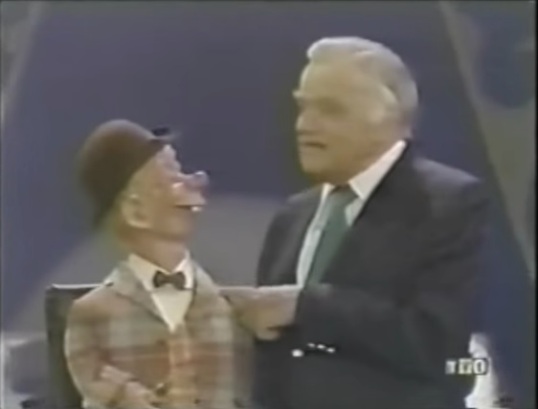
THAT DUMMY’S A BIGOT!
Speaking of dummies, we then cut to Rip Taylor who says that he was was supposed to introduce impressionist Rich Little but he can’t because there was an accident at rehearsals yesterday. We then get a flashback of Rich Little attempting to impersonate a swimmer by jumping into the pool. Underwater, Rich Little’s stunt double collides with Cindy and — oh no! — Rich Little has amnesia.
(In the 70s, Rich Little was one of the original cast members of Orson Welles’s The Other Side of The Wind. Despite having a key supporting role, Little reportedly left the production rather abruptly. I sincerely hope that he didn’t leave because he got offered The Brady Bunch Hour. That said, Peter Bogdonavich replaced Little on Welles’s film and gave an excellent performance as Brooks Otterlake.)
At the Brady Compound, Cindy feels bad for giving Rich Little amnesia and really, she should. STUPID CINDY! Things get even more awkward with Rich Little’s wife calls and asks how her husband is doing and Carol just can’t bring herself to admit that Rich has amnesia. Rich eventually shows up in the living room and tries to remember who he is by doing a series of imitations of people who he claims not to remember.
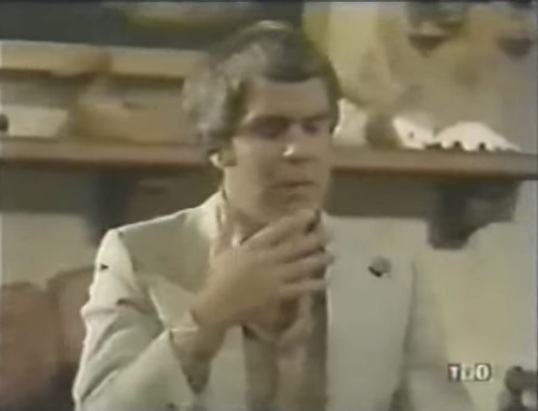
“What are we going to do!?” Carol wails.
“Frankly my dear,” Rich replies, “I don’t give a damn.”
Cut to Edgar Bergen and a dummy welcoming us to the second half of the Brady Bunch Hour. “These people don’t care about our problems,” Edgar says, “They want to know what happened to Rich Little.” Damn straight, Edgar.
At the Brady Compound, Alice tells Carol and Mike that Rich is asleep and they both hope that he’ll wake up as Rich. Cindy then comes in, still whining about how she’s responsible for Rich losing his memory. Carol tells her that, “This could have happened to anyone.” Stop lying, Carol. This literally could not have happened to anyone.
Rich wakes up and announces that he now remembers that he’s one of the Brady kids. Unfortunately, it turns out that he thinks that he’s the youngest and therefore most immature of all the Bradys. Of course, Rip Taylor shows up and explains that he’s also a psychologist and he can help Rich gets his memory back. What’s odd is that Rip is playing his character, Jackie Merrill, in this scene but he previously appeared as himself when he told us that Rich got amnesia at rehearsals. Seriously, not even the show could keep straight what was going on.
Anyway, Rich jumps into the ocean and bumps into Rip Taylor and he gets his memory back. Gee, I’m glad that worked out.
We then cut to Peter begging Greg not to toss him into the pool this week because he has a crush on this week’s musical guest. Mike shows up and says the weekly pool thing is getting boring and if there’s anything Mike knows, it’s how to be boring. Greg and Peter work together to throw Mike in the pool. Mike looks pretty mad so I guess we know which two sons are going to end up getting beaten once filming on the episode is wrapped.
A folk singer named Melanie comes out and sings a song in front of the pool.

Screenshots From Hell
Carol comes out and sings a song called Beautiful Noise. Beautiful Noise was only a year old when it appeared on The Brady Bunch Hour. Did someone at the show finally get the memo that trying to make The Brady Bunch look cool by having them sing showtunes from 1920s wasn’t working? As for the song itself, Florence Henderson has a good voice but she still oversings it. In all fairness, it’s hard to blame her for that. That was just her style of singing and it’s not her fault that she was often given songs that really weren’t right for her.
Next up is a weird skit where Ann B. Davis plays Apple Annie, a woman in the 40s who, one day, is given a wooden puppet named Pinocchio who dreams of being a real boy. Christopher Knight plays the puppet while Florence Henderson provides the voice of the fairy godmother who promises that he will someday become a real boy. Then Rip Taylor shows up as a director who wants to turn Pinocchio into a star. Maureen McCormick and and Barry Williams play Pinocchio’s co-stars and somehow, it all ends with everyone singing Ease On Down The Road from The Wiz. This skit goes on forever and it’s painfully unfunny. Cocaine was very popular in the 70s.
We then cut Greg, Peter, and Marcia talking about how Peter never knows what the finale is going to be. This time, Peter swears he knows what the finale is but then he admits that he doesn’t know what the finale is. Greg says, “You never what the finale is,” and OH MY GOD, MAKE IT STOP!
Carol and Mike come out. “Hi, kids are you ready for the finale?”
“I don’t know what the finale is,” Peter replies.
“You never what the finale is,” Mike says….
SHUT UP!
Anyway, Carol says that the finale is songs about the movies and then everyone scurries off stage. I will never understand why this show always thought it was a good idea to start every finale with everyone running off stage in a panic.
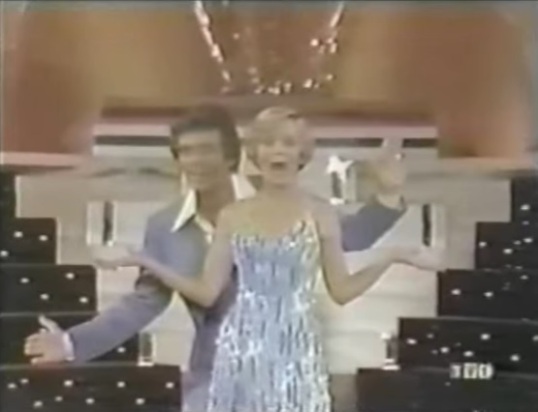
Mike and Carol get things started by singing That’s Entertainment! There’s nothing more hip than that, right?
Speaking of hip, here comes Greg to sing Pinball Wizard! Greg pays homage to Elton John by wearing big sunglasses.
Carol oversings For All We Know, from the 1970 films Lovers and Other Strangers.
The Kroftettes stand around while The Pink Panther theme plays.
The Brady Kids sing Live and Let Die with all of the wholesome enthusiasm of a church youth group.
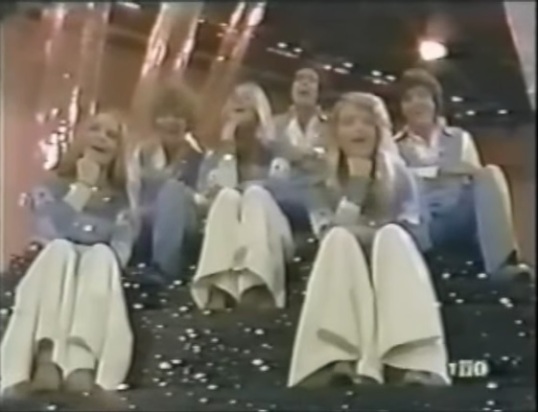
Yes, they’re singing Live and Let Die.
Rip Taylor sings that annoying Superblahblahblah song from Mary Poppins.
Melanie, looking as if she realizes her career will never recover, sings Over The Rainbow.
And then the entire cast comes out to reprise That’s Entertainment!
And that’s it! This episode actually had potential. Rich Little thinking that he was a Brady Kid could have actually been funny but, in the end, the show didn’t really do much with it. The show tried to liven things up with some songs that had been written after the 20s but the Bradys were so naturally square that it didn’t really make much difference.
Next week: Marcia gets engaged! Awwwwwww!
Welcome to Retro Television Reviews, a feature where we review some of our favorite and least favorite shows of the past! On Thursdays, I will be reviewing City Guys, which ran on NBC from 1997 to 2001. The entire show is currently streaming on Tubi!

This week, one season ends and another begins. Will City Guys never end!?
Episode 3.25 “Mom on the Rocks”
(Dir by Frank Bonner, originally aired on June 10th, 2000)
The third season comes to an end with …. mid-terms!
Mid-terms? Does school never end in the world of City Guys!? Is there no summer in New York City? Still, Ms. Noble assures everyone that they’ll be fine if “you’ve kept up with the school work.” I’m not sure how they’re supposed to keep up with anything when Ms. Noble is constantly giving them community service assignments but whatever. Someday, these students will graduate and discover that none of them have the slightest idea how to live without Ms. Noble telling them what to do.
Dawn is directing the school’s ballet (which is called, I kid you not, Cinderella In The Hood) and she needs an extra dancer. L-Train volunteers (“Can I get jiggy with it?”) and this, of course, leads to a lot of “Oh my God, a man is wearing tights” jokes. Jamal and Al also volunteer to work crew, mostly so they can hit on the dancers. (From my experience, this was actually a pretty accurate reflection of what the crew usually did during high school dance performances. Of course, it was also my experience that the stage crew tended to get in the way and no one would be caught dead checking any of them out.) Isn’t Al dating Dawn? I guess this is another case of NBC showing the episodes out-of-order. Anyway, if you couldn’t guess that two dancers are going to end up with broken toes and Jamal and Al are going to end up having to replace them, then you obviously didn’t see the episode of Saved By The Bell where Zack discovered he was one credit short of graduating.
(Of course, the dance is being performed on the roof of the school! How is that even practical? Does Manny High not have an auditorium?)
Dawn has more problems than just the fact that she’s apparently not a very good ballet director. She’s also agreed to tutor Chris and Cassidy on Biology but when they show up at Dawn’s house, they discover that Dawn’s mother (Jennifer Savidge) is an alcoholic! The next day, at school, Cassidy shows Chris all of the AA and Al-anon pamphlets that she’s spent the night collecting. Chris suggests that maybe they should stay out of it. “We have to do something!” Cassidy exclaims. Why, Cassidy? Why do you have to do something? It’s not your problem. To me, this is more evidence of the influence of Ms. Noble. Sometimes, the best thing to do is to leave people alone and let them deal with things on their own schedule.
Anyway, just as you probably guessed that Al and Jamal were going to end up wearing tights, you probably also guessed that Dawn’s mother is going to show up for the performance drunk. Dawn gets embarrassed but luckily Ms. Noble is there to tell Dawn that she shouldn’t have tried to hide her mother’s problem in the first place. Wait? What? Go away, Ms. Noble. Seriously, what was Dawn supposed to do? Walk into school and tell everyone that her mother was an alcoholic? Add to that, this is season 3 of this dumbass show. After three years of Dawn relentlessly pushing herself to always be the best and basically having a panic attack over the least little thing, how did it never occur to anyone that maybe Dawn had issues at home? It’s not Dawn’s responsibility to tell anyone. If anything, it seems like everyone else failed in their responsibilities towards her.
Ms. Noble also mentions that Cassidy and Chris got Dawn’s mother some coffee. Dawn’s mother then shows up, magically sober, and says that she’s willing to go to AA. Screw AA. It looks like all she needs is coffee!
This episode was cringe city. Let’s move on to the fourth season.
Episode 4.1 “Kickin’ It”
(Dir by Frank Bonner, originally aired on September 23rd, 2000)
The fourth season begins with the school year already in swing. Al is a star soccer player and….
Wait. Let me re-read that to make sure I didn’t get that wrong.
Since when — in all of the episodes that have preceded this one — has Al ever shown any athletic ability? Then again, the show randomly turned Jamal into a baseball superstar so I guess I shouldn’t be surprised that Al is suddenly New York’s best teenage soccer player. Unfortunately, Al is so good at soccer that his coach encourages him to focus more on playing than studying. Fortunately, Ms. Noble catches him and L-Train giving a weakass oral report on Abraham Lincoln and she not only tells Al to get himself together but that he’s getting an F on his report. (L-Train, meanwhile, is just an innocent bystander who also gets an F because he was unlucky enough to be partnered with Al.) Al realizes that he needs to do better in school so he tells the coach not to give him any more special treatment. (That would definitely happen, as teenagers are notorious for refusing special treatment.)
Meanwhile, Ms. Noble wants to lose some weight because her high school reunion is coming up and she is looking forward to seeing an old boyfriend. Cassie, Chris, and Jamal make it their duty to help Ms. Noble get in shape. Cassie is so excited when she hears that Noble want to impress a man. Uh, kids — WHY DO YOU CARE!? SHE’S YOUR PRINCIPAL! NO ONE CARES ABOUT THEIR PRINCIPAL! And, seriously, doesn’t Ms. Noble ever get tired of having to share every aspect of her personal life with her students?
Anyway, the kids decide to crash Ms. Noble’s high school reunion so that they can tell her ex-boyfriend about all the success that Ms. Noble has had in her life since she was in high school and …. actually, you know what? This is too stupid to even detail. I mean, the reunion is held on the freaking roof of Manny High, for God’s sake. This is such a dumb show and I’ve still got 51 more episodes left to review. So, I’ll just wrap things up that Ms. Noble and her boyfriend head off to the auditorium, where I assume they’re going to spend the entire reunion having nostalgia sex. As a result, we now know that this school has an auditorium and there’s absolutely no reason why everything has to be done on the roof.
As for next week’s episodes, I’m sure something will happen that will annoy me.
Today’s music video of the day comes to us from Italy and I liked it because it’s very, very dramatic. When you’ve only got a few minutes to make an impression, always embrace the dramatic.
Enjoy!
Welcome to Retro Television Reviews, a feature where we review some of our favorite and least favorite shows of the past! On Wednesdays, I will be reviewing the original Love Boat, which aired on ABC from 1977 to 1986! The series can be streamed on Paramount Plus!

This week, the second season begins with a super-sized episode!
Episodes 2.1 & 2.2 “Marooned / The Search / Issac’s Holiday”
(Dir by Paul Stanley, originally aired on September 16th, 1978)
The second season of The Love Boat started with double-sized episode, promising twice the romance, twice the comedy, and twice the running time!
(Subsequently, this episode was split in two for syndication, hence the double numbering.)
Among the passengers on this cruise is none other than Isaac Washington (Ted Lange)! The Love Boat’s iconic bartender has decided to spend his vacation where he works and he’s bought a ticket to sail on the Pacific Princess. It might seem strange to want to spend your vacation at the office but in Isaac’s case, I can see the appeal. As we saw during the first season, no one works harder than Isaac. He somehow always manages to be behind every single bar on the ship and it often appears that he’s the only bartender on the boat! To top it off, he’s always on call. He’s earned a vacation and he’s earned the right to be served for once. From the minute Isaac boards the boat, he’s playfully asking the crew to do things for him and none of them mind because he’s their friend Isaac. One of the key reasons why The Love Boat worked was that the friendships between the members of the crew felt very real. As such, there’s never any doubt that Isaac would want to spend his vacation with Gopher, Doc, and Julie.
(Interestingly enough, the Captain doesn’t seem to realize that Isaac’s on the boat until Isaac takes his seat at the captain’s table.)
Of course, there are some problems with Isaac’s vacation. Isaac quickly notices that the substitute bartender, Wally (played by Norm Crosby), is a bit sullen and not very knowledgeable about his drinks. As well, Isaac has lied to a passenger named Mara (Lola Falana), telling her that he’s a wealthy race car driver. Bitter old Wally just can’t wait to tell Mara the truth.
Even worse, when Captain Stubing goes to visit a nearby island, Deputy Captain Cunningham (Dick Martin) is left in charge and he quickly proves himself to be thoroughly incompetent. (The show makes a point of assuring viewers that Cunningham actually works for a different cruise line and is just training on the Pacific Princess.) Cunningham ignores the news that a hurricane is on the way. When the hurricane hits, it’s falls on Isaac to take charge and make sure the passengers are safe. Of course, to do this, he has to admit that he’s not a race car driver. He’s just a bartender who, in a just world, would probably be a captain.
Meanwhile, Stubing, Doc, Gopher, Julie, and a group of passengers (Avery Schreiber, Barbi Benton, Edie Adams, and Audra Lindley) are all being held captive on that nearby island. Their captor is an eccentric hermit named David Crothers (played by John Astin, who was often cast as eccentric hermits). David has a gun, one that later turns out to be full of not bullets but dirt. Unfortunately, the hurricane that threatens the Pacific Princess also maroons everyone else on the island and they have to wait for someone to rescue them. Injured by a falling tree, Gopher spends his time deliriously speaking to imaginary women in foreign accents. Doc, for once, actually gets to do some medical stuff and assures everyone that Gopher will be fine. Interestingly enough, no one seems to be that worried about being captured by a crazed hermit. Perhaps that’s because John Astin is just too naturally friendly to be viewed as a threat.
Finally, Jeannie Carter (Donna Mills) is on the boat because she’s been told that one of the passengers is her long-lost mother. Soap opera actor Mike Adler (David Birney) offers Jeannie the moral and emotional (and romantic) support to confront the woman but the woman (Laraine Day) turns out to be Mike’s mother as well! Agck!
The 2nd season premiers, with its mix of melodrama, broad comedy, romance, and hurricane-strength winds, is pretty much exactly what most viewers would want out of a show like The Love Boat. Isaac gets to save the day while John Astin hams it up and David Birney, Donna Milles, and Laraine Day wring every emotion that they can out of their soap opera-style storyline. It’s a fun and undemanding show, one that gets by on its breezy style and the likable chemistry between the cast.
This episode is also important because it was the second episode (after the first season’s supersized episode) in which the opening credits featured video images of the guest stars as well as their names. This would continue in every subsequent episode and eventually become of the show’s trademarks.
Next week: Julie’s parents board the boat!
Welcome to Retro Television Reviews, a feature where we review some of our favorite and least favorite shows of the past! On Tuesdays, I will be reviewing the original Fantasy Island, which ran on ABC from 1977 to 1986. The entire show is currently streaming on Tubi!

Smiles, everyone, smiles! It’s time to search for Bigfoot!
Episode 2.11 “The Flight of the Great Yellow Bird / The Island of Lost Women”
(Dir by Joseph Pevney, originally aired on November 25th, 1978)
This week’s episode is all about people looking for things.
Tattoo, for instance, is looking for success on the stock market. He thinks he’s got a hot tip on how to make a lot of money. Mr. Roarke rolls his eyes when Tattoo speaks about it. Obviously, Mr. Roarke has heard a lot about Tattoo’s hot tips and he’s given up on pretending to have any respect whatsoever for his loyal assistant. Later, Mr. Roarke will order Tattoo to get his stock ticker out of the office. One gets the feeling that, much like Joseph P. Kennedy in the 1920s, only Mr. Roarke will be smart enough to escape the collapse of the world’s economy.
(Legend has it that Joseph Kennedy — father of the Kennedy children — got out of the Stock Market when the guy who was shining his shoes started giving him stock tips. Kennedy figured that if even the shoe shine guy was playing the market, that meant there were too many deals being made. Kennedy turned out to be correct and, as a result, his family suffered not at all during the Great Depression. Of course, after the Great Depression, there would be suffering all around.)
While Tattoo looks for money, this week’s guests look for ancient legends.
For instance, Barney Shore (Robert Morse) is a sailor who spent two years on an atomic submarine.
“He went two years without seeing a woman!?” Tattoo says, “Boss, what did he do?”
Well, what do you think he did!? Mr. Roarke, being a gentleman, says that Barney spent all of his time reading and researching legends of an island that was populated only by women. Barney’s fantasy is to discover the island and indeed, he does. Barney is dropped off on a tropical island that is populated by women who all dress as if they’re extras in an Italian Hercules movie.
Unfortunately, for Barney, Queen Delphia (Cyd Charisse), has very strict rules about men on the island. Only one man is allowed to be around the women per year. That man is crowned the Harvest King and his job is to …. well, make sure that the population continues to grow. Of course, once the Harvest King has done his job, there’s no reason to keep him around and he’s sacrificed. Barney falls in love with one of the women and he convinces the rest of the tribe that it’s okay for men and women to live together on the same island. Good for Barney….
“But what about Bigfoot!?”
I hear you, I’m getting to him. Barney’s a nice guy and I’m glad he survived his trip to the island but obviously, the main attraction here is to watch Peter Graves play the world-renowned adventurer Singapore Eddie Malone. Eddie comes to Fantasy Island to give a lecture about his hunt for Bigfoot. However, he’s hired to help Prof. Smith-Myles (Barbara Rush) explore an isolated area of the island where Bigfoot may indeed live. Eddie is here to help the professor experience her fantasy of finding Bigfoot while Eddie’s fantasy is to be a true explorer and everyone’s fantasy comes to true! Of course, Eddie is also an old friend of Rourke’s and, at the end of the episode, Tattoo suggests that maybe the whole thing was just Roarke’s fantasy to make Eddie feel better about his life.
But what about Bigfoot!?
The actual Bigfoot doesn’t really get much screen time, sorry. Then again, I think that’s why Bigfoot is so intriguing. He’s elusive! He’s fun to search for. He’s fun to talk about. But spending too much time with him would just take away the mystery. Besides, who needs Bigfoot when you have Peter Graves glowering and doing his whole “international man of mystery” routine?
This was a silly episode and both stories felt a bit rushed but Peter Graves gave such a grave, deep-voiced performance that the episode was still entertaining. Hopefully, Bigfoot will return!

Welcome to Retro Television Reviews, a feature where we review some of our favorite and least favorite shows of the past! On Mondays, I will be reviewing Hang Time, which ran on NBC from 1995 to 2000. The entire show is currently streaming on YouTube!

Hang Time! I’ll always remember me and my friends at hang time …. damn, that song really get stuck in your head.
Episode 3.21 “Kristy Connor”
(Dir by Patrick Maloney, originally aired on November 22nd, 1997)
So, apparently, Coach Fuller’s basketball camp is still a thing and the members of the team are still his camp counselors. As I mentioned last week, it really does seem like everyone should be going to class and playing high school basketball but apparently, school is on hiatus.
After a long day of counseling basketball players, Kristy — who is NOT a basketball player so I’m still not really sure why she’s even at the camp — heads into town to get a pizza. She borrows Julie’s jacket. While at the pizza joint, she meets Jordan. Jordan is a handsome and totally charming counselor at another camp. He sees that Kristy is wearing Julie’s jacket and he immediately decides that Kristy must be his favorite basketball player, Julie Connor! “You’re famous!” he says. Julie is also blonde while Kristy has red hair so you have to wonder if Jordan is really that smart. I mean, does he assume that anyone wearing a football jersey actually plays football? Does he assume that the guy wearing a LeBron James t-shirt is actually LeBron James? Or is he just really obsessed with that jacket?
Speaking of stupid, Coach Fuller asks Vince to call his father to have some hamburgers delivered to the camp. Vince accidentally orders a cow. Instead of telling Fuller what happened, the team tries to hide the cow in the camp. Because that makes sense….
Anyway, Coach Fuller challenges the other camp to a basketball game. Since Jordan is on the other team, Kristy has to pretend to be Julie on the court. Jordan comes to realize that Kristy isn’t Julie but assures her that he still likes her. “I like your red hair,” he says, which totally disproves my theory that he’s color-blind.
Eh. I hate all of this camp stuff. Let’s move on.
Episode 3.22 “Game Point”
(Dir by Patrick Maloney, originally aired on November 22nd, 1997)
“Remember that time you guys helped Teddy stop smoking? Or helped Danny stand up to his bully?” Kristy asks, as this episode begins.
Oh, dammit, it’s a clip show.
Despite still being at the basketball camp, Kristy is having to do schoolwork. It turns out that not all of her credits transferred from her “old school,” which I believe is the first time that the show has acknowledged that Kristy just kind of showed up out of nowhere at the start of season 3. She’s having to write a paper on how team sports help people learn how to get along. The players are a bit cynical about Kristy’s theory but she shows them the error of their ways by saying stuff like, “Remember when Michael first joined the team?”
It’s a clip show, with all of the awkward banter that tends to go with it. It’s difficult to convincingly deliver lines like, “Remember that time we all stole Coach Fuller’s car?” or “Remember the last twelve guys Julie’s dated since this show began?”
Hopefully, next week, basketball camp will be a memory and the Tornadoes will be back in school!
Welcome to Retro Television Reviews, a feature where we review some of our favorite and least favorite shows of the past! On Sundays, I will be reviewing the made-for-television movies that used to be a primetime mainstay. Today’s film is 1993’s The Tower! It can be viewed on YouTube!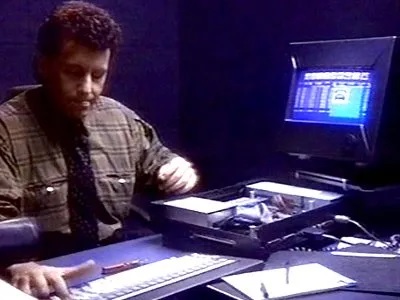
The plot of 1993’s The Tower could probably best be described as, “Paul Reiser gets a job and gets everyone killed.”
Technically, Paul Reiser is playing Tony Minot, a guy who would rather spend his time in his apartment, composing new age synthesizer anthems and eating left over pizza, than actually go to work. But make no mistake about it. Tony is basically Paul Reiser, all the way down to the neurotic mannerisms and the bad jokes.
Anyway, through the help of an old friend, Tony has gotten a job. He’s going to be working in a state-of-the-art tower, one that is totally run by a computer system known as CAS. CAS is designed to eliminate any and all security threats. For instance, when an unauthorized pigeon lands on the tower’s roof, it doesn’t take long for CAS to reduce that pigeon to a bunch of floating feathers. Tony has been told that it’s very important that 1) he have his security card with him at all times and 2) that he not damage his security card in any way.
So, of course, Tony damages his security card.
With the help of a security guard, Tony still manages to get inside the tower but, since his card doesn’t work, CAS considers Tony to be a security risk. When Tony proceeds to casually violate several security rules and stays in the building after hours, CAS decides to destroy him. Unfortunately, since Tony is kind of needy and always has to have people around him, everyone else in the building ends up getting killed too.
(This is a 1993 film and it was made for television so none of the kills are especially interesting. One guy gets caught in the closing doors of an elevator. Someone else gets trapped in an overheated sauna.)
The majority of the film deals with Tony crawling around the building, just like Bruce Willis in Die Hard. CAS is determined to kill both him and his potential love interest. We’re supposed to be angry at CAS and concerned about the world’s dependence on technology but you know what?
THIS IS ALL TONY’S FAULT!
Seriously, if Tony hadn’t damaged his card, none of this would have happened. Tony was specifically told not to damage his card but obviously, it didn’t occur to him that maybe he should try to follow the rules of his new workplace during his first day on the job!
The Tower is very much a film of its time. That’s obvious just from the cartoonish CGI and the fact that someone thought casting Paul Reiser as a Die Hard-style action hero was a good idea. Beyond that, it’s a film that’s very concerned about the rise of computers and technology. In 1993, I’m sure audiences were like, “OH MY GOD! COMPUTERS CAN’T BE REASONED WITH!” but, when I watched the film last night, I was just like, “So, they don’t have voice or facial recognition? What type of company is this?”
Anyway, The Tower is not exactly a good movie but it’s oddly watchable. Maybe it’s just because of how strange it is to see Paul Reiser doing the whole Die Hard thing. (Before anyone asks, The Tower was not meant to be a spoof. In fact, it takes itself pretty seriously.) Or maybe it’s just the fact that, by the end of the movie, you’ll totally be on the Tower’s side.
Go, CAS, go!
This week I decided to get a head start on my retro television reviews and I ended up watching and writing up reviews for three months worth of Hang Time and California Dreams. I am exhausted and I have dueling theme songs stuck in my head.
Here are some thoughts:
Abbott Elementary (Wednesday Night, ABC)
“Fire!” This week’s episode of Abbott Elementary was a classic and, after two somewhat uneven episodes, a return to form. I loved Ava’s response to the fire. I would have done the same. “Wait, you went to a spa?” Well, where else should she have gone?
Accused (Tuesday Night, FOX)
This week, the accused was a father-turned-vigilante, on trial for the murder of a man who molested his daughter. The idea had the potential to be interesting but the execution was flat. The episode’s big guest star was Malcolm-Jamal Warner, who gave a credible performance but who was also a bit on the dull side.
California Dreams (YouTube)
I watched six hours of California Dreams this weekend. I will never get the theme song out of my head.
The Devil Next Door (Netflix)
This is a Netflix docuseries about John Demjanjuk, a retired auto worker in Detroit who was accused of being Ivan the Terrible, a notorious Nazi concentration camp guard. While Demjanjuk was indeed a former camp guard, there’s still some debate over whether he was also Ivan The Terrible. It was a fascinating and disturbing story. With Demjanjuk now dead, we’ll probably never know for sure whether or not he was Ivan but that doesn’t change the fact that this rather mild-looking elderly man was a participant in the most monstrous crimes in history.
Fantasy Island (Tubi)
I reviewed Fantasy Island here!
Hang Time (YouTube)
I watched and wrote up reviews for 15 hours worth of Hang Time episodes this week. I’m exhausted but, on the plus side, I won’t have to watch the show again until June.
The Love Boat (Paramount+)
I wrote up the first season finale of The Love Boat here!
Night Court (Tuesday, NBC)
In this week’s episode, a bunch of children led a protest in Abbie’s courtroom. My goodness, it was truly an embarrassing episode. Night Court doesn’t know if it wants to be goofy or edgy and the lack of focus is really becoming an issue.
Night Music (YouTube)
This was a live music program from the 80s. The episode that I watched on Friday night featured Stevie Ray Vaughn, Van Dyke Parks, and David Sanborn. The music was great!
The Super Bowl (Sunday Night, FOX)
I watched it for the commercials, as the game didn’t really interest me and I didn’t have any real feelings about either one of the two teams playing. However, I will say that everyone that I know is pretty happy that the Eagles lost. And while I don’t have anything against the Eagles as a group of individual athletes, I do kind of resent the Philadelphia Parking Authority, as a result of having watched too many episodes of Parking Wars.
The Watchers (Netflix)
I watched the first four episodes of this Netflix miniseries on Tuesday night. The mystery was intriguing but, like so many Ryan Murphy-produced programs, it felt like there was way too much padding and I kind of started to lose interest in it all as the story progressed. Fortunately, both Naomi Watts and Bobby Cannavale were well-cast.
Welcome to Retro Television Reviews, a feature where we review some of our favorite and least favorite shows of the past! On Saturdays, I will be reviewing California Dreams, which ran on NBC from 1992 to 1996. The entire show is currently streaming on YouTube!

Welcome to season 4!
Episode 4.1 “Two Too Much”
(Dir by Patrick Maloney, originally aired on September 9th, 1995)
I have to admit that I’ve now reached the point where I automatically smile as soon as I hear the opening of the California Dreams theme song. Over the past few months, I’ve come to appreciate California Dreams with its (mostly) good cast, its occasionally clever writing, and even its inoffensive music. Of course, compared to City Guys and One World, anything is going to look good but California Dreams is a surprisingly entertaining show. It has its own enjoyably odd but mellow vibe.
The fourth season gets off to a good start with a ballet class! Yay! Of course, Sam and Lorena are in the class. But so are Mark and Sly, largely because they both think it’ll be a good place to pick up girls. And so is Tony, due to Sam ordering him to take the class. Jake, however, thinks that ballet is stupid and doesn’t understand why Lorena doesn’t want to spend all of her time watching him ride his motorcycle …. uh-oh, I think I see where this is going and I’m not happy about it because I’m one of the few people who thinks that Jake and Lorena were a good couple.
After his fight with Lorena, Jake finds Tiffani at Sharky’s and asks her for advice. However, Tiffani is on a date with Keith Dell, “the teen radio shrink.” Keith, who is a hilariously mellow and understanding character, tells Jake that a successful relationship is all about compromise. Keith then suggests that Jake and Tiffani are still in love. “Wooooo!” the audience replies.
Determined to try to make it work with Lorena, Jake tries to share her interests. He takes her shopping for shoes. Then he shows up for ballet class, having exchanged his leather jacket for a pair of tights and ready to dance. After Lorena accuses Jake of embarrassing her, Jake has a black-and-white fantasy about being married to Lorena. Of course, it’s called I Love Lorena. Jake becomes Desi Arnaz. Lorena becomes Lucille Ball. Fred and Ethel are embodied by Sam and Tony. Even in the fantasy, though, Jake keeps accidentally saying that he loves Tiffani. It’s actually pretty funny, largely because of the chemistry of the cast.
I’m sure everyone reading this can guess what’s going to happen. Jake and Lorena amicably break up. Jake and Tiffani get back together. Tony becomes dance-crazed and puts together a wonderfully pretentious performance at Sharky’s. As always, everything happens at Sharky’s.
Despite the fact that my favorite couple broke up, this was a good start for the fourth season. The cast’s chemistry was as strong as ever, Jake and Lorena’s breakup was handled intelligently, and William James Jones had some funny moments as he went mad for ballet. And who knows? I liked Jake and Lorena but Jake and Tiffani have chemistry as well. Maybe this breakup was all for the best….
Episode 4.2 “My Valentine”
(Dir by Don Barnhart, originally aired on September 16th, 1995)
It’s Valentine’s Day! Looking to make his first Valentine’s Day with Samantha a special one, Tony writes a love song and has Jake sing it. After Jake finishes the song, Sly says that it was the perfect gift. Tiffani agrees that it was very romantic. “No,” Sly says, “it was free.”
Oh, Sly …. never change!
Tony, however, is worried that Sam will be returning to Hong Kong as soon as they graduate from high school. Tony’s solution is to ask her to marry him. Sam says, “Yes!” The audience goes crazy but the Dreams have their doubts. Lorena and Jake think Tony and Sam are too young to get married. Sly agrees but his main concern is whether or not Tony and Sam will hire the Dreams to play at their wedding reception. I’m not sure how that would work, considering that Tony and Sam are in the Dreams.
Tony and Sam haven’t been engaged for more than a day before they have their first fight. Sam discovers that Tony hasn’t told his parents that they are engaged. “If you can’t yell your parents,” she says, “your obviously too immature to get married!”
“I’m not immature,” Tony replies, “I just didn’t want them to ground me.”
Hey, it make me laugh. I laughed even harder when Sam revealed that she hadn’t told her parents either.
Anyway, Tony and Sam break up but, luckily, they get back together a few hours later at the big Valentine’s Day dance, agreeing to date and putting off marriage for now. I was glad about that. Tony and Sam are a cute couple and no one should break up on the most romantic day of the year! While Tony and Sam are getting back together, Jake and Tiffani are having an O. Henry moment as they realize that they’ve both sold their most prized possessions to get the other a present. It’s a sweet moment for them. Meanwhile, Lorena gets to wear a really cute red dress so everyone’s a winner this Valentine’s Day!

I own the same dress!
Next week: Tiffani is principal for a day! I’m sure this won’t lead to any drama at all….

