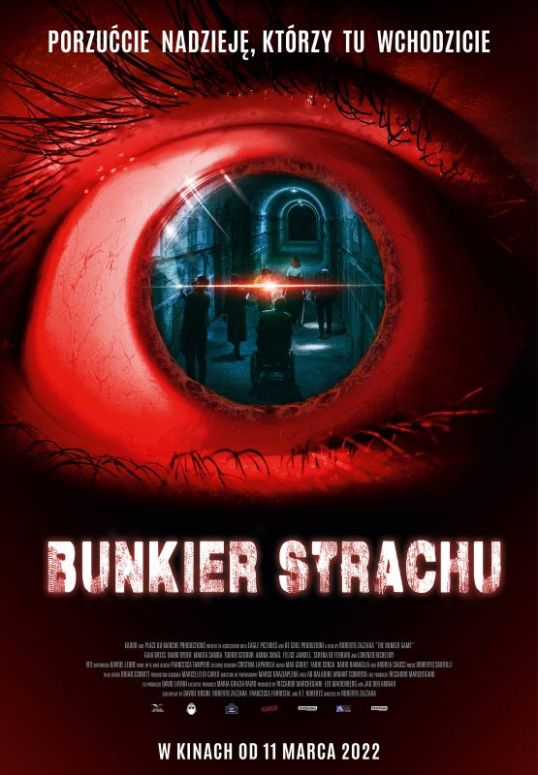
The TSL’s Horror Grindhouse: The Bunker Game (dir by Robert Zazzara)


The Bunker Game, which made its debut on Shudder earlier this year, opens with what appears to be a bit of alternate history worldmaking.   The viewer watches a black-and-white documentary that presents a world in which the Nazis conquered Europe during World War II but, ten years after Germany’s victory, the United States dropped an atomic bomb.  As a result, Europe is now an atomic wasteland.  A handful of survivors managed to find shelter in Italy, hiding out and forming a new society in an underground bunker that was built by Mussolini in the 30s.  The underground society is an authoritarian one, where mad scientists experiment on the citizens and storm troopers seem to be around every corner.  However, there is a small rebellion brewing….

Sounds potentially interesting, right?  Well, don’t get too attached to the alternative history spin because, within the first few minutes of the film, it’s revealed that the people in the bunker aren’t actually citizens of an authoritarian state and, while the Bunker is indeed real, the rest of Europe is just fine.  It turns out that documentary was just a part of an elaborate and very expensive game.  Instead of being the last refuge of the Third Reich, the Bunker is full of LARPers, people who have spent a good deal of money so that they can spend a week pretending to be …. well, Nazis.

Now again, this sounds like it could be potentially interesting.  Why would a group of people pay money in order to enter a real underground bunker and pretend to be some of the most evil people who have ever existed?  It’s an intriguing premise but, just as with the alternate history angle, don’t get to attached to it because it doesn’t take long for the film to abandon the whole LARPing plot.

Instead, unforeseen circumstances lead to the game ending early and most of the LARPers heading home. The Bunker Game proceeds to tell a fairly standard story about a handful of people who find themselves isolated in the now-deserted Bunker.  When one of their friends disappears, they split up to search for him and soon, some sort of supernatural force is killing them one-by-one.  The group is made up of identifiable types.  One person is quirky.  Another person is serious and professional.  Another is a stereotypical zoomer.  Another one is too uptight and obviously destined to go crazy before the movie is over.  For the most part, the film focuses on Laura (Gaia Weiss) and her cousin, Harry (Mark Ryder).  Harry is determined to leave the Bunker and never again deal with any LARPers.  Laura, meanwhile, finds herself strangely drawn to the Bunker, even once it becomes obvious that something is killing all of her friends.  Harry cannot understand why Laura would want to be part of the Bunker Game in the first place.  Laura cannot understand why anyone would want to live in the real world.  Most viewers will probably be able to guess where this is all going.

That said, The Bunker Game gets the job done.  The underground bunker is a wonderfully creepy setting and, even if they are playing types, the cast still does their best to bring their characters to life.  (Of course, all of them are playing characters who spent a lot of money so that they could pretend to be Nazis so, well-acted or not, most viewers will have limited sympathy for them.)  Though it’s hard not to regret that the film didn’t do more with its potentially interesting plot, director Roberto Zazzara does a good job of creating and maintaining a properly ominous atmosphere.  For what it is, The Bunker Game works well enough.  One can regret that it’s not thematically challenging while also acknowledging that, whatever flaws the narrative may have, the film still gets the job done.  Those who are just looking for a well-made horror film and who aren’t necessarily concerned with whether or not the plot makes total sense will probably enjoy The Bunker Game.
Retro Television Reviews: Hang Time 1.9 “Stranded” and 1.10 “The Sweat Shack”


Welcome to Retro Television Reviews, a feature where we review some of our favorite and least favorite shows of the past!  On Mondays, I will be reviewing Hang Time, which ran on NBC from 1995 to 2000.  The entire show is currently streaming on YouTube!

I’ll always remember, me and my friends at Hang Time!

It’s time to check in and see what’s happening at Deering High!

Episode 1.9 “Stranded”

(Directed by Howard Murray, originally aired on November 4th, 1995)

“Great!” Sam announces halfway through this episode, “we’re all stuck together and we hate each other!”

And yes, it is true.  After a terrible loss, Coach Fuller makes the team come in for a Saturday morning practice.  Only a few members of the team make it due to the fact that it’s snowing and those who do make it end up getting trapped in the gym by the blizzard!  Way to go, Coach!

This actually wasn’t a bad episode.  For one thing, memories of the 2021 Texas blizzard are still fresh on my mind so, for once, I could relate to what the characters on the show were going through.  I actually have been snowed in, with the power going on-and-off.  Fortunately, I wasn’t trapped in a gym.  I was in my house, with a book to read.

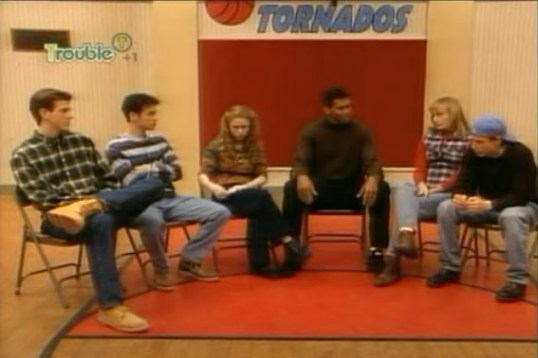
The majority of the episode was taken up with a group therapy session, in which Fuller tried to get the team to open up about both the loss and their feelings to each other.  And while I initially groaned when the scene started, it was actually handled fairly well.  We got to hear each character’s inner thoughts and it turned out that most of them were just as tired of Julie being the center of every storyline as the viewers undoubtedly were.  Add to that, a new member of the cast made an appearance when one brave boom mic made an appearance, hovering over the group.

While everyone tried to figure out how to survive being stuck in the gym overnight (did none of these high school students have parents trying to dig them out?), Julie and Chris debated whether they could both date and be teammates and Mary Beth, who was in the gym despite not being a member of the basketball team, tried to take care of the fake baby that she had been assigned for a class assignment.

As I said, this was not a bad episode.  Chris and Julie were still an amazingly boring couple but, with this episode, it felt as if the cast had finally come together as an ensemble.  Still, it’s strange that the episode ended with Michael saving everyone in the high school as opposed to say the parents who were undoubtedly wondering to where their children had disappeared during the worst blizzard in Indiana history.  Did the adults in town just not care about their high school basketball team?

Episode 1.10 “The Sweat Shack”

(Directed by Howard Murray, originally aired on November 11th, 1995)

This was a weird episode.  Mary Beth’s father demanded that she get a job so, somehow, she ended up as manager of the Sports Shack (which is the store in the mall where most of the characters work).  At first, Mary Beth is too lenient of a boss.  Then she become too strict of a boss.  All of her employee go on a strike but is there really a Sports Shack union?  Is the strike even legal?  Couldn’t everyone be arrested for disturbing the peace and, even more importantly, why can’t Mary Beth just fire all of them and hire cheap replacements?  That would definitely cut down on payroll.

Meanwhile, Coach Fuller is in charge of a new exchange programs where members of the basketball team pair up with girls from Russia and …. wait, WHAT!?  Earl gets a Russian who loves hanging out with him.  Michael gets a Russian who is overweight so, of course, the audience goes, “Whoa!”  “You are fresh prince,” the Russian tells Michael, on account of the fact that Michael appears to be the only black student at Deering High.  “Hah hah hah!” the audience responds.  Eventually, Michael learns an important lesson about not judging Russian mail order brides by their weight.  It’s all more than a little cringey but it is kind of sweet that Earl’s exchange student even follows him around while he’s working his security job at the mall.

Anyway, this one of those episode that kind of felt as if it was just a mix of scenes and storylines that had been cut from other episodes.  Perhaps it would have been better if everyone had been trapped at the mall by another blizzard.  Seriously, blizzards bring out the best of this show.

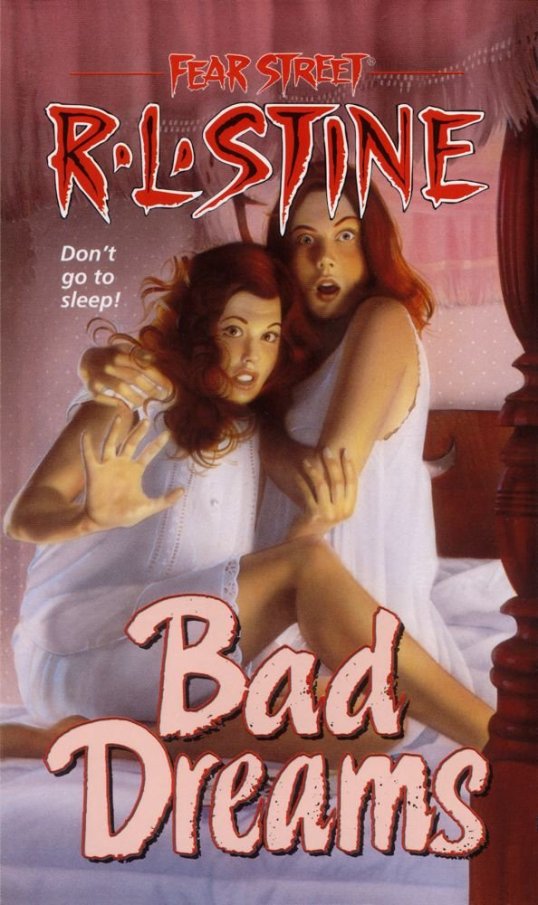
Horror Novel Review: Bad Dreams by R.L. Stine


First published in 1994, Bad Dreams is yet another R.L. Stine YA novel about life on Fear Street.

This time, it’s Maggie and her younger sister Andrea who have moved into a new house on Fear Street.  Maggie and Andrea are rivals about almost everything.  They’re both super competitive swimmers who are fighting for the right to represent their high school at the State Championship.  They both like Justin, who is typical boring R.L. Stine boyfriend.  They ever argue over who should get the ornate bed in Maggie’s new bedroom.  Because Maggie agreed to let Andrea have the bigger room, Maggie gets to keep the bed.

I don’t know, Maggie.  You might want to rethink that.

It turns out that the last owner of the bed was actually stabbed to death while laying on top of it.  Soon, Maggie is having disturbing dreams where she sees the murder happening.  Is Maggie being contacted from beyond the grave or are her dreams warning her that she’s about to become the next victim?  And what about all the strange noises coming from the attic?

Soon, Maggie is struggling when it comes to school and swimming because she’s just not getting enough sleep!  (This book made me happy that I’ve never needed more than 3 hours of sleep to function.)  However, the other two girls who are competing against Maggie and Andrea for a chance to go to State each falls victim to a bizarre accident!  Someone is taking out the competition!  Is it the ghost?  Is it Andrea?  Could it even be Maggie herself!?

Will Maggie be able to solve the mystery?  Will she eventually get a good night’s sleep and fulfil the promise of having sweet dreams?  Will she and Andrea ever be able to put aside their sibling rivalry?  And who will go to State!?

And, perhaps most importantly, does anyone really care?

As far as the plot is concerned, Bad Dreams is an example of R.L. Stine on autopilot.  All of the questions are eventually answered but the answers seem to come out of nowhere and it’s hard to escape the feeling that Stine pretty much just kept writing until he reached the minimum word requirement and then he decided to quickly wrap things up without really worrying about whether or not he had provided enough clues to keep the reader from feeling as if she had been denied a fair chance to solve the mystery on her own.  That said, the first of Maggie’s dreams was nicely creepy and the constant arguing between Maggie and Andrea was kind of entertaining.  I’ve got three older sisters so I imagine that every single one of them could probably have related to Maggie at some point while we were all growing up.  (It also helped that Andrea and Maggie had red hair, just like me!)  Plus, all of the drama around the swim team reminded me of the later episodes of Saved By The Bell: The New Class, in which it suddenly turned out that everyone at Bayside was obsessed with the swim team.  Today, books like this are best used for nostalgia and that’s what I definitely felt while reading Bad Dreams.

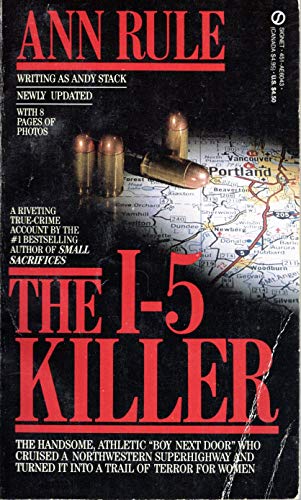
Book Review: The I-5 Killer by Ann Rule


Yesterday, I reviewed The Serial Killer Letters, a book that is largely made up of letters written by serial killers.  As I mentioned in my review, I was particularly disturbed by the many letters that were written by Randall Woodfield, a former football player who is currently serving a life sentence for one murder but who has been linked to 44 others.

What was it that so disturbed me about Woodfield’s letters, beyond the fact that they were the words of a man who targeted women who physically resembled me?  Some of it was the fact that Woodfield took a flirtatious tone in his letters, presenting himself as being just a charming but hapless guy who ended up suffering from a bit of bad luck.  The fact that he included shirtless pictures of himself with his letters was undeniably icky.  There was also the fact that, despite having been linked to several murders by DNA and a lot of other evidence, Woodfield continued to adamantly claim that he had been set up and railroaded and basically misrepresented by everyone who had ever written or spoken about his case.  In fact, Woodfield was so adamant that, when first reading his words, it was tempting to question why someone who has been serving a life sentence since 1981 and who has no hope of ever getting out would not just go ahead and confess.  Even the author of The Serial Killer Letters admitted to initially feeling conflicted about Woodfield and his claims of innocence.  However, in order to believe Woodfield’s story, you would have to believe that cops in several different jurisdictions all decided to independently conspire against one person.  Considering that his DNA has been linked to several cold cases, you’d have to accept that the DNA evidence was planted at a time when most people weren’t even sure what DNA was.  You would have to ignore all of the other evidence against Woodfield.  You would also have to explain away the fact that three of Woodfield’s suspect victims were acquaintances of his and that all three of them died around the same time and in similarly violent circumstances.  One could accept that a gigantic conspiracy was formed to put Randy Woodfield in prison.  Or one can accept that Randy Woodfield is guilty.

In Woodfield’s letters, he spent a good deal of time ranting about the true crime writer Ann Rule.  In 1984, Rule wrote a book about Woodfield’s crimes, The I-5 Killer.  In fact, Woodfield devoted so much space to accusing Rule of being a part of a conspiracy against him that I felt the need to read The I-5 Killer to see what Rule had to say.  It’s pretty much a standard true crime book, one that gives the sordid details of Woodfield’s crimes while also detailing the investigation that led to Woodfield’s arrest.  The book delves into Woodfield’s background, revealing him to have been a popular high school athlete who, even at the age of 14, had a disturbing compulsion to expose himself to complete strangers.  Woodfield drifted after high school but he was a good enough football player to be drafted by the Packers.  Unfortunately, even while at training camp, Woodfield couldn’t stop exposing himself to strangers.  The Packers decided they didn’t need him on their team and Woodfield instead became a thief, a rapist, and a murderer.  At the same time, he also worked as a bartender and always had a new girlfriend who was willing to help finance his lifestyle.  The book is full of quotes about how charismatic Woodfield could be while tending bar.  However, there’s also a lot of quotes concerning the fact that even Woodfield’s friends and defenders thought he was an idiot.

The book details Woodfield’s crimes and the efforts of one of the survivors of his rampage to not only recover from being shot but also to find the courage to come face-to-face with Woodfield in court.  It makes for disturbing reading but the book should also be praised for revealing that Randy Woodfield was not a Hannibal Lector or a Dexter Morgan or any of the other charming, fictional murderers who tend to turn up in the movies or on television.  Randy Woodfield was a loser, through and through.  His motives were not complex and his methods were not clever.  He was an idiot.  One can understand why Woodfield hates Rule’s book but the book itself provides an invaluable service.  After you read enough true crime books, you come to realize that most murderers are, for the most part, very dull people.

The edition that I read included an update on Woodfield in prison.  It mentioned that Woodfield had become a prolific letter writing and that he always made sure to send everyone a shirtless picture of himself before asking them for money.

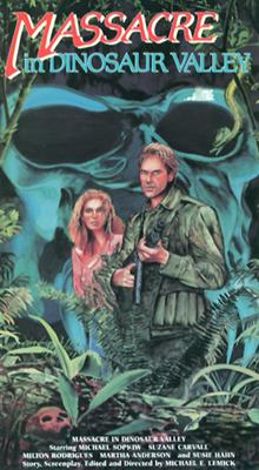
International Horror Review: Massacre in Dinosaur Valley (dir by Michele Massimo Tarantini)


As I watched the 1985 Italian film, Massacre in Dinosaur Valley, I found myself wondering one thing.

“Where are the dinosaurs!?”

Perhaps I’ve been spoiled by the Jurassic Park franchise but whenever I see the word “dinosaur” in a title, I expect to see dinosaurs.  That’s actually probably the main reason why I, or anyone else for that matter, would watch Massacre in Dinosaur Valley.  Unfortunately, there are no dinosaurs in this film.  Instead, a paleontologist shows up to explain that the valley is called Dinosaur Valley because it is the home to so many fossils.  This, of course, is the equivalent of telling us that, even though a city is really boring now, you should have seen it several thousand years ago.  Unfortunately, we also don’t get to see any fossils in Massacre in Dinosaur Valley.

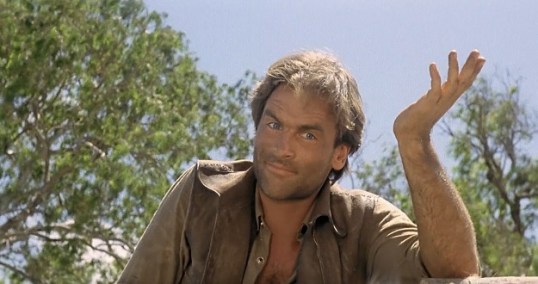
An actual screen shot from Massacre in Dinosaur Valley

There is, however, a massacre.  When a plane crashes in the valley, the pilot is killed but the majority of the passengers survive.  Insane Vietnam vet John Heinz (Milton Rodriguez) declares himself to be the leader of the survivors, even while his drunk wife (Marta Anderson) taunts him about everything from his lack of sexual prowess to the fact that his war record apparently isn’t as impressive as he claims.  The majority of the survivors would rather be led by Kevin Hall (Michael Sopikw), a soldier of fortune who is first introduced hitching a ride on a truck and then admitting that he doesn’t even have the five dollars that he promised to pay the driver.  Kevin seems like a bit of a loser but he’s better looking than Heinz and a good deal more laid back as well.

That said, it really doesn’t matter whether Kevin or John is in charge of the survivors because, what the valley lacks in dinosaurs, it makes up for in cannibals.  When the cannibals attack, the survivors rather foolishly split up and quickly discover that, if the cannibals don’t get you, the quicksand will.  Kevin ends up making his way through the jungle with Myara (Gloria Cristal) and Belinda (Susan Hahn).

Massacre in Dinosaur Valley was released towards the end of the infamous Italian cannibal cycle.  In Italy, it was originally given the much more honest title of Nudo e selvaggio, which translates to Naked and Savage.  In some parts of the world, it was released as Cannibal Ferox 2, in an effort to associate the film with Umberto Lenzi’s infamous shocker.  The plot of Massacre in Dinosaur Valley obviously owes much to Cannibal Ferox.  Fortunately, there’s far less animal cruelty in Massacre In Dinosaur Valley.  Unfortunately, the plot moves slowly and none of the film’s violence or gore is as nightmarishly realized as in the equivalent scenes from Ferox.  As well, no one in the Dinosaur Valley cast can really duplicate the charisma of Ferox‘s Giovanni Lombardo Radice, Lorraine De Selle, and Zora Kerova.

That said, even if he wasn’t a particularly dynamic actor, Michael Sopkiw was still a likable lead and he was the best thing that Massacre In Dinosaur Valley had going for it.  Sopkiw is a bit of an enigmatic figure when it comes to the history of Italian exploitation films.  He was an American actor and a model who, in quick succession, starred in four Italian films.  He started his career with Sergio Martino’s 2019: After The Fall of New York and then went on to star in Lamberto Bava’s Blastfighter and Monster Shark before ending his acting career with Massacre In Dinosaur Valley.  Sopkiw was good looking and he had a likeable screen presence.  It’s easy to imagine that he could have had a career similar to Michael Dudikoff’s if he had stuck with it.  But Sopkiw apparently decided that acting in B-movies wasn’t for him and he instead went into botany and started a company that makes special glass bottles that protect their contents from exposure to the sun.  Good for him.

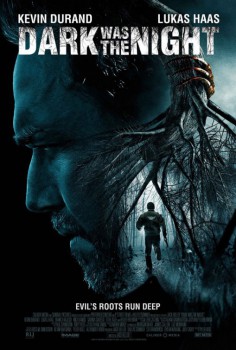
Horror Film Review: Dark Was The Night (dir by Jack Heller)


The 2014 horror film, Dark Was The Night, takes place in the town of Madison Woods.

Madison Woods is a small, isolated town that is located somewhere up north.  It’s one of those dreary blue collar towns where everyone knows everyone else.  Most of the citizens work in the logging industry, attend the same church, and drink at the same bar.  It’s not a town where much happens.  The police force consists of two guys, Sheriff Paul Shields (Kevin Durand) and his new deputy, Donny Saunders (Lukas Haas).  Donny worked in New York City before moving to Madison Woods.  Shields is currently estranged from his wife.  That’s the type of thing that passes for big news in Madison Woods.

When one of the local farmers complains that one of his horses has disappeared, Shields and Saunders assume that the horse has just run off.  When other animals start to disappear, Shields continues to insist that it’s all just a coincidence.  When the local hunters start to talk about an ancient legend of a monster that lives in the woods, Shields replies that there are no monsters and, for good measure, there’s no God as well.  (In many ways, Shields is a perfect example of the old joke about how the best way to spot an atheist is to wait a few minutes and he’ll tell you.)  Even when weird cloven footsteps start to show up around town and Shields himself spots something in his backyard, the Sheriff continues to insist that there is a rational explanation for all of this.  Meanwhile, Saunders hangs out at the bar and drinks and really, who can blame him?  As far as I can tell, it’s not like Madison Woods has a movie theater or anything like that.  It’s a really boring town.  You can either develop the beginnings of a drinking problem or you can start random fights or you can get ripped apart by the thing in the woods.  Make your choice.

Eventually, Shields and Saunders do discover that there is something lurking out in the woods.  And, despite their attempts to come up with a rational explanation, the creature proves itself to be more than just some animal.  Instead, it’s a true supernatural monster, tracking its prey through the community.  As a group of loggers discover at the start of the movie, the creature is just as quick to attack humans as it is to go after deer and other wild animals.  With the entire town locked away in the church basement (because, as Night of the Living Dead proved, the basement is always the safest place), Saunders and Shields try to figure out how to stop a monster that neither one of them has ever seen before.

Dark Was The Night was loosely inspired by a true story.  In 1885, the citizens of Topsham in the UK were stunned to wake up one cold morning and discover a series of cloven footprints in the snow.  The footprints led through the entire city and it appeared that whatever was responsible for them had stopped in front of every house and place of business.  Some claimed that the footprints belonged to the devil while others said that it was just some sort of animal.  The Devil’s Footprints, as the story became known, serves as a bit of Rorschach test.  Those inclined to believe in the supernatural have little trouble believing that the Devil visited the town of Topsham while the more rational among us assume that the footprints were left by a wild animal and then people saw whatever they wanted.  Dark Was The Night moves the story to the modern day and to America but the question remains the same.  Is there really a monster in the woods or, as Shields initially believes, are people just seeing what they want to see?  Unfortunately, the film reveals the monster’s existence within its opening minutes.  The film would have perhaps been more effective if there had at least been some mystery about whether or not Shields’s initial instincts were correct.

Dark Was The Night is a deliberately paced film, which again would be more effective if there was any mystery at all as to whether or not the monster actually existed.  On the plus side, the film is full of atmosphere and Kevin Durand and Lukas Haas are both effective as the two lawmen who find themselves in over their heads.  Fans of Lost will remember Durand as the evil Martin Keamy, who was one of the most heartless characters to ever appear on that show or any other show.  Durand gets to play the hero in Dark Was The Night and gives a good performance as a man who discovers that not everything has a rational explanation.  That said, while the film has some interesting ideas and performances, it ultimately becomes just another monster-laying-siege film and the ending is one that most viewers will see coming from miles away.  It’s not a bad film but it’s still never quite as good as one might hope.

Horror on the Lens: Robot Monster (dir by Phil Tucker)


Today’s horror film is a true classic of its kind, the 1953 science fiction epic Robot Monster.

Now, I should admit that this is not the first time that I’ve shared Robot Monster in October.  I share it every year and, every year, YouTube seems to pull the video down in November.  That sucks because Robot Monster is one of those weird films that everyone should see.  So, I’m going to share it again.  And, hopefully, YouTube will let the video stay up for a while.

As for what Robot Monster is about…

What happens with the Earth is attacked by aliens?  Well, first off, dinosaurs come back to life.  All of humanity is killed, except for one annoying family.  Finally, the fearsome Ro-Man is sent down to the planet to make sure that it’s ready for colonization.  (Or something like that.  To be honest, Ro-Man’s exact goal remains a bit vague.)

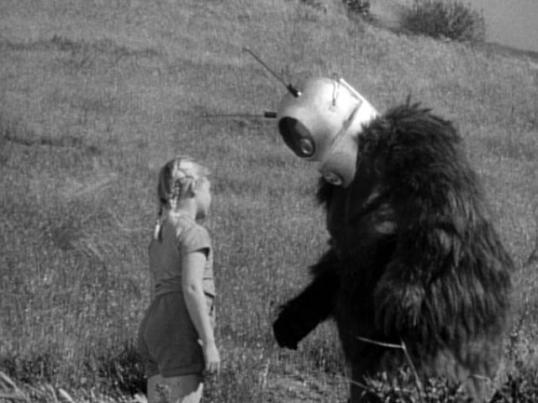
Why is Ro-Man so fearsome?  Well, he lives in a cave for one thing.  He also owns a bubble machine.  And finally, perhaps most horrifically, he’s a gorilla wearing a diver’s helmet.  However, Ro-Man is not just a one-dimensional bad guy.  No, he actually gets to have a monologue about halfway through the film in which he considers the existential issues inherent in being a gorilla wearing a diver’s helmet.

Can humanity defeat Ro-Man?  Will Ro-Man ever get his intergalactic supervisor to appreciate him?  And finally, why are the dinosaurs there?

Despite the film’s reputation for being borderline incoherent, most of those above questions actually are answered if you pay attention to the first few scenes of Robot Monster.  In fact, one could even argue that Robot Monster is maybe a little bit more clever than it’s often given credit for.  Of course, it’s still a zero-budget mess of a film but it’s also undeniably fun and, in some sections, unexpectedly dark.  If you’ve never seen it before, you owe it to yourself to set aside an hour and two minutes in order to watch it.  You’ve never see anything like it before.

Finally, I should note that Robot Monster’s hero was played by George Nader, who actually did go on to appear in several mainstream films.  Despite his good looks and talent (which may not be obvious in this film but which he did have), George Nader struggled to get starring roles in Hollywood, where he was often dismissed as just being a member of Rock Hudson’s entourage.  (It’s been theorized that Nader struggled because the studios feared that giving him too big of a role would lead to the gossip magazines writing about Nader’s relationship with Hudson, though the two were just friends.  Nader was in a relationship with Hudson’s private secretary, Mark Miller, from 1947 until Nader’s death in 2001.)  Nader finally left Hollywood and went on to have a pretty successful career in Europe.  He was perhaps best known for playing secret agent Jerry Cotton in a series of films in the 60s.

Enjoy Robot Monster!

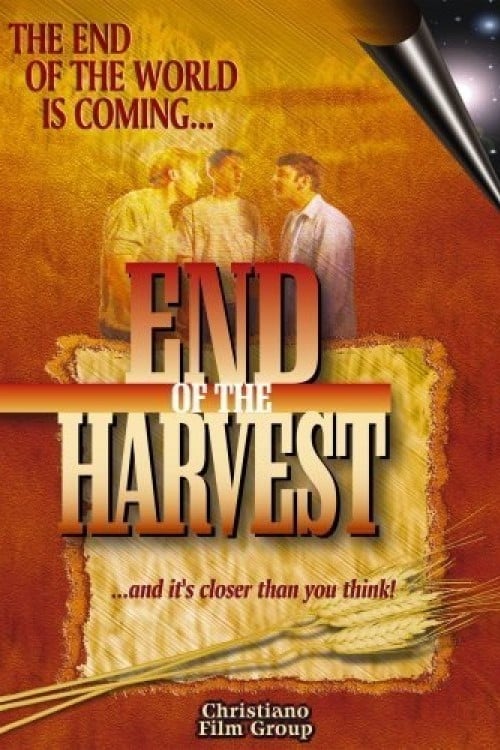
October Positivity: End of the Harvest (dir by Rich Christiano)


This 1995 film takes place on a college campus that is ruled over by the worst possible people …. THE PHILOSOPHY CLUB!

Okay, that might be an exaggeration.  It’s a big campus and undoubtedly, most of the students are just doing their own thing and don’t particularly care about any of the clubs or any of the Greek organizations or any of that stuff.  That said, it does seem like a surprisingly large amount of people are interested in the weekly Philosophy Club debates, despite the fact that the Philosophy Club itself seems to only have three members.

After seeing his religious friend get totally trampled while trying to debate the existence of God, Scott (Brad Heller) decides that it’s time to take a stand.  Scott used to be a wild frat boy and he even lost his license due to a DUI.  But now, he’s super Christian and he’s totally excited because he found a 50 year-old thesis about when the Bible says the world is going to end.  Scott challenges the Philosophy Club to a debate and soon, flyers are being put up all over campus.

The only problem is that Scott isn’t ready for the debate.  The Philosophy Club has uncovered the secrets of Scott’s dark past and, after they harass him on campus and start calling his ex-girlfriends, Scott starts to feel that he won’t be able to make his case.  He begs Matt (David A.R. White) for help but Matt says that it’s pointless to try to debate anything in front of the Philosophy Club.  The Philosophy Club doesn’t care about anything but Marx and Nietzsche.  Matt not only thinks that the debate will be a waste of time but he also thinks that it will actually drive people away from religion.

Of course, Matt has another reasons for not wanting to talk about the end of the world.  He’s been having odd dreams, in which he’s standing in a wheat field and watching an old farmer using a scythe to bring in the last harvest….

There have been several faith-base films that have been set on campus and they all have the same basic plot.  A religious person goes to college and has their faith tested by people who were raised differently and who insist that science or philosophy can serve as a substitute for religion.  It always seems to lead to a classroom debate and the religious student usually wins because all of the arguments have been slanted to their side.  Of course, it’s not just Christian films that do this.  If there’s one thing that Christians and atheists share in common, it’s an almost total ignorance about how the other side views the world and the questions of existence.  Anti-Christian films always fall back on the stereotype of the fanatical parents who refuse to allow their children to leave the house.  Christian films, on the other hand, always seem to feature an atheist who is angry at God.  End of the Harvest doesn’t go quite as far into those stereotypes as some other Christian films do but it’s still hard not to notice that the bizarrely smug members of the Philosophy Club are left speechless by some pretty basic arguments.  It’s the fantasy that both atheists and Christians tend to indulge in, the one where you come up with the pithy one-liner that no one can refute.  Christians always want to know how you can be angry at a God you don’t believe in.  Atheists always want to know, if God created everything, who created God.  In the real world, both arguments can be easily refuted but, in the movies, they’re always game changers.

End of the Harvest is a fairly standard religion-on-campus film.  It’s not going to convert anyone.  That said, the scenes of Matt standing in that wheat field have a nicely surreal feel to them.  In those scenes, it really does feel like the end is coming.

Horror on TV: Ghost Story 1.2 “The Concrete Captain” (dir by Richard Donner)


In the 2nd episode of Ghost Story, an important lesson is learned.  If you’re going to bury a sea captain, do not bury him in concrete because his spirit belongs to the ocean.  Upset his spirit and he’ll basically ruin whatever hopes you have of bringing tourists to the seashore!

This episode stars Gena Rowlands and Stuart Whitman and it was directed by none other than Richard Donner.  Donner, of course, would go on to direct such films as The Omen, Superman, and Lethal Weapon.

Enjoy!

(Despite the weird thumbnail, this video should work if you click play.)

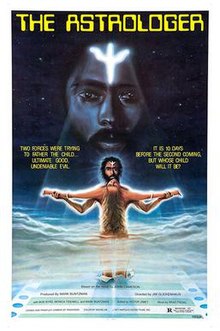
The TSL’s Horror Grindhouse: The Astrologer (dir by James Glickenhaus)


Quite possibly one of the most boring film ever made, 1975’s The Astrologer tells the story of …. well, I’m not really sure what the point of it all is.

Basically, an astrologer named Alexi Abarnel (Bob Byrd) has figured how to combine the zodiac with 70s technology and, as a result, everyone’s potential for good and evil can be determined simply by typing their birthdate into a computer.  The U.S. government funds his agency, which is known as Interzod.  And let’s be honest, that does sound like the type of dumbass thing that the government would fund, especially when the Democrats are in power.

According to the stars, the second coming of Christ is only a few days away.  Alexi is convinced that he has married the woman who is destined to give birth to the Savior.  Because of this, he refuses to consummate his marriage because it’s very important that she remain a virgin.  However, he hasn’t bothered to inform her of any of this so poor Kate (Monica Tidwell) spends all of her time wondering why her husband hasn’t touched her in five years of marriage and why it’s also so important to him that she never tell anyone the actual date of her birth.

Meanwhile, a group of gypsies are traveling the country and, under the leadership of Kajerste (Mark Buntzman), they are both murdering people and also compelling people to commit suicide.  Interzod is concerned about Kajerste because of his “zodiacal” potential but Alexei is also concerned that he doesn’t have Kajerste’s exact birthdate.  But the fact that Kajerste is commanding his followers to kill people should be enough to clue Interzod into the fact that Kajerste is bad guy, regardless of whether he’s a Capricorn or an Aquarius.  Fortunately, Interzod has come up with a plan on how to kill Kajerste, one that involves implanting thoughts in his head via electrodes and tranquilizer dots.  A young congressman (Al Narcisse) wants to help because he’s so interested in Interzod’s work.  However, it turns out that the ludicrously complicated plan to take out Kajerste is …. well, ludicrously complicated.  If my tax money is going to fund Interzod, I would hope they would make better use of it.

The film’s plot definitely has the potential to be interesting but, unfortunately, The Astrologer is a very, very talky film.  It only has a 78-minute running time and the majority of the film is made up people having very long and very dry conversations about how Interzod works and why its work is important.  The problem is that there’s not really any need to convince the viewers that Interzod is important or to show us how it works.  No watching this film is going to be interested in an in-depth examination of a fictional government agency.  Everyone knows that this isn’t 60 Minutes and it’s not like the NSA has hand-picked the correspondent who is going to be reporting on them.  This is a film about spies, astrology, and a killer cult.  It should be a lot of fun but instead it’s incredibly boring.

That’s not to say that it’s a total waste.  This was James Glickenhaus’s first film as a director.  Glickenhaus went to direct some well-regarded action films in the 80s and there are a handful of isolated moments in The Astrologer where it is obvious that the film was made by someone who had a good visual eye.   A cult ceremony scene that is almost totally made up of freeze frames is nicely done.  And, as always, it’s hard not to admire the ambition of someone trying to make a metaphysical thriller and tackle the big questions of existence on a budget.

In the end, though, the most interesting thing about The Astrologer is its insistence on having its characters frequently use the term “zodiacal.”  Take a drink every time that you hear someone say, “zodiacal” but don’t drive afterwards.