Welcome to Late Night Retro Television Reviews, a new feature where we review some of our favorite and least favorite shows of the past! On Fridays, I will be reviewing Friday the 13th, a show which ran in syndication from 1987 to 1990. The show can be found on YouTube!
Tonight, we have the first Halloween episode of Friday the 13th: The Series!
Episode 1.5 “Hellowe’en”
(Dir by Timothy Bond, originally aired on October 26th, 1987)
Somehow, it was not until I watched this episode that I noticed that the Friday the 13th antique shop is names Curious Goods. I guess that’s a good name for a cursed antique shop. (It’s probably more inviting than going with something more honest, like Evil Junk.) Certainly, it appears that it was good enough to keep the place open, even though the owners spent most of their time taking back the antiques from the people who bought them.
This episode takes place during a Halloween party. Is it a good idea to throw a Halloween party in a location that is full of cursed items? That’s the exact question that Micki asks Ryan but Ryan thinks that the store needs to do something to let the neighborhood know that it’s not as scary as it looks. Ryan is actually thinking like a businessman, whereas Micki is thinking like someone who just wants to find all of the cursed antiques so she can get back to planning her wedding. Personally, I think Micki has the right idea.
That said, it’s not a bad party. Ryan dresses up like a renaissance prince. Micki wears a black gown that is to die for. (I assume Micki is costumed as the lead singer of an 80s goth band.) Jack, who really should have been the voice of reason when Ryan first suggested the party, dresses up like a wizard. A lot of people from the neighborhood come to the shop and they watch as Jack performs some simple magic tricks. Unfortunately, the party is ruined when two dummies wander down to the basement and accidentally activated a crystal ball. The lights in the store go out. There are scary noises. Everyone abandons the shop, except for Ryan and Micki.
Where is Jack? He’s taking a mysterious little girl trick-or-treating, just to suddenly discover that the girl is actually a Satanic creature who was sent to distract him while the ghost evil uncle Lewis (R.G. Armstrong) confronted Ryan and Micki in the shop. Lewis, who is wandering around because the damned are apparently allowed to do so only on Halloween night, lies and says that he needs the amulet of Zohar so that he can free his wife from a curse but, after Ryan and Micki stupidly bring him the amulet, Lewis announces that the amulet will actually allow him to transfer his spirt into the body of someone who has recently died, as long as that person died from natural causes. Lewis is going to use the amulet to return permanently to the land of the living.
Lewis and the little demon girl head down to the local morgue. Fortunately, Jack has broken free of the trap that the demon put him in and Ryan and Micki have, for once, managed to figure out what’s happening on their own. Between the efforts of Jack, Ryan, and Micki and Lewis’s own pickiness when it comes to picking a body, Lewis’s time runs out and he is dragged back to Hell.
This was a fun episode. Not only did did it feature Ryan and Micki wearing their very 80s Halloween costumes but it also featured an enjoyably over-the-top performance from R.G. Armstrong as evil Uncle Lewis. All Halloween episodes should be as enjoyable as this one.
Now streaming on Netflix, Sly is a documentary about the life and career of Sylvester Stallone.
The documentary opens with Stallone watching as all of his belongings in his Hollywood mansion are packed in boxes so they can be shipped to his new home in New York. As I listened to Stallone talk about how you sometimes have to return to your roots to discover who you truly are, it occurred to me that Stallone is one of those people who is never not playing a role. Even when he’s not Rocky Balboa or John Rambo or any of the other characters that he’s played in the movies (or, less frequently on television), he’s still playing Sylvester Stallone, the bigger-than-life movie star who has been an inescapable part of the American pop cultural landscape for longer than I’ve been alive. Watching Stallone talk about what it’s like to go, overnight, from being an unknown to being a celebrity, I never doubted his sincerity but I was always aware of how carefully chosen his words seemed to be. Sylvester Stallone lets the audience in but he’s still careful about how much he reveals about himself.
The same can be said of the documentary, which largely focuses on Rocky, Rambo, and The Expendables, with a little Lords of Flatbush, F.I.S.T., Paradise Alley, and Cop Land trivia tossed in as well. Stallone admits that he’s not proud of all of the films that he’s made, citing Stop! Or My Mom Will Shoot! as his biggest regret. (Arnold Schwarzenegger pops up to brag about how he was smart enough to turn down the script when it was originally sent to him.) That said, there’s not much attention given to Stallone’s films with Roger Corman or for the films that he did for Cannon. Sorry, there’s no Over The Top trivia. There are a few clips from Cobra and Rhinestone but not much more. If you’re looking for a documentary about the B-movies of Sylvester Stallone, this is not it. (Interestingly enough, even films like Demolition Man — which was one of Stallone’s better non-Rocky and non-Rambo films — are also glossed over.) Beyond talking his troubled relationship with his father, mentioning his love for daughters, and a moment where he gets noticeably emotional while talking about his late son, there’s not much information here about Stallone’s private life. And again, it’s not that Stallone owes anyone any of that information. At one point, Stallone says that he hasn’t had a moment of privacy since the release of Rocky and he’s probably right. He’s earned the right to keep some things private.
Also interviewed in the documentary are Frank Stallone, Quentin Tarantino, film critic Wesley Morris, director John Herzfeld, and Talia Shire. Frank comes across as a lot more genuine here than he did in his own documentary while Talia does the best job of understanding the appeal of Rocky.
This is a documentary that will probably best be appreciated by people who are already fans of Stallone. Stallone doesn’t attempt to win over his doubters but, having been a star for nearly 50 years, Stallone can definitely argue that his doesn’t owe his doubters any effort. Watching the documentary, it became clear to me that Stallone is one of those pop cultural figures who it is impossible not to love. Everything about him, from the rough Hell’s Kitchen childhood to his decision to write a movie for himself to his decision to move into the director’s chair, is pure Americana. There’s a reason why Rocky Balboa often appears with an American flag.
(That said, I still think that Stallone’s best performance was in First Blood and, in this documentary, Stallone gets genuinely emotional as he discusses when he discusses why he felt it was important for Rambo to survive the end of the film.)
He’s a survivor and he’s confident enough to admit that he got a bit arrogant after the success of Rocky. Stallone still has that confidence that borders on arrogance but he’s aging well and it’s hard not to feel that he’s earned the right to brag on himself. (It helps, of course, that he’s become a better actor as he’s aged.) Stallone may not totally open up but he still has his movie star charisma. When he talks, you listen. When he moves, you watch. We’ll miss him when he’s gone.
Welcome to Retro Television Reviews, a new feature where we review some of our favorite and least favorite shows of the past! On Fridays, I will be reviewing T. and T., a Canadian show which ran in syndication from 1987 to 1990. The show can be found on Tubi!
This week, season one of T and T comes to a close!
Episode 1.23 “Working It Out”
(Dir by Don McCutcheon, originally aired on June 23rd, 1988)
“In this episode,” Mr. T tells us, “push turns to shove and shove turns to ugly as a battle of sexes rages at Decker’s gym.”
Of all of the supporting characters who have been featured during the first season of T and T, Decker (played by David Nerman) has been the most prominent. That makes sense when you consider that each first season episode features at least a few minutes of T.S. Turner throwing jabs in a boxing ring or hitting the punching bag in Decker’s Gym. Decker is T.S.’s best friend. He may not be smart but he is loyal.
This episode finds Decker in a bit of quandary because Jessie (Allison Mang) wants to join the gym but, when she brings in the membership fee, Decker is shocked to discover that Jessie can also be a girl’s name! Decker’s gym is full of men who like to walk around in towels and say stuff like, “Where do you think you’re going, little girl?” Decker says the gym is men only.
(Myself, I don’t know why anyone would want to join Decker’s shabby little gym, which looks like it reeks of sweat.)
Amy decides to sue for her right to use the gym and she hires Amy Taler. Amy sends T.S. Turner down to Decker’s gym to talk to him about letting Jessie join. Decker explains he has no problem with Jessie joining but gym bully Madigan (Kevin Lund) doesn’t want to any girls to join. How much of a bully is Madigan? His nickname is Mad Dog and he even accuses T.S. of “getting soft!”
Meanwhile, Amy informs Jessie that the gym is a public business and therefore anyone can join. She also points out that there are other gyms in Canada, some of which are co-ed and women only. Jessie says that Decker’s sweaty, shabby gym — which, I would add, has been the scene of several major crimes since this season began — is the closest to her house. Personally, I would happily add a few minutes to my trip so that I could join a gym that doesn’t look like the set of a bad 70s porno but what do I know?
“She’s effeminate, isn’t she?” Sophie asks Amy about Jessie.
“You mean a feminist?” Amy replies.
“Yeah,” Sophie nods.
Amy rolls her eyes without answering Sophie’s question. Personally, I’m wondering how Sophie went from being a computer expert in one episode to not knowing what a feminist is in this episode.
Back at the gym, Decker tries to talk Madigan into accepting Jessie as a member of the gym. Decker tells Madigan that the men of the gym will just have to stop walking around without any clothes on. “We’re working out and sweating!” Madigan replies, “It makes sense to walk around without any clothes on!” And maybe Madigan would have a point if he was living in ancient Sparta but this is Toronto!
Decker goes to the law office, to talk to Amy. Decker is worried that Madigan will kill Jessie. Amy suggests turning his gym into a private club so that he can bar women from joining and offers to draw up the papers for him. Whose side are you on, Amy!?
The next day, when Jessie shows up at the gym, Madigan and every guy in the gym walks out. Only T.S. Turner stays to support Decker and Jessie. When the guys fail to return the next day, Turner says, “Who cares? I’m here. Jessie’s here. Amy’s here.”
Decker points out that everyone who left is going to want a refund on their membership fees and he’s not going to have the money to keep the gym open. Decker will soon lose his business but at least Jessie didn’t have to spend an extra 5 or 10 minutes driving to a gym that doesn’t have a history of people being murdered in the locker rooms.
Later, when Jessie is out jogging, she’s approached by Madigan who explains that Turner has set up a “fitness test” at the gym to prove that Jessie has what it takes to be a member. Jessie hasn’t heard anything about this and — oh no! Is Madigan trying to trick Jessie into returning to the gym so that he and his evil friends can attack her!? No, actually, it turns out that Turner actually did set up the fitness test but no one bothered to tell Jessie, which would seem to defeat the purpose of the whole thing.
(Amy says that Jessie left the gym before giving Turner a chance to explain his plan to her but why couldn’t he just call her and tell her? I mean, I know this show is set in Canada but surely Jessie has a phone. It’s not like they’re in Manitoba.)
Later, Amy takes Jessie to the gym, where Turner is waiting. “Oh, Amy!” Turner says, “That’s a nice dress you have on. You got plans?”
“Dinner date,” Amy says.
“Don’t stay out too late,” Turner growls.
Anyway, the fitness test ends in a tie, which means that Jessie didn’t beat Madigan. This is a problem because, as Madigan points out, Turner specifically said that Jessie would have to win to join the gym. Jessie admits that “Mad Dog” Madigan is right. Decker suggests letting the membership vote. (Why didn’t you just do that to begin with, Decker!?) Madigan says he wants to fight Turner without gloves.
“Now I see why they call you Mad Dog,” Turner replies before removing his jacket in slow motion and then flattening Madigan with one punch.
So, Jessie gets to join the gym, all because one man knocked out another.
“You know, Jessie,” Amy says, “I think you may have started a revolution.”
Anyway, this was a silly episode. Jessie absolutely should have been allowed to join the gym, if she really wanted to spend her time at that ugly, foul-smelling hub of crime. But the episode’s main message appeared to be that you can accomplish anything as long as Mr. T is around to beat up anyone standing in your way.
Episode 1.24 “Now You See It”
(Dir by Patrick Loubert, originally aired on June 20th, 1988)
Amy — and not T.S. — provides the introduction for the finale episode of season one. “In this episode,” she tells us, “a psychic sees through a violent drug rip-off but no one is willing to listen.”
Despite not doing the intro for this episode, T.S. is still present. At the courthouse, after Amy wins an acquittal for a shoplifter named Billy (Simon Reynolds, the stockboy from one of the other Canadian shows that I’m reviewing for Retro Television Reviews, Check It Out.). T.S. tells Billy, “Look here, little brother, if you want to change your life, meet me at Decker’s Gym.” Is he going to try to set Billy up with Jessie? T.S. leaves to buy the Billy a sandwich, which means that Amy is alone when she meets Emma (Gwynneth Walsh), a psychic who wants to sue the the police for firing her because they didn’t like her vision of what happened when a heroin dealer was murdered in a warehouse.
Amy agrees to sue the police — specifically Detective Thompson (A.C. Peterson) — for being rude to the psychic. As she later tells T.S., it may seem like a small thing but it’s important to her. “Sometimes,” T.S. replies, “it’s the small things that matter.”
Thompson agrees to apologize to Emma. After he does so, Amy snaps, “You can stop playing the nice guy! You’re off the hook!” And, of course, Thompson isn’t a nice guy. He’s the one killing the drug dealers! T.S. figures this out when Billy tells him that he doesn’t want to deal drugs anymore because “the streets are dry” and T.S. has a series of black-and-white flashbacks to Thompson talking about the dead drug dealers.
Anyway, Thompson is captured and season one ends with an episode that attempted to cram 60 minutes worth of plot into just 30 minutes. Overstuffed episodes were a frequent issue when it came to T and T‘s first season.
The first season can best be described as being uneven. The show was at its best when it took advantage of Mr. T’s unique screen presence. Though he definitely didn’t have the greatest range as an actor, Mr. T did show some comedic timing. The show struggled whenever it didn’t focus on T.S. Turner and oddly, that happened in more than a few episodes, as if Mr. T wasn’t the main reason why anyone would be watching this show to begin with. As a character, there was nothing particularly consistent about Amy, who was sometimes brilliant and sometimes woefully naïve. The supporting cast was frequently underused, though Catherine Disher had a few funny moments as Sophie. Seen today, the show is a time capsule of Canada in the late 80s and that is perhaps the main reason to watch it.
Welcome to Late Night Retro Television Reviews, a feature where we review some of our favorite and least favorite shows of the past! On Thursdays, I will be reviewing Highway to Heaven, which aired on NBC from 1984 to 1989. The entire show is currently streaming on Tubi and several other services!
This week, Jonathan and Mark go country!
Episode 1.5 “Song of the Wild West”
(Dir by Victor French, originally aired on October 17th, 1984)
This week’s episode of Highway to Heaven has a country music theme as Mark’s car ends up breaking down outside of a country-western bar.
I have to admit that I had mixed feelings about this theme. Quite frankly, country music is not my type of music. As I’ve explained in the past, my musical tastes run the gamut from EDM to more EDM. Country music has just never really done much for me, though I’ve done a line dance or two.
That said, I grew up all over the Southwest. I live in Texas. I’m a city girl but I knw what it’s like to walk through the high grass on a humid day. I know what it’s like to be woken up at sunrise by the sound of a rooster. I’ve ridden horses. I once milked a cow but I really didn’t enjoy it at all. I know the country and I like the people who live out in the country and, though I’m meant to live in a city, I still feel a bit of nostalgia whenever I see a farmhouse or a muddy pickup truck. This episode did have a legitimate country feel, which I appreciated.
Jonathan actually had a handful of missions in this episode. First off, he had to help Trudy Swenson (Joan Kjar) win the bar back from Nick Claybourne (Clifton James), the blowhard who won the bar in a rigged poker game from Trudy’s husband. Secondly, he had to help gas station owner Tim Higgins (Jerry Hardin) come to terms with the musical ambitions of his teenage daughter, Sara (Michele Greene). And finally, he had to help Sara reunite with her mother, an alcoholic country music star named Pasty Maynard (Ronee Blakely). And he had to do all this while also working as a bartender at the bar. Not only did Jonathan have to solve everyone’s emotional problems but he had to convince the local drunk to drink a cup of coffee as opposed to ordering another shot.
Mark doesn’t do much this week and I assume that’s because Victor French also directed the episode. As a result, everything pretty much falls on Jonathan and it almost feels as if he’s been given too much to do. Throughout the episode, he’s rushing back and forth between Tim, Trudy, and Patsy. Add to that the fact that the action stops for a minutes at a time so that Patsy and Sara can perform and you end up with an episode that feels a bit overstuffed.
This episode didn’t really work for me. I could appreciate the fact that the episode did a good job capturing the country milieu but country music just doesn’t do much for me. And this episode had a lot of country music.
In 1942, Hamburg’s Reserve Police Battalion 101 was sent to Poland. This was not the first time that the battalion was sent to Poland and it would not be the last. Under the command of Col. Wilhelm Trapp, Reserve Police Battalion 101 was made up of 500 men who were in their 30s and were considered to be too old to serve in the regular army. Though they were officially assigned to the patrol the streets and keep order in the territories that had recently surrendered to Nazi Germany, their actual assignment was to round up Polish Jews and either send them to the concentration camps or to personally execute them via firing squad.
After the war ended and many (but not all) of the leaders and members of the battalion were put on trial for war crimes, it was noted that the majority of the men in the battalion were well-educated. Before they had joined the battalion, many of them worked in office jobs and few of them had publicly expressed any anti-Semitic opinions. Quite a few members of the battalion had families at home. One of officers actually got married shortly before being sent back to Poland and he even brought his wife along with him so that they could have a working honeymoon. Only a few members of the battalion were members of the Nazi Party and many had joined simply because being a part of the police meant that they wouldn’t have to go to the front lines.
Perhaps the most shocking thing that was discovered was that, before the first massacre was carried out by the battalion, Wilhelm Trapp called the men together and informed them of what their orders were. Reportedly, he had tears streaming down his face as he told the men what they had been told to do. He announced that any man who did not want to take part in the mass killing would not be force to nor would he be punished for refusing to do so. Essentially, Trapp told the men that they could disobey the orders if they chose to do so and that the men who did follow the orders would essentially be volunteering to do so. One man stepped to the side and, when another officer started to yell at him, Trapp ordered the officer to stop. Eventually, 12 of the 500 members of the battalion would decline to take part. The rest of the battalion, including Trapp, followed orders and gunned down 1,500 Jews from the Józefów ghetto. The men who refused to take part were not punished, beyond the casual insults of the other members of the battalion. That these men were allowed to continue to serve without being executed, demoted, or otherwise penalized exposed as a lie one of the major defenses offered up by Nazi war criminals, that they had no choice but to follow orders. In the end, Reserve Police Battalion 101 is estimated to have been responsible for the death of 83,000 Jews.
Wilhelm Trapp and his superior, Otto Ohlendorf, were executed after the trial. Trapp expressed remorse even during the war but he never refused to carry out his orders. Ohlendorf never expressed a moment of sadness, saying that he had done everything for Germany. Many of the other members of the battalion returned to their “normal” lives after the war, returning to the office or continuing to work as cops. In 1964, several of them were put on trial for war crimes but only 5 were convicted and the longest sentence handed out was for eight years..
The German documentary, Ordinary Men, presents a sobering look at the men and the crimes of Reserve Police Battalion 101. It asks a question for which there is no easy answer. If 12 members of the battalion were willing to refuse to take part in the massacres, why couldn’t the rest of them? The members of the battalion who took part in the firing squads reported suffering from nightmares and depression afterward, leading to the officers holding frequent parties in an attempt to keep everyone’s spirts up. But if the killings were so traumatic to the men, why did they continue to participate in them even though they had the option to opt out? Was it peer pressure? Was it a misplaced sense of nationalism? Was it a fanatical hatred of the Jews? Or were some of the men just sociopaths looking for an excuse to kill? Ordinary Men suggests that all of these things were factors, just as it also suggests that, for many of the men, the massacres just became a part of the job. The documentary suggests that the battalion split into three groups. There was the group that loved their work. There was the group who followed orders but tried not to think about what they had done afterwards. And then there were those who opted out and who, at worst, were given latrine duty as a result. And yet even those who opted out did not chose to desert the battalion nor did they reportedly try to save anyone from being executed. They refused to take part but they also didn’t do anything to stop it.
Narrated by Brian Cox and featuring interviews with historians and actual historical footage of the members of the battalion, Ordinary Men is a look at the nature of evil and also an important documentation of what human beings are capable of doing to each other. It’s certainly more than relevant today.
Welcome to Retro Television Reviews, a feature where we review some of our favorite and least favorite shows of the past! On Thursdays, I will be reviewing Jennifer Slept Here, which aired on NBC in 1983 and 1984. The entire show is currently streaming on YouTube!
This week, we are reminded that Joey has the worst father in the world.
Episode 1.5 “Calendar Girl”
(Dir by John Bowab, originally aired on November 18th, 1983)
So far, the episodes of Jennifer Slept Her that I’ve watched have focused on Jennifer’s friendship with Joey, the teenager who is the only person who can see her. Joey’s family has remained largely in the background, occasionally wondering why Joey is talking to himself.
This week’s episode serves to remind the viewer (and I’m going to use the singular for viewer here because I’m probably the only person in the world binging this show in 2023) that Joey’s father, George (played by Fiona Apple’s father, Brandon Maggart), is the worst person in the world.
George was Jennifer’s attorney when she was alive. Apparently, even when Jennifer was living and paying his salary, George didn’t think much of her. Starting with the very first episode, George has frequently described Jennifer as being a “tramp.” In the second episode, George was happy to allow an exploitive biopic of Jennifer to be filmed in his house, which used to be Jennifer’s house. Seriously, the fact that George hated Jennifer but then moved right into her mansion after she died tells us all we need to know about him. The show keeps trying to portray George as just being a typical bumbling sitcom Dad but, just judging from his actions, George is the devil.
This week’s episode finds George in a foul mood because the IRS is demanding that Jennifer’s back taxes be paid off. George decides to auction off a lot of Jennifer’s former possessions, including the stuff in the attic. Jennifer doesn’t have any problem with George selling her movie memorabilia but, as she tells Joey, the stuff in the attic is “personal.” Joey is torn because George has offered to give him a percentage of the auction’s profits if Joey finds stuff that they can sell. Joey really wants to go to Cancun for Spring Break but he needs $600.
Joey does go up to the attic but he promises not to put anything up for auction without Jennifer’s permission. When Joey finds a nude calendar featuring Jennifer amongst her possessions, Jennifer explains that it was something she did when she was a struggling actress and she would prefer the world not know about it. Joey agrees not to give the calendar to his Dad but George stumbles across it anyway and immediately starts yelling about how much money he’s going to make off of it.
Again, George is the worst human being on the planet.
Joey tells his father that “maybe we shouldn’t sell it.” George and Joey’s mother (played by Georgia Engel, who delivered her lines in such a soft voice that I could barely hear them) think that Joey just wants the poster for masturbatory purposes. George explains that the nude picture of Jennifer is the most valuable thing that they have to sell. George can’t wait to sell the calendar to a publisher.
Joey apologizes to Jennifer but says he can’t go against his father. Jennifer thinks about what a wonderful career she had and how now, she’s just going to be remembered for “hanging in every muffler shop in America.” Awwwww! George, you suck!
Luckily, George is also incredibly stupid. He gives Joey the responsibility of holding onto the calendar until the day of the auction. At the auction, Joey substitutes a picture of Jennifer as a baby for the calendar. Fortunately, the picture still sells for $22,000.
In the end, George says that he’s proud of Joey for standing up for what he believes in but we all know that George still sucks.
This is one of those episodes that really only worked because of the energetic performance of Ann Jillian, who was consistently better than the material that was given to her. A lot of the jokes would have fallen very flat if not for Jillian’s delivery and comedic timing. In the end, Jennifer kept her calendar and Joey presumably went to Cancun. And George …. well, let’s hope he found a shred of human decency somewhere in the house.
Welcome to Late Night Retro Television Reviews, a feature where we review some of our favorite and least favorite shows of the past! On Wednesdays, I will be reviewing Monsters, which aired in syndication from 1988 to 1991. The entire show is streaming on Youtube.
For this week’s episode, the dead rise and …. hey, wait a minute. Horrorthon’s over! And yet, here I am reviewing another show about zombies. Oh well, let’s get to it!
Episode 1.5 “My Zombie Lover”
(Dir by David Misch, originally aired on November 19th, 1988)
It’s the night of the dead!
In a small town, the dead rise once a year and feast on the flesh of the living. No one is sure why this happens. As one person explains it, some people think that it’s a gypsy curse and some people think that it’s due to radiation and others think that it’s just the result of poor embalming techniques. But every year, for one night, families in the town head out with their guns and they spend a few hours killing zombies.
Dottie (Tempestt Bledsoe) is home, visiting from college. She doesn’t want to go out and hunt zombies. Nor does she want to go see her old high school acquaintances. She just wants to stay on the couch while Dad (Ed Wheeler), Mom (Marcella Lowery, the terrible principal from City Guys), and her younger brother, Brad (Eugene Byrd), head outside. Dad can’t wait to kill some zombies. Brad, meanwhile, thinks that the zombies should be left alone and is carrying a protest sign.
After her family boards up the house and then leaves, Dottie is surprised to hear a knock at the door. She answers the door and finds Paul Nichols (Steve Harper) standing outside with some flowers. Paul was in Dottie’s French class but he died before he could graduate from high school. Now, he’s back in zombie form and he just wants Dottie to know that he always had a crush on her. Soon, Paul and Dottie are talking about old times. Unfortunately, Paul cannot resist the temptation to bite Dottie’s hand but Dottie forgives him.
Suddenly, Dad, Mom, and Brad return. Dad takes one look at Paul and aims his rifle. Shouting that she loves Paul, Dottie jumps in front of her zombie boyfriend and is killed by the bullet that was meant for him. However, since this is the night of the dead, Dottie immediately returns in zombie form. She and Paul are both hungry and they ask if there’s any meat in the house. Dad and Mom think for a moment and then they both look down at Brad and share a smile.
In other words, Brad was the only person in town who cared about the zombies and now, he’s going to be eaten.
I appreciated this episode’s rather macabre sense of humor and I especially liked the way Dad ran through all the possible reasons for the zombies returning. (They are all reasons that have been suggested in various Romero zombie films.) Unfortunately, a few too many of the jokes fell flat for this episode to really be considered a total success. Tempestt Bledsoe, in particular, seemed to be confused by the episode’s grotesque humor, giving a performance that never quite found the right balance between sincerity and humor. That said, I did like Steve Harper’s performance as the saddest zombie in the world. He only gets to eat once a year but, rather than do that, he just wants to let Dottie know that he liked her. Awwwwww!
Despite some tonal inconsistences, this was an entertaining episode, one that I appreciated as a fan of zombie films.
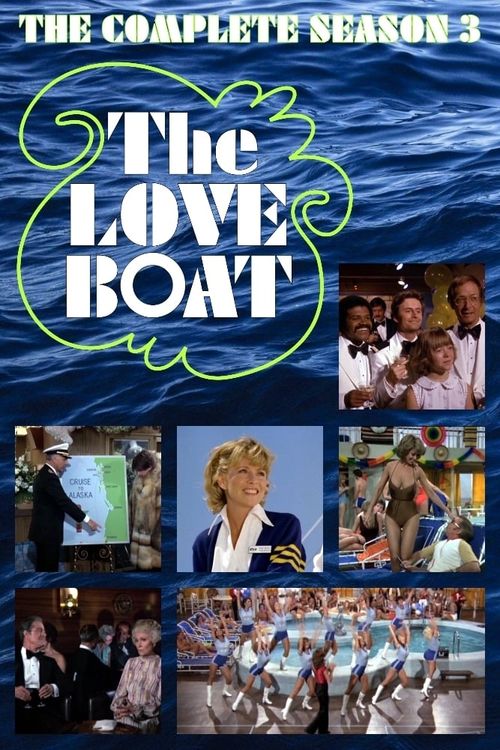
Welcome to Retro Television Reviews, a feature where we review some of our favorite and least favorite shows of the past! On Wednesdays, I will be reviewing the original Love Boat, which aired on ABC from 1977 to 1986! The series can be streamed on Paramount Plus!
Come aboard! They’re expecting you!
Episode 3.14 “The Stimulation of Stephanie/Life Begins at 40/The Next Step”
(Dir by Allen Baron, originally aired on December 1st, 1979)
After being unexplainably absent last week, Vicki returns this week and is once again somehow a member of the Love Boat crew, despite only being 12. Nobody asks where she was last week and certainly, no one asks her how she’s doing in school. In fact, not only the crew but also the passengers seem to be totally accepting of the idea of a 12 year-old working as the assistant to the cruise director. I guess the 70s were a different time.
If I seem to be harping on the strangeness of Vicki living on the boat, that’s because this week’s episode really isn’t that interesting. This week’s episode is a fairly bland one. It’s so bland that it really leaves you with no choice but wonder about the logistics of how the boat works. And really, that’s something that should never happen when you’re watching a show like The Love Boat. If you’re worrying about real-life questions while watching a show like this, it means that you’re watching an episode that just isn’t working. The Love Boat, like Fantasy Island, should be an escape from reality and not an excuse to wonder about how it all works.
As usual, we’ve got three storylines to deal with. Jo Anne Worley plays Dottie Anderson, who is 39 years old and still unmarried. She’s booked herself in the honeymoon suite because she is determined that she is going to meet a man and get married over the course of the cruise. Julie assures Dottie that there’s nothing wrong with being single when you’re 4o, which is easy for Julie to say because someone asks her to get married during almost every cruise. Anyway, Dottie flirts with a lot of men and ultimately, she comes to realize that Julie was right. She embraces being single and leaves the boat happy. Yay! This storyline didn’t add up too much but at least Jo Anne Worley knew how to deliver a joke.
Meanwhile, pro football player Virgil Plummer (Roosevelt Grier) is upset because he’s about to retire from the game that he loves and he doesn’t know what the future holds for him. With the help of his wife (Melba Moore) and Isaac, Virgil realizing that he can pursue a career as a cook. Personally, I’m not sure why he wouldn’t just retire and live off the millions he made as a football player. Or maybe he could become a coach or one of those “fight for every inch” motivational speakers. Grier and Moore had a likable chemistry (even if it did feel more like a close friend chemistry as opposed to a married chemistry) but again, this storyline just didn’t add up too much.
Finally, sex research Norman Bridges (Dick Martin) and his assistant, Stephanie Champman (Char Fontane) board the boat. Bridges wants to research the roots of sexual simulation. Stephanie is in love with Bridges, though you have to wonder why because he’s kind of a boring jerk. Still, when Norman thinks that Doc Bricker is trying to seduce Stephanie, Norman goes down to Bricker’s cabin and punches him. Unfortunately, Norman wasn’t wearing his glasses and didn’t initially realize that the woman in Doc’s cabin was not Stephanie but was instead a passenger named Lena (Judy Landers). Eventually, Norman does figure out that Stephanie loves him and they leave the boat together. Somehow, Norman got away with assaulting the ship’s doctor. This storyline was just dumb. No one in their right mind would fall in love with someone as clueless and self-absorbed as Norman.
This was a less-than-satisfactory cruise. But that’s what happens when you break child labor laws.
The Caine Mutiny Court-Martial is a film that I wanted to like more than I actually did.
The movie, which is based on a play by Herman Wouk (which was itself based on a novel by Wouk that was adapted into an Oscar-nominated film in 1954), takes place in a Naval courtroom. Lt. Steven Maryk (Jake Lacey) is on trial, accused of mutiny against his commanding officer. Maryk claims that, when the ship sailed into a storm, his commanding officer, Philip Francis Queeg (Kiefer Sutherland), was giving orderss that put the entire ship at risk. With the support of the officers, Maryk relieved Queeg of command. Maryk claims that he did so with the knowledge that it would lead to him being court-martialed.
Maryk is assigned Lt. Greenwald (Jason Clarke) as his defense counsel. Greenwald is not happy with his assignment because he think that Maryk is guilty and he believes in the chain of command. When Maryk and his fellow officers claim that Queeg was showing signs of mental instability, Greenwald wonders how they came to that conclusion. Whereas Maryk and his fellow officers, including Keith (Tom Riley) and Keefer (Lewis Pullman), claim that Queeg was dangerously unstable, Greenwald sees an insecure commander who was abandoned by his men. Greenwald comes to realize that keeping Maryk out of the brig will mean destroying Queeg on the stand.
As I said, I wanted to like this film more than I actually did. The Caine Mutiny Court-Martial was the final film to be directed by William Friedkin. Friedkin started his career by directing adaptations of plays like The Birthday Party and The Boys In The Band, so another theatrical adaptation does feel like an appropriate bookend for a legendary career. Friedkin’s best films featured troubled and somewhat obsessive individuals, people who are almost addicted to taking risks. That’s certainly an accurate description of several of the characters in The Caine Mutiny Court-Martial, from Queeg to Keefer to even Greenwald himself. After Friedkin passed away in August, I found myself really hoping that The Caine Mutiny Court-Martial would be one final brilliant Friedkin film.
There’s a lot of good things to be said about The Caine Mutiny Court-Martial, including the fact that Jason Clarke is well-cast as Lt. Greenwald. But, in the end, The Caine Mutiny Court-Martial is essentially a filmed play and, despite a camera that moves frequently, it all feels rather stagey and, at a time, a bit too theatrical. As good as Clarke is, some other members of the cast can’t break free of the film’s staginess and their performances often feel disappointingly superficial. This is especially true of Monica Raymund as the prosecutor and, surprisingly, Kiefer Sutherland as Queeg. Sutherland, who, when he was younger, would have been the ideal pick for the role of Lt. Keefer, gives an overly mannered performance as Queeg, one that is all tics and nerves but with little of the vulnerability that Humphrey Bogart brought to the role in the 1954 film.
Friedkin’s The Caine Mutiny Court-Martial takes place in 2022, as opposed to the World War II setting of Wouk’s original novel. This does lead to an interesting subtext, as Friedkin’s version of the story is set during a time when many people are no longer confident in America’s military leadership. (Wouk’s novel and play came out while America was still feeling confident after the victory of the Allies in World War II.) Friedkin takes a direct approach to the material, allowing the audience to decide for themselves whether Maryk did the right thing.
It’s a solid enough film but one that never quite escapes its stage origins. Friedkin’s respect for the material comes through, even if the film isn’t totally successful.
The 2021 film, 2025 — The World Enslaved By A Virus, opens with a series of title cards.
We learn that the Coronavirus has raged out of control.
We learn that fear of the virus led to the creation of a one world government.
We learn that “communism is everywhere.”
We also learn that English is now the official language of the world. (Yay! Take that, French!)
Finally, we learn that Christianity has been outlawed.
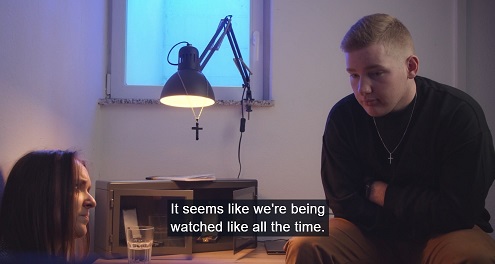
It’s a scary world, one in which everyone is enslaved by the fear of the virus. It’s a world where free thought is no longer allowed. It’s a world where everyone is expected to pledge allegiance to the “new Constitution.” It’s a world where former friends rat each other out to the authorities and privacy is a thing of the past.
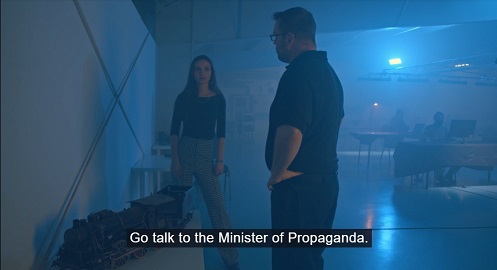
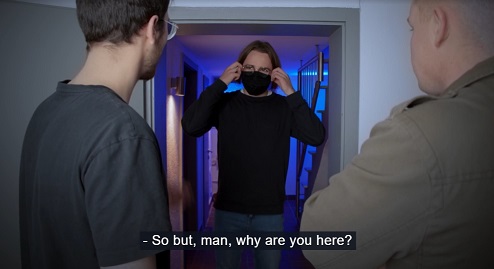
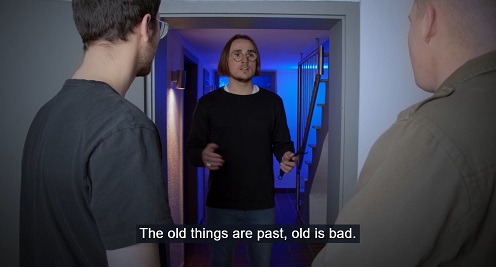
As you can probably guess from screenshot above, 2025 is not a particularly expensive-looking film. This is the end of the world on a budget and one gets the feeling that the majority of that budget went to filming a fairly decent shoot out and car chase that occurs towards the end of the film. As a result, this is one of those films where our characters spend a lot of time sitting in their apartment and talking about what’s going on in the world and how they feel about it. We hear about what happens but we rarely get to see it. Watching the film, one gets the feeling that many of the conversations were improvised, which means that there’s a lot of awkward pauses and meandering sentences. On the one hand, that doesn’t make for a particularly compelling narrative. On the other hand, it does capture the feelings of isolation and ennui that haunted many people during the Coronavirus lockdowns.
The film follows a group of Christians as they try to fight back against the one world government. It starts with them spray painting Jesus fish onto walls and sidewalks. (One of the sidewalks that they use as a canvas is covered by leaves so you can’t help but feel that one strong gust wind is going to totally destroy all of their work.) Eventually, a hacker shows up at their apartment and helps them get their message out. Christians start to meet in secret and our main character (played by one of the film’s two directors, Joshua Wesley) gives a variation of Mel Gibson’s Braveheart speech.
While the Christians are doing that, the government is plotting how to get more people to swear allegiance to the “New Constitution.” Again, since this is the end of the world on a budget, the government is represented by one small office and a handful men wearing tactical vests. They’re not extremely intimidating but, just as with the film’s sense of isolation, their incompetence tends to mirror the incompetence of the actual authorities during the lockdowns.
Eventually, even the Christians’s wussy neighbor is showing up at their door and telling them that they need to stop what they’re doing before they make everyone’s life difficult. They need to accept the new world order.
2025 is indeed a bad movie. The pace is slow. The acting is terrible. The dialogue is risible. The film has been developing a reputation for being one of the worst ever made and there’s certainly a case to be made. That said, much like Plan 9 From Outer Space, 2025 has worth as a historical document. Setting aside the religious aspect of 2025,the film does definitely capture the paranoia that people were feeling during the lockdowns. Some people were paranoid about the virus and other were paranoid about the government but the important thing is that, in the end, everyone was paranoid. With all the gaslighting that’s going on from people who desperately want us to believe that the lockdowns actually weren’t as big or traumatic a thing as we all know they were, a film like 2025 serves as a useful historical document. It’s a recording of the way many people felt about the world just two years ago.
Of course, that doesn’t actually make it a good film. You can’t have everything.




 Through the Shattered Lens