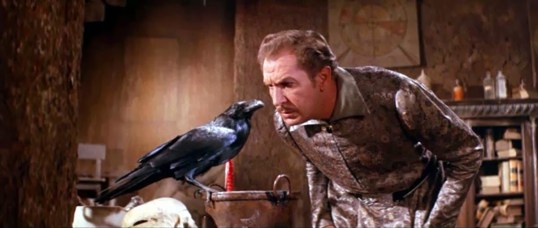
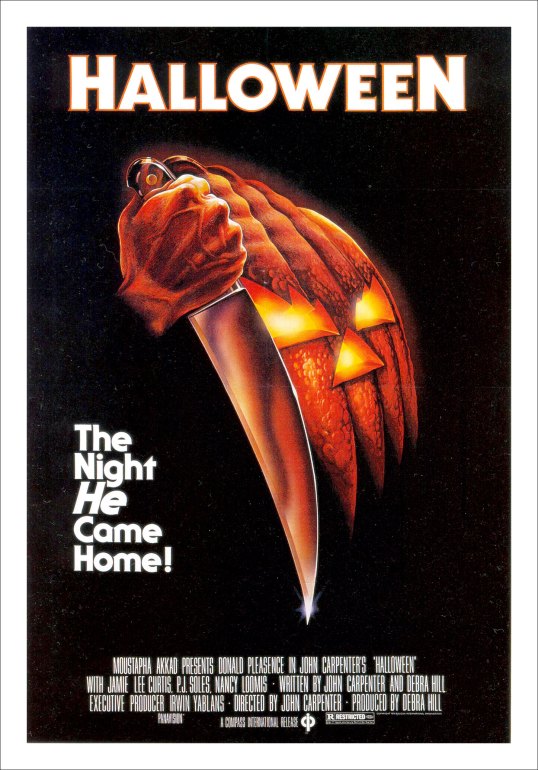
Halloween’s coming to an end. Actually, here in America, it’s come to an end everywhere except on the west coast. What better way to bring our annual Horrorthon to a close than spending a few minutes with Vincent Price and the Raven?
Unfortunately, I don’t know exactly when this was filmed. But no matter! It’s Vincent Price reading Edgar Allen Poe!
On this, the final day of our annual Horrorthon, we offer you a final Horror on TV entry.
In this episode of Highway to Heaven, angel Jonathan Smith (Michael Landon) tries to defeat the devil for the soul of his friend Mark (Victor French). This episode, a true Halloween episode, originally aired on October 30th, 1985, and it features guest turns from Anthony Zerbe and the great Michael Berryman.
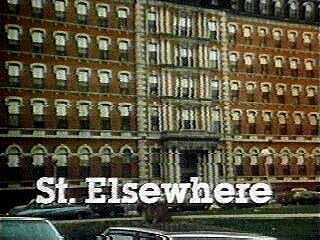
Welcome to Retro Television Reviews, a feature where we review some of our favorite and least favorite shows of the past! On Fridays, I will be reviewing St. Elsewhere, a medical show which ran on NBC from 1982 to 1988. The show can be found on Hulu and, for purchase, on Prime!
This week, season two comes to an end.
Episode 2.22 “Hello, Goodbye”
(Dir by Linda Day, originally aired on May 16th, 1984)
Due to St. Eligius being structurally unsound, the first floor is temporarily closed. The ER, which was the busiest part of the hospital, is no longer operative and Shirley Daniels is assigned to redirect any and all ambulances to Boston General. As Joan explains it, either the first or the third floor had to be closed so that a team of engineers could strengthen the building. The third floor is surgery, where all the money is made. And so, it’s the ER that closes. Joan, meanwhile, is designated as the scapegoat for all of the recent problems at St. Eligius. She loses her job with the mayor’s office.
Fresh from interviewing a nervous Dr. Elliott Axelrod (Stephen Furst) for a position as a resident, Dr. Auschlander collapses. Dr. Westphall fears that his old friend is going to die but finally, Auschlander wakes up and says that he’s not done fighting yet. Neither is St. Eligius.
Luther finds a stuffed Cheshire cat for a young heart patient. Dr. Craig finally starts to forgive his drug addict son, Stephen (Scott Paulin). And Dr. Morrison takes his son on a walking tour of Boston and meets a college student named Clancy (a young Helen Hunt). Even though Clancy label Morrison a “boomer,” she still spends the night with him. Morrison finally takes off his wedding ring and appears ready to try to move on with his life.
The second season ends on a melancholy note. Apparently, the show’s producers weren’t sure whether or not St. Elsewhere was going to be renewed for a third season and this episode was designed to work as both a season and a series finale. Very few of the regular characters appear and the episode is dominated by Westphall and Morrison, both of whom tend to be rather somber. In other words, this is a depressing episode but it’s not an episode without hope. Auschlander does wake up. Morrison does pursue a tentative relationship with Clancy. Even with the hospital temporarily shut down, life goes on. Unlike Wendy Armstrong, nobody gives up. It’s sad but at least there’s a chance that things could get better.
Both this episode and the second season overall were a roller coaster, deftly mixing drama and comedy and giving the show’s ensemble cast a chance to shine. Next week, we start season three!
With Halloween approaching, the Shattered Lens presents to you a recording of the 2015 West End production of The Rocky Horror Show, featuring Richard O’Brien, Emma Bunton, Stephen Fry, Anthony Head, Ben Forster, Haley Flaherty, and David Bedella.
The film is so popular that I think some people tend to overlook Rocky Horror‘s theatrical origins. Personally, I prefer this energetic stage version to the film.
It feels strange to actually watch The Rocky Horror Picture Show without an audience.
I say this because the film is actually far better known for its fans than anything else. First released in 1975 to middling reviews and, at first, anemic box office returns, The Rocky Horror Picture Show went on to become the first great cult film. It’s literally been playing in theaters for 25 years, which has to be some sort of record. When one sees Rocky Horror Picture Show in a theater, one does not merely sit back and watch in a state of suspended animation. Instead, most of the audience becomes a part of the show. They yell, they dance, and many of them return night-after-night. I have been to two midnight showings of the Rocky Horror Picture Show and I have to admit that it was actually pretty intimidating both times. The people in the audience — the veterans who knew every line and knew exactly what to do — were, more or less, friendly. I’ve read some online horror stories about people who felt like they weren’t welcome the first time they attended a showing. I had the opposite experience. No one was rude, no one glared. It was definitely a cliquey group but I felt as if they had earned the right to be in their clique. No one seemed to be bothered by the fact that I was mostly there just to observe. (I should also mention that neither showing that I attended demanded that the first-time watchers stand up or go to the front of the theater or anything like that. Apparently, there’s quite a few people online who got upset over being singled-out as “virgins” and never got over it.) But it was intimidating in much the same way as meeting a friend of a friend is intimidating or exploring a new town is intimidating. I was surrounded by people who had a deep connection with each other, one that had been forged by sharing the same experience for years. It was a communal experience that was actually touching to see, even if I never stopped feeling like an outsider.
It’s interesting to compare the midnight showings of The Rocky Horror Picture Show to the midnight showings of The Room. I attended several midnight showings of The Room and I have to admit that I eventually soured on them as it became clear that many people were showing up to taunt the film as opposed to enjoying it for the odd, communal experience that it was. The last few The Room showings that I attended were filled with a hostility that left me feeling a bit uncomfortable. Whereas The Room’s cult has often felt a bit mean-spirited (as if everyone had gathered together to laugh at Tommy Wiseau for thinking he could make a movie), The Rocky Horror Picture Show‘s cult is based on a genuine love for the film.
As for the film itself, I watched it last month without an audience and I judged it solely as a film. The pacing is a bit off and, without the group experience, it’s a lot easier to notice that the film’s storyline doesn’t make a bit of sense, though that was undoubtedly deliberate on the part of the filmmakers. That said, Tim Curry’s performance still gives the film a jolt of energy, recapturing your attention and holding it until the film comes to a close. (The genius of Curry’s performance as that, as flamboyant as it is, he still plays Dr. Frank-n-Furter as being an actual characters with feelings and emotions. He doesn’t just coast on attitude. One need only compare him to Laverne Cox in the 2016 TV production to see how strong Curry’s performance is.) Susan Sarandon brings some depth to her performance as Janet and, if Barry Bostwick is a little on the dull side of Brad …. well, the heroes who appeared in the film that Rocky Horror sends up were rarely that exciting. I enjoyed the snarky humor of Richard O’Brien’s performance and the energy that Meat Loaf brought to the production. Charles Gray, in the role of the Criminologist, really doesn’t get enough credit for holding the film’s disparate parts together.
In the end, when viewed as a film as opposed to a communal experience, The Rocky Horror Picture Show is undoubtedly flawed but it’s still energetic enough to work. The love for the old sic-fi films comes through and Tim Curry’s uninhibited performance works with or without an audience. The Rocky Horror Picture Show is a film that brings people together and I hope it continues to do so.
Johnny was perfectly happy being dead until some obnoxious college friends decided to take a camping trip and came across a locket hanging off of a fire tower. The locket was what kept Johnny’s soul at rest. When one of the group decided to take the locket so that he could give it to his girlfriend, Johnny came back to life.
Already haunted by the tragic memories of his life and how a bunch of bullies murdered him by tricking him into falling off of the tower, Johnny is determined to retrieve the locket. Slowly and methodically, he walks through the wilderness, killing everyone that he encounters as he searches for the one thing that will….
Well, it’s a slasher movie! You know how these things go!
Released in 2024 and directed by Chris Nash, In A Violent Nature‘s plot may be typical slasher stuff but the way the story is told makes the film unique. Nash tells the story almost totally from the point of view of the undead Johnny. The camera follows Johnny as he makes his way through the woods and what we learn about him and his motivations largely comes from the snippets of conversations that we hear from people in the distance. Johnny’s victims largely appear in the distance, having typical slasher film conversations but we only hear them in passing, like fragments from a half-remembered dream or movie. We’re learning with Johnny.
As such, this is the rare slasher movie that requires that one actually pay attention to what is being said. It’s also a rare slasher movie that requires a good deal of patience on the part of the viewers. Johnny moves slowly and so does the movie. Though the kills are certainly bloody and there are plenty of genuinely frightening moments, the film is ultimately more about the sight of hulking, single-minded Johnny walking through the woods and through fields of brilliantly green grass than anything else. If Terence Malick made a slasher movie, it would look a lot like In A Violent Nature. Would Terence Malick have included the yoga kill? Perhaps. I think he would have included a voice-over though about nature, though. (Speaking of the yoga kill, it’s notable that this non-traditional slasher movie features one of the bloodiest killings of the genre, as if the director wanted to make sure that we understood he didn’t consider his film to be too good for the genre. I appreciated that.)
A film like this is great if you’re a fan of both Malick and horror, as I am. If you prefer your slasher films to be a bit less self-consciously esoteric in their approach, you might wonder what all of the hype was about. In A Violent Nature is one of those films that the viewer will either love or the viewer will give up on after several minutes of watching Johnny staring out at the lake. It’s an experimental film and, like all experimental films, it’s not for everyone. That said, if you have the patience for it, it’s an engrossing and off-beat slasher flick.
For the record, you can count me amongst those who thinks that Ben got everyone killed. We root for Ben because he’s the more likable character but, in the end, Harry was right and Ben ended up becoming a cold-blooded murderer. These are the type of things that make Night of the Living Dead the scariest zombie film ever made. The living are just as terrifying as the dead.
I should also note that, for all the criticism the character gets, Barbara has one of the most totally realistic reactions that I’ve ever seen in a horror movie. She’s in shock and denial. I would probably have the same reaction.
And now, here is the greatest zombie film ever made!
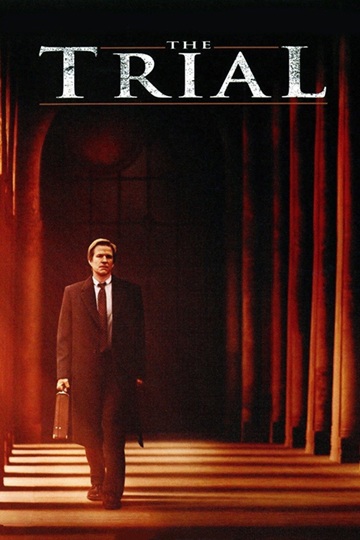
Mac is a Southern lawyer, even though it’s been a while since he practiced. After his wife and children were killed in a car accident, Mac decided to retire from practicing law but he never surrendered his license. A judge (Rance Howard) reaches out to him, asking him to serve as a public defender for Pete Thomason (Randy Wayne), a young man who has been accused of murdering his girlfriend. The evidence is stacked against Pete and there are plenty of wealthy people who, for various reasons, want Pete to quickly be convicted. Mac takes the case because he can tell that Pete is being railroaded. When he discovers that Pete will possibly be facing the death penalty if he’s convicted, the case becomes very personal for Mac.
The prosecuting attorney (Bob Gunton) has managed to find a doctor (Brett Rice) who is willing to testify that Pete is a sociopath. (The doctor has a reputation for finding just about anyone on trial to be a sociopath.) Mac finds a doctor of his own, Dr. Anne Wilkes (Clare Carey), his testifies that Pete is nowhere near being a sociopath. The problem is that Pete has no memory of what happened the night of the murder. Mac may believe that Pete is innocent but can he convince the jury when the evidence all seems to suggest otherwise?
Like The List, The Trial was based on a novel by Robert Whitlow and it was directed by Gary Wheeler. I was pretty hard on The List in last night’s review but I actually rather enjoyed The Trial, which was a solid and well-made legal thriller. (The film’s status as a faith-based film largely comes from a scene in which Mac quotes the Book of Provers in regards to how, during a trial, it’s easy to believe the first person who speaks but it’s equally important to listen to how the accused replies.) I enjoyed the twists and turns of the plot and the film’s ending worked well. Though the film had a a made-for-television feel to it (despite having been a theatrical release), it still held and rewarded my interest.
It helped that the cast was well-selected and everyone gave good performances. Matthew Modine, in particular, gave a strong performance as Mac, playing him not as being a saint but instead as being someone who was just determined to give his client the defense he deserved and to ultimately do the right thing. Robert Forster played Mac’s brother-in-law and lead investigator and he brought his own brand of world-weary determination to the part. Nobody plays a smug prosecutor as well as Bob Gunton, though it should be noted that the character himself never became a caricature. Rance Howard was the ideal judge, tough but fair. Randy Wayne was sympathetic as the confused Pete. The cast really brought the film’s world to life.
I always enjoy a good legal thriller and The Trial was certainly that.
Welcome to Late Night Retro Television Reviews, a feature where we review some of our favorite and least favorite shows of the past! On Thursdays, I will be reviewing Highway to Heaven, which aired on NBC from 1984 to 1989. The entire show is currently streaming on Tubi and several other services!
This week, Mark is a disappointed again.
Episode 4.20 “Aloha”
(Dir by Michael Landon, originally aired on March 2nd, 1988)
Jonathan gets Mark all excited by saying that their next assignment is a Hawaiian mission. Mark says, “We’re going to Hawaii!” He’s looking forward to it and who can blame him? After a countless number of assignments that found him working in crummy jobs and depressing neighborhoods, Mark thinks that he’s going to be most beautiful place on Earth.
Nope, sorry, Mark. You’re going to a rundown apartment complex called the Hawaiian Sands. The complex is managed by Aulani (Mokihana), a singer who found fame in Hawaii but not in Los Angeles. Instead, in L.A., she was hit by a truck and left in a wheelchair. Now, she spends her days bitter, constantly yelling at her handyman and former partner, Alvin (Danny Ing). Alvin loves Aulani and Aulani loves Alvin but she’s too angry and scared of opening up emotionally to admit it. When Alvin learns that he doesn’t have much longer to live, he plans to return to Hawaii. Aulani refuses to admit that she cares. Luckily, her new tenant Jonathan is there to set her straight.
As I’ve often said, the main strength of this show was its nonstop earnestness. Even at its most sentimental, it still worked because the show was just so dang sincere. That’s ultimately the case here. Danny Ing gives a very touching performance as Alvin. Your heart breaks for him. Mokihana overacts in the role Aulani, to the extent that she actually becomes pretty annoying. But, despite that, the show itself was so sincere and well-intentioned that it was impossible not be touched by the end of this episode.
Add to that, Hawaii — there’s no place more beautiful to visit. I wonder what Halloween is like in Hawaii. Maybe I’ll find out next year!

 Through the Shattered Lens