For today’s music video of the day, we have the latest from Texas’s own Selena Gomez!
Enjoy!
For today’s music video of the day, we have the latest from Texas’s own Selena Gomez!
Enjoy!
Welcome to Late Night Retro Television Reviews, a feature where we review some of our favorite and least favorite shows of the past! On Mondays, I will be reviewing CHiPs, which ran on NBC from 1977 to 1983. The entire show is currently streaming on Freevee!

This week, the key words on the highway of California are “team work!”
Episode 1.16 “Vintage ’54”
(Dir by Barry Crane, originally aired on January 26th, 1978)
It’s a three-day weekend and that means the California Highway Patrol even more mayhem to deal with than usual!
For instance, two car thieves are driving up and down the highway, searching for classic cars. One stolen car belongs to 85 year-old Margaret Downey (Marjorie Bennett), who proceeds to go down to the station and personally demand that Sgt. Getraer find her car. The thieves are eventually caught, thanks to the entire Highway Patrol working as a team and keeping an eye out for stolen cars. The emphasis here was on teamwork, which Ponch and Baker just doing their part as opposed to be singled out.
It’s also teamwork that reunites a baby with the family that accidentally left her behind at a rest stop. Ponch and Baker are the ones who take the baby to the station and they’re the ones who nickname the baby “Princess” and buy her toys but, in the end, it’s the entire Highway Patrol working together that eventually brings the baby back to her grateful parents.
Baker and Ponch do get a moment in the spotlight when a skydiver ends up getting tangled up and hanging from a highway overpass. Baker is the one who grabs hold of her legs to keep her from falling while Ponch is the one who recruits a crane to help rescue her. But again, Baker and Ponch are not working alone. Instead, there are other motorists who help out, some by holding onto Baker and another by allowing Ponch to use his crane.
My point is that this episode was all about people working together to make the world a better and a safer place. That’s not a bad message and the show delivers it with a good deal of sincerity. With the exception of the scenery-chewing Marjorie Bennett, everyone is on their best behavior with this episode, with even Erik Estrada toning down his usual overacting. And, of course, there’s two exciting motorcycle chases, both of which are very well-filmed. There was nothing particularly amazing about this episode. It was pretty much a typical hour of CHiPs but it was still very well-done.
Next week, Ponch and Baker have an important lesson to teach about hitchhiking!
Welcome to Retro Television Reviews, a feature where we review some of our favorite and least favorite shows of the past! On Mondays, I will be reviewing Miami Vice, which ran on NBC from 1984 to 1989. The entire show is currently streaming on Tubi!

This week, we learn the cost of working Vice.
Episode 2.4 “Out Where The Buses Don’t Run”
(Dir by Jim Johnston, originally aired on October 18th, 1985)
This is it. This is the episode that is regularly cited as being one of the best, if not the best, episodes that Miami Vice ever aired. Out Where The Buses Don’t Run takes a look at the psychological costs of spending one’s life obsessing on crime and justice. What starts out as a comedy turns into the bleakest episode of the show so far.
Things get off to a great start, with Crockett and Tubbs pursuing a drug dealer on the beach. While The Who’s Baba O’Riley plays on the soundtrack, the dealer roller skates down a sidewalk and a preacher (played by Little Richard) sends his young congregation out to collect money. As Crockett and Tubbs wait for their chance to arrest the dealer, someone watches them from a nearby window and takes pictures. Crockett asks Tubbs if he ever gets the feeling that he’s being watched.
The man taking the pictures turns out to be Hank Weldon (Bruce McGill), a former Vice cop who quit the force six years prior when a case that he had spent three years making fell apart and a drug lord was set free on a technicality. The drug lord vanished after the case against him was thrown out and it’s assumed that he was murdered by his associates. Hank, however, insists that the drug lord is still alive and he’s returned to Miami. He wants Crockett and Tubbs to help him finally catch the criminal that evaded him all those years before.
A quick check with Weldon’s former partner, Marty Lang (David Strathairn), reveals that Weldon left the force after he had a nervous breakdown and he’s spent the past few years in a mental facility. The loud and flamboyant Weldon is obviously still unstable but Crockett and Tubbs cannot shake the feeling that he might know what he’s talking about.
And, as is revealed at this end of this episode, they’re right …. kind of. Weldon does know where the missing drug lord is. The drug lord is walled up in an abandoned building. He’s been there since 1979. At the end of episode, with Tubbs, Crockett, Castillo, and Lang watching, Weldon tears down the wall and reveals the decayed skeleton of the drug lord. Weldon announces that he murdered him and walled him up. Lang then reveals that he helped.
“He was my partner,” Lang says, “Understand?”
Crockett understands and the audience understands as well. When Weldon’s obsession drove him crazy, Lang was the only one to whom he could turn. And Lang, being his partner, was the only one who understood how he felt. Lang may have been a cop but his number one loyalty was to his partner, just as Crockett’s number one loyalty will always be to Tubbs.
As played by Bruce McGill, Hank Weldon goes from being a cheerful eccentric to a bitter and paranoid lunatic to, finally, a man who can no longer stand to hide what he’s done. It’s an excellent performance that keeps the audience guessing. He may be a murderer and he’s obviously still unstable but your heart can’t help but break for him. The combination of Jim Johnston’s moody direction, a perfect collection of songs on the soundtrack, and the performances of Bruce McGill and David Strathairn really do come together to make this an excellent episode. In the end, it’s hard not to feel that Crockett and Tubbs are both one step away from becoming Weldon and Lang themselves.
Welcome to Late Night Retro Television Reviews, a feature where we review some of our favorite and least favorite shows of the past! On Sunday, I will be reviewing the Canadian series, Degrassi Junior High, which aired on CBC and PBS from 1987 to 1989! The series can be streamed on YouTube!

Sorry, I fell asleep last night before I could write up this week’s episode of Degrassi Junior High! Belatedly, here’s some thoughts on the episode to focus on the Farrell Twins.
Episode 2.8 “Sealed With A Kiss”
(Dir by Kit Hood, originally aired on February 22nd, 1988)
After spending much of the first two seasons of Degrassi Junior High in the background, the Farrell Twins — Heather and Erica — are at the center of this episode.
Heather (Maureen Deiseach) is the responsible twin who has never had a date and thinks that French kissing sounds gross. Erica (Angela Deiseach) is the twin who is older by about six minutes and who wants to date and have fun. Heather and Erica have always been close but, as this episode begins, they’re both a little annoyed with the other. That’s not just a twin thing, it’s a sibling thing and, as the youngest of four sisters, I could relate. My sisters and I have always been very close but, growing up, I think all of us always fought to establish our own individual identities outside of just being one of four Bowman girls. I specifically refused to try out for cheerleading in high school because two of my sisters had been cheerleaders and I wanted to find my own thing to do. Considering my long history of klutziness, that was probably for the best. Anyway….
When Degrassi holds a dance with another school, Erica meets Aaron (David Stratton). Aaron is kind of a dork (i.e., he’s in high school but he comes to a junior high dance) but he wears a leather jacket and drives his dad’s car. Heather is scandalized when she and Alexa comes across Erica making out with Aaron on a stairwell. Erica’s happiness over having a boyfriend is short-lived, as she soon comes down with a fever and a sore throat and fears that Aaron has given her mono.
(“At least he didn’t give you AIDS,” Alexa cheerfully says.)
While a miserable Erica rests in bed, Aaron stops by the Farrell house to see her. When Heather explains that Erica is sick, Aaron decides that one twin is as good as another and invites Heather to take a ride in his Dad’s car. Heather agrees and she ends up making out with Aaron as well. Oh no! MONO!
Well, don’t worry. It turns out that Erica just needs to have her tonsils taken out. No one has mono. She and Heather both agree that Aaron was a dork. Heather says that at least there’s a difference between them now. One has tonsils and the other doesn’t. Uhmm …. okay, Heather.
The Farrell Twins have never been my favorite characters on Degrassi Junior High. Erica is shallow and Heather is judgmental. That said, their showcase episode was not a bad one. Along with being able to relate to the sibling dynamic, I could also relate to Erica and Heather competing for the attention of a guy who, quite frankly, wasn’t worthy of either of them. And I had to laugh at Alexa’s cheerful vapidness as she managed to see the positive in everything that the twins were getting upset about. Even the show’s final twist was kind of a nice relief from Degrassi’s usually bleak view of teenage life. For once, no one was seriously ill. No one had an STD. No one was left sobbing as the end credits rolled. Instead, the show ended with a dumb joke about tonsils. It was a nice change-of-pace.
Next week …. Stephanie is suicidal!

In this 2023 film, teenage golf champion Emily (Evangeline Griffin) transfers from one private Christian academy to another. At her new school, the golf coach, Coach Kelly (Jenn Cooke), tells her two best players, Madison (Amelia Still) and Hannah (Ashley Brant), to befriend Emily and gauge whether or not she plans on continuing to play golf in high school.
When they approach Emily in the school’s cafeteria, they are shocked when Emily says that she’s a pretty good golf player and she plans to be state champion again. They are scandalized when Emily mentions that she broke all of Coach Kelly’s old records at her previous school. They are stunned when Emily suggests that she’s a better golfer than Coach Kelly ever was.
“Are you a Christian?” Madison asks.
Yes, this is another one of those films. This is another Dave Christiano-directed film in which high school athletics (in this case, golf) are used as a metaphor for faith. Emily may say she’s a Christian but first she’s going to have to learn that being a Christian means always doing what your coach tells you to do (even if that means hitting with a seven when you’d rather use your nine) and, of course, being a humble winner and a gracious loser. As Coach Kelly explains it, Emily could be the best player in the world but God might have plans for her that don’t include winning the state championship. To me, that’s an odd way to look at things. I mean, if God is the one who is deciding who is going to win the tournament, why waste all that time with practicing your swing and learning how to putt? It takes Emily a while to listen to Coach Kelly so we end up with a lot of scenes of Madison and Hannah sucking up to the coach while Emily rolls her eyes in the background. One wonders if Christiano realized that Madison and Hannah are both the type of people who everyone hated in school, the snitches who followed the rules and called out anyone who didn’t. Emily may be arrogant but at least she seems like she gets some sort of enjoyment out of winning. At least she acts like a human being as opposed to a Sim, waiting to be told what to do.
Meanwhile, Madison is freaking out over whether or not she’ll be able to afford to attend Zion College. She has applied for all of the scholarships and she’s been working part-time and saving her money and her father is willing to contribute a little as well but Madison is still short $5,000. Madison suggests that she could take out a student loan but her mother says, “No, your father doesn’t want you borrowing any money.”
On the one hand, that’s good advice.
On the other hand, Madison’s the one who is paying for most of her tuition so shouldn’t she be the one to decide whether or not to apply for a student loan? I mean, Madison is going to be a legal adult by the time she starts college. And it’s not like Dad is helping out all that much so who cares what he thinks? Still, Madison’s mother tells her that it might just be God’s plan for Madison to go to a community college. And again, with all due respect, you have to wonder if we’re supposed to take comfort in the idea of a God who micromanages ever aspect of our lives.
Finally, Hannah learns that a friend is pregnant and thinking about getting an abortion. Hannah tells her friend that she can’t get an abortion because the Bible says, “Do unto others.” As Hannah explains it, how would her friend feel if she had been aborted? Her friend takes Hannah’s words to heart and tells her father that she’s pregnant. This leads to a montage of her father yelling at her but we don’t hear what he’s saying because a very mid Christian rock is playing over the soundtrack. Everything works out in the end, of course. Speaking as someone who has never been comfortable with the extremes of either side of the abortion debate , this whole scene really irked me, as it was very heavy-handed and poorly written. It’s easy to win an argument when the other side isn’t allowed to present its case. Just because pro-abortion writers tend to caricature pro-life arguments, that still doesn’t make it any less strident when pro-life writers do the same thing to the other side.
In the end, everything works out. Emily learns to be humble. Madison goes to college. Hannah is hopefully prepared to babysit. The film ends with one golfer getting disqualified for making a technical mistake, just for Emily to beg that the rules be suspended so that the other golfer can get the trophy she’s earned. Amazingly, the rules are suspended which really isn’t the way rules are supposed to work. Apparently, the message is that God’s rules cannot be broken but UIL’s rules are fair game.

First aired on television in 1970, The Brotherhood of the Bell tells the story of Andrew Patterson (Glenn Ford).
Andrew Patterson is a widely respected economics professor. He is an influential academic, one who has a nice house, a beautiful wife (Rosemary Forsyth), and a father-in-law (Maurice Evans) who owns a very successful business. Patterson is also a member the Brotherhood of the Bell, a secret society made up of successful men who all graduated from the prestigious College of St. George in San Francisco. Patterson has been a member of the society for 22 years and he’s never really taken it that seriously. He thinks of it as just being a collection of influential men who enjoy getting together and discussing their vision for the world.
That all changes when the man who brought Andrew to the Society, Chad Harmon (Dean Jagger), gives Andrew an assignment. The Society wants him to deliver an envelope to his friend, Dr. Konstantin Horvathy (Eduard Franz). Horvathy is up for a deanship that another member of the Society desires for himself. Inside the envelope is damaging information that the Society has gathered about the people who helped Horvathy defect to the United States, information that will be made public unless Horvathy withdraws as a candidate. Reluctantly, Andrew shows Horvathy the envelope. Horvathy responds by committing suicide.
Stricken with guilt, Andrew decides to expose the existence of the Society but he discovers that won’t be easy. Almost overnight, Andrew’s perfect life starts to collapse. He loses his job. The IRS launches an investigation of his father (Will Geer). As Chad explains it, the Society is responsible for everything that Andrew has and, therefore, the Society can take everything away. When Andrew goes public, he’s dismissed as just being paranoid and soon, Andrew truly is paranoid. With his marriage in ruins, Andrew goes on a talk show and can only watch helplessly as his claims are dismissed by the host (William Conrad) and as the audience argues about whether or not the Society is a white plot, a communist plot, a Jewish plot, a Catholic plot, or a government plot. Even the people who believe Andrew are too busy fighting amongst themselves to provide any help for him or to stand up to the unified power of the Brotherhood. The host repeatedly rings a bell during the show, the better to mock everyone’s fears. The film makes a good point. Crazed theorists are often a conspiracy’s best friend.
An intelligently written and well-acted film, The Brotherhood of the Bell‘s main strength is the direction of Paul Wendkos. The lighting gets darker and the camera angles become increasingly more skewed as Andrew’s paranoia grows. In fact, Wendkos does such a good job of visualizing Andrew’s deteriorating mental state that it’s easy to wonder if maybe everyone is right and all of this really is just happening in Andrew’s head. Though the film ends on a slightly triumphant note, it’s hard not to feel that it’s a temporary victory at best. The Brotherhood of the Bell (which I imagine was based on Yales’s Skull and Crossbones) will always be there.
14 Days of Paranoia:
Welcome to Retro Television Reviews, a feature where we review some of our favorite and least favorite shows of the past! On Sundays, I will be reviewing the made-for-television movies that used to be a primetime mainstay. Today’s film is 1972’s The Judge and Jake Wyler! It can be viewed on YouTube.
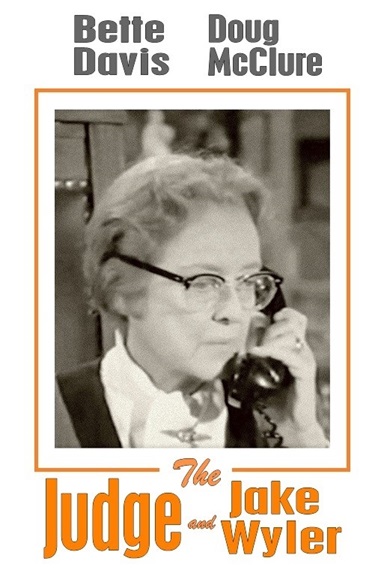
Judge Meredith (Bette Davis) is a retired criminal court judge who has developed a severe case of hypochondria. She lives in a mansion that she never leaves. Anyone who comes to see her must be personally vacuumed by her butler before they can be allowed to stand in her presence. She hates people who take too long to get to the point and she also has little use for people who are rude on the phone. She especially dislikes cigarettes and refuses to have even an unlit one in her presence.
Jake Wyler (Doug McClure) is an ex-con who is currently on supervised probation. Despite his criminal past, he’s a likable and amiable guy and, every morning, he wakes up with a new woman in his bed. Jake enjoys tweaking authority and he always has a pack of cigarettes on him somewhere.
Together, they solve crimes!
They actually do! The judge is dealing with retirement by running her own detective agency, one that is exclusively staffed by people that she previously sentenced to prison. Jake does most of the leg work as far as the agency is concerned. The Judge calls him every morning and demands to know why he’s not working harder. Jake would rather just sleep-in but working for the judge is a part of his parole. She could easily send him and everyone else working for her back to prison. This sounds like a pretty unfair situation to me and the Judge is so demanding that I think it could be argued that she’s an abusive boss. But, because this is a pilot for a TV show and the Judge is played by Bette Davis, everyone is very loyal to her.
At the start of the film, Jake reveals to Robert Dodd (Kent Smith) that his wife, Caroline (Lisabeth Hush), has been cheating on him with Frank Morrison (Gary Conway). When Robert is later found dead in a hospital room, the official verdict is that he committed suicide. However, his daughter, Alicia (Joan Van Ark), claims that her father was murdered. At first, both Jake and the Judge suspect that Alicia just wants to collect a bigger life insurance settlement but it turns out that Dodd’s beneficiary wasn’t even Alicia. The money is going to his second wife, the one who was cheating on him. While the Judge yells at people on the phone, Jake investigates the death of Robert Dodd.
The Judge and Jake Wyler is a mix of comedy and mystery. Jake has a way with a quip and the majority of the suspects, including John Randolph and Eric Braeden, all have their own eccentricities. Director David Lowell Rich does a good job of keeping the action moving and the mystery itself is actually pretty interesting. Surprisingly, the show’s only real flaw is Bette Davis, who seems to be rather bored in the role of Judge Meredith. Even though the character seems to have been specifically written for her trademark caustic line delivery, Davis delivers her lines with little enthusiasm. One gets the feeling that she wasn’t particularly happy about the idea of having to do a television pilot.
Davis need not have worried. The Judge and Jake Wyler did not turn into a series. That said, the movie is an entertaining and diverting murder mystery.
Welcome to Late Night Retro Television Reviews, a feature where we review some of our favorite and least favorite shows of the past! On Saturdays, I will be reviewing the Canadian sitcom, Check it Out, which ran in syndication from 1985 to 1988. The entire show is currently streaming on Tubi!

This week, Cobb’s descends into chaos!
Episode 1.19 “My Darling Serpentine”
(Dir by John Bell, originally aired on February 19th, 1986)
Last week, Edna left Howard after an argument and Howard had an affair with her replacement. It was implied that Edna leaving Howard was a frequent occurrence and that Howard was the least romantic man alive.
This episode, Edna and Howard are once again totally in love and Howard is so romantic that Edna can even brag about all of the presents that he’s given her over the years.
Continuity, what is it?
This year, Howard is busy at the store so he makes the mistake of sending Alf the security guard out to pick up a piece of jewelry for Edna. Alf, however, gets distracted while walking by a pet store and instead, he returns to the store with a hamster. Edna freaks out about the idea of owning a rodent and instead, she gives it to Murray. The hamster then escapes into the store, which isn’t good since there’s a health inspector in the neighborhood.
Meanwhile, it’s prom night for Murray and he needs a date. Not surprisingly, he asks supercool Marlene to be his date. Also not surprisingly, Marlene laughs in his face. However, after thinking about how she never got to go to her prom because she dropped out of school, Marlene changes her mind. Murray is super-excited until Christian and Alf suggest that Marlene is going to take his virginity. When Marlene shows up in the break room in her prom dress and a blue wig, Murray freaks out.
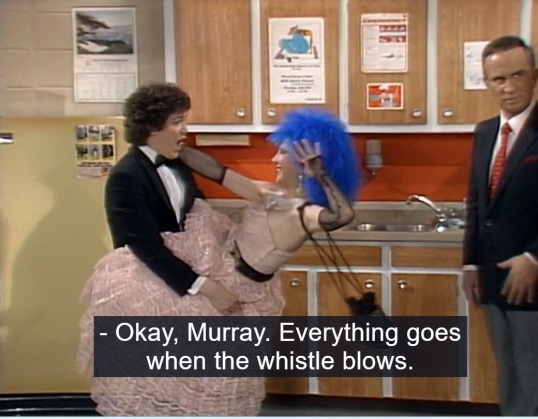
Murray runs away and disappears into the store. Now, everyone not only has to look for the hamster but also for Murray.
This episode is a bit frantic but it made me laugh. A lot of that was because Gordon Clapp made his third appearance on the show, playing the cheerfully dumb Viker. Previously, Viker was the store’s electrician. In this episode, he’s suddenly a pest control expert. In order to track down the hamster, he released a snake into the store. In order to track down the snake, he releases a mongoose. “I’m glad I don’t shop here,” Viker says. Gordon Clapp delivers all of Viker’s lines with such sincerity that his brief appearance elevates the entire episode.
In the end, thinks work out. The snake is caught when it attacks Howard. Marlene forgives Murray and they head off to prom. The hamster runs off with Marlene’s blue wig. And Edna is surprisingly forgiving about Howard telling the security guard to buy her an anniversary present. As for the mongoose …. well, I’m sure it found a good place to live. The important thing is that this episode made me laugh more than the typical episode of Check It Out! I enjoyed it.
Greetings from Lake Texoma! It’s been a relaxing week and exactly what I needed. Here’s some thoughts on what I watched out on the deck.
Abbott Elementary (Wednesday Night, ABC)
“Janine smokes weed every day!”
Finally! After being slightly disappointed with the previous episodes of Abbott Elementary, this week’s episode was definitely a return to form! Whether it was all of the teachers talking about their drugs of choice or the hilarious FADE assembly, this episode epitomized everything that makes this show special. And while Janine smoking weed every day may seem a bit unexpected, it makes sense when you consider that she dated Tariq for ten years.
American Idol (Sunday Night, ABC)
Whenever American Idol starts a new season, I always find myself saying, “Is that show still on?” Seriously, it’s been a while since American Idol was a huge part of the cultural landscape and it’s been even longer since the show introduced America to genuine talents like Kelly Clarkson and Carrie Underwood.
This season got off to an odd start, with Ryan Seacrest saying that the previous winner had put his home state of Hawaii on the map. No, Ryan — I’m pretty sure people knew about Hawaii before American Idol. As I watched the rest of the first audition episode, it occurred to me that, once again, the judges were too concerned about their own image to really offer up any sort of constructive feedback. That’s one reason why a show like this needs someone who is willing to be brutally honest and who has nothing to lose by being the show’s “villain.” Simon Cowell was a brilliant judge because he could always just hop on a plane and head back to the UK if his criticism ever turned America against him. Katy Perry, Luke Bryan, and Lionel Richie, on the other hand, all have brands that are based on being likable and not destroying people’s dreams.
Everyone who auditioned had a tragic backstory and they all did that thing were they oversold the emotion of whatever they were singing. It was kind of boring, to be honest. It’s been a long time since the show has produced a true American idol.
Bubblegum Crisis (Night Flight Plus)
Jeff and I watched an episode of this anime on Saturday morning. I have no idea what was going on in the episode but a lot of stuff blew up.
Dr. Phil (YouTube)
On Thursday night, Jeff and I watched an episode in which a woman named Lynsey accused her ex of abusing their daughter. That Lynsey was lying was pretty obvious from the start. Eventually, Lynsey got angry and stormed off stage. She came back out a bit later and accused Dr. Phil of turning her story into a “circus.” Usually, I’m totally in favor of people giving Dr. Phil a hard time but, in this case, Lynsey really was the worst.
Lauren Lake’s Paternity Court (YouTube)
He was the father! Yay! I had an episode of this playing in the background on Friday morning while I was in the process of waking up.
Law & Order (Thursday Night, NBC)
After playing the role for almost as long as I’ve been alive, Sam Waterston played Jack McCoy for the last time this week. McCoy resigned as District Attorney in order to protect his subordinates from the political fall-out of prosecuting a friend of the Mayor’s. I would have liked to have seen McCoy retire on his own terms, as opposed to being forced out. Quitting in the face of political pressure felt out of character for Jack McCoy. And the fact that he resigned to protect Price and Maroun, neither one of whom really feels worthy of the sacrifice, only adds insult to injury.
I find it interesting that almost every episode of Law & Order seems to feature a wealthy murderer. Do poor people not commit crimes in New York City?
Maury (YouTube)
“You are the father!” “You are not the father!” “You’re going to be in this baby’s life, right?” “Oh, you know it, Maury!” I watched way too much Maury on Friday and I will never forgive myself.
Night Flight (Night Flight Plus)
On Friday night, Jeff and I watched a profile of Ozzy Osbourne and Black Sabbath.
The Vanishing Shadow (Night Flight Plus)
On Friday night, Jeff and I watched another episode of this 1930s serial. Our heroes spent the entire episode fleeing gangsters.
Watched and Reviewed Elsewhere:
On July 18th, 1969, while American astronauts were preparing to land on and then take their first steps on the Moon, a 28 year-old woman named Mary Jo Kopechne attended a party on Chappaquiddick Island in Massachusetts.
A former aide to Robert Kennedy who was reportedly devastated by his assassination, Mary Jo was one of several former campaign workers who gathered at an isolated cabin that night. According to the others at the party, Mary Jo (who was described as being a devout Catholic who rarely drank) was one of the first people to leave the party. She left with another guest. The next morning, that guest’s car was found overturned in Poucha Pond. Dead in the backseat was Mary Jo Kopechne, who had suffocated as the car slowly filled up with water. It was later determined that she had been alive and trapped in the car for hours before dying. The owner of the car was back at his hotel. He had returned there after crashing his car and, while he had taken a shower and combed his hair and called his father, he had not bothered to call the police.
Normally, a driver in this situation would be in serious legal jeopardy. Along with having left the scene of the accident, he also left Mary Jo to die. It was generally agreed that if he had called the police within an hour of the accident occurring, Mary Jo could have been saved. However, because he was Ted Kennedy and the last remaining of the fabled Kennedy brothers and a man who many expected would someday be president, he was given a slap on the wrist and the death of Mary Jo would be forever described as being a “Kennedy tragedy” as opposed to a Kopechne tragedy.
Not surprisingly, there has been a lot of speculation about what had happened in the moments leading up to the crash. Like his brothers, Ted Kennedy was a notorious and reckless womanizer. Unlike his brothers, Ted also had a reputation for being a heavy drinker. Some went as far as to accuse Ted of deliberately murdering Mary Jo, as if the actions that Ted later admitted to were not, in themselves, already bad enough. While people may disagree on the circumstances that led to the accident, it is generally agreed that, if Ted had been anyone other than a Kennedy, he would have served time in prison. The incident ended Ted’s presidential dreams but it didn’t keep him from being described as being the “lion of the Senate” when he died in 2010. Indeed, when Ted died, many people on twitter expressed their shock as they read or heard about Mary Jo Kopechne for the first time in their lives.
(In 2010, Mary Jo would have been seventy years old.)
Obviously, no one was going to make a movie about Mary Jo Kopechne’s death while Ted was still living. Indeed, even after Ted died, it still took seven more years for the story to be turned into a film and producer Byron Allen struggled to even book the film in theaters. 2017’s Chappaquiddick stars Jason Clarke as Ted and, briefly, Kate Mara as Mary Jo. The film speculates as to what happened that night and it probably gets fairly close to the truth. The accident is an accident, a result of Ted freaking out when a cop stops him for speeding and sees him with a woman who isn’t his wife. Ted, who is portrayed as being an immature manchild, turns to his handlers and then his family for help. His fails to call the authorities because, to Ted, there is no greater authority than his abusive father (Bruce Dern).
For the most part, Ted passively sits by as associates of his late brothers — including Ted Sorenson (Taylor Nichols, giving the film’s strongest performance), Joe Gargan (Ed Helms), and Paul Markham (Jim Gaffigan) — take over his defense and carefully craft his every response. Ted’s attempts to provide input are shot down and it’s made clear that his job is to shut up and concentrate on returning the Kennedys to the White House. The film’s best scenes feature Sorenson growing frustrated at all of Ted’s mistakes. Very little concern is shown for the fact that Mary Jo Kopechne, a Kennedy true believer, is dead due to Ted’s recklessness. When she was alive, Mary Jo was held up as a symbol of the Kennedy youth. When she died, she was just viewed as being an obstacle to keeping the Kennedys from reaching the power to which they felt entitled.
As you can probably guess, Ted Kennedy does not come off particularly well in this film. At his best, he’s a wimp who is struggling with a legacy of which he knows he’s not worthy. At his worst, he is pathologically self-absorbed and incapable of feeling empathy for the woman he left to drown in the backseat of his car. Both he and Mary Jo and ultimately the voters who are expected to reelect him even after he leaves Mary Jo to die are ultimately portrayed as just being pawns of the shadowy men who lurk behind the scenes of every political operation.
It’s not a happy film and it certainly has its flaws but it provides an important service, reminding viewers that death of Mary Jo Kopchene was more than just as a “Kennedy tragedy.”

14 Days of Paranoia:
 Through the Shattered Lens