Film Review: Underground (dir by Vincent Sherman)


1941’s Underground tells the story of two brothers on opposite sides in Nazi Germany.

Kurt Franken (Jeffrey Lynn) is a patriotic German who believes that the country got a raw deal at the end of World War I and who is a strong supporter of the Nazis.  He served in the army, fighting on the front.  When he returns home to Berlin, he’s missing an arm.  Whenever his friends and his family say that they’re sorry that he lost his arm, he replies that he was happy to make the sacrifice for his country.  When someone starts to mourn for his son who was killed in the fighting, Kurt accuses the man of being a traitor for doubting the wisdom of the government.  Kurt is a true believer, just the type to be recruited by the SS and tasked with helping to investigate who is behind a series of anti-Nazi radio broadcasts.  Kurt believes that, if the government says it, it must be right.  Laws must be obeyed and orders followed without question.  Kurt, in other words, is a very familiar type.

What Kurt doesn’t realize is that the man behind the broadcasts is his own brother, Eric (Phillip Dorn).  As Kurt investigates, he falls in love with Sylvia (Kaaren Verne) without realizing that she is also a part of the resistance.  While Kurt tries to discover who is behind the underground radio station, Eric and his fellow resistance members attempt to stay one step ahead of the Gestapo.

For a film made in 1941, the film’s doesn’t flinch from showing the brutality of the Gestapo.  Like all authoritarian dictatorships, The Third Reich is determined to quash any and all signs of dissent and they investigate the underground radio station with a ruthlessness that even takes Kurt by surprise.  Witnessing first hand the brutality and sadism of the government for which he gave his arm, Kurt starts to doubt his previous beliefs.  But will Kurt’s doubts come in time to save the lives of Eric and his fellow resistance members?

Made at a time when the United States was still officially neutral in the violent conflict that was sweeping the rest of the world and released just a few months before the U.S. officially declared war on the Axis Powers, Underground is a powerful look at life under a dictatorship.  Shot in a noir style, the film’s black-and-white imagery perfectly captures the harshness of life in Germany while the shadows in the background perfectly capture the paranoia of knowing that saying the wrong word could lead to arrest, torture, and death.  The film’s final minutes involve a guillotine sitting ominously in the background, a reminder that Nazi Germany was not the first authoritarian regime and that it would not be the last.

The film is well-acted, with Jeffrey Lynn epitomizing the otherwise intelligent people who allow themselves to get caught up in the madness of the majority.  His discovery of the truth about Germany was obviously meant to mirror the awakening of the Americans who previously supported a policy of neutrality.  By the end of the film, both Karl Franken and the audience understand that the time for neutrality has passed.


Retro Television Review: The Hunted Lady (dir by Richard Lang)


Welcome to Retro Television Reviews, a feature where we review some of our favorite and least favorite shows of the past!  On Sundays, I will be reviewing the made-for-television movies that used to be a primetime mainstay.  Today’s film is 1977’s The Hunted Lady!  It  can be viewed on YouTube.

Detective Susan Reilly (Donna Mills) reluctantly teams up with a chauvinistic cop named Sgt. Arizzio (Alan Feinstein) to investigate a United States senator who has presidential ambitions.  Arizzio believes that the senator is being back by the Mafia and that it would be disastrous for the country if a mob-connected politician ended up in the White House.  (Being mob-connected didn’t seem to hurt John F. Kennedy but still….)

Now, Detective Reilly and Sgt. Arizzio working together to take down a corrupt senator sounds like an intriguing premise for a movie, right?  Well, oddly enough, that’s not what this movie is actually about.  Instead, it’s about Susan going on the run after she’s framed for Arizzio’s murder.  She escapes from police custody with the help of her father.  Though she’s still recovering from being shot earlier in the film, Susan makes her way to Reno and attempts to hide out from both the cops and the Mafia assassin that has been sent to kill her.

Susan hiding out in Reno.  Hmmm …. sound like an intriguing premise for a movie, right?  Well, don’t get to attached to Susan pretending to be a professional gambler because it turns out that bullet wound was more serious than she realized and she ends up passing out from blood loss.  When she awakens, she’s in a free clinic that is run by Dr. Arthur Sills (Robert Reed).  Dr. Sills doesn’t ask Susan too many questions about her past and even hires Susan on as a nurse.  Susan and Dr. Sills fall in love and try to clear the name of a Native American who has been accused of blowing stuff up.

Doing some research, I was not surprised to discover that The Hunted Lady was originally developed as a possible television show.  The show would have played out like a combination of Charlie’s Angels and The Fugitive, with Susan moving from town to town and getting involved with a new set of guest stars each week.  With both the police and the mob trying to track her down, Susan would try to clear her name while also helping out strangers.  Unfortunately, The Hunted Lady wasn’t exactly a hit in the ratings and Susan’s further adventures went untold.

The main problem with The Hunted Lady is an obvious one.  The idea of the Mafia trying to install one of their guys in the White House is considerably more intriguing that Susan falling in love with Dr. Sills while working at a free clinic.  The whole time that Susan was helping the doctor’s patients, I was thinking, “But what about the senator?”  Donna Mills was surprisingly convincing as a tough cop but she had next to no chemistry with Robert Reed.  If anything, Reed looked annoyed at just having to be there.

Anyway, here’s hoping that Susan cleared her name eventually.  You can only run for so long.

Scenes That I Love: Harry’s Nightmare from The Conversation


1974 was a very good year for Francis Ford Coppola.  Not only did he direct the Oscar-winning Godfather Part II but he also directed another film that was nominated for Best Picture, an intense study of paranoia called The Conversation

Today’s scene that I love comes from The Conversation.  Surveillance expert Harry Caul (Gene Hackman, giving one of his best performances) fears that his work may lead to murder.  In this scene, he has a nightmare in which he tries, in vain, to talk to one of the people who he has been surveilling.  This scene perfectly captures the horrific logic and helpless feeling of a nightmare.  Harry, who is not the most open or emotional of men, can only be his true self in his dreams.

Late Night Retro Television Review: Check it Out! 2.1 “Getting To Know You”


Welcome to Late Night Retro Television Reviews, a feature where we review some of our favorite and least favorite shows of the past!  On Saturdays, I will be reviewing the Canadian sitcom, Check it Out, which ran in syndication from 1985 to 1988.  The entire show is currently streaming on Tubi!

Today, we start a new season of Check It Out!

Episode 2.1 “Getting to Know You”

(Dir by Alan Erlich, originally aired on October 3rd, 1986)

The second season of Check It Out! opens with some changes at Cobb’s Grocery store.

Howard now has a mustache.  Tonya Williams and Henry Beckman are no longer listed in the opening credits so I guess Jennifer and Alf have moved on from working at the store.  Gordon Clapp, however, is now listed in the opening credits so Viker, who was one of more consistently funny characters during the first season, is now a series regular.

The episode opens with zero customers in the store.  Due to a broken waterline, the store’s parking lot has been taken over by a bunch of construction workers.  Howard calls them “apes.”  Marlene is sick of them hitting on her whenever she comes to work.  Christian thinks he could take them on.  And Mrs. Cobb is demanding that Howard lay off two employees to help offset costs.

Howard could always point out that, with Jennifer and Alf gone, the store now only has seven employees but he doesn’t.  Instead, he follows Edna’s advice and sits down for one-and-one interviews with his employees and gets to know them.  Howard thinks that he’ll be able to find an employee who doesn’t really need the job but instead, he discovers that all of his employees are wonderful people.  Marlene cries about how difficult her life has been lately.  Murray talks about how both of his parents are out of work.  Leslie volunteers to give up his job and Howard is so touched that there’s no way he can possibly accept Leslie’s offer.  Jack Christian, who is usually pretty self-centered and obnoxious, seems like an easy choice but then he gets beaten up defending Marlene from the construction workers.

Finally, Howard realizes that there’s only one thing he can do.  He lays off Edna and then he lays himself off.  He announces that he and Edna are going on vacation and they’ll be back in four months.  Ummm …. look, I’ll be honest.  I’ve never been through the experience of being fired or laid off so I don’t really fully understand how it all works.  Isn’t Howard kind of taking a risk here?  I mean, I guess Howard is assuming that Christian will just fill in for four months and then Howard and Edna will return and everything will go back to normal.  But what if Mrs. Cobb hires a new manager?  What if she doesn’t want to take back Howard and Edna?  I mean, to me, it sounds like Howard basically just quit his job and forced Edna to quit her’s as well.  But everyone in the store seems to be convinced that Howard will be back in just a few months.

I guess my point is that Check it Out! doesn’t seem like it was always 100% realistic.

Anyway, this episode was okay.  It reintroduced all the characters and gave us a chance to get reacquainted with them, as any season premiere should.  Gordon Clapp, Jeff Pustil, and Kathleen Laskey all had moments that made me smile.  Those three have the ability to make even the simplest of lines funny.  During the first season, Don Adams could occasionally be a bit overly frantic as Howard.  For the second season premiere, though, his performance felt a bit toned down and it no longer felt as if he and the show were begging for laughs.  Still, I just can’t get over that ending.  Edna was so excited that her boyfriend essentially put her future employment at risk.

Next week, we’ll see if Howard still has a job.

Lisa Marie’s Week In Television: 3/31/24 — 4/6/24


Here’s a few thoughts on what I watched this week.  (Most of this week was taken up with movies as opposed to television.)

Dirty Pair Flash (YouTube)

Yuri and Kei tried to capture a notorious con artist but instead ended up getting stranded in the middle of the wilderness with him.  This is the first episode of Dirty Pair Flash where I’ve actually been able to follow the plot and I have to admit it was pretty amusing.  I relate to Yuri.  We have a similar attitude towards life and I appreciated her efforts to stay positive.

Dr. Phil (YouTube)

Dr. Phil talked to a cheating husband and the wife who got revenge by having an affair of her own.  Phil seemed fairly annoyed with both of them and I really can’t blame him.

Geraldo (YouTube)

In an episode from the late 80s, Geraldo Rivera talked to teenagers on death row, all of whom claimed to be former Satanists.  I didn’t believe a word of it.  One of the teens that Geraldo talked to ended up going to Oklahoma’s gas chambers ten years later so I guess the whole Satanism scam didn’t work for him.  Myself, I’m just wondering how long Geraldo Rivera has been around.

It’s Always Sunny In Philadelphia (Hulu)

Heh heh, the bowling episode.  Dee finally knocked over a pin, just to discover that everyone had already left to go find something better to do.  I laughed.

Law & Order (Thursday Night, NBC)

This week, via Peacock, I got caught up on the last three episodes of Law & Order.  They were, as is typical of this show, uneven. The first episode that I watched dealt with a shooting at a hospital and it was well-done.  The second episode was yet another one about a murdered millionaire and a dominatrix and it was enjoyably trashy.  The third episode was a take on the death of Jordan Neely and it felt a bit like Leftist fanfic, straight down to portraying the Daniel Penny stand-in as being a secret white supremacist.

I continue to enjoy Reid Scott’s performance as the newest cop.  Tony Goldwyn has now taken over as District Attorney and I guess he’ll be okay, though it’s going to be difficult to replace Sam Waterston.  Neither Price nor Maroun seem like they were worth Jack resigning to protect.

Night Court (Peacock)

I finished up Night Court’s second season this week.  I’m not really sure why I felt the need to watch the remaining episodes, because I laughed even less while watching the second season than I did while watching the first season.  I think the main problem with this show is that there’s really no room for the characters to develop.  Abby will always have to be impossibly naive or the show will have to totally change direction.  Dan will always have to be a cynic or the show won’t work.  The supporting characters all have to be one-dimensional or the show will be thrown off-balance.  It’s just not a very good show, despite the best efforts of Melissa Rauch and John Larroquette.

Watched and reviewed elsewhere:

  1. Baywatch Nights
  2. Beane’s of Boston
  3. Check it Out — The review will be dropping in about 90 minutes
  4. CHiPs
  5. Degrassi Junior High — The review will be dropping tomorrow
  6. Fantasy Island
  7. Friday the 13th: The Series
  8. Highway to Heaven
  9. The Love Boat
  10. Miami Vice
  11. Monsters
  12. T and T
  13. Welcome Back Kotter

Retro Television Review: Welcome Back, Kotter 3.16 “Sweatwork”


Welcome to Retro Television Reviews, a feature where we review some of our favorite and least favorite shows of the past!  On Saturdays, I will be reviewing Welcome Back Kotter, which ran on ABC  from 1975 to 1979.  The entire show is currently streaming on Tubi!

This week, Arnold Horshack becomes the mad prophet of the air waves.

Episode 3.16 “Sweatwork”

(Dir by Bob Claver, originally aired on December 22nd, 1977)

At the new apartment, Gabe tells Julie about his Uncle Herman.  “He’s a sports mechanic,” Gabe explains, “He fixes basketball games.”

Hey, that’s illegal!

Meanwhile, at the school, Woodman asks to meet with Freddie.  Freddie agrees, even though Woodman has been acting strangely.  Woodman enters the classroom and immediately asks for a high five, holding up his hand and saying, “Right on, bro.  Skin me.”

Woodman is excited because the school board is giving money to every high school to start a radio station.  And the station that gets the highest ratings will receive a trophy.  Buchanan High has never won a trophy before.  Because Freddie has radio experience, Woodman want Freddie to be in charge of Buchanan’s station.  Freddie agrees.

“That’s groovy!” Woodman says.

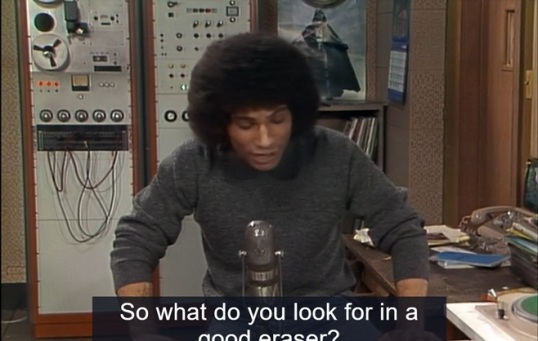
Juan Epstein and Darth Vader at the station

Freddie makes Epstein the consumer repairs reporter while giving Horshack the lead anchor role.  (Vinnie is also said to be a reporter but John Travolta is never actually seen in this episode.)  Unfortunately, Horshack turns out to be ratings poison.

“He reminds me of Tokyo Rose,” Woodman says, while listening to Horshack.  “Bye bye, young G.I.”

Freddie follows Woodman’s orders and fires Horshack but he does agree to allow Horshack one more broadcast to say goodbye.  Grabbing the microphone, Horshack asks his listeners to go to their windows and shout, “I’m fed up, Arnold …. AND I DON’T CARE WHO KNOWS IT!”

Suddenly, Horshack is ratings gold.  He’s the mad prophet of the air waves.  He has fans who hang on his every word.  But when Horshack announces that the teachers should not be given a raise, he is invited to the Kotter apartment.  Gabe tells Horshack that he has meddled in the primal forces of nature and “YOU WILL ATONE!”

Horshack drops his anti-teacher rhetoric and goes back to being a normal, boring broadcaster.  His ratings crash.  Woodman vengefully announces that Horshack will be kept after school.

“This has been the story of Arnold Horshack,” Gabe says, “the only man kept after school for bad ratings.”

The episode ends with Gabe telling Woodman about how his Uncle Simon was buried in a rented tux and his father has to pay $15 a month as a result.  Woodman finds the joke to be hilarious and laughs so much that even Gabe starts to get nervous.

This episode, which you’ve already guessed was a parody of Network, had its moments.  Gabe is barely in this sone but I did enjoy his take on Ned Beatty’s famous monologue.  And any episode that features a lot of Woodman is going to be enjoyable because John Sylvester White was always delightfully unhinged in the role.  In the end, how one reacts to this episode will depend on how much tolerance one has for Ron Pallilo’s performance as Arnold Horshack.  By the time the third season came around, Pallilo’s performance in the role had gone from eccentric to cartoonish and a little of Horshack tended to be a lot.  Personally, I think Epstein should have been this episode’s Howard Beale.  That said, I chuckled quite a bit while watching this episode.  It was certainly better than the radio station episodes of Saved By The Bell.

Next week, Gabe freaks out when the Sweathogs are taught by a computer!  A.I. has been around a lot longer than I thought.

Late Night Retro Television Review: Friday the 13th: The Series 1.24 “Pipe Dreams”


Welcome to Late Night Retro Television Reviews, a new feature where we review some of our favorite and least favorite shows of the past! On Fridays, I will be reviewing Friday the 13th: The Series, a show which ran in syndication from 1987 to 1990. The show can be found on YouTube!

This week, Ryan discovers that Uncle Louis’s latest victim is his own father!

Episode 1.24 “Pipe Dreams”

(Dir by Zale Dalen, originally aired on July 11th, 1988)

Ryan has been invited to the wedding of Connie (Marion Gilsenan) and Ray Dallion (Michael Constantine).  Ray is Ryan’s estranged father.  As Ryan explains it to Micki, this is only the latest of Ray’s many marriages.  Ray has spent his entire life trying to get rich and he often neglected his son while pursuing his dream.  Ray will do anything to get rich.  Ryan feels that there are more important things than money, like tracking down cursed antiques.  Ryan decides to go the wedding but he brings his cousin Micki along with him for moral support.  I mean, considering that Micki has just lost two potential husbands in a row, why wouldn’t she want to attend a wedding?

As the result of inventing a new type of gun, Ray has come into money.  Ryan is horrified that his father would get rich off of weaponry but Ray explains that he was inspired by Uncle Louis.  If Louis could get rich just by running a rinky dink antique store, why can’t Ray get rich from his inventions?  Ryan explains that Uncle Louis got rich by selling cursed antiques and selling his soul to the Devil and now, Ryan and Micki spend all of their time traveling around the country (which is totally Canada, regardless of what the show occasionally claims) and trying to undo Louis’s evil.  Ray doesn’t seem to be particularly surprised by any of this.

Ray has an antique of his own, a pipe that Louis gave to him.  Whenever Ray smokes the pipe, it produces an orange smoke that disintegrates anyone that it surrounds.  You know that gun that Ray invented?  Well, it turns out that he didn’t actually invent it.  Instead, he stole it after using his magic pipe to kill the original inventor.  When Jack shows up for the wedding and informs Ryan of all of this, Ryan cannot believe it.  He may be estranged from his father but Ryan can’t accept that he’s turned evil.  But, as we all know from previous episodes, using the cursed antiques is like getting hooked on drugs.  Once you use it once, you become addicted to using it again and again.

This is yet another episode of Friday the 13th that ends with a freeze frame of someone sobbing.  In this case, it’s Ryan crying.  As easy as it id to poke fun at how often Ryan and Micki end up either sobbing or staring at the camera with a forlorn look on their face, it’s actually a sign of the show’s intelligence that it realizes and acknowledges that dealing with cursed antiques is going to take a mental and emotional toll on someone.  Both Ryan and Micki has lost a lot of people this season.  In this episode, Ryan loses his father and, due to the performances of John D. LeMay and Michael Constantine, it definitely carries an emotional punch.  Like so many of the “villains” on this show, Ray was not inherently evil.  Instead, he was a man who lost his soul due to Louis’s evil deal with the Devil.  The best episodes of Friday the 13th are tragedies and that’s certainly the case with this episode.

Film Review: The Man In The Glass Booth (dir by Arthur Hiller)


Who is Arthur Goldman?

That’s the question at the heart of the 1975 film, The Man In The Glass Booth.

When we first meet Arthur Goldman (Maximilian Schell), he is a wealthy businessman who lives in a Manhattan high-rise and who appears to rarely leave the safety of his penthouse.  He is waited on by two assistants, Jack (Henry Brown) and Charlie (Lawrence Pressman), both of whom he talks to and treats as if they are members of his own family.  His most frequent visitor is his psychiatrist, Dr. Weissburger (Robert H. Harris), who frequently stops by and asks Arthur if he’s been taking his medication.

Arthur Goldman is a man who loves to talk.  Indeed, the first hour of the film feels almost like a nonstop monologue on the part of Goldman, with just occasional interjections from the other characters.  Goldman was born in Germany.  He talks about how, when he was young, he and his family were sent to a concentration camp and it was there that he witnessed the murder of his father by the camp’s sadistic commandant, Dorff.  Dorff is one of the many Nazis who disappeared to South America at the end of the war.

When Goldman spots a car that always seems to be parked across the street from his building, he becomes paranoid.  He says that he’s being watched and even suggests that Dorff has come to capture him.  Instead, it turns out that Mossad come for him.  As the agents explain it to Charlie, dental records prove that Arthur Goldman is actually Commandant Dorff.  Goldman/Dorff is taken back to Israel to stand trial for his crimes.

Are Arthur Goldman and Dorff the same man?  Once in Israel, Goldman tells anyone who will listen that he is Dorff and that he feels no guilt for his actions.  He insists on being allowed to wear his SS uniform during the trial.  Because of threats to his safety, a booth made of bullet-proof glass has been placed in the courtroom.  As the trial commences, The Man in the Glass Booth continues to rant and rave and declare his guilt.  However, the prosecutor (Lois Nettleton) comes to doubt that the man is who he says he is.

The Man In The Glass Booth is based on a novel and play by Robert Shaw.  (The same year that The Man In The Glass Booth was released, Shaw played Quint in Jaws.)  The film was produced as a part of an experiment called American Film Theatre, in which well-known plays would be adapted to film and then would be shown at 500 participating movie theaters in America.  Each production would only be shown four times at each theater and subscriptions were sold for an entire “season” of films.  It sounds like an interesting experiment and the type of thing that I would have enjoyed if I had been around back then.  Today, of course, these productions would have just premiered on a streaming service.

The Man In The Glass Booth is a film that very much feels like a filmed play.  There are only three locations — Goldman’s penthouse, his cell, and the courtroom where he is put on trial.  The three act structure is very easy to spot.  Maximilian Schell’s performance is also very theatrical.  In fact, it’s so theatrical that, for the first hour or so, I found myself wishing that he would just stop talking for a few second or two.  He was so dramatic and so flamboyant and so intentionally over-the-top that he became somewhat exhausting.  But, during the second hour, I came to see that all of that “overacting” was actually setting up the film’s final act.  Schell talks so much that, when he finally does find himself unable to explain himself, it’s a shocking moment and one that perfectly captures not just the evil of the Nazis and the Holocaust but also how the legacy of that evil lives on after the fall of the Third Reich and the deaths of the majority of the Holocaust’s perpetrators.  At that moment, I realized that The Man In The Glass Booth never stopped speaking because silence would force him to confront the horrors of the past and the trauma, guilt, and uncertainty lurking in his subconscious.  Maximilian Schell was nominated for an Oscar for his performance here and, by the end of the film, I totally understood why.

The Man In The Glass Booth requires some patience.  Actually, it requires a lot of patience.  However, those who stick with it will discover an intelligent and thought-provoking film about not only the horror of the past but also how those in the present deal with and rationalize those horrors.  Though the film is a bit too stagey for its own good, it’s also one that sticks with you even after the curtain falls and the end credits roll.

Retro Television Review: T and T 3.3 “Halfway to Nowhere”


Welcome to Retro Television Reviews, a new feature where we review some of our favorite and least favorite shows of the past! On Fridays, I will be reviewing T. and T., a Canadian show which ran in syndication from 1987 to 1990.  The show can be found on Tubi!

This week, Terri and Turner take down the loathsome head of a halfway house.

Episode 3.3 “Halfway to Nowhere”

(Dir by Don McCutcheon, originally aired January 20th, 1990)

Roman (Louis Ferreira) is an angry young man who is on parole and who has been living at a halfway house that is run by Eddy (Danny Pawlick).  When Roman discovers that Eddy has been harassing Roman’s girlfriend, Sissy (Krista Bridges), Roman attacks Eddy.  Eddy kicks Roman out of the halfway house and attempts to have him sent back to prison.

Terri just happens to be in the police station when Roman is brought in and, just like Amy used to do before her mysterious disappearance, Terri declares herself to be Roman’s attorney.  (One gets the feeling that the show’s producers just crossed out Amy’s name on a bunch of scripts and wrote in “Terri.”)  Roman turns out to be a terrible client who refuses to talk to anyone, including the attorney who is trying to keep him out of jail.  Terri finally calls up T.S. Turner and asks him for help.

Turner’s reaction is to growl about how late it is.

Seriously, what’s going on with Turner this season?  He’s in an even worse mood than usual.  Maybe he’s mad because Amy has mysteriously vanished without explanation.  After all, Turner owed Amy.  Amy was the one who got him out of prison.  It made sense that Turner would always be willing to drop everything to help out Amy.  Terri is just some random lawyer who has shown up out of nowhere.

Terri, it should be said, is not a very good lawyer.  At the parole hearing, she puts Eddy on the stand and asks him a bunch of questions, despite not having a clue as to how Eddy is going to respond.  She also dramatically announces that she will be calling Sissy as a witness before she knows whether or not Sissy has agreed to testify.  When Turner steps into the courtroom without Sissy and shakes his head because Sissy refuses to testify, Terri is forced to walk back her words.  I doubt that parole board appreciated that and they probably took their frustration out on Terri’s client.

In the end, Sissy does agree to wear a wire and Eddy stupidly talks about all the crimes that he’s committed as the head of a halfway house.  Eddy ends up getting arrested and Sissy and Roman are reunited briefly.  That said, it appears that Roman is still going to go back to jail because Terri is a terrible attorney.

On the plus side, this episode featured one of the most loathsome villains to ever show up on T&T and it was satisfying to watch Terri and Turner take him down.  On the other hand, it would have been even more satisfying if Terri wasn’t terrible at her job and if Turner didn’t seem to be annoyed by even having to be in her presence.  This episode was a mixed bag but at least it looked like Eddy was going away for a long time.

Late Night Retro Television Review: Highway to Heaven 2.4 “Cindy”


Welcome to Late Night Retro Television Reviews, a feature where we review some of our favorite and least favorite shows of the past!  On Thursdays, I will be reviewing Highway to Heaven, which aired on NBC from 1984 to 1989.  The entire show is currently streaming on Freevee and several other services!

This week, Jonathan and Mark travel to Hollywood …. again.

Episode 2.4 “Cindy”

(Dir by Michael Landon, originally aired on October 23rd, 1985)

Vincent DeGeralimo (Bill Macy) is a fast-talking, good-hearted talent agent who is still trying to sell acts that were out-of-style during Vaudeville.  He wants to get a booking for a lion tamer but Jonathan appears to him and says that Vincent’s main concern should be helping out his daughter.

Cindy DeGeralimo (Hallie Todd) is an aspiring actress who is currently working as a waitress in a diner.  Her evil boss (Alice Ghostley) has three untalented daughters who all want to be actresses as well.  Cindy’s newest coworker, Mark Gordon, just wants to meet a movie star.

Pretending to work in the mailroom of a major Hollywood studio, Jonathan convinces producer Maxim Prince (Kip Gilman) that the best way to find a star for his new picture would be to hold a ball and invite every aspiring actress in town to attend.

Can you see where this is going?  Yep, it’s a remake of Cinderella, except this time Cinderella has a pushy father who keeps trying to change her before she goes to the ball.  Cindy finally gets fed up and says that she wants to be a star but she also doesn’t want to be some sort of Hollywood phony.  Vincent accepts Cindy’s feelings and everything works out in the end.

Usually, I’m pretty lenient when it comes to reviewing this show but this episode just annoyed me.  Even by the standards of Highway to Heaven, it was overly sentimental and heavy-handed.  Bill Macy gave such a frantic performance as Vincent that it was hard to watch him.  As well, Mark was so excited about being in Hollywood that I found myself wondering if he forgot about all the time he spent in Hollywood during the first season.

Indeed, this is not the first episode of Highway to Heaven to feature Jonathan dealing with the entertainment industry and I imagine it won’t be the last.  Considering how much control Michael Landon had over this show, I always get the feeling that the Hollywood episodes were personal for him, especially as they always seemed to deal with parents regretting the fact that they put work ahead of their families.  That said, the portrayal of Hollywood in this episode was so old-fashioned and idealized that I get the feeling that it was Landon’s way of showing what he wished Hollywood was like as opposed to what it actually was.  Landon’s Hollywood is a town where anyone can be a star and anyone can find a happiness.

As for this episode, it was a bit too corny for its own good.  Next week, though, Jonathan battles the Devil for Mark’s soul!  That should be fun.