Late Night Retro Television Review: Friday the 13th: The Series 1.25 “What A Mother Wouldn’t Do”


Welcome to Late Night Retro Television Reviews, a new feature where we review some of our favorite and least favorite shows of the past! On Fridays, I will be reviewing Friday the 13th: The Series, a show which ran in syndication from 1987 to 1990. The show can be found on YouTube!

This week, a crib from the Titanic demands blood!

Episode 1.25 “What A Mother Wouldn’t Do”

(Dir by Neill Fearnley, originally aired July 18th, 1988)

After being told that her unborn child should be aborted because it’s just going to die anyway, Leslie Kent (Lynne Cormack) seeks peace inside an antique shop called Curious Goods.  The shop’s owner, Lewis Vedredi (R.G. Armstrong), shows her an antique crib that he says was on the Titanic.  Leslie is intrigued by the crib and, six months later, she is overjoyed when her friends reveal that they have purchased the crib for her as a gift.  Seriously, who wouldn’t want a crib that was once used by a baby who probably drowned in icy water when the Titanic sank?

The crib does have a special power.  It can cure sick babies!  Of course, the cure only works if the crib’s owner first kills seven people in a body of water.  After baby Allison is born, Leslie and her husband Martin (Michael Countryman) start killing random people in an effort to save their baby’s life.

It presents quite a moral quandary.  If Micki and Ryan don’t retrieve the cursed crib, Leslie and Martin will continue to kill.  However, if they do get the crib, Allison will die.  Are they prepared to sacrifice an innocent baby just to get their hands on the crib?  To its credit, Friday the 13th: The Series didn’t shy away from these questions.  In this episode, the villains are not unsympathetic.  Martin hates to kill but he’s trying to save his baby.  As for Leslie, the episode’s title says it all.  What wouldn’t a mother do to save the life of her baby?  As disturbing as the murders may be, they’re nowhere near as frightening as the cold and clinical way that Leslie is ordered to get an abortion at the start of the episode.

In the end, both Martin and Leslie end up sacrificing themselves to save Allison’s life.  But Allison disappears from her crib, leaving a terrified Micki to wonder if the evil within the crib has taken her.  Fear not.  As the final shot show, her babysitter Debbie (Robyn Stevan), grabbed the now healthy baby from the crib and then got on bus to start a new life.  The baby looks up at her and smiles for the first time.  Awwwww!

This was a good episode, with Micki and Ryan both coming to realize that the owners of the antiques are often as much victims as those they harm.  Chris Wiggins dif good job of portraying Jack’s single-minded determination to find all of Lewis’s cursed antiques while Lynne Cormack and Michael Countryman were poignant as two villains for whom you couldn’t help but feel some sympathy.

Next week, season one comes to an end!

Retro Television Review: T and T 3.4 “Cry Wolf”


Welcome to Retro Television Reviews, a new feature where we review some of our favorite and least favorite shows of the past! On Fridays, I will be reviewing T. and T., a Canadian show which ran in syndication from 1987 to 1990.  The show can be found on Tubi!

This week, someone from the past shows up but it’s not Amy.

Episode 3.4 “Cry Wolf”

(Dir by Alan Simmonds, originally aired on January 26th, 1990)

While filming footage for what is sure to be a riveting cinematic essay on urban decay, high school student Martina (Joanne Vannicola) films a drug deal going to down in an abandoned warehouse.  (The world of T and T was full of abandoned warehouses where people were either selling drugs or hiding stolen money.)  Unfortunately, Martina runs out of film before actually capturing the drugs being exchanged.  Everyone who sees the footage says that it doesn’t prove anything.

Martina decides to take justice into her own hands.  I’m not really sure why.  Martina’s obsession with tracking down the drug dealers and getting them arrested feels somewhat unhinged and it’s a bit disturbing to see coming from a teenager.  I mean, Martina doesn’t know the drug dealers.  She is apparently not a user of cocaine.  She’s just decided that these people deserve to be taken down by her.  One gets the feeling that Martina is going to grow up to be a member of the secret police.

Martina’s investigation leads her to a suburban couple who capture her and make plans to eventually kill her.  Fortunately, Martina’s best friend is Joe Casper (Sean Roberge) and he is able to enlist his mentor, T.S. Turner, to save Martina’s life.

That’s right!  Joe’s back.  He was a semi-regular during the second season, appearing in the opening credits even though he rarely got to do anything on the show.  Still, the return of Joe would, in theory, be the perfect opportunity for the show to explain what happened to Amy.  Amy and Joe were close, after all. It seems like it would be natural for Joe and Turner to say something about missing Amy and perhaps provide us with a clue as to why Amy has been replaced by Terri.

However, that doesn’t happen.  In fact, Turner acts as if he barely knows Joe, despite the fact that he practically adopted him during the second season.  “Why are you kids always here?” he growls when he sees Joe and Martina in Decker’s gym.  And seriously, why is everyone always in Decker’s gym?  The place is a dump!  And is there no one at the gym who could tell T.S. that the hot pink bodysuit that he wears while boxing looks kind of silly?

Anyway, T.S. goes down to the suburbs and saves Martina.  As usual, it doesn’t take much effort because the drug dealers are all kind of wimpy whereas T.S. Turner is Mr. T.  It was only as things ended that I realized that Terri didn’t even appear in this episode.  With Amy gone and Terri not being all the important, T and T is feeling more and more like T.

This episode was pretty dumb but I did appreciate that the drug dealers were essentially just two suburbanites who had no idea what they were doing.  That was a nice twist.  But otherwise …. yeah, pretty dumb.

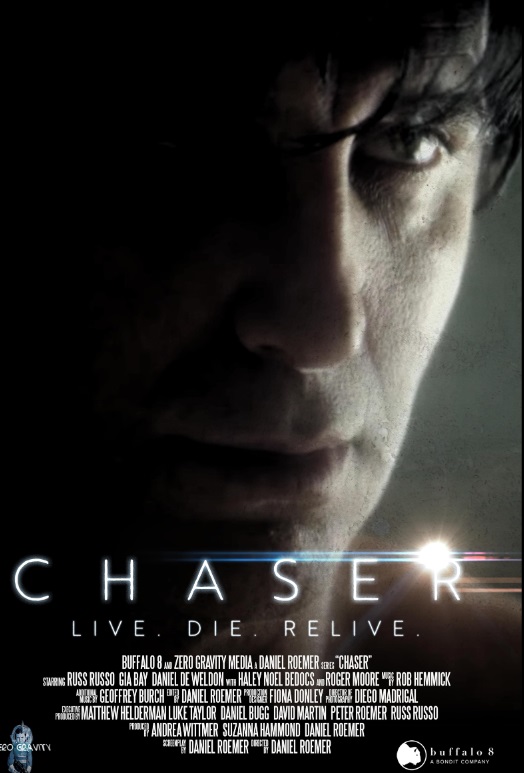
Television Review: Chaser (dir by Daniel Roemer)


Over the course of 8 episodes, Chaser tells the story of Eddi Sebastian (Russ Russo).

Eddi is a film editor, someone who spends almost all of time looking over different takes of different scenes and trying to arrange them into the perfect story.  Eddi is also shy, awkward, and so broke that he’s about to get kicked out of his home.  He has a hopeless crush on B-actress Annabel Ruysch (Gia Bay) and he regularly finds himself being bullied by Annabel’s arrogant (and married) boyfriend, Gar Madden (Daniel de Weldon).

When Eddi’s laptop stops working, his replacement comes with a special bonus.  Eddi can now use the laptop to not only edit the movies but also to edit real life.  As he learns via the mysterious Hal, he can edit anything that happens as long as he does so within a 24-hour period.  Anything that he changes becomes his new reality but the editing must be done with a 24-hour period and the laptop must be connected to the internet.

Considering that he is lonely and broke, it is not surprising that, at first, Eddi uses the laptop to his advantage.  Soon, he is waking up next to Annabel and heading off with her to Ohio in hopes of helping her shoot a film that will get into South by Southwest.  Also in Ohio is Fran Rosemarin (Haley Noel Bedocs), a former actress who beat Annabel out for a role and then, after the film was made, abandoned Hollywood and returned to the anonymity of middle America.  While Eddi continually tries to edit his life and Annabel obsesses on what could have been, Fran seems content to plan her wedding, which is also going to be combined with a football watch party.

However, when Gar shows up in Ohio, Eddi is forced to confront the fact that editing life is not as easy (or as harmless) as he assumed.

Directed by Daniel Roemer, Chaser is an intriguingly ambitious series.  Starting out as a comedy about a nerdy editor who uses his powers to change a bad date into a good one, the series branches out to consider questions of free will, morality, destiny, and even the struggle of Middle America to survive in a changing world.  For all of Eddi’s problems, they’re nothing compared to the old man who is seen standing on the side of the road and holding a sign asking for money.  The more that Eddi edits existence, the more complicated things become.

It’s an interesting question, really.  Would you edit your life if you could?  One of the things that sets movies and television apart from real life is that, while filming, you get multiple takes.  The performers get more than one chance to deliver their lines correctly and, if someone says the wrong thing, the director can yell “cut” and call for another take.  Ideally, the editor uses the best takes.  Sometimes, the editor even combines several different takes, mixing them into something that appears to have been shot all at once as opposed to multiple times.  One could argue that the editor becomes almost God-like in their power to decide what will be seen and what will be left on the cutting room floor.  In the movies, everyone always knows the right thing to say and they always react in the most cinematic way possible.  Every failure can be edited out. That’s one reason why, especially in troubled times, people turn to the movies.  But some would argue that it’s the unexpected and the spontaneous events, the ones that we can’t control, that make life worth living.  In Chaser, Eddi gets to live the dream of every movie lover.  He gets to treat his real life as a film but, as quickly becomes apparent, there’s a difference between editing events and actually living with the end results.

As I said, it’s an intriguing story and it’s one that plays out at a brisk place over 8 episodes.  The visuals are often wonderfully surreal and the cast does a good job of bringing the multi-layered story to life.  One thing I really liked about this show is that no one was mere caricature.  The character of Fran could have easily been one-dimensional but instead, as played by Haley Noel Bedocs, she became one of the most interesting characters on the show.

Chaser is available on Amazon Prime so be sure to check it out.

Late Night Retro Television Review: Highway to Heaven 2.5 “The Devil and Jonathan Smith”


Welcome to Late Night Retro Television Reviews, a feature where we review some of our favorite and least favorite shows of the past!  On Thursdays, I will be reviewing Highway to Heaven, which aired on NBC from 1984 to 1989.  The entire show is currently streaming on Freevee and several other services!

This week …. it’s Halloween!

Episode 2.5 “The Devil and Jonathan Smith”

(Dir by Michael Landon, originally aired on October 30th, 1985)

It’s Halloween and Mark Gordon has got himself in some trouble.

Left alone while Jonathan helps a guy learn that gambling is never a good idea, Mark accidentally runs over a kid.  The child is taken to the hospital in critical condition.  Though Mark is told that the accident was not his fault, he still feels guilty and remarks to one doctor (Anthony Zerbe) that he would even give up his own soul for the child to get better.  And wouldn’t you know yet — suddenly, the child gets better!

It turns out that the doctor wasn’t a doctor at all.  He was Jabez Stone, a bookstore owner who works for the Devil (played, with two horns on his head, by Michael Berryman).  Jabez explains that unless Mark holds up his end of the bargain, the child will die.  He gives Mark a contract to sign, stating that he will give his soul to the Devil at the end of Halloween.  Without Jonathan around to advise him, Mark signs the contract.

When Jonathan does finally return from his mission, he’s not happy to hear about what Mark has done.  Jonathan explains that he can’t just order Jabez to destroy the contract.  Instead, he’s going to have to somehow convince Jabez to give him the contract.  In short, Jonathan is going to have to pull a con job.  Since he’s an angel, Jonathan is not allowed to lie or steal.  But there is a con artist named CJ Barabbas (Conrad Janis) who might be willing to help.

Or, CJ might be planning on tricking Jonathan into surrendering his own soul to Devil!  As CJ tells Jabez, he would be willing to do anything to make sure he got a cushy office job if he should happen to end up in Hell.  Is CJ planning on betraying Jonathan or is it just another part of the con?

Well, you can guess the answer.  We’re only in the second season of a five-season show and, if Jonathan lost his soul, that would make the rest of the series kind of awkward.  There’s never any doubt that CJ is playing a long con on Jabez and the Devil and it’s actually pretty easy to guess just how exactly he’s going to pull it off.  This isn’t The Sting.  It’s Highway to Heaven.

That said, this was a fun episode.  Michael Berryman and Anthony Zerbe both seemed to be having a ball playing such cartoonishly evil characters and Conrad Janis was actually rather charming in the role of CJ Barabbas.  Season 2 has gotten off to an uneven start but this episode was both humorous and, in its way, kind of touching.  Landon and French were close friends in real life and that friendship comes through as Jonathan tries to keep Mark from spending an eternity in Hell.

Next week, Jonathan teaches a bunch of factory workers a lesson about pollution!

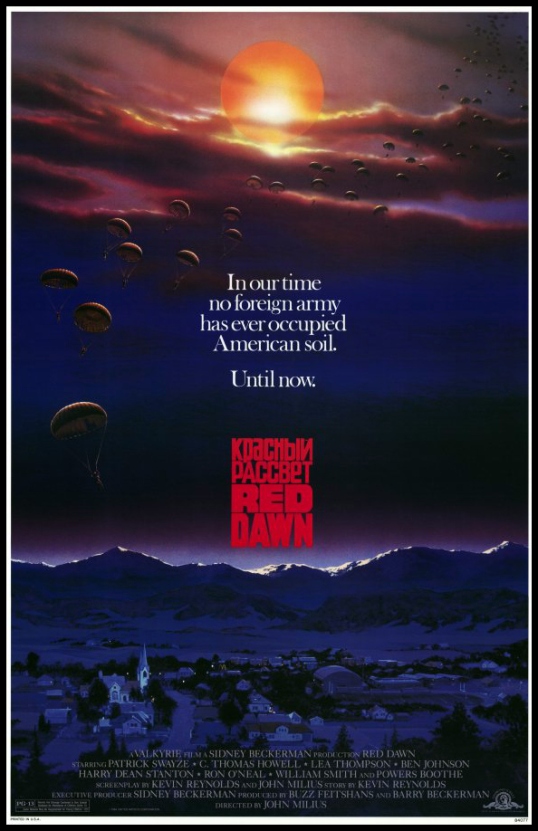
Scenes That I Love: The Traitor Scene From Red Dawn


The original Red Dawn doesn’t get as much credit as it deserves.

It’s often described as just being an anti-communist film but actually, it’s a lot more complex than that.  Yes, it’s about a group of teenagers who wage guerilla warfare against communist invaders.  But it’s also about how those teenagers lose their innocence as a result and how they all come to realize that war is not as simple as they thought it was.  The movie celebrates the Wolverines while also mourning that they were put in the position to have to risk and sacrifice their lives in the first place.

That’s what today’s scene that I love is all about.  After they are tracked down and attacked by a group of Russian soldiers, the Wolverines discover that one of the original members of the group visited his father in town and was forced to swallow a tracking device.  In this scene, the group is forced to deal with the reality of war.  The fact that the traitor was a friend to all of them and popular enough to be president of his class just adds to the difficulty of emotionally processing with his betrayal.  Patrick Swayze can’t bring himself to pull the trigger.  C. Thomas Howell, on the other hand, is so quick to shoot his former friend that you realize just how consumed by hate he has become.

Today’s scene was directed by the brilliant John Milius.

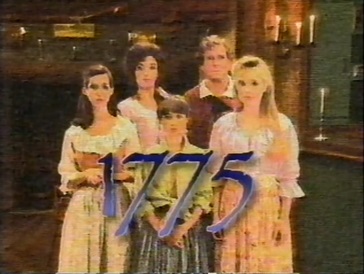
Retro Television Review: 1775 1.1 “The Pilot”


Welcome to Retro Television Reviews, a feature where we review some of our favorite and least favorite shows of the past!  On Thursdays, I will be reviewing 1775, which aired on CBS in 1992.  The entire show is currently streaming on YouTube!

This week, we take a trip into the past.  Welcome to 1775!

Episode 1.1 “Pilot”

(Dir by David Trainer, originally aired on September 5th, 1992)

The year is 1775 and the streets of Philadelphia are awash in rumors of war and revolution.  While some prepare for war and others continue to declare their loyalty to the British Empire, Jeremy (Ryan O’Neal) and Annabelle Proctor (Lesley-Anne Down) just try to run their inn and find suitable husbands for their three daughters.  The youngest daughter (Danielle Harris, of Halloween fame) wants a horse because all of her friends have a horse.  She also wants to run off with a patriot and is offended when the pro-British Governor Massengill (Jeffrey Tambor) stops by the inn.

The Proctors know that one way to marry off their daughters would be to have them attend a fancy ball.  Unfortunately, that would require paying money that they don’t have.  Jeremy may have to ask his smug brother-in-law for cash.  His brother-in-law’s name?  George Washington.  Who plays George Washington?  Somewhat inevitably, Adam West.

Now, I know Adam West playing a smug and superficial George Washington might sound like a lot of fun but West only shows up for one scene and it’s a short one at that.  And he really doesn’t get any fun lines or really any opportunity to do any of his trademark Westing.  It’s a bit of a wasted opportunity.

Actually, the entire show feels like a wasted opportunity.  Reportedly, 1775 was an attempt to do a Blackadder for America but the pilot lacks all of Blackadder’s lacerating wit.  Instead of poking fun at American history and traditions in the way that Blackadder did to the Brits, 1775 is just a typically lame family sitcom that happens to take place in 1775.  The youngest daughter wants a horse …. BECAUSE IT’S 1775!  If it was the modern era, she would want a car.  That’s the entire joke.

As for the show’s cast, Lesley-Anne Down delivers a few snarky put-downs with elan but Ryan O’Neal appears to be lost in the main role.  Have you seen that famous clip of Ryan O’Neal saying, “Oh man, oh God,” over and over again?  Well, that’s the level of his performance here.  O’Neal sleepwalks through the show, delivering his lines in the weary voice of someone who needs the paycheck but otherwise could hardly care less.  When he gets exasperated with his daughters, he sounds numbly homicidal.  It’s not a pleasant performance and it features none of the fierce intelligence that Rowan Atkinson brought to countless incarnations of Edmund Blackadder.

Not surprisingly, only one episode of the show aired before it was canceled.  The series didn’t even reach the start of the Second Continental Congress but that’s okay.  We all know how that went.

Film Review: Berlin Correspondent (dir by Eugene Forde)


In the 1942 film, Berlin Correspondent, Dana Andrews plays Bill Roberts.

Bill is an American journalist, working out of Berlin.  Because the film takes place before America’s entry into World War II, Bill pretends to report only what the Germans want him to report.  Even while there are bombs exploding outside of the studio, Bill and his fellow correspondents report that everyone in Berlin is happy and that the German government is doing a great job.

However, Bill fills his reporting with code words, which are then interpreted by listeners in the American Intelligence service.  They understand that when Bill says that the people are happy, that means that they’re actually miserable.  When Bill says that the weather in Berlin is cloudy, that means that there is dissent brewing in the government.

Still, Captain Von Rau (Martin Kosleck) comes to suspect that Bill might be sending out secret messages and he decides to send someone to not only compromise Bill but to also discover who is feeding Bill information.  Von Rau sends his own fiancée, Karen Hauen (Virginia Gilmore), to seduce Bill.  Little does Von Rau suspect that Bill’s source of information is Karen’s own father (Erwin Kalser) and that Karen herself is going to end up falling in love with Bill.

Berlin Correspondent is typical of the films that were made to try to build support for the American war effort during the Second World War.  The hero is a tough and cynical American who pretends to not care about what is happening in the rest of the world but who eventually reveals himself to be an idealist with a strong sense of right and wrong.  Bill may say that he’s only in Berlin to report the news but, when Karen’s father is sent to a concentration camp, Bill proves himself to be willing to risk his own life to help the older man make it to Switzerland.  Karen’s father stands in for the members of the German resistance who worked from the inside to bring down the Nazis.  Bill and Karen’s love serves as a reminder that the world can come back together but only after Hitler has been defeated.

The two main Nazi villains are played by Martin Kosleck and Sig Ruman, two German actors who immigrated to the United States to escape the real-life Nazis.  Kosleck and Ruman play their characters as being buffoonish bullies who are easily outsmarted by street smart Americans like Bill.  It’s the film’s way of saying to the audience, “Are you really going to let these idiots think that they can defeat America?”  Still, a scene is included in which a crippled girl is described as being someone who should be put to death.  It’s a necessary reminder that the Nazis may be idiots but they’re also a legitimate threat.

Berlin Correspondent clocks in at a brisk 70 minutes and it features a typically strong leading performance from Dana Andrews.  If you needed someone to fight for America, 40s-era Dana Andrews would definitely be a good pick to go with.  It’s a joy to watch him outsmart the Nazis.

Retro Television Review: The Love Boat 4.11 “That’s My Dad/Captive Audience/The Captain’s Bird”


Welcome to Retro Television Reviews, a feature where we review some of our favorite and least favorite shows of the past!  On Wednesdays, I will be reviewing the original Love Boat, which aired on ABC from 1977 to 1986!  The series can be streamed on Paramount Plus!

Merry Christmas!

Episode 4.11 “That’s My Dad/Captive Audience/The Captain’s Bird”

(Dir by Allen Baron, originally aired on December 20th, 1980)

It’s time for the Love Boat’s annual Christmas cruise and, appropriately enough, this cruise is all about family.

For instance, Captain Stubing has decided that the perfect Christmas gift for Vicki would be a parrot.  After the bird is brought on board, Stubing decides that the perfect place to hide it would be in Gopher’s cabin.  Gopher goes along with this because it’s something of a miracle that he hasn’t been fired yet.  I mean, when you’ve screwed up as much as Gopher has, you’re not really in a position to argue with your boss.  The only problem with all of this is that the parrot won’t talk.  Stubing isn’t happy about that so Isaac and Gopher try to teach the bird to sing a Christmas carol.  Instead, the bird starts saying, “Captain Stubing is a jerk!”  Uh-oh!

Meanwhile, singer Bobby Braddock (Jack Jones, who sang The Love Boat theme song) boards the ship with his wife, Susan (Laraine Stephens).  What Bobby doesn’t know is that his father, Richard (Allan Jones), and his mother, Lil (Dorothy Lamour), are also on the ship.  Bobby got his start as a part of Richard’s act and Richard has never forgiven Bobby for going solo.  Julie, Lil, and Susan all hope that they can bring father and son back together again.  Needless to say, Richard doesn’t appreciate being tricked into boarding a boat with his son.  He grimaces while listening to Bobby sing Winter Wonderland and then storms out of the lounge when Julie asks him to join his son on stage.  Merry Christmas, I guess!

Still, as bad as Bobby Braddock has it, it’s nothing compared to what’s going on with young Scotty (Meeno Peluce).  Looking to escape an abusive life at home, Scotty sneaks on board the ship by telling the crew that another passenger, Jeff Dalton (Dirk Benedict), is his father.  Scotty then proceeds to follow Jeff around the boat.  Jeff has no idea that everyone thinks that he is Scotty’s father.  When Jeff meets a woman and politely tells Scotty to scram, the crew is scandalized.  When Stubing sees the bruises on Scotty’s back, he assumes that Jeff is responsible.

Well, don’t worry.  Things may look bleak at the halfway mark but everything works out in the end.  Jeff realizes that maybe he would like to be a father to a random runaway.  Richard realizes that he can forgive his son for wanting to make his own way.  Crew members dress up like Santa Claus and Vicki has a happy holiday on the ocean.

You know what?  This was a silly episode but I enjoyed it.  I’m a sucker for Christmas episodes and this one had enough comedy and drama to keep me entertained and the story involving Scotty and Jeff even touched my heart a little.  This was definitely a cruise worth taking.

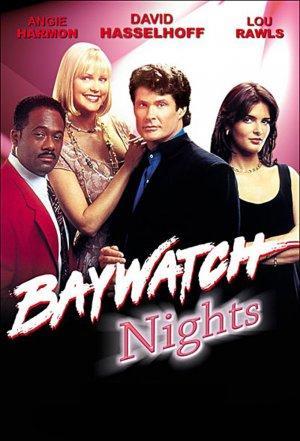
Late Night Retro Television Review: Baywatch Nights 1.21 “A Closer Look”


Welcome to Late Night Retro Television Reviews, a feature where we review some of our favorite and least favorite shows of the past!  On Tuesdays, I will be reviewing Baywatch Nights, a detective show that ran in Syndication from 1995 to 1997.  The entire show is currently streaming on You tube!

Mitch has yet another old friend who needs help!

Episode 1.21 “A Closer Look”

(Dir by Bernard L. Kowalski, originally aired on May 11th, 1996)

Another old friend of Mitch’s had a problem.

Seriously, how many old friends does Mitch have and why are all of them always getting involved in something dangerous?  And why is it always Mitch’s responsibility to help them out?  I mean, doesn’t Mitch ever just want to tell them to take care of their own problems?  Mitch isn’t Superman, after all.  He’s a middle-aged guy who is already struggling to balance his day job with his night job.  STAND UP FOR YOURSELF, MITCH!

Anyway, Dewey Morgan (Gary Collins, looking like Robert Redford in All Is Lost) is worried that his model wife, McKenna (Lisa Schad), has been replaced by an imposter.  As he explains it, she’s been different ever since she returned from a health spa.  She looks the same but there’s just all sorts of little differences.  It’s the type of things that only an intimate acquaintance — like a husband, for instance — would notice.

Mitch is skeptical.  He thinks that maybe Dewey is just upset because McKenna has recently left him and is now finding success as a model.  Still, Mitch decides to investigate because Dewey is an old friend.  It’s never really made clear how Mitch and Dewey became friends in the first place but Dewey does spend a lot of time in a wet suit and on a surf board.  So, I guess having a shared love of having a mid-life crisis on a beach is the bond that holds Mitch and Dewey together.

Personally, I think it would have been interesting if Mitch and Ryan had discovered that McKenna actually was McKenna and Dewey really was some sort of unbalanced stalker.  That would have been a nicely unexpected twist and it would also have forced Mitch to reconsider his loyalty to all of his old friends.  It would have given the show a chance to say something about the dangers of a beach bum having a mid-life crisis.  But that’s just not the Baywatch Nights way.  It turns out that the real McKenna is dead and the woman claiming to be Dewey’s wife is an imposter.

Usually, I enjoy melodramatic nonsense like this but this episode featured both a murder and an attempted murder and all of that violence felt somewhat out-of-place.  Baywatch Nights works best as goofy fun.  Having people actually die kind of takes away from the goofiness and it makes me wonder how Mitch is holding up mentally.  I mean, he just wanted to make some extra money as a private investigator.  Instead, he’s being regularly exposed to the worst that humanity has to offer.

The first season is nearly over and that’s good because, as this rambling review might indicate to the careful reader, I’m getting kind of bored with it.  The second season is a lot of fun because Mitch and Ryan spend 22 episodes dealing with aliens, vampires, and Vikings!  But, before we can get to all that, there’s one more first season episode to go.

We’ll deal with it next week.

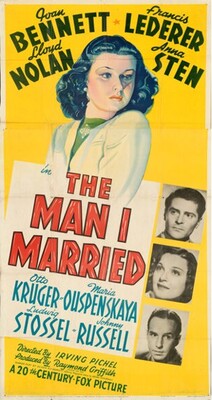
Film Review: The Man I Married (dir by Irving Pichel)


In 1940’s The Man I Married, Joan Bennett stars as Carol Cabbott Hoffman.

Carol is a New York-based art critic.  She is young, sophisticated, wealthy, and politically naive.  Because she has been married to a German for seven years, she has been keeping up with what has been happening in Germany but it’s clear that she doesn’t really understand the full story of what she’s hearing.  As she says, at one point, she has heard bad things about the Nazis but she also tries to keep an open mind and not get drawn in by “propaganda.”

Her husband, Eric Hoffman (Francis Lederer), has not been back to Germany in ten years and he says that he has little interest in ever returning.  But, when he receives a letter from his father (Otto Kruger), Eric announces that he has to return home for a visit.  Before Carol, Eric, and their son, Ricky (Johnny Russell), leave for Germany, they are approached by their friend, Dr. Hugo Gerhardt (Ludwig Stossel).  He explains that his brother has been imprisoned in a concentration camp and he asks Carol and Eric to deliver money to him and to appeal to the American embassy for help.  Carol agrees to do so.  Eric is noticeably reticent.

As soon as they arrive in Germany and Eric learns that his father wants him to take over the family’s factory, Eric starts to change.  He and a former schoolmate named Freida (Anna Sten) are a bit too happy to see each other again.  Eric insists on listening to the nightly radio broadcasts from Dr. Goebbels.  When Freida mentions that it is illegal to joke about Hitler, Eric surprises Carol by defending the law.  With Eric spending all of his time with Freida and dismissing Carol’s understandable suspicions by saying that she’s just being jealous, Carol meets an American correspondent named Keith (Lloyd Nolan) who reveals to her the truth of life in Nazi Germany.  Carol discovers that, rather than being the economically-strong paradise that Eric and Freida claim it to be, Germany is a place where many citizens live in fear of being heard saying the wrong thing and, as a result, they’ve chosen to close their eyes to what is going on around them.

The Man I Married is an interesting film.  It’s an anti-Nazi film that was released at a time when America was still technically a neutral nation.  Indeed, the film almost feels like it was made to prepare Americans for the inevitability of war with Germany.  When Keith mocks Carol for trying to be neutral about the Nazis, it’s clear that he’s meant to be speaking to the audience watching the film.  Eric begins the film as an erudite and seemingly charming man but, as soon as he arrives in Germany and is reunited with Freida, he reveals himself to be a fervent Nazi.  The film warns the audience not to trust those who were trying to excuse or dismiss Germany’s actions.

This is also one of the few films made before World War II that really acknowledged just how central anti-Semitism was to the Nazi ideology, acknowledging the concentration camps at a time when many in the West were refusing to admit they existed, either because they were in denial or because they just didn’t care.  Towards the end of the film, a major character is discovered to have had a Jewish mother and the reaction to the news reveals the hate that was at the heart of the Third Reich.

The Man I Married, with its portrayal of a populace that has convinced itself that their government is never to be questioned and that all dissent must be punished, is a film that feels just as relevant today as it did in 1940.  It’s a film that warns viewers of the risk of disbelieving their own eyes.