Retro Television Review: Malibu, CA 1.12 “The Big Storm”


Welcome to Retro Television Reviews, a feature where we review some of our favorite and least favorite shows of the past!  On Thursdays, I will be reviewing Malibu CA, which aired in Syndication in 1998 and 1999.  The entire show is currently streaming on YouTube!

This week, a mudslide changes everything …. kind of.

Episode 1.12 “The Big Storm”

(Dir by Gary Shimokawa, originally aired on January 10th, 1999)

Stads and Jason are coming up on their big, six-month anniversary!  Stads wants to celebrate at a volleyball tournament.  Jason wants to celebrate at the “Puff Daddy” concert.  You can really tell how old this show is by the fact that 1) they’re still calling him “Puff Daddy” and 2) they’re taking seriously the idea of wanting to see him in concert.

With Stads annoyed that Jason never seems to want to do anything that she wants to do, Jason turns to Sam for advice.  Sam says that Jason should drive into Beverly Hills and buy a necklace that Stads wants.  Sam even accompanies Jason on the drive.  Awww!  What a good freind.

But then — oh no! — a storm hits.  Jason and Sam end up getting trapped in their car by a mudslide.  Trapped together, Jason and Sam share a kiss.  Its a big moment that would have been bigger if it made any sense.  Seriously, until that moment, Sam had never shown any interest in Jason whatsoever.  But now, suddenly, they’re kissing and preparing to die together.  I understand that it’s probably mudslide panic but still, it just feels as if it comes out of nowhere.

Fortunately, Jason and Sam are rescued by the lifeguards (including Stads).  Jason and Sam agree not to tell Stads about the kiss.  Jason also gives Stads the necklace (Awwww!  It’s a nice necklace!) and then suggests that, instead of seeing Puff Daddy, they just have a romantic dinner.  Stads agrees.

Unfortunately, at dinner, Stads says that she knows what happened in the car.  Jason says the kiss didn’t mean anything, just to discover that Stads was just referring to Jason and Sam talking in general.  Stads gives Jason back his necklace and then dumps him.  Good for Stads, she deserves better!

This is one of those storylines that would have worked better if I actually cared about any of the characters on the show but, for the most part, everyone is so shallow that it’s hard to really get worked up when they get trapped in a mudslide.  As well, it would have helped if Sam had ever previously shown any interest in Jason.  As well, while Jason did have a crush on Sam when the show began, that didn’t seem to last long.  Two people who produce absolutely no romantic sparks shared a kiss.  It didn’t really do much for me.

As often happens with this show, the B-plots were better than the main plot, largely because Brandon Brooks and Priscilla Inga Taylor were both willing to full embrace the absurdity of their characters.  After Peter told Murray to stop talking so much, Murray resorted to typing his words out on his laptop and having a computerized voice repeat them.  That made me laugh.  Meanwhile, Tracy — who is now dating Kip, the dumb lifeguard from the previous episode — explored her artistic side by getting a camera and taking pictures of a shirtless Scott wearing an Abraham Lincoln beard.  It was weird enough to be funny.

Anyway, Stads has escaped Jason …. for now.  Run, Stads, run!
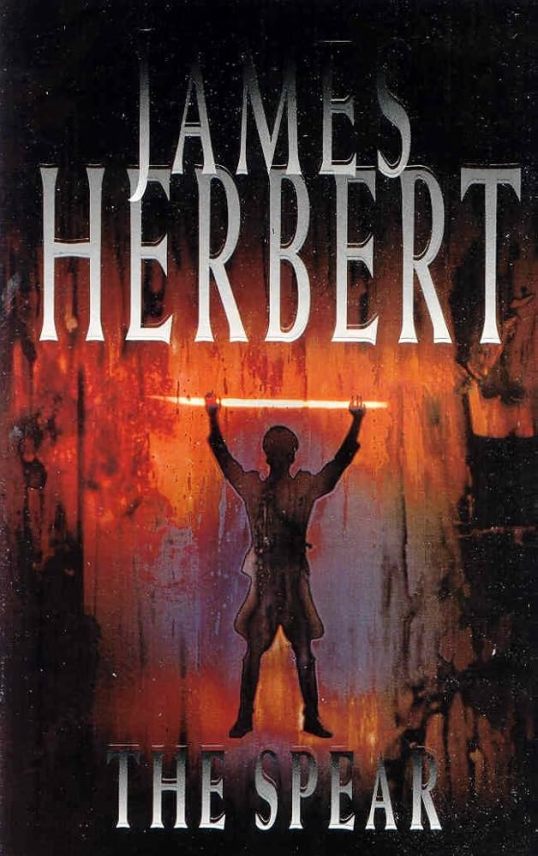
Horror Novel Review: The Spear by James Herbert


In the 1978 novel The Spear, Harry Steadman is an ex-Mossad agent who is now a private investigator.  Steadman is hired to investigate the disappearance of another Mossad agent and soon finds himself caught up in an international conspiracy of wealthy and high-rnking Neo-Nazis who are hoping to use the Spear of Longinus to resurrect the feared head of the SS Heinrich Himmler!

The Spear is a fast-moving mix of horror and action.  Imagine James Bond if Bond found himself battling ancient demons and you have an idea of what The Spear is like.  As often happened to James Bond, Harry Steadman is lucky to be dealing with a bunch of villains who just can’t stop themselves from stopping the action to lay out all of their plans.  That said, the book does a good job of creating an atmosphere of paranoia and unease as Steadman finds himself going up against an occult conspiracy that involves some of the most powerful people in the world.  Like all good paranoia thrillers, The Spear creates a world where literally no one can be trusted.  The action is frequently over-the-top and the horror is memorably gruesome.  A scene involving a crucifixion is particularly nightmarish.  Harry Steadman is a compelling hero, one who doesn’t love violence but who understands what’s at stake.  The Spear does not shy away from discussing the evil of the Nazis and, in today’s world where anti-Semitism is on the rise and where people are openly making excuses for Hitler and arguing that the Allies were somehow not the good guys in World War II, Herbert’s novel feels very relevant to the world today.

The Nazis search for ancient artifacts and Himmler’s belief that their power could be wielded for Germany also inspired Raiders of the Lost Ark and Indiana Jones and The Last Crusade.  A former chicken farmer and a committed Pagan, Himmler was reportedly a strong believer in the power of the occult and there is some speculation that, along with the Lost Ark of the Covenant, Noah’s boat, and the Holy Grail, the Spear of Longinus was one of the artifacts that Himmler instructed his agent to search for.  For all the time that they spent searching, the Nazis apparently never found any of the artifacts that they believed would deliver them to victory.  By the end of World War II, even Himmler was secretly negotiating with the Allies.  At the war’s end, Himmler committed suicide while in custody of the Allies.

Of course, the real Holy Lance was discovered in Antioch during the Crusades and currently sits in the Manoogian Museum in Vagharshapat, Armenia.


October True Crime: An Officer and a Murderer (dir by Norma Bailey)


Gary Cole is an interesting actor.

He’s handsome in a distinguished way, even if he’s played some roles that have required him to play down his looks.  (Think about his perm in The Brady Bunch Movie or the glasses that he wore in Office Space.)  He’s not exactly movie star handsome but he’s definitely good-looking enough to be the star of his own detective series.  He’s got the authoritative voice of someone who you instinctively trust.  You look at Gary Cole and you see someone who knows what’s going on and who you would probably trust in a crisis.

At the same time, with just about every character that Cole has played, there’s always been a sign of something lurking behind the friendly smile and perfect haircut.  At the very least, there’s usually a hint of a threat concealed behind his polite manner.  Gary Cole is the ideal actor to play a character who has secrets to hide, whether he’s playing Mike Brady as someone who cheerfully offers up nonsensical advice or telling one of his employees that he’s going to need to come in over the weekend.  It’s hard to trust a character played by Gary Cole.  Cole has appeared in a wide variety of films and shows.  As anyone who has seen Veep can tell you, Gary Cole can be a very funny actor.  But where Gary Cole really shines is when he plays the bad guy who no one suspects is a bad guy.

In 2012’a An Officer and A Murderer, Gary Cole plays a very bad guy indeed, Russell Williams.  Williams is a colonel in the Canadian Air Force.  He’s such a highly respected figure that he was given the job of flying with the Queen of England when she last visited Ontario.  Williams has a big house in the suburbs.  He has a beautiful wife (played by Nahanni Johnstone).  His neighbors love him and they all say hi whenever he’s out for his morning run.  Williams had just been appointed the new commander of the local Canadian Air Force base.  He’s a respected and beloved figure who raises money for charity, mentors younger pilots, and seems like the ideal gentleman.

But at night, Russell Williams sneaks out of his house and breaks into the homes and apartments of single women.  He starts out as an underwear thief, obsessively cataloging all of the bras and the panties that he steals from each house.  Unknown to his wife, he has two suitcases filled with stolen underwear.  Occasionally, he even wears them himself.  The two detectives (played by Laura Harris and Rossif Sutherland) who investigate the break-ins theorize that the perpetrator is going to start to escalate his activities and Williams soon does just that. Williams assaults a young mother, blindfolding her and then filming her while he poses with her.  He breaks into another house and removes his clothes while he stares at the homeowner showering just a few feet away.  Eventually, two women are murdered.  The detectives suspect Russ but can they get him to slip up and give them the evidence that they need to arrest him?

An Officer and A Murderer is based on a true story, which makes it all the more disturbing to watch as Williams breaks into his neighbor’s homes and even tries to frame an innocent man for his crimes.  Watching this movie, I found myself wondering about all of the neighbors that I’ve had over the years.  Part of living in neighborhood is trusting the people around you but how well do we know the people who are living just a few houses or a few apartment away from us?  An Officer and a Murderer tells a sordid story and occasionally, it lingers over the details of Williams’s crimes to such an extent that you worry that Williams’s real-life victims are being exploited all over again.  That’s always an issue with films about real-life crimes.  That said, Gary Cole gave a genuinely frightening performance as Russell Williams and, if nothing else, the film reminded me to make sure that all of my doors and windows are locked tonight.

Horror Film Review: Godzilla (dir by Luigi Cozzi, Inshiro Honda, and Terry Morse)


The year was 1976 and the flamboyant Italian producer, Dino de Laurentiis, was drumming up a lot of publicity for his remake of the monster classic, King Kong.  In Italy, the journalist, screenwriter, and director Luigi Cozzi assumed that the King Kong remake would be a huge hit and decided to get in on the action himself.  If Italian audiences loved a film about a big monkey, how about a film about a big radioactive lizard?

Cozzi’s original plan was to buy the distribution rights to Gojira but Toho Studios turned him down.  They did, however, agree to allow Cozzi to distribute the American cut of Gojira, Godzilla, King of the Monsters.  (That’s the version where Raymond Burr appears as American reporter Steve Martin and, through some clever editing tricks, appears to be interacting with the characters from the original Japanese version.)

Cozzi immediately ran into two huge problems when it came to distributing Godzilla, King of the Monsters.  First off, the film was in black-and-white and most Italian theater owners refused to show black-and-white films.  Cozzi’s solution was to “colorize” the film by putting translucent gel over the frame, resulting in random splotches of color that gave the entire film what could generously be called a radioactive glow.  Secondly, the American cut was considered to be too short for theatrical distribution.  Cozzi proceeded to re-cut the re-cut, adding in scenes of actual war footage and clips from other 50s monster movies.  As a result Cozzi’s film opens not with Tokyo on fire but instead stock footage of Hiroshima before the bomb was dropped.  Later, footage of actual victims of the bomb would he used as footage of victims of Godzilla.

Having re-cut the film, Cozzi then decided that the movie could use a synthesizer-heavy soundtrack, which was provided by Vince Tempera, Fabio Frizzi, and Franco Bixio.

The end result …. well, the end result is a mess but it’s a mess that fascinating for fans of Godzilla.  The colorization creates an odd effect, in which the images are all familiar but still seem different, as if being viewed in a dream.  Often times, the splashes of color are so harsh and random that it makes it difficult to actually see what’s happening in the scene.  I had to look away a few times, due to the harshness brightness of some of the yellows.  There are a few times — and by that, I mean a very few times –when the color effects oddly work.  In those rare moments, Godzilla’s atomic nature seems to be radiating through the entire movie.

As for the “new footage,” it’s thoroughly tasteless to use actual footage from Hiroshima and Nagasaki but, at the same time, it also serves to remind the viewer of the national trauma that inspired the creation of Godzilla in the first place.  The footage reminds the viewer of the horrors of war while also leaving viewers wondering they really should be watching it used in the way that it’s used in this movie.  (For his part, Cozzi said he used actual war footage because modern audiences would expect more violence and destruction than was present in the original film.  It’s reasonable to assume that any subtext was purely accidental.)

Finally, the soundtrack …. actually, I like this version’s score.  It’s wonderfully ominous, especially at the start of the film.

Nicknamed Cozilla by Cozzi himself, 1977’s Godzilla is a bizarre experiment that doesn’t quite work but I would say it’s still one that should be seen by anyone who is interested in the history of either Godzilla or exploitation films in general.  (And make no mistake, this version of Godzilla is definitely an exploitation film.)  For years, the film was impossible to see outside of Italy.  Now, of course, you can find a copy on just about every torrent site.

Previous Godzilla Reviews:

  1. Godzilla, King of the Monsters (1958)
  2. Godzilla Raids Again (1958)
  3. King Kong vs Godzilla (1962)
  4. Mothra vs. Godzilla (1964)
  5. Ghidorah: The Three-Headed Monster (1964)
  6. Invasion of the Astro-Monster (1965)
  7. Godzilla vs. The Sea Monster (1966)
  8. Son of Godzilla (1967)
  9. Destroy All Monsters (1968)
  10. All Monsters Attack (1969)
  11. Godzilla vs Hedorah (1971)
  12. Godzilla vs Gigan (1972)
  13. Godzilla vs Megalon (1973)
  14. Godzilla vs Mechagodzilla (1974)
  15. The Terror of Mechagodzilla (1975)
  16. Godzilla vs. Mothra (1992)
  17. Godzilla vs. Destoroyah (1995)
  18. Godzilla, Mothra, and King Ghidorah: Giant Monsters All-Out Attack (2001)
  19. Godzilla (2014)
  20. Godzilla: Planet of the Monsters (2017)
  21. Godzilla, King of the Monsters (2019)
  22. Godzilla vs Kong (2021)
  23. Godzilla Minus One (2023)

Horror Film Review: The Asphyx (dir by Peter Newbrook)


The Asphyx, a 1972 horror film from the UK, opens in what would have been the film’s modern day.  A horrific accident occurs when two cars collide.  The drivers are both dead, with one of the them rather grotesquely hanging out of a shattered windshield.  And yet somehow, an elderly pedestrian who was trapped underneath the two cars is still alive and able to shuffle away from the accident.

The film then jumps back to the Victorian-era.  Sir Hugo Cunningham (Robert Stephens) is a scientist who is studying what happens at the exact moment of death.  Taking a look of several pictures that were taken of people as they died, he spots a dark smudge that seems to be hovering near the subject of each photograph.  Later, while making a home movie with an amazing new device called a motion picture camera, Sir Hugo can only watch in horror as his son Clive (Ralph Arliss) and Clive’s fiancee, Anna (Fiona Walker), both drown in a boating accident.  When Sir Hugo later looks at the film, he notices a ghostly blue light that seems to be hovering over both his son and Anna.

Sir Hugo speculates that the light could be what the ancient Greek called the Asphyx, a force that comes for everyone’s life in the moment right before death.  Hugo theorizes that everyone has their own individual Asphyx and he also comes to believe that if one were to capture their own Asphyx before it takes away their life, the result would be immortality.  Working with his reluctant adopted son, Giles (Robert Powell), Hugo sets out to capture an Asphyx.  Unfortunately, to do so means that someone has to be on the verge of death so that their Asphyx will show up.  Giles is not happy about the idea of strapping Hugo into an electric chair or of sitting in a gas chamber himself but he agrees to do so in return for Hugo’s permission to marry Hugo’s daughter, Christina (Jane Lapotaire).

(Before we all say, “Ewwww!,” let us remember that Clive is only adopted.  Still, it does feel a bit strange.)

The experiments lead to both tragedy and success.  Heads roll, literally.  And while Giles’s doubts continue to grow, Hugo finds himself more and more obsessed with the idea of living forever.

The Asphyx is a rather low-key horror film.  No one is going to mistake this for one of Hammer’s bloody and flamboyant films.  The horror is less in what is seen and more in what is implied.  That said, the premise is an intriguing one, the film’s plot unfolds with a good deal of intelligence, and both Robert Powell and Robert Stephens overact so grandly during the film’s final few minutes that those who are just looking for a campy British horror film will be satisfied.  Robert Stephens gives a very good performance as Sir Hugo, a scientist who claims that he’s just tying to make the world a better place but who is actually motivated by his own megalomania.  (He reasons that he deserves to be immortal because he’s a scientist and his contributions are too important to be ended by a mere death.)  Robert Powell’s somewhat wooden acting style actually makes him ideal for the role of Giles, who is written to be, at least in the beginning, a somewhat boring person.  The film’s best performance comes from Jane Lapotaire, whose reaction to discovering how far her father is willing to go to capture an Asphyx is simply heart-breaking to watch.

The Asphyx is a great pick if you’re looking for an off-beat and intelligent horror film this scary season.

Horror Movie Review: The Fall of the House of Usher (dir by Roger Corman)


The 1960 film, The Fall Of The House of Usher, opens with Phillip Winthrop (Mark Damon) riding his horse across a desolate landscape.

There’s a foreboding mansion in the distance but what the viewer immediately notices is that the land around the mansion looks almost post-apocalyptic.  Even though the film is set in the 1800s, the misshapen trees and the high winds all bring to mind a film set in a nuclear-scarred world, the type where you expect to find radioactive mutants hiding behind every tree and rock.

Phillip is a young aristocrat who is traveling to the home of the Usher family.  He is engaged to marry Madeleine Usher (Myrna Fahey) but, as soon as he arrives at the mansion, her older brother, Roderick (Vincent Price, with no mustache and blonde hair), informs Phillip that he will never be allowed to marry Madeleine.  Roderick explains that the Usher family is cursed and he even takes Phillip on a tour of Usher family history, showing him a series of truly hideous paintings of past Ushers.  One Usher was a murderer.  Another Usher was blackmailer.  An Usher wearing a pirate’s cap is identified as being a slave trader.  The Ushers are cursed, with each family member destined to become insane.  Roderick’s mission is to bring the Usher bloodline to a close and that means that Madeleine cannot marry.

Phillip disagrees, especially when the sickly Madeleine herself says that she wants to escape from her seemingly mad brother.  With the house itself continually shaking as if it’s on the verge of collapsing, Phillip becomes determined to take Madeleine away.  Roderick tries to warn him not to.  Even the friendly butler, Bristol (Harry Ellerbe), encourages Phillip to give up.  But Phillip remains stubborn and determined.  However, when Madeleine suddenly collapses and dies, it appears that Phillip’s plans to marry her are at an end.  But is Madeleine truly dead?

Based on a short story by Edgar Allan Poe, this was, at the time, the most expensive film that Roger Corman and American International Pictures had ever made.  (It was also their first color film.)  Of course, the budget was still just $300,000 and the Usher mansion was largely constructed out of props that were borrowed from other films.  That said, the film had a name star and, with its vivid colors and its fiery finale, it certainly looked like a big-budget film.  This film marked the first collaboration between Vincent Price and Roger Corman and it was a box office success, making  a million dollars at a time when a million dollars really meant something..  Corman and Price would go on to do several other Poe adaptations together, all of which were distinguished by Price’s villainous performances and Corman’s pop art visuals.

Seen today, The Fall of the House of Usher can seem to be a bit slow.  With only one location and a cast of only four actors, it often feels a bit stagey.  Mark Damon is rather stiff as Phillip.  (One can see why he abandoned acting to become a producer.)  But Vincent Price’s performance as Roderick Usher continue to entertain, with Price delivering every line of dialogue with his trademark aristocratic archness.  There’s nothing subtle about Price’s performance but Price’s tendency to overact perfectly matched Corman’s vivid visuals and it’s interesting to watch a hyperactive Price performance paired with the type of dull performance that Mark Damon offers up.

The fiery finale still packs a certain punch and, watching it, one can see why Corman and Price said, “Let’s do this again!”  The Fall of the House of Usher (which is also available on some streaming sites as simply House of Usher) remains an enjoyable macabre Halloween treat.

House of Usher (1960, dir by Roger Corman, DP: Floyd Crosby)


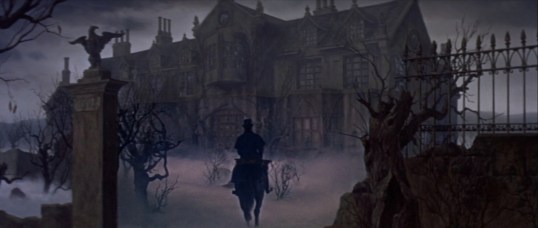
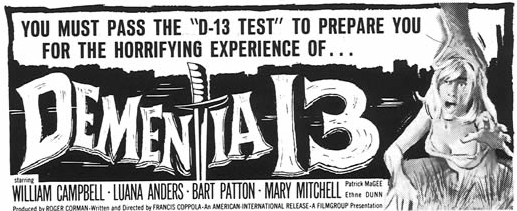
Horror on the Lens: Dementia 13 (dir by Francis Ford Coppola)


(I originally shared this film back in 2011, 2019, 2022, and 2023 — can you believe we’ve been doing this for that long? — but the YouTube upload keeps getting taken down!  So, I’m resharing it today!)

For today’s excursion into the world of public domain horror, I offer up the film debut of Francis Ford Coppola.  Before Coppola directed the Godfather and Apocalypse Now, he directed a low-budget, black-and-white thriller that was called Dementia 13.  In a possible sign of things to come, producer Roger Corman and Coppola ended up disagreeing on the film’s final cut and Corman reportedly brought in director Jack Hill to film and, in some cases, re-film additional scenes.

Regardless of whether the credit should go to Coppola, Corman, or Hill, Dementia 13 is a brutally effective little film that is full of moody photography and which clearly served as an influence on the slasher films that would follow it in the future.  Speaking of influence, Dementia 13 itself is obviously influenced by the Italian giallo films that, in 1963, were just now starting to make their way into the drive-ins and grindhouses of America.

Speaking of giallo films, keep an eye out for Patrick Magee, who gave a memorable performance in Lucio Fulci’s The Black Cat.  Luana Anders, who plays the duplicitous wife in this film, showed up in just about every other exploitation film made in the 60s and yes, the scene where she’s swimming freaks me out to no end.  Other films featuring Luana Anders include Night Tide and Easy Rider, in which she played one of the hippies who unsuccessfully enticed Peter Fonda and Dennis Hopper to stay at the commune.

As for Francis Ford Coppola, well, he’s gone on to have quite a career, hasn’t he?  It’s been quite a journey from Dementia 13 to Megalopolis!

October Positivity: Mindreader (dir by Rich Christiano)


2022’s Mindreader start out telling the story of the Great Dexter (Hamish Briggs).

In 1974, Dexter amazed audiences with his mid-reading tricks.  He also amazed his fellow magicians, none of whom could figure out how Dexter performed his tricks.  Dexter insisted that they only needed to consider his catch phrase — “I don’t really do magic, I just read minds,” — to understand how he was able to know what people were thinking.  Dexter said that his fellow magicians just needed to have faith that he could do what he could do.

But the other magicians, because they were so used to the idea of tricking their audiences, would not accept what Dexter said.  They launched an investigation into how Dexter was able to read minds.  A particularly jealous magician tried to fool Dexter by lying about what he was thinking.  Dexter, of course, saw right through him and humiliated the magician in front of his peers.  Those who worked at the same theater as Dexter were offered money to spy on and betray Dexter.  Dexter’s story eventually ended with tragedy.

Years later, Dexter is a revered figure.  The same organization of magicians that persecuted him now wants to honor him.  They interview those who knew Dexter.  They hear about Dexter’s powers.  They hear about how Dexter’s ability to read minds helped countless people.  And they still demand to know how Dexter could have read minds.  Dexter’s now aged assistant tells them that they can either believe it was a trick or they can accept that Dexter could do what he said he could.

Now, it’s pretty obvious what this film is getting at.  Dexter is obviously meant to be a Christ figure and his persecution is meant to parallel the betrayal and crucifixion of Jesus.  It’s not at all subtle but it’s still fairly well-done.  For a Rich Christiano film, the first hour of Mindreader is well-directed, well-acted, and nicely paced.

However, the film takes an abrupt turn when the end credits suddenly roll at the 60 minute mark and a whole new film begin.  Suddenly, the viewer finds themselves watching as a bunch of college students as they stand up and leave a movie theater.  They agree the movie was interesting but they don’t say much else about it.  The student who invited them to the movie goes to his dorm room and feels like a failure for not talking to them about the film’s message.  But, the next day, he discovers that at least one of them is interesting in what the film was really about and they proceed to discuss it.

Two things about this ending:

Number one, it feels more than a little self-congratulatory.  One gets the feeling that this ending was Christiano’s way of clapping back at every critic (like me!) who has ever suggested that a lot of faith-based films don’t really do much to reach people who don’t already agree with their point of view.

Number two, as the magicians in this film could have told you, you should never reveal how it’s done.  There’s a difference between getting people to think about something and telling people to think about it.  After an effective hour, Mindreader gets too heavy-handed for its own good.

Sometimes, you have to have faith in your audience.

Late Night Retro Television Review: Monsters 2.16 “Perchance to Dream”


Welcome to Late Night Retro Television Reviews, a feature where we review some of our favorite and least favorite shows of the past! On Wednesdays, I will be reviewing Monsters, which aired in syndication from 1988 to 1991. The entire series is streaming on YouTube.

This week, it’s all about dreams!

Episode 2.16 “Perchance to Dream”

(Dir by Paul Boyington, originally aired on February 4th, 1990)

Alex (Raphael Sbarge) is a college student whose dorm room has become one wild place.  Blood continually drips from a chair.  A subway train occasionally roars past the window.  A giant nun peeks in on him and tries to swat him with a ruler.  These are all images that Alex used to see in his dreams but now, they’re entering his waking world and what’s really strange is that everyone else can see them too.  His subconscious has become reality.

Thinking that it might have something to do with a recent mugging in which Alex struck his head and apparently lost the ability to sleep, Alex’s girlfriend, Megan (Sarah Buxton), asks Kyle (Kenneth Danziger), an expert on dreams, for help.  Arriving at Alex’s dorm room just in time to save Alex from the nun and her ruler, Kyle theorizes that, because Alex isn’t sleeping, he’s projecting his dreams into the real world.  The only solution is for Alex and Megan to enter a portal that leads them straight into Alex’s subconscious.  If Alex can find his dream self, he can finally get some rest.  Of course, Alex and Megan will have to avoid and defeat a series of trains, muggers, and nuns to accomplish their task.

This episode is entertainingly goofy.  It was obviously inspired by the popularity of the Nightmare on Elm Street films but the monster here is not a wisecracking killer like Freddy Krueger but instead, it’s just Alex’s bad childhood memories and the trauma of having been mugged.  As I watched this episode, I was impressed that Monsters tried to do something different than usual but I was also very aware that 20 minutes was not enough time to tell the story that this episode wanted to tell.  For this episode to really work, the viewer would have to feel a deep connection to Alex.  Raphael Sbarge gives a likable performance as Alex and he has a really cute chemistry with Sarah Buxton but 20 minutes still isn’t enough time to really get to know the guy.

When seen today, the special effects are undeniably primitive but there’s something kind of charming about that.  The scene where the giant nun tries to swat Alex with a ruler looks silly today and I imagine it probably looked silly in 1990 as well but it’s a fun kind of silly.  The same can be said of the scene where Alex and Megan plunge into his subconscious.  CGI has come a long way but today’s realistic CGI just doesn’t have the do-it-yourself charm of early chroma keying and matte shots.  I liked that Alex’s subconscious was not only goofy but cheap as well.

Horror on TV: One Step Beyond 1.2 “Night of April 14th” (dir by John Newland)


For today’s televised horror, we have the second episode of the 1960s anthology series, One Step Beyond.

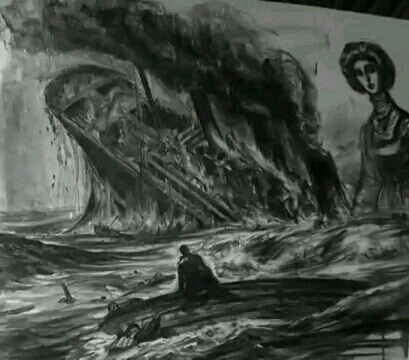
In this episode, a young Englishwoman is haunted by dreams of drowning.  Try as she might, she can’t get the feeling of doom out of her mind.  Perhaps her upcoming trip to New York will help to relax her.  Her fiancee even tells her that they’ll be traveling to New York on the most luxurious ship ever built.  The name of that ship?  Why, the Titanic, of course.

For the record, there actually were quite a few people who apparently did have psychic premonitions of doom when it came to the Titanic.  Perhaps the most infamous example was the author Morgan Robertson, who wrote a novel in 1898 that was called The Wreck of the Titan: Or, Futility.  That book managed to perfectly predict that sinking of the Titanic, right down to the iceberg and the number of lives lost.

This episode originally aired on January 27th, 1959.

Enjoy!