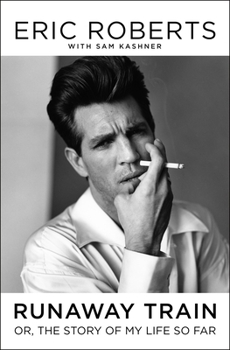
Book Review: Runaway Train Or, The Story Of My Life So Far by Eric Roberts with Sam Kasher


Hell yeah, Eric Roberts has written a book!

A friend of mine recently sent me Eric Roberts’s just published autobiography as a gift.  I was excited because, as any of our regular readers know, I am a huge fan of the insanely busy Eric Roberts.  That said, I wasn’t really expecting much from the book because most Hollywood autobiographies that I’ve read have had a tendency to be a bit dry.  Often times, the author (or their ghost writer, as the case may be) is either too concerned about not offending anyone or too bitter about the state of their career to really provide much honest insight into their life or their chosen profession.

Eric Roberts, however, is the exception to the rule.  Runaway Train is a fascinating read.  Roberts comes across as being very honest about his career, his demons, his family, and his compulsive need to always be working.  Roberts admits to being a workaholic but, as he explains it, it’s better to be addicted to acting than to be addicted to cocaine.  And I have to say that I think he has a point there.

Roberts writes about his dysfunctional childhood, his time as a star, and his more recent career as an actor who is willing to appear in just about everything.  He writes about his addictions and how they almost ruined his life.  He writes about his marriage to Eliza and fully takes responsibility for all the times that he’s screwed up.  (Roberts screwing up is a recurring theme throughout the book, almost to the extent that you just want to give the guy a hug and tell him to stop being so hard on himself.)  He writes about the time that he spent as a patient of Dr. Drew on Celebrity Rehab.  (In perhaps the book’s funniest moment, he realizes that he needs to be addicted to something if he’s going to go on Celebrity Rehab.  Eventually, he agrees to go on the show for help with his marijuana addiction, despite Roberts belief, which I agree with, that you can’t actually get addicted to marijuana.)  Roberts writes about some of his films, though he obviously can’t write about all 700 of them.  So, while there is no Top Gunner trivia, there are three pretty interesting chapters devoted to Star 80, The Pope of Greenwich Village, and Runaway Train.

Roberts does write about other celebrities, though he does so in a way that is neither petty nor obsequious.  He writes about his friendship with Robin Williams with an honesty that few other celebs would be willing to risk.  Danny Trejo, Eddie Bunker, Mickey Rourke, Christopher Walken, Sterling Hayden, Doug Kenney, Sharon Stone, Rod Steiger, and Sylvester Stallone all show up at one point or another.  And yes, Eric Roberts does write about his relationship with both his sister Julia and his daughter, Emma.  Eric is open about he and Julia having been occasionally estranged but he manages to do so in a way that protects everyone’s privacy.  One might never expect this from some of the roles that he’s played but Eric Roberts comes across as being a pretty classy, if somewhat eccentric, guy.

I loved this memoir.  I recommend it to all of you.
October True Crime: Gacy: Serial Killer Next Door (dir by Michael Feifer)


Released this year, Gacy: Serial Killer Next Door tells the story of two neighbors in the 70s.

Bobby (Mason McNulty) is a typical 7os teenager, with long hair and a laid back attitude.  He’s what my grandparents used to call a “good kid.”  He helps out his neighbors and he only charges 50 cents an hour.  When he sees someone new moving in, he immediately offers to help the man unload all of his furniture.  He gets along with his parents.  He’s popular with his friends.  Bobby seems destined to grow up to become the type of guy who you would want living next door to you.

His new neighbor is named John (Mike Korich).  John is a small businessman with local political ambitions.  He entertains at parties under the name Pogo the Clown.  He has a loud and, if we’re going to be honest, somewhat grating laugh.  He’s a dorky guy but he seems to be super-friendly.  In fact, he’s a bit too friendly.  He’s very quick to invite young men like Bobby to come home with him.  Bobby can’t help but notice that John’s new friends enter the house but they don’t ever seem to leave.

“I’ve never met anyone named John Wayne before,” Bobby says, when he first meets John.

“My mother named me after a cowboy,” John Wayne Gacy replies.

Soon, Bobby’s curiosity gets the better of him and he starts investigating Gacy on his own.  He comes to believe that Gacy is murdering the men that he brings home and then keeping their bodies in the house.  Unfortunately, no one wants to believe Bobby.  John, a murderer?  Friendly, clownish, buffoonish John?  “He works for the Democrats!” Bobby’s mother says at one point, a line that genuinely made me laugh.

There’s a lot of laughter to be found in Gacy: Serial Killer Next Door.  John Wayne Gacy loves to put on his clown makeup, kill people, and laugh.  The laughing gets old pretty quickly, to be honest.  The real-life John Wayne Gacy was executed after less than 20 years on Death Row.  If his real-life laugh was anything like his laugh in the movie, I’m surprised that they weren’t any quicker about doing away with him.

The real-life John Wayne Gacy was one of the worst serial killers in American history.  He killed dozens, so much so that he’s still considered to be a suspect in several unsolved murders.  He tortured his victims in the worst ways imaginable.  And he never even bothered to fake any sort of remorse for his crimes.  Instead, after he was jailed, he sold Gacy merchandise to morbid collectors.  His last words, before being put to death, were reportedly, “Kiss my ass.”  John Wayne Gacy is the type of murderer who makes people like me, who are against the death penalty in general, seriously reconsider their feelings.

Considering how terrible Gacy and his crimes were, it’s a bit odd that Gacy: Serial Killer Next Door almost plays out like a comedy at time.  The film portrays Gacy as being so openly evil that it’s hard  not to smile whenever an adult refuses to believe Bobby’s claim that there might be something wrong with the man who enjoys wearing clown makeup and carrying around a set of handcuffs.  A scene where Gacy comes over to Bobby’s house and asks if he can use the phone is pure cringe comedy.  The problem is that I don’t think that the scene was meant to be comedic.

Gacy: Serial Killer Next Door is a bit of a misfire as a true crime film, as it gets the majority of the facts wrong.  (That said, it was correct about John Wayne Gacy being a Democrat.)  It works as a comedy but one could argue that a film about John Wayne Gacy should not be a comedy, even if it is largely unintentional on the part of the filmmakers.  Mason McNulty gave a good and sympathetic performance as Bobby and Mike Korich was properly creepy as Gacy.

In the end, we should probably just be happy that John Wayne Gacy is dead.

Horror Film Review: The Pit and the Pendulum (dir by Roger Corman)


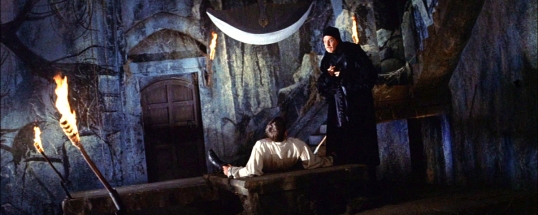
The second of Roger Corman’s Edgar Allan Poe adaptations, 1961’s The Pit and The Pendulum opens in much the same way as The Fall of the House of Usher.  A young Englishman (played by John Kerr) rides a horse across a colorful but desolate landscape.  A castle sits in the distance.

Of course, as opposed to  the 19th Century British setting of The Fall of the House of Usher, The Pit and the Pendulum takes place in 16th Century Spain, at a time when the country was still scarred by the horrors of the Inquisition.  And Francis Barnard is not traveling to the castle to see his fiancée but instead, he’s searching for information about the disappearance of his sister, Elizabeth (played by the one and only, Barbara Steele).  At the castle, Francis meets Elizabeth’s husband, Nicholas (Vincent Price) and Nicholas’s sister, Catherine (Luana Anders).  Nicholas explains that Elizabeth died under mysterious circumstances, while suffering from a rare blood disorder that seemed to quickly sap away her will to live.  Nicholas’s best friend, Dr. Leon (Anthony Carbone), explains that Elizabeth died of fright after she locked herself in one of the iron maidens in the castle’s torture chamber….

Oh yes, the castle has a torture chamber.  Nicholas’s father was a leader of the Inquisition and he used the castle as a place to conduct his business.  Nicholas’s father was a madman who suspected that his wife was cheating on him.  One day, while young Nicholas was exploring the torture chamber, he witnessed his father murder both his wife and his brother.  Nicholas watched as his mother was entombed alive and ever since, he’s been terrified of the idea of premature burial.  In fact, his fear that he may have buried alive Elizabeth while she was still alive is driving him mad.  The sudden arrival of the suspicious Francis doesn’t help matters….

The Pit and the Pendulum opens with splashes of color spreading across the screen, a sign that Corman was once again in a pop art state of mind when he directed this film.  The Pit and The Pendulum takes everything that worked (and didn’t work) about The Fall of the House of Usher and it turns it all up by a notch or two.  The castle is even more gothic.  Vincent Price’s Nicholas is even more mentally fragile than his Roderick Usher, though Nicholas is also a quite a bit more sympathetic.  If Roderick was a control freak who used his family’s curse as an excuse to embrace his own authoritarian tendencies, Nicholas is just a frail man suffering from PTSD.  He’s definitely more of a victim than a victimizer … or, at least, he is at first.  Much like Mark Damon is The Fall of the House of the Usher, John Kerr is a bit of a stiff in the role of Francis but it doesn’t matter.  Vincent Price is the main attraction here and Corman’s direction shows that he understood that.

And then there’s the Pendulum.  It takes a while for the Pendulum and its swinging blade to make an appearance but when it does, it lives up to the hype.  The Pendulum swings and Corman goes all out, zooming into Price’s crazed eyes while the Pendulum comes closer and closer to its latest victim.  The images are tinted red and green and the Pendulum itself seems to swing in a slow motion, the cinematic equivalent of a nightmare come to life.

The Pit and the Pendulum is a wonderful work of gothic pop art.  Featuring Vincent Price at his most wonderfully unhinged, this is a film we should all watch this Halloween.

Pit and the Pendulum (1961, dir by Roger Corman, DP: Floyd Crosby)


Horror On the Lens: Creation of the Humanoids (dir by Wesley E. Barry)


The Creation of the Humanoids (1962, dir by Wesley Barry)

What makes us human?  What does it mean to have free will?  What is love?  What is freedom?  The questions and more are asked in the low-budget (and rather odd) science fiction epic The Creation of the Humanoids, which you can view below!

Now, I should warn that Creation of the Humanoids is an extremely talky film.  And the plot is occasionally difficult to follow. There’s a lot of ennui to be found in this particular film, both from the humans and those who have been built to serve them  However, I find it impossible not to love this one because it’s just such a strange movie.  I love it for the colorful set design, the contrast between the resentful robots and the paranoid humans, and the fact that the film — despite being made for next to nothing — actually has more ambition than anything ever made by several of the more successful directors working today. And, while it may not really be a horror film in the way that some of our other October films are, it still feels appropriate for the Halloween season. It just has the perfect holiday atmosphere.

First released in 1962, Creation of the Humanoids was reportedly one of Andy Warhol’s favorite films.  Keep an eye out for Plan 9 From Outer Space‘s Dudley Manlove.

October Positivity: The Apocalypse (dir by Justin Jones)


First released in 2007 and produced by The Asylum, The Apocalypse opens in much the same way as many Asylum films.  An asteroid is hurtling towards the Earth.  It crashes into our planet without warning, destroying the town of Monterey.  (“And nothing of value was lost!” says the old timey Borscht Belt comedian.)  Then more asteroids strike the planet, causing mass panic.  The power goes out.  People desperately try to reach their loved ones.

And then a tornado hits out of nowhere.

And then the state of California is suddenly hit by torrential rainfall.

And then….

Well, you get it.  Things are not going well in California or in the rest of the world.  As I said at the start of this review, the Earth being bombarded with asteroids is a pretty common theme when it comes to the Asylum.  Indeed, anyone who has watched more than a handful of Asylum films is probably already picturing the stock footage of the asteroid hurtling through space with Earth in the distance.  I’ve lost track of how many times I’ve seen that rock start to burst into flames as it enters the atmosphere.

What sets The Apocalypse apart from other Asylum asteroid films is that, after the first asteroid hits, people start to vanish.  They’re not crushed underneath an asteroid, or at least they aren’t as far as we can tell.  Instead, they just seem to vanish into thin air, as if they’ve been taken to another place.  Those who do not vanish can only stand around and wonder why they didn’t go to church more often….

“I’ve been left behind,” one character says and yes, this is indeed a mockbuster version of the Left Behind films.  I guess it makes sense.  The Asylum has produced mockbuster versions of every other genre out there.  Why shouldn’t they also try to cash in on the end times.  Really, one has to respect the fact that the Asylum managed to make its own Left Behind film without abandoning the idea of the world being bombarded by asteroids.

(And, if we’re going to be honest, the idea of God using asteroids to destroy humanity actually makes a lot more sense than the usual story that these films tend to tell.  I mean, asteroids have to be good for something, right?)

The Apocalypse follows Jason (Rhett Giles) and Ashley (Jill Stapley), a divorced couple who are trying to make their way through the state of California so that they can see their daughter Lindsay (Kristen Quintrall) before the world ends.  Along the way, Jason and Ashley discuss their own failed marriage and their guilt over the death of their son.  Though Jason and Ashley do have to deal with some unexpected weather and asteroid events, the film itself is surprisingly somber for an Asylum film.  There’s far less self-referential humor than in the usual Asylum film.  The pace is deliberate, thoughtful, and, to be honest, a bit too reverential for its own good.  The world ends but it ends very slowly.  This is probably the talkiest film that the Asylum has ever produced.

That said, the film does create a believable portrait of the type of desperation that would accompany the end of the world, with the various characters all attempting to find some sort of peace before everything ends.  The special effects may be a bit cheap but the images of deserted streets and desolate countryside are far more effective than what one might expect from an Asylum film.  This is a case where the mockbuster, flaws and all, is still superior to the original.

Late Night Retro Television Review: Highway to Heaven 2.19 “Heaven on Earth”


Welcome to Late Night Retro Television Reviews, a feature where we review some of our favorite and least favorite shows of the past!  On Thursdays, I will be reviewing Highway to Heaven, which aired on NBC from 1984 to 1989.  The entire show is currently streaming on Freevee and several other services!

This week, things get a little bit sad on the highway to Heaven.

Episode 2.19 “Heaven on Earth”

(Dir by Michael Landon, originally aired on February 26th, 1986)

Now, this episode made me cry!

While visiting an amusement park on their day off, Jonathan and Mark come across a lost six year-old girl named Sarah (Morgan Nagler).  Jonathan offers to take Sarah to the park’s security office but Sarah says that she’s not allowed to go anywhere with a stranger.  After explaining that he’s a former cop and knows how to deal with lost children, Mark asks Sarah for the name of her mother.  After learning that Sarah’s mother is named Nancy, Mark goes to the security office and has them page her.  Soon, Sarah and Nancy are reunited.  Yay!

Later, as they drive through the desert, Mark and Jonathan are nearly run off the road by a drunk driver.  A few moments later, they come across an auto accident.  The owner of a jeep swerved to avoid the drunk and instead crashed into a station wagon.  Jonathan suddenly tells Mark that they should leave but Mark walks up to the overturned car and discovers that it was being driven by Nancy.  Nancy survived the accident but Sarah did not.

Broken-hearted, Mark blames himself.  He tells Jonathan that, if he hadn’t been so eager to show off, Sarah and Nancy wouldn’t have left the park when they did and they wouldn’t have been in the car accident.  Mark pulls the car over to the side of the road and tells Jonathan to get out.  Jonathan reluctantly does so and Mark drives off.

Mark drives until the car runs out of a gas on the outskirts of a small town.  The proprietor of a local store tells Mark that the town’s pretty much been dead since the new turnpike was built.  There are two gas stations but they’re both closed on Wednesday because the owners like to go fishing together.  Reluctantly, Mark goes to the local boarding house and asks for a room for the night.

Mark is shown his room by a helpful girl named Wendy (Alyson Croft).  Inside his room, Mark spots a picture of Wendy with Sarah and realizes that Jonathan led him to the boarding house.  Later, at dinner, Mark meets Wendy’s father, a divinity student named Tom Ward (Michael Anderson, Jr.)  When Wendy goes to call her friend Sarah to find out how the amusement park was, Mark can only sit in silence as Wendy tells her father that Sarah’s family wants to speak to him.  Without telling Wendy why, Tom says that he has to go to Sarah’s house.  He tells Wendy to get to bed early and then he leaves with his wife and their infant son.

Mark goes back to his room.  Wendy pops in and to give him a heater because the furnace is broken.  Unfortunately, the heater is also broken and makes an annoying clicking sound.  Mark angrily kicks it over before going for a walk.

While standing outside of a church, Mark hears the sirens of fire engines.  The Ward house is on fire!  The firemen manage to get out Wendy’s grandmother but they say there’s no way to rescue anyone else.  Mark rushes into the house, determined to save Wendy.  And …. he promptly faints.

When he awakens, he’s with Jonathan.  Jonathan says that “the boss” has decided to give Mark the chance to play God.  Mark says that he wants everything he wishes to be true and that he wants all of his mistakes to be corrected as if they never happened.

As a result, the town is suddenly thriving but the proprietor of the now 24-hour gas station is dead as a result of having worked himself to death.  Wendy is alive but, because Mark wished for her to have everything she ever wanted, she’s now a spoiled brat.  And Sarah….

When Mark demands to see Sarah, Jonathan takes him to the cemetery and shows him that Sarah is still dead.  Jonathan explains that Sarah’s death was not his fault.  It was the fault of the drunk driver and there was nothing Mark could have done to save her.

Mark awakens in the burning house.  Not only does he manage to save Wendy’s life but, once he’s released from the hospital’s burn unit, he and Jonathan once again hit the highway….

This was a good episode, though I have to say that the Wards were a lot more forgiving about Mark burning down their house than I would have been.  This episode worked largely due to Victor French’s heartfelt performance as Mark.  Watching him, it was impossible not to feel his pain.  In the end, the message was a good one, though I do think it would have been nice to see the drunk driver punished for his actions.

Horror On TV: One Step Beyond 1.3 “Emergency Only” (dir by John Newland)


Tonight’s episode of One Step Beyond features Jocelyn Brando (sister of Marlon) as a purported psychic who warns a skeptical man that he will soon be traveling by train, that he will meet a woman with an usual, snake-design ring, and that she will end up chasing him with a knife.

The man laughs her off.  Why, he never travels by train!  Sure, he has a trip coming up but he’s already paid for his plane tickets.  This just proves what the man has always suspected, that psychic’s are all phony!  But then he gets a message that his flight has been cancelled and he’s going to have to travel to his destination by …. TRAIN!

CAN YOU PROVE IT DIDN’T HAPPEN!?

This episode originally aired on February 3rd, 1959.

The TSL Horror Grindhouse: Boogeyman II (dir by Ulli Lommel)


Filmed in 1982 but not released until 1984, Boogeyman II is — as the name implies — the sequel to 1980’s The Boogeyman.

What’s that, you say?  You don’t remember anything about The Boogeyman and you don’t want to take the time to read my review of it?  Well, don’t worry.  It’s not necessary to have seen the original Boogeyman to follow the sequel, largely because the sequel is full of flashbacks to the first film.  Boogeyman II is only 79 minutes long and 30 minutes of that running time is taken up with footage from the first Boogeyman.  Indeed, if you want to see the good parts of Boogeyman without having to deal with any of the filler, I would recommend just watching the first 30 minutes of Boogeyman II.

There is a plot to Boogeyman II, kind of.  Having survived the massacre of her family at the farm, the now-divorced Lacey (played by Suzanna Love, the then-wife of director Ulli Lommel) goes out to California to visit her friends, actress Bonnie (Shannah Hall) and her husband, director Mickey (Lommel).  How is it that Lacey, who was portrayed as being a simple and not particularly worldly farm wife in the first film, happens to be friends with a wealthy actress and director?  It’s never really explained.

Bonnie and Mickey ask Lacey whether or not the people who killed her family were ever caught.  Lacey replies that they can’t be caught because they’re spirits.  Over dinner, Lacey tells Bonnie and Mickey the story of the shattered mirror and the killer whose spirit was trapped in the broken glass.  Bonnie and Mickey listen sympathetically, though they both think that Lacey’s crazy.  (Perhaps they noticed that Lacey’s flashbacks include scenes in which she wasn’t even present.  Or maybe they’re wondering why Lacey would take the time to apparently describe a lengthy, bondage-themed nightmare that she had during the first film.  Or maybe they’re just amazed by the presence of John Carradine in the flashbacks.)  Bonnie and Mickey also think that Lacey’s story would make a great movie!

For some reason, Lacey is still carrying around a piece of the haunted mirror.  This is the mirror that contains the spirit that possessed her during the first film and which killed the majority of her family.  I would throw that piece of the mirror away but I guess Lacey’s more sentimental than I am.  A creepy butler named Joseph (Sholto von Douglas, a rather stiff actor who still had a fascinatingly menacing screen presence) steals the piece of the mirror and soon, Hollywood phonies are dying.

Boogeyman II was directed by the late Ulli Lommel, a German director who got his start as an associate of Rainer Werner Fassbinder’s and who eventually came to America, where he hung out with Andy Warhol, directed some documentaries about the American punk scene, and married heiress Suzanna Love.  Love bankrolled Lommel’s early films, including The Boogeyman.  With Lommel, it was always a challenge to figure out how seriously he took any of his films.  In interviews, he would joke about being an exploitation filmmaker while, at the same time, claiming that his films were designed to expose the hypocrisy of American society.  Boogeyman II is full of phony Hollywood types and there’s a scene where Mickey comments that, in America, “exploitation is a genre.”  It’s probably not a coincidence that it’s the servant, Joseph, who uses the mirror to take out the film’s wealthy victims.  The opening credits of Boogeyman II appear to literally be written in magic marker.  Is Lommel mocking expensive Hollywood productions or could Lommel only afford a box of magic markers?  I suppose both could be true.

The best parts of Boogeyman II are the flashback to the first film, which was a genuinely atmospheric horror film with some serious pacing issues.  The rest of Boogeyman II is dull, though you do have to appreciate the sense of ennui that Lommel brings to the proceedings.  Was the ennui intentional?  That’s the mystery of Ulli Lommel.

As for Lommel, he and Love eventually divorced and Lommel ended his career making trashy true crime films that went direct-to-video.  As usual, Lommel claimed that his crime films were meant to be a serious critique of everything that was wrong with America.  Lommel’s true crime films have none of the atmosphere or occasional flashes of wit that distinguished Lommel’s earlier films.  Was Lommel an incompetent director or was he a subversive artist?  Again, both could be true.  Lommel died in 2017, bringing to close an enigmatic career.

A Blast From the Past: Saved By The Belding (dir by Matt Hamilton and Scott Hamilton)


Do you all remember that time that Rod Belding came to Bayside High School as a substitute?

At first, the students were surprised.  Rod was the younger brother of their stuffy principal, Richard Belding.  Richard was going bald.  Rod had long blonde hair.  Richard was boring.  Rod was exciting.  Richard was by-the-book.  Rod took chances.  Richard wanted to go on a boring class trip.  Rod wanted to take the students white water rafting!  When Richard called Rod out for the way he was running his class, student Zack Morris accused Richard of just being jealous of his brother.  You would think this would get Zack suspended but instead, the studio audience just said, “Awwww!”

But then, the night before the students were due to leave for their rafting trip, Rod told Richard that he had met a flight attendant and he was abandoning the students.

“Cover for me,” Rod said.

“I’m tired of covering for you, Rod.  Get out of my school!” Richard snapped.

That said, Richard did cover for his brother.  He said Rod had the flu and then he volunteered to take the students on their rafting trip.  Kelly Kapowski was so thrilled that she kissed Richard on the cheek, which one would expect to lead to Mr. Belding losing his job once word got out that he had physical contact with a student.  Instead, the audience applauded.

Zack asked Richard why didn’t tell the truth about Rod.  It turned out Zack had overheard the whole conversation.  Richard admitted that the students at Bayside got the less exciting Belding.

“We got the better Belding,” Zack replied as the audience awwed and applauded once again.

The audience was there because this was all an episode of Saved By The Bell.  In fact, “The Fabolous Belding Boys” was perhaps the best episode of Saved by the Bell, featuring excellent performances from both Dennis Haskins and Edward Blatchford.

The 2010 short film, Saved By The Belding, tells the story of a group of men who don’t understand that Saved By The Bell was just a television show and that Dennis Haskins and Edward Blatchford were just actors.  Hoping to help them regain some sense of reality, their psychiatrist takes them to the Hollywood home of Ed Blatchford.  Ed is excited to talk to his fans, asking them if they know him from his work in Last of the Mohicans.  The men, however, want to know is he really had the flu or if Richard was just covering for him.  Ed, realizing that the men don’t understand that he’s not actually Rod Belding, invites them to join him for dinner at a nice restaurant.  However, as Ed is heading to the restaurant, he runs into an old acquaintance — a flight attendant — who invites him to come have dinner with her.

Will Ed abandon his new friends?  And will Dennis Haskins once again have to come to the rescue?

Saved By The Belding is a sweet little film, one that views the cultural obsession with Saved By The Bell with both affection and wit.  (That said, the cultural obsessions does seem to be waning a bit.  For the first time in a long time, it’s next to impossible to find the show streaming online.)  Both Dennis Haskin and especially Ed Blatchford deserve a lot of credit for being good sports and appearing as versions of themselves.  Ed’s shock when Dennis appeared out of nowhere made me laugh out loud.

Check it out below and ask yourself who got the better Belding.

Retro Television Review: Malibu, CA 1.12 “The Big Storm”


Welcome to Retro Television Reviews, a feature where we review some of our favorite and least favorite shows of the past!  On Thursdays, I will be reviewing Malibu CA, which aired in Syndication in 1998 and 1999.  The entire show is currently streaming on YouTube!

This week, a mudslide changes everything …. kind of.

Episode 1.12 “The Big Storm”

(Dir by Gary Shimokawa, originally aired on January 10th, 1999)

Stads and Jason are coming up on their big, six-month anniversary!  Stads wants to celebrate at a volleyball tournament.  Jason wants to celebrate at the “Puff Daddy” concert.  You can really tell how old this show is by the fact that 1) they’re still calling him “Puff Daddy” and 2) they’re taking seriously the idea of wanting to see him in concert.

With Stads annoyed that Jason never seems to want to do anything that she wants to do, Jason turns to Sam for advice.  Sam says that Jason should drive into Beverly Hills and buy a necklace that Stads wants.  Sam even accompanies Jason on the drive.  Awww!  What a good freind.

But then — oh no! — a storm hits.  Jason and Sam end up getting trapped in their car by a mudslide.  Trapped together, Jason and Sam share a kiss.  Its a big moment that would have been bigger if it made any sense.  Seriously, until that moment, Sam had never shown any interest in Jason whatsoever.  But now, suddenly, they’re kissing and preparing to die together.  I understand that it’s probably mudslide panic but still, it just feels as if it comes out of nowhere.

Fortunately, Jason and Sam are rescued by the lifeguards (including Stads).  Jason and Sam agree not to tell Stads about the kiss.  Jason also gives Stads the necklace (Awwww!  It’s a nice necklace!) and then suggests that, instead of seeing Puff Daddy, they just have a romantic dinner.  Stads agrees.

Unfortunately, at dinner, Stads says that she knows what happened in the car.  Jason says the kiss didn’t mean anything, just to discover that Stads was just referring to Jason and Sam talking in general.  Stads gives Jason back his necklace and then dumps him.  Good for Stads, she deserves better!

This is one of those storylines that would have worked better if I actually cared about any of the characters on the show but, for the most part, everyone is so shallow that it’s hard to really get worked up when they get trapped in a mudslide.  As well, it would have helped if Sam had ever previously shown any interest in Jason.  As well, while Jason did have a crush on Sam when the show began, that didn’t seem to last long.  Two people who produce absolutely no romantic sparks shared a kiss.  It didn’t really do much for me.

As often happens with this show, the B-plots were better than the main plot, largely because Brandon Brooks and Priscilla Inga Taylor were both willing to full embrace the absurdity of their characters.  After Peter told Murray to stop talking so much, Murray resorted to typing his words out on his laptop and having a computerized voice repeat them.  That made me laugh.  Meanwhile, Tracy — who is now dating Kip, the dumb lifeguard from the previous episode — explored her artistic side by getting a camera and taking pictures of a shirtless Scott wearing an Abraham Lincoln beard.  It was weird enough to be funny.

Anyway, Stads has escaped Jason …. for now.  Run, Stads, run!