Film Review: Argo (dir. by Ben Affleck)


When I made out my list of my 26 favorite films of 2012, Argo came in at number 19,  I think that Argo is a likable, funny, and frequently exciting film.  Not only does it feature some of Ben Affleck’s best work as a director (though I still think Affleck has yet to top Gone, Baby, Gone) but also some of his best work as an actor.  If The Town left my skeptical about Affleck’s film-making talents, Argo made me a believer again.  That said, while I think that Argo is a good film, I don’t think it’s a great film but that opinion definitely places me in both the minority of filmgoers and, since my sister Erin considers Argo to be the best film of 2012, Bowmans as well.

Based on a true story, Argo takes place in 1979.  The Shah of Iran has been overthrown and the American embassy in Tehran is overrun by Islamic militants.  Over 50 Americans are taken hostage but six embassy workers manage to escape and end up hiding in the home of the Canadian ambassador (Victor Garber).  The U.S. State Department has to find a way to get the six of them out of Iran before the militants discover their existence.

It’s up to CIA agent Tony Mendez (played, of course, by Ben Affleck) to come up with a better plan than attempting to smuggle bicycles into Iran.  Mendez’s scheme is to team up with a Hollywood makeup artist (John Goodman) and a B-movie producer (Alan Arkin) and to convince the Iranian government that he and the 6 embassy workers are actually a film crew and that they’re in Iran not on a rescue-and-escape mission but instead to scout locations for a science fiction film called Argo.

Argo, for the most part, works.  As a director, Affleck manages to deftly juggle both comedy and suspense.  The scenes where Arkin and Goodman teach Affleck how to be a Hollywood phony are frequently hilarious, while the scenes in Iran are effectively tense and claustrophobic.  The film is full of little period details that ring true and I’m still shocked that Argo didn’t receive an Oscar nomination for either Best Costume Design or Best Production Design.  The wide lapels on Ben Affleck’s suits may not have been as flamboyant as the costumes in Les Miserables but, like the costumes in Les Mis, the very sight of them not only transported us to a different time but made that time plausible as well.

As you might expect from an actor-turned-director, Affleck gets good performances from his entire cast.  Goodman and Arkin are both sympathetic as recognizable Hollywood types and Bryan Cranston has a few good scenes as a fellow CIA agent.  While the 6 hostages are all pretty much interchangeable, they are still all well-cast and sympathetic.

That said, when I saw the film, it was hard to escape the feeling that the first half of the film (in which the embassy workers hid out at the Ambassador’s house while Affleck, Arkin, and Goodman worked on promoting their fake film) was dramatically more interesting and compelling than the far more conventional second half.  Once Affleck actually reaches Tehran, Argo becomes a rather predictable, if still well-made and exciting, movie.  Perhaps that’s why, as much as I enjoyed Argo, the film didn’t make as much of an impression of me as a film with a more challenging narrative would have.  Ultimately, Argo tells the true story of people in tremendous danger but the film itself feels very safe.

Argo is one of the most acclaimed films of 2012 and it’s been nominated for 7 Oscars, including Best Picture.  To just about everyone’s surprise, Ben Affleck was not nominated for best director.  While I personally would not have nominated either Argo or Affleck, the fact of the matter is that the reason Argo has received so much acclaim is because of Affleck’s work behind the camera.  Argo is such a director’s film that it’s next to impossible to argue that Argo‘s one of the best films of the year without also arguing that Affleck is one of the best directors of the year.  Hence, Affleck’s lack of a nomination does feel like a definite snub.  Even speaking as someone who was not as enthralled with Argo as much as everyone else, I would still have nominated Affleck long before I wasted a nomination on Benh Zeitlin for relying too much on a hand-held camera while filming Beasts of the Southern Wild.

While the Academy may have snubbed Affleck, the Hollywood Foreign Press Association did not.  Earlier this night, Affleck won the Golden Globe for best director and Argo won best picture.  (Though, I have to say, I find myself wondering if my friend Jason Tarwater was right when he suggested that the notorious starfuckers of the HFPA honored Argo mostly because they wanted to hang out with the film’s co-producer, George Clooney.)  Given the fact that it’s been over 20 years since a film won Best Picture without receiving a nomination for Best Director, Affleck and Clooney might just have to be happy with the universal acclaim.

The Daily Grindhouse: BTK (dir. by Michael Feifer)


Kane Hodder as The BTK Killer

One of the unfortunate things about being a self-appointed “film critic” is that the majority of the films that have been released over the past century are neither good nor bad.  Instead, they’re simply “bleh.”  Neither good enough to be memorable nor bad enough to be truly entertaining, a bleh film sits in the gray area between good and bad.  These are the films that you watch and maybe if you’re in the right mood or you’re watching with the right audience, you’ll find the experience of watching the film tolerable.  And if you’re not in the right mood, you’ll end up bored and will probably start to forget about the film before the end credits even roll.  When you make it a point to see (and review) as many films as you possibly can, the end result is that, in between the joy of discovering some really great examples of cinematic art, you end up sitting through a lot of bleh films.

The 2008 horror film BTK is the epitome of a bleh film.

Like many direct-to-DVD horror films, BTK is based on a true-life case of serial murder.  Dennis Rader was an animal control officer living in the suburbs of Wichita, Kansas.  He was also a prominent member of the local church and, by most accounts, a devoted family man and father of two.  He was also a remorseless serial killer who, over two decades, killed at least 10 people.  His oldest victim was 62.  His youngest was 9.  When he wasn’t murdering, Rader was writing taunting letters to the police in which he named himself the “BTK,” for Bind Torture Kill.

What makes Rader’s crimes even more disturbing is that he nearly got away with them.  It wasn’t until 13 years after his last confirmed murder that Rader was arrested and confessed to being the BTK killer.  When Rader appeared in court for sentencing, he again gave the details of all ten of his admitted murders and, for a few weeks afterward, it was next to impossible to turn on a TV without seeing the footage of this mild, middle-aged men calmly explaining how he killed ten people.  I was 19 at the time and I can tell you that I had more than a few nightmares as a result of Dennis Rader.

It wasn’t just Rader’s crimes that frightened me.  It was the fact that Dennis Rader wasn’t some masked psycho like I used to seeing in the movies.  What frightened me was that Dennis Rader seemed so normal.  Dennis Rader was literally the killer next door.

A lot of great horror films have been based on the concept of the killer next door but unfortunately, BTK, though competently directed by Michael Feifer, is not one of them.  Offering up a highly fictionalized account of Rader’s crimes, BTK is pretty much a typical psycho film that uses its true life origins to hide the fact that there’s not really much going on.  Playing the title role, Kane Hodder (of Friday the 13th fame) is menacing and effective when the film calls on him to be the evil BTK but he’s far less effective when it comes to recreating the mask of normalcy that Rader used when dealing with his friends and his neighbors.

The reason why the real-life Dennis Rader was such a frightening and disturbing figure was because he seemed so normal and ordinary.  The fear that he inspires comes not from his crimes but from the fact that if Dennis Rader could have been a serial killer than just about anybody could be.

That’s a genuinely scary idea that the cinematic BTK never seems to grasp.

Film Review: Judgment At Nuremberg (dir by Stanley Kramer)


I previously posted a review of the 1967 best picture nominee Guess Who’s Coming To Dinner that was somewhat critical of Stanley Kramer as a filmmaker.  In retrospect, I feel like I may have been a bit too dismissive of Stanley Kramer.  When one looks over the list of every film that has ever been nominated for best picture, one comes across the name Stanley Kramer (as a producer, a director, or both) far too many times to just blindly dismiss him for the sin of being old-fashioned.  While Kramer made his share of well-intentioned misfires like Guess Who’s Coming To Dinner, he was also responsible for some films that remain important and watchable today.  Judgment at Nuremberg is one of those films.

Judgment at Nuremberg opens in 1947, with one car being driven through the ruins of Nuremberg, Germany.  Inside the car is Dan Haywood (Spencer Tracy), a judge from Maine who has been appointed chief of a military tribunal that will be passing judgment on four German judges who are accused of crimes against humanity for their legal rulings during the Nazi regime.  As Haywood quickly learns,  many people don’t feel that the Nazi judges should be held as accountable for their actions as men like Hitler, Goebbles, and Goering should have been.  It’s up to Haywood to determine whether the accused were simply doing their job or if they had a responsibility to defy the laws that they had sworn to uphold.

Judgment at Nuremberg almost feels like two films.  The first film is a courtroom drama, where the Nazi judges (the main one of which is played by Burt Lancaster) are prosecuted by the fiery Col. Tad Lawson (Richard Widmark) and defended by the idealistic Hans Rolfe (Maximilian Schell).  While Lawson approaches the case and regards the defendants with righteous anger, Rolfe takes a more cerebral approach to defending the undefensible.  Rolfe argues that the judges were following the laws of Germany and that if the tribunal finds them guilty than it will be finding the entire nation of Germany guilty.  (In a rather clever twist, director Kramer and screenwriter Abby Mann initially make the German defense attorney a far more likable character than the American prosecutor.)  During the trial, we also hear heart-wrenching testimony from two people (played by Montgomery Clift and Judy Garland) who were victimized by the Nazi regime and the judges who gave legal legitimacy to the regime’s crimes.

The second film deals with Haywood adjusting to working in Germany and trying to understand how the Nazis could have come to power in the first place.   Haywood asks several Germans to tell him about life under the Nazis and every time, he is met with bland excuses.  (“We were not political,” he is told more than once.)  The film’s strongest scenes are the ones where Haywood simply walks alone through the ruins of Nuremberg.  Spencer Tracy was a uniquely American actor and, much as he did in Guess Who’s Coming To Dinner, Tracy here stood in for every American who was struggling to make sense of a changing world.

In his book Pictures At A Revolution, Mark Harris correctly points out that Stanley Kramer started out as a producer and, even after he started directing, he still approached filmmaking like a producer.  While that approach led to many uninspiring films, it was also the right approach for Judgment at Nuremberg.  Perhaps realizing that Judgment at Nuremberg was a long and talky movie about a disturbing subject manner, Kramer made the very producer-like decision to fill Judgment at Nuremberg with recognizable faces.  While this approach has proven disastrous for many films, it works quite well in Judgment at Nuremberg.

This is one of the most perfectly cast films of all time, with all of the actors bringing both their characters and the issues that they’re confronting to vivid life.  As the main defendant, Burt Lancaster brings a combination of intelligence and self-loathing to his role, playing him in such a way to reveal that even he can’t believe the evil he upheld as a judge.  Meanwhile, Spencer Tracy is perfectly cast as a world-weary man who is simply trying to figure out what justice means in the post-war world.  Maximilian Schell plays his role with so much passion that it’s impossible not to listen to him even when you despise the argument he’s making.  Marlene Dietrich has an extended cameo where she plays the widow of Nazi general who befriends Judge Haywood but still refuses to admit that she knew anything about what Adolf Hitler was doing.  Even William Shatner shows up, playing a small role as Haywood’s chief military aide and yes, he does deliver his lines in that Shatner way of his.

First released in 1962, Judgment at Nuremberg won Oscars for Best Actor (Maximilian Schell) and Best Adapted Screenplay (Abby Mann) and was nominated for 9 more: Best Picture, Best Director, Best Actor (Spencer Tracy), Best Supporting Actor (Montgomery Clift), Best Supporting Actress (Judy Garland), Best Black-and-White Art Direction, Best Black-and-White Cinematography, Best Black-and-White Costume Design, and Best Film Editing. While it’s hard to argue with the victory of West Side Story in that year’s Oscar race, Judgment at Nuremberg remains a watchable and thought-provoking film.

The Daily Grindhouse: Toe Tags (dir by Darla Enlow)


Bad things are happening at the Valley Creek Apartments.  The residents are getting naked and getting murdered by a stranger with a knife.  Could the murderer by the creepy landlady?  Or could it be … someone else?  Two detectives (played by director Darla Enlow and Marc Page) are determined to solve the crimes and it quickly turns out that both of them have a connection to every single person who has been murdered.  The very angry coroner (Scott Killman) is upset because someone keeps breaking into the morgue and stealing all of the toe tags.  An even angrier police captain (Larry Scott) shows up at random moments to yell at the two detectives.  Finally, there’s a crime scene photographer (Andrew Lombardo) who seems to enjoy his job way too much.  Needless to say, it all concludes with a surprise ending that actually works a lot better than you might expect.

Toe Tags, which was released in 2003, is probably the one of the least known, most obscure films that I’ve ever reviewed for the Shattered Lens.  I came across the film as a part of Decrepit Pit Of Nightmares box set, which I bought as the result of reading a review of Las Vegas Bloodbath that was written by our very own Ryan C., the Trashfilm Guru.  So, when you get right down to it, its’ pretty much Ryan’s fault that I watched Toe Tags.

Well, that’s okay because I actually enjoyed the nonstop silliness of Toe Tags.  Clocking in at 68 minutes and shot-on-video, Toe Tags is one of those zero budget exploitation films that you have to admire just because it actually managed to get made and released.  The whole film has this random, improvised feel to it.  The story is quite bold about its refusal to make any sense and, while none of the actors give good performances, they’re all trying so hard that it’s impossible not to like them.  My favorite performers were Scott Killman and Larry Scott.  You could seriously tell that both of them were having a lot of fun going over-the-top with even the simplest line of dialogue.

The end of the film features about 10 minutes of clips of the actors blowing their lines or cracking up into laughter and, to my surprise, I actually enjoyed this obvious padding.  It was nice to see that everyone had fun even while they were having to play dead and it reminded me of the fun that I use to have doing plays in high school.  The end credits feature credits like, “Thank you Craig Lamb for the endless supply of blood” and “Production assistant…anyone on the set!,” and, again, they just add to likable drama club feel of the whole production.

(Warning: There’s some nudity in the trailer below and a lot of fake blood.)

Film Review: Camelot (dir by Joshua Logan)


Back when I was 18 years old, I auditioned for a community theater production of Camelot.  For as long as I can remember, I’ve always been intrigued with the spectacle and romance of the Arthurian legends and I just knew that I would make the perfect Guinevere.  And so, for two nights, I auditioned.  I performed “Baby One More Time” as my audition song, I showed off my dance moves, and I did countless cold readings with countless potential Arthurs and Lancelots.  At the end of the two days, the director told me that he would be in touch and I left with stars in my mismatched eyes, convinced that I had won the role of Guinevere.

Two days later, I got a call not from the director but from the assistant director.  She informed me that while my dancing was impressive, I wasn’t right for the role of Guinevere because:

1) I was too young.

2) I couldn’t sing.

3) My voice carried too much of a rural twang for me to be a believable Queen of England.

However, she did tell me that I had been selected to be a part of the “chorus.”  Well, I may have only been 18 but I still had my pride so I told her that, if I couldn’t I play Guinevere, I had no interest in being in their little production of Camelot.  I was later told that this caused a lot of people to assume that I was a diva but no matter, I stand by my decision.

When I later saw the theater’s production of Camelot, I felt thoroughly vindicated.  It wasn’t just the fact that the actress they cast as Guinevere had no stage presence, no boobs, and a horsey face.  It’s the fact that Camelot itself isn’t a very good show.  As good as the songs are, Camelot is something of a talky mess and Pellinore is one of the most annoying characters ever.

It was only after I saw that mediocre production that I discovered that there was a film version of Camelot. Released in 1967, the Warner Bros. production was one of the many big budget musicals released in the late 60s.  It has a terrible reputation (and was a box office bomb) but I recently decided to watch it for two reasons.

First off, Camelot was nominated for five Academy Awards (though not best picture) and won three (Best Art-Set Decoration, Best Costume Design, and Best Music — Scoring of Music, Adaptation or Treatment).  That means that Camelot won two more Oscars than The Graduate and one more than Bonnie and Clyde.

Secondly, this film version of Camelot features Franco Nero (who, in 1967, was literally the most handsome man in the world) in the role of Lancelot.

And so, I recently set aside 3 hours and I watched the film version of Camelot.

Camelot tells a familiar story.  Arthur (played here by Richard Harris) becomes king of England and he marries Guinevere (Vanessa Redgrave).  At the magnificent castle of Camelot, the most noble knights of England gather at a round table and Arthur preaches equality and chivalry.  Eventually, the righteous French knight Lancelot (Franco Nero) travels to Camelot and becomes Arthur’s  greatest knight.  However, Lancelot and Guinevere fall in love and, as a result of the schemes of Arthur’s illegitimate son Mordred (David Hemmings), Lancelot and Arthur are soon at war with each other.

Despite my dislike of the stage production, I actually started watching the film version with high hopes.  I have a soft place in my heart for the overproduced musical spectacles of the late 60s and I figured that what was slow on stage might be more tolerable when seen on film.  Unfortunately, I was incorrect.  Camelot is a painfully old-fashioned film and, clocking in at 179 minutes, it’s also one of the most boring movies ever made.  Richard Harris was reportedly miserable while making the film and it shows in his performance.  You get the feeling that King Arthur would rather be anywhere other than Camelot.

The only time that the film comes alive is when Franco Nero is allowed to command the screen.  While the very Italian Nero is somewhat miscast as the very French Lancelot, that doesn’t change the fact that Nero plays the role with a passion that’s missing from the rest of the film.  Franco Nero’s blue eyes did more to make me believe in Camelot than any of the songs sung by Richard Harris.  One need only watch the scenes that Franco shares with Vanessa Redgrave to understand why they’ve been a couple for over 40 years.

Ultimately, Camelot is interesting mostly as an example of how the old Hollywood studio establishment attempted to deal with competition from television and European films.  Instead of attempting to adapt to the new culture of the 60s, the old studio bosses just continued to make the same movies they had always made, with the exception being that they now spent even more money than before to do so.  While it’s easy to mock them, you have to wonder if the Camelot of 1967 is all that different from the John Carter of today.

The Daily Drive-In: The Creature From The Black Lagoon (dir. by Jack Arnold)


As anyone who knows me can tell you, Lisa Marie doesn’t do water.

Seriously, I have a very intense fear of drowning and, while I might enjoy laying out by the pool during the summer, you’re never going to catch me actually going anywhere near the deep end.  I’m the epitome of the girl who loves the beach but hates the ocean.  As a result, I have a hard time with movies the feature swimmers thrashing about in the water or ancient monsters coming up to the surface in search of swimsuit-clad victims.

For lack of a better term, these films freak me out.

Sometimes, however, it’s fun to be freaked out.  Perhaps that’s why I so love the 1954 monster classic, The Creature From The Black Lagoon.

Like all good B-movies from the 1950s, The Creature From The Black Lagoon starts off with a lot of stock footage and a stuffy narrator telling us about how the Earth was created and how mankind originally evolved from a creature that crawled out of the sea.  The narrator manages to cover all the bases by including a few Biblical quotes with his explanation of how evolution works.

From the beginning of mankind, we fast forward to the 1950s.  A fossilized claw has been discovered in the Amazon and a group of scientists think that it could be evidence of the missing link in human evolution.  Mark (Richard Denning), who is kind of a jerk, funds an expedition to the Amazon to search for more evidence.  Accompanying Mark is hunky young scientist David (Richard Carlson) and David’s girlfriend, Kay (Julie Adams).  Traveling on a boat captained by the rather gruff Lucas (Nestor Paiva), they go to the camp where the fossil was originally discovered.  However, once they arrive, they discover that everyone in the camp has been killed.  Lucas suggests that the camp was attacked by a jaguar.

Lucas, needless to say, is totally incorrect.  The film isn’t called The Jaguar From The Black Lagoon.  It’s called The Creature From The Black Lagoon and the creature, also known as the Gill-Man (played by Ben Chapman when on land and by Ricou Browning whenever he’s underwater), is none too happy about these strangers invading his home.  Soon, the Gill-Man is stalking the expedition as they move up and down the Amazon River.

The Creature From The Black Lagoon is probably best known for the dream-like sequence in which Kay, wearing a white bathing suit that is simply to die for, swims in the Amazon River without realizing that the Creature is following just a few feet below her.  This scene (which does little to help with my aquaphobia) is one of the most iconic in the history of monster cinema.  Expertly framed by director Jack Arnold, this scene is distinguished by the graceful movement of both Julie Adams and Ricou Browning.  It’s as close as a monster movie has ever gotten to duplicating ballet.

Ultimately, like all good monster films, the Creature from the Black Lagoon is on the side of the monster.  The members of the expedition are, for the most part, interchangeable and, when the Gill-Man attacks, he’s acting more out of self-defense than out of hostility.  The expedition, after all, has invaded his home.  Like many 50s B-movies, the theme for The Creature From The Black Lagoon is not that people should be careful while investigating mysteries but that most mysteries are best left unsolved.

When you combine one of the genre’s most iconic monsters with Jack Arnold’s atmospheric direction, the end result is one of the best B-movies ever made.

What Lisa and Erin Watched Last Night #63: Bring It On (dir. by Peyton Reed)


Last night, my sister Erin Nicole (a.k.a. Dazzling Erin) and I watched the classic 2000 cheerleading movie Bring It On on AMC.

Why Were We Watching It?

Seriously, how can you not watch Bring It On?

Back in high school, while I was doing my goth ballerina thing, Erin Nicole was a cheerleader and, though she denies it, she pretty much was Kirsten Dunst back then.  Anyway, Erin usually refuses to watch Bring It On because she says she had already had to sit through it a few hundred times by the time she turned 17.  For this reason, I always make it a point to let Erin know when Bring It On is on TV and to try to trick her into watching it with me.

But last night, to my surprise, she was the one who saw the movie listed in the guide and started watching it because, according to her, there was nothing else on.  (Personally, I think Erin was feeling nostalgic but she denies it.)  I joined her shortly after the movie started and, according to Erin, I spent the next two hours jumping around and acting all hyper.  That’s not quite the way I remember it but Erin’s the cheerleader so I’ll take her word for it.

What’s It About?

Torrance (played by Kirsten Dunst) is the new captain of her high school’s cheerleading squad and is determined to lead them to yet another national title.  However, Missy (Eliza Dushku), a new member of the squad, reveals that the squad only won those titles by stealing routines from an inner city cheerleader squad.  Torrance now has to create an original routine while dealing with her cheating boyfriend (Richard Hillman) and flirting with Missy’s brother (Jesse Bradford), who looks a lot like Paul Rudd and is skeptical about whether cheerleading’s really all that important in the grand scheme of things.

What Worked?

Let’s just come right out and say it: Bring It On is one of the greatest high school movies ever made.  It’s fun, it’s funny, and best of all, it’s real.  The film’s director, Peyton Reed, the film’s writers, Jessica Bendinger and Stephen White, and the film’s cast all perfectly capture just how important the little dramas are when you’re a teenager.  The film even manages to say something very important about issues like race and economic inequality.

Plus, as Erin and I both agreed last night, Jesse Bradford is HOT!

According to Erin, she has flashbacks and starts laughing uncontrollably  whenever she hears the line “These are spirit fingers!”

What Didn’t Work?

It all worked.  Seriously, if you can be critical of a film like Bring It On then you’re probably taking life too seriously.

“OH MY GOD!  Just like Erin!” Moments

Last night, I finally got Erin to admit that she liked Bring It On because it reminded her of her cheerleading days but Erin added, “But I wasn’t as bouncy as Kirsten Dunst is in this movie.”  To that, I can only smile and say, “Whatever,” because, as everyone knows, the Bowman Girls are always bouncy.  That’s a part of our charm.

Lessons Learned

If you’re going do it, then bring it!

Film Review: Dead End (dir. by William Wyler)


Originally released in 1937, Dead End is a gangster film with social conscience.  Based on a Broadway play and featuring a screenplay by the iconic progressive writer Lillian Hellman, Dead End is a crime film that’s more interested in the root causes of crime than in crime itself.

Dead End takes place over the course of one day in the slums of New York City.  While tenement children spend their time swimming in the East River and idealizing gangsters, wealthy people live in high-rise apartments and depend on the police and their doorman (played, naturally enough, by Ward Bond) to keep them protected from the poor people living next door.

Among the poor is Drina (Sylvia Sidney), who divides her time between marching on a picket line and trying to keep her younger brother Tommy (Billy Halop) from hanging out with the local street gang, the Dead End Kids (Huntz Hall, Bernard Punsly, Leo Gorcey, and Gabriel Dell).  Drina’s childhood friend is Dave (Joel McCrea), an idealistic architect who is having an affair with a rich man’s mistress (Wendy Barrie).

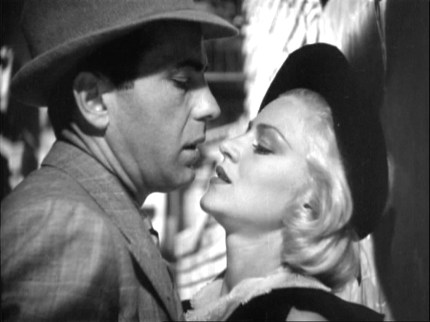
Complicating things is the arrival of Baby Face Martin (Humphrey Bogart).  Like Dave, Martin grew up in the slums.  However, while Dave is trying to escape by making an honest living, Martin has already escaped by choosing a life of crime.  Now, he’s viewed as a hero by Tommy and his friends and with wariness by Dave and Drina who know that Martin’s presence will eventually lead to the police invading their home.  Martin, however, is more concerned with seeing his mother (Marjorie Main) and his ex-girlfriend (Clare Trevor), who has become a prostitute and is suffering from syphilis.

For a film that was made close to 80 years ago, Dead End holds up pretty well.  Is this because it’s a brilliant film or just because the connection between poverty and crime has remained one of the constants of human history?  It’s probably a combination of both.  Considering that Dead End was filmed on a Hollywood backlot, it’s a surprisingly gritty and realistic film that only occasionally feels a bit stagey.  The film’s entire cast does a good job of bringing this particular dead end to life, though the obvious star of the film is Humphrey Bogart.  As played by Bogart, Baby Face Martin is both sympathetic and despicable, the epitome of the potential that can be found and wasted in any American city.

Dead End was nominated for best picture but lost to The Life of Emile Zola.  The film also received a much deserved nomination for best art design but lost to Lost Horizon while Clare Trevor lost the race for best supporting actress to Alice Brady, who won for In Old Chicago.  Perhaps most surprisingly of all, Humphrey Bogart did not even receive a nomination for his excellent work in Dead End.  Meanwhile, the film’s tough gang of street kids proved to be so popular that they, as a group, were cast in several other films.  Originally credited as the Dead End Kids (and later known as the Bowery Boys), they ended up making a total of 89 films together.  With the possible exception of Angels With Dirty Faces, none of those films are as highly regarded as Dead End.

The Daily Grindhouse: Mother’s Day (dir. by Darren Lynn Bousman)


One of the great things about writing about films is that occasionally you both get to watch a film that, despite all of your expectations, turns out to be pretty good and then you get to tell other people about it!  Case in point: 2012’s Mother’s Day.

Mother’s Day opens with two memorable scenes.  In the first scene, we watch as a mysterious woman sneaks into a hospital and kidnaps a baby out of the maternity ward.  When a guard attempts to stop her, he ends up with a knife driven into his throat.  While we’ve seen similar scenes in other horror movies, it’s rare that we’ve ever seen this scene handled as well as it is in Mother’s Day.

The second scene opens with an almost intrusive close-up of a woman (played by Jaime King) sobbing as she stares at herself in a mirror.  Again, it’s not that we haven’t seen this scene in other horror films.  Instead, it’s the fact that Jaime King so totally throw herself into those sobs.  We believe her tears and immediately, we want to know why she’s crying and we want to know how she’s connected to that baby being kidnapped from the hospital.  In just two scenes, Mother’s Day captures our attention and, once it grabs a hold of us, it doesn’t let go for the next two hours.

It turns out that King and her husband have just bought a new house and, on one stormy night, they’re throwing a party with a few of their closest friends.  It quickly becomes obvious that, regardless of how happy everyone’s pretending to be, there’s a lot of tension between King and her husband.  Something has happened in the past that no one wants to talk about…

Suddenly, three heavily armed men barge into the house and take everyone hostage.  The three of them are brothers and they’ve just robbed the bank.  The youngest has been shot and is bleeding to death on the couch.  The oldest brother explains that they’re looking for their mother.  She used to live in the house before King and her husband bought it.  The brothers didn’t know that their mother had been kicked out of the house and they’ve been mailing money to the address for the past few months.  When King and her husband claim that none of the money ever showed up at the house, the brothers call their mother and soon, mom shows up to take control of the situation.

Mom is named Natalie and she’s played by Rebecca De Mornay.  From the minute she shows up, it’s obvious that Natalie is both obsessed with her children and that she’s totally and completely insane.  Continually switching between being sweet and psychotic, Natalie is a thoroughly frightening and disturbingly believable monster.  De Mornay wisely underplays Natalie’s more showy moments and prevents the character from becoming just another stereotypical movie psycho.  Instead, she’s the type of villain that we can easily imagine meeting in the real world.  Needless to say, that makes her a hundred time more frightening than any faceless killer with a machete.

Mother’s Day, which was made in 2010 but not released in the U.S. until earlier this year, is a remake of low-budget, 1980 horror film.  This is a rare case where the remake is about a thousand times better than the original.  Director Darren Lynn Bousman keeps the action moving at a perfect pace and the film’s cast (which includes True Blood‘s Deborah Ann Woll in a showy role) creates a disturbingly credible gallery of rogues and victims.

Mother’s Day is a rarity — a horror remake that not only deserves to be seen but which is so good that the original might as well just be an afterthought.

( An earlier version of this review appeared on HorrorCritic.com.)


Film Review: Guess Who’s Coming To Dinner (directed by Stanley Kramer)


Sometimes, you just had to be there.

That was my reaction as I watched the 1967 Best Picture nominee Guess Who’s Coming To Dinner.  While this film may have been topical and even controversial when it was first released, when watched today it seems to be rather mild and tame.

In Guess Who’s Coming To Dinner, Spencer Tracy plays Matt Drayton.  Matt’s a San Francisco newspaper publisher, a respected member of the upper class establishment.  His wife, Christina (Katharine Hepburn), owns a trendy art gallery and Matt spends his spare time playing golf with Monsignor Ryan (Cecil Kellaway).  He’s the father of the free-spirited Joey (Katharine Houghton, who was Hepburn’s niece in real life).  He’s also, as we’re told repeatedly by every other character in the film, a liberal who supports the civil rights movement.

As the film begins, Joey is returning from a vacation in Hawaii and she has big news.  While in Hawaii, she met and fell in love with the widowed John Prentice, a highly succesful doctor who is literally on the verge of winning a Nobel Peace Prize.  Though he’s 16 years older than her and they’ve only known each other for 10 days, Joey and Prentice are planning on getting married.  While Joey thinks that she’s bringing Prentice to San Francisco just so her parents can meet their future son-in-law, Prentice has specifically come to ask Matt’s permission to marry Joey.  As Prentice explains to Matt, he’ll call the marriage off if Matt doesn’t approve.

John Prentice, by the way, is played by Sidney Poitier and that is the source of the film’s conflict.  Will Matt give his daughter permission to marry a polite, considerate, wealthy, saintly, world-renowned doctor despite the fact that he happens to be black?

Watching Guess Who’s Coming To Dinner was a bit of a culture shock to me, both because I’m the result of an interracial marriage myself (my mom was Spanish and my dad’s white) and because several of my friends are either in or have been a part of an interracial relationship or marriage.  For people my age, it’s not a big deal.  We take it for granted that if you find someone to be attractive, you can have a relationship with him regardless of whatever race he may happen to be.

While I was doing research on Guess Who’s Coming To Dinner, I was reminded that this wasn’t always the case.  When Guess Who’s Coming To Dinner was first released in 1967, interracial marriage was still illegal in 17 states.  In that same year, U.S. Secretary of State Dean Rusk offered to resign when his daughter married a black man.  When Guess Who’s Coming To Dinner was first released, interracial marriage still a controversial subject and when Spencer Tracy struggled with his feelings about it, he stood in for countless Americans who, though they may  have taken pride in how tolerant they were, still weren’t sure what they would do if a black man tried to join their family.

As you can probably guess, Guess Who’s Coming To Dinner is far more interested in teaching a lesson than telling a story.  It’s perhaps not surprising that the film was directed and produced by Stanley Kramer.  Kramer was one of the most prominent filmmakers of the 1960s.  He specialized in making big films that dealt with big issues, the type of films that were regularly nominated for an academy award but rarely honored with an actual win.  In many ways, Guess Who’s Coming To Dinner is a prototypical Kramer picture — its heart is in the right place but the film itself is so conventional and free of ambiguity that it never manages to truly challenge the status quo that it claims to be criticizing.*

In his excellent look at the 1967 nominees for best picture, Pictures At A Revolution: Five Movies And The Birth of The New Hollywood, Mark Harris provides a fascinating behind-the-scenes look at the filming of Guess Who’s Coming To Dinner.  Harris quotes Kramer as explaining that the character of John Prentice had to be perfect because, if the character had any flaws, then bigots in the audience would have seized on those flaws as the reason why Prentice and Joey should not be allowed to marry.  As Kramer explains it, the entire film was set up to make it clear that the only possible reason that Matt could have to object to Prentice would be the color of his skin.

To an extent, I can see Kramer’s point (and again, it’s hard to judge what was necessary to make a point in 1967 from the perspective of 2013) but, as I watched Guess Who’s Coming To Dinner, it was hard not to feel that the main problem with the film was that Prentice was just too perfect.  Certainly, he was too perfect to be in love with Joey who, as played by Houghton, simply seemed to be too naive and foolish to be a good match for a man who is on the verge of winning a Nobel Prize.  Even more importantly, it’s hard to escape the fact that this accomplished, confident black man still needs to get the permission of a well-meaning white liberal before he can marry the woman he claims to love.

Ultimately, despite the film’s noble intentions, it feels more than a bit condescending.  At no point is Prentice allowed to show any anger or frustration at having to prove himself.  There’s even a scene where Prentice criticizes his own father for being too hung up on racism.  “Not until you and you’re whole lousy generation lay down and die will the weight of you be off our backs … You think of yourself as a colored man … I think of myself as a man!” Prentice tells him, as if his success was due to ignoring racism as opposed to defying it.

If Guess Who’s Coming To Dinner has dated badly as a look at race relations in the United States, it remains watchable because of the performances of Katharine Hepburn and Spencer Tracy.  This was their 9th and final film together and the love that these two accomplished actors felt for each other shines through every scene.  Tracy was seriously ill while making the film (and died before it was released) but he gave one of his best and most heartfelt performances here.  He was nominated for a posthumous Oscar but lost to Rod Steiger, who co-starred with Poitier in the film that beat Guess Who’s Coming To Dinner for best picture, In The Heat of the Night.

In the Heat of the Night is best-remembered for the scene in which Poitier angrily declares, “They call me …. MISTER TIBBS!”  This line epitomized the righteous anger that he was not allowed to display in Guess Who’s Coming To Dinner.  If only Guess Who’s Coming To Dinner had its own “MISTER TIBBS” moment, it might be remembered as something other than a film that seems curiously out-of-place as a nominee for best picture.

—

* That said, Kramer’s post-Guess films were actually pretty interesting and a bit more daring.  Some day, I’ll have to get around to reviewing his 1970 campus unrest film, R.P.M.