Retro Television Review: Homicide: Life on The Street 4.2 “Fire Part Two”


Welcome to Retro Television Reviews, a feature where we review some of our favorite and least favorite shows of the past!  On Sundays, Lisa will be reviewing Homicide: Life On The Street, which aired from 1993 to 1999, on NBC!  It  can be viewed on Peacock.
Guest reviewer alert!  I’m filling in for Lisa on the Homicide beat this week.  Let’s take a look at the second episode of the fourth season.

Episode 4.2 “Fire Part Two”

(Dir by Nick Gomez, originally aired on October 27th, 1995)

Continuing from where the previous episode ended, Pembleton, Bayliss, and Kellerman investigate the second warehouse fire.  Another victims has been found burned to a crisp in the fire.  Her dental records identify here are Bonnie Nash, a teenage girl.  The positioning of her body indicates that, unlike the first victim, she was already dead when the fire was set.

Pembleton continues to dislike Kellerman and gets especially annoyed when Kellerman announces that he’s decided to quit smoking.  Bayliss is suffering from a degenerative disc and spends more time complaining about the pain than actually investigating the case.  It’s Kellerman who solves the case and tricks chemistry teacher Gavin Robb (Adam Trese) into confessing.  While in the box with him, Kellerman plays good cop and even tells Robb that he’s free to leave after Robb denies being the arsonist.  As Robb stands, Kellerman whispers, “Why did you kill the dog?”

Without thinking, Robb replies, “I didn’t know it was there.”

(Of course, there was no dog there.)

Realizing his mistake, Robb confesses.  Bonnie was one of his students.  Having decided to kill her, Robb set the first fire to fool everyone into thinking that there was a serial arsonist on the loose so that the arsonist would be blamed when Bonnie’s body was found in the second fire.  The first death was an accident.  The death of Bonnie was premeditated.  When asked why he killed Bonnie, Robb replies, “That’s my personal business.”

Giardello invites Kellerman to join Homicide.  At first, Kellerman refuses because he doesn’t think he’s smart enough to be a member of the murder police.  But after visiting his father at his dead-end job in a distillery, Kellerman changes his mind.

Meanwhile, Kay and Munch both study for the sergeant’s exam.  Kay makes it to the exam and probably aces it.  Munch can’t find his lucky socks and misses it.  I would have missed it too.  You can’t do anything without the lucky socks.

This episode was an improvement over the previous episode.  Last episode, Kellerman came across as being a cliche, the hot-headed cop who has a problem with authority.  This episode, Kellerman was more likable and also a lot less cocky.  That he’s insecure about whether or not he can keep up with the other homicide detectives makes him a very relatable character.  It would have to be intimidating to find yourself suddenly working with someone like Frank Pembleton, who is always portrayed as being the best of the best.

As I mentioned last week, Reed Diamond was originally a controversial addition to the cast.  At the time, many critics said the show was selling out by casting an actor who didn’t look like Ned Beatty or Jon Polito.  Reed Diamond and Mike Kellerman would both prove themselves, leaving little doubt that they belonged.  Later, Homicide would make some bad casting decisions.  (Five word: Jon Seda as Paul Falsone.)  But Reed Diamond, with this episode, steps up and shows that he can keep up with the rest of the squad.


Retro Television Review: Homicide: Life On The Street 4.1 “Fire: Part One”


Welcome to Retro Television Reviews, a feature where we review some of our favorite and least favorite shows of the past!  On Sundays, Lisa will be reviewing Homicide: Life On The Street, which aired from 1993 to 1999, on NBC!  It  can be viewed on Peacock.

Episode 4.1 “Fire: Part One”

(Directed by Don Scardino, originally aired on October 20th, 1995)

Hey, guest reviewer here!  It’s my pleasure to review the fourth season premiere of Homicide.  As someone who lived in Baltimore while the show was airing, I watched every episode of Homicide (and later, The Wire).  It was always interesting to see Frank Pembleton and Tim Bayliss and John Munch and Kay Howard walking down streets that I recognized.  It didn’t matter that the show presented Baltimore as being a hotbed of murder and corruption, mostly because anyone who has lived in Baltimore knows that our city is often just that.  There are wonderful places and people in Baltimore.  There’s also a a lot of problems.

Enough editorializing from me!  Let’s talk about the fourth season premiere.  It opens with Kay and Munch talking about how Detectives Beau Felton and Stanley Bolander have been suspended without pay for 22 weeks because of some drunken shenanigans at a cop convention.  That was the way that the show wrote out former series regulars Daniel Baldwin and Ned Beatty.  (Baldwin was dropped due to his drug addiction.  Beatty wanted to get back to movies.)  Felton?  Sure, I could imagine him doing something stupid at a convention.  But the idea that conservative, straight-laced Bolander would join him in that behavior?  That’s never sat well with me.  That was out of character for Stanley Bolander.

Gee’s unit is now down by three detectives.  He needs replacements but Megan Russert — Tim’s cousin, we’re told! — says that they can’t afford to hire any new detectives.  Maybe Gee should reach out to another division and see if anyone wants to transfer.  Gee looks at the Board, which is covered in red ink.  His remaining detectives are struggling to close cases and nobody wants to partner up with Lewis.

Pembleton and Bayliss, the best Homicide team out there, are investigating a warehouse fire.  An unidentified body has been found in the warehouse, burned to a crisp.  They meet Detective Mike Kellerman (Reed Diamond), the cocky and youngish arson investigator who is convinced that the fire was set by a bigshot businessman named Matthew Rowland.  Kellerman gets on Pembleton’s nerves but he bonds with Bayliss.  Even though it hasn’t happened by the end of this episode, it’s obvious that Kellerman  is going to end up at Homicide.  And because everyone in this episode keeps talking about how they refuse to partner up with Lewis, you can guess who Kellerman is going to end up working with.

Mike Kellerman went on to become one of the best characters on the show.  Everyone remembers the Luther Mahoney story arc.  Reed Diamond eventually became a key member of the ensemble.  But I can remember the controversy that initially greeted his character.  A lot of viewers and critics resented that he was replacing the popular Ned Beatty.  (No one really cared about Daniel Baldwin.)  Reed Diamond was seen as a pretty boy actor who was intruding on a gritty crime drama.  As an introduction, this episode doesn’t do Kellerman many favors.  He comes on very strong and, within minutes, he’s antagonizing and double guessing Pembleton.  A scene where Megan confronts him about going after Matthew Rowland makes it seem like the show is trying too hard to be a typical cop drama.  It reminded me of when Itchy & Scratchy added Poochie and Poochie was just too in your face with his coolness.  Luckily, Reed Diamond was a better actor than Homer Simpson and Mike Kellerman did not die on the way back to his home planet.  Instead, after this shaky introduction, he became a key member of one of the best casts in the history of television.

This episode ends on a cliffhanger, with another fire being set at another warehouse.  Kellerman’s going to be around for a while, whether Frank Pembleton likes it or not.

Homicide: The Movie (2001, directed by Jean de Segoznac)


Before The Wire, there was Homicide: Life On The Streets.

Based on a non-fiction book by the Baltimore Sun’s David Simon, Homicide: Life on the Streets aired for seven seasons on NBC, from 1993 to 1999. For five of those seasons, Homicide was the best show on television. Produced and occasionally directed by Barry Levinson, Homicide was filmed on location in Baltimore and it followed a group of Homicide detectives as they went about their job. From the start, the show had a strong and diverse ensemble, made up of actors like Andre Braugher, Ned Beatty, Jon Polito, Melissa Leo, Kyle Secor, Clark Johnson, Richard Belzer, Daniel Baldwin, and Yaphet Kotto. When Polito’s character committed suicide at the start of the third season (in a storyline that few other shows would have had the courage to try), he was replaced in the squad by Reed Diamond.

Homicide was a show that was willing to challenge the assumptions of its audiences. The murders were not always solved. The detectives didn’t always get along.  Some of them, like Clark Johnson’s Meldrick Lewis, had such bad luck at their job that it was cause for alarm whenever they picked up the ringing phone. As played by Andre Braugher, Frank Pembleton may have been the most brilliant detective in Baltimore but his brilliance came with a price and his non-stop intensity even led to him having a stroke while interrogating a prisoner. Kyle Secor played Pembleton’s partner, Tim Bayliss.  Bayliss went from being an idealistic rookie to a mentally unstable veteran murder cop in record time, spending seven seasons obsessing on his first unsolved case. Homicide dealt with big issues and, much like its spiritual successor The Wire, it refused to offer up easy solutions.

Despite the critical acclaim and a much hyped second season appearance by Robin Williams (playing a father who was outraged to hear the detectives joking about the murder of his family), Homicide was never a ratings success. After five seasons of perennially being on the verge of cancellation, the producers of Homicide finally caved into NBC’s demands.  The storylines became more soapy and the cases went form being random and tragic to being what the detectives had previously dismissively called “stone cold whodunits.”   New detectives joined the squad and the focus shifted away from the more complex veterans. Not only did this not improve ratings but also those who had been watching the show from the start were not happy to see Pembleton and Bayliss being pushed to the side for new characters like Paul Falsone (Jon Seda) and Laura Ballard (Callie Thorne). Falsone, in particular, was so disliked that there was even an “I Hate Falsone” website. At the end of the sixth season, Andre Braugher left the show and that was the end. The seventh season limped along, with Bayliss growing increasingly unstable.  The show ended with the implication of Bayliss turning into a vigilante and resigning from the Baltimore PD. It was not a satisfying ending. Richard Belzer’s John Munch moved to New York and became a regular on Law & Order: SVU but the rest of the detectives and their fates were left in limbo.

Fortunately, on February 13th, 2000, NBC gave Homicide another chance to have a proper conclusion with Homicide: The Movie.

Homicide: The Movie opens with a montage of Baltimore at its best and its worst, a reminder that Homicide never abandoned the city that had supported it for seven years.  While other shows recreated New York or Chicago on a soundstage, Homicide was always an authentic product of Baltimore. Lt. Al Giardello (Yaphet Kotto) is now running for mayor on a platform calling for drug legalization. When Giardello is shot at a campaign stop, all of the current and former members of the Homicide Unit come together to investigate the case.   While Giardello fights for his life, Pembleton and Bayliss partner up for one final time.

Homicide: The Movie fixes the main mistake that was made by the final two seasons of the show. Though all of the detectives get their moment in the spotlight (and all true Homicide fans will be happy to see Richard Belzer and Ned Beatty acting opposite each other for one final time), the focus is firmly on Pembleton and Bayliss. It doesn’t take long for these two former detectives, both of whom left the unit for their own different reasons, to start picking up on each other’s rhythms. Soon, they’re talking, arguing, and sometimes joking as if absolutely no time has passed since they were last partnered up together. But, one thing has changed. Bayliss now has a secret and if anyone can figure it out, it will be Frank Pembleton. What will Pembleton, the moral crusader, do when he finds out that Bayliss is now a killer himself?

The movie follows the detectives as they search for clues, interview suspects, and complain about the state of the world.  However, in the best Homicide tradition, the investigation is just a launching point to investigate what it means to be right or wrong in a city as troubled as Baltimore.  In the movie’s final half, it becomes more than just a reunion movie of a show that had a small but fervent group of fans. It becomes an extended debate about guilt, morality, and what it means to take responsibility for one’s actions. The final few scenes even take on the supernatural, allowing Jon Polito and Daniel Baldwin a chance to appear in the reunion despite the previous deaths of their characters.

Despite being one the best shows in the history of television, Homicide: Life on the Streets is not currently streaming anywhere, not even on Peacock.   (Considering how many Homicide people later went on to work on both Oz and The Wire, it would seem like it should be a natural fit for HBOMax.) From what I understand, this is because of the show’s signature use of popular music would make it prohibitively expensive to pay for the streaming rights. Fortunately, every season has been released on home video.   Homicide: The Movie is on YouTube, with the music removed.  The movie’s final montage is actually more effective when viewed in complete silence.

Shattered Politics #76: Good Night, and Good Luck (dir by George Clooney)


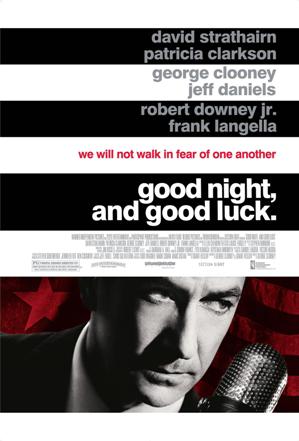
Goodnight_posterOne of my favorite episodes of South Park is called Smug Alert!  As you may remember, this is the episode where the citizens of South Park all buy hybrid cars and end up getting so self-satisfied that a dangerous cloud of smug forms over the town.  At the same time, another smug storm is racing across the United States.  This smug storm was created by the speech that George Clooney gave when he won the Oscar for Syriana.  When those two clouds of smug meet, it’s the perfect storm.  It also ends up destroying San Francisco.

The same year that Clooney was named Best Supporting Actor for Syriana, he was also nominated for directing the 2005 best picture nominee, Good Night, and Good Luck.  In his speech, Clooney specifically said that he felt he was winning supporting actor to make up for not winning director and proceeded to give the speech that he would have given if he had won director.

And looking back, I think that we do have to admit that it was a very smug speech.

Fortunately, Good Night, and Good Luck has aged better than Clooney’s speech.

I do have to admit that, when I recently rewatched Good Night and Good Luck, I was a little concerned.  I always manage to forget that the film starts on a really bad note.  The year is 1958 and news anchorman Edward R. Murrow (played by David Strathairn) is receiving an award.  As Murrow stands behind the podium, he proceeds to give a long and self-righteous speech about how television should be used not to entertain but to educate as well.  And, quite frankly, he comes across like such a pompous blowhard that I was dreading the idea of having to spend the next 90 or so minutes with him.

But then, fortunately, the film entered into flashback mode and, until the final few minutes of the film, we didn’t have to listen to anymore of Murrow’s speech.  The majority of Good Night and Good Luck takes place in 1953.  U.S. Sen. Joseph McCarthy (who appears in archival footage throughout the film) has declared that he has the names of communists who hold important positions in both the government and the media.  Murrow and his producer, Fred Friendly (George Clooney) defy the corporate overlords of CBS and bravely investigate and challenge McCarthy’s claims.  McCarthy and his henchmen respond by trying to smear both Murrow and one of his reporters (Robert Downey, Jr.) as a communists.  As always seems to happen in films about McCarthyism, another supporting character reacts to the change of communism by committing suicide.  And, in this particular vision of the fight against Joseph McCarthy, Edward R. Murrow and the media save America.

Of course, if you actually make the effort to learn history, you’ll discover that it wasn’t just Edward R. Murrow who stood up to McCarthy.  In fact, you’ll discover that Murrow stood up to McCarthy after several other prominent people — on both sides of the political divide — had already done so.  If anything, the real-life Murrow seems to have more in common with pompous scold seen at the beginning and end of the film, as opposed to the one that we see standing up to McCarthy.

One can very legitimately debate whether or not Murrow deserves all of the credit that he’s given in this film.  Still, the film does make a larger and very important point.  We, as Americans, have to always be on guard against witch hunts and against demagogues and the forces of fear and paranoia that are always trying to shape our politics.  And, whether or not Murrow was a hero or just a bystander, one cannot deny that the larger message of Goodnight, and Good Luck remains as relevant today as when the film was originally released.

Judging from some of his other films — The Monuments Men and the Ides of March — I don’t particularly feel that George Clooney is that good of a director.  But he does do a good job with Good Night and Good Luck.  (In fact, he does such a good job that you can’t help but feel that it’s the exception to the rule as far as Clooney the director is concerned.)  Filmed in wonderful black-and-white and full of good performances, Good Night, and Good Luck remains surprisingly watchable.

Just avoid any George Clooney Oscar speeches while watching it.  San Francisco has never recovered.

Trailer: Much Ado About Nothing


There’s finally a trailer out about the little film that Joss Whedon made while doing post on his previous little film called The Avengers.

Much Ado About Nothing is a modern and Whedon’s own interpretation of the classic William Shakespeare comedic play. Filmed over the span of 12 days in Whedon’s own Santa Monica home, the film has a cast of Whedom alumni who either has worked with the writer-director on one of his tv series or in his films. The trailer itself has a coolness factor that has to be part jazz used in the trailer and half seeing all the familiar faces Whedon fans have come to know and love through the years like Amy Acker, Alex Denisof, Nathan Fillion and, more recently, Clark Gregg.

Much Ado About Nothing premiered at the 2012 Toronto International Film Festival  and will make it’s North American wide release on the date of June 7, 2013.