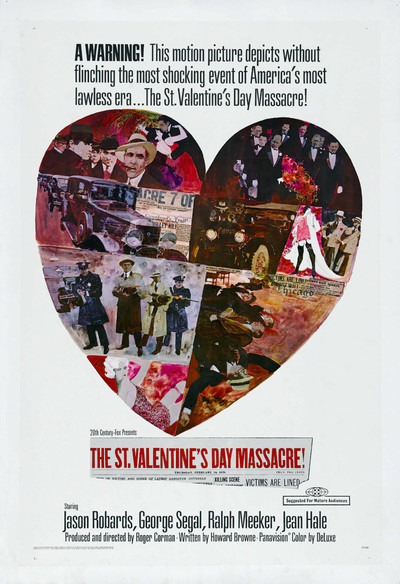
Low budget auteur Roger Corman had visited the gangster genre twice before, with 1958’s MACHINE GUN KELLY (featuring Charles Bronson in the title role) and I, MOBSTER (starring noir vet Steve Cochran ). Nine years later, Corman produced and directed THE ST. VALENTINE’S DAY MASSACRE, with major studio backing, star power, and a million dollar budget. It’s still a Roger Corman film though, which means it’s a helluva lot of fun!
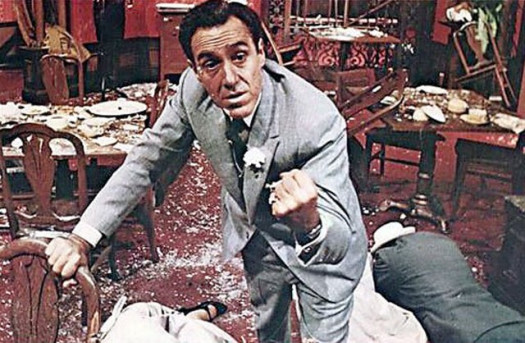
We’re in 1929 Chicago (as narrator Paul Frees tells us), a time of lawlessness, bootlegging, and mob killings on a daily basis. Two rival factions are battling to control the Windy City: the Southside gang led by ‘Scarface’ Al Capone (Jason Robards) and his Northside enemy ‘Bugs’ Moran ( Ralph Meeker ). Moran sends his top hood Peter Gusenberg (George Segal) to muscle in on Capone’s rackets, but when Big Al’s mentor Patsy is gunned down by Moran’s assassins, the crime boss goes…
Mickey Spillane’s Mike Hammer novels have long been one of my favorite Guilty Pleasures. Spillane’s books were the literary equivalent of knocking back shots of Jack Daniels with no chaser. The misanthropic Mike Hammer’s Sex & Violence filled adventures are rapid paced, testosterone fueled trips through a definitely un-PC world where men are men, women are sex objects, and blood and bullets flow freely through a dark, corrupt post-war world. Spillane turned the conventional detective yarn on its ear and, though critics hated his simplistic writing, the public ate up his books by the millions.
The film version of Spillane’s KISS ME DEADLY turns film noir on its ear from its opening shot of Christine Bailey (a young Cloris Leachman) running down a lonely highway, almost getting run over by Mike Hammer. The PI picks her up and the opening credits roll backwards to the strains of Nat King Cole crooning “Rather Have The Blues”. This beginning set-up lets…
Speaking as a Southerner (well, a Southwesterner), I’ve always found in interesting that the rest of America loves to talk about how much they hate us but, at the same time, they also love books and movies set down here. From the era of silent cinema to today with films like August: Osage County, people up north are obsessed with Southern melodrama.
It’s interesting because I’ve lived down south for most of my 29 years and there’s really not any more melodrama down here than there is anywhere else. In fact, one of the main reasons that I enjoy watching Southern melodramas is because I enjoy seeing what the folks up north actually believe to be true. I watch and I think to myself, “Northerners actually believe this shit.” And then I laugh and laugh.
Take, for example, the 1961 film Ada. Ada is pure Southern political melodrama. (Admittedly, one of the best political films of all time — All The King’s Men — is a Southern melodrama but, to put it politely, Ada is no All The King’s Men.)
Ada tells the story of Bo Gillis (Dean Martin), a guitar-playing, singing sheriff who is running for governor of an unnamed Southern state. Bo is running as a reform candidate but actually he’s just a figurehead for the wealthy and corrupt Sylvester Marin (Wilfred Hyde-White). Bo is popular with the crowds, he has a great speech writer named Steve (played by the great character actor, Martin Balsam), and he has ruthless supporters who are willing to do anything to get him elected. What he doesn’t have is a wife. But that changes when he meets a prostitute named Ada (Susan Hayward) and marries her three weeks before the election.
At first, Sylvester demands that Bo get the marriage annulled. Bo, however, refuses. Fortunately, it turns out that the wife of Bo’s opponent is a drug addict. Sylvester’s henchman Yancey (Ralph Meeker) leaks the news to the press and Bo is elected governor.
The only problem is that, once Bo is elected, he declares the he wants to run an honest administration and he starts to question Sylvester’s orders. After the lieutenant governor is forced to resign, Ada lobbies to be appointed to the job. Soon after Ada is confirmed, Bo is nearly blown up in his car. While Bo is recovering, Ada serves as acting governor. Will Ada be able to defeat Sylvester and convince Bo that she wasn’t responsible for trying to get him killed?
Watch and find out!
Or don’t.
Ada truly puts the drama into melodrama. (It does not, however, bring the mellow.) This is one of those films that’s full of overheated (yet strangely forgettable) dialogue and vaguely familiar character actors speaking in thick Southern accents. Susan Hayward is so intense that you worry she might have killed a grip before shooting her scenes while Dean Martin spends most of the movie looking as if he’s waiting for the Rat Pack to show up and take him to a better party.
This is one of those films that you watch and you think to yourself, “Northerners actually believe this shit.”
Yesterday, I took a look at Executive Action, a 1973 docudrama about the assassination of John F. Kennedy. Today, I want to take a look at another film inspired by the Kennedys, the 1979 satire Winter Kills.
As the film opens, it’s been 16 years since a popular and dynamic President named Tim Kegan was assassinated in Philadelphia. Despite constant rumors of conspiracy, the official story is that Kegan was killed by a lone gunman and that gunman was subsequently killed by another lone assassin. The President’s half-brother, Nick (played by Jeff Bridges, who looks so impossibly young and handsome in this film), has disappointed his father (John Huston) by declining to follow his brother into politics. Instead, he spends most of his time sailing on corporate oil tankers and dating fashion editor Yvette (Belinda Bauer). This all changes when a dying man named Fletcher (and played, underneath a lot of bandages, by Joe Spinell) asks for a chance to speak to Nick. Fletcher reveals that he was the 2nd gunman and that he was hired by to kill President Kegan. Before dying, Fletcher tells Nick where he can find the rifle that was used to kill the President.
Following Fletcher’s directions, Nick finds both the rifle and proof that his brother’s death was the result of a conspiracy. Determined to find out who was truly behind the conspiracy, Nick goes to see his father, the flamboyant tycoon Pa Kegan (John Huston) who, we discover, is only alive because he frequently gets blood transfusions from young women. With Pa’s encouragement, Nick is sent on an increasingly bizarre odyssey into the darkest shadows of America, a world that is populated by militaristic businessmen, sinister gangsters, and an unemotional man named John Cerutti (Anthony Perkins) who very well may be the most powerful man in the world.
The martyred President might be named Tim Kegan, his accused assassin might be named Willie Abbott, and the man who shot Abbott might be named Joe Diamond (and might be played by Eli Wallach) but make no mistake about it — Winter Kills is a thinly disguised look at both the Kennedy assassination and the Kennedy family. Based on a novel by Richard Condon (who also wrote the conspiracy classic, The Manchurian Candidate), Winter Kills takes all of the various Kennedy conspiracy theories and intentionally pushes them to their most ludicrous extremes. The end result is a film that tries (and occasionally manages) to be both absurd and sincere, a portrait of a world where paranoia is the only logical reaction.
As I discovered from listening to director William Richert’s commentary on the Anchor Bay DVD, Winter Kills had a long and complicated production history. The film was produced by two marijuana dealers, one of whom was murdered by the Mafia shortly after the film premiered while the other would later be sentenced to 40 years in prison on federal drug charges. The production actually went bankrupt more than a few times, which led to Richert, Bridges, and Bauer making and releasing another film specifically so they could raise the money to finish Winter Kills.
When Winter Kills was finally released, it got a good deal of attention because of its spectacular cast. Along with Bridges, Huston, Perkins, and Wallach, the film also features cameo appearances by Tomas Milian, Elizabeth Taylor, Ralph Meeker, Richard Boone, Sterling Hayden, Dorothy Malone, Toshiro Mifune, and a host of other actors who will be familiar to those of us who enjoy watching old movies on TCM. And yet, according to Richert, the film itself was barely released in to theaters, the implication being that Winter Kills was a film about conspiracies that fell victim to a conspiracy itself.
Given the film’s history and the subject matter, I was really hoping that Winter Kills would turn out to be a great movie. Unfortunately, it really doesn’t work. The film struggles to maintain a balance between suspense and satire and, as a result, the suspense is never convincing and the satire is ultimately so obvious that it ends up being more annoying than thought-provoking. The cast may be impressive but they’re used in such a way that film ultimately feels like it’s just a collection of showy celebrity cameos as opposed to being an actual story.
That said, Winter Kills remains an interesting misfire. Jeff Bridges is a likable and compelling lead (and he gives the film much-needed focus) and, playing a role that has a lot in common with his better known work in Chinatown, John Huston is a always watchable if not necessaily likable. Best of all is Anthony Perkins, who plays a role that, in light of what we now know about the NSA, seems oddly prophetic.
Finally, best of all, Winter Kills remains an interesting time capsule. If nothing else, it reminds us that mistrust and paranoia are not unique to this century.
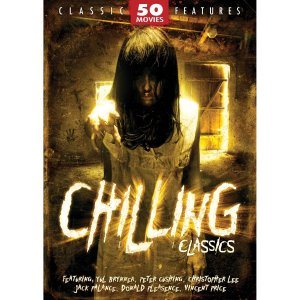
It seems that every film lover owns at least one of those box sets of public domain films that Oak Creek Entertainment puts out. You know which ones I mean — the box sets usually have about 50 to 100 movies crammed onto 12 discs and always have titles like “Astounding Adventure Classics.” Most of the time, you’ll recognize one or two of the movies included (usually Night of the Living Dead) and you’ll end up buying it because they only cost like 6 bucks and that’s pretty good for 50 movies, even if you already know most of those movies are going to suck. I own several of these box sets, including 50 Chilling Classics.
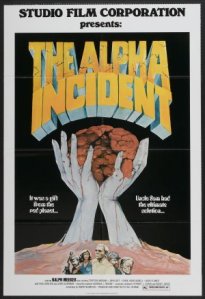
I’ve recently decided to write a review for every single film that I have in my collection and I figured, what better place to start than with the often-forgotten and ignored public domain films that can be found in 50 Chilling Classics? So, let’s get things started by reviewing a little public domain film from Wisconsin called The Alpha Incident.
Made in 1977, The Alpha Incident tells us what happens when a train, carrying a deadly virus brought back from Mars, makes a stop over at a small country train station. It seems that Hank (played by George “Buck” Flower, who giggles a lot) had taken it upon himself to inspect that deadly cargo and has accidentally released it into the atmosphere. The train station, and the five people trapped inside, are quarantined by the U.S. government. Trapped in the station are the increasingly crazed Hank, the cold Dr. Sorenson (Stafford Morgan), gruff bully Jack (John F. Goff), neurotic secretary Jenny (Carol Irene Newell), and the shy station agent, Charlie (Ralph Meeker, who was the best-known actor in the cast). The five are told to wait while American scientists try to find a cure for the virus. Under no circumstances can they 1) leave the station and 2) fall asleep because, the minute they do, the virus will cause their brain to literally explode out of the back of their head. For the rest of the film (which, honestly, would probably have worked better as a play), the five fight among themselves, wonder if they’re infected, and above all else, struggle to stay awake.
The Alpha Incident was directed by Bill Rebane, an independent filmmaker who is based up in Wisconsin. Apparently, Rebane’s unique cinematic vision has won him a cult following among fans of low-budget horror and sci-fi films. One term that I’ve often seen used to describe him is “the Ed Wood of Wisconsin.” On the basis of the Alpha Incident, I don’t know if that’s a fair comparison. Yes, the film does drag at time and the editing pretty much defines the term “ragged” but the movie still held my interest and not in a solely “what the fuck am I watching?” sort of way. Yes, the performances are uneven, ranging from histrionic (George “Buck” Flower and John F. Goff) to boring (Stafford Morgan) to adequate (Ralph Meeker) to surprisingly good (Carol Irene Newell) but the characters themselves aren’t the usual stereotypes and, while the dialogue is often a bit clunky, the film’s story is an interesting one and the ending is just so wonderfully cynical and downbeat. With it’s portrayal of common people trying to survive the mistakes of a faceless government, The Alpha Incident is so wonderfully 70s that I it made me want to go to a club, tell my companions, “I’m going to powder my nose,” and then snort someone else’s cocaine.
Like many of the best B-movies, The Alpha Incident was made with more ambition than skill but it’s still a film that, if you truly appreciate the low-budget exploitation movies of the 70s, is more than worth seeing.



 Through the Shattered Lens