Catching Up With The Films of 2025: The Fantastic Four: First Steps (dir by Matt Shankman)


I have to admit that I groaned when Marvel’s The Fantastic Four: First Steps opened with a title card informing me that it was taking place on “Earth-828.”

You have to understand that all of the multiverse nonsense is the one of the main things that led to me losing interest in both the Marvel and the DC films.  The idea that there are multiple Earths out there and they’ve all got different versions of the same heroes and villains just feels incredibly lazy to me.  It’s like a get out of jail free card.  If you make a bad movie, you can just claim that it was took place on another Earth.  If a character dies on one Earth, it doesn’t really matter because there’s another version out there.  What are the actual stakes when there’s a million different Earths to choose from?  For that matter, if I’m presumably living on Earth-1, why should I care about Earth-828?  Earth-828 has nothing to do with me.

Imagine my surprise, then, when one of the best things about the film was that it turned out to be that it was taking place on an alternate Earth, one that mixes the culture of the 1960s with advanced technology and a retro-futuristic style.  This is a rare Marvel film that is enjoyable just to look at.  The production design is top-notch, mixing the past with the future in a very playful way.  As much as I dislike the whole multiverse thing, Earth-828 does seem like it would be a fun place to visit.

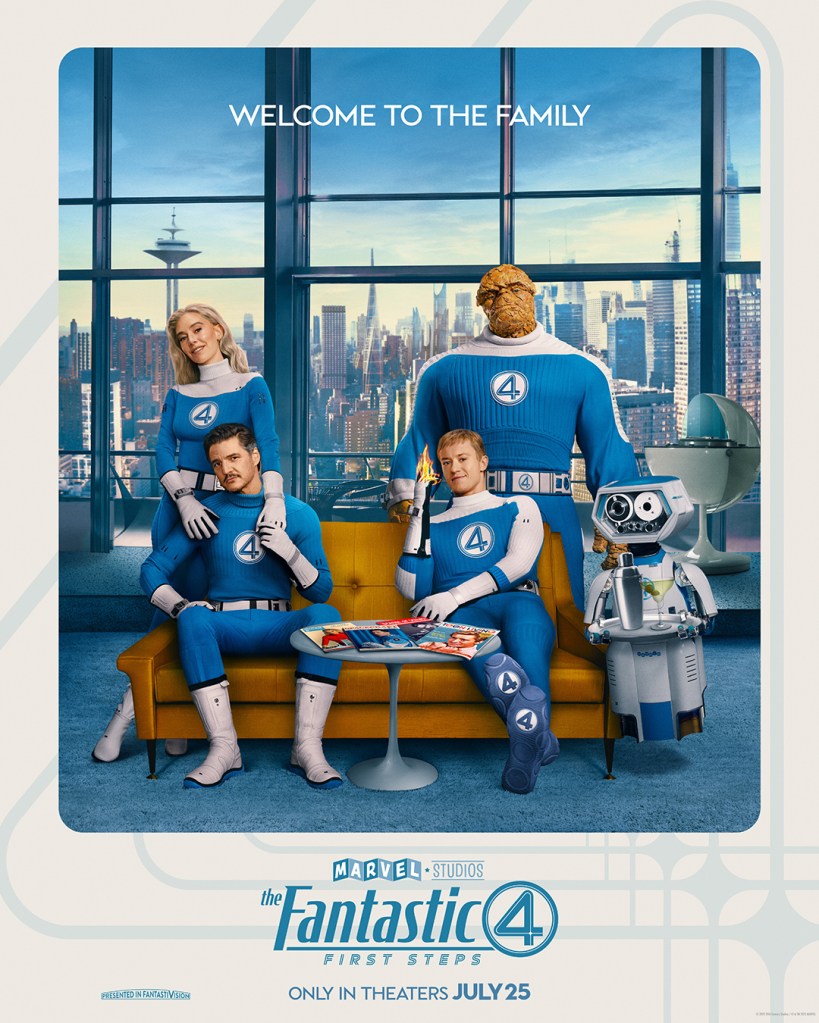
Earth-828 has advanced technology because of its only team of super heroes, the Fantastic Four.  Fortunately, Marvel seems to understand that 1) origin stories tend to be bland in general and 2) viewers have already had to sit through two disappointing and presumably unrelated Fantastic Four films that centered around them getting their powers.  So, First Steps opens with the team having already taken their trip into space, the one that led to them returning with altered DNA.  Reed Richards (Pedro Pascal) can stretch himself.  His wife, Susan Storm Richards (Vanessa Kirby), can turn invisible and knock things around with …. invisibility rays, I guess.  Susan’s brother, Johnny (Joseph Quinn), can burst into flame and fly.  (Wow, DNA is amazing!)  And their friend, Ben Grimm (Ebon Moss-Bachrach), has skin that has been transformed into a layer of orange rock.  Ben can knock holes in walls but he can’t seem to get the world to understand that there is an intelligent and kind-hearted soul underneath the fearsome exterior.  The citizens of Earth-828 are worshipful of the Fantastic Four and the team has ushered in an era of peace.

When a naked silver woman on a surfboard (Julia Garner) appears in Times Square, she announces that Earth has been selected as the latest feast for Galactus (Ralph Ineson), a giant creature who is so powerful that he must consume planets in order to satisfy his appetite.  Galactus offers to spare Earth but only if he is given Reed and Susan’s baby, Franklin.  Galactus says that Franklin possesses the “power cosmic,” which is something that I assume we’re going to be hearing a lot about over the next few MCU films.

As far as later phase Marvel productions are concerned, The Fantastic Four: First Steps is an entertaining-enough film.  Vanessa Kirby is a bit on the dull side as Sue but it should be noted that, in all of the various film versions of The Fantastic Four, Sue has always been the least interesting member of the group.  Pascal is likable as Reed, even if his stretchy superpower feels a bit silly.  Ebon Moss-Bachrach and Joseph Quinn both give strong performances, with Quinn especially bringing some depth to a character who, in lesser hands, could come across as being shallow.  Ralph Ineson is a properly intimidating villain and Julia Garner has just the right amount of sad-eyed intensity for the role of the morally ambiguous Silver Surfer.  The film looks great, the retro style holds the viewer’s attention, and there are a few moments of genuine wit that harken back to the best moments of the 1st phase of the MCU.  That said, it’s hard to ignore that this is yet another Marvel movie where the whole thing ends with a fairly predictable battle and a healthy dose of Dues Ex Machina.  The film is entertaining but it definitely sticks to the established MCU formula.

The film ends with a mid-credits scene and a promise that the story will continue in Avengers: Doomsday.  I wonder what Earth that one will take place on.
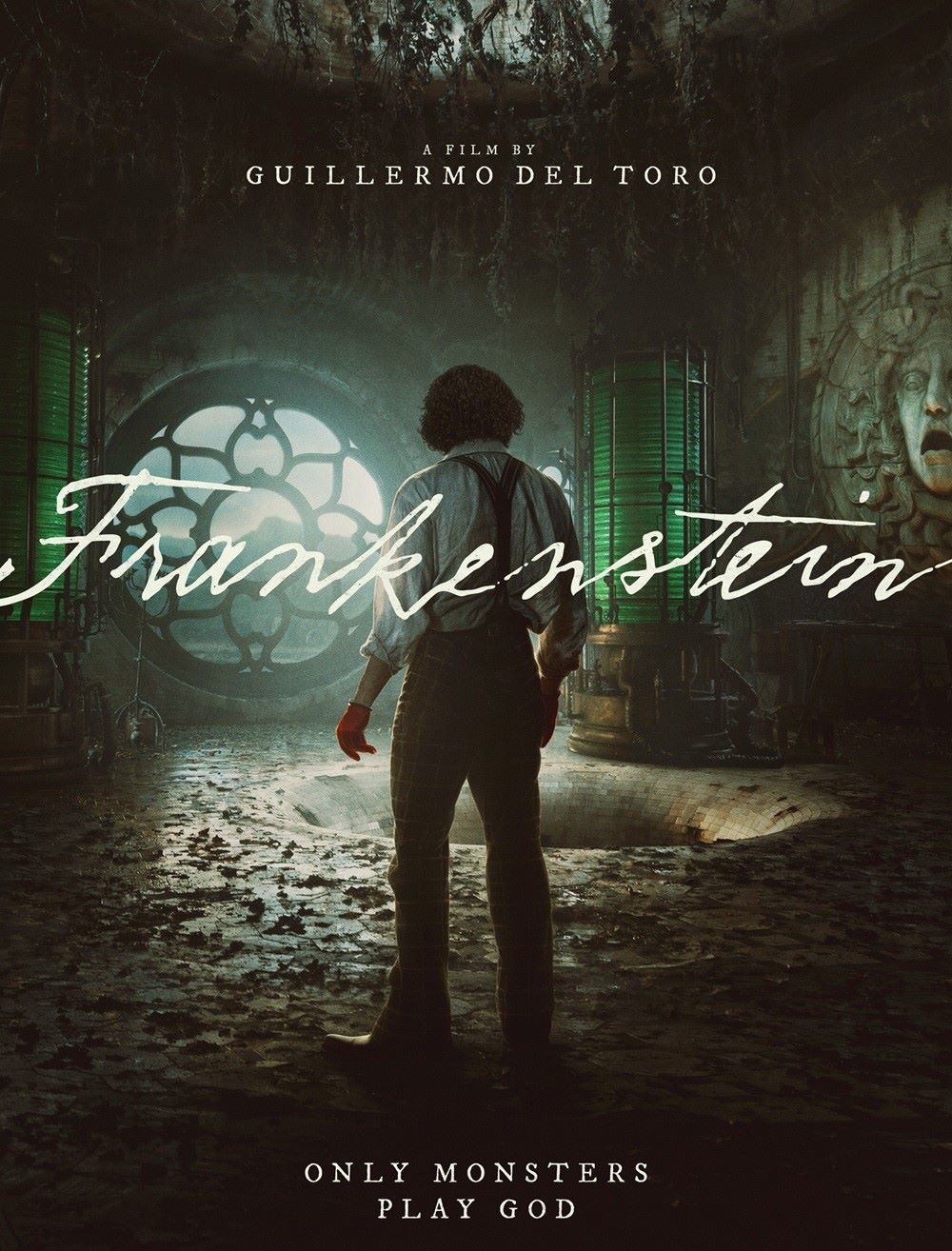
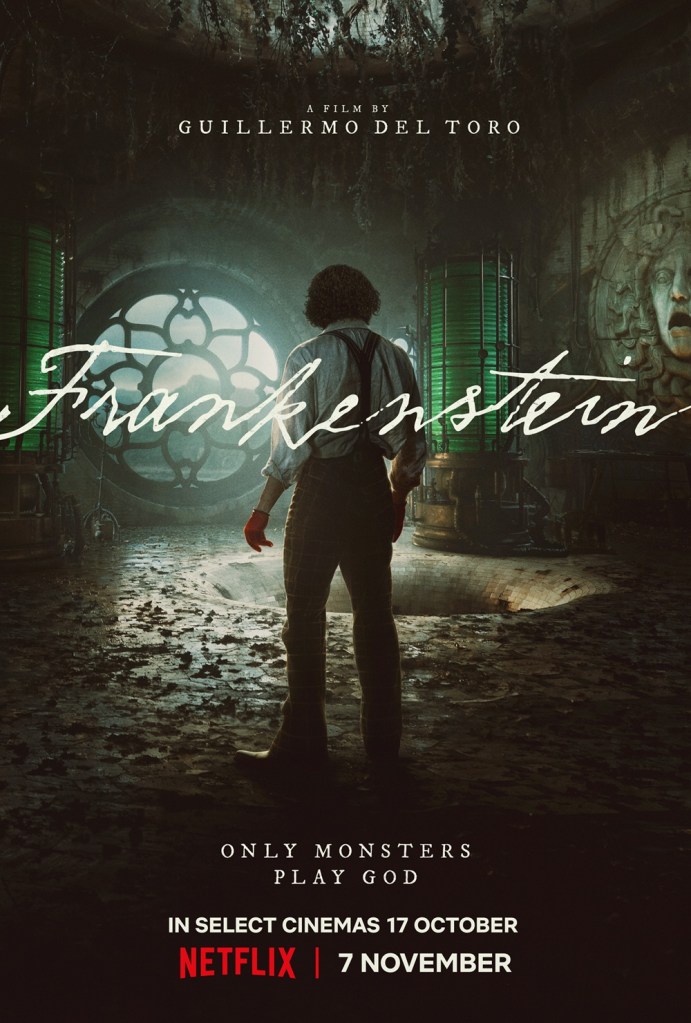
Review: Frankenstein (dir. by Guillermo Del Toro)


“An idea, a feeling became clear to me. The hunter did not hate the wolf. The wolf did not hate the sheep. But violence felt inevitable between them. Perhaps, I thought, this was the way of the world. It would hunt you and kill you just for being who you are.” — the Creature

Guillermo del Toro’s long-awaited take on Frankenstein finally lumbers to life after years of speculation and teases, and it’s every bit the dark, hypnotic fever dream you’d expect from his imagination. The film, a Netflix-backed production running close to two and a half hours, stars Oscar Isaac as the guilt-ridden Victor Frankenstein and Jacob Elordi as his tragic creation. The result lands somewhere between Gothic melodrama and spiritual lament—a lush, melancholy epic about fathers, sons, and the price of neglect. It’s both a triumph of aesthetic world-building and a case study in overindulgence, the kind of movie that leaves you haunted even when it occasionally tests your patience.

From the very first frame, del Toro plunges us into a Europe steeped in rot and beauty. His world feels more haunted than alive—every misty street lamp and echoing corridor loaded with centuries of decay. Victor, introduced as both a visionary and a failed son, is shaped by years of cruelty at the hands of his domineering father, played with aristocratic venom by Charles Dance. That upbringing lingers in every decision he makes, especially when he turns to science to defy death. Del Toro shoots his laboratory scenes as though they were sacred rituals: the flicker of candlelight reflecting off glass jars, the close-up of trembling hands threading sinew into flesh. When the Creature awakens, lightning cracks like some divine act of punishment. It’s a birth scene that feels more emotional than monstrous—Elordi’s raw, wordless confusion gives it a painful tenderness that lingers longer than the horror. Del Toro discards the usual clichés of flat heads and neck bolts, opting for something far more human: an imperfect body full of scars and stitched reminders of mortality.

One of the most striking choices del Toro makes is reframing Victor and the Creature as mirror images rather than opposites. Instead of playing Victor as a simple mad scientist, del Toro paints him as a broken man desperate to reclaim the control he never had as a child. That fear and obsession ripple through the Creature, who becomes his unacknowledged shadow—an extension of Victor’s failure to love or take responsibility. The movie often frames the two in parallel shots, their movements synchronized across different spaces, suggesting that creator and creation are locked in a tragic loop. The audience watches both sides of the story—Victor’s guilt and the Creature’s anguish—without clear moral lines. This emotional split gives the film its heartbeat: the Creature isn’t a villain so much as a rejected child, articulate and lonely, begging to know why he was made to suffer.

Jacob Elordi’s performance is revelatory. He channels something hauntingly human beneath the layers of prosthetics and makeup. There’s a fragility to the way he moves—those long, uncertain gestures feel less like a monster testing its strength and more like someone trying to exist in a world that never wanted him. His eyes carry the movie’s emotional weight; the moment he sees his reflection for the first time is quietly devastating. Oscar Isaac, meanwhile, leans hard into Victor’s manic idealism, all sweat-soaked ambition and buried grief. He makes the character compelling even at his most despicable, though at times del Toro’s dialogue spells out Victor’s torment too bluntly. Still, the scenes between them—particularly their tense reunion in the frozen north—achieve the Shakespearean tragedy that del Toro clearly aims for.

Visually, Frankenstein is pure del Toro—sumptuous, grotesque, and alive in every corner of its composition. Each frame looks painted rather than filmed: flickers of gaslight reflecting on wet marble, glass jars filled with organs that seem to breathe, snow settling gently on slate rooftops. The film feels drenched in the texture of another century, yet vibrates with modern energy. Costume designer Kate Hawley, longtime collaborator of del Toro, deserves special recognition here. Her work helps define the story’s emotional tone, dressing Victor in meticulously tailored waistcoats that hint at obsession through precision, and the Creature in tattered fabrics that seem scavenged from several lives. Elizabeth’s gowns chart her erosion from warmth to mourning, using color and texture as silent narration. Hawley’s palette moves from opulent golds and creams to bleak greys and winter blues—visually tracing how ambition and grief drain the light from these characters’ worlds. The costumes, much like del Toro’s sets, feel alive with history, heavy with stories stitched into every seam.

Mia Goth gives a strong, if underused, turn as Elizabeth, Victor’s doomed fiancée. Her early scenes bring a spark of warmth to the story’s coldness; her later ones turn tragic in ways that push Victor toward his final breakdown. Minor characters—the townspeople, the academics, the curious aristocrats who toy with Victor’s discovery—carry familiar del Toro trademarks: grotesque faces, eccentric manners, glimmers of compassion buried in callousness. The composer’s score matches this tone perfectly, alternating between aching melodies on piano and surging orchestral crescendos that make even the quiet scenes feel mythic. Combined, the sound and visuals give Frankenstein a grandeur that most modern horror films wouldn’t dare attempt.

Still, not every gamble lands cleanly. Del Toro’s interpretation leans so hard into empathy that it dulls the edges of the original story’s moral conflict. Shelley’s Creature grows into a murderous intellect, acting out of vengeance as much as sorrow; here, his violence is softened or implied, as though del Toro can’t quite bring himself to stain the monster’s purity. The effect is powerful emotionally but flattens some of the tension—Victor becomes the clear villain, and the Creature, the clear victim. It fits del Toro’s worldview but leaves the viewer missing some ambiguity. The pacing also falters in the middle third. There are long, ornate monologues about divinity, creation, and guilt that blur together into a swirl of purple prose. The visuals never lose their grip, but the script occasionally does, especially when it slows down to explain what the imagery already tells us.

Those fits of overexplanation aside, del Toro’s Frankenstein stays deeply personal. The story connects directly to the themes he’s mined for years: innocence cursed by cruelty, love framed in pain, beauty stitched from the broken. The Creature isn’t just man made from corpses; he’s a kind of prayer for grace—a plea for understanding in a world defined by rejection. Victor’s failure to nurture becomes an act of spiritual cowardice rather than scientific arrogance. The parallels between them give the film its emotional voltage. Every time one character suffers, the other feels it by proxy, as if their bond transcends life and death.

By the final act, all the grand tragedy is distilled into the silence between two beings who can’t forgive each other—but can’t let go, either. The closing image of the Creature, trudging across a barren arctic plain beneath a rising sun, borders on mythic. His tear-streaked face and quiet acceptance of solitude bring the story full circle: a being born of man’s arrogance chooses forgiveness when his maker couldn’t. It’s sad, tender, and surprisingly spiritual, hinting at del Toro’s constant fascination with mercy in a cruel universe.

As a whole, Frankenstein feels like the culmination of del Toro’s career obsessions condensed into one sprawling film. It’s not perfect—it wanders, it sermonizes, and it sometimes sacrifices fear for sentiment—but it’s haunted by sincerity. You can see del Toro’s fingerprints in every gothic curve and crimson hue, and even when he overreaches, you believe in his conviction. Isaac anchors the film with burning intensity, Elordi gives it wounded humanity, and Goth tempers the heaviness with grace.

In the end, this version of Frankenstein isn’t about horror in the traditional sense. It’s not there to make you jump—it’s there to make you ache. The film trades sharp scares for bruised hearts, replacing terror with empathy. Del Toro reanimates not just flesh but feeling, dragging one of literature’s oldest monsters into our modern reckoning with parenthood, grief, and the burden of creation. It’s daring, messy, and undeniably alive. For better or worse, it’s exactly the Frankenstein Guillermo del Toro was always meant to make.

Horror Trailer: Frankenstein


The official trailer for Guillermo Del Toro’s take on the Mary Shelley’s classic gothic horror Frankenstein has finally been released.

An earlier teaser was sent out months ago, but that was mostly played off like sizzle reel of what Del Toro had been up to with this latest adaptation. This official trailer gives us a much more closer look at the type of adaptation Del Toro decided to take with Shelley’s novel of the tortured scientist and his creation.

Even though it will be show up on Netflix on November 7, 2025, I do believe that this film needs to be seen on the big screen when a select cities get them on October 17, 2025.

Fantastic Four: First Steps (Official Trailer)


Since Iron Man first hit theaters in the summer of 2008, especially with the post-credits scene of Nick Fury asking Tony Stark if he knew anything about the Avengers Initiative, comic book fans have always been hoping that all the Marvel Comics properties would soon interact with each other. X-Men and Fantastic Four characters were controlled by 20th Century Fox.

This began to change in 2011 with the massive hack of Sony servers which gave the public behind-the-scenes info on Sony execs worried about the Spider-Man film franchise and how it was lagging behind Disney’s Marvel Cinematic Universe under the control of uber-producer Kevin Feige. In just a few years after this hack rumors of Spider-Man being loaned out to become part of the MCU became fact.

The next major shift in fans wanting all of Marvel properties becoming part of the MCU was Disney’s purchase and merger with 20th Century Fox in 2017 and completed in 2019. With just a few small restrictions here and there (Universal still hold the rights to the Incredible Hulk character but allowed Disney to the character), the MCU was now pretty much complete.

The first thing fans wanted was a new take on Marvel Comics’ first family: The Fantastic Four.

There’s been several attempts to put the Fantastic Four on the big-screen. From the 1994 unreleased Roger Corman low-budget film to the three films when 20th Century Fox was still a separate studio, fans never really bought into those iterations. But now that the first family was back under Marvel Studios control, especially with Kevin Feige as producer, fans were once again hopeful.

The first official trailer is now out and it looks like it will lean heavily on the Fantastic Four’s 1960’s origins right down to the retro-futuristic design and theme. How the film will explain where the team has been during the MCU timeline will be a narrative that a team of screenwriters and director Matt Shankman will have to navigate.

Fantastic Four: First Steps arrives in theaters on July 25, 2025.

Film Review: Nosferatu (dir. by Robert Eggers)


I stepped out of the doors of the Regal Times Square yesterday, feeling giddy as a schoolkid. In my hands were a custom popcorn bucket and an Orlock Funko-Pop. I thoroughly enjoyed Robert Eggers Nosferatu and Christmas Morning was a delight. It was Film Euphoria. It was as if Halloween had one last gift to give, one final end of film zinger, and give it did.

At my early morning showing for Robert Eggers Nosferatu, we had at least one fellow who fell asleep and snored through the bulk of the film. Not loud enough to be disruptive, but it almost mimicked the strange purring sounds of the film’s antagonist. Granted, I understand. My showing was around 10a.m. on Christmas Morning and perhaps they partied hard the night before. Anything’s possible. Still, part of me likes to think that a person walking into a Robert Eggers film may have some expectations. With only three films under his belt – The Witch, The Lighthouse, and The Northman, regular audiences know that he has a taste for the macabre (perhaps even the unhinged), usually employs a slow burn when it comes to pacing and works with a great deal of light and shadow. If either of his previous films worked for you, Nosferatu‘s a near perfect fit for his style. If you’re not a fan of Eggers work, nor a fan of the previous renditions of Nosferatu, there’s little here that will make you change your mind (save for just a little more gore, perhaps). It’s a little hard to spoil a story that’s more than a century old, but Eggers makes enough changes to keep the film from being the exact note for note story as before. Is it scary? Yes. Is there blood? Sure, but none of it is in the ‘jumpscare every other second’ variety. If that’s what you’re looking or hoping for, none of the Nosferatu’s (including this one) will deliver that and you will be quite disappointed. This is a prime cut of wagyu beef, not your everyday sirloin.

As most know, Nosferatu was essentially stolen from Bram Stoker’s Dracula. The original – Nosferatu: A Symphony of Horror was a silent film released back in 1922 by F. W. Murnau. Although the story was written and changed to fit German audiences, elements were still very close to Stoker’s and the Stoker Family tried to get rid of it. Copies were burned, but like that Jumanji box, it managed to slither through the years, gaining popularity to the point of Canonization. If Film History is your thing, I highly recommend watching the 1922 film, if you haven’t already. It amazes me how most of what they did was accomplished (my favorite scene being Orlok prepping his coffins for his trip). At the time of this writing, the movie is currently available on Amazon Prime. For me, I love the 1979 update by Werner Herzog, Nosferatu The Vampyre. There are a few minor changes in the plot, but it’s just as powerful.

Thomas Hutter (Nicholas Hoult, Mad Max: Fury Road) is married to his lovely wife Ellen (Lily-Rose Depp, The King) in the town of Wisborg. Ellen suffers from fits of melancholia, which cause her to either spurt morbid tales or put her in convulsive fits. He’s looking for a way to improve his financial station with his bride while keeping her problems hushed, and has found a great opportunity from his boss, Herr Knock (Simon Burney, Mission Impossible: Rogue Nation). It appears a wealthy old man wishes to move to Wisborg and purchase an estate there. The only stipulation is that he is infirm and cannot make the journey. Thomas is charged with traveling to the Carpathian mountains, where he is to visit Count Orlock at his home with the deeds and contracts. During his trip, Thomas is warned of the dangers ahead, but proceeds full on, meeting the Count and his strange ways. Upon learning of Ellen and her beauty, the Count sets off a chain of events that will put all of Wisborg at risk. Can the Count be stopped in time?

There’s so much love in this production, it seems. It certainly has the atmosphere down. Cinematographer Jarin Blaschke, who worked on all of Eggers previous films, weaves some magic with light that in some scenes rival Alejandro Amenabar’s The Others. Lanterns and candles are blinding, while at the same time, you might find yourself squinting to see the figure in the shadows. I had a few “look around the screen” moments while watching it. There’s absolutely nothing to complain about from a visual standpoint, it’s just beautiful. It’s also quite dark in nature. We’re dealing with vampires, possession and the occult, which Eggers takes in a few extremes (particularly through Skarsgard, Depp and Burney). Ancient tomes? Check. Romani banishing the darkness with Garlic? Check. Consecrating the soil? Done. The sound design in the film is nice, particularly with the breathing and talking for Orlok, which felt like it travelled through the audience. Blood squelches, screams are crisp. There’s little more I can say there, really. I was entertained and transported.

The cast is wonderful. The only thing I’ve ever watched Lily-Rose Deep do was Yoga Hosers, and she’s come a long way from that. Ellen is a tortured character, and Deep rides this through – fits, convulsions and all – to a point where you may wonder if she was really okay on set. We follow Nicholas Hoult’s Thomas as he moves from quiet reservation to curious disbelief and then ultimately, just full on terrified. Even the smaller roles work. Simon Burney’s character becomes repulsive. Emma Corrin, who had a fun turn earlier this year in Deadpool & Wolverine has good moments, along with Aaron Taylor-Johnson (Kraven the Hunter). Then there’s Dafoe. It never hurts to have Willem Dafoe in your lineup. This is his third film with Eggers and he’s come something of a lucky charm as Prof. Ebenhart von Franz. As the Van Helsing of the story, Dafoe is a treat to watch on screen, especially when paired with Ralph Ineson from The Witch. I could watch the two of them as detectives solving Gothic/Victorian X-Files in their own series or movies.

As Orlock, Bill Skarsgard (John Wick 4) really melts into the role, giving the character a low near constant purr and a voice that enunciates every word. Perhaps it was just me, but I did have a bit of a problem figuring out what Orlock was saying at some points. It improved as the story went on, though. Orlock’s look does veer from the traditional, through. That’s a jolt in itself. While he looks more like the Draugr in Skyrim or in Eggers own The Northman, I found myself thinking of “Taserface” in Guardians of the Galaxy, Vol. 2. If you can get past that feeling, it still works. It’s a creepy character and Skarsgard does it justice, I felt.

Clocking in at about 2 hours and 12 minutes, it’s considered the longest Nosferatu film. I found this odd because were a number of sequences the original and remake had that Eggers missed (like the loading of the coffins). The film is cut pretty well, for what it’s worth, though I’m not sure what they could have removed to trim scenes down.

If the film has any faults, any problems, there was one. The one weird misstep in all of this is a sex scene that seemed just a little out of place. I understand why it happened, and how it was supposed to fuel the story, but it comes on so fast and fierce that I sat there in the audience whispering…”Wait…what’s happening…Whoa…now? Here? Why?” Mind you, this is coming from someone who watched Shame more than once when it was first released. That, if anything, might freak a few people out if they’re not ready for it. Either that, or I’m becoming prudish in my old age.

Overall, I loved Nosferatu. If it weren’t so expensive to get out to a theatre, I’d make another run at it. As a remake, it easily stands toe to toe with John Carpenter’s The Thing and Chuck Russell’s The Blob as one you can sit on the shelf next to those who came before it. It’s a worthy adaptation, with moments of sheer dread and some that may push a boundary or two.

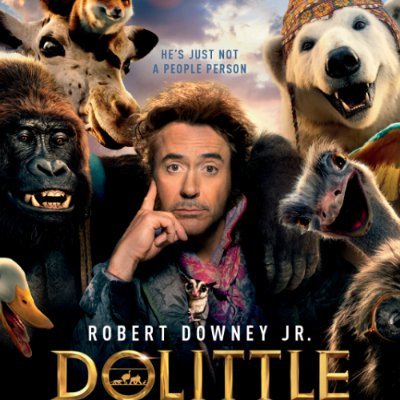
The Films of 2020: Dolittle (dir by Stephen Gaghan)


Dolittle tells the story of Dr. Dolittle (Robert Downey, Jr.), the eccentric doctor who can talk to the animals and who hasn’t had much use for humans ever since the tragic death of his wife, Lily (Kasia Smutniak).  Dolittle would be happy to just spend his entire life locked away in his estate, talking to Poly the Parrot (voice of Emma Thompson) and Chee-Chee the Gorilla (voice of Rami Malek) and all of the other animals but Dolitle has to eventually leave his home because otherwise, there wouldn’t be a movie.

When Queen Victoria (Jessie Buckley) is mysteriously taken ill, only Dolittle can save her.  Dolittle quickly realizes that the Queen has been poisoned and that the only cure for the poison is to be found on a tree that’s located on an island that no one has ever seen before.  Soon, Dolittle and the animals are sailing in search of the island.  Accompanying them is Tommy Stubbins (Harry Collett), a sensitive teen who hates to hunt and who hopes to become Dolittle’s apprentice.  Pursuing Dolittle is the evil Dr. Blair Mudfly (Michael Sheen), who went to college with Dolittle and who is in cahoots with the conspirators who are trying to do away with Queen Victoria.

Got all of that?  I hope so because we haven’t even gotten to the dragon with a set of bagpipes crammed up her ass.  Yes, you read that correctly.

Last year, Dolittle was one of the few major studio productions to actually get a wide release before COVID-19 closed down all the theaters.  It was released in January, which is traditionally the time when studios release the films that they hope everyone will have forgotten about by the time April rolls around.  January is traditionally the month when studios release the films that they know aren’t any good.  And, indeed, the reviews of Dolittle were overwhelmingly negative.  Not only did the critics hate Dolittle but audiences were also rather unenthusiastic and the film bombed at the box office.  Indeed, under normal circumstances, the reaction to Dolittle and its subsequent box office failure would be considered one of the year’s biggest disasters.  However, 2020 was a year of disasters.  Compared to everything else that ended up happening over the past 12 months, Dolittle’s lukewarm reception seems almost quaint now.

Earlier today, I finally watched Dolittle on HBOMax.  I was expecting the film to be terrible but it’s actually not quite as bad as I had been led to believe.  I mean, don’t get me wrong.  Dolittle has a ton of problems.  The tone is all over the place as the film tries to mix cartoonish humor with thrilling adventure in a style that owes more to the Pirates of the Caribbean franchise than it does to Dr. Dolittle.  Despite a few self-consciously manic moments, Robert Downey, Jr. seems remarkably bored in the lead role.  Many of the jokes fall flat and the awkward attempts to shoehorn the usual message of “be true to yourself” into the film just felt awkward.  That said, the CGI animals were cute enough to hold my interest and that’s really the most important thing when it comes to a film like Dolittle.  Cute animals — even computer generated ones — help to make up for a lot of flaws.

Dolittle’s final scene hints at a sequel or even a franchise.  Considering the reaction to the first film, I doubt we’ll get a second.  I do think Dr. Dolittle could make for an enjoyable PIXAR film but it might be time to give the live action adaptations a rest.

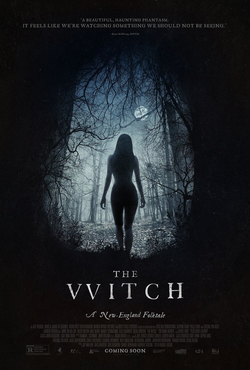
Film Review: The Witch (dir by Robert Eggers)


The_Witch_poster

Consider this:

After causing quite a stir at the 2015 Sundance Film Festival, the horror film The Witch has finally been given a general release.  It is a genuinely creepy and thought-provoking horror film, one that works as a historical recreation (it takes place in 17th century America), a psychological thriller (you’re never sure who is allied with the witch and who isn’t), and an atmospheric horror film.  The film has been critically acclaimed and, for those who care about this sort of thing, it currently has a score of 86 over at Metacritic.  For once, I agree with most of the critics.

And yet, The Witch is underperforming at the box office.  According to Cinemascore, audiences have given The Witch an average grade of C-.

That’s sad but it’s understandable.  The Witch moves at a deliberate pace, it requires that the audience have at least a rudimentary knowledge of history, and a good deal of its horror comes less from shock and more from the anticipation of that shock.  The Witch is a very cerebral horror film and, as a result, it’s not a crowd pleaser.  It’s not for everyone.  Instead, it’s a film for discriminating horror fans like you and me.

The Witch opens with William (Ralph Ineson) and his family being kicked out of a village in New England.  William is a deeply religious man and apparently, his style of Calvinism has offended everyone else in the village.  After leaving, William and his family end up settling on a stretch of land that is right next to a dark forest.  William builds a house and a farm on the land, his wife Katherine (Kate Dickie) gives birth to a fifth child, and all seems right with their world.

Or is it?

As quickly becomes obvious, William’s family is not as content as they may originally seem to be.  His teenager daughter, Tomasin (Anya Taylor-Joy) and son, Caleb (Harvey Scrimshaw) are both struggling with the burden of growing up totally isolated from the rest of civilization.  Katherine secretly years to return home.  Twins Mercy (Ellie Grainger) and Jonas (Lucas Dawson) are both rambunctious and keep playing with an aggressive black goat that they’ve named Black Phillip.  William, himself, is struggling to make ends meet and has even resorted to secretly selling a silver cup, a present from Katherine’s mother.  The crops are dying and the farm animals are just as likely to produce blood as they are milk.

And, then, the baby disappears.  One day, while Tomasin is playing with him, something drags the baby into the woods and kills him.  At first, the family assumes that it was a wolf but we know that it was a witch.

If there’s one thing that I wish this film had done, I wish it had left it a little bit more ambiguous as to whether or not there was actually a witch out in that forest.  The Witch appears extremely early in the film.  The actress playing her, Bathsheba Garnett, has a genuinely unsettling screen presence and provides the film with one of its creepiest scenes but, at the same time, it’s hard not wonder what The Witch would have been like if the audience had been forced to wonder if there really was a witch in the forest or if the family was just being paranoid in seeking a supernatural reason for their increasingly bad luck.

And make no mistake about it, things go from bad to worse for William’s family, with William growing increasingly fanatical and all of the children accusing each other of witchcraft.

At the end of the film, we’re told that The Witch is based on historical records and that a good deal of the dialogue was lifted directly from diaries, court transcripts, and letters from the 17th Century.  The Witch does have a genuinely authentic feel to it.  At no point do you doubt that you’re watching a historically accurate recreation of the 17th century.  That accuracy works in the film’s favor, giving it an almost documentary-like feel.  At the same time, it also means that the audience has to adjust its thinking.  This is a film about people who lived in a far different culture from today and, to the film’s credit, the characters react like 17th Century Calvinists and not 21st century film goers.

In many ways, The Witch is a demanding film.  It’s not for everyone.  I enjoyed the film but, for the record, I can understand why a lot of people in the audience did not.  (And, I have to admit, that even I occasionally got frustrated with the film’s slow pace.  It pays off in the end but The Witch still demands a bit of patience.)  Though there are a few shockingly bloody scenes, The Witch is largely a mood piece.  Almost of the film’s scares come not from jump scenes but from an unrelenting atmosphere of darkness and doom.  Making his directorial debut, Robert Eggers accomplishes a lot with just a few shots of that dark forest, the trees ominously looking down on the humans who have foolishly wandered too far into the wilderness to ever come back.

It may not be for all tastes but I recommend taking a chance on The Witch.

A Dark Glimpse of The Witch


TheWitch

It’s been a great couple years when it comes to what the snooty cinephiles would consider as horror in cinema. Sure, we still get the slashers, zombies, found footage paranormals and even the odd cannibal exploitation, but of late we’ve also been getting some great atmospheric and truly disturbing horror of the gothic kind.

The last couple years alone we’ve gotten such great horror films as It Follows, Babadook, The Conjuring, We Are What We Are and The Sacrament to name a few. We have a film straight out of Sundance that looks to join this list.

The Witch is the first film for writer/director Robert Eggers. Working off of his own script, Eggers’ film won him the Directing Award in the Drama Category during Sundance. With critics at the festival lauding the film, The Witch was soon picked up by A24 Films for a theatrical distribution.

The Witch is set for a 2016 release.

Review: Game of Thrones S2E10 “Valar Morghulis”


“We are the watchers on the Wall.” — Qhorin Halfhand

[spoilers within]

With last week’s explosive ninth episode, “Blackwater”, it was going to take much to make tonight’s season finale to really stand out. Just like the first season’s finale we get an episode that deals with the aftermath of the previous episode and also goes a long way into setting up events for the upcoming third season.

“Valar Morghulis” is the title of tonight’s episode and it’s spoken by Jaqen H’ghar to Arya as the two part ways. It’s a saying in Essos from ancient High Valyrian (a Roman Epire-like civilization which perished centuries before the series’ timeline) that translated means “All men must die”. Jaqen sees potential in Arya in becoming like him, a Faceless Man, assassins who follow the teaching of the so-called Many-Faced Gods. While Arya seems intrigued by the offer her need to re-connect with her family takes precedence over everything else. As the two part ways Jaqen imparts to Arya a coin that should she ever need passage to Braavos to start her journey into becoming a Faceless Man. In another instance that this series still has magic in it’s DNA we finally see why Jaqen is a Faceless Man as he walks away from Arya and her group wearing a new face.

Tonight’s episode lays the foundation that next season magic and sorcery may become more common place than the first two season of the series. We see Daenerys finally make her way into the House of the Undying to retrieve her dragonlings from the warlocks of Qarth. It’s a sequence that’s akin to spirit journey for the Targaryen Queen-to-be and Mother of Dragons as she walks the darkened halls and corridors of the House of Undying until an egress suddenly takes her North of the Wall to find a Dothraki tent where she discovers the two most precious things she has lost since coming to Essos. In what I could only see as a surprise that was kept by showrunners Benioff and Weiss from the press and bloggers (a feat nowadays) Daenerys sees her husband Khal Drogo and who could only be their son both alive and waiting for her.

Her reaction to this event was both poignant and tragic in that she finally has a chance to be with those she loves most but must give up the quest to retake Westeros with her dragons. Her decision to leave the tent and leave behind those she loves comes as her character finally realizing that sentimentality and the needs of her heart must take a back seat and wait. Daenerys comes out the other side a more confident ruler and one whose magic really is stronger than those warlocks who scheme to keep her and her dragons captive for themselves. It really sets up the Daenerys character on a much stronger footing for next season just like last season’s finale did. For all the moping around Daenerys did for most of season 2 the pay off in the end goes a long way into forgiving the show’s writers in their inability to write her character’s motivations consistently. Most likely the naive young girl being used by others for their own agendas and ends would be seen less and less next season while the Mother of Dragons reasserts her authority.

The same can’t be said for one of the five kings vying for control of Westeros. For those who have read the third novel the scenes with King Robb Stark were full of sentimentality but lacking in the cold-hearted logic that rulers must use in order to play the game of thrones successfully. Even his mother, Catelyn Stark, sees danger in Robb’s actions with the Volanti healer Talisa Maegyr. Catelyn knows well enough that Robb could destroy everything he has won and worked for since war begun because he has thought with his heart and not with his head. In what could almost be seen as more doom coming for the House of Stark, Robb cements his relationship with Talisa in secret even though we’ve come to learn through two season of this show that nothing ever remains secret for long.

Back in King’s Landing we see the balance of power shift once more as Tywin Lannister’s opportune arrival to take victory from the jaws of defeat at the end of last week’s episode sees him back as Hand of the King to Joffrey. Tyrion has lost all the advantages he had worked and gamed for all season as even Bronn has been removed as Commander of the Goldcloaks. We’ve not seen Tyrion laid so low as we have in this episode and the horrible scarring of his face looks to go deeper as he finally realizes that as much as he would enjoy running away with Shae and leave the politicla intrigues and backstabbing of the kingdom it’s something that he would miss terribly because it’s the one thing he’s best at. With Tywin now in charge of the kingdom and Petyr Baelish having earned himself the king’s good graces for manufacturing the alliance between the two most powerful houses in the kingdom with the Lannisters (Baratheon by name only) and the Tyrell’s of Highgarden. It’s going to be interesting to see how Tyrion readjusts to the new power dynamics in King’s Landing for season 3. If there’s one thing we’ve come to learn about Tyrion over two season’s worth of episodes it’s that he’s a survivor first and foremost.

Lastly, we come to Jon Snow and his dilemma North of the Wall. A captive of the wildlings and seen as someone very important for the still unseen Mance Rayder the so-called King-beyond-the-Wall, Jon must do the only logical thing (something Qhorin halfhand agrees as the only thing that could save Jon and maybe give him time to warn the Wall) and earn the trust of Ygritte, Rattleshirt and the rest of the wildlings even if it means killing one of his own to do so. In what would be one of several sweeping scenes that show the epic nature of this series lest we forget Ygritte shows Jon over the lip of a glacier the army of wildlings Mance Rayder has gathered.

Yet, it’s not that army that gives tonight’s episode that cliffhanger send-off that last season’s finale did with Daenerys coming out of the funeral pyre with her three dragonlings perched on her unharmed body. No, tonight’s episode gets a cliffhanger that is more ominous and reinforces the House Stark motto of “Winter Is Coming”. We see poor Samwell Tarly (having been abandoned by the two other Night’s Watch Brothers once they heard the three horn blasts in the distance) scared out of his wits as he realizes that the three horn blasts that hasn’t been heard for thousands of years could only mean one thing: the White Walkers are on the march towards the Wall. In a final acknowledgement that as realistically the show has tried to portray the series in terms of warfare and political intrigue there’s no getting away from the fact that magic is still alive in this world born out of George R.R. Martin’s fevered mind as a massive army of undead slouches south towards the Wall and the kingdoms beyond it.

This scene just ups the ante on what we could only imagine what would be season three of the show. Across the Narrow Sea we have Daenerys Stormborn gradually detaching sentimentality from how she operates and this could only mean more bad news for the warring kingdoms of Westeros. The power struggles against King Joffrey looks to be going the mad king’s way as Lannisters and Tyrells ally together to retake the rest of the rebelling kingdoms. Now we have two armies, one living and preparing to go south towards the Wall (most likely to get away from the gathering White Walker horde) and the other undead and also heading towards the only bastion (one that is ridiculously undermanned) protecting the southern kingdoms from a gathering darkness.

If there was a complaint about this season’s storytelling it was that so much of the novel this season was based on was condensed to make it fit in a ten-episode season. Despite lulls in character development with Jon Snow and Daenerys we get major pay-offs for these two with tonight’s season finale. It’s good news that showrunner Benioff and Weiss has decided to split book three, A Storm of Swords, into two with the first half comprising season three with the latter half set aside for season four. Even with missteps along the way tonight’s season finale goes a long way into proving that HBO’s Game of Thrones is currently the best genre show on tv and one of the best tv shows airing now.

Now we have ten months of waiting to see how Westeros and Essos will deal with the events that ended season two. One thing for sure is that we’ll see more people die before all questions get answered if ever.