Today’s song of the day is the main theme from Peter Weir’s 1986 film, The Mosquito Coast, composed by Maurice Jarre.
Today’s song of the day is the main theme from Peter Weir’s 1986 film, The Mosquito Coast, composed by Maurice Jarre.
Today’s scene that I love comes from Peter Weir’s 1985 film, Witness. In this scene, the Amish come together and raise a barn. This scene celebrates community and also gives Harrison Ford a chance to show off his real-life carpentry skills.
4 Or More Shots From 4 Or More Films is just what it says it is, 4 shots from 4 of our favorite films. As opposed to the reviews and recaps that we usually post, 4 Shots From 4 Films lets the visuals do the talking!
August 21st is the birthday of the great (and sadly retired) director Peter Weir. It’s time for….
4 Shots From 4 Peter Weir Films
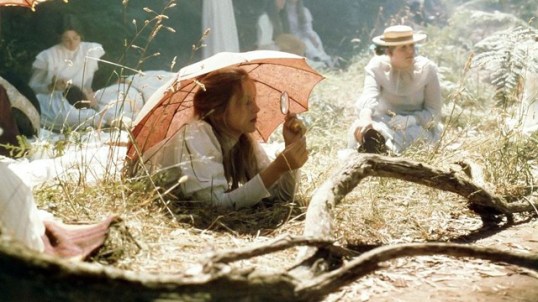
Picnic At Hanging Rock (1975, dir by Peter Weir, DP: Russell Boyd)
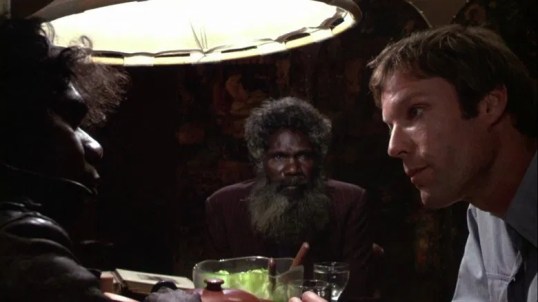
The Last Wave (1977, dir by Peter Weir, DP: Russell Boyd)
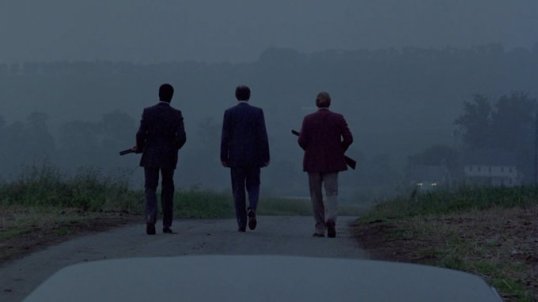
Witness (1985, dir by Peter Weir, DP: John Seale)

The Truman Show (1998, dir by Peter Weir, DP: Peter Biziou)
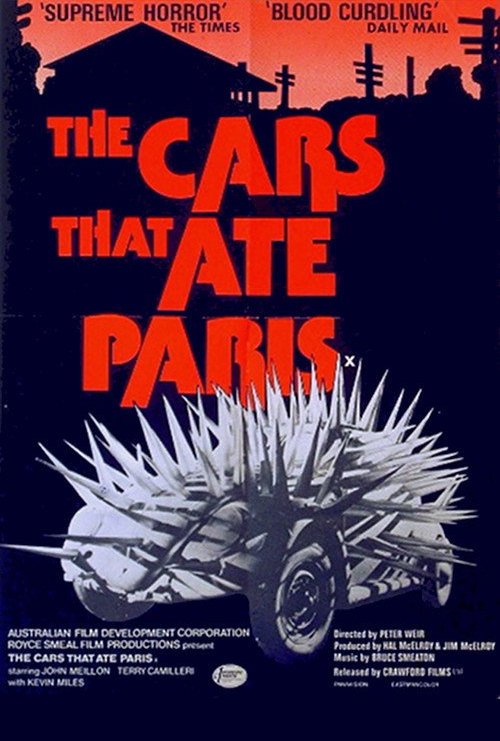
Taking place in a vaguely futuristic world, the 1974 Australian film, The Cars That Ate Paris, opens with an attractive and impossibly happy couple going for a drive in the countryside and getting killed in a truly horrific car accident, one that apparently was deliberately set up.
Meanwhile, two brothers — Arthur (Terry Camilleri) and George (Rick Scully) — are traveling across Australia, in search of work. Everywhere they go, they see long lines of desperate people looking for a way to make money, suggesting that the economy has basically collapsed. George does the driving, largely because Arthur’s license was taken away after he accidentally killed a pedestrian. Arthur is struggling with both the guilt and a phobia of cars in general.
That phobia only gets worse after Arthur and George are involved in a automotive accident of their own. George is killed but Arthur survives. Taken to the small, rural town of Paris, Arthur is adopted as a bit of a mascot by the town’s seemingly friendly mayor, Len Kelly (John Mellion). At first, Arthur is relieved to have survived but he soon comes to realize that the residents of Paris have no intention of ever letting him leave.
Paris, it turns out, is a bit of a strange place. The entire economy is based on collecting scrap metal from the many cars that crash within the city limits. The local hospital is full of car crash victims, the majority of whom end up getting lobotomized and used as test subjects for the local doctor. Indeed, the only thing that kept Arthur from a similar fate was that the mayor assured everyone that Arthur’s phobia of driving has rendered him “harmless.” (And just to make sure that Arthur doesn’t lose that phobia, he’s sent to a psychologist who spends nearly the entire session showing him grotesque pictures of car accident victims.) Though the mayor continually talks about how Paris represents the “pioneer spirit” that made Australia great, the town’s teenagers don’t seem to be too impressed with the place. They spend all of their time driving around in cars that they’ve modified into small tanks. (Their leader drives a compact car that has been covered in metal spikes, transforming it into a motorized porcupine.) Arthur wants to escape the town but can he conquer not only his own fears but also avoid being killed by the citizens who have adopted him?
The Cars That Ate Paris is a rather uneven film. It gets off to a good start and the town is memorably creepy but, once Arthur had been adopted by the mayor, it starts to drag and not much happens until the teens finally get around to turning on their elders during the final fifteen minutes of the film. Arthur is a frustratingly passive character and his car phobia never really feels credible. The film attempts to mix horror, science fiction, and satire but it comes across as being rather disjointed. Thematically, it’s probably most interesting as a precursor to the Mad Max films, having been inspired by the same Australian car culture that inspired George Miller. In fact, The Cars That Ate Paris almost feels like a prequel to the Mad Max films. One half expects a young Mel Gibson to pop up at the end, wearing Max’s patrolman uniform and shaking his head at the madness of it all.
That said, the film features a few striking images and Paris is a memorably desolate town. This really isn’t that surprising, given that The Cars That Ate Paris was directed by Peter Weir. This was Weir’s first feature film, though he had previously directed several shorts, and the film very much comes across as being the work of a talented artist who was still learning how to use those talents to tell a compelling story. In the end, Peter Weir’s involvement is the main reason to watch The Cars That Ate Paris. The film doesn’t really work but it does provide a chance to see an early effort from someone who would eventually become one of the most interesting directors of his time.
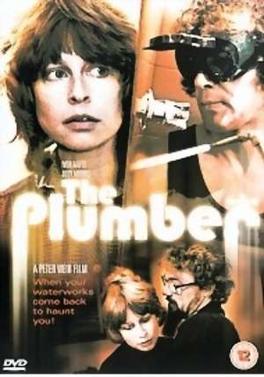
Peter Weir’s 1979 film, The Plumber, is essentially a battle of wills between two very different characters.
Jill Cowper (Judy Morris) is a masters student in anthropology. She’s educated, articulate, liberal-minded, and upper middle class. She’s married to Dr. Brian Cowper (Robert Coleby), a highly respected academic who is on the verge of being offered a position with the World Health Organization.
Max (Ivar Kants) is the plumber at the Cowpers’s building. We don’t find out much about his background, though it’s hinted that he’s had some previous trouble with the law. Max is friendly and talkative and, as soon becomes clear, amazingly determined. When he shows up at the Cowpers’s apartment, he tells Judy that he’s simply doing a check on all the building’s bathrooms. When Judy lets him in to do his inspection, Max announces that he needs to fix something with the plumbing. It should only take a day or two.
Except, of course, it takes more than a day or two. Max continually shows up at the apartment, usually waiting until Brian has left for the day. His comments to Jill become more and more intrusive and, whenever Jill takes offense, Max says that she’s misinterpreting him and that he’s just trying to be friendly. When Jill tells Brian that she thinks Max is intentionally destroying the plumbing so that he’ll have an excuse to be in the apartment, Brian refuses to believe her. When Jill tells her best friend, Meg (Candy Raymond), about what’s going on, Meg says that Max seems handsome and harmless.
Meanwhile, Max continues to work in the apartment’s bathroom, eventually turning it into a maze of pipes that seems to be constructed specifically to trap anyone unfortunate enough to enter the room….
The Plumber was originally made for Australian television. Though it was given a limited theatrical release in the United States (largely due to the arthouse success of Peter Weir’s previous films, The Last Wave and Picnic at Hanging Rock), The Plumber feels very much like a made-for-TV movie or perhaps an extended episode of an anthology series. It has a brisk 76-minute running time and visually, it features none of the striking imagery that one typically associates with Weir’s cinematic work. There’s no beautiful or majestic shots of the outback (like in Picnic at Hanging Rock) or the ocean (like in Master and Commander: Far Side of the World). Instead, the film takes place in the type of ugly and soulless cityscape that Harrison Ford was escaping from in Witness.
That said, The Plumber is still a memorable piece of work, one that feels perhaps more relevant today than when it was first released. Anyone who has ever dreaded having to take their car in for repairs or having to call someone out to fix an appliance will be able to relate to what Judy goes through with Max. The film is a reminder that, as much as we tell ourselves otherwise, we really are at the mercy of strangers. Judy may be better educated than Max and she may have more money than Max but what she doesn’t have, at least until the end of the film, is Max’s animal cunning. Max knows exactly what to say to get inside of the apartment and, once he’s inside, he knows exactly what to do to make it impossible for Judy to keep him from returning.
As upsetting as Max’s actions are, what’s even more upsetting is how everyone refuses to believe Judy when she tries to tell them what’s going on. Judy is told she is overreacting. Judy is told that she just doesn’t understand how these things work. Max gets offended that Judy doesn’t appreciate all of the hard work that he’s doing for her, despite the fact that she never asked him to do any of it. He does everything short of telling her that she needs to smile more. He’s the ultimate toxic presence, invading Judy’s life and refusing to leave. Everyone has had to deal with a Max but, for women, he’s an especially familiar and loathsome figure. The film may have clearly been made for Australian television but its themes are universal.
Because almost all of the action takes place in one small apartment, The Plumber is undeniably stagey. (It’s easy to imagine it as being a two-act play.) However, it’s also very well-acted and occasionally even darkly humorous. (As loathsome as Max is, it’s hard not to laugh a little when you see the maze of pipes he’s constructed in the bathroom.) It occasionally shows up on TCM so keep an eye out.
 For whatever reason, I’ve lately found myself very much enjoying films about the end of the world. Who knows why. Maybe it’s because I’m dreading having to sit through another election year. Seriously, if the world just ended now, we could all be saved a lot of trouble.
Add to that, the weather’s been weird this year (and please do not take that statement to mean that I want to hear about climate change because seriously, that crap bores me to death). We got hit by snow earlier in the year. (I live in Texas, where snow is a big deal.) It rained more than usual during spring. Summer started late but when it did, it was hot and dry and there was not a rain cloud to be seen. Two days ago, out of nowhere, it started raining and right now, we are under a flash flood warning. Since I believe that existence is random chaos with no rhyme or meaning, I don’t necessarily think there’s any huge meaning behind the strange weather. But still…
The 1977 film The Last Wave is all about strange weather and, in many ways, it’s the perfect film to watch while you’re stuck inside, waiting for the rain to stop. (Watch it with Take Shelter and have a watery apocalypse double feature.) The film opens in the Australian outback. The sky is blue and clear. And yet the children at a small schoolhouse hear thunder rumbling in the distance. When it suddenly starts to pour down rain, the kids are excited. Their soaked teacher manages to herd them back into the schoolhouse. As the teacher struggles to calm the children down, we suddenly hear something pounding down on the schoolhouse’s tin roof. Suddenly, the windows are shattering as huge chunks of ice crash through them. Looking outside, the teacher is confronted with the sight of torrential rain, gigantic hail, and a perfectly blue and cloudless sky.
Meanwhile, in Sydney, three Aborigines are accused of murdering a fourth outside of a bar. Assigned, by legal aid, to defend them is David Burton (Richard Chamberlain), a complacent upper middle class attorney. Since David usually deals with tax law, he doesn’t understand why he has been assigned the case. However, he take is because he feels a strange link to one of the accused men, Chris Lee (David Gulpilil).
Much like Michael Shannon in the previously mentioned Take Shelter, David has been visions and dreams in which he sees the world flooded. As he researches the case, he begins to suspect that he may be seeing visions of the future….
Well-acted and visually stunning, The Last Wave is a thought-provoking meditation on nature of reality, the end of the world, the “old ways” vs the “new ways,” and whether or not humanity is even worth saving. On top of all that, it features an absolutely brilliant final scene!
All in all, it’s not a bad way to pass the time on a rainy afternoon.
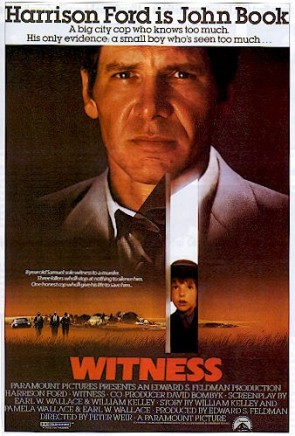 Last night, I was lucky enough to watch Witness, a best picture nominee from 1985.
Taking place in Pennsylvania, Witness tells the story of what happens when an Amish widow named Rachel (Kelly McGillis) and her 8 year-old son Samuel (Lukas Haas) decide to take a trip to visit Rachel’s sister. Traveling on an Amtrak train, Samuel is amazed by his first view of the world outside of the close-knit and insular Amish society. However, Samuel’s excitement soon turns to horror when they arrive in Philadelphia and he witnesses a man being brutally murdered.
Detective John Book (Harrison Ford, who received his first and, to date, only Oscar nomination for this film) is assigned to the case and arranges for Rachel and Samuel to stay with his sister. John soon discovers that the murder was committed by two crooked cops, McFee (Danny Glover, who is pure evil in this film) and Ferguson (Angus MacInnes). John goes to his superior officer, Chief Schaefer (Josef Sommer) with his evidence. Soon after, McFee attempts to kill and seriously wounds John. John realizes that Schaefer must be corrupt as well.
Book manages to drive Rachel and Samuel back to their farm in Lancaster County but, after dropping them off, he passes out from blood loss. Knowing that sending John to the hospital would reveal Rachel and Samuel’s location to Schaefer, Rachel’s father (Jan Rubes) reluctantly allows John to stay at the farm.
And so, while McFee, Ferguson, and Schaefer search for him, John temporarily pretends to be Amish. He works in the fields. He helps to build a barn. He becomes something of a surrogate father to Samuel and he begins a forbidden flirtation with Rachel.
He also goes to town, where he watches as an idiotic local bullies the Amish, knowing that their religion forbids them from fighting back. John responds by punching a bully, upsetting both the Amish and the a local store owner who yells that this will be terrible for the tourism. In many ways, the scene is played for laughs and applause but there’s a very serious subtext here, as it would appear that the area’s main appeal to tourists is that you can humiliate the Amish without having to worry about any sort of retaliation.
While we, as viewers, definitely get some satisfaction from seeing John punch that jackass, it also allows Schaefer to discover where he and Rachel are hiding. One morning, McFee, Ferguson, and Schaefer pull up outside the farm. They get out of their car and, as the sun rises and with beautiful green fields on either side of them, the three men hold up their shotguns and start to walk down the road….
Witness may technically be a cop film but it’s actually so much more. It’s a character study of a deeply cynical man who finds himself changed by simple and innocent surroundings. It’s a love story, with Ford and McGillis illuminating the screen with their chemistry. It’s a celebration of community, with the harshness of Philadelphia being contrasted with life among the Amish. It’s a film full of beautiful images and it also features an excellent performance from Harrison Ford.
It’s a good film. I’m glad that I witnessed Witness.

Last Monday, after I first heard that Robin Williams had committed suicide, I struggled to find the right words to express what I was feeling. Finally, I ended up posting this on Facebook:
Finally, a little over a week later, I still don’t know what to say. How do you sum up a life in just a few words? I don’t think that they can be done for anyone. It certainly can’t be done for as iconic a figure as Robin Williams. So, instead of trying to do the impossible, I’ve spent the last few days watching and reviewing a few of Robin Williams’ films.
And, of course, one of those films had to be the 1989 best picture nominee Dead Poets Society.

Now, a quick warning. The review below is going to contain spoilers. I’m going to talk about some very important plot points. But surely you’ve seen Dead Poets Society already. And even if you haven’t seen it, surely you’ve heard what the film is about and surely, you know what happens. After all, who doesn’t? But if you are one of those people who does not know or who has not seen the film — well, why haven’t you?
The first time I ever saw Dead Poets Society was in a high school creative writing class. Our teacher — who, it quickly became apparently, considered herself to be the real-life version of the teacher played by Robin Williams — showed it to us, over the course of three class periods, as an introduction to writing poetry. I enjoyed the film but the rest of the class absolutely loved it. Especially the guys. For the rest of the class year, I would listen to those guy as they bragged about how they were seizing the day. I remember one day, the classroom was empty except for me and one of the boys. I can’t remember what led to him doing it (and it could very well have been my suggestion that he try) but he eventually ended up standing on top of a desk just like the students at the end of the film. Unfortunately, public high school desks aren’t quite as sturdy as private school desks and my friend soon ended up crashing to the floor as the desk slipped out from underneath him.
Ah, memories.
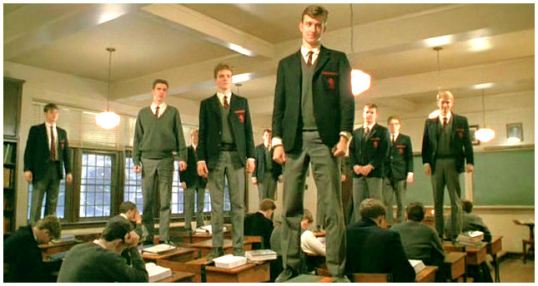
Yes, Dead Poets Society is one of those films. It’s a film that everyone seems to have seen, loved, and found to be inspirational. And I have to admit that I’ve grown to appreciate it more over the years since I first saw it back in creative writing class. With each subsequent viewing, I find myself less critical of the film’s melodramatic and predictable moments and more willing to accept the film for what it is — a celebration of life, poetry, and teaching. Dead Poets Society, from the very moment that Robin Williams makes his first appearance sitting at the end of a line of stodgy old men and flashing an unapologetically impish smile, is a film that defies easy cynicism. It’s a film that embraces you and you have to be very hard-hearted not to embrace it back.
Dead Poets Society, of course, tells the story of a private school in the 1950s and what happens when a new teacher (Robin Williams, naturally) encourages his students to celebrate creativity, to “seize the day” as the saying goes. Not surprisingly, just about every other adult thinks that the students would be better off not seizing the day but instead preparing for a life of WASPy conformity. This leads to a few of Mr. Keating’s students forming a secret society where they can read poetry, talk about their feelings, and basically do their best to honor the memory of Walt Whitman.
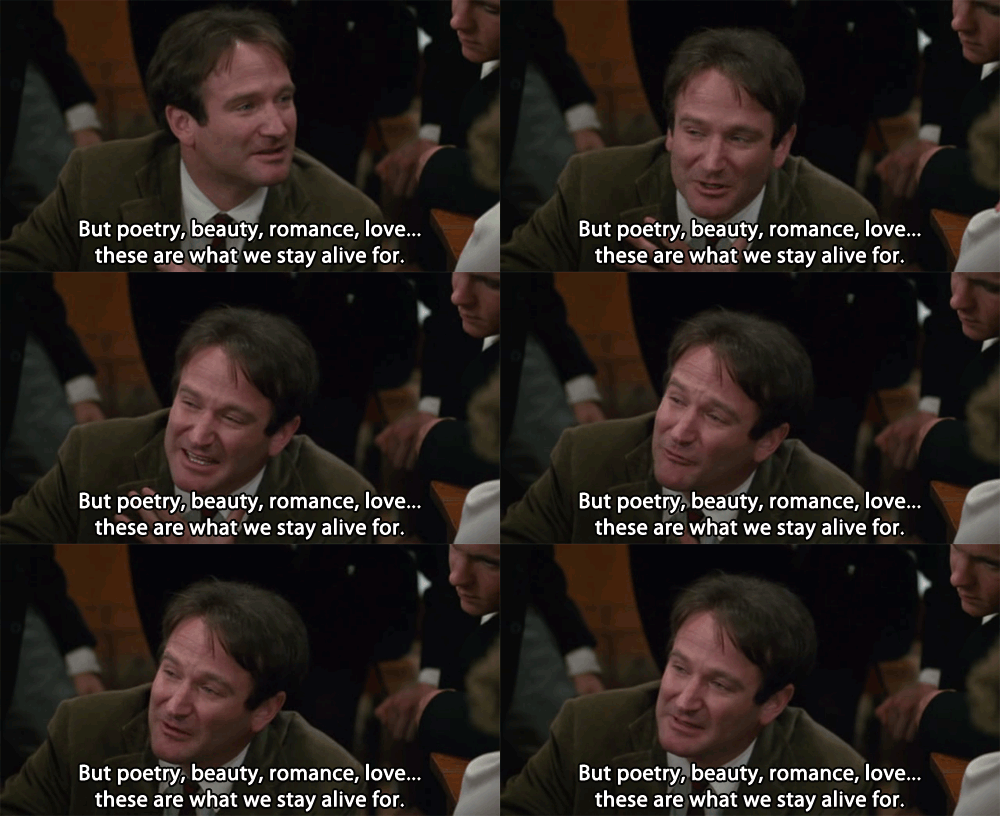
There are seven members of the Dead Poets Society:
There’s Gerard Pitts, who doesn’t really make much of an impression. The main thing that I always notice about Gerard Pitts is that he looks like a young version of Sam Waterston. This made sense when I checked the end credits and I discovered that he was played by James Waterston, son of Sam.
Stephen Meeks (Allelon Ruggiero) is another one who doesn’t actually get to do much (beyond boast about the fact that he has a genius I.Q. and create a makeshift radio) but, with his cute glasses, unruly hair, and friendly manner, it’s impossible not to like him.
Of the three main villains in Dead Poets Society, none of them are quite as loathsome as Richard Cameron (Dylan Kussman). The stern headmaster (played by Norman Lloyd) and the judgmental father (played by Kurtwood Smith) at least have the excuse of being old and set-in-their-boring-ways. Cameron, however, starts out as a member of the Dead Poets Society but still has absolutely no problem betraying them. As opposed to the adults in the movie, Cameron is someone who still had a chance to be something more than a worm. That being said, Dylan Kussman makes Cameron into a memorable worm.
Then there’s Knox Overstreet (played by Josh Charles, who appears to have only aged a year or two in between this movie and the first season of The Good Wife). We know that Knox is rich because his name is Knox Overstreet. Knox has a crush on a girl who goes to the local high school. Knox’s subplot doesn’t really amount to much but it’s impossible not to like him because Josh Charles was (and is) simply adorable.
Charlie Dalton (played, quite well, by Gale Hansen) is the one who most enthusiastically embraces the idea of seizing the day. He’s the one who pretends to get a tattoo, who demands to be known by a new name, who attempts to protest the school’s out-dated traditions, and who ultimately is punished with expulsion after he physically attacks Cameron. (And, as sorry as I was to see Charlie leave the movie, Cameron totally deserved it.) For a few months in 2008, Gale Hansen was a very active participant on the IMDB message boards, answering questions, giving advice, and generally just being a very gracious guy. However, he suddenly stopped posting and, just as mysteriously, all of his previous posts were subsequently deleted. Hansen, himself, hasn’t acted since 1998 and that’s a shame because he really did do a good job as the enthusiastic, idealistic, and not-quite-as-worldly-as-he-thinks Charlie Dalton.
Neil Perry (played by Robert Sean Leonard) is the one who, inspired to seize the day, appears in a local production of A Midsummer Night’s Dream and, as a result, earns the wrath of his overbearing father. Seen now, in the shadow of Robin Williams’ tragic death, the scene where Neil commits suicide takes on a terrible poignance and it no longer feels as melodramatic as it did the first time that I saw it. Whereas, originally, it seemed hard to believe that a character played by the energetic and charismatic Leonard would end up committing suicide over a play, we now know that energy and charisma do not necessarily equal happiness.
And finally, there’s Todd Anderson (played by a very young Ethan Hawke), who is pathologically shy and who, at the end of the film, finally finds the strength to climb up on his desk. After years of seeing in him in various Richard Linklater films, it’s strange to see the usually verbose Hawke playing such an introverted character. But he does a good job, turning Todd into the film’s moral center.

And then there’s their teacher, John Keating who, quite frankly, might as well be named Robin Williams. That’s not to say that Williams doesn’t give a good performance as Keating. Indeed, Williams is the glue that holds the film’s ensemble together and his performance so dominates the entire film that, every time that I’ve seen it, I’ve always been surprised to discover just how little screen time he actually has in Dead Poets Society. As embodied by Robin Williams, John Keating becomes the type of teacher that everyone wishes they could have had just once. The power of his performance comes from the fact that he not only inspires the viewers to “seize the day” but he actually makes you believe that the day is worth holding on to. Without Robin Williams, Dead Poets Society would be easy to dismiss as just being a film about a bunch of privileged teenagers reading poetry and pretending to be rebels. With Williams, however, the film becomes a celebration of life.
Robin Williams, R.I.P.
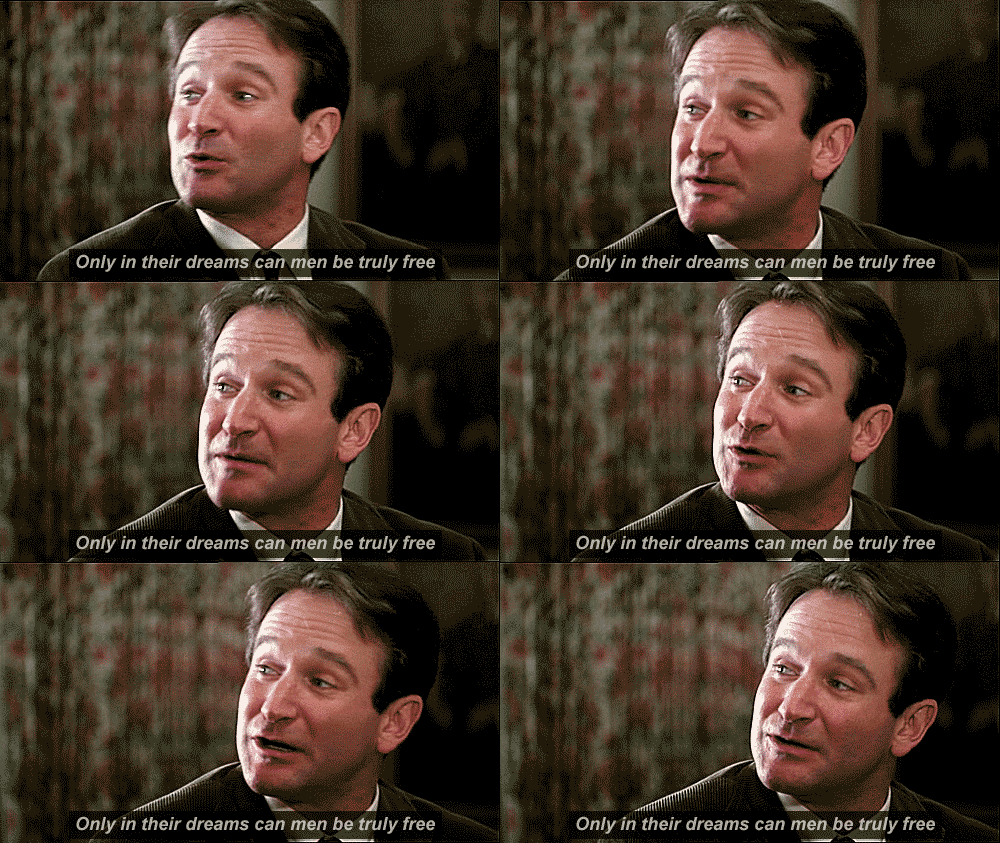
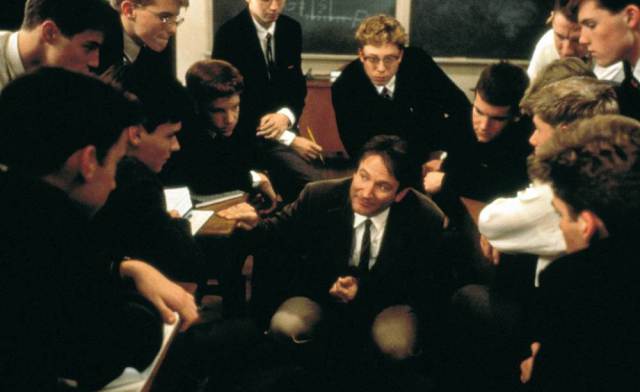
With each passing year I get older and part of that process means many of the people I grew up admiring and looking to for inspiration has passed. They’ve all left an indelible mark on me and continue to push and prod me in making my own mark on the world before my own time comes to pass.
So, it was with a sad heart when I found out that Robin Williams passed away today. As to the manner of his passing I won’t dwell on it, but instead on how he has made an impact on my life and on the world. He might have just been a comedian and an actor known to have entertained several generations of people, but he would always be John Keating to me, first and foremost.
I was already a fan of Williams from watching his hit show Mork & Mindy. I’ve even been a fan of his films, but I truly began to admire the man after his performance as English teach John Keating in 1989’s Dead Poets Society. He was able to take his rapid-fire gift for gab but meld it with such a poignant and emotional performance as a teacher in a tradition-bound prep school who really cared about the kids in his charge.
I would say that his performance and this film was instrumental in opening up the world of literature and the joys of the written word to my teenage self. This film and his work in it showed me that literature shouldn’t be something to be endured, but instead something that should nurture and inspire me.
To say that Robin Williams has been an inspiration to me would be an understatement.
Rest in peace, my captain and you’ve certainly left your verse on this world.
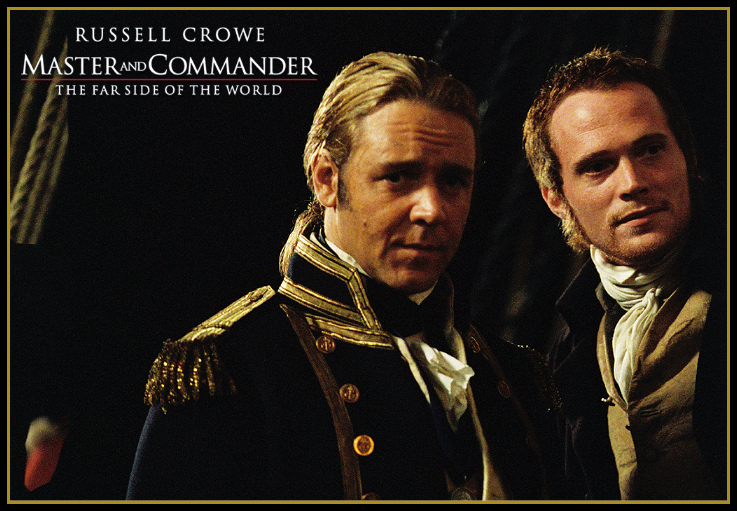
If there was a film which deserved better when it first came out in 2003 it would be Peter Weir’s epic adaptation of the Patrick O’Brian seafaring novels starring the character of Capt. Jack Aubrey. It was just bad luck on the part of Weir’s film that it came out the same year and month as the juggernaut that would sweep through not just the box-office for the 2003 holiday season, but all through the award-season. If Master and Commander: The Far Side of the World had only come out a year later there’s a great chance it would’ve been the frontrunner for 2005 Academy Awards for Best Picture, Best Director, Best Adapted Screenplay and many more. But the juggernaut that was Peter Jackson’s Lord of the Rings: The Return of the King would not be denied after two previous years when Jackson and his magnum opus were passed over.
To say that Peter Weir was at the top of his game with Master and Commander would be an understatement. Working from a script written by Weir himself and John Collee, the film would take several episodes from the Patrick O’Brian Aubrey-Maturin novels and combine them to make a coherent and thrilling period piece that rarely ever get made anymore. This was epic filmmaking at its finest with Weir’s direction keeping the long-running time of the film from becoming too tedious. Yet, he was also able to keep the film from becoming one battle setpiece following another. There was enough of a balance between the quiet storytelling, especially between the characters of Capt. “Lucky” Jack Aubrey (played by Russell Crowe in what had to be his best role ever) and his close friend and ship’s doctor Stephen Maturin (Paul Bettany matching Crowe scene for scene) to keep the film grounded in reality.
Master and Commander is set during the Napoleonic Wars when France and England battle it out on land and in the high seas. On one side is the HMS Surprize captained by Jack Aubrey which patrols the sea lanes from French privateers looking to attack and loot the rich English whaling ships to help fund Napoleon’s ambitions. The film is actually a cat-and-mouse thriller wrapped around a character piece as Aubrey’s ship and crew, outgunned and less armored than the French frigate Acheron it has come across during its patrol, must not just try and survive but find a way to beat it’s larger opponent. It’s during the quiter scenes in-between sea engagements that the film actually becomes stronger. We see life onboard the HMS Surprize as being quite harsh and primitive and not so glamourous as past films about sailing life would have audiences believe. The film shows how this harsh life for volunteers and press-ganged crew ratings creates a strong bond of fellowship amongst the crew members that when they believe someone is jeopardizing their lives they quickly turn on that individual. But it’s through the near-dictatorial handling of his crew which keeps both ship and crew from devolving into mutiny. Crowe does a great job of giving Jack Aubrey that balance of ruthless taskmaster whose word is law onboard, but also gives his captain that bon vivant flair which when used accordingly makes Aubrey a hero to the very men he has to lord over.
This benevolent dictator was balanced out by Bettany’s Dr. Maturin who acts not just as the scientific counter to Aubrey’s militaristic personality, but also as the conscience of the ship who looks first to the crew’s well-being. This dynamic between Crowe and Bettany kept the film anchored and stabilized as we see the long-standing friendship between these two get tested not just by the crisis they find themselves in but also the vast ideological differences between the military man and the scientist. Yet, despite all their problems and difference when things became rough the two would settle it amicably and concentrate on their shared task with their bond of friendship intact and much stronger after.
The film doesn’t shirk it’s thrills as Master and Commander provides audiences with some of the most thrilling and accurate portrayal of naval combat during the Napoleonic era. There are no steel-hulls or rapid-fire guns. The engagements between the HMS Surprize and the Acheron were all brutal affairs from the first time the latter ambushes Aubrey’s ship early in the film to the final battle which sees not just ship-to-ship fighting but boarding actions as the crew of the Surprize attempt a desperate gamble to take the fight to the bigger French privateer. It’s a testament to Weir’s direction that even through the chaotic nature of each battle he’s able to keep each scene easy to follow and allow for main characters to stand out for audiences to recognize.
It’s a shame that the film didn’t succeed in the box-office more than it did. Master and Commander: The Far Side of the World showed that there was still old-school epic filmmaking left in Hollywood with filmmakers willing to tell a grand story with bigger-than-life characters on a broad canvas. The fact that it took an even more epic film to surpass Peter Weir’s film shouldn’t detract from this film’s accomplishments.
 Through the Shattered Lens