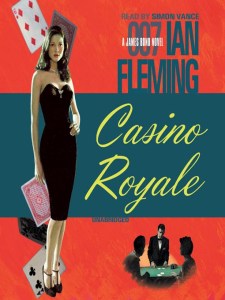
A Blast From The Past: Casino Royale (dir by William H. Brown)


Everyone knows that Sean Connery made his debut of James Bond in 1962’s Dr. No but what they may not know is that Sean Connery was not the first actor to play James Bond.  James Bond made his first appearance 8 years earlier when an American television show called Climax! presented a 48-minute adaptation of Ian Fleming’s first Bond novel, Casino Royale.

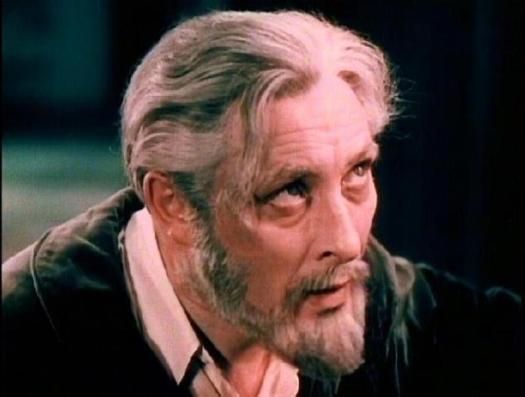
In this version of Casino Royale, James Bond was known as Jimmy Bond and he was about as American as you can get.  (Felix Leiter, meanwhile, was now English and named Clarence Leiter).  Jimmy Bond was played by Barry Nelson, an actor who is probably best known for playing the blandly friendly hotel manager in Stanley Kubrick’s The ShiningCasino Royale’s villain, Le Chiffre, was played by none other than Peter Lorre.

This version of Casino Royale was initially meant to serve as a pilot for a weekly television series but, perhaps fortunately, the Climax version of Casino Royale didn’t get much attention when it was originally aired.  According to Sinclair McKay’s authoritative Bond book, The Man With The Golden Touch, this version of Casino Royale was forgotten about until a copy of it was discovered in the 1980s.  By that time, of course, everyone knew that James Bond was English and that Felix Leiter was American.

Thanks to YouTube, I’ve seen the Climax! Casino Royale and it’s definitely a curiosity.  If Dr. No hadn’t launched the James Bond film franchise, there would be little reason to watch this version of Casino Royale.  It moves a bit slowly, is way too stagey, and it reveals that, contrary to what we’ve all heard, live television was not always the greatest thing on the planet.  Not surprisingly, this adaptation contains none of the brutality or the moral ambiguity that makes Fleming’s novel such a fun read.  American television audiences would not see Jimmy Bond strapped naked to a chair and an American television show would never end with the hero saying, “The bitch is dead.”  The best you can say about this version of Casino Royale is that Peter Lorre makes for a good villain (in fact, of the three versions of Casino Royale, the television version is the only one to feature an effective Le Chiffre) and Barry Nelson would have made a good Felix Leiter.

That said, I still find the television version of Casino Royale to be fascinating from a historical point of view.  This is the type of show that you watch for curiosity value.  This is the type of show that you watch so that you can think about how different things could have been.

So, presented for your viewing pleasure, here’s the original version of Casino Royale:

Horror Film Review: Tales of Terror (dir by Roger Corman)


Eh, anthology films.

I have to admit that I’ve never been a huge fan of anthology films.  Anthology films are almost always a bit uneven.  Some filmmakers are better suited to making short films than others and, as anyone who has ever sat through one can tell you, sitting through a boring short film is actually worse than having to watch a boring long film.  Too often, anthology films are just a collection of boring short films.  If you get lucky, there might be a good segment hidden amongst all of the bad segments.  But even so, that often means sitting through 30 minutes of bad filmmaking for 15 minutes of something that’s moderately entertaining.

1962’s Tales of Terror is an anthology horror film.  Directed by Roger Corman, the film is a part of his Poe cycle and features adaptations of three Poe short stories, Morella, The Black Cat, and The Facts In The Case of M. Valedemar.  While it definitely suffers from the flaws that afflict many anthology films, Tales of Terror is saved a bit by the presence of Vincent Price.  Price not only appears  in all three of the films but he also provides the narration that links each film.  As I mentioned when I reviewed The Premature Burial, one cannot underestimate the importance of Vincent Price and his unique style of acting when it comes to discussing Corman’s Poe adaptations.  With his dramatic flourishes and his theatrical style of speaking, Price was the perfect star for these films.  As an actor, he perfectly complimented Corman’s flamboyant and colorful direction.  It also helps that Price himself seems to be truly enjoying himself in all of these films.  His eccentricity brings the film’s to life.

As for the separate stories that make up Tales of Terror, things get off to a rather macabre start with Morella.  Leonora (Maggie Pierce) returns home to visit her father (Vincent Price), who is now a drunken wreck who continues to blame Leonora for the death of her mother, Morella (Leona Gage).  Morella died while giving birth to Leonora.  Leonora is shocked to discover that her father is keeping her mother’s decomposing body in the mansion.  Leonora, who is suffering from a terminal illness, tries to take care of her father.  However, Morella’s spirit remains in the house, leading this story to a rather depressing and unsettling ending.  This story was effectively done, playing out like a particularly morbid companion to The Fall Of The House of Usher.

The Black Cat is presented as a comedy, starring Peter Lorre as a man who becomes convinced that his wife is cheating on him with a snobby wine taster who is, of course, played by Vincent Price.  This overlong segment did not work for me and I have to admit that a lot of that is because I love cats, black cats in particular.  Beyond that, the humor is a bit too broad.  Corman could do comedy, as he showed with Little Shop of Horrors, but he seems to be trying a bit too hard here.

Finally, the third segment is The Facts In The Case of M. Valdemar, in which Vincent Price plays the title character.  The dying Valdemar employs a hypnotist (Basi Rathbone) to put him in a trance to help relieve his suffering.  However, the hypnotist hopes to marry Valdemar’s wife (Debra Paget) and, after putting Valdemar into a trance, he leaves the dying man there.  Valdemar, whose body starts to decay, cannot die.  But, once he becomes angry enough, he can still rise from his bed to seek revenge even as his body putrefies.  This segment was the best of the three, featuring Price’s best work in the film and also a wonderfully villainous turn from Basil Rathbone.  The makeup effects that were used to capture Valdemar’s decay remain effectively frightening today.

Tales of Terror is two good stories and one mediocre one, which is better than the usual anthology film.  Still, not surprisingly, the main reason watch is for the wonderful Vincent Price.

Horror Film Review: The Raven (dir by Roger Corman)


“Shall I ever see the rare and radiant Lenore again?” — Dr. Erasmus Craven (Vincent Prince)

“How they Hell should I know?” — Dr. Adolphus Bedlo (Peter Lorre)

This exchange comes from Roger Corman’s 1963 film, The Raven, and it pretty much epitomizes the film.  Very loosely based on the poem by Edgar Allan Poe, The Raven was one of the many Poe adaptations that Corman did with Vincent Price.  As opposed to the other films in Corman’s Poe cycle, The Raven was a flat-out comedy, one that parodied the other films in the cycle.  Reportedly, Peter Lorre improvised his response to Vincent Price’s question about Lenore.  In fact, Lorre improvised a good deal of his performance and his jokes sometimes even took Corman by surprise.  As a result and despite the fact that Richard Matheson did write a script for the film, The Raven is one of those films that feels like it was made up while the camera was rolling.

The Raven is a film about three sorcerers who are always fighting and arguing with each other.  Dr. Erasmus Craven (Vincent Price) spends his time mourning the late Lenore.  The evil Dr. Scarabus (a frail-looking Boris Karloff) has his own castle where he lives with the ghost of the late Lenore (Hazel Court).  Dr. Adolphus Bedlo (Peter Lorre) is a sarcastic ne’er-do-well who saw Lenore in Scarabus’s castle and was transformed into a talking raven as a result.

In raven form, Dr. Bedlo flies over to Craven’s castle and convinces Craven to transform him back into human form.  After informing Craven that Scarabus has Lenore’s ghost in his castle, the heart-broken Craven decides to head over to Scarabus’s castle and get some answers.  Accompanying the group is Craven’s daughter, Estelle (Olive Sturgess) and Bedlo’s son, Rexford (Jack Nicholson, looking somewhat lost in the role of a boring young man).

At the castle, Scarabus puts on an act of being a friendly and gracious host but the opposite soon turns out to be true.  In fact, the entire castle is full of secrets and it quickly turns out that hardly anyone — with the exception of Estelle and Rexford — are who they actually claim to be.  It leads to a battle in magic between Craven and Scarabus.  I nearly described their battle as being “epic” but that’s probably not the right world.  It’s epic by the standards of Roger Corman but actually, the big battle is just as jokey as the rest of the film.

The Raven is definitely not a film that’s meant to be taken seriously.  One gets the feeling that Corman knew that the presence of Price, Karloff, and Lorre would make the film a success no matter what the film was like so he decided to have some fun with it.  (Price and definitely Lorre appear to have been in on the joke while Karloff was perhaps a bit less so.)  To be honest, the film’s only earnest moments come courtesy of Oliva Sturgess and Jack Nicholson but, because Nicholson is Nicholson, you watch those earnest moments waiting for Rexford to arch an eyebrow or flash that devilish grin.  Unfortunately, he doesn’t.  Jack is pretty boring here.

The Raven, if we’re going to be honest, is probably too jokey for its own good but it’s still hard to resist the charm of Price, Lorre, and Karloff.  The film is a chance to see three horror icons acting opposite each other and, as a result, it’s a fun film for horror fans.  Vincent Price breaks the fourth wall at the end of the film and it’s hard not to love it.

Horror Scenes I Love: Peter Lorre in Tales of Terror


Born in what is now Slovakia, Peter Lorre began his acting career in Europe, appearing on the stage and making quite an impression when he starred in Fritz Lang’s M.  When the Nazis came to power, Lorre was one of the many film artists who left Germany.  At first, he moved to France but, in 1934, he set sail for the United States and continued his career in Hollywood.  A popular character actor, Lorre appeared in such classic films as The Man Who Knew Too Much, The Maltese Falcon, Mad Love, Arsenic and Old Lace and Casablanca.  Though his role in Casablanca was small, he still played a key role when he gave Rick the letters of transit.

He also appeared in several horror films, often opposite his good friend Vincent Price and Boris Karloff.  In this scene from 1962’s Tales of Terror, Lorre and Price challenge each other to a wine-drinking contest.


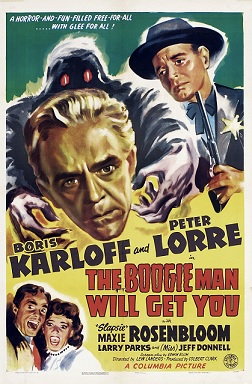
Horror on the Lens: The Boogie Man Will Get You (dir by Lew Landers)


Today’s horror on the lens is a short horror comedy from 1942.  In The Boogie Man Will Get You, Winnie Slade (Miss Jeff Donnell) buys an old house from Prof. Billings (Boris Karloff) with plans to covert it into a hotel.  However, one of the conditions of the sale is that Prof. Billings and his servants be allowed to live on the property.  What Winnie doesn’t know is that Prof. Billings had been conducting experiments on traveling salesman.  He hopes to turn them into supermen who, much like Captain America, can then be sent overseas to fight the Nazis.  However, his experiments have yet to be successful and have mostly just resulted into a lot of salesman being buried out in the rose garden.

However, things start to look up for Prof. Billings when he meets Dr. Lorencz (Peter Lorre), who is not only a doctor but also a mayor, sheriff, and dog catcher.  Seriously, Dr. Lorencz can do it all!

The Boogie Man Will Get You is a fun little time capsule of the time in which it was made.  For horror fans, it is mostly interesting because it features both Boris Karloff and Peter Lorre.  Both Karloff and Lorre appear to be having a lot of fun parodying their usual screen images.

Enjoy!

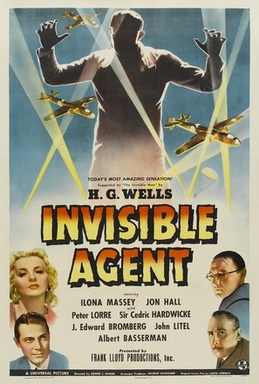
Horror Film Review: Invisible Agent (dir by Edwin L. Marin)


In 1942, the world was at war and everyone, whether a soldier or a civilian, was expected to do their part for the war effort.  That included the best and the brightest of Hollywood.  Stars like Jimmy Stewart, Clark Gable, and Henry Fonda enlisted in army.  Others sold war bonds and narrated patriotic news reels.  Even the Universal monsters did their part for the war effort, with the Invisible Man becoming the Invisible Agent in the 1942 film of the same name.

Invisible Agent opens in 1940, with Frank Griffin, Jr. (Jon Hall), the grandson of the original Invisible Man, being confronted by a Nazi (Sir Cedric Hardwicke) and a Japanese spymaster (Peter Lorre) at his print shop in Manhattan.  They want his grandfather’s invisibility formula.  At first, they offer to pay him for it.  Then, when Frank refuses, they threaten to chop off his fingers.  Frank manages to escape with both his fingers and the formula.  As Frank later tells the Americans, he’s not willing to give the formula to anyone because he knows how dangerous it can be if not used properly.  As far as Frank is concerned, the formula must never be used again.  Frank does say that he might change his mind under extraordinary circumstances.

The film cuts to a series of headlines announcing that the Japanese have bombed Pearl Harbor.  The circumstances are now extraordinary and Frank agrees that it is time to use the formula for the war effort.  But he agrees to do so on the condition that only he be allowed to take the formula.  Frank becomes the Invisible Agent, taking the formula and then parachuting into Nazi Germany.  Unseen, Frank searches for information about Nazi spies in the U.S. and the details of Germany’s plan to bomb New York.  Along the way, he meets Maria Sorenson (Ilona Massey), a wealthy German woman who is lusted after by the members of the German high command but who is actually working for the Resistance.  Frank also finds himself, once again, coming across the two men who previously threatened him in New York.

Here are the positive things about this film.  Invisible Agent has an intriguing premise.  The Nazis are such monsters that even the once fearsome Universal monsters are joining the effort to take them down.  The film also features two intelligent performances from Cedric Hardwicke and Peter Lorre, both of whom bring some unexpected shadings to their villainous roles.  The opening scene in Manhattan plays out like an intense film noir and, once the action moves to Germany, director Edwin L. Marin keeps things moving at a steady pace.

Unfortunately, Invisible Agent has one huge problem that it cannot overcome.  Jon Hall gives a remarkably charmless performance in the title role, flatly delivering his lines and showing very little in the way of personality.  When you’re not seen for the majority of the film, it’s important to have a voice that’s full of personality.  That’s one reason why the previous Invisible Man films benefitted from the casting of actors like Claude Rains and Vincent Prince.  Jon Hall, on the other hand, just comes across as being dull.  He gives a boring performance, whether visible or not and, as a result, Invisible Agent falls flat in a way that the previous Invisible films did not.  There’s no real stakes in his turning invisible because there really wasn’t much to him to begin with.

Still, I thank the Invisible Agent for his service.

Previous Universal Horror Reviews:

  1. Dracula (1931)
  2. Dracula (Spanish Language Version) (1931)
  3. Frankenstein (1931)
  4. Island of Lost Souls (1932)
  5. The Mummy (1932)
  6. The Invisible Man (1933)
  7. The Bride of Frankenstein (1935)
  8. Dracula’s Daughter (1936)
  9. Son of Frankenstein (1939)
  10. The Invisible Man Returns (1940)
  11. The Wolf Man (1941)
  12. Ghost of Frankenstein (1942)
  13. Frankenstein Meets The Wolf Man (1943)
  14. Son of Dracula (1943)
  15. House of Frankenstein (1944)
  16. House of Dracula (1945) 
  17. Creature From The Black Lagoon (1954)

THE MALTESE FALCON is the Stuff Film Noir Dreams Are Made Of (Warner Brothers 1941)


gary loggins's avatarcracked rear viewer

1941’s THE MALTESE FALCON may not be the first film noir (most people agree that honor goes to 1940’s STRANGER ON THE THIRD FLOOR ). It’s not even the first version of Dashiell Hammett’s 1930 detective story – there was a Pre Code film with Ricardo Cortez as Sam Spade that’s pretty good, and a 1936 remake titled SATAN MET A LADY with Warren William that’s not. But first-time director John Huston’s seminal shamus tale (Huston also wrote the amazingly intricate screenplay) virtually created many of the tropes that have become so familiar to fans of this dark stylistic genre:

THE HARD-BOILED DETECTIVE – Private investigators had been around since the dawn of cinema, from Sherlock Holmes to Philo Vance to Charlie Chan, but none quite like Humphrey Bogart’s Sam Spade. Both Cortez and William played the character as flippant skirt-chasers, but in Bogie’s hands, Sam Spade is a harder…

View original post 667 more words

10 Horror Stars Who Never Won An Oscar


gary loggins's avatarcracked rear viewer

It’s Oscar night in Hollywood! We all may have our gripes with the Academy over things like the nominating process (see my posts on THE OTHER SIDE OF THE WIND STAN & OLLIE and THEY SHALL NOT GROW OLD ), but in the end, we’ll all still be watching – I know I will!

One of my gripes over the years has always been how the horror genre has gotten little to no attention from Oscar over the years. Sure, Fredric March won for DR. JEKYLL & MR. HYDE , but there were plenty of other horror performances who’ve been snubbed. The following ten actors should have (at least in my opinion) received consideration for their dignified work in that most neglected of genres, the horror film:

(and I’ll do this alphabetically in the interest of fairness)

LIONEL ATWILL

 Atwill’s Ivan Igor in MYSTERY OF THE WAX MUSEUM goes…

View original post 1,042 more words

Dark Genesis: STRANGER ON THE THIRD FLOOR (RKO 1940)


gary loggins's avatarcracked rear viewer

“Tuesdays in Noirvember” continues with what many consider to be the first film noir…

Fans of the film noir genre often cite movies like THE MALTESE FALCON or REBECCA among the first entries in this stylistic category, but a case can certainly be made for STRANGER ON THE THIRD FLOOR, a bizarre B-film made by director Boris Ingster. It features all the elements associated with the dark genre: a big city setting, interior monologues, an extended nightmare sequence, flashbacks, Expressionistic set design… hell, it’s even got noir’s favorite patsy Elisha Cook Jr ! The only thing missing is that downbeat cynicism you find in post-war films, but since America hadn’t yet entered World War II, we can forgive the happy ending and concentrate on what makes this movie the seminal film noir.

First, there’s the plot: star reporter Michael Ward is the key witness in a murder case against young…

View original post 535 more words

Cleaning Out the DVR #21: Halloween Leftovers 3


gary loggins's avatarcracked rear viewer

Time to reach deep inside that trick-or-treat bag and take a look at what’s stuck deep in the corners. Just when you thought it was safe, here’s five more thrilling tales of terror:

YOU’LL FIND OUT (RKO 1940; D: David Butler) – Kay Kyser and his College of Musical Knowledge, for those of you unfamiliar…

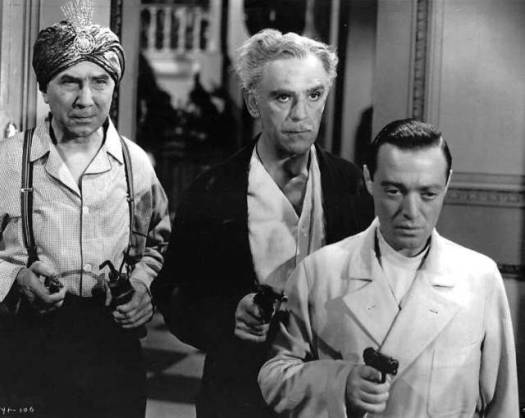
…were a Swing Era band of the 30’s & 40’s who combined music with cornball humor on their popular weekly radio program. RKO signed them to a movie contract and gave them this silly but entertaining “old dark house” comedy, teaming Kay and the band (featuring Ginny Simms, Harry Babbitt, Sully Mason, and the immortal Ish Kabibble!) with horror greats Boris Karloff , Bela Lugosi , and Peter Lorre . It’s got all the prerequisites: secret passageways, a creepy séance, and of course that old stand-by, the dark and stormy night! The plot has Kyser’s…

View original post 960 more words