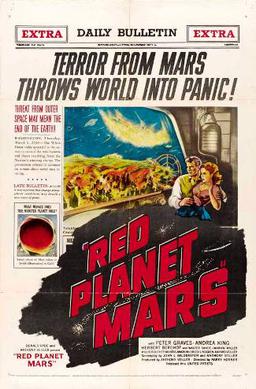
Red Planet Mars (1952, directed by Harry Horner)


Chris Cornyn (Peter Graves) and his wife, Linda (Andrea King) are two scientists who have spent the years since World War II listening to transmissions from Mars.  The technology that they use was developed by a scientist who may have been a Nazi but the Cornyns feels that the greater good of learning about Mars outweighs the problematic background of their equipment.

One day, the transmitters pick up a message from Mars, announcing that Mars is a Socialist paradise where there is no fear of nuclear war.  The Soviets are gleeful because they think the Martian messages will lead to the collapse of NATO.  But then the Martians start sending out religious messages, which lead to riots in the USSR and Eastern Europe.

Are the Martians really contacting Earth?  Is God really transmitting a message from Mars?  Or is a more sinister figure responsible?

Red Planet Mars is one of those films that only could have been made at the height of the Cold War.  Despite the title, the film is decidedly Earth-bound and full of stock footage of the nations of the world reacting to the Martians.  The main theme is that, Martians or not, nothing is more important than protecting the American way of life. even if that means sacrificing your own life and misleading the world.  Even if it is now impossible to listen to his dialogue without thinking about the “Do you like movies about gladiators?” conversations from Airplane!, Peter Graves was the perfect, no-nonsense messenger.  An artifact of a different time, the movie’s greatest strength is that it takes its ridiculous story seriously and even today, it leaves you wonder how we would react to messages from Mars.  Hopefully, we would today be more skeptical.  People in 1953 would believe anything.

30 More Days of Noir #10: Death in Small Doses (dir by Joseph M. Newman)


Ah, speed.

I have to admit that I always find films about amphetamines to be fascinating because I take them for my ADD.  I’ve been taking Dexedrine since I was in middle school and it has always amused me how people who don’t have ADD seem to think that the meds will give you super powers.  For instance, every season of Big Brother, there’s people online who get outraged over certain houseguests taking Adderall.  “She had an unfair advantage!” someone will say, “Because she’s taking Adderall!”  What can I say?  People who don’t have ADD just don’t get it.  Yes, if you have ADD, the meds can help you focus but it’s not like they’re going to give you any sort of special power that’s not available to any other person.

(I will admit that there is a slight difference between me on my meds and me off my meds.  Actually, my family says that there’s a huge difference but I think they’re exaggerating.  It is true that I’m a lot more focused when I take my Dexedrine.  My mind wanders a bit less than usual and I’m also usually in better control of my frustrations.  When I take my meds, I can finish any project.  When I don’t take them, I can talk about finishing any project.)

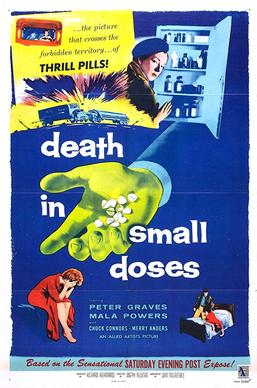
Dexedrine focuses me but apparently, it does the opposite for those who don’t have ADD.  The 1957 film, Death in Small Doses, features a truck driver named Mink Reynolds who, despite not having ADD, pops too many capsules and ends up playing really loud music and trying to force a waitress to dance with him.  He also hallucinates seeing a car and then grabs a knife and tries to kill another truck driver.  To be honest, that seems a bit extreme to me.  In fact, I’d almost argue that Mink’s behavior would indicate that the filmmakers really didn’t know much about amphetamines.  Making things even stranger is that Mink is played by Chuck Connors, who was a remarkably inexpressive actor.  Watching Connors, with his stone face, trying to dance and jump around is an interesting experience.  Mink is supposed to be a jazz-crazed, speed-abusing hepcat but instead, he comes across like an animatronic mannequin.  You can almost hear the gears shifting whenever he has to move across the screen.

Mink’s fellow truck driver is Tom Kaylor (Peter Graves), a seemingly upright man who is usually seen wearing a tie and who looks like he would be more comfortable working behind a desk than driving a truck.  Of course, that’s because Tom is actually an FBI agent!  He’s working undercover, pretending to be a truck driver so that he can smash a ring of drug dealers!  Of course, the problem here is that everything about Peter Graves’s screen presence shouts out, “Narc!”  With his square jaw and his perfect haircut and his stiff but authoritative delivery of his dialogue, he seems like he was created in a lab that specifically set out to develop the most stereotypical FBI agent imaginable.  There’s not a single rough edge to him and it’s hard to buy that the other truck drivers wouldn’t see straight through him.

While Tom tries to bust the ring, he also finds time to possibly fall in love with two different women, both of whom seem as if they might know more than they’re letting on.  Amy (Merry Anders) is the waitress who has developed a drug habit of her own.  Val (Mala Powers) owns the boarding house when Tom and Mink live.  Can Tom trust either one of them?  And will Tom not only undercover the identity of the head of the drug ring but also survive long enough to bring the dealers to justice?

So, here’s the thing.  During its worst moments — i.e., whenever Chuck Connors is jumping all over the place and talking about how much he loves his friend “benny” — this is a campy and rather silly film that makes Reefer Madness look subtle by comparison.  However, during its best moments, this is a tough and entertaining noir that features good performances from Merry Anders and Mala Powers.  Both Anders and Powers manage to transcend the film’s sillier moments and they actually bring a charge of reality to the story.  And while director Joseph M. Newman may not have known much about drugs, he did know how to shoot a fight scene.  Making good use of its desolate locations (the truck drivers spend a lot of time driving through the desert) and setting many of the film’s best moments at night, Newman overcomes some of the script’s weaker moments.  In the end, it makes for a rather uneven but entertaining viewing experience.  Despite the film’s cluelessness about drugs and the miscasting of both Graves and Connors, this lesser-known noir is worth tracking down.

Horror on The Lens: Where Have All The People Gone? (dir by John Llewellyn Moxey)


For today’s horror on the lens, we have a 1974 made-for-TV movie about what happens when a family comes down from the mountains and discovers that everyone’s disappeared.

“Where have all the people gone!?” is the obvious question and it’s also the title of this film.  Our own Jedadiah Leland reviewed this movie back in March and he described it as being “effectively creepy.”  I watched it with my friends in the Late Night Movie Gang a few months later and we described as being perhaps the best Peter Graves film we had seen since we watched that one where everyone was a clone.

So, after those recommendations, how can you not watch Where Have All The People Gone?

Enjoy!

https://www.youtube.com/watch?v=39GjSbiMzXY&t=1s

Where Have All The People Gone? (1974, directed by John Llewellyn Moxey)


Steve Anders (Peter Graves) and his teenage children, David (George O’Hanlon, Jr.) and Deborah (Kathleen Quinlan), are exploring a cave in the mountains of California when they experience a sudden earthquake.  After managing to escape from the cave and meeting a man who tells them about how there was a bright flash of light in the sky before the earthquake, the three of them come down from the mountain and discover that there does not appear to be anyone around.  Instead, where people once stood, there are now only piles of clothes and white dust.  Where have all the people gone?

As the Anders try to make their way back home to Malibu, they discover that the entire world has changed.  Towns are completely deserted and once friendly animals are now viscous and hostile.  While Steve tries to keep his children from giving up hope, he also tries to find the answer to the question, where have all the people gone?

This film, which is only a little over an hour long, was made for NBC.  Though the film’s short running time can sometimes make it feel rushed, Where Have All The People Gone? is still a effectively creepy movie from made-for-television specialist John Llewellyn Moxey.  Though it’s always difficult to accept an actor like Peter Graves as being anyone other than Peter Graves, he actually did a pretty good job playing the confused father and there are some good scenes where both of his children deal with thing in their own way.  (David refuses to get emotional.  Deborah does the opposite.  Only Steve understands the importance of mixing emotion with reason.)  When they do finally find another survivor, she’s played by Verna Bloom and the scene where they come across her sitting in her car, apparently catatonic, is really well-handled.

Though the film does eventually explain where all the people have gone, it still has an unsatisfying, open-ended ending.  It wouldn’t surprise me if this film was meant to be pilot for a potential televisions series because it ends with the promise of future adventures.  A weekly tv series would have allowed the Anders family to find more survivors and more angry animals but instead, the story ends with everyone still unsure as to what type of world they’re about to inherit.

If you’re one of those who is stuck inside right now, Were Have All The People Gone? is reasonably diverting and is available on YouTube and Prime.

Film Review: The Adventurers (dir by Lewis Gilbert)


The 1970 film, The Adventurers, is a film that I’ve been wanting to watch for a while.

Based on a novel by Harold Robbins, The Adventurers was a massively expensive, three-hour film that was released to terrible reviews and even worse box office.  In fact, it’s often cited as one of the worst films of all time, which is why I wanted to see it.  Well, three weeks ago, I finally got my chance to watch it and here what I discovered:

Yes, The Adventurers is technically a terrible movie and Candice Bergen really does give a performance that will amaze you with its ineptitude.  (In her big scene, she sits in a swing and, with a beatific look on her face, begs her lover to push her “Higher!  Higher!”)

Yes, The Adventures is full of sex, intrigue, and melodrama.  Director Lewis Gilbert, who did such a good job with Alfie and The Spy Who Loved Me, directs as if his paycheck is dependent upon using the zoom lens as much as possible and, like many films from the early 70s, this is the type of film where anyone who gets shot is guaranteed to fall over in slow motion, usually while going, “Arrrrrrrrrrrrgh….”  A surprisingly large amount of people get shot in The Adventurers and that adds up to a lot of slow motion tumbles and back flips.  Gilbert also includes a sex scene that ends with a shot of exploding fireworks, which actually kind of works.  If nothing else, it shows that Gilbert knew exactly what type of movie he was making and he may have actually had a sense of humor about it.  That’s what I choose to believe.

Despite the fact that The Adventurers is usually described as being a big-budget soap opera, a good deal of the film actually deals with Latin American politics.  For all the fashion shows and the decadence and the scenes of Candice Bergen swinging, the majority of The Adventures takes place in the Latin American country of Cortoguay.  If you’ve never heard of Cortoguay, that’s because it’s a fictional country.  Two hours of this three-hour film are basically devoted to people arguing and fighting over who is going to rule Cortoguay but it’s kind of impossible to really get to emotionally involved over the conflict because it’s not a real place.

Ernest Borgnine plays a Cortoguayan named — and I’m being serious here — Fat Cat.  Seriously, that’s his name.  And really, how can you not appreciate a movie featuring Ernest Borgnine as Fat Cat?

Fat Cat is the guardian of Dax Xenos (Bekim Fehmiu).  Dax’s father is a Cortoguayan diplomat but after he’s assassinated by the country’s dictator, Dax abandons his home country for America and Europe.  While he’s abroad, Dax plays polo, races cars, and has sex with everyone from Olivia de Havilland to Candice Bergen.  He also gets involved in the fashion industry, which means we get two totally 70s fashion shows, both of which are a lot of fun.  He marries the world’s richest heiress (Bergen) but he’s not a very good husband and their relationship falls apart after a pregnant Bergen flies out of a swing and loses her baby.

Throughout it all, Fat Cat is there, keeping an eye on Dax and pulling him back to not only Cortoguay but also to his first love, Amparo (Leigh Taylor-Young), who just happens to be the daugther of Cortoguay’s dictator, Rojo (Alan Badel).  In fact, when Fat Cat and Dax discover that an acquaintance is selling weapons to Rojo, they lock him inside of his own sex dungeon.  That’s how you get revenge!  And when Dax eventually does return to Cortoguay, Fat Cat is at his side and prepared to fight in the revolution.  Incidentally, the revolution is led by El Lobo (Yorgo Voyagis), who we’re told is the son of El Condor.

The Adventurers is melodramatic, overheated, overlong, overdirected, and overacted and, not surprisingly, it’s eventually a lot of fun.  I mean, the dialogue is just so bad and Lewis Gilbert’s direction is so over the top that you can’t help but suspect that the film was meant to be at least a little bit satirical.  How else do you explain that casting of the not-at-all-Spanish Bekim Fehmiu as a Latin American playboy?  Candice Bergen plays her role as if she’s given up any hope of making sense of her character or the script and the rest of the cast follows her lead.  Ernest Borgnine once said that The Adventurers was the worst experience of his career.  Take one look at Borgnine’s filmography and you’ll understand why that’s such a bold statement.

The Adventurers is three hours long but it’s rarely boring.  Each hour feels like it’s from a totally different film.  It starts out as Marxist agitprop before then becoming a glossy soap opera and then, once Fat Cat and Dax return home and get involved in the revolution, the film turns into “modern” spaghetti western.  It’s a film that tries so hard and accomplishes so little that it becomes rather fascinating.

And, if nothing else, it reminds us that even Fat Cat can be a hero….


A Herman Wouk Double Feature: The Winds of War (1983, directed by Dan Curtis) and War and Remembrance (1988, directed by Dan Curtis)


When the great American novelist Herman Wouk passed away earlier this month at the age of 103, he left behind a rich and varied literary legacy.  From 1947, the year that his first novel was published to 2016, the year that he published his memoirs, Wouk wrote about religion, history, science, and even the movies.  However, Wouk will probably always be best remembered for the three novels that he wrote about World War II.

Based on his own Naval service during World War II, The Caine Mutiny was published in 1951 and was later adapted into both a successful stage play and an Oscar-nominated film.  It also won Wouk a Pulitzer Prize and established him as a major American writer.  Nearly 20 years later, Wouk would return to the history of the Second World War with two of his greatest literary works, The Winds of War and War and Remembrance.  (Originally, Wouk was only planning on writing one book about the entire war but when it took him nearly a thousand pages to reach Pearl Harbor, he decided to split the story in two.)  Beginning in 1939 and proceeding all the way through to the end of the war, the two books followed two families, the Henrys and the Jastrows, as they watched the world descend into war. Along the way, the book’s fictional characters rub shoulders with historical characters like Hitler, Churchill, FDR, and even Stalin.  Carefully researched and meticulously detailed, the books were both critically acclaimed and popular with readers and, despite some soapy elements, they both hold up well today.

Given their success, it’s not a surprise that both The Winds of War and War and Remembrance were adapted for television.  Today, HBO would probably give the books the Game of Thrones treatment, with 8 seasons of war, tragedy, romance, and Emmys.  However, this was the 1980s.  This was the age of of the big-budget, all-star cast network miniseries.  Wouk’s epic history of World War II was coming to prime time.
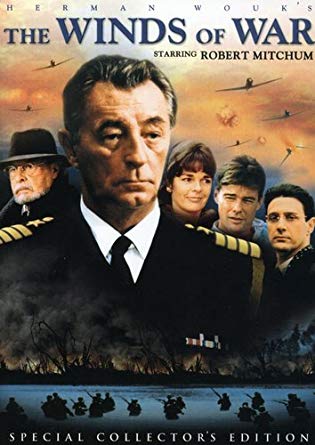
With a total running times of 15 hours, The Winds of War originally aired over seven evenings in 1983.  Produced and directed for ABC by Dan Curtis, The Winds of War had a 962-page script, a 200-day shooting schedule, 285 speaking parts, and a then-record budget of $35,000,000.  It also had Robert Mitchum, starring as Victor “Pug” Henry, an ambitious naval officer who somehow always managed to be in the right place to witness almost all of the events leading up to America’s entry into World War II.  Jan-Michael Vincent played Pug’s son, Byron, while John Houseman took on the pivotal role Aaron Jastrow, a Jewish scholar though whose eyes the home audience would witness the rise of fascism in Europe.  Terribly miscast as Natalie, Aaron’s niece and Byron’s lover, was 44 year-old Ali MacGraw.  Among those playing historical figures were Ralph Bellamy as FDR, Howard Lang as Churchill, and Gunter Meisner as Hitler.

I recently watched The Winds of War on DVD and, despite some glaring flaws that I’ll get to later, it holds up well as both a history of World War II and a tribute to those who battled Hitler’s evil.  Like Wouk’s novels, the miniseries does a good job of breaking down not only how Hitler came to power but also why the rest of the world was often in denial about what was happening.  Watching the entire miniseries in one setting can be overwhelming.  It’s a big production and it is also unmistakably a product of a time when the major networks didn’t have to worry about competition from cable.  It takes its time but, in the end, you’re glad that it did.  All of the little details can get exhausting but they’re important to understanding just how Hitler was able to catch the world off-guard.
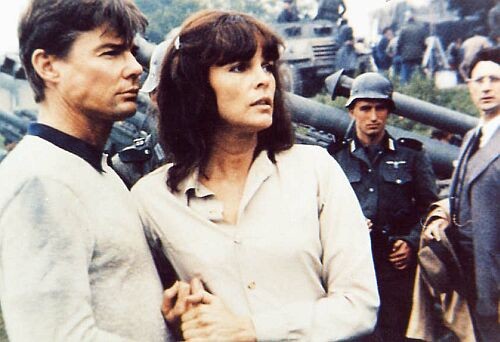
Jan-Michael Vincent and Ali MacGraw in The Winds of War

The miniseries does suffer due to the miscasting of some key roles.  Both Jan-Michael Vincent and Ali MacGraw were far too old for their roles.  Vincent was 38 and MacGraw was 44 when they were cast as naive and idealistic lovers trying to find themselves in Europe.  It’s perhaps less of a problem for Vincent, who had yet to lose his looks to alcoholism and who looked enough like Robert Mitchum that he could pass as Mitchum’s son.  But MacGraw is simply terrible in her role, flatly delivering her lines and looking more like Vincent’s mother than his lover.  It’s particularly jarring when she mockingly calls diplomat Leslie Sloat “Old Sloat,” because Sloat was played by David Dukes, who was six years younger than MacGraw.
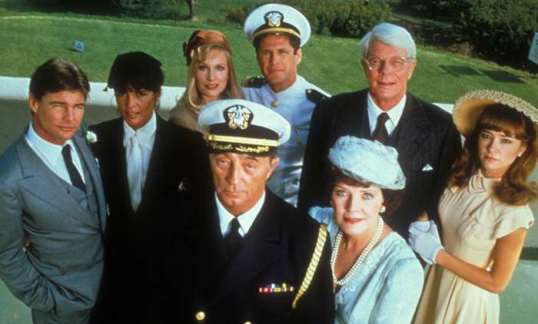
67 year-old Robert Mitchum was also much too old to play an ambitious junior officer, one whose main goal in life is still to ultimately become an admiral.  When he ends up having an affair with a younger British journalist played by 30ish Victoria Tennant, the difference in their ages is even more pronounced than in Wouk’s novel.  (Pug was in his 40s in The Winds of War.)  However, Mitchum overcomes his miscasting by virtue of his natural gravitas.  With his weary presence and authoritative voice, Mitchum simply is Pug.
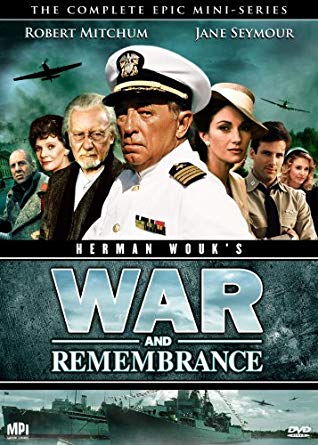
A ratings hit and a multiple Emmy nominee, The Winds of War was followed up five years later by War and Remembrance.  Like its predecessor, War and Remembrance set records.  The script ran 1,492 pages and featured 356 speaking parts.  The production employed 44,000 extras and filming took nearly two years, from January of 1986 to September of 1987.  With a budget of $104 million, it was the most expensive television production to date.  The final miniseries had a 30-hour running time, which was divided over 12 nights.  War and Remembrance not only made history because of its cost and length but also as the first major production to be allowed to film on location at the Auschwitz concentration camp.  For many members of the generation born after the end of World War II, War and Remembrance would serve as their first introduction to the horrors of the Holocaust.

Director Dan Curtis returned and with him came Robert Mitchum, now in his 70s and still playing a junior naval officer.  David Dukes once again played the hapless diplomat, Leslie Sloat.  Ralph Bellamy also returned as FDR as did Victoria Tennant as Mitchum’s lover, Polly Bergen as Mitchum’s wife, and Peter Graves as Bergen’s lover.  However, they were the exception.  The majority of the original cast was replaced for the sequel, in most cases for the better.  With John Houseman too ill to reprise his role, John Gielgud took over the role of Aaron Jastrow while Hart Bochner replaced the famously troubled Jan-Michael Vincent.  Robert Hardy took over the role of Churchill while Hitler was recast with Steven Berkoff.  Best of all, Jane Seymour replaced Ali MacGraw in the role of Natalie and gave the best performance of her career.  Other characters were played by a mix of up-and-comers to tv veterans, with the cast eventually including everyone from Barry Bostwick and Sharon Stone to E.G. Marshall and Ian McShane.
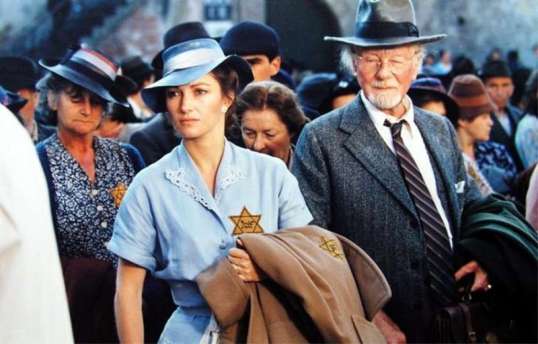
Jane Seymour and John Gielgud

With a stronger cast and (ironically, considering the running length) a more focused storyline, War and Remembrance is superior to The Winds of War in every way.  That doesn’t mean that it’s perfect, of course.  The scenes featuring Barry Bostwick as a submarine commander feel as if they go on forever and Robert Mitchum still seems like he should be preparing for retirement instead of angling for a promotion.  But none of that matters when the miniseries focuses on Aaron and Natalie Jastrow and their struggle to survive life in the Theresienstadt Ghetto and eventually Auschwitz.  At the time that War and Remembrance was initially broadcast, the concentration camp scenes were considered to be highly controversial and many viewers complained that they were so disturbing that they should not have been aired during prime time.  (This was four years before Schindler’s List.)  Seen today, those scenes are the most important part of the film.  Not only do they show why the war had to be fought but they also demand that the world never allow such a thing to happen again.

Though it was considered by a rating disappointment when compared to its predecessor, War and Remembrance was still a multiple-Emmy nominee.  Controversially, it defeated Lonesome Dove for Best Miniseries.  Both Winds of War and War and Remembrance have been released on DVD and, like the books that inspired them, they both hold up well.  They pay tribute to not only those who fought the Nazis but also to the humanistic vision of Herman Wouk.
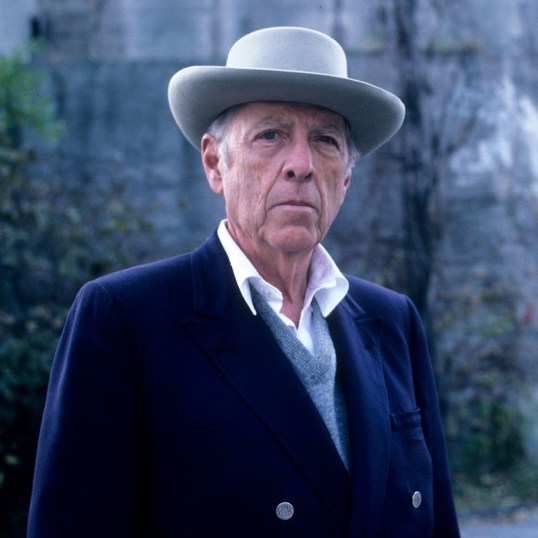
Herman Wouk (1915-2019)
The TSL’s Horror Drive-In Grindhouse: Attack of the Eye Creatures (dir by Larry Buchanan)


1965’s Attack of the Eye Creatures is an odd little movie.

It starts, as so many bad sci-fi movies do, with Peter Graves narrating about how the government has been keeping an eye on a flying saucers that’s apparently been hovering over the Earth for quite some time.  However, a quick visit to Project Visitor reveals that the soldiers assigned to protect us are more interested in using their monitoring equipment to spy on teenagers making out in their cars!

Agck!

EWWWWWW!

Total invasion of privacy!

Of course, what’s particularly sad about the whole thing is that you know that’s totally what would happen in real life as well.  Give a group of people the power to spy on anyone in the world?  Of course they’re going to end up spying on people fooling around in cars!  That’s one reason why Earth is just as doomed today as it was in 1966.

Anyway, the flying saucer does eventually land.  Unfortunately, our government is too incompetent to do anything about it.  The aliens inside turn out to be …. well, not that impressive.  For one thing, they don’t speak.  There are none of the grandiose threats to conquer the world that we’ve come to expect from aliens.  At the same time, we also don’t have to hear about how the rest of the universe is disappointed in us for polluting our planet and blowing each other up so that’s a good thing.  So often, intergalactic visitors can be so judgmental!  Anyway, these aliens are lumpy and gray and they’ve got several eyes.  They don’t really look that impressive.  Seriously, check this jerk out:

As I said, the government turns out to be pretty useless when it comes to battling the aliens and the local police are skeptical that any intergalactic visitors would bother to land in their crappy little town.  Fortunately, as always happens whenever the controlling legal authorities fail to do their job, there are teenagers and they’re willing to do what needs to be done to protect the world!

Of course, if Stan (John Ashley) and Susan (Cynthia Hull) are going to rally the troops against the aliens, they’re going to have to borrow someone’s phone.  That’s going to mean convincing the local old man to let them use his phone.  The old man, who has had enough of those crazy kids with all their kissing and the jazzy lingo, is more interested in using his shotgun to keep people off his lawn.

Meanwhile, two drunks decide that they want to get in on all this alien business.  They both later die and no one in the movie seems to care.  That’s just the type of movie that this is….

….and if it sounds familiar, that’s probably because you’ve seen the 1957 drive-in classic, Invasion of the Saucer Men!  Basically, in the mid-60s, American International Pictures commissioned Texas filmmaker Larry Buchanan to remake some of their most successful drive-in films.  Apparently, the plan was to sell them to television.  So, Buchanan took the script for Saucer Men, tossed in some scenes of the government spying on people (Buchanan was a noted conspiracy theorist who previously directed The Trial of Lee Harvey Oswald), and called his film Attack Of the Eye Creatures!

Yet, while Invasion of the Saucer Men was a genuinely clever sci-fi satire, Attack of the Eye Creatures is done in by Buchanan’s inability to keep his story moving at a steady pace and it doesn’t help that the iconic Saucer Men have been replaced by men who appear to be wearing trash bags.  Attack of the Eye Creatures is an unfortunate remake and one that should be viewed only after you’ve watched Invasion of the Saucer Men and maybe every other public domain sci-fi film that’s currently on YouTube.

http://www.youtube.com/watch?v=mviLfx3o70Q

Horror on the Lens: Killers From Space (dir by W. Lee Wilder)


Today’s horror on the lens is Killers From Space, a 1954 film about …. well, killers from space!

Like a lot of 1950s sci-fi films, this one features Peter Graves as a properly grave-voiced scientist.  It’s about some googly-eyed aliens who abduct people and force them to reveal America’s nuclear secrets!  This low-budget, independent film has quite a pedigree.  It was directed by Billy Wilder’s brother and written by his nephew, Myles.

Enjoy!

A Movie A Day #308: Number One With A Bullet (1987, directed by Jack Smight)


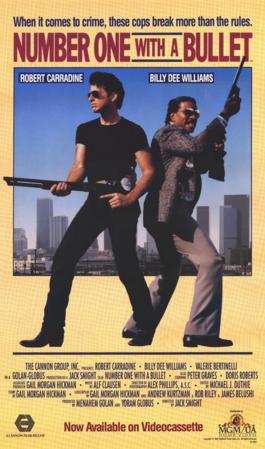
Number One With A Bullet is the story of two cops.  Nick Barzack (Robert Carradine) is so crazy that the all criminals have nicknamed “Beserk.”  (Who says criminals aren’t clever?)  Nick’s partner, Frank Hazeltine (Billy Dee Williams) is so smooth that jazz starts to play whenever he steps into a room.  Nick keeps a motorcycle in his living room, wants to get back together with his wife (Valerie Bertinelli), and has an overprotective mother (Doris Roberts).  Hazeltine is Billy Dee Williams so all he has to worry about is being the coolest man on Earth.  Their captain (Peter Graves!) may want them to do things by the book but Nick and Hazeltine are willing to throw the book out if it means taking down DaCosta, a so-called respectable citizen who they think is actually the city’s biggest drug lord.

It is natural to assume that, because of the whole crazy white cop/centered black cop storyline, this movie was meant to be a rip-off of a well-known film starring Mel Gibson and Danny Glover but actually, Number One With A Bullet was released a week before Lethal Weapon.  As well, while Carradine’s Nick is almost as crazy as Mel Gibson’s Riggs, it is impossible to imagine Billy Dee Williams ever saying that he’s “too old for this shit.”  Williams is having too good a time listening to jazz and picking up women.  Whenever Hazeltine shows up, Number One With A Bullet feels like a Colt 45 commercial that somehow costars Robert Carradine.  Whenever the film is just Carradine, it feels like an unauthorized sequel to Revenge of the Nerds where Lewis gets really, really pissed off.

Number One With A Bullet is a Cannon film and entertaining in the way that most late 80s Cannon films are.  There is a lot of action, a little skin, and some dated comedy, much of it featuring Robert Carradine having to dress in drag.  There is also a mud wrestling scene because I guess mud wrestling was extremely popular back in the 80s.  They may not be Gibson and Glover but Carradine and Williams still make a good team and they both seem to be having a ball.  For fans of cheap 80s action films, there is a lot to enjoy in Number One With A Bullet.

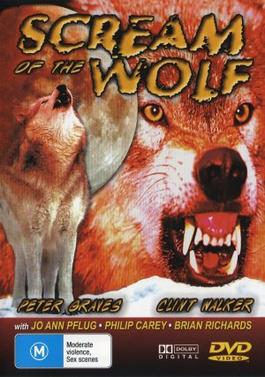
Horror on the Lens: Scream of the Wolf (dir by Dan Curtis)


For today’s horror on the lens, how about a little werwolf action?

In the 1974 made-for-TV movie, Scream of the Wolf, Peter Graves is a writer who is asked to help solve a series of mysterious murders.  The fact that both human footprints and wolf tracks have been found at each murder scene has led some people to assume that the killer must be a werewolf!  Will Graves be able to prove them wrong or will it turn out that they are right?  Graves calls in a famous hunter (Clint Walker) to help track down the killer but it turns out that the hunter has secrets of his own.

I’m going to guess that, like Baffled!, Scream of the Wolf was a pilot disguised a movie.  I assume that the hope was that the movie would lead to a series where Peter Graves would solve a different paranormal mystery every week.

Well, that series never materialized by Scream of the Wolf is still an enjoyable film.  The screenplay was by none other than Richard Matheson while made-for-TV horror specialist Dan Curtis sat in the director’s chair.

In the end, Scream of the Wolf is only 72 minutes long and I know for a fact that you don’t have anything better to do right now.  I watched this movie two months ago with Patrick Smith and the Late Night Movie Gang and we had a blast.

Have fun!