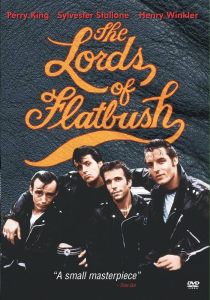
The Lords of Flatbush (1974, directed by Stephen F. Verona and Martin Davidson)


The year is 1958 and four Brooklyn teenagers, all members of a largely non-violent street gang called The Lords of Flatbush, have enough grease in their hair to start a city-wide kitchen fire.  It’s their senior year of high school.  Chico (Perry King) tries to hook up with a new, blonde transfer student (Susan Blakely).  Butchey (Henry Winkler) makes everyone laugh and hides the fact that he’s secretly really smart.  Stanley (Sylvester Stallone) deals with his impending marriage to Frannie (Maria Smith).  Everyone has to grow up eventually but at least the Lords of Flatbush will always have their memories and probably their leather jackets.

Nostalgia films that were extremely popular in the 70s, as the baby boomers were already starting to mythologize their youth.  Lords of Flatbush is very much about that nostalgia, leading to a film that feels sincere but which is also pretty predictable.  With its coming-of-age storylines and its mix of drama and comedy, Lords of Flatbush owes an obvious debt to American Graffiti.  The movie, like its characters, is likable but not exactly memorable.  Today, it’s really only known because it featured early performances from Sylvester Stallone and Henry Winkler.  Winkler got his signature role as the Fonz on Happy Days largely based on his performance as Butchey, though Butchey is nowhere near as cool as the Fonz.  Pre-Rocky, this movie was Stallone’s calling card in Hollywood and he rewrote enough of his own lines that he got an additional dialogue credit.  Stallone actually gives a pretty good performance, even if he is obviously closer to 30 than 18.

Stallone’s best scene is when Stanley is trying to buy an engagement ring and Frannie insists that he buy one that costs $1,600.  For the first time, Stanley realizes that getting married means committing to something other than hanging out with his friends and working on his car.  Stanley buys the ring but threatens the jewelry store owner afterwards, telling him to never show Frannie a $1,600 ring again.

The Lords of Flatbush is a film about the past but it’s mostly interesting due to the future of its stars.
Retro Television Review: St. Elsewhere 1.6 “Legionnaires: Part One”


Welcome to Retro Television Reviews, a feature where we review some of our favorite and least favorite shows of the past! On Fridays, I will be reviewing St. Elsewhere, a medical show which ran on NBC from 1982 to 1988.  The show can be found on Hulu!

This week, Peter White continues to disappoint everyone.

Episode 1.6 “Legionnaires: Part One”

(Dir by Thomas Carter, originally aired on December 7th, 1982)

Dr. Peter White (Terence Knox) is perhaps the most incompetent doctor at St. Eligius.  Over the course of the first few episodes, we have watched as he’s taken advantage of his fellow residents, been rude to patients, misdiagnosed obvious medical conditions, and complained nonstop about how difficult his life is.  Dr. White is struggling to balance the punishing schedule of being a resident with also being a husband and the father to a young girl and a newborn.  He’s in over his head.

What’s interesting is that, despite all of his problems, he’s not a particularly sympathetic character and I don’t think he’s meant to be.  He’s never going to be a good doctor and he doesn’t have the courage to admit it.  Instead of finding a career for which he’s suited, he insists on being a doctor and risking the life of anyone unlucky enough to be his patient.  What makes Dr. White an especially disturbing character is that there are probably a lot of doctors in the real world who are just like him.  They’re overwhelmed and they make stupid mistakes.  I get overwhelmed sometimes too, as does everyone.  And, like everyone, I occasionally make mistakes.  However, my mistakes usually amount to something like missing a cringey typo that causes me to feel embarrassment until I get a chance to fix it.  A doctor’s mistake can lead to people dying.

This week, Dr. White attempts to give penicillin to a patient who is allergic.  Fortunately, Dr. Westphall is able to stop White from putting his patient into a coma.  Dr. White also manages to lose his hospital-issued pager and, when he’s told that it will cost him $300 to get a new one, he freaks out.  A chance meeting with a lawyer in the hospital cafeteria leads White to offer to sell out the hospital by recommending the lawyer to anyone willing to sue because they ended up with a doctor like Peter White.  White finally raises the money by donating his sperm.  The nurse at the sperm bank says that it’s really generous for a doctor to donate.  Not this doctor!

While Peter is screwing up his life, Dr. Westphall is dealing with what appears to be an outbreak of Legionnaire’s Disease in one of the wards.  Westphall wants to immediately shut down the ward.  Dr. Auschlander and board member H.J. Cummings (Christopher Guest — yes, that Christopher Guest) disagree.  However, after another young woman dies of what appears to be Legionnaire’s, Westphall orders the ward to be closed and the patients to be relocated.

Meanwhile, Kathy Martin broke up with Fiscus because she felt their fling was turning into a relationship and Dr. Cavanero dealt with a nurse who disliked her.  Neither one of those subplots did much for me, though Kathy is emerging as one of my favorite characters on this show.  Before breaking up with Fiscus, she goes to a funeral of a stranger just so he won’t be buried without someone there to mourn him.  She wears white to the funeral.  One doctor comments that she’s never seen Kathy wear white before.  Kathy’s a great character and deserves better than just being Fiscus’s girlfriend.

This episode was an improvement over the last episode I watched.  According to the title, it’s also only “Part One” so I imagine there will be some fallout over closing that ward next week.  We’ll see what happens.

Retro Television Review: St. Elsewhere 1.5 “Samuels and the Kid”


Welcome to Retro Television Reviews, a feature where we review some of our favorite and least favorite shows of the past! On Fridays, I will be reviewing St. Elsewhere, a medical show which ran on NBC from 1982 to 1988.  The show can be found on Hulu!

This week’s episode of St. Elsewhere featured Dr. Craig winning an award.  Good for him!

Episode 1.5 “Samuels and the Kid”

(Dir by Thomas Carter, originally aired on November 30th, 1982)

This week’s episode of St. Elsewhere was kind of boring,  It wasn’t a bad episode because the show was well-acted and even the boring subplots felt as is they were part of a bigger whole but, especially when compared to last week’s episode, Samuels and the Kid just wasn’t as compelling.

The Kid of the title is Robbie Durant (Jeremy Licht), a young patient who needs to have some minor surgery done on his ankle.  Dr. Samuels take a really intense interest in the kid, bonding with him and even offering him tickets to a Patriots football game.  At first, it seems like Samuels is just trying to be nice to a kid who is in a scary situation.  (When I was growing up, I spent a few nights in the hospital because of my asthma and it always scared me to death.)  But, at the end of the episode, it is revealed that Samuels had a son who was Robbie’s age who died in a freak accident.  As for Robbie, the operation is a success but he still dies as the result of an embolism.  It was sad but, at the same time, I knew Robbie was going to die as soon as he showed up in the hospital.  I’ve seen enough medical shows to know.

Dr. Cavanero was at a bed-and-breakfast when she learned that one of her patients had gone into labor and was at her apartment alone.  Cavenro had to beg people for change so that she could use a pay phone to call the patient’s neighbors so that she could talk them through delivering the baby.  Seen today, the most interesting thing about this storyline is that it takes place at a time when people had to carry around quarters so that they could call each other in case of an emergency.  (There is a very dusty old payphone a few blocks away from my house.  I assume it doesn’t work and I don’t think it’s been touched by human hands since the 90s — and I’m certainly not going to touch it! — but it’s always interesting to see it sitting there like some haunted beacon of the past.)

Dr. Fiscus continued to have sex with Kathy Martin.  Good for them but I really don’t know that I need to spend a good deal of time listening to Howie Mandel talk about his sex life.

Dr. Chandler (Denzel Washington) accused a nurse of being incompetent.  Nurse Rosenthal (Christina Pickles) got mad at him for yelling at the nurse in the hospital hallway.  Dr. Westphall mediated and agreed to move the nurse to another floor.  Denzel Washington is always fun when he’s yelling at people.

There was one very funny scene.  Dr. Craig won an award for surgeon of the year and gave an extremely long, pompous, and rather bitter acceptance speech.  (The award was a plaster cast of his own hands.)  William Daniels played the scene perfectly and I have a feeling that Dr. Craig is going to end up becoming my favorite character.  As a bonus, Daniels’s wife, Bonnie Bartlett, appeared as Craig’s wife.  By the middle of Craig’s speech, even she had stoppled listening and lit a cigarette.

As I said, this was a little bit of a boring episode.   Still, I look forward to the future of the show!

Speaking of the future, this is my last St. Elsewhere review of 2024.  My next review of this show will post on January 3rd!


Late Night Retro Television Review: CHiPs 2.1 “Peaks and Valleys”


Welcome to Late Night Retro Television Reviews, a feature where we review some of our favorite and least favorite shows of the past!  On Mondays, I will be reviewing CHiPs, which ran on NBC from 1977 to 1983.  The entire show is currently streaming on Freevee!

This week, the second season begins.

Episode 2.1 “Peaks and Valleys”

(Dir by Phil Bondelli, originally aired on Sept. 16th, 1977)

The second season premiere of CHiPs brings some changes.

Most noticeably, the theme song has been redone and now, instead of being driven by the horn section, it now features a bass-driven disco beat.  From the minute the new version of theme song begin, you know that you’re watching a show that was filmed in the heart of the 70s.

Secondly, the second season premiere is considerably less gritty than any of the episodes that aired during the first season.  If the first season concerned itself with showing the day-to-day duties of the members of the California Highway Patrol, from the mundane to the occasionally exciting, the second season announces from the start that it’s about fast cars, fast motorcycles, and slow motion crash footage.

Ponch is considerably more competent in this episode than he ever was during the first season.  For his part, Getraer no longer seems to dislike Ponch as much as he did just a few months ago.  No mention is made of Ponch being on any sort of departmental probation.  Now, Ponch is as professional and competent as Jon Baker.

Finally, the California High Patrol now has a new chief mechanic.  Harlan Arliss (played by Lou Wagner) is short, sarcastic, and wears a tie along with his white mechanic coat.  Arliss is not impressed with the way Baker and Ponch treat their motorcycles, though he seems to reserve most of his ire for Baker.  (“Your tire pressure is low!”)  Arliss may seem like he is overly critical but he also keeps a really cute dog at the garage.

That said, some things remain the same.  As always, Baker finds himself feeling unappreciated.  The episode opens with a camper the crashes in slow motion.  The driver, Bob Niles (a bearded Troy Donahue), suffers a spinal injury as the result of someone moving him after the accident.  Niles can’t remember exactly who moved him and it appears that Baker, Ponch, and the Highway Patrol might get sued.

Then Baker burns his hand saving a man from a burning vehicle.  And a little child shoots a toy gun at Baker.  And then two rednecks call in a fake emergency so that they can shoot up a police car.  Is it any surprise that both Baker and Ponch are tempted to quit the force and take a job selling used cars for Baker’s high school friend, Stan Bosca (Richard Gates)?

Fortunately, Bob does get his memory back and remember that it was a bunch of construction workers who moved him.  So, it sucks for those well-intentioned workers (hello, lawsuit!) but at least Baker and Ponch are off the hook.  And, after seeing how sleazy the used car business is, Baker and Ponch decide to remain on the force and go disco dancing instead!

Actually, Ponch dances.  Baker watches and smile awkwardly.  It’s interesting that the majority of the episode is centered around Baker having an existential crisis but it all ends by highlighting Ponch on the dance floor. If nothing else, it proves that the people behind the show understood that Wilcox was the actor while Estrada was the one with the big personality.

I enjoyed this episode.  The scenery was nice.  The show made good use of slo mo of doom when Niles crashed his vehicle.  The dog was cute.  And the opening theme song was so catchy that I’m still hearing it hours after watching the show.  With this episode, the second season got off to a good start.

Film Review: The Panic In The Needle Park (dir by Jerry Schatzberg)


The 1971 The Panic in Needle Park tells the story of two young lover in New York City.

Helen (Kitty Winn) is an innocent runaway from Indiana who, when we first meet her, has just had a back alley abortion.  Her boyfriend, Marco (Raul Julia), doesn’t seem to be too concerned about her or anyone else for that matter.  Instead, it’s Marco’s dealer, Bobby (Al Pacino), who checks in on Helen and who visits her when she eventually ends up in the hospital.  It’s also Bobby who gives her a place to stay after she gets out of the hospital.

Bobby is a small-time dealer.  He’s not book smart but he knows how to survive on the streets and it’s hard not to be charmed by him.  He literally never stop talking.  As he explains it to Helen, he’s been in jail 8 times but he’s not a bad guy.  His brother, Hank (Richard Bright, who also co-starred with Pacino in The Godfather films), is a burglar and he legitimately is a bad guy but he and Bobby seem to have a close relationship.  Bobby also swears that he’s not a drug addict.  He just occasionally indulges.  It doesn’t take long to discover that Bobby isn’t being completely honest with either Helen or himself.

Together, Bobby and Helen ….

Well, they don’t solve crimes.  In fact, they really don’t do much of anything.  That’s kind of the problem with movies about drug addicts.  For the most part, drug addicts are boring people and there’s only so many times that you can watch someone shoot up before you lose interest.  Heroin may make the addicts feel alive but, with a few notable exception (Trainspotting comes to mind), it’s always been a bit of a cinematic dead end.  The film takes a documentary approach to Bobby and Helen’s descent into addiction and it’s not exactly the most thrilling thing to watch.

Bobby and Helen live in an area of New York that’s known as needle park, largely due to the fact that it’s full of addicts.  It’s a place where people sit on street corners and nod off and where everyone’s life is apparently fueled by petty crime.  An unlikable narcotics detective (Alan Vint) occasionally walks through the area and tries to talk everyone into betraying everyone else.  It turns out that being a drug addict is not like being in the mafia.  Everyone expects you to betray everyone else.

As I said, it’s a bit of a drag to watch but you do end up caring about Bobby and Helen.  They come across as being two essentially decent people who have gotten caught up in a terrible situation.  Even when they piss you off, you still feel badly for them because you know that they’ve surrendered control of their lives to their addictions.  It helps that they’re played by two very appealing actors.  This was only Al Pacino’s second film and his first starring role but he commands the screen like a junkie James Cagney.  Meanwhile, making her film debut, Kitty Winn gives a sympathetic and likable performance as Helen.  You watch Winn’s vulnerably sincere performance and you understand why Helen would have looked for safety with undeserving losers like Marco and Bobby and, as a result, you don’t hold it against her that she seems to be addicted not just to heroin but also to falling for the wrong men.  Helen does a lot of stupid things but you keep hoping that she’ll somehow manage to survive living in needle park.

Pacino, of course, followed-up The Panic In Needle Park with The Godfather.  As for Kitty Win, she won best actress at Cannes but the role didn’t lead to the stardom that it probably should have.  Her best-known role remains playing the nanny in The Exorcist.