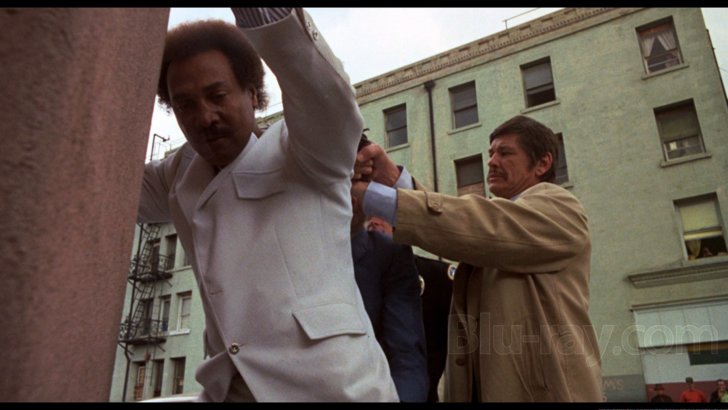
Brad reviews THE STONE KILLER (1973), starring Charles Bronson!


THE STONE KILLER opens in Spanish Harlem with detective Lou Torrey (Charles Bronson) following a young man, who had just shot a cop, into an abandoned building. When the young man refuses to turn himself in, and even tries to shoot Torrey, he gets blown away. In trouble with his superiors on the force, and being dragged in the press for the shooting, Torrey decides to change locations and continue his law enforcement career under his friend Les Daniels (Norman Fell) in Los Angeles. Soon after he arrives in Los Angeles, Torrey and his partner Mathews (Ralph Waite) are working a case against a drug dealer, when they arrest “Bootlace” Armitage (Eddie Firestone), a drug addict, but also a well-known hitman from New York. Torrey is delivering the “mechanic” back to New York for outstanding warrants when Armitage says that he is willing to give up some big information on “Wexton” in exchange for a reduced sentence. When Armitage is gunned down in what is obviously a professional hit, it’s clear that there is something going on that involves the name Wexton. We soon learn more as we meet mafia leader Al Vescari (Martin Balsam). As Vescari walks through a cemetery, he tells the leader of his operation, Lawrence (Stuart Margolin), of his plans to get revenge for a string of mafia killings that occurred 42 years earlier by using “stone killers,” in this case, former military men with no connection to the mob. As the film moves forward, Detective Lou Torrey and his fellow cops will eventually put the pieces together and find themselves taking on these “stone killers” and the mob! 

I’ll just go ahead and say up front that I’m a big fan of THE STONE KILLER these days, but that’s because the movie has grown on me over the years with repeat viewings. When I first watched the film as a teenager in the 1980’s, I enjoyed it as a tough cop film, but it wasn’t one of my favorites. I think that part of the reason I didn’t appreciate it as much back then is the more convoluted plot of the film. Most Bronson films have simple and easy to follow plot lines, but THE STONE KILLER includes a somewhat complicated mafia assassination plan, and it also sends the cops on wild goose chases that have nothing to do with the actual story. Watching the film as an adult, I appreciate Director Michael Winner taking us with him on some of those 1970’s flavored tangents that include getting to hang out with some hippies at an ashram, as well as some unjustly accused black militants. 

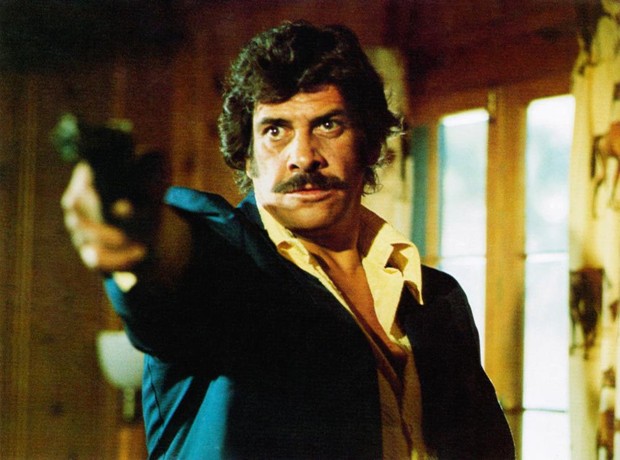
Even though the plot is more complicated than the average Charles Bronson film, director Michael Winner gives us some of the best action sequences of Charles Bronson’s career. There are two sequences in particular that stand out to me. After the impressive opening scenes where Torrey blows away the gun wielding young man in Spanish Harlem, it takes a while to get to the next extended action sequence, but it’s definitely worth the wait. The scene involves Detective Torrey in a car chase where he’s after one of the stone killers, Albert Langley (Paul Koslo), who’s on a motorcycle. In an era of great car chases, this is a doozy that features many amazing and dangerous stunts. The late 60’s and early 70’s are an embarrassment of riches for cinematic car chases and this one stands the test of time. The next great action sequence occurs later in the film when Detective Torrey and the cops bust the home and facility where the killers have trained for the planned massacre. Bronson is still in his physical prime in 1973, and his athletic prowess is clearly on display as he slides across floors, jumps on tables, and does anything else that is required to take down the bad guys. The film is not wall to wall action, but what’s here is as badass as it gets. 

Detective Lou Torrey is a really good role for Charles Bronson. In his best roles, Bronson is tough, but you can also tell that he cares about other people. That’s definitely the case here as he consistently shows empathy for some of the people he’s after. For example, at the beginning of the film, he has to shoot the young man in Spanish Harlem in self-defense, but he later explains to his sister that he didn’t want to do it, even expressing some understanding of how the young man may have found himself in that situation. A little later while arresting a drug dealer with his partner Mathews, Torrey is clearly disgusted when his partner uses racial slurs during the arrest. Torrey then talks to the man with respect and gets the needed information to arrest the man buying the drugs. There are further examples later in the film as he deals with other drug addicts and militants. I say none of this to insinuate that Bronson’s character is weak in any way. Rather, he seems to want to do his job and arrest criminals in a professional manner. He’s also a complex character in some ways as he will bend the rules to get what he needs if he has to. He does end up punching the car thief, Jumper (Jack Colvin), a couple of times during an interview. While this is definitely not legal, in the context of this film, it’s required in order to get to the facts of the case. Bronson is actually quite great in the film. 

Besides international superstar Charles Bronson, Michael Winner put together an amazing cast for THE STONE KILLER. Martin Balsam had won an Oscar a few years earlier, and he’s good here as the mafia boss with four decades worth of patience for revenge. Ralph Waite is also excellent as Bronson’s incompetent, racist partner Mathews. It’s hard to believe the guy would go on to play Papa Walton based on the ignorance he shows in both this film and in the Bronson/Winner collaboration CHATO’S LAND from the prior year. It’s fun watching both Norman Fell and John Ritter work together in this film, especially knowing that they would be making television history a few years later on the classic TV sitcom “Three’s Company.” The last two actors I want to mention are Stuart Margolin as the leader of the stone killers, Lawrence, and Paul Koslo as the bi-sexual badass musician Albert Langley. Both actors, especially Koslo, are good here and would have important roles with Bronson the next year as well. Margolin was an important character in DEATH WISH, and Koslo may have even outdone his work here the next year as a particularly slimy weasel in MR. MAJESTYK. Oh yeah, be sure to look for a short, uncredited cameo from B-movie queen Roberta Collins! I also want to shout out the musical score from Roy Budd, who also did the score for GET CARTER (1971). Thanks to Budd’s work, the opening credits are very cool and memorable. 

THE STONE KILLER was marketed as Charles Bronson’s “Dirty Harry” and meant to be his breakout hit in America. Unfortunately, while the film was an international hit, the actual grosses in the United States were respectable but not as much as the filmmakers had hoped for. As such, we didn’t get any more entries in the case log of Detective Lou Torrey and Bronson would have to wait another year for his American box office breakout with DEATH WISH. But that’s okay because THE STONE KILLER has stood the test of time as an excellent 1970’s cop film, emerging in my personal rankings as a major feather in the cap of Charles Bronson’s career. 

Brad’s “Scene of the Day” – The incredible car chase in THE STONE KILLER (1973)!


I’ve been really busy the last few days preparing to record the next episode for the THIS WEEK IN CHARLES BRONSON Podcast. We’ll be covering THE STONE KILLER where Bronson plays a tough cop who stumbles upon a mafia revenge scheme decades in the making. It’s an interesting film that I can’t wait to cover in detail with a great group of Bronson enthusiasts. Did you know that THE STONE KILLER contains an incredibly underrated “car chases a motorcycle” sequence? The 70’s were so full of great stunts that some of the very best have almost been forgotten. Well that just doesn’t set well with me, so I’m sharing that chase with all of you. It’s a sequence that was filmed in 1973, the same year I was born, so it’s extra special to me. Enjoy my friends!

Film Review: Joe Kidd (dir by John Sturges)


1972’s Joe Kidd opens with the title character (played by Clint Eastwood) in jail.  Joe is a New Mexico rancher and apparently, someone with a long history of getting in trouble with the law.  This time, he’s been arrested for poaching and disturbing the peace.  Given a choice between a fine and ten days in jail, Joe goes for the ten days.  Cowardly Sheriff Mitchell (Gregory Walcott) says he’s going to put Joe to work.  Joe Kidd snarls in response.

However, that’s before Luis Chama (John Saxon), a Mexican revolutionary, raids the courthouse and demands that all of his people’s ancestral land be returned to them.  Local landowner Frank Harlan (Robert Duvall) forms a posse to track Chama down.  Joe says that he has nothing against Chama but that changes once he discovers that Chama raided his ranch and beat up one of his ranchhands.  Joe joins the posse but he soon discovers that Harlan and his men are sadists who are more interested in killing Mexicans than actually capturing Chama.

I was actually pretty excited about watching Joe Kidd.  Clint Eastwood, Robert Duvall, and John Saxon, three of my favorite actors in the same movie!  How couldn’t I be excited?  Unfortunately, neither Duvall nor Saxon are at their best in this film.  Frank Harlan is a one-dimensional villain and Duvall doesn’t make much of an effort to bring any sort of unexpected nuance to the character.  Duvall doesn’t give a bad performance but it’s hard not to feel that Harlan is a character who could have been played by any forty-something actor.  It feels like waste to cast such a good actor in such a thin role.  (Add to that, I prefer Duvall when he plays a good guy as opposed to when he plays a bad guy.)  As for Saxon, this is probably one of his worst performances but his character is also rather underwritten and the film can’t seem to decide if it wants the viewer to be on his side or not.  Saxon delivers his lines in an exaggerated Mexican accent that makes it difficult to take Louis Chama seriously.  Gregory Sierra would have made a good Louis Chama but Saxon just seems miscast.

Fortunately, Clint Eastwood is always a badass, even in an uneven film like this.  Eastwood is at his best in the early scenes, when he’s grouchy and hungover and annoyed at finding himself in the jail.  He is believably outraged by Harlan’s tactics and, in typical Eastwood fashion, he delivers every pithy one-liner with just enough style to keep things interesting.  That said, Eastwood is let down by a script that never really makes it clear why Joe Kidd stays with the posse once it becomes clear that he’s traveling with a bunch of sociopaths.  Joe’s motivations are never really clear.  In the end, he seems like he goes through a lot of trouble to protect his farmland and get revenge for one of his ranch hands (who is just beaten up), just to then desert it all once all the shooting is over.

That said, Joe Kidd is a gorgeous film to look at and Joe makes creative use of a steam engine.  This isn’t the film to show anyone who isn’t already an Eastwood fan.  But, for those of us who are already fans of Clint, it’s enjoyable to watch him snarl, even if it is in a lesser film.

Brad’s “mini-review” of LOVE AND BULLETS (1979), starring Charles Bronson! 


Charles Bronson is an Arizona cop who goes to Switzerland to bring back a gangster’s girlfriend (Jill Ireland). The gangster (Rod Steiger) sends a hitman (Henry Silva) to kill her so she can’t tell his crime secrets to the authorities.  

This isn’t one of Bronson’s best films, but it’s still a fun movie to watch on a chilly, rainy day. There are some good action scenes set in various cold & snowy European locations. This is Bronson in “Bond” mode which is kind of fun and different. And what can you say about a stuttering Rod Steiger screaming at his advisors about the meaning of “love.” It’s fun stuff when you like Steiger as much as I do. I do deduct half a star because Steiger gets so mad at one point that he turns over a table with some of the biggest, most scrumptious looking shrimp I’ve ever seen. That was completely uncalled for and wasteful, but not quite as wasteful as Bronson and Henry Silva in the same movie without an epic battle of some sort. The fact that they didn’t fight it out on the Matterhorn itself can only be described as a missed opportunity. 

Happy Birthday in heaven to Al Lettieri! Enjoy this bad-ass scene from MR. MAJESTYK!


I love actor Al Lettieri. He was such an incredible “heavy” in classic movies like THE GODFATHER and THE GETAWAY.

I will always appreciate his performance as Frank Renda, one of the most badass bad guys that Charles Bronson ever faced in a movie. It’s a shame that he died so young, because he was an incredible actor. Enjoy this badass scene from MR. MAJESTYK, and remember one of the greats! 

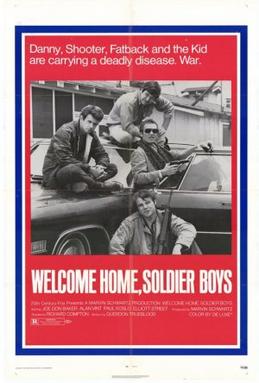
Welcome Home, Soldier Boys (1971, directed by Richard Compton)


Talk about embarrassing!  When Lisa told me that today was Joe Don Baker’s birthday, I decided that I would review Speedtrap, as 1977 car theft movie that Lisa and I watched last week.  But, when I took a look at the imdb to double check the name of the character that Baker played in Speedtrap, I discovered that I had already reviewed it!

Instead of talking about Speedtrap a second time, I’m going to recommend one of Joe Don Baker’s early films.  In Welcome Home, Soldier Boys, Baker stars as Danny, the leader of a group of Green Berets who have just returned from Vietnam and can no longer find a place in society.  Danny, Kid (Alan Vint), Shooter (Paul Koslo), and Fatback (Elliott Street) go on a cross-country road trip.  After they kill a prostitute (Jennifer Billingsley) who demanded more money than they were willing to pay, they visit many sites from their youth.  They go to a high school basketball team.  They spend some time in a sleazy motel.  (Geoffrey Lewis plays the desk clerk.)  They get into a fight with a mechanic (Timothy Scott) over the price of some auto repairs.  After being cheated by one too many people and realizing that no one cares about the sacrifices that they made for their country, they put on their uniforms and violently take over a small town, leading the National Guard to show up to take them all out.

Welcome Home, Soldier Boys is a pretty ham-fisted anti-war allegory and the plot sometimes meanders too much for its own good.  With its road trip violence, its a dry run for director Richard Compton’s far more cohesive Macon County Line.  The movie still packs a punch, due to the efforts of the cast and the violent ending.  The movie is full of familiar characters actors, who are all convincing in their roles but it really is dominated by Joe Don Baker’s hulking intensity.  Danny is the dark side of the amiable country boys that Joe Don Baker would play in so many other movies.  Danny is angry but, as a stranger in a strange land, he’s sometimes sympathetic.  Ultimately, Danny wants the respect that was given to the returning soldiers of the previous generation.  Instead, he comes back to country that doesn’t want much to do with him or his friends.  Returning from serving overseas and still trying to deal with the things that he saw in overseas, Danny feels lost in and rejected by his home country.  It’s one of Baker’s best performances.

MR. MAJESTYK (1974) and a shotgun butt to the nuts! Happy Friday!


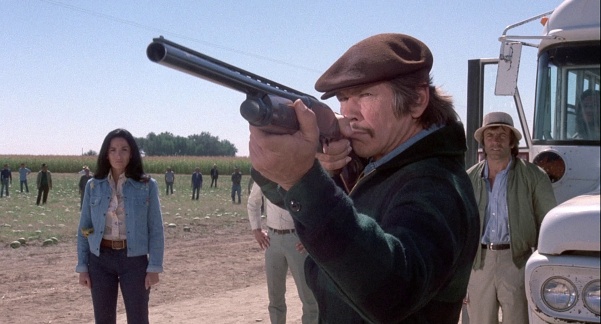
One of my favorite Charles Bronson films is MR. MAJESTYK, and one of my favorite scenes in any movie is this badass masterpiece. It encompasses just about everything I love in a movie. It has the beautiful Linda Cristal. It has the slimy Paul Koslo who doesn’t really understand who he’s dealing with. It has Bronson saying tough guy lines in a way that only he can say them…”you make sounds like you’re a mean little ass-kicker…” And finally it has that shotgun. It just doesn’t get any better than this. 

Enjoy my friends, and have a great weekend!! This should help! 

Film Review: Voyage of the Damned (dir by Stuart Rosenberg)


In 1939, an ocean liner named the MS St. Louis set sail from Hamburg.  Along with the crew, the ship carried 937 passengers, all of whom were Jewish and leaving Germany to escape Nazi persecution.  The ship was meant to go to Havana, where the passengers had been told that they would be given asylum.  Many were hoping to reunite with family members who had already taken the voyage.

What neither the passengers nor Captain Gustav Schroeder knew was that the entire voyage was merely a propaganda operation.  No sooner had the St. Louis left Hamburg than German agents and Nazi sympathizers started to rile up anti-Semitic feelings in Cuba.  The plan was to prevent the passengers from disembarking in Cuba and to force the St. Louis to then return to Germany.  The Nazis would be able to claim that they had given the Jews a chance to leave but that the rest of the world would not take them in.  Not only would the Jews be cast as pariahs but the Germans would be able to use the world’s actions as a way to defend their own crimes.

Captain Schroeder, however, refused to play along.  After he was refused permission to dock in Cuba, he then attempted to take the ship to both America and Canada.  When both of those countries refused to allow him to dock, Schroeder turned the St. Louis toward England, where he planned to stage a shipwreck so that the passengers could be rescued at sea.  Before that happened, Belgium, France, the Netherlands, and the United Kingdom jointly announced that they would accept the refugees.

Tragically, just a few days after the passengers disembarked, World War II officially began and Belgium, France, and the Netherlands all fell to the Nazi war machine.  It is estimated that, of the 937 passengers on the St. Louis, more than 600 of them subsequently died in the Nazi concentration camps.

The journey of the St. Louis was recreated in the 1976 film, Voyage of the Damned, with Max von Sydow as Captain Schroeder and a collection of familiar faces playing not only the ship’s passengers and crew but also the men and women in Cuba who all played a role in the fate of the ship.  In fact, one could argue that there’s a few too many familiar faces in Voyage of the Damned.  One cannot fault the performances of Max von Sydow, Malcolm McDowell, and Helmut Griem as members of the crew.  And, amongst the passengers, Lee Grant, Jonathan Pryce, Paul Koslo, Sam Wanamaker, and Julie Harris all make a good impression.  Even the glamorous Faye Dunaway doesn’t seem to be too out-of-place on the ship.  But then, in Havana, actors like Orson Welles and James Mason are awkwardly cast as Cubans and the fact that they are very obviously not Cuban serves to take the viewer out of the story.  It reminds the viewer that, as heart-breaking as the story of the St. Louis may be, they’re still just watching a movie.

That said, Voyage of the Damned still tells an important true story, one that deserves to be better-known.  In its best moments, the film captures the helplessness of having nowhere to go.  With Cuba corrupt and the rest of the world more interested in maintaining the illusion of peace than seriously confronting what was happening in Germany, the Jewish passengers of the St. Louis truly find themselves as a people without a home.  They also discover that they cannot depend on leaders the other nations of the world to defend them.

Defending the passengers falls to a few people who are willing to defy the leaders of their own country.  At the start of the film, Nazi Intelligence Chief Wilhelm Canaris (Denholm Elliott) explains that Captain Schroeder was selected specifically because he wasn’t a member of the Nazi Party and could not be accused of having ulterior motives for ultimately returning the passengers to Germany.  Canaris and his fellow Nazis assume that anti-Semitism is so natural that even a non-Nazi will not care what happens to the Jewish passengers.  Instead, Schroeder and his crew take it upon themselves to save the lives of the passengers.  It is not Franklin Roosevelt who tries to save the passengers of St. Louis.  Instead, it’s just a handful of people who, despite unrelenting pressure to do otherwise, step up to do the right thing.  Max von Sydow, who was so often cast in villainous roles, gives a strong performance as the captain who is willing to sacrifice his ship to save his passengers.

Flaws and all, Voyage of the Damned is a powerful film about a moment in history that must never be forgotten.

Film Review: Heaven’s Gate (dir by Michael Cimino)


First released in 1981 and then re-released in several different versions since then, Heaven’s Gate begins at Harvard University.

The year is 1870 and the graduates of Harvard have got their entire future ahead of them.  At the graduation ceremony, Joseph Cotten gives a speech about how, as men of cultivation, they have an obligation to help the uncultivated.  Student orator Billy Irvine (John Hurt) then gives a speech  in which he jokingly says the exact opposite.  Amongst the graduates, Billy’s friend, Jim Averill (Kris Kristofferson), laughs at Billy’s speech.  It’s a bit of a strange scene, if just because all of the graduates appear to be teenagers except for Hurt and Kristofferson, who are both clearly in their 30s.  The graduates of Harvard sing to their girlfriends and dance under a tree and, for a fleeting moment, all seems to be right with the world.

Twenty years later, all seems to be wrong with the world.  Averill is now the rugged and world-weary marshal of Johnson Country, Wyoming.  Cattle barons are trying to force immigrant settlers to give up their land.  Gunmen, like Nate Champion (Christopher Walken) and Nick Ray (Mickey Rourke), are accepting contracts to execute immigrants who are suspected of stealing cattle.  When Averill stands up for the people of Johnson Country, the head of the Wyoming Stock Grower Association, Frank Canton (Sam Waterston), hires a group of mercenaries to ride into Johnson County and execute 125 settlers.  Billy Irvine, who now is dissolute alcoholic who works with Canton, warns his old friend Averill.  Averill, who has fallen in love with Ella (Isabelle Huppert), the local madam, announces that he will defend the immigrants.  Nate, who is also in love with Ella, considers changing sides.

Heaven’s Gate is loosely based on an actual event.  I actually have three distant ancestors who traveled to Wyoming to take part in the Johnson County War.  All three of them survived, though one of them was shot and killed in an unrelated manner shortly after returning to Ft. Smith, Arkansas.  That said, director Michael Cimino is clearly not that interested in the historical reality of the Johnson County War or the issues that it raised.  Just as he did with Vietnam in The Deer Hunter, Cimino uses the Johnson County War as a way to signify a loss of national innocence.  Averill and Irvine start the film as hopeful “young” men with the future ahead of them.  By the end of the film, one is dead and the other is living on a yacht and dealing with what appears to be crippling ennui.

Heaven’s Gate is a bit of an infamous film.  Though the film was pretty much a standard western, Cimino still went far over-budget and turned in a first cut that was over six hours long.  A four hour version was briefly released in 1980 but withdrawn after a week, due to terrible reviews and audience indifference.  A studio-edited version that ran for two hours and 35 minutes got the widest release in 1981.  Since then, there have been several other versions released.  Cimino’s director’s cut, which was released as a part of the Criterion Collection in 2012, runs for 212-minutes and is considered to now be the “official” version of Heaven’s Gate.

For years, Heaven’s Gate had a terrible reputation.  It’s failure at the box office was blamed for bankrupting United Artists.  After the excesses of the Heaven’s Gate production, studios were far more reluctant to just give a director a bunch of money and let him run off to make his movie.  (They should have learned their lesson with Dennis Hopper and The Last Movie.)  Described by studio execs as being self-indulgent and even mentally unstable, Michael Cimino’s career never recovered and the director of The Deer Hunter went from being an Oscar-winner to being an industry pariah.  (Some who disliked The Deer Hunter’s perceived jingoistic subtext claimed that Heaven’s Gate proved The Deer Hunter was just an overrated fluke.)  However, the reputation of Heaven’s Gate has improved, especially with the release of Cimino’s director’s cut.  Many critics have praised Heaven’s Gate for its epic portrayal of the west and, ironically given the controversy over The Deer Hunter, its political subtext.  It’s anti-immigrant villains made the film popular amongst the Resistance-leaning film historians during the first Trump term.

So, is Heaven’s Gate a masterpiece or a disaster?  To be honest, it’s somewhere in between.  Whereas it was once over-criticized, it’s now over-praised.  Visually, it’s a beautiful film but those who complained that the film was too slow had a point.  As with The Deer Hunter, Cimino takes the time to introduce us to and immerse us in a tight-knit immigrant community.  Personally, I like the much-criticized scenes of the fiddler on skates and Averill and Ella dancing in the roller rink.  Overall though, as opposed to The Deer Hunter, the members of the film’s victimized community still feel less like individual characters and more like symbols.  As for the political subtext, I think that any subtext of that sort is accidental.  (I feel the same way about The Deer Hunter, which I like quite a bit more than Heaven’s Gate.)  Cimino is more interested in the loss of innocence than whether or not the Johnson County War can be fit into some sort of nonsense Marxist framework.

The main problem with the film is that there is no center to keep everything grounded.  Kris Kristofferson had a definite screen presence but, as an actor who was incapable of showing a great deal of emotion, he lacks the gravitas necessary to keep from being swallowed up by Cimino’s epic pretensions.  Isabelle Huppert, an otherwise great actress, also feels lost in the role of Ella and Sam Waterston is not necessarily the most-intimidating villain to ever show up in a western.  Christopher Walken, as the enigmatic and intriguing Nate Champion, gives the best performance in the film but his character still feels largely wasted.

There are some brilliant visual moments to be found in Heaven’s Gate.  I even like the Harvard prologue and the ending on the boat, both of which are not technically necessary to the narrative but still add an extra-dimension to both Averill and Irvine.  But, in the end, Heaven’s Gate is big when it should have been small and epic when its should have been intimate.  It’s a misfire but not a disaster.  Even great directors occasionally have a film that just doesn’t work.  Speilberg had his 1941.  Scorsese has had a handful.  Coppola’s career has been a mess but no one can take his successes away from him.  Michael Cimino, who passed away in 2016, deserved another chance.

Late Night Retro Television Review: CHiPs 2.22 “Ride the Whirlwind”


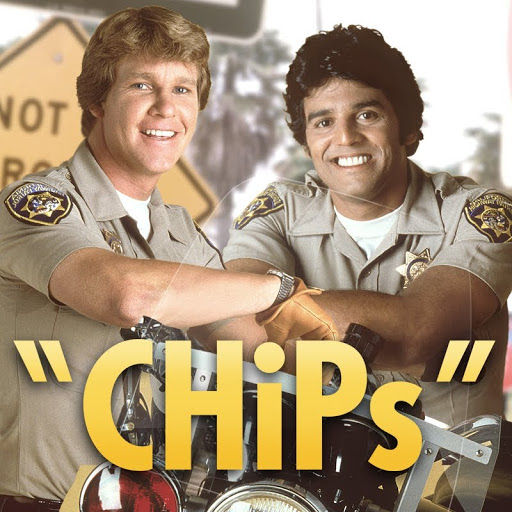
Welcome to Late Night Retro Television Reviews, a feature where we review some of our favorite and least favorite shows of the past!  On Mondays, I will be reviewing CHiPs, which ran on NBC from 1977 to 1983.  The entire show is currently streaming on Freevee!

This week, Baker takes charge!

Episode 2.22 “Ride The Whirlwind”

(Dir by Larry Wilcox, originally aired on March 10th, 1979)

Just as with the week’s episode of Miami Vice, I am going to do a bullet-point review of this week’s episode of CHiPs because, quite frankly, it’s the holidays and I’m pressed for time.

  • In order to combat a crime wave that has apparently broken out in the nearby California hills, Baker has suggested creating a three-person dirt-bike team.  His hope is that the team will be made up of him, Ponch, and Sindy.  However, when Sindy gets delayed while helping a stranding motorist and ends up missing the morning briefing, Baker is forced to pick Grossman (Paul Linke) instead.
  • “Yay!” you might be saying.  Seriously, Grossman is a far more entertaining character than Sindy.  However, Ponch, Baker, and Sindy are not happy about it.  My personal feeling is that if riding a dirt bike was that damn important to Sindy, she should have arrived on time.
  • Ponch pays Grossman forty dollars to fake an injury so Sindy can take his place.  Grossman takes the money and then explains that he would have done it for free, just because he can tell who much riding a dirt bike means to Sindy.  If it meant so much to her, she could have showed up on time!
  • The dirt bike patrol is a huge success.  One guy rides through an old woman’s lettuce patch on his bike.  Baker tracks down the miscreant and not only gives him a ticket but also gets a date with the guy’s girlfriend.
  • Larry Wilcox also directed this episode, which perhaps explains why, for once, Baker’s the one who gets a date as opposed to Ponch.
  • Ponch busts a city councilman who later explains that he was just riding his bike recklessly because he was having a midlife crisis.
  • Sindy busts a punch of PCP dealers.  It takes her two tries, however.  The first time she chases them, she falls off her bike and sprains her ankle.  The second time, she proves that she belongs on a bike.
  • That’s good because Getraer is in a total panic about putting a woman on any sort of motorcycle, even just a dirt bike.  “If she gets injured,” Getraer warns Baker, it’ll be bad news for the entire department.  Getraer, I guess, hasn’t noticed that the entire second season had pretty much centered on just how hyper-competent Sindy is.
  • The stars of this episode were the California scenery and the stunt people.  The members of the dirt bike patrol all wear bulky uniforms and face-obscuring helmets, in order to disguise the fact that Larry Wilcox, Erik Estrada, and Brianne Leary are clearly not the ones who are actually riding the bikes.
  • Noted character actor Paul Koslo appears as one of the PCP dealers.  He’s believably redneck-y.
  • This episode featured some impressive stunts, which is really the main thing that most people ask for when it comes to a show like this.  That said, I do think the episode would have been more with Grossman as a member of the team.

Next week: Season two ends!