30 More Days of Noir #3: Guns, Girls, and Gangsters (dir by Edward L. Cahn)


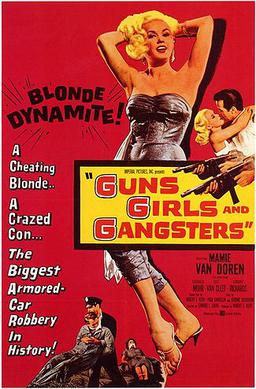
Guns, Girls, and Gangsters!  The title of this 1958 film pretty much sums it all up.

Now, technically, I guess you could debate whether or not the criminals in this film really qualify as gangsters.  When I hear the term “gangster,” I tend to think of the big Mafia chieftains, like Al Capone and the Kennedys.  Maybe it’s because I’ve seen The Godfather too many times but I always associate gangsters with wealth, big mansions, elaborate weddings, and aging crooners who need someone to chop off a horse’s head in order to get a role in From Here To Eternity.  However, the gangsters in this film are all basically small-time criminals.  One of them does own a nightclub but it’s not a very impressive nightclub.  If anything, they’re wannabe gangsters.  However, Guns, Girls, and Wannabes just doesn’t have the same ring to it.

Chuck Wheeler (Gerald Mohr) has a plan.  He wants to rob an armored car.  It’s a Vegas armored car, so of course it’s going to be full of money and since Michael Corleone killed Moe Greene three years before, there shouldn’t be too many repercussions from hijacking it.  (Sorry, I’m still thinking about The Godfather.)  To enlist the aid of a nightclub owner, he enlists the aid of a singer named Vi (Mamie Van Doren).  Vi just happens to be the wife of Chuck’s former prison cellmate, Mike (Lee Van Cleef).  Vi has been demanding a divorce for a while but Mike won’t grant it because he’s insanely jealous.  He probably wouldn’t be happy to find out that Chuck and Vi are now a couple but, fortunately, he’s locked up.

Except, of course, Mike escapes from prison around the same time that Chuck and the gang manage to hijack that armored car.  As you can guess, this leads to mayhem and havoc.  That’s where the guns of the title come into play….

Guns, Girls, and Gangsters is an entertaining little B-noir.  It’s only 70 minutes long so the film doesn’t waste any time getting to the action.  (There’s also a narrator who serves to fill in any plot holes and to keep the audience entertained with his rather self-important delivery.)  Gerald Mohr is a bit on the dull side as Chuck but you better believe that Lee Van Cleef is 100% menacing and oddly charismatic as the as the always angry Mike.  Van Cleef brings a charge of very real danger to the film.  (Perhaps he’s the gangster that the title was referring to, though I would still think of him as being more of an outlaw than a gangster.)  And, of course, you’ve got Mamie Van Doren, playing yet another tough dame in dangerous circumstances.  Van Doren gets to perform two musical numbers in Guns, Girls, and Gangsters and they both have a low-rent Vegas charm to them.  Watching this film, it occurred to me that Van Doren may not have been a great actress but she had the perfect attitude for films like this.  She played characters who did what they had to to do survive and who made no apologies for it and it’s impossible not to be on her side when she’s having to deal with creeps like Chuck or sociopaths like Mike.

Guns, Girls, and Gangsters is an entertaining B-noir.  There’s enough tough talk, cynical scheming, and deadly double crosses to keep noir fans happy.
Horror Film Review: Night of the Lepus (dir by William F. Claxton)


There’s really only one lesson to be learned from the 1972’s Night of the Lepus.

There is absolutely no way to make a rabbit look menacing.

Oh sure, you can film them in slow motion.  And you can add a lot of weird sound effects and you can do a lot of extreme close-ups to make them look bigger than they actually are.  You can do a lot of stuff as a part of your effort to make a rabbit into a scary monster but you’ll pretty much be wasting you time.  Rabbits are simply not intimidating.  There’s a reason why the idea of a killer rabbit was so funny in Monty Python and The Holy Grail.

Now, don’t get me wrong.  I’m enough of country girl that I know the damage that wild rabbits can do.  They eat crops.  They eat bark.  They chew on irrigations lines.  If you’re a farmer or even just someone who wants to maintain a nice garden, you know that rabbits can be a nuisance.

However, that doesn’t change the fact that there’s nothing really menacing rabbits.  Rabbits are cute and, for the most part, they’re fairly timid.  They’re aware that, in the brutal world of nature, they’re designated prey and, as a result, they try to stay out of the way.  Rabbits are shy and they hop around and there’s absolutely nothing frightening about them.

(We actually have quite a few rabbits in my neighborhood.  It’s not unusual for me to see one hopping through the front yard.  Whenever I go for a run in the early evening hours, it’s not unusual for me to see several rabbits hopping through a nearby park.)

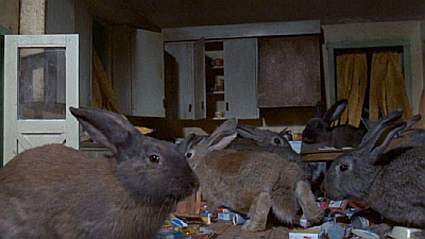
Night of the Lepus is a strange film that attempts to make rabbits frightening.  It takes place in the southwest and it features a bunch of mutated, giant rabbits who hop around the desert in slow motion and who savagely kill everyone that they meet.  The plot makes it sound like a spoof but Night of the Lepus takes itself very seriously, which needless to say is a mistake.  It even opens with documentary footage that’s designed to make sure that we understand that rabbits are actually very dangerous.  It’s all very odd and you have to wonder why, out of all the wild animals in the southwest, the filmmakers decided to go with the least intimidating creature possible.  I mean, there are coyotes and Gila monsters in the desert.  Imagine having a giant coyote coming at you.  That would be scary!

Instead, we get giant rabbits, attacking a cast of actors who definitely deserved better.  Stuart Whitman, Janet Leigh, Rory Calhoun, DeForest Kelly, they’re all talented actors and, in this film, they’re reduced to fighting a bunch of giant rabbits.  No one comes across particularly well, though just about everyone in the cast does manage to keep a straight face.  Still, the problem is that the rabbits are just too damn cute.  Even after they’ve killed half the cast, you still don’t want anything to happen to them.  When Whitman and Calhoun opened fire on a group of rabbits and killed a few of them, I actually found myself getting mad at the humans.  Leave the rabbits alone! I thought.  You humans have had your chance!  This the land of rabbits now!

Anyway, Night of the Lepus is silly but it’s kind of fun, just because the giant rabbits are cute.  They’re kind of like the giant guinea pigs that attacked South Park a few seasons ago.  They’re murderous but they’re adorable!


An Offer You Can’t Refuse #8: Force of Evil (dir by Abraham Polonsky)


The 1948 film noir, Force of Evil, plays out like a fever dream of dark and disturbing things.

The film begins on the third of July with attorney Joe Morse (John Garfield) telling us that, by the end of the 4th of July, he will have made his first million dollars, something that he describes as being “an important moment in every man’s life.”  Joe has an appreciation of money that one can only get from growing up poor.  By his own admission, Joe spent most of his youth on the streets, committing petty crimes.  It was his older brother, Leo (Thomas Gomez), who held things together back home and who kept Joe from getting into any truly serious trouble.  Now, years later, Joe is an attorney and Leo is a small-time player in New York’s numbers racket.

(The numbers racket, as the film explains, is an illegal lottery in which people — mostly in working class neighborhoods — bet on which three numbers will be drawn at the end of the day.  In this film, those three numbers are the last three digits of “the handle”, the amount race track bettors placed on race day at a major racetrack, published in the major newspapers in New York.)

Joe now works for Ben Tucker (Roy Roberts).  Tucker may look like a respectable businessman and he may operate out of an office building but he’s actually a gangster.  He got his start as a bootlegger and then, after prohibition ended, he moved into the number game.  He and Joe have come up with a scheme to consolidate and take over the entire New York numbers racket.  They’re going to fix the handle so that, on July 4th, everyone who picks “776” as their three numbers will win.  (As Joe explains, a mix of patriotism and superstition leads to thousands of people picking 776 on every Independence Day.)  When the small time operators don’t have the money to pay off the winners, Tucker will loan them the money to stay afloat.  However, by accepting the loan, the operators will now be in debt to Tucker and Tucker will basically control their operations.  Anyone who doesn’t want to work for Tucker will either be out of work or dead.  It’s all strictly business.

The only problem is that Joe knows that the plan will basically bankrupt Leo.  When Joe goes to Leo and tries to warn him, Leo refuses to listen to him.  Leo may be a criminal but he’s an honest criminal and he has no interest in getting involved with someone like Ben Tucker.  Leo watches out for the people working underneath him and treat them fairly, a concept that men like Ben Tucker will never understand.  In fact, the only thing that Leo asks from Joe is that Joe make sure that Leo’s longtime secretary, Doris Lowry (Beatrice Pearson), is taken care of.

Needless to say, things get even more complicated from there….

Force of Evil presents us with a world where everyone — with exception of maybe Doris — is corrupt and where everything — from blackmail to murder — is strictly business.  Greed is the motivator for every action and the more money that comes in, the easier it is to justify every ruthless act.  Joe makes his fortune over the course of one of America’s most sacred holidays but it comes at the expense of his brother.  His brother tries to do the right thing as far as his employee are concerned, just to discover that the Walter Tuckers of the world don’t care what happens to the people who work for them as long as the money keeps coming in.  It’s a dark and cynical movie, a gangster movie were the cops are just as dangerous as the people they’re arresting and where concepts like love and loyalty mean nothing when there’s money to be made.

As directed by Abraham Polonsky, Force of Evil plays out like a filmed nightmare.  Every interior seems to be full of ominous shadows and the exterior scenes always seem to find characters like Leo Morse and his timid accountant (Howland Chamberlain) dwarfed by the city around them.  Gangsters like Ben Tucker and his associates emerge from the darkness, with the film’s final shoot-out taking place in complete darkness and featuring characters shooting at shadows despite not knowing who that shadow might belong to.  It’s a dark and claustrophobic world that Polonsky presents, one that always seems to be closing in on the Morse brothers and the people unlucky enough to be around them.  (The real world would later close in on Polonsky, an unapologetic Marxist whose ideology is obvious in the film’s portrait of crime just being another form of big business.  Polonsky was among those blacklisted in the 50s.  Force of Evil was the first of only three movies that he would ever direct.)

John Garfield plays Joe Morse with a barely contained anger.  Even after he’s made his first million, he’s still angry at the world.  Getting rich is his revenge on a society that predicted that someone like him would never amount to anything.  Roy Roberts is perfectly sleazy as the outwardly respectable Walter Tucker and Marie Windsor has a few wonderful scenes as his vampish wife.  Perhaps the film’s best performance comes from Howland Chamberlain, playing an accountant who soon finds himself in over his head as Tucker makes his move on Leo’s operation.

Tough, violent, and visually unforgettable, Force of Evil is an excellent gangster film and a classic noir.  It’s definitely an offer that you can’t refuse.

John Garfield in Force of Evil

Previous Offers You Can’t (or Can) Refuse:

  1. The Public Enemy
  2. Scarface
  3. The Purple Gang
  4. The Gang That Could’t Shoot Straight
  5. The Happening
  6. King of the Roaring Twenties: The Story of Arnold Rothstein 
  7. The Roaring Twenties


A Movie A Day #154: The Day They Hanged Kid Curry (1971, directed by Barry Shear)


Welcome to the Old West.  Hannibal Heyes (Pete Duel) and Kid Curry (Ben Murphy) are two of the most wanted outlaws in the country, two cousins who may have robbed trains but who also never shot anyone.  After being promised a pardon if they can stay out of trouble for a year, Heyes and Curry have been living under the names Joshua Smith and Thaddeus Jones.
During a trip to San Francisco to visit his old friend, a con artist named Silky O’Sullivan (Walter Brennan), Heyes is told that Kid Curry is currently on trial in Colorado.  When Heyes goes to the trial, he discovers that the accused (Robert Morse) is an imposter and that the real Kid Curry is watching the trial from the back of the courtroom.  It turns out that the man of trial is just an attention seeker , someone who is so desperate for fame that he is willing to be hanged to get it.  At first, Curry thinks this is a great thing.  After the imposter hangs, everyone will believe that Curry is dead and they’ll stop searching for him.  Heyes, however, disagrees, especially after the imposter starts to implicated Heyes in crimes that he didn’t commit.

Obviously inspired by Butch Cassidy and the Sundance Kid, Alias Smith and Jones was one of the last of the classic TV westerns.  Though I originally assumed that it was the show’s pilot, The Day They Hanged Kid Curry was actually the first episode of the second season.  With commercials, it ran 90 minutes.  Because of its extended running time, The Day They Hanged Kid Curry was not included in Alias Smith and Jones‘s standard rerun package.  Instead, it was edited to remove the show’s usual opening credits and it was then sold as a motion picture, despite the fact that it is very obviously a television show.

As long as no one is expecting anything more than an extended television episode, The Day They Hanged Kid Curry is okay.  I have never been a big Alias Smith and Jones fan but this episode’s plotline, with Robert Morse confessing to crimes he didn’t commit just so he can have a taste of fame before he dies, feels prescient of today’s culture.  For classic western fans, the main reason to watch will be the chance to see a parade of familiar faces: Slim Pickens, Henry Jones, Paul Fix, and Vaughn Taylor all have roles.  Most important is familiar Western character actor and four-time Oscar winner, Walter Brennan, as Silky O’Sullivan.  This was one of Brennan’s final performance and the wily old veteran never loses his dignity, even when he’s pretending to be Kid Curry’s grandmother.

As for Alias Smith and Jones, it was a modest success until Pete Duel shot himself halfway through the second season.  Rather than retire the character of Hannibal Heyes, the show’s producers replaced Pete Duel with another actor, Roger Davis.  One day after Duel’s suicide, Davis being fitted for costumes.  This move was not popular with the show’s fanbase and Alias Smith and Jones was canceled a year later, though it lived on for years in reruns.

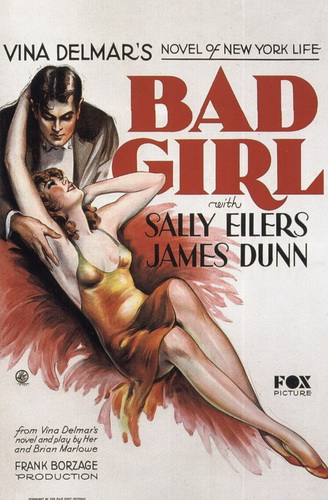
Lisa Reviews An Oscar Nominee: Bad Girl (dir by Frank Borzage)


bad-girl

Seeing as how I started this day by watching Fifty Shades Darker, it seemed appropriate to end the day by watching yet another film about the difficulty of finding love and commitment.  This film came out a little bit earlier than Fifty Shades of Grey.  In fact, it even predates the whole concept of fan fiction.  This film came out in 1931 and it would probably be totally forgotten today if not for the fact that, 85 years ago, it was nominated for Best Picture.

Of course, that’s not to say that Bad Girl is particularly well-known.  Until I came across it on my list of best picture nominees, I didn’t know that it even existed.  According to Wikipedia, it was based on a novel and a play and it did rather well at the box office.  The Academy apparently liked it, awarding it Oscars for both Best Director and Best Adapted Screenplay.  It’s currently available on YouTube.  That’s where I saw it.  But, despite all of that, it definitely appears to be one of the more obscure films to have ever been nominated for best picture.

Bad Girl opens with Dorothy Hailey (Sally Eilers) in a wedding gown.  However, she’s not getting married.  Instead, she’s a store model and, in a rather surreal little sequence, Dorothy and her co-workers walk through the store in their bridal gowns while sleazy men leer at them.  As Dorothy complains to her best friend, Edna Diggs (Minna Gombell), men are “only interested in one thing.”  When Dorothy’s boss propositions her, Dorothy claims to have a prizefighter husband waiting for her at home.  In truthfulness, Dorothy lives with her overprotective brother (William Pawley), a judgmental brute who accuses her of being a tramp if she stays out too late.

At Coney Island, Edna makes a bet that Dorothy won’t be able to get surly Eddie Collins (James Dunn) to talk to her.  Dorothy takes the bet and then proceeds to go over to Eddie and play a ukulele, until Eddie gets annoyed enough to tell her to be quiet.  Eddie claims to not like women  and he accuses Dorothy of being a tease.  “Listen, sister,” he tells her, “if you don’t want guys to salute, take down the flag.”

Wow, Eddie sure does seem to be a jerk, doesn’t he?

Well, don’t worry.  It turns out that Eddie isn’t as bad as he seems, it’s just that he’s often in a bad mood because he doesn’t have much money and he wants to open up his own radio store.  However, Eddie and Dorothy quickly fall in love and soon, they’re married…

But, of course, things never go that smoothly.  It turns out that Eddie is proud and stubborn.  Fortunately, he’s played by a charming actor named James Dunn because, without Dunn’s considerable working class charm, Eddie would probably be insufferable.  Dorothy, meanwhile, fears letting Eddie know that she’s pregnant…

And you know what?

I liked Bad Girl.  

On the one hand, Bad Girl is definitely a dated film.  Any film released in 1931 is going to seem dated when watched in 2017.  But, at the same time, that also means that Bad Girl works as a nice little time capsule.  Watching Bad Girl was like stepping into a time machine.  And it turns out that the 1930s weren’t that bad!  Everyone wore nice clothes and talked like James Cagney.

But, dated it may be, there is also an almost timeless quality to Bad Girl.  Even decades after the film was originally released, the likable chemistry between James Dunn and Sally Eilers feels real and you really do care about what happens to them.  You feel like they belong together and it’s hard not to worry when they fight or when they misunderstand each other’s intentions.  (This happens rather frequently.)  Furthermore, Bad Girl is a film about people who, often times, are struggling just to make ends meet.  That’s something to which everyone can still relate.  It certainly sets it apart from a lot of the other films made both then and today.

Bad Girl was nominated for best picture but it lost to a film that was almost its total opposite, Grand Hotel.  Unlike most of the other old best picture nominees, I have never seen Bad Girl on TCM but it is on YouTube and you can watch it below!

Shattered Politics #19: To Kill A Mockingbird (dir by Robert Mulligan)


To_Kill_a_Mockingbird_poster

So, I guess I should explain why I’m including the classic 1962 film (and best picture nominee), To Kill A Mockingbird, in this series of reviews of films about politicians.  After all, while To Kill A Mockingbird dealt with the issue of racism in Alabama in a surprisingly honest manner, it doesn’t feature any elected officials.  Nobody shows up playing Gov. Benjamin J. Miller or President Franklin Roosevelt.  Instead, this film is about a wise lawyer named Atticus (Gregory Peck), an innocent man named Tom (Brock Peters), a girl named Scout (Mary Badham) and her older brother Jem (Philip Alford), and a mysterious recluse named Boo (Robert Duvall).

However, if you’ve read Harper Lee’s wonderful novel, then you know that Atticus is not just the smartest man in Maycomb, Alabama.  He’s also a member of the Alabama state legislature and his political career is a fairly important subplot in the book, with him occasionally having to leave home so he can go down to Montgomery and help to write the budget.  (Incidentally, Harper Lee’s father actually was a member of the Alabama House of Representatives.)

In the film, no mention of Atticus being a member of the state legislature is made but I still choose to believe that he was.  Because, as played by Gregory Peck, Atticus Finch is exactly the type of man who you would want to think of as serving in government.  He’s wise, compassionate, and firm.  For much of To Kill A Mockingbird, he is literally the only sane adult in Maycomb.  He’s the only attorney willing to defend Tom Robinson when Tom is accused of raping a white girl.  When a mob shows up to lynch Tom, Atticus is the only adult willing to stand up to them.  (Fortunately, Jem also runs up and shames the mob by reminding them that she goes to school with their children.)  And, in court, it is Atticus who proves that Tom is innocent.

When Tom is still convicted, what makes it all the more devastating is that wise and compassionate Atticus doesn’t seem to be surprised as all.  If even Atticus feels that there is no hope for a black man to get a fair trial from an all-white jury, the film seems to be saying, then there truly is no hope.

Of course, the film is not just about Atticus.  It’s about Scout and Jem and their friend Dill (John Megna) and how the three of them grow up and learn the truth about their world.  Watching them from behind the closed doors of his house is the mysterious and reclusive Boo Radley.  When Boo shows up towards the end of the film, I always find tears in my mismatched eyes.  Boo is played, in his film debut, by Robert Duvall.  Duvall doesn’t say a word but he still makes an incredible impression as the shy and withdrawn Boo.

So, I may be cheating a lot by including To Kill A Mockingbird in this series of reviews.  Oh well.  Who am I to turn down a chance to rewatch it?  To Kill A Mockingbird is just a great film.


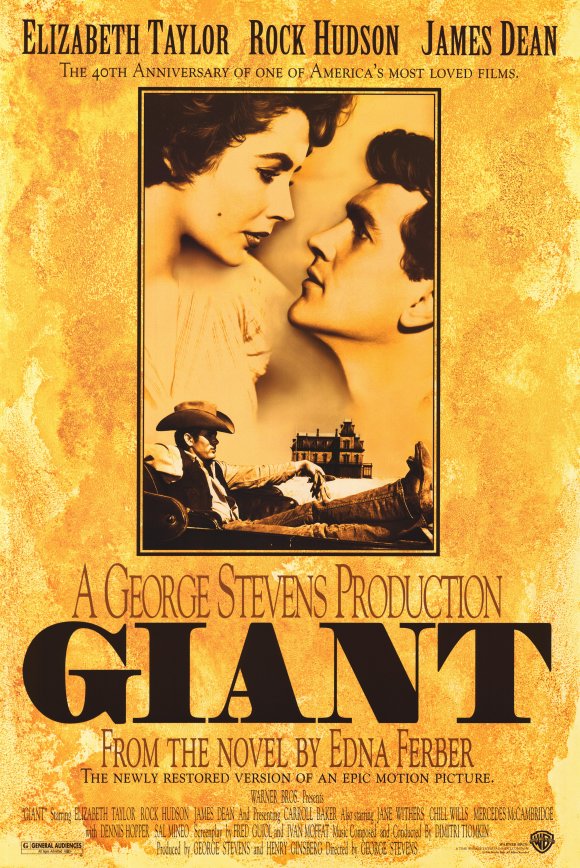
Embracing The Melodrama #12: Giant (dir by George Stevens)


Giant

Let’s continue to embrace the melodrama by taking a look at the 1956 best picture nominee, Giant.

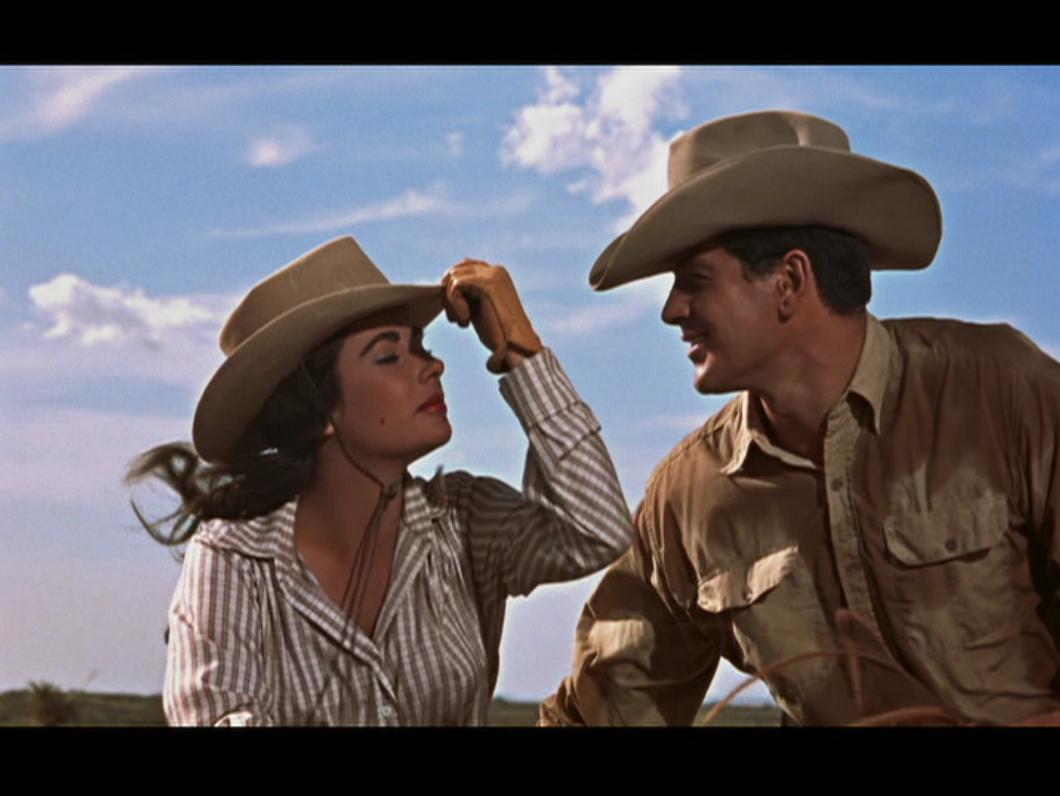
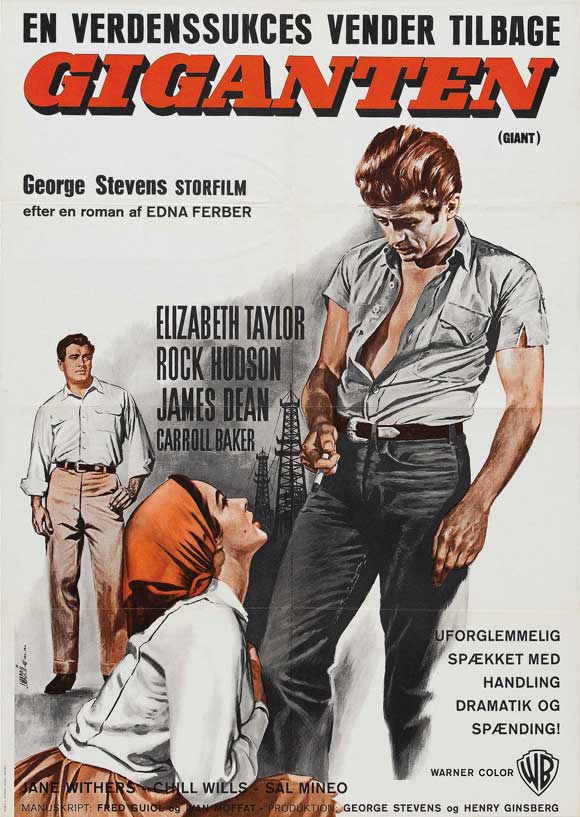
Giant is a film about my home state of Texas.  Texas rancher Bick Benedict (Rock Hudson) goes to Maryland to buy a horse and ends up returning to Texas with a bride, socialite Lesley Lynnton (Elizabeth Taylor).  At first, Lesley struggles to adapt to the harsh and hot Texas landscape.  Bick’s sister, Luz (Mercedes McCambridge) takes an instant dislike to Lesley and Bick is annoyed by Lesley’s concern over the living conditions of the Mexicans that work on Bick’s ranch.  It sometimes seems like the only person who appreciates Lesley is Jett Rink (James Dean), an ambitious ranch hand who secretly loves her and who is planning on becoming a rich man.  That’s exactly what happens when oil is found on the land around Bick’s ranch.  While Bick stubbornly clings to the past, oilman Jett represents both the future of Texas and the nation.  Meanwhile, Bick and Lesley’s son (played by a very young Dennis Hopper) challenges his father’s casual bigotry when he falls in love with a Mexican girl.

Taylor and Hudson

Giant is appropriately named because it is a huge film.  Clocking in at 201 minutes, Giant tells a story that spans several decades and features a big cast that is full of familiar faces, all struggling for their chance to somehow stand out from everyone else around them.  Even the film’s wonderful panoramic shots of the empty Texas landscape only serve to remind us of how big the entire film is.  To a certain extent, the size of Giant‘s production is to be understood.  In the 1950s, Hollywood was having to compete with television and they did this by trying to make every film into a major event.  You watch a movie like Giant and you practically hear the old Hollywood moguls shouting at America, “See!?  You can’t get that on your precious TV, can you!?”

For those of us watching Giant today, the length is both a blessing and a curse.  It’s a curse because the movie really is too damn long.  The opening scenes drag and many of them really do feel superfluous.  It’s hard not to feel that the real story doesn’t really start until about 90 minutes into the movie.  And once the story really does get started,  there’s still way too much of it for it all to be crammed into one sitting.  Oddly enough, you end up feeling as if this extremely long film is still not telling you everything that you need to know.  If Giant were made today, it would probably be a two-part movie on either HBO or Lifetime and it would definitely feature a lot more sex.

However, to be honest, one of the reasons that I did enjoy Giant was because it was as big as it was.  I mean, the film is about Texas so of course it should be a little excessive!  Everything’s bigger in Texas and that includes our movies.  Add to that, Giant may be too long but it uses that length to deals with issues that are still relevant today — oil, immigration, and racial prejudice.  Rock Hudson may not have been a great actor but he is at least convincing as he transitions from bigotry to tolerance.

But really, when it comes to Giant, most people are only interested in James Dean.  And they definitely should be because Dean gives a great and compelling performance here.  Dean brings all of the emotional intensity of the method to material that one would not naturally associate with method acting and the end result is amazing to watch.  Giant was released after Dean had been killed in that infamous car wreck.  I can only imagine what it must have been like to be sitting in a theater in 1956 and to see this compelling and charismatic actor towering above the world on the big screen while aware, all the time, that his life had already been cut short and he would never been seen in another film.

James Dean

Even better, Dean’s new style of acting clashes perfectly with Hudson’s old style of acting, making the conflict between Bick and Jett feel all the more real and intense.  Much as Bick represents old Texas and Jett represents the new Texas, Hudon and Dean represented the two sides of Hollywood: the celebrity and the artist.  Needless to say, Dean wins the battle but, surprisingly, Hudson occasionally manages to hold his own.

I can’t necessarily say that Giant is an essential film.  A lot of people are going to be bored by the excessive length.  But if you’re a fan of James Dean or if you’re from Texas, Giant is a film that you need to see at least once.

elizabeth_taylor_giant_swedish_movie_poster_2a