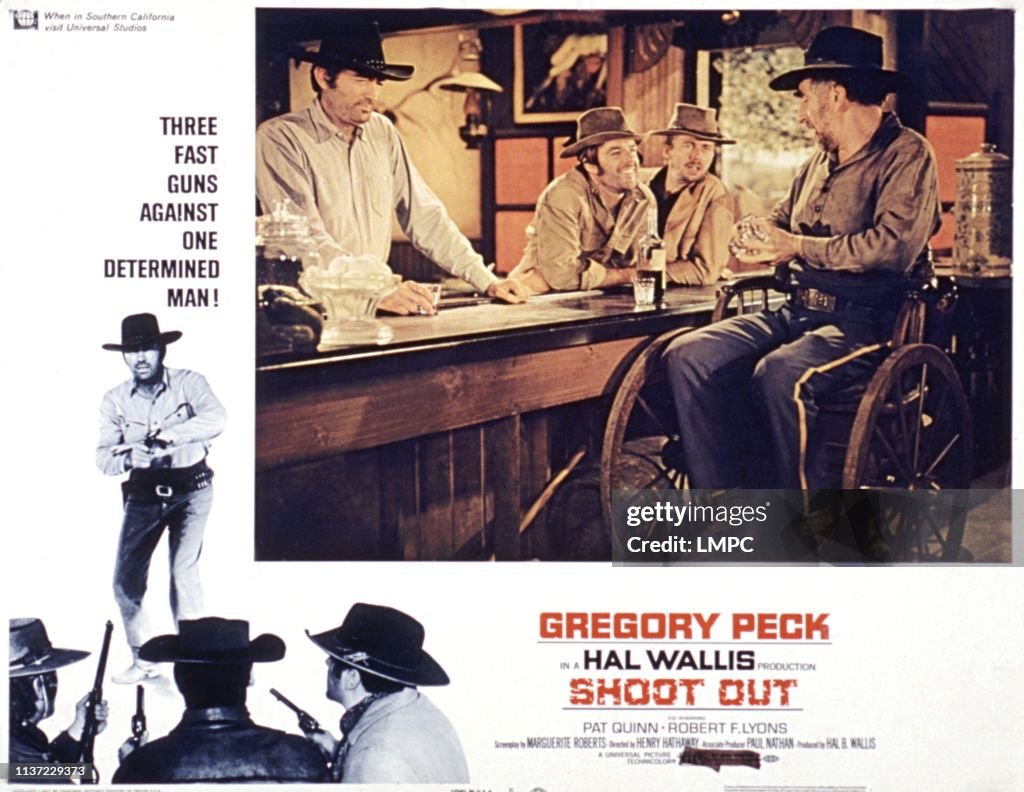
Brad reviews SHOOT OUT (1971), starring Gregory Peck & Robert F. Lyons! 


After serving a stretch at the Canon City penitentiary, Clay Lomax (Gregory Peck) gets out with only one thing on his mind… revenge on his former partner Sam Foley (James Gregory), who shot him in the back during a bank robbery, leaving him to take the rap. Foley isn’t a fool, though, so he’s hired a trio of young punks, Bobby Jay (Robert F. Lyons), Skeeter (John Davis Chandler), and Pepe (Pepe Serna) to surveil Lomax and let him know if he’s heading to his home in Gun Hill with payback on his mind. These guys are about as crazy as it gets, and they make two major mistakes. First, they kill Lomax’s friend Trooper (Jeff Corey) who lets him know where Foley is with his dying breath. Second, they kidnap the prostitute Alma (Susan Tyrell) just because they want to treat her like crap and have fun with her, which turns out to be a dumb move. Interrupting Lomax’s quest for revenge, he finds himself being forced to care for a young child named Decky (Dawn Lyn), who just may be his daughter with a lady back in Kansas City who used to be his “friend.” Looking after Decky, and then meeting and falling for the widow Juliana Farrell (Patricia Quinn), Lomax is soon facing off against his most dangerous foe, the crazed Bobby Joe, as he attempts to protect all these new people that he loves so he can move on with his life. But is it all too late?!!

I love westerns, but I must admit that I’m not the biggest fan of director Henry Hathaway’s SHOOT OUT. Hathaway has directed some of my favorite actors and movies, like Charles Bronson’s debut film with Gary Cooper, YOU’RE IN THE NAVY NOW (1951), along with the Jimmy Stewart film CALL NORTHSIDE 777 (1948) and John Wayne’s Oscar winning TRUE GRIT (1969). Unfortunately, it seems his best years are behind him, and he would only direct one more film after this, the less than excellent black action film HANGUP (1974). This isn’t exactly Gregory Peck’s best work either. Coming nine years after his Oscar winning performance in TO KILL A MOCKINGBIRD (1962), this is definitely not even close to that kind of level. Don’t get me wrong, I do enjoy his turn as Lomax when he’s the wronged outlaw looking for revenge, but I don’t really care at all for his part as the reluctant father figure trying to deal with the six-year-old Decky. I found Dawn Lyn to be more annoying than cute in the role, and this storyline distracted me from the revenge plot that I actually enjoyed. As a co-host of the “This Week in Charles Bronson Podcast,” we had the opportunity to interview Robert F. Lyons, who plays the bad guy, Bobby Jay Jones. I specifically asked him about this film and what it was like working with Gregory Peck. While he enjoyed working with Peck, his response about the film itself was telling…. “The work in there is not my work.” If you’ve watched much of the excellent actor’s work before, you can immediately understand what he means. Lyons goes so over-the-top as the spying outlaw Bobby Jay Jones, that his performance is inconsistent with the bulk of his career. Lyons told us that his performance was orchestrated by Hathaway in a way that he disagreed with, and he essentially disowns his work in the film. You can see a similar vibe with his “gang” that includes the actors John Davis Chandler and Pepe Serna. 

While I’m not a huge fan of the overall direction of the storyline or the focus of some of the main performances in SHOOT OUT, I am appreciative of the genre and the classic western stars that Hathaway cast in supporting roles. I especially enjoy seeing Jeff Corey in the small but pivotal role as the wheelchair bound Trooper, Paul Fix as the train brakeman who delivers Decky and a stack of cash to Lomax, and Arthur Hunnicutt as the ranch owner who barters with Lomax over the price of a pony. Hunnicutt is a particular favorite of mine although his role here is very small. Nominated for an Oscar for his performance in Howard Hawks’ THE BIG SKY (1952), Hunnicutt is from the small town of Gravelly, Arkansas, which is not far from where my own family is from. He even attended the same college that I graduated from, the University of Central Arkansas, which was known as the Arkansas State Teachers College when he (and my dad) went there. And then there is the setup of the revenge scenario at the beginning and the final showdown at the end, classic staples of the western genre. These are enjoyable and satisfying moments as Lomax settles his scores and the bad guys get their comeuppance.

Overall, SHOOT OUT is best enjoyed by fans of old school westerns and star Gregory Peck. It veers aways from the best storylines of the genre and wastes a lot of time with uninteresting melodrama, but it does offer us another chance to see some of our great character actors doing what they do. That means something to me. 

I’ve included our podcast episode with Robert F. Lyons below. He discusses SHOOT OUT at around the 1:00:30 mark.
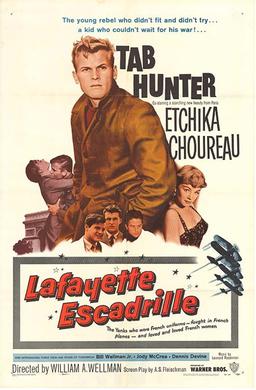
Lafayette Escadrille (1958, directed by William Wellman)


In the days leading up to World War I, spoiled rich kid Thad Walker (Tab Hunter) flees Boston after getting hit with a car theft charge and ends up in Paris.  He befriends a group of American expatriates (including David Janssen, Will Hutchins, Jody McCrea, and William Wellman, Jr.) and eventually joins the French Air Force as a members of the Lafayette Escadrille.  Thad also falls in love with a French prostitute named Renee (Etchika Choureau) and, after Thad strikes a French officer, he goes on the run with her.

I always wonder how many people have watched this film over the years because of the presence of a young Clint Eastwood in the cast, just to discover that he doesn’t get many lines and his character is largely interchangeable with the other young actors playing the members of the Lafayette Escadrille.  This is a Tab Hunter movie, meaning that the action is dominated by Hunter’s sincere but bland screen persona.  Director William Wellman wanted to cast Paul Newman in the lead role and that would have been something to see.  Instead, the studio insisted on Hunter.  They also insisted that Wellman change the film’s ending so that Hunter could survive instead of getting shot down on his very first mission.  William Wellman was so disgusted with the studio that he retired from directing.

What had to make it all especially galling for the director was that Lafayette Escadrille was based on his own life.  His son, William Wellman Jr., plays “Bill Wellman” in the film and Thad was based on actual friend of Wellman’s.  The film was meant to be a tribute to his friends, many of whom did not survive World War I.  Instead, the studio insisted that it be just another Tab Hunter service comedy.  The best scenes are the ones where it’s just Thad and his friends trying to make it through basic training.  Unfortunately, those scenes are overshadowed by Thad on the run.

The film is still there for those of us who enjoy catching future stars.  Clint Eastwood, David Janssen, Tom Laughlin, Will Hutchins, Brett Halsey, and Jody McCrea are all present and accounted for.  Rumor has it that James Garner can spotted in the background but I couldn’t find him and Garner had already co-starred with Brando in Sayonara when this move was made so I doubt he was doing background work.  Tab Hunter’s blandness sinks the production but the rest of the cast would go on to better things.

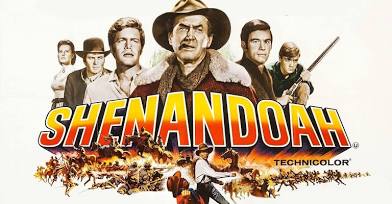
I review SHENANDOAH (1965), starring James Stewart! 


Jimmy Stewart plays Charlie Anderson, the patriarch of a large farming family in Virginia during the time of the Civil War. His family doesn’t own slaves, so he doesn’t figure it’s any of their business what all the fighting is about. He wants to keep working the land in hopes that the war will pass them by. Besides, he has six sons, a daughter, and a daughter in law that he wants to keep safe. He’s trying to keep the family together on his own as his beloved Martha had passed away sixteen years earlier giving birth to their youngest son, who we only know as Boy (Phillip Alford). Aside from the war that’s going on all around them, things seem pretty good for the Anderson’s. They all sit down for a big delicious meal every night. They attend Church every Sunday where they’re usually late and given the side-eye by Pastor Bjoerling (Denver Pyle). One of the sons, James Anderson (Patrick Wayne) and his wife Ann (Katharine Ross), have a precious newborn baby to take care of. The beautiful daughter Jennie (Rosemary Forsyth) is being courted by, and eventually marries, a lovestruck confederate officer named Sam (Doug McClure). Unfortunately the war won’t just go away, and when Boy is taken prisoner by Union soldiers, Charlie can’t stand idly by any longer. They head out to find him and bring him home. 

In the guise of an entertaining semi-western, SHENANDOAH does a great job of illustrating how futile and randomly tragic war can be. The movie starts out lighthearted and fun as the family goes about its normal life, with Jimmy Stewart’s Charlie Anderson giving his homespun advice and rolling his cigars. This is a self-sufficient family that loves, respects and enjoys each other even if they don’t agree on everything. But the war keeps inching its way into their lives. First in the form of small group of confederate soldiers who come by to get some water and try to convince the boys to join up. None of the boys will join up, but they do help bury the soldiers when they’re ambushed and killed just down the road. Next a group of men come to the ranch to try to confiscate their horses for the Union army. Of course, Charlie Anderson isn’t going to let that happen and this turns into the type of brawl that seems to come right out of John Wayne western comedy like MCLINTOCK. Everybody joins in with the participants punching and being punched repeatedly, while Boy keeps getting knocked into the horse trough. This shouldn’t be a surprise because Director Andrew V. McLaglen directed MCLINTOCK and many other John Wayne films. Finally, Boy is taken prisoner because he is wearing a confederate cap that he found floating down the steam while he was out fishing one day. Once Charlie and most of his family head out to search for Boy, the movie begins a turn into tragedy. I won’t give the specifics away, but some members of the family will die, and not a single one of their deaths will be based on the actual fighting of a war. Rather, their deaths will be based on the chaos and depravity that surrounds the war. It’s tough to see, especially when they were all so happy just a little bit earlier. For me, the movie’s changes in tone make the tragedy more powerful and really drive home its message about the futility of war. But the Anderson family, like the United States of America after the Civil War, is made up of tough, resilient folks, and the movie ends on a hopeful note that definitely brought some extra moisture to my eyes. 

Jimmy Stewart commands the screen in SHENANDOAH. You simply can’t take your eyes off of him, and his performance alone would make the movie worth watching. But with its powerful message, excellent cast, and solid direction, the movie is much more than just Stewart’s strong performance. I highly recommend it. 

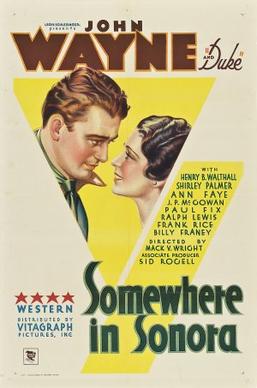
Somewhere In Sonora (1933, directed by Mack V. Wright)


After stagecoach rodeo racer John Bishop is framed for causing a competitor to have an accident, he’s hauled off to jail.  Fortunately, Bishop’s boss, Bob Leadly (Henry B. Walthall), comes through for Bishop and helps him escape from the jail.  To thank Bob, Bishop heads down to Mexico to search for Bob’s son, Bart (Paul Fix).  The last that Bob heard, Bart was running with an outlaw gang called “The Brotherhood of Death.”  The only way get out of the Brotherhood of Death is to die.

By an amazing coincidence both Bart and Bishop’s girlfriend, Mary (Shirley Palmer), are in the Mexican town of Sonora.  To try to get Bart to return home, Bishop goes undercover and infiltrates the gang.  Once inside, Bishop discovers that gang leader Monte Black (J.P. McGowan) is planning on robbing the silver mine that belongs to Mary’s father.

This is a John Wayne B-western, typical of the poverty row productions that he was making before John Ford cast him as the Ringo Kid in Stagecoach and made him into a star.  This one features the usual horse chases and bar fights and John Wayne gives a solid-enough performance in the lead role.  The most interesting thing about it is that, even though it’s a western, it’s set in modern times.  I guess frontier days lasted longer in some parts of the county than in others.

John Wayne’s horse, Duke, appears in this picture and shows again that he was the most talented of all the horse actors in the 30s.  He earned his co-starring credit.

Happy Birthday in heaven to the great Paul Fix! A “4 Shots From 4 Films” special edition…


If you love movies, then there’s no doubt you’ve seen the work of the great movie and TV character actor Paul Fix. With over 340 acting credits to his name, including 26 with John Wayne, Fix co-starred in some of the best movies and TV shows ever made. Born on March 13th, 1901, Fix passed away on October 14th, 1983, leaving behind a tremendous legacy of superior performances. I just wanted to take a moment to remember this amazing actor who’s provided me with so much great entertainment over the years!! 

THE RIFLEMAN T.V. Series (1958-1963)

TO KILL A MOCKINGBIRD (1962)

STAR TREK: WHERE NO MAN HAS GONE BEFORE (1966)

EL DORADO (1967)

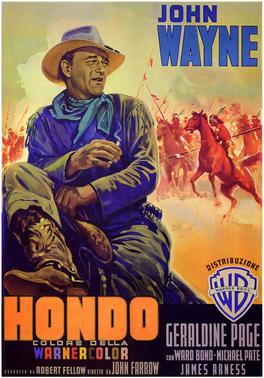
HONDO – John Wayne takes on Apaches!


John Wayne is just one of those actors I love. He’s made so many great movies. My personal favorites are RIO BRAVO, TRUE GRIT, BIG JAKE, THE SONS OF KATIE ELDER, THE MAN WHO SHOT LIBERTY VALANCE, THE SEARCHERS, THE QUIET MAN, RED RIVER, THE SHEPHERD OF THE HILLS and STAGECOACH. But hell, there are so many great ones not listed above. He just knew how to play tough, honorable, flawed men in his uniquely John Wayne way. When I hit play on a John Wayne film, I know I’m in for a good time. 

The 1953 John Wayne movie HONDO starts with a man and his dog walking through a dusty, rocky landscape on their way towards a pond and a rough looking farmhouse. He’s greeted by a woman and her young son. The man, Hondo Lane (Oscar winner John Wayne), is a scout for the U.S. Cavalry who’s just escaped from Apaches but lost his horse in the process. The woman, Angie Lowe (Oscar winner Geraldine Page), allows Hondo to stay at her ranch to rest and get something to eat. She tells him that her husband is away in the hills chasing wildcats for the day, and he asks her if he can buy a horse to get back to his cavalry post. Hondo ends up having to stay a few days at the ranch in order to break a wild, rambunctious horse before it can be ridden. While there, Hondo learns that Angie doesn’t really know where her husband is, as he left months ago and has never returned. Hondo and Angie share some nice conversation and even a kiss. Before he leaves, he tells her that she’s not safe at her remote ranch. It seems that the U.S. government has broken their treaty with the Apaches and no one is safe in the area. Angie refuses to leave her farm as the Apaches have always treated her well, using her spring for water. Hondo heads back to his post and is barely out of sight when the Apaches show up. Will they scalp Angie and her son, Johnny? Will Angie’s husband ever show back up? Will Hondo come back to the ranch and kiss her again in the moonlight? Will Hondo teach Johnny how to swim by throwing him into the pond? Will Hondo have to save a regiment of pony soldiers and settlers from marauding Apaches? It’s my guess that you probably know the answers to these questions, and that’s part of the fun of watching John Wayne movies. 

It should come as no surprise that I enjoyed HONDO. John Wayne plays a variation of his normal tough, honorable, honest character, and I like that character. Geraldine Page was nominated for her first Oscar for her performance as Angie Lowe. It was the first of eight nominations she would receive in her career. She’s an interesting actress. She’s not conventional at all in this role yet she absolutely nails it. I haven’t watched much of her work so I need to check some more of her stuff out. Ward Bond shows up as fellow cavalry scout Buffalo Baker. It’s always fun to see Wayne and Bond work together. They go together like peas and carrots. Leo Gordon is effectively slimy as the deserter Ed Lowe, and James Arness shows up as cocky young man who’s humbled and then redeems himself through battle. It’s a fine cast that helps in the fun factor. 

It’s not a perfect film, especially by the social standards of 2024, but it’s a fun and entertaining western. I liked it. 

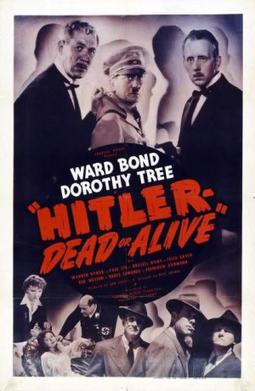
Film Review: Hitler — Dead or Alive (dir by Nick Grinde)


The 1942 film, Hitler — Dead or Alive, opens with two reporters visiting a prominent industrialist named Samuel Thornton (Russell Hicks).  They are curious about a statue of three men that stands outside of Thornton’s mansion.  Thornton proceeds to tell them the story of the three men.

In 1939, shortly after the Nazis invaded Poland and with the United States still pursuing a policy of neutrality, Thornton independently offered a million dollars to anyone who could bring Adolf Hitler to justice, dead or alive.  Accepting the offer were three ex-cons who had just been released from Alcatraz, Steve Maschick (Ward Bond), Hans “The Dutch” Havermann (Warren Hymer), and Joe “The Book” Conway (Paul Fix).  (As you may have guessed “The Book” is the intellectual of the group and yes, he wears glasses.)  After Thornton makes clear to them that they’re going to have to make sure that they either capture or kill the real Hitler and not one of his many doubles, the three men join the Royal Canadian Air Force and, along with ace pilot Johnny Stevens (Bruce Edwards), they head for Germany.

Made for an obviously low-budget, this B-movie is a bit of a curiosity.  It starts out as a comedy, with the three cooks cracking jokes about going straight and a lengthy sequence in which they try to work up the courage to parachute into Germany.  Even after they get caught by the Gestapo and sent to a prison camp, much of the film is played for laughs.  It’s not until they escape from the prison and Johnny sacrifices his life while shooting it out with the Nazis that the film starts to take a more serious turn.  Steve, who starts out the film only caring about the money, comes to realize that there are more important things than just finding a quick payday.

Steve, Hans, and Joe end up at the mansion of Else von Brandt (Dorothy Tree), a secret member of the German resistance who is so trusted by the Nazis that Hitler himself (played by Bobby Watson) will be stopping by for a visit.  By this point, Steve explains that he no longer cares about the money.  As far as he’s concerned, he’s now working for free.  After learning about all of the people who have been killed by Hitler, Steve is determined to stop him, even if it means sacrificing his own life.

There are still moments of humor to the found in the latter half of the film.  When Steve, Hans, and Joe confront Hitler, one of the first things that they do is shave off his mustache.  But the film’s conclusion is ultimately a very serious one and features one particular act of violence that I imagine stunned audiences in 1942.  Having told the story of the three men and their mission to get Hitler, Samuel Thornton ends the film by saying that it doesn’t matter whether Germany is being led by Hitler or Hitler’s double.  What matters is eradicating all of the Nazis from the Earth.  In the end, the message of the film is a simple one.  It’s okay to laugh.  It’s okay to joke.  But, in the end, everyone must do their part.

Hitler — Dead or Alive was made for an obviously low-budget and there are a few scenes, especially in the beginning, where the pace feels a bit off.  Just as with Beast of Berlin, the film’s version of a German prison camp feels like it could have been lifted from a dozen American crime films.  But Ward Bond is a strong hero and he delivers his lines with conviction, especially when he discusses why nothing is more important than stopping Hitler.  He gets good support from both Paul Fix and Warren Hymer.  The film may start out as a comedy but it’s anti-Hitler message comes through loud and clear.  Seriously, how can you not appreciate a film about defeating the Nazis?

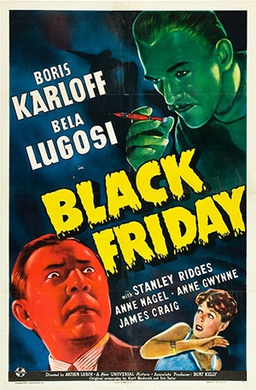
Horror Film Review: Black Friday (dir by Arthur Lubin)


The 1940 film, Black Friday, opens with Dr. Ernest Sovac (Boris Karloff), a once-respected scientist, being led out of his cell on Death Row and being taken to the electric chair.  As he enters the death chamber, he hands one of the gathered reporters his journal.  Dr. Sovac says that he wants the reporter to know the true story of how he came to be on Death Row.  While the police strap Dr. Sovac into the electric chair, the reporter reads the journal.

It’s flashback time!

Months earlier, Dr. Sovac’s best friend, an befuddled English professor named George Kingsley (Stanley Ridges), is nearly fatally injured when he has the misfortune to get caught in the middle of an attempt to assassinate a gangster.  In order to save George’s life, Sovac performs a brain transplant, giving George part of the gangster’s brain.  George does recover but now he’s got the gangster inside of his head, trying to take control.  Much like Dr. Jekyll, George continually switches identities and becomes a viscous hoodlum who is looking for revenge against those who betrayed him, including gang boss Eric Marnay (Bela Lugosi).

Dr. Sovac, however, is more concerned with the fact that, before he died, the gangster apparently hid a good deal of money somewhere.  Sovac wants that money for himself so that he can build his own laboratory and hopefully help other people with otherwise incurable brain conditions.  Sovac tells himself that, once he gets his hands on the money, he can find a way to rid George of his evil alternative personality.  But until George finds the money, Sovac is content to allow George to continue turning into a murderous gangster.  Things, however, come to a head when George starts to threaten Sovac’s daughter (Anne Gwynne).

Black Friday is yet another Universal Horror Film featuring Boris Karloff was a mad scientist.  What makes Dr. Sovac a compelling character is that he starts out with the best of intentions.  He just wants to save the life of his best friend and Sovac’s desperation is increased by the fact that George himself was just an innocent bystander when he was injured.  Later, when Sovac starts searching for the gangster’s money, his intentions are again not necessarily bad.  He sincerely wants to do some good with that money and he uses those good intentions to justify allowing George to do some very bad things.  In the end, Sovac becomes so obsessed with being able to fund his laboratory that he loses sight of the price that both he and George are having to pay.  Karloff does a great job of playing Sovac, showing how a kind man manages to lose track of his morals until it is too late.  Stanley Ridges is also well-cast as George and does an excellent job of switching back and forth from being a befuddled professor to a ruthless gangster.  There’s an excellent scene in which George, attempting to teach his class, suddenly hallucinates that all of his students have become gangsters.  Ridges does a great job playing it.

Reportedly, the film was originally conceived with Karloff playing George and Bela Lugosi playing the role of Dr. Savoc.  However, Karloff said that he would rather play Savoc and, as such, Lugosi lost a role for which he probably would have been very well-cast.  Since Lugosi was a bit too naturally sinister for the role of George, he instead had to settle for a small role as a gang leader.  Lugosi, it should be said, is a convincing gangster but it’s still hard not to be disappointed that, in this film, he and Karloff don’t share any scenes together.

Previous Universal Horror Reviews:

  1. Dracula (1931)
  2. Dracula (Spanish Language Version) (1931)
  3. Frankenstein (1931)
  4. Island of Lost Souls (1932)
  5. The Mummy (1932)
  6. The Invisible Man (1933)
  7. The Bride of Frankenstein (1935)
  8. Dracula’s Daughter (1936)
  9. Son of Frankenstein (1939)
  10. The Invisible Man Returns (1940)
  11. The Wolf Man (1941)
  12. Ghost of Frankenstein (1942)
  13. Invisible Agent (1942)
  14. Frankenstein Meets The Wolf Man (1943)
  15. Son of Dracula (1943)
  16. House of Frankenstein (1944)
  17. The Invisible Man’s Revenge (1944)
  18. House of Dracula (1945) 
  19. Creature From The Black Lagoon (1954)

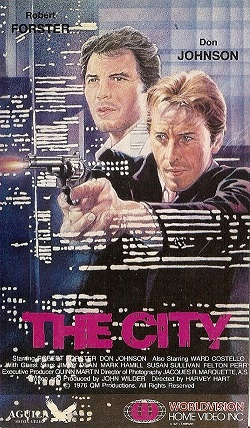
Retro Television Reviews: The City (dir by Harvey Hart)


Welcome to Retro Television Reviews, a feature where we review some of our favorite and least favorite shows of the past!  On Sundays, I will be reviewing the made-for-television movies that used to be a primetime mainstay.  Today’s film is 1977’s The City.  It  can be viewed on YouTube!

“Civilization began when man realized that he could not survive alone. He left the wilderness and built his citadels, security against intruders and erosion from within. The cities of the world have since become the crossroads of trade and ideas. Ideas that have made the human race more powerful than primitive man could ever have dreamed. Among these was an invention, a machine that conquered to contemporary enemies of man: time and distance….”

So goes the opening narration of 1977’s The City.  The narrator is the veteran character actor (and television producer) William Conrad and, as he speaks, we sees images of the California desert eventually being conquered by the growing city of Los Angeles.  It’s a bit of a portentous opening for a film that turns out to be fairly standard police procedural but it makes sense when you consider that The City was apparently meant to be a pilot for an anthology series about the people of Los Angeles.

The City features Mark Hamill, shortly before Star Wars would turn him into a cultural icon.  Hamill plays Eugene Banks, a sweaty, wild-eyed petty criminal who has made his way to Los Angeles from Texas.  Banks manages to get a nice apartment and a job working at a gas station.  One day, after a lawyer demands that Banks fill the tank of his Porsche, Banks snaps.  He grabs a wrench and attacks the car.  Then, he attacks the lawyer, beating the man until he dies.  Banks proceed to go on a crime and killing spree across Los Angeles, flashing a particularly scary-looking knife whenever he gets the chance.

Searching for Banks are two mismatched cops.  Matt Lewis (Robert Forster) is the tough-as-nails, emotionally reserved veteran with a bad knee and a determination to catch the bad guys.  The case becomes personal for Lewis after Banks kills his partner.  Brain Scott (Don Johnson) is a shaggy-haired country boy, much like Banks.  Brian comes from a wealthy family and is a bit more idealistic in his approach than Lewis.

Banks, it turns out, is obsessed with a country singer named Wes Collins (Jimmy Dean).  Banks not only resents the fact that Collins has everything that Banks has ever wanted but he’s also convinced that Collins is actually the father who abandoned him when he was a baby.  Banks wants to get revenge and he’s not going to let anyone, whether they be a bystander, a cop, or a dog, stand in his way.

Yes, Eugene Banks kills a dog in this film.  Fortunately, it happens off-screen but it’s still an indication of just how different this role is from Hamill’s best-known live action role.  As the two cops, Forster and Johnson work well together and bring their somewhat stereotypical characters to life but the main reason most people will watch this film will be for the chance to see Mark Hamill play an absolute lunatic.  With the exception of his somewhat dodgy Texas accent, Hamill does a good job with the role.  He’s got the crazy eyes down and he’s actually frightening when he attacks the lawyer at the start of the film.  The film itself is a bit predictable (i.e., the mismatched partners learn to work together, the bad guy gives a speech at an inopportune time) but The City is worth watching for the cast.

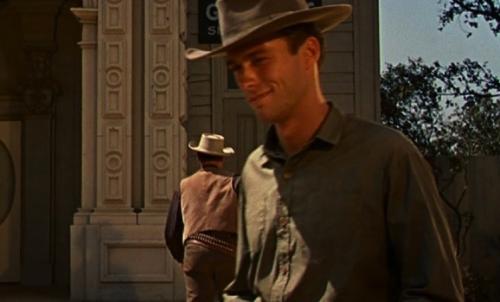
Star in the Dust (1956, directed by Charles F. Haas)


The time is the late 1800s and the place is the town of Gunlock.  Gunlock is split between the ranchers and the farmers, with the ranchers eager to buy all of the land around the town and the farmers refusing to sell.  Trying to keep the peace is Sheriff Bill Jorden (John Agar), who not only wants to keep war from breaking out in Gunlock but who also wants to live up to the example of his legendary father.

There’s a prisoner in the Gunlock city jail.  Sam Hall (Richard Boone) is a notorious gunman who has been convicted of killing three farmers.  He’s due to hang at sunset but everyone in town believes that Sam will somehow escape the executioner.  (They’re even taking bets down at the local saloon and casino.)  Everyone knows that Sam was hired by the ranchers but Sam has yet to name which rancher specifically invited him to come to town.  The farmers want to lynch Sam.  The ranchers want to break him out of jail and arrange for him to be killed in the resulting firefight.  Meanwhile, Sheriff Jorden insists that he’s going to carry out Sam’s sentence by the letter of the law.  Complicating matters for Jorden is that he’s engaged to Ellen Ballard (Mamie Van Doren), the sister of the main rancher, George Ballard (Leif Erickson).

I was really surprised by Star in the Dust, which turned out to be far better than I would normally expect a John Agar/Mamie Van Doren western to be.  Though Agar, Boone, and Van Doren get top-billing, Star in the Dust is really an ensemble piece, with several different people responding to the possible hanging of Sam Hall in their own way.  Sam’s girlfriend, Nellie Mason (Colleen Gray), tries to figure out a way to keep Sam alive.  One of the ranchers, Lew Hogan (Harry Morgan), is morally conflicted about whether or not to honor his word to help Sam escape, especially after he finds out that Sam tried to rape his wife (Randy Stuart).  Even the old deputies (played by James Gleason and Paul Fix) get a few minutes in the spotlight before the shooting begins.  The town of Gunlock comes to life and everyone, from the villains to the heroes, has a realistic motivation for reacting in the way that they do to Sam’s pending execution.

Mamie van Doren’s role is actually pretty small.  She doesn’t have enough screen time to either hurt or help the film overall.  John Agar is as stiff as always but, for once, it works for his character.  Sheriff Jorden isn’t written to be a bigger-than-life John Wayne type.  Instead, he’s just a small town lawman trying to do his job and keep the peace.  Not surprisingly, the film is stolen by Richard Boone, who brings a lot of unexpected shading and nuance to the role of Sam Hall.  Hall may be a killer but he has his own brand of integrity and, if he’s going to die, he’s determined to do it his way.

Produced by the legendary Albert Zugsmith, Star in the Dust is a surprisingly intelligent and well-acted B-western.  If you watch carefully, you might even spot Clint Eastwood playing a ranch hand named Tom who wants to know if he should put money down on Sam Hall being hanged.  Though he was uncredited in this tiny role, Star in the Dust was Eastwood’s first western.