Today’s horror on the lens is the 1957 Roger Corman-directed, sci-fi “epic,” Not of this Earth.
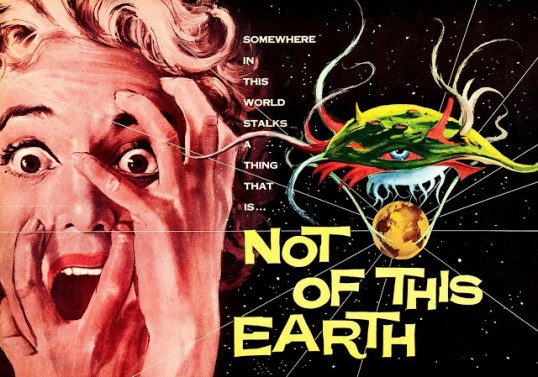
Paul Johnson (Paul Birch) may seems like a strange character, with his stilted way of speaking and his sunglasses and his overdramatic reaction to any and all loud noises. Paul could us be an eccentric. Or, he could be …. NOT OF THIS EARTH! Actually, his habit of draining people of their blood and sending weird, umbrella-like creatures out to attack his enemies would seem to suggest that the latter is probably true.
Listen, it’s not easy being a blood-sucking alien. I mean, sure, there’s always seems to be people stupid enough to show up at your mansion so that you can drain their bodies. Paul is lucky that he doesn’t exactly seem to be surrounded by brain surgeons. But sometimes, things happen. For instance, someone might show up from your home planet and demand an immediate transfusion! What is an alien to do?
Watch this low-budget but undeniably entertaining film to find out! And be sure to especially keep an eye out for the great Dick Miller, who reportedly improvised his role as a vacuum cleaner salesman. (Before going into acting, Miller actually did sell vacuum cleaners door-to-door.)
“You finally did it! You blew it up! …. Goddamn you to Hell!”
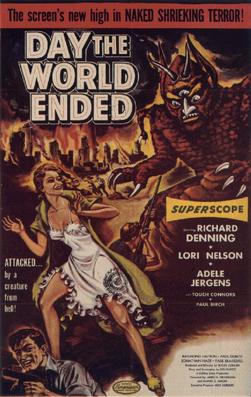
That’s right. Just as how the original Planet of the Apes showed us what the world would look like centuries after a nuclear war, 1957’s Day The World Ended shows us what things would be like in the weeks afterwards. And guess what? It wouldn’t be a lot of fun.
Day The World Ended starts with the bombs dropping and mushroom clouds forming in all of their fearsome glory. (Oppenheimer may have hated his greatest achievement but aesthetically, the atomic bomb is still an impressive invention.) Jim Maddison (Paul Birch) and his daughter, Louise (Lori Nelson), manage to survive by camping out in a steel bunker that Maddison built especially for the moment. As a former Navy commander, Maddison understood that the world was on the verge of nuclear war and he also understood that only those with discipline would survive. He’s filled with bomb shelter with supplies and he’s told Louise that only the two of them can use the shelter. Anyone else is out of luck.
Unfortunately, people keep showing up at the shelter and asking to come in. And while Maddison is prepared to leave them outside with the fallout and the mutants that have started to roam the desert, Louise just can’t stand the thought of leaving anyone to die. Reluctantly, Maddison starts to allow people to join him and his daughter. Some of them, like geologist Rick (Richard Denning), are a good addition to the group, Rick is actually an expert in uranium mining and a potential husband for Louise. (Louise has a fiancé but he’s missing. She keeps his picture by her bed. The picture, of course, is actually a photo of director Roger Corman.) Unfortunately, not everyone is as likable and well-intentioned as Rick. Lowlife hood Tony (Mike Connors) and his girlfriend, Ruby (Adele Jergens) show up and continue to act as if they’ve got the police after them even though the police were probably atomized with the rest of civilization. And finally, there’s a man (Jonathan Haze) who is transforming into a mutant and who develops a strange mental connection to Louise.
No one said the end of the world would be easy!
Day The World Ended was Corman’s fourth film as a director and it was also his first film in the horror genre. (It’s actually a mix of science fiction and horror but whatever.) The film was enough of a box office success that it inspired Corman to do more films in the genre. Seen today, it’s obviously an early directorial effort. It lacks the humor that distinguished Corman’s later films. In fact, the film is actually a little bit boring. Watching a film like this really drives home just how important Vincent Price and his energy were to Corman’s later films. This film doesn’t have an actor like Vincent Price or Boris Karloff or even Dick Miller, someone who could energize a film just through the power of their own eccentricities. Instead, Mike Connors, Paul Birch, and Richard Denning all give dull performances as the survivors. This is a historically important film because, without its box office success, Corman probably would have stuck with doing B-westerns and gangster films. Filmgoers should be happy that audiences in the 50s were drawn in by the film’s title and their own paranoia about nuclear war. It’s a film that one appreciates as a piece of history, even if it doesn’t quite stand up to the test of time.
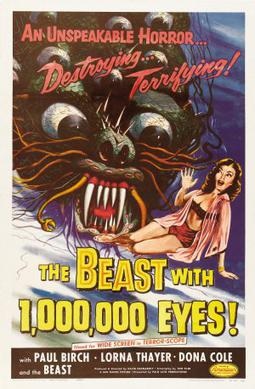
The 1955 film, The Beast With A Million Eyes, has three credited directors and reportedly, Roger Corman also stepped in and took over the direction as well, even though he received no screen credit. That’s a lot of directors for a relatively simple sci-fi/horror film. Reportedly, the problem with the directors came from the fact that The Beast With A Million Eyes was a non-union production and, after one day of production, the unions threatened to picket the set and basically shut down production unless the entire cast and crew signed up for the guilds. The unions eventually got their members and their money but all of the drama set production so far behind that Roger Corman stepped in, fired award-winning cinematographer Floyd Crosby, and proceeded to finish up the film himself.
As for the film itself, it takes place in the California countryside. Allan Kelly (Paul Birch, who was one of the first guys to get killed in The War of the Worlds and later played the dying alien in Corman’s Not Of This Earth) has no use for modern society and he has moved his family to a ranch in the California desert. His family is not particularly happy about this. His wife, Carol (Lorna Thayer), hates being isolated from the world. Their teenage daughter, Sandy (Dana Cole), is lonely and has a strained relationship with her mother. The only thing that makes Sandy happy is her boyfriend (played by Dick Sargent, who would later take over the role of Darin on Bewitched) and her dog. Perhaps the worst part of living out in the desert is that their handyman is a weirdo known as Him (Leonard Tarver).
Now, I should mention that, when I was growing up, my family moved around a lot. I spent a while living on a few farms that were owned by my aunts, uncles, and grandparents. Even after we finally settled down in Texas, I would still frequently visit their farms. I enjoyed visiting the farms, even though I’m pretty much a city girl at heart. I can say that The Beast With A Million Eyes definitely captured the isolated feel of country life. Watching the film, I could feel the heart of the unforgiving sun. I could feel the feeling of tall grass against my bare legs. And, at times, I could even remember the sound of roosters in the distance and crickets and grasshoppers chanting in the night.
Fortunately, my family was never bothered by aliens while we were on the farm. Unfortunately, the same cannot be said for the family at the center of The Beast With A Million Eyes. An alien decides to test its invasion plan on the family. First, the animals turn against the family, including the poor family dog. (This is probably not a film to watch if you feel about dogs the way that I feel about cats.) Then, the handyman suddenly turns against the family as well. The alien is taking over the minds of the living beings around, starting with animals and then moving on to humans. Can the family defeat the aliens? And will nature ever be the same?
Hey, I liked The Beast With A Million Eyes! Usually, when the film has a lot of directors, it results in a disjointed mess but The Beast With A Million Eyes actually had an interesting story and a lot of country atmosphere. As opposed to the stereotypically perfect 50s family, the family at the center of The Beast With A Million Eyes is believably dysfunctional but, in the end, they have to come together to save the humanity. I just hope the rest of the world would be willing to do the same.
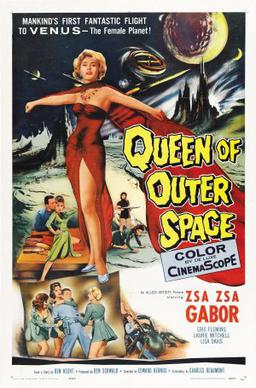
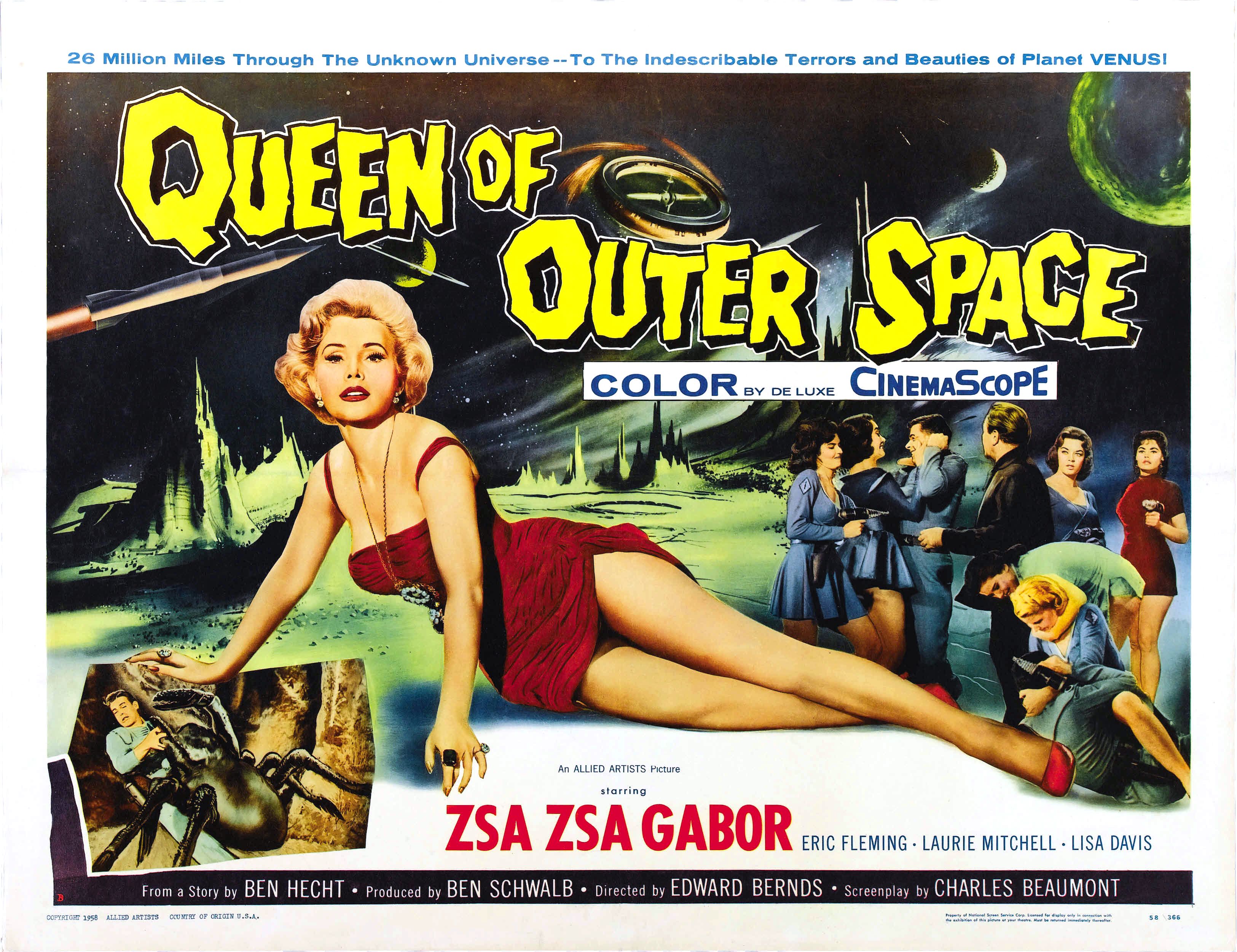
In 1958’s Queen of Outer Space, four rather dumb men take off in a spaceship from Earth.
There’s Lt. Larry Turner (Patrick Waltz) and Lt. Mike Cruze (David Wilcox), both of whom come across like they like to spend the weekend hanging out at their old frat house, playing beer pong. And then there’s Prof. Konrad (Paul Birch), who is smart because he knows what the word “atmosphere” means. And finally, in charge of the flight, is Captain Neal Patterson (Eric Fleming), who is upright and kind of dull.
The four men are supposed to be going to a space station but they get knocked off course by an animated laser beam and the ship crash lands on a mysterious planet that’s covered with cardboard rocks and plastic trees. Prof. Konrad takes one look at the planet and says that they’re on Venus.
Uh-oh! That’s not good! Isn’t Venus like a really bad place for human beings to find themselves?
Well, apparently not, because soon the four men are casually walking around the planet without so much as wearing a space suit or bringing along an oxygen supply. They even stop to get some sleep among the cardboard rocks. That’s when they’re captured by Venus’s inhabitants.
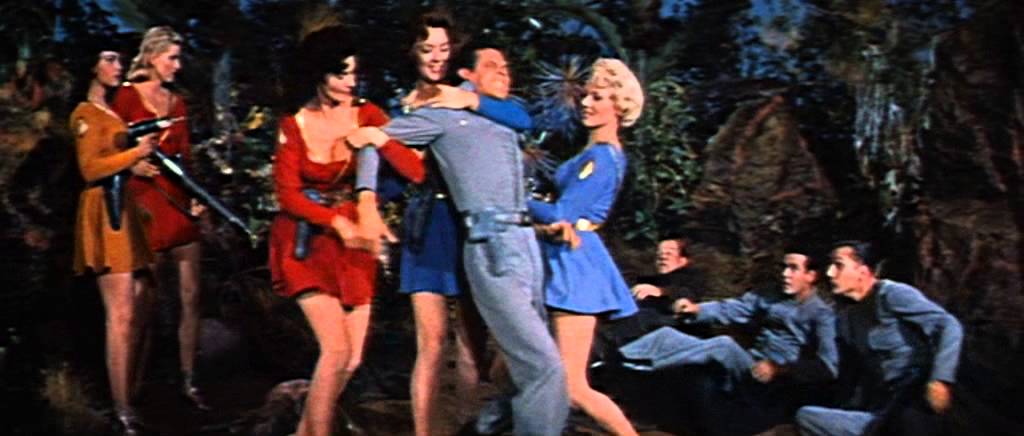
To the men’s shock, they discover that Venus is exclusively populated by women! The men are all like, “Hey, how you doing?” And the women are all like, “Silence, we have ray guns!”
Anyway, long story short, it turns out that Venus is ruled over by a disfigured queen (Laurie Mitchell), who hates men in general and Earth men in specific. She’s built a giant space laser that she’s planning to use to destroy Earth and it’s up to the men to stop her! Fortunately, they’ve got some help from Talleah (Zsa Zsa Gabor), a Venusian courier who has a wardrobe that’s to die for and who has apparently been waiting her entire life for men to come to Venus. When the Queen flirts with the captain, Talleah jealously exclaims, “I hate the Queen!” and that’s pretty much all it takes to start a revolution.
Needless to say, this is an incredibly sexist movie but, at the same time, it’s so goofy (in a 1950s sort of way) that you really can’t get too outraged by it. Instead, you just kinda cringe when Turner and Mike suggest that the captain needs to “turn on some of that old black magic” and invite the Queen out for a midnight stroll. Prof. Konrad quickly adds that Venus actually has several moons, though not all of them can be seen. I mean, it’s dumb but, at the same time, it’s just so 1958.
It’s really is a thoroughly ludicrous movie but, watching it, you get the feeling that the entire cast understood that it was ludicrous and they adjusted their performances accordingly. I mean, this is a movie that features Zsa Zsa Gabor putting on a mask and attempting to imitate the Queen while making absolutely no attempt to hide her trademark Hungarian accent. This is also a movie that features a giant rubber spider that pops up out of nowhere and for nor particular reason. I guess they just had the spider on set for the day and they decided to toss it in.
Queen of Outer Space is an incredibly silly movie but it’s entertaining in it’s own stupid way. Don’t take it too seriously. It’s only 80 minutes. Watch it for the experience.
Today’s horror on the lens is the 1957 Roger Corman-directed, sci-fi “epic,” Not of this Earth.
Paul Johnson (Paul Birch) may seems like a strange character, with his stilted way of speaking and his sunglasses and his overdramatic reaction to any and all loud noises. Paul could us be an eccentric. Or, he could be …. NOT OF THIS EARTH! Actually, his habit of draining people of their blood and sending weird, umbrella-like creatures out to attack his enemies would seem to suggest that the latter is probably true.
Listen, it’s not easy being a blood-sucking alien. I mean, sure, there’s always seems to be people stupid enough to show up at your mansion so that you can drain their bodies. Paul is lucky that he doesn’t exactly seem to be surrounded by brain surgeons. But sometimes, things happen. For instance, someone might show up from your home planet and demand an immediate transfusion! What is an alien to do?
Watch this low-budget but undeniably entertaining film to find out! And be sure to especially keep an eye out for the great Dick Miller, who reportedly improvised his role as a vacuum cleaner salesman. (Before going into acting, Miller actually did sell vacuum cleaners door-to-door.)
Originally released in 1957, Roger Corman’s Not Of This Earth is about a man named Mr. Johnson (played, in a nicely creepy performance, by Paul Birch).
At first glance, Mr. Johnson may look like your typical dark-suited, 1950s businessman but, on closer examination, there’s definitely something off about him. Why does he always wear those dark sunglasses? Why is he so sensitive to loud noise? Why does he move stiffly, as if he’s still getting used to his ody? And when he speaks, why is his tone always so formal and correct? Never trust anyone who doesn’t use a contraction or two. Why is it that Mr. Johnson seems to spend all of his time in his mansion, only venturing outside so that he can visit the local blood banks?
Could it be that Mr. Johnson is …. not of this earth!?
Well, yes, of coursem he’s an alien. I mean, it says so right in the title of the movie! It turns out that Mr. Johnson comes from a planet called Davanna. The inhabitants of Davanna are dying of a mysterious blood disease so he’s been sent to Earth so that he can run tests on human blood. Needless to say, Mr. Johnson is under constant pressure from his bosses back home. They expect Johnson to find a cure but there’s only one problem. Human blood is sometimes hard to come by.
Oh sure. Johnson can always go to the local doctor (William Roerick) and get a transfusion. But, unfortunately, Johnson is often forced to deal with his need for blood by murdering anyone who happens to be near the house, whether it be a teenager or a vacuum cleaner salesman. Like a vampire, Johnson drains them of their blood before retreating to the safety of his mansion.
Paul Birch gives a wonderfully odd performance in the role of Mr. Johnson, playing him in such a way that suggests that Mr. Johnson is still not quite comfortable with his human disguise. When he starts speaking with his stilted and awkward syntax, he’s like a man who has just learned how to speak another language. On the one hand, it’s tempting to feel sorry for Mr. Johnson because he’s desperately trying to save his people. On the other hand, he does end up killing a lot of people.
Beverly Garland and Morgan Jones play Nadine and Harry, a nurse and a policeman who stumble across the truth of Mr. Johnson’s origins. Beverly Garland was one of those confident, no-one-is-going-to-conquer-my-planet actresses who could elevate any film by her presence alone and, as this film shows, if you’re trying to stop the aliens from stealing all of Earth’s blood, Beverly Garland was someone who you would want on your side.
With the exception of a scene featuring Dick Miller as a slick salesman, director Roger Corman plays the material straight and the end result is a quickly paced and, at times, genuinely creepy little sci-fi/horror hybrid. Corman makes good use of his low-budget and even the film’s cheap look ultimately works to its advantage. The stark black-and-white cinematography perfectly captures the harshness of Mr. Johnson’s mission. This an effective and enjoyable B-movie.
Finally, since this is a Roger Corman production, be sure to look for all of the usual suspects. As mentioned above, Dick Miller plays a salesman. (Before becoming an actor, Miller actually did work as a door-to-door salesman and he ad libbed the majority of his dialogue.) Jonathan Haze appears as one of Mr. Johnson’s servants. And, of course, the film was written by Corman’s longtime collaborator, Charles B. Griffith. Three years after making Not Of This Earth, Corman, Haze, Miller, and Griffith would collaborate on the somewhat more light-hearted Little Shop of Horrors.
QUEEN OF OUTER SPACE has quite an interesting pedigree. Screenwriter Charles Beaumont (THE TWILIGHT ZONE) adapted a story by Ben Hecht, of all people, then director Edward Bernds got his frequent Three Stooges/Bowery Boys collaborator Ellwood Ullman to punch things up a little. The resulting mishmash is a huge contender in the “so-bad-it’s-good” sweepstakes, a sci-fi schlockfest featuring goofy special effects, sexism, and Zsa Zsa Gabor!
The movie’s right up there with PLAN NINE FROM OUTER SPACE in its cheesiness, except in glorious Technicolor. Set in a futuristic 1985, space Captain Neil Patterson (Eric Fleming, RAWHIDE’s trail boss) and his intrepid crew (Dave Willock, Patrick Waltz) are assigned to shuttle Professor Konrad (sci-fi stalwart Paul Birch) to Space Station A, where there’re “indications of some trouble up there”. Off they go into the wild blue yonder, where they witness the station being blown to smithereens by a mysterious ray (via cartoon animation)…
“When the legend become fact, print the legend.” — Maxwell Scott (Carleton Young) in The Man Who Shot Liberty Valance (1962)
Though I understand and respect their importance in the history of both American and Italian cinema, I have never really been a huge fan of westerns. Maybe its all the testosterone (“A man’s got to do what a man’s got to do…”) or maybe it’s all the dust but westerns have just never really been my thing.
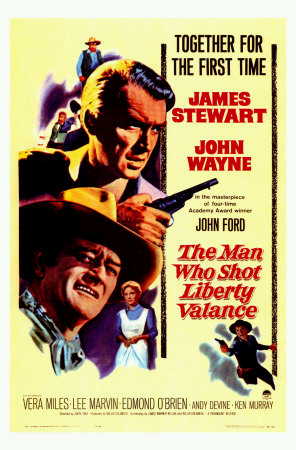
However, I will always make an exception for The Man Who Shot Liberty Valance, which is not just a great western but a great film period.
But you already knew that. It’s a little bit intimidating to review a film that everyone already knows is great. I even opened this review with the exact same quote that everyone uses to open their reviews of The Man Who Shot Liberty Valance. To a certain extent, I feel like I should have found a quote that everyone hasn’t already heard a thousand times but then again, it’s a great quote from a great film and sometimes, there’s nothing wrong with agreeing with the critical consensus.
The Man Who Shot Liberty Valance opens with a train stopping in the small western town of Shinbone. The residents of the town — including newspaper editor Maxwell Scott (Carleton Young) — are shocked when Sen. Rance Stoddard (James Stewart) and his wife Hallie (Vera Miles) get off the train. Sen. Stoddard is considered to be a front-runner to become the next Vice President of the United States. Scott is even more shocked to discover why the Stoddards are in town. They’ve come to Shinbone to attend the funeral of an obscure rancher named Tom Doniphon (played, in flashback, by John Wayne).
Sitting in the funeral home with Doniphon’s coffin (and having reprimanded the local mortician for attempting to steal Tom’s boots), Rance tells Scott why he’s come to pay respect to Tom Doniphon. We see, in flashback, how Rance first came to Shinbone 25 years ago, an idealistic lawyer who — unlike most of the men in the west — refused to carry a gun. We see how Rance was robbed and assaulted by local outlaw Liberty Valance (a wonderfully intimidating and bullying Lee Marvin), we discover how Rance first met Hallie while working as a dishwasher and how he eventually taught her how to read, and we also see how he first met Tom Doniphon, the only man in town strong enough to intimidate Liberty Valance.
At first, Rance and Doniphon had an uneasy friendship, epitomized by the condescending way Doniphon would call Rance “pilgrim.” Doniphon was in love with Hallie and, when he attempted to teach Rance how to defend himself, he was largely did so for Hallie. Rance, meanwhile, was determined to bring law and society to the west.
And, eventually, Rance did just that. When Shinbone elected two delegates to the statehood convention in the territory’s capitol, Rance attempted to nominate Doniphon for the position but Doniphon refused it and nominated Rance instead, explaining that Rance understood “the law.” When Liberty Valance attempted to claim the other delegate spot, Rance and Doniphon worked together to make sure that it instead went to newspaper editor Dutton Peabody (Edmond O’Brien). And when Liberty Valance attempted to gun Rance down in the street, Rance shot him.
Or did he?
That’s the question that’s at the heart of The Man Who Shot Liberty Valance. However, as a film, The Man Who Shot Liberty Valance is far less interested in gunfights than it is in politics. Perhaps the most important scene in the film is not when Rance and Liberty meet out on that dark street. Instead, it’s the scene at the statehood convention where the reformers (represented by Rance) and the cattlemen (represented by John Carradine) battle over who will be the territory’s delegate to Washington. Between John Carradine orating, the horses riding in and out of the hall, Edmond O’Brien drinking, James Stewart looking humble, and John Wayne glowering in the background, this is one of the best political scenes ever put on film.
When Rance first arrives in the west, there is no political system in place. With the exception of the ineffectual town marshal (Andy Devine), there is no law. The peace is kept by men like Tom Doniphon and, oddly enough, by Liberty Valance as well. (Whether he realizes it or not, Shinbone’s fear of Liberty has caused the town to form into a community.) What little official law there is doesn’t matter because the majority of the Shinbone’s citizens can’t read.
When Rance arrives, he brings both education and the law. He makes Shinbone into a town that no longer needs Liberty Valance but, at the same time, it no longer need Tom Doniphon either. Hence, it’s Rance Stoddard who goes from dishwasher to U.S. Senator while Tom Doniphon dies forgotten. Rance represents progress and unfortunately, progress often means losing the good along with the bad things of the past.
(It’s no coincidence that when Rance and Hallie return to Shinbone, the first person that they see is the former town marshal, who no longer wears a star and who, we’re told, hasn’t for years. Time has passed by.)
It’s a bittersweet and beautiful film, one that features four great performances from Stewart, Wayne, Marvin, and Vera Miles. Personally, I like to think that maybe Sen. Stoddard had a daughter who married a man named Smith and maybe they had a son named Jefferson who later made his way to the Senate as well.


 Through the Shattered Lens