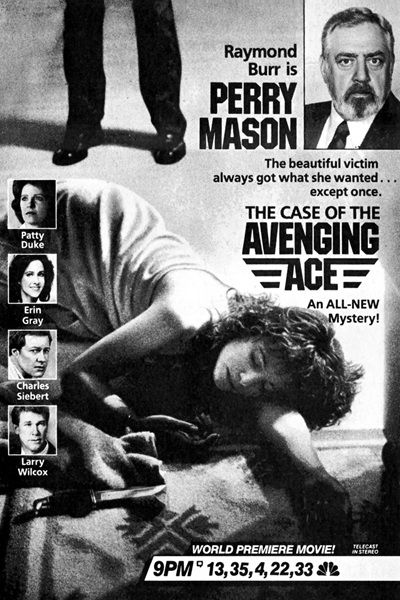
Back when Perry Mason (Raymond Burr) was a judge, he rejected the appeal of Kevin Parks (Larry Wilcox), an Air Force colonel who was accused of stalking and killing Amy Beth Sawyer (Dotty Coloroso). Even though Perry had his doubts, he did not find any legal grounds for an appeal. In the present day, when Parks is accused of killing a new witness who could have provided him with an alibi, Perry agrees to represent Parks in court and tries to prove that Parks was not guilty of either murder.
This movie was much more complicated than the typical Perry Mason movie but it was a good change of pace and the mystery itself kept me guessing. I was sure I knew who the murderer was and I turned out I was wrong. Perry’s guilt about turning down Kevin Parks’s original appeal added a new dimension to the movie and it was interesting to see Perry doubting himself, even if it was just for a few minutes.
Again, Raymond Burr spent most of this movie either sitting or leaning against something. Even unwell, he still gave a good performance and his chemistry with Barbara Hale was as charming as ever. Paul Drake, Jr. (William Katt) did the leg work and got involved in a few good chases. The only thing more interesting than the mystery was Paul’s hair, which gets bigger and bigger each movie.
Welcome to Retro Television Reviews, a feature where we review some of our favorite and least favorite shows of the past! On Sundays, I will be reviewing the made-for-television movies that used to be a primetime mainstay. Today’s film is 1971’s If Tomorrow Comes! It can be viewed on YouTube.
If Tomorrow Comes tells the story of a forbidden marriage.
In 1941, Eileen Phillips (Patty Duke) meets David Tayanaka (Frank Liu) and the two of them quickly fall in love. David asks Eileen to marry him and Eileen says yes, even though they both know that it won’t be easy. Eileen’s father (James Whitmore) and her brother, Harlan (Michael McGreevey), are both prejudiced against the Japanese and David’s parents (played by Mako and Buelah Quo) would both rather than David marry someone of Japanese descent. Eileen and David decide to elope first and tell their parents afterwards.
On December 7th, Eileen sneaks out of the house and joins David at his church. They are married by Father Miller (John McLiam), who agrees to keep their secret. Eileen and David then drive over to the church attended by Eileen’s family but no sooner have they arrived than the local sheriff (Pat Hingle) pulls up and announces that the Japanese have bombed Pearl Harbor. The sheriff instructs everyone to return home and to listen to their radios. David slips his wedding ring off his finger. Telling the parents will have to wait.
Eileen’s father and brother are convinced that every Japanese person in town, even though the majority of them were born in America and have never even been to Japan, is a subversive. David and his family are harassed by government agents like the oily Coslow (Bert Remsen). One morning, they discover that all of their farm animals have been killed and someone has written “REMEMBER PEARL HARBOR” with their blood. When Franklin D. Roosevelt orders the internment of the Japanese, David’s father is among those taken away. When Harlan continues to harass David, it eventually leads to not just one but two tragedies.
If Tomorrow Comes is a real tear-jerker, one that features a great performance from Frank Liu and a good one from Patty Duke. Though it may seem a tad implausible that David and Eileen would get married just an hour before Japan attacked Pearl Harbor (and considering the attack occurred on a Sunday morning, I’m a little curious how they found a priest who was free to secretly marry them), the film does a good job of showing how fear can lead to otherwise good people doing terrible things. One of the film’s strongest moments comes as David’s father is taken away to an internment camp and the Japanese prisoners try to prove their loyalty by spontaneously singing America, The Beautiful. It’s a moment that reminds us of the danger of letting our fear destroy our humanity.
It’s a film that still feels relevant today, with its portrayal of heavy-handed government agents searching for subversives and ignoring the Constitution in order to save it. When David visited his father at the internment camp, I thought about how, at the heigh of the COVID pandemic, it was not unusual to see people demanding that the unmasked and the unvaccinated by interned away from the rest of the world. If Tomorrow Comes is a love story and a melodrama and tear-jerker but, above all else, it’s a warning about the destructive power of fear and prejudice.
Welcome to Retro Television Reviews, a feature where we review some of our favorite and least favorite shows of the past! On Wednesdays, I will be reviewing the original Love Boat, which aired on ABC from 1977 to 1986! The series can be streamed on Paramount Plus!
It’s Valentine’s Day on The Love Boat!
Episode 1.20 “Memories of You / Computerman / Parlez Vous?”
(Dir by Richard Kinon, originally aired on February 13th, 1978)
It’s time for the annual Valentine’s Day cruise! On Valentine’s Day, only singles are allowed to board the Love Boat. Everyone, even the members of the crew, wears a heart-shaped nametag. Julie has decided to liven things up by hiring Nick Heider (Frankie Avalon), who claims that his computer can decide who is compatible and who isn’t. Captain Stubing is hoping that the computer will set him up with someone because apparently, Stubing is tired of being single. To be honest, that really doesn’t make much sense. When you’re the captain of the ship, you’re going to get laid on Valentine’s Day. It doesn’t matter if you’re bald, middle-aged, and take yourself a little bit too seriously. A captain has power and power is an aphrodisiac.
Nick turns out to be kind of sleazy, with his wide collars and his unbuttoned shirts. Nick also has a crush on Julie and he wants her to take part in his compatibility survey. Julie says that she doesn’t believe that computer can decide who is compatible. If Julie doesn’t believe in Nick and his computer, why did she hire him for the cruise?
As you can probably guess, Nick fills out a survey for Julie anyway. The computer pairs them together and Julie and Nick actually do fall in love, though I have a feeling we will never again see or hear about Nick after this episode. Meanwhile, Captain Stubing is told that the computer can’t find any matches for him. The Captain is pretty depressed until all of the computer-selected couples start fighting. I would think that people taking a dislike to each other would be a problem on Valentine’s Day cruise but whatever. The computer fails and Stubing smiles smugly.
While this is going on, Gopher is recruited to act as a translator for two French women (Barbi Benton, Susan Silo) who are on the cruise. Gopher’s French turns out to be really bad but fear not. It turns out that the French women are actually Americans and they speak perfect English. They’re just pretending to be French in order to attract wealthy men. Jamie Farr and Danny Dayton nearly fall for the scam but then Gopher hears the women speaking English and he exposes them. Of course, despite ruining their scam, Gopher still gets a (temporary) girlfriend out of it when Brigitte (played by Barbi Benton) turns out to be very forgiving.
Finally, Doc thinks that he’s found his soulmate for the cruise when he spots jingle writer Lilly Mackin (Patty Duke). However, Lilly can’t stop looking at another passenger named Ted (Ricky Nelson). Lilly swears that Ted looks just like Alex, her former partner who mysteriously vanished. Doc suggests that Ted might be suffering from stress-related amnesia. Fortunately, Ted falls in love with Lilly and, after she kisses him, he starts to slowly remember bits of his past life as Alex. That’s the power of Valentine’s Day on The Love Boat!
I loved this episode. I took French in high school and college and I used to be really pretentious about it so I definitely related to Brigitte and Yvonne. And the amnesia story was just intriguing enough to hold my attention. Finally, I could help but laugh at how impressed everyone was with Nick and his match-making computer. There was nothing that Nick said that sounded different from what we currently hear in Match.com and EHarmony commercials. That said, I agree with Julie. Romance should be spontaneous and unpredictable, not pre-programmed.
The Valentine’s Day cruise was success! Will the success continue? We’ll find out next week!
On tonight’s episode of Circle of Fear, John Astin plays a former actor who now makes a meager living as a security guard at the studio where he once worked. Unfortunately, the studio is shutting down. John Astin will be out of a job but, as he discovers one night, he’s not the only one who fears being forgotten. This is the type of story that could only have been told in the days before physical media, streaming sites, and cable.
Patty Duke, who was married to Astin at the time, plays his character’s wife. Playing their baby is John and Patty’s newborn, future actor MacKenzie Astin. William Castle, who served as executive producer of Circle of Fear, appears as the head of the studio.
This episode originally aired on February 16th, 1973.
The 2018 film, Power of the Air, tells the story of David Williams (Nicholas X. Parsons). David thinks that he can be a committed Christian despite the fact that he spends every weekend at the movies. In fact, he and his friends have a streak going. For over 40 weekends, they have gone to the movies and David has never once worried about all of the violence, nudity, and adult language that he sees.
Some might say that this is because David is an adult who has found a way to relax after work. However, a Nigerian missionary named Emeka Odum (played — quite well, it must be said — by Veryl Jones) says that it’s because David is using the movie theater as a substitute for church. As Odum explains it, the movie theater has become America’s new house of worship and, as a result, America is now a second-rate nation that has lost its way. Why, in three years, America might even have a president who obviously doesn’t know where he is half the time. And it’s all Hollywood’s fault! Well, actually, the movie suggests that it’s really your fault for going to the movies.
If that sounds like an old-fashioned message, that’s because Power of the Air is a very old-fashioned movie. That is perhaps not surprising, as this is a Dave Christiano production, but it still feels strange to hear David — the character and not the director, though one gets the feeling that it’s not a coincidence that they share the same name — announce that he can no longer watch any movies that feature people cursing. I mean, avoiding a movie because of violence makes sense to me. Avoiding a movie because of nudity or political messaging is also understandable. Everyone has different things that they’re looking for. But avoiding a movie because of cursing is basically just another way of announcing that you’re never going to watch another movie. I mean, I’ve known plenty of Christians who do curse. At the same time, I do have to admit that I hardly ever curse but that’s just because I don’t want to sound like everyone else. I gave up cursing for Lent and my sisters all accused me of cheating because, according to them, it’s not really a sacrifice if you give up something that you don’t actually do.
Anyway, David wants to use mass media to spread a good Christian message so he comes up with the idea of broadcasting a commercial on all fifteen of his city’s radio stations at the exact same time. As he sees it, this will mean that everyone will hear the commercial whether they try to change the station or not. (Or, you know, they might just turn off their radio. Or they might turn down the volume. Or they might resent having David’s message forced upon them and respond by going to a Marvel film.) Unfortunately, Charlie (Patty Duke), the manager of the biggest station in town, doesn’t want to run a religious commercial. Can David change her mind?
Of course, I think the real problem with David’s plan is that the days of people spending all day listening to the local radio stations are pretty much over. That’s true today and it was true when this film was made in 2018. There are now so many options out there and so many other ways to keep oneself entertained during the day that the idea of everyone in the city listening to local AM radio seems a bit naïve. David really should have started a podcast or something.
Anyway, Power of the Air is a fairly slow-moving film and it’s one of those films that will mostly appeal to people who already agree with its message. The film is probably most interesting as Dave Christiano’s feature-length justification for making the type of movies that he does. The main message seems to be that if only more people watched Christiano’s films, then David wouldn’t have had to spend all that money on those radio ads.
Welcome to Retro Television Reviews, a feature where we review some of our favorite and least favorite shows of the past! On Wednesdays, I will be reviewing the original Love Boat, which aired on ABC from 1977 to 1986! The series can be streamed on Paramount Plus!
Come aboard, we’re expecting you….
The Love Boat 1.5 “The Joker Is Mild / Take My Granddaughter, Please / First Time Out”
(Dir by Richard Kinon and Alan Rafkin, originally aired on October 29th, 1977)
This week’s cruise is all about remaining true to yourself!
For instance, Julie makes what appears to be a big mistake when she agrees to let a washed-up comic named Barry Keys (Phil Foster) do a show in the ship’s lounge. Throughout the cruise, Barry gets on everyone’s nerves with his old-fashioned jokes and his vaudeville stylings. Captain Stubing gives Julie an annoyed look whenever Barry starts to speak. Julie knows that her career is on the line but she made a promise. And Barry, it turns out, know what he’s doing. When it comes time for his performance, he asks for a stool so that he can sit in the middle of the stage and talk about the generation gap. (“Let’s rap, as the kids say,” Barry says.) Hooray! Barry has revived his career and Julie still has a job.
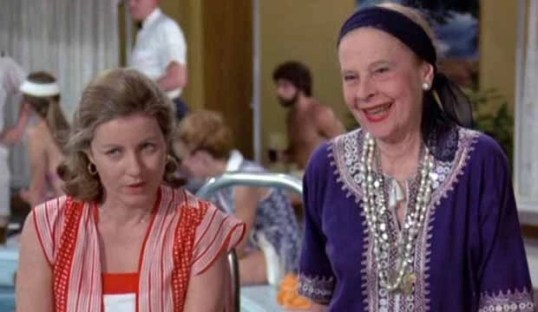
Meanwhile, Mrs. Warner (Ruth Gordon) is determined to find a husband for her granddaughter, Shirley (Patty Duke, who spends the entire episode looking as if she’s wondering how she could go from winning an Oscar to this). Shirley would like to hook up with the pleasantly bland Dave King (played by Tab Hunter). Mrs. Warner wants her to go out with Dr. Bricker! In the end, Shirley stands up for herself, as any single 30 year-old should. (To be honest, I thought Patty Duke’s character was closer to 40 but that’s mostly the fault of whoever in the costume department decided to make her wear some of the least flattering outfits available.) It’s all for the best. Dave is a nice guy and Doc has an exam room full of pornographic magazines to take care of.
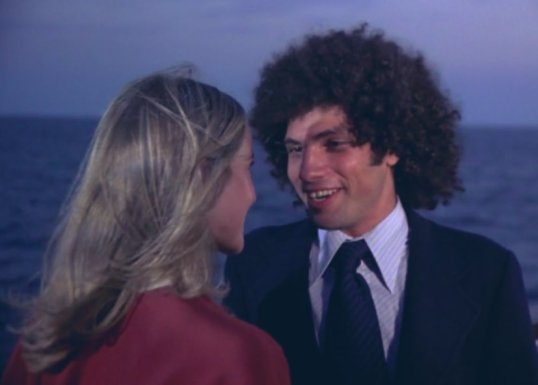
Finally, a group of college students board the ship with one mission in mind. They want their friend Dan (Robert Hegyes, who has a truly impressive head of hair) to lose his virginity. Dan, it turns out, is not only shy but he also has no idea how to talk to women. Fortunately, her runs into Marcia Brady (Maureen McCormick) and it turns out that Marica likes shy, socially awkward guys with a lot of hair. Okay, technically Maureen is playing Barbara Holmes but seriously, we all know that Barbara was actually Marcia.
This was a majorly uneven episode. Barry’s revised act didn’t seem any funnier than his old stuff and it was kind of hard to sympathize with Shirley and her inability to make her own decisions. That said, Maureen McCormick and Robert Hegyes made for a cute couple and their storyline was the most satisfying of the episode. Personally, I think this episode would have worked better if Ruth Gordon had played Maureen McCormick’s grandmother as opposed to Patty Duke’s. McCormick was young enough that it would have been a bit less pathetic for her to be bossed around by her grandmother and one can imagine how Ruth Gordon would have reacted to McCormick picking hairy Dan over a doctor.
Oh well! The important thing is that everything worked out in the end and love won’t hurt anymore.
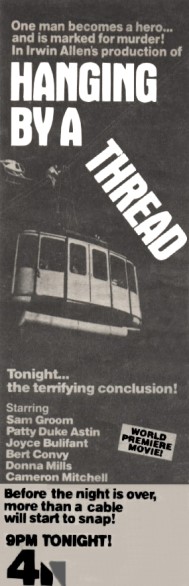
A group of old friend who call themselves the Uptowners’ Club (yes, really) want to go on a picnic on top of a remote mountain. The only problem is that they have to ride a cable car up to the mountain and there are reports of potentially bad weather. It’s not safe to ride in a cable car during a thunderstorm. Drunken ne’er-do-well Alan (Bert Convy) doesn’t care and, since his family owns both the mountain and the tramway, his demands that he and his friends be allowed to ride the cable car are met. One lightning strike later and the members of the Uptowners’ Club are stranded in a cable car that is perilously suspended, by only a frayed wire, over treacherous mountain valley.
With no place to go, there’s not much left for the members of the Uptowners’ Club to do but bicker amongst themselves and have lengthy flashbacks that reveal every detail of their own sordid history. Paul (Sam Groom) is angry with Alan because Alan is now engaged to his ex-wife (Donna Mills). Sue Grainger (Patty Duke) is angry with everyone else because they don’t want to admit how their old friend Bobby Graham (Doug Llewellyn) actually died. The other members of the Uptowners’ Club are angry because there’s not much for them to do other than watch Duke and Convy chew on the scenery. Because of the supposedly fierce winds, someone is going to have to climb out on top of the cable car and repair it themselves. Will it be Paul or will it be cowardly drunk Alan? On top of everything else, Paul is set to enter the witness protection program and has got hitmen who want to kill him.
This made-for-TV disaster movie was produced by Irwin Allen. Are you surprised? It’s also three hours long and amazingly, Leslie Nielsen is not in it. It’s hard to understand how anyone could have produced a cable car disaster film and not given a role to Leslie Nielsen. Cameron Mitchell’s in the film but he’s not actually in the cable car so it’s a missed opportunity. Any film that features Patty Duke detailing how her friends got so drunk that they ended up killing the future host of The People’s Court is going to at least have some curiosity value but, for the most part, Hanging By A Thread gets bogged down by its own excessive runtime and lack of convincing effects. Hanging By A Thread came out at the tail end of the 70s disaster boom and it shows why the boom didn’t continue into the 80s.
(Warning: This review contains spoilers. A lot of them.)
Last week, I posted a poll and I asked you, the Shattered Lens readers, which film I should watch on March 20th and then subsequently review. You voted and the winner was the classic 1967 trashfest, Valley of the Dolls.
Based on a best-selling (and trend-setting) novel by Jacqueline Susann, Valley of the Dolls starts out with a disclaimer that informs us that the story we’re about to see is totally fictional and purely imaginative. That disclaimer is probably the funniest part of the entire film as Valley of the Dolls is notorious for being one of the first films dedicated to showing middle America just how miserable and screwed up those famous show business types truly are. As such, the main reason for watching a movie like this is so you can sit there and compare the cinematic troubles of a character like Neely O’Hara to the true-life troubles of an actress like Lindsay Lohan. Valley of the Dolls tells the story of three aspiring stars who, as they find fame, also find themselves dealing with heartbreak, insanity, and dolls. No, not the type of dolls that my mom used to collect. These “dolls” are a bunch of red pills that do everything from keeping you thin to keeping you awake and focused. (Though the pills are never actually called anything other than “dolls,” they appear to be the same pills that I take for my ADD.)
The least interesting of our three heroines is Anne Welles (Barbara Parkins). Unfortunately, Anne is also pretty much the center of the rather draggy first hour of the film. Anne is a walking cliché, a naive girl from a small town in New England who moves to New York, gets a room at the Martha Washington Hotel for Women, and a job at a local theatrical agency. “I want to have a marriage like mom and dad…but not yet!” Anne breathlessly tells us. Anne eventually ends up as the mistress of Lyon Burke (played by Paul Burke), a writer-turned-theatrical-agent who you know has to be a cad because his name is Lyon Burke and he takes Anne’s virginity but then refuses to marry her afterward. Anne eventually becomes a model and finds fame as the face of Gilligan Hairspray but she soon finds herself forced to watch as her two best friends travel down a path of self-destruction.
Anne is the film’s token “good girl” and, as such, she’s rather bland and boring. However, her character is interesting when considered as a symbol for the confused sexual politics of the time. Valley of the Dolls was made in 1967, at a time when Hollywood was still trying to figure out how to deal with the emerging counter-culture. The end result? A lot of rather old-fashioned films that were full of jarringly out-of-place counter-culture moments. By the time Valley of the Dolls came out, it was allowable to acknowledge that a single girl might actually have sex but she still had to, at the very least, feel an unbelievable amount of angst about it. That certainly is the case with Anne. Watching the film today, it’s hard to understand just what exactly Anne’s feeling guilty about. Lyon isn’t married. Anne finds success even as she pursues her relationship with him. Up until the final half of the film (at which point the morality of the time demands that both Anne and Lyon suddenly start acting totally out-of-character), Lyon treats her with about as much respect as you could probably expect to get from a man in the 1960s. And yet, Anne can’t feel complete simply because Lyon is hesitant about marrying her. When she and Lyon finally do make love, they do it with the lights off so the only thing the viewer sees are two shadowy figures holding each other. Following the film’s logic, if the lights had been left on, the character of Anne would have had to have been punished later in the film for allowing the audience to see too much of her.
When Anne first comes to New York, she befriends two actresses. The more tragic of the two is Jennifer North (played by Sharon Tate, who would be tragically murdered two years after this film came out), an insecure blonde who is valued more for her body than her talent. Jennifer spends her spare time doing bust exercises (“To hell with them!” she declares at one point as she glares down at her chest, “Let ’em droop!”) and dealing with phone calls from her mother, demanding that Jennifer send her money. Jennifer eventually ends up marrying a singer named Tony (played by Tony Scotti). Tony is a well-meaning if simple-minded guy who is married to a creepily overprotective sister (played by Lee Grant). Eventually, it turns out that Tony has a neurological disease and he’s eventually checked into a sanitorium. Penniless, Jennifer goes France and makes “art films.” (In one of Valley of the Dolls’ better moments, we’re shown a clip of this “art film” and it turns out to be a pitch perfect satire of every single pretentious soft-core film to ever come out of Europe.) Upon returning to America, Jennifer discovers that she has breast cancer and, declaring “All I’ve got is my body,” she commits suicide.
Though Sharon Tate gets considerably less screen time than her co-stars, she probably gives the strongest performance in this film. Certainly, her story is the most emotionally effective (even if it’s hard not to feel that, as is typical of the films of both the 60s and today, Jennifer is being punished for taking off her clothes on camera). Tate perfectly captures the insecurity that comes from being continually told that you have nothing more to offer beyond how you look. In her first appearance, she’s wearing an outrageously large headdress. “I feel a little top-heavy,” she says. “You are a little top-heavy,” some guy replies while leering at her breasts. If you doubt that Sharon Tate was a good actress, just watch her reaction. She perfectly captures a pain that I personally know far too well. Her subsequent suicide scene, which has the potential to be the most tasteless part of this film, is actually the most powerful and again, it’s because Tate plays the role perfectly.
(It’s been nearly four years since I lost my mom to breast cancer and I have to admit, I had a hard time watching the scenes where Jennifer discusses her diagnosis. Tate gave a great performance here and it’s a shame that she’s been permanently linked in the public imagination with Charles Manson and the later accusations against her husband, Roman Polanski. She had real talent.)
As poignant of Sharon Tate was in her role, the film’s fame (and infamy) ultimately rests with our third heroine, Neely O’Hara (played by Patty Duke in a performance that suggests that she was literally possessed during the filming). Neely is a scrappy, aspiring singer who is fired from a broadway show when her singing threatens to upstage aging star Helen Lawson (played by Susan Hayward, who was brought in to replace Judy Garland). Neely, however, refuses to let anything keep her down and soon, she’s singing at a Cystic Fibrosis telethon and becoming a big star. She marries her boyfriend Mel (played by Martin Milner, who grits his teeth and spits out every line) and moves to California where she soon becomes a big star and then finds herself hooked on “booze and dolls.” (“I need a doll!” she insists on several occasions.)
One reason the film’s 2nd hour is so much more fun than the first is because the film’s focus shifts from boring Anne to out-of-control Neely. Increasingly temperamental and unstable, Neely soon starts to spend all of her time with dress designer Ted Casablanca (a great name, if nothing else.) “You’re spending more time than necessary with that fag Ted Casablanca,” Mel tells her to which Neely replies, “Ted Casablanca’s no fag and I’m the dame who can prove it.” This, of course, leads to a divorce and soon Neely is living with Mr. Casablanca who informs her, after he gets caught cheating, “You made me feel as if I was queer…that little whore makes me feel 9 feet tall.”
When Lyon and Anne attempt to force Neely to enter a sanitorium, she responds to running off to San Francisco where she enters a bar and shouts, “I’M NEELY O’HARA!” before then wandering down a sleazy street and ranting, “Boobies, boobies! Nothing but boobies! Who needs them!?” Needless to say, this leads to her eventually overdosing and ending up in that sanitorium where she has a huge freak-out before singing a duet with Tony and resolving to get her life back in order. This, naturally, leads to her getting released, having an affair with Lyon, and then returning to Broadway where, in the film’s most deliriously odd moment, she steals Helen Lawson’s wig and flushes it down a toilet.
Valley of the Dolls is, admittedly, a terrible film but it’s also a lot of fun and that’s largely because of Patty Duke’s berserk performance as Neely O’Hara. Earlier, I said that Duke’s performance appears to suggest that she may have been possessed but, honestly, that barely begins to describe it. Whereas Tate managed to find some truth in the film’s melodrama and Parkins gives a performance that suggests that the script put her in a coma, Duke attacks every inch of melodramatic dialogue, barking out her dialogue with all the ferocity of a yapping little chiuaua. Duke gives a performance that is so completely and totally over-the-top that it’s hard not to respect her commitment to capturing every overheated, melodramatic moment.
I have to admit that one reason why I love this film is because I’m hoping that someday some enterprising director will remake it and cast me as Neely O’Hara. Everytime I watch this film, I find myself thinking about how much it would be to respond to every petty annoyance by screeching out, “I’m NEELY O’HARA!” Seriously, just think about it. As a character, Neely is a talented, ambitious, emotional, unstable, immature, demanding, bratty, spoiled, and determined. Sound like anyone whose film reviews you might have been reading recently? From my previous experience as a community theater ingenue, I can assure you that I can deliver melodramatic dialogue with the best of them and, unlike Patty Duke in this film, I can actually dance. Unfortunately, I can’t carry a tune to save my life but I’m thinking maybe they could bring in Kelly Clarkson to serve as my singing voice. (Or maybe Jessica Simpson. Did I ever mention that we both went to the same high school? Though not at the same time, of course.) After all, if Patty Duke could be obviously dubbed, why not me? I can just see myself now, wandering down some sleazy city street, singing to myself and declaring at the top of my lungs, “Ted Casablanca’s no fag and I’m the dame who can prove it!” I know that Lindsay Lohan will probably insist that this is the role she was born to play, but seriously, who needs Linsday when you’ve got a Lisa?
Beyond the so-bad-that-its-good appeal of the film, Valley of the Dolls is a fascinating cultural artifact for the reasons that I previously hinted at while talking about the character of Anne Welles. Valley of the Dolls was made in 1967 and, as such, it’s a perfect exhibit of an unstable time when Hollywood was unsure about whether it should embrace the “new morality” or if it should continue to recycle the same sort of old-fashioned filmmaking that had nearly bankrupted the big studios. The result was several films that felt oddly schizophrenic in their approach and that is certainly the case with Mark Robson’s direction of Valley of the Dolls. Whether it’s the way the film continually hints at nudity and sex while carefully not revealing too much or the way that random psychedelic sequences seem to suddenly appear on-screen, this is a movie that perfectly captures an uncertain film industry trying to figure out where it stands in a scary new world.
As always, I enjoyed watching this undeniably bad but just as undeniably compelling film. Our readers chose well! Thank you to everyone who voted and I hope you’ve enjoyed reading this review almost as much I enjoyed writing it.
Yesterday, as part of my ongoing struggle with insomnia, I watched the 1967 Hollywood expose, Valley of the Dolls. This is one of the most legendary so-bad-it’s-good films of all time but I have to admit that the main reason I started watching it was because I had been told that the movie was also extremely dull. I was hoping it might put me to sleep.
No such luck.
I am not ashamed to admit that I loved Valley of the Dolls in all of its over-the-top, ludicrous glory. I’m also not ashamed to admit that I now have a new life’s ambition. And that ambition is to play the iconic role of talented, neurotic, and unstable pill popper, Neely O’Hara in a modern-day remake of Valley of the Dolls (which, hopefully, will be directed by Arleigh who I’m sure could help me get in touch with my inner Neely).
In the original Valley, Neely was played by Patty Duke who sang, screamed, and doped as if the world depended on it. Below is my favorite scene of Neely mayhem, the one in which Neely gets into a catfight with an aging rival (played by Susan Hayward).
(Much like the rest of the movie, this scene starts out slow and requires a little bit of patience on the part of the viewer but, in the end, that patience will be rewarded.)




 Through the Shattered Lens