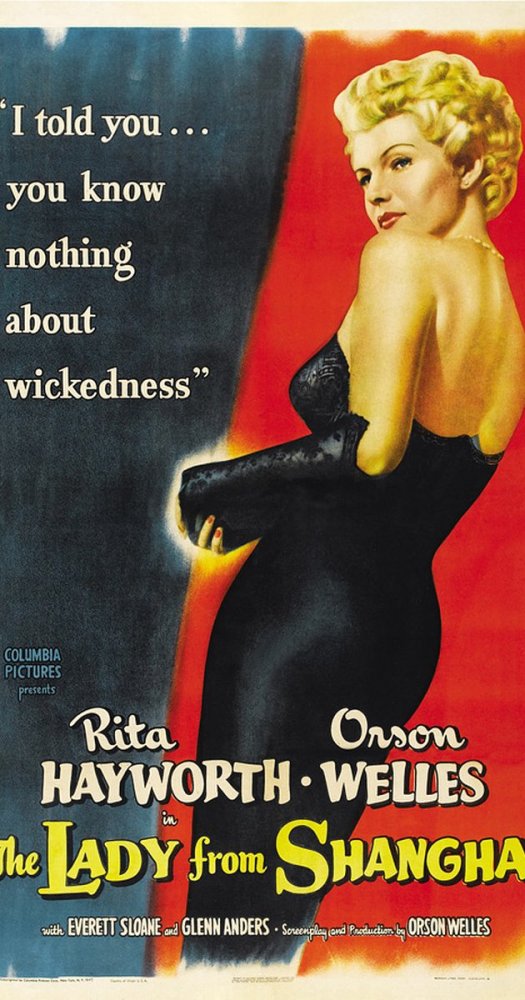
For my money, THE LADY FROM SHANGHAI is the perfect film noir, a tour de force by producer/writer/director/star Orson Welles that assaults the senses and keeps the viewer enthralled at all times. All this despite the meddling of Columbia Pictures czar Harry Cohn, who demanded Welles reshoot scenes and ordering its 155 minute running time cut down to 87. The version we see today, released in the states in 1948 (it was first run in France six months earlier), is still a brilliant piece of filmmaking thanks to the immense talents of Welles and his cast and crew.
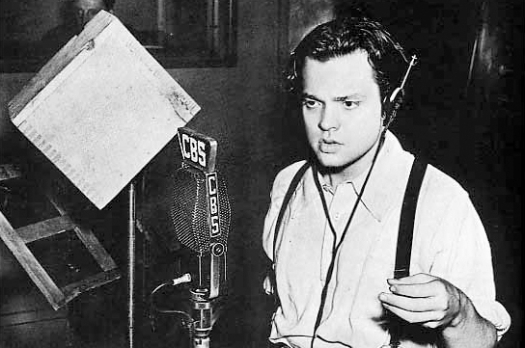
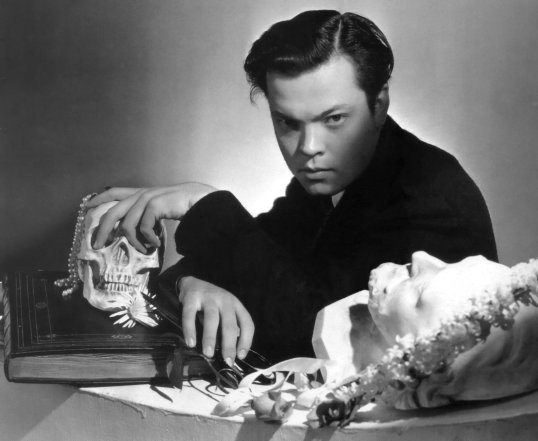
Orson Welles scared the pants off American radio listeners with his Oct. 30, 1938 “Mercury Theatre on the Air” broadcast of H.G. Wells’ WAR OF THE WORLDS. Signed to an unprecedented contract by RKO, Welles’ first feature was of course CITIZEN KANE (1941), now considered by many the greatest film ever made. The film didn’t light…
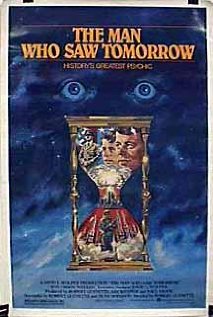
If you have ever wanted to witness the sad fate that awaits most geniuses who challenge the system, you could not do any worse than to watch The Man Who Saw Tomorrow.
The Man Who Saw Tomorrow is a low-budget “documentary” about Nostradamus, the 16th century French alchemist who some people consider to be a prophet and others consider to be a charlatan. Nostradamus has been credited with predicting everything from the rise of Napoleon and Hitler to the 9-11 terror attacks. Others argue that the writings of Nostradamus were so obscure and prone to mistranslation that they could be interpreted in just about any way. While he did write about an evil dictator that he called “Hister,” he was also widely credited with predicting an atomic war in 1999.
The Man Who Saw Tomorrow argues that Nostradamus was indeed a prophet and it makes its case through cheap historical reenactments and a lot of stock footage. The Zapruder film is used. So is footage from A Tale of Two Cities, War and Peace, Earthquake, and Waterloo (Be sure to keep an eye out for Rod Steiger). Some of the predictions, like Edward Kennedy becoming President and World War III starting in 1986, are easy to laugh at. Others, like conflict in the Middle East leading to a nuclear war, would be frighteningly credible if the film wasn’t so obviously made on the cheap. No skepticism of Nostradamus is implicitly acknowledged but there are interviews with a few believers, including psychic Jeane Dixon (whose first name the film misspells).
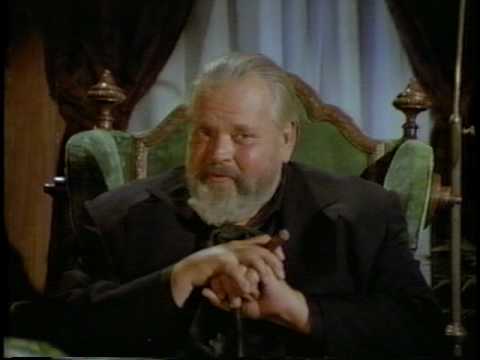
And narrating it all is none other than one of the most important filmmakers of all time, Orson Welles. Sitting at a desk in front of a bookcase and occasionally puffing on a cigar, the director of Citizen Kane lends his deep and recognizable voice to the film’s narration but also adds just a touch of sarcasm to his tone. The movie may believe that Nostradamus saw the future but Welles is going to damn well make sure that everyone understands that he does not. When Welles talks about Nostradamus’s predictions for the future, he says, “But before continuing, let me warn you now that these predictions of the future are not at all comforting – and I might go on to add that these visions of the past, these warnings of the future, are not the opinions of the producers of this film. They’re certainly not my opinions.” He really emphasizes that last sentence, as if he had already grown weary of people approaching him in the streets and asking him if he thought Nostradamus had predicted Watergate.
Sadly, Welles spent a good deal of his career doing jobs like this. The films and the roles were often beneath his talent but they provided Welles with the money that he needed to pursue his own projects, many of which were never to be completed. At the time he did The Man Who Saw Tomorrow, Welles was trying to raise the money to complete post production on his final film, The Other Side of The Wind. The Other Side of The Wind would remain unfinished at the time of Welles’s death but it now appears that, 41 years after principal photography was completed, the film may finally see the light of day thanks to Netflix.
As for The Man Who Saw Tomorrow, it seems only fair to give Orson Welles the final word. When asked about the film and Nostradamus on The Merv Griffin Show, Welles replied, “”One might as well make predictions based on random passages from the phone book.”
4 Shots From 4 Films is just what it says it is, 4 shots from 4 of our favorite films. As opposed to the reviews and recaps that we usually post, 4 Shots From 4 Films is all about letting the visuals do the talking.
Today is the 100th birthday of the great filmmaker and showman Orson Welles! And what better way to celebrate than listening to the famous 1938 radio broadcast of War of the Worlds? Reportedly, this caused mass panic when it was originally aired as people tuned in late and were convinced that the Earth actually had been invaded by Martians!
(Like Martians would want this dump! Seriously….)
Enjoy and join us all in wishing Orson Welles a happy 100th!
I have to admit that I’m always a little bit cynical whenever I hear various film fans bemoaning films that were never made. These are the films that were nearly made but ended up being abandoned because the production company ran out of money or maybe a lead actor died or maybe the studio refused to release it or else they released it in a heavily edited form. There’s a certain tendency among hipsters to decide that any movie that they will never be able to see would automatically have been the greatest film ever. It’s rare that anyone ever suggests that maybe it’s for the best that Stanley Kubrick never made his version of Napoleon or that maybe Ridley Scott’s version of I Am Legend would have been just as bad as the version that starred Will Smith or even that the footage that we have of Orson Welles’s unfinished The Other Side of The Wind doesn’t look that impressive.
In fact, some day, I want to see a documentary about an abandoned film where everyone says, “Oh my God, I’m glad that movie never got made. It would have sucked!”
However, that documentary is never going to be made. The great thing about praising a film that was never made was that you don’t have to worry about anyone watching the film and then going, “You have no idea what you’re talking about!”
For instance, I recently watched an excellent documentary called Jodorowsky’s Dune. This film tells the story of how the iconoclastic director Alejandro Jodorowsky attempted to make a film out of the science fiction novel Dune in the mid-70s. During the documentary, Jodorowsky explains that his version of the story would, in many ways, be different from the book. Since I’ve never read the book nor have I seen any of the various adaptations that actually were eventually produced, I can’t say whether Jodorowsky’s changes would have been an improvement. For that matter, I can’t say whether or not Jodorowsky’s film would have been great or if it would have been a legendary misfire. I’ve seen El Topo and The Holy Mountain so I’m pretty sure that his version of Dune would have been uniquely his own. But there’s no way for me — or anyone else for that matter — to say whether or not the film would have been any good because, after assembling an intriguing cast (Orson Welles, Mick Jagger, Salvador Dali, and David Carradine) and recruiting several talented artists and technicians (H.R. Giger, Dan O’Bannon, Chris Foss, and Moebius), Jodorowsky was never able to make his film. The Hollywood studios took one look at Jodorowsky’s vision and said, “There’s no way were paying for that.”
However, the documentary goes on to make a very intriguing argument that Jodorowsky’s Dune may be the most influential film never made. Many of the people who collaborated with Jodorowsky would go on to work on other science fiction films and, when they did, they brought with them many of the ideas and concepts that were originally developed for Dune. The documentary not only suggests that this might be true but also offers up some pretty compelling evidence, showing us how everything from Raiders of the Lost Ark to Prometheus has featured scenes that originally appeared in Jodorowsky’s Dune storyboards.
I may not be totally convinced that Jodorowsky’s Dune would have been the greatest film ever made but I love this documentary. The majority of it is spent just listening as Jodorowsky, alternating between English and Spanish, tells us the story of what he hoped to do with Dune and how, ultimately, he could not do it. Jordorowsky’s love of film and art is obvious with each word that he says. Whether he’s talking about meeting Salvador Dali or passionately advocating for creativity and imagination, Alejandro Jodorowsky is never less than charming and inspiring.
If you love movies, you’ll love Jodorowsky’s Dune. If you don’t love movies, Jodorowsky’s Dune will change your mind.
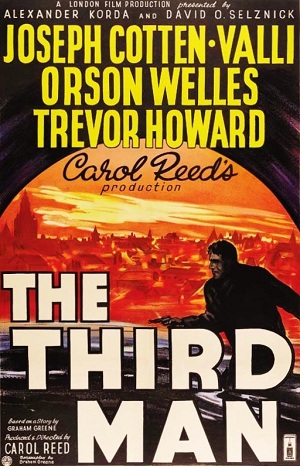
Some movies are merely good. Some movies are undeniably great. And then, a handful movies are so amazingly brilliant that, every time you watch, you’re reminded why you fell in love with cinema in the first place.
The Third Man is one of those brilliant films.
Directed by Carol Reed and scripted by novelist Graham Greene, The Third Man takes place in the years immediately following the end of World War II. Pulp novelist Holly Martins (Joseph Cotten) comes to Vienna to search for his old friend Harry Lime (Orson Welles). Upon arriving, Holly is shocked to learn that Harry makes his living selling diluted penicillin on the black market.
In the classic scene below, Harry and Holly have a clandestine meeting in a Ferris wheel and Harry justifies both his actions and the lives that have been lost as a result of them.
While Orson Welles’ performance is (rightfully) celebrated, I’ve always felt that Joseph Cotten’s work was even more important to the film’s success. While Welles made Harry Lime into a charismatic and compelling villain, it was Cotten who provided the film with a heart.
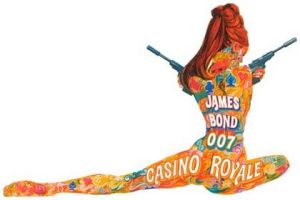
As you probably already know, we here at the Shattered Lens have been counting down the days until the American release of Skyfall by reviewing every single film in the James Bond franchise. Today, we take a look at the first non-EON Bond film, the epic, psychedelic 1967 spoof Casino Royale.
Where to begin?
When Ian Fleming’s first James Bond novel, Casino Royale, was published in 1953, veteran Hollywood producer Charles K. Feldman bought the film rights. However, Feldman didn’t buy the rights to Fleming’s subsequent novels and was forced to sit by and watch as Albert Broccoli and Harry Saltzman had unexpected success with Dr. No and the subsequent EON-produced Bond films. Much as Kevin McClory did with Thunderball, Feldman first attempted to co-produce a serious adaptation of Casino Royale with Broccoli and Saltzman. However, when Feldman, Broccoli, and Saltzman couldn’t come to an agreement on how each side would be compensated in the proposed production deal, Feldman decided to make Casino Royale on his own. He also decided that, instead of trying to compete with EON by making a “straight” James Bond film, his version of Casino Royale would be a satirical extravaganza.
Feldman’s vision of James Bond is apparent from Casino Royale’s opening credits. While the credits are definitely based on the iconic openings of the EON Bond films, they’re also designed to play up the fact that Casino Royale — in the grand tradition of the Hollywood studios at their most excessive — is meant to be a big budget, all-star extravaganza.
Casino Royale actually starts out with a pretty clever premise. It seems that the name “James Bond,” is simply a code name that has been assigned to several British spies over the years. As M (played by John Huston, who also directed the first third of the film), explains it, the name “James Bond” strikes such fear in the hearts of Britain’s enemies that the name must be kept alive.
(Speaking for myself, this is an idea that I kinda wish that the official James Bond series would adopt. If nothing else, it would certainly explain how Pierce Brosnan and Daniel Craig could possibly be the same person.)
The original James Bond (played by David Niven) has long since retired to his stately country estate, where he spends his time playing the piano and complaining about how the agents who have inherited his name are sullying his reputation with excessive womanizing and violence. It turns out the Sir James Bond is a man renowned for his “celibate image.” At the start of the film, Bond is asked to come out of retirement by not only M but the heads of the CIA, KGB, and French secret service as well. SMERSH, an organization of female assassins that’s led by the mysterious Dr. Noah, has been eliminating agents worldwide and only the original (and very chaste) Bond can defeat them. Bond, however, refuses and M responds by ordering a mortar attack on Bond’s estate. The estate is blown up but so is M and Bond soon finds himself returning to London as the new head of MI6.
Interestingly enough, David Niven was one of the actors who was considered for the role of James Bond in Dr. No. Reportedly, Ian Fleming was quite enthusiastic for Niven to take the role but, by the time that Dr. No went into production, Niven was considered to be too old. There’s a nice bit of irony here in seeing David Niven playing a retired James Bond who spends a good deal of the film complaining about the men who have subsequently assumed his name.
Once Niven takes over MI6, he orders that, in order to confuse SMERSH, all British agents (including female agents) will be known as James Bond. The rest of the film is divided into episodes that feature these new James Bonds battling SMERSH and the mysterious Dr. Noah.
Among these agents, there’s the handsome Coop (played by Terrence Cooper) who has been trained to resist all sexual temptations.
There’s Mata Bond (Joanna Pettet), the daughter of Sir James Bond and Mata Hari.
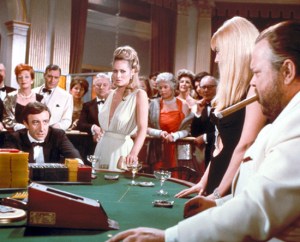
There’s Vesper Lynd (Ursula Andress) who is sent to seduce and recruit the expert gambler Evelyn Tremble (Peter Sellers) so that Tremble can beat SMERSH agent Le Chiffre (Orson Welles) at the Casino Royale.
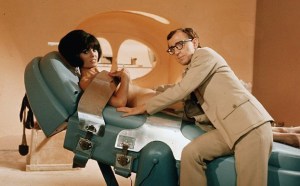
Best of all, there’s Sir James Bond’s nephew, Jimmy Bond. Jimmy Bond is played by Woody Allen and … well, let’s just take a look at Jimmy’s first scene in the film:
Casino Royale had a notoriously troubled production history and most of those troubles seemed to center on Peter Sellers. While the film was designed to be a broad, slapstick comedy, Sellers reportedly insisted on trying to play his role straight and even rewrote his lines to make his scenes more dramatic. Welles eventually grew so disgusted with Sellers that he refused to be in the same room with him. This caused quite a bit of difficulty since Sellers was in almost every scene that featured Welles. Eventually, Sellers walked off the film and the film had to be hastily (and awkwardly) rewritten to account for his sudden absence.
When one watches Casino Royale today, it’s hard to escape the conclusion that Sellers was essentially correct. While most of Casino Royale often feels disjointed and incoherent, the scenes featuring Sellers, Andress, and Welles are some of the strongest in the film. Sellers’ dramatic approach doesn’t negate the film’s comedy. If anything, it makes the comedy even stronger because Sellers actually seems to be invested in the reality his character, regardless of how ludicrous a situation that character may find himself in.
When I watched Casino Royale, I was struck by the stark contrast between the parts of the film that worked and the parts that didn’t. This is a movie that truly swings from one extreme to another. Either the film’s satire is working brilliantly (mostly in the scenes featuring Woody Allen and Peter Sellers) or it’s falling completely flat (like in an extended sequence that features Deborah Kerr as a SMERSH assassin).
I found myself laughing more at the little scenes than the big set pieces. For instance, I loved it when David Niven embraces Miss Moneypenny (Barbara Bouchet) just to be then told that she’s actually the daughter of the original Miss Moneypenny. I don’t know much about the actor Terrence Cooper (though, according to Wikipedia, he was also a contender to take the role of James Bond in the official series) but I enjoyed the brief sequence where Moneypenny “tests” him to see if he can take on the Bond identity. Unfortunately, the film doesn’t really have enough of these small, clever moments.
Ultimately, I found that Casino Royale works best when viewed as a time capsule. Casino Royale was made at a time when the established major Hollywood studios (and veteran producers like Charles K. Feldman) were struggling to remain relevant. Foreign films (including, it must be said, the James Bond films) were challenging the common assumptions of what could and what couldn’t be shown on-screen and the studio system reacted by trying to make films that would appeal to younger audiences while also reassuring older audiences that the movies hadn’t really changed that much. The end result were films like Casino Royale that featured the occasional psychedelic sequence along with cameos from old (and safe) Hollywood stars like George Raft, William Holden, and Charles Boyer. Casino Royale is the type of self-indulgent film that could only have been made in 1967 and, as such, it’s a valuable time capsule for all of us cinematic historians.
I also have to admit that, as excessive as Casino Royale may be, I happen to love excess. Casino Royale might be overlong and occasionally incoherent but the costumes are simply to die for. The film is a visual feast, if nothing else.
Casino Royale was released to scathing reviews and terrible box office but, in the years since, it has become something of a cult favorite. Our own Trash Film Guru has identified Casino Royale as his favorite Bond film. Myself, I found the film to be extremely flawed and yet oddly fascinating to watch. Casino Royale is a total mess and that is both its greatest flaw and greatest strength.
Tomorrow, we’ll return to the official James Bond series by taking a look at You Only Live Twice.
Okay, yes, it is May Day and apparently, that’s a big deal to a certain class of political activist. But, let’s be honest — political causes are forgotten from decade to decade. However, a great film lives forever.
And, for me, today is all about one of the greatest films ever made.
71 years ago today, on May 1st, 1941, Orson Welles’s masterpiece Citizen Kane was first released to a movie-going public that wasn’t quite ready for it. And that was their loss because Citizen Kane has proven itself to be one of those rare films that remains just as entertaining and fascinating the 100th time you watch it as it was the first time.
One of my fondest memories is of the first time I saw Citizen Kane in film class. As I sat there listening to our professor drone on about the historical importance of what we were about to see, I was fully prepared to watch Citizen Kane and dismiss it — as I had so many other critically beloved films — as just being another overrated, academically-embraced movie.
“After all,” I thought as the movie started, “I already know Rosebud is a sled* and I haven’t even seen the freaking film. What’s the point?”
And as the film played out in the darkened auditorium, I soon discovered exactly what the point was. The point was that Citizen Kane is one of the greatest and most watchable films ever made. It’s that rare “important” film that’s actually fun to watch. It didn’t matter that I already knew what Rosebud was. In fact, I didn’t even think about it. I was too busy enjoying Joseph Cotten’s sly turn as Jedadiah Leland and the sleazy, pragmatic villainy of Ray Collins as “Boss” Jim Gettys. I was too busy cringing in a combination of sympathy and embarrassment as poor Susan Kane (Dorothy Comingore) made her disastrous operatic debut. I sat there and I was transfixed by a flawless cast that brought a vibrant life to even the smallest of roles. (My personal favorite was Paul Stewart’s wonderfully cynical performance as Raymond the Butler.) But most of all, I sat there in awe of the talent of Orson Welles. At that time, I knew little about Welles’ subsequent career troubles. I just knew that I was watching a masterpiece.
I wish I could write more (because there’s so much more to say about this film) but now’s my time to curl up on the couch in front of the TV and watch one of the greatest films ever made…
—
* And don’t you even think of going, “How about a spoiler warning!?” about that whole Rosebud comment. Seriously, if you didn’t already know that Rosebud was a sled then I have nothing to say to you.
Yesterday, I posted a tracking shot from Jean-Luc Godard’s Weekend. Today, I want to offer up another great tracking shot, this one from a much better director and a much better movie: Orson Welles’ Touch of Evil. This 3 and a half-minute, unedited tracking shot begins in the United States and ends in Mexico. It also starts off one of the greatest films of all time.
Hi there. Lisa Marie here. I know that usually when I show up on this site, it’s too either toss up 6 more exploitation trailers or to present a review of a film that’s been unfairly dismissed (or foolishly overpraised) by the mainstream media. It’s what I love doing and I hope everyone gets at least a little occasional pleasure out of it. (If you don’t — well, please don’t tell me. I’m surprisingly sensitive.)
Last week, I expected that, at this time, I would have posted a review (probably negative) of the mainstream’s latest attempt to make an art film — David Fincher’s The Social Network.
Unfortunately, life in general — and my body in specific — had other plans. I’ve been sick since Wednesday and, for the first time in over a year, I did not spend my weekend at the movies. It’s enough to make a girl cry.
(That said, I did spend most of the weekend lounging about in various states of undress so maybe concentrating on that image will help to lessen the sting of no Social Network review…)
However, while I may not be able to give you my Social Network review, I do feel that I can give you my Social Network pre-viewing review.
Just based on the evidence presented to me so far, the Social Network sucks.
Consider the evidence:
1) Peter Travers of Rolling Stone says that the Social Network will make me “believe in film again.” Excuse me? Francios Truffaut coming back from the dead — or at least Jean-Luc Godard making one more vaguely entertaining movie before dying– will make me believe in film again. I refuse to join a religion based on a movie about fucking Facebook. Sorry, Mr. Travers.
2) Andrew O’Heir at Salon.com has compared The Social Network to — wait for it — Citizen Kane. Hopefully, when the zombie apocalypse comes, Zombie Orson Welles will eat Andrew O’Heir first.
3) According to Rotten Tomatoes — the web’s greatest resource of Mainstream Opinion — The Social Network is the best-reviewed film of 2010 so far. For a film to be that loved, it must be really needy. And what do needy things do? They manipulate, they lie, and they go out of their way to beg you to like them. A great film doesn’t give a fuck what you think.
4) The movie stars Jesse Eisenberg who has already been in 3 great movies — The Squid and the Whale, Adventureland, and Zombieland. Sorry, Jesse but only Giovanni Lombardo Radice is allowed to appear in four great films in just four years.
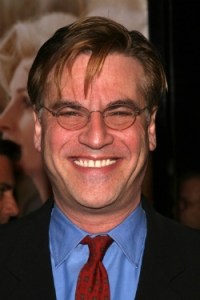
5) The movie is written by Aaron Sorkin. This movie is being advertised as the “defining” movie as my generation. Sorry, but the defining movie of my generation isn’t going to be written by some smug, 50 year-old, male, sexist, crackhead.
6) The movie is directed by David Fincher which normally would be a good sign except all the reviews are concentrating on Aaron Sorkin. So, is our Mr. Fincher so needy for an Oscar that he’s basically abandoned his own vision in the service of some smug, 50 year-old, male, sexist, crackhead?
7) Apparently, this movie celebrates rich kids getting richer. Just what America needs right now. Yes, let’s celebrate the dumbfug toadsuckers of the world while the guy flipping your burger over at McDonald’s loses his health insurance.
8 ) The Social Network is apparently number one at the box office after this weekend and apparently has gotten great word of mouth. You know who else got great word of mouth at one time? Adolf Hitler, that’s who. Up until it was no longer socially acceptable, the mainstream loved him too.
9) The Social Network has a really crappy, first draft title. Seriously, that’s the name of the movie?
10) Sasha Stone, over at Awardsdaily.com, loves this fucking movie and to me, that’s reason enough to assume it’s going to be an overrated piece of foolishness. Seriously, Awardsdaily.com is a great site if you want to keep up with all the Oscar buzz but — when it comes to reviews — Sasha Stone, Ryan Adams, and the rest of the site are all so middle class and predictable. (Of course, what do you expect from a site that regularly quotes William Goldman?)
So, that’s my pre-viewing review of The Social Network. Hopefully, I’ll see it next weekend and be able to post an actual review. Then we’ll be able to see if the film simply conformed to my own biases or if it truly is worthy of all the hype.
Until then, I’d love to hear your thoughts on The Social Network and the growing chorus of mainstreamers who insist that this is the greatest film of all time. Am I being too hard on it or is this yet another example of the mainstream emperor wearing no clothes?

 If you have ever wanted to witness the sad fate that awaits most geniuses who challenge the system, you could not do any worse than to watch The Man Who Saw Tomorrow.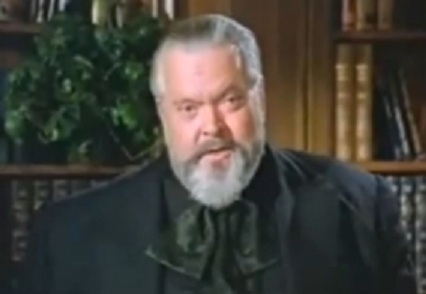



 Through the Shattered Lens