Elliot (Brendan Fraser) has a go-nowhere job at a computer company and an unrequited crush on Alison (Frances O’Connor), a co-worker who doesn’t even know who he is. One night, at a bar afterwork, he’s approached by the Devil (Elizabeth Hurley), who offers Elliot seven wishes in return for his soul. Elliot agrees but then he discovers that the Devil is tricky and his wishes always have an complication. Elliot wants to be powerful so the Devil turns him into a Columbian drug lord. Elliot wants to be sensitive and the Devil turns him into a whiny crybaby. Elliot wants to be president and suddenly, he’s Abraham Lincoln being told to get ready for the theater. Whenever things start to get too dangerous, the Devil brings Elliot back to reality so that she can continue to taunt him.
An Americanized remake of a British comedy that starred Dudley Moore and Peter Cook, Bedazzled was unfairly savaged by the critics when it was first released. While it can’t match the wit and heart of the original and not all of the wishes are equally effective, the remake has its charms. When Bedazzled first came out, most people talked about Elizabeth Hurley’s sexy performance of the Devil. When she appears as a school teacher, it’s not a surprise that every student brings her an apple at the start of the day. Hurley is so sexy that it’s easy to miss that she’s also giving a really good performance. Hurley’s Devil is a prankster. She likes to steal souls but mostly, she’s just having fun ruining all of Fraser’s wishes. Brendan Fraser is likable as Elliot and the way he responds to each wish gives him a chance to show off his comedic skills. Finally, the movie has a good ending, with Elliot growing up and realizing the truth about his crush on Alison.
Bedazzled may not be up to the level of some of director Harold Ramis’s otherfilms but it’s still better than its reputation.
With the season already underway, football players are going on strike! They want better contracts. They want more money. They want …. well, they want a lot of stuff. Meanwhile, the fans just want to know who is going to make the playoffs. There are only four games left in the season and the Washington Sentinels need to win three of them to make it into the playoffs. The owner of the team (Jack Warden) recruits burned-out coach McGinty (Gene Hackman) to take over a team that will be made up of replacement players. McGinty says that he wants to pick his own players and he doesn’t want any interference from the team’s owner. Anyone want to guess how long that’s going to last?
McGinty’s team is made up of the usual collection of quirky misfits who show up in movies like this. Tight End Brian Murphy (David Denman, who later played Roy on The Office) is deaf. One of the offensive linemen is a former SUMO wrestler. Orlando Jones plays a receiver who has a day job at a grocery store. The kicker (Rhys Ifan) is a Welsh soccer player. (Okay, a footballer, I don’t care, call it whatever you want.) Jon Favreau plays a berserk defender who is a member of the police force. Leading them on the field is Shane Falco (Keanu Reeves), a quarterback with a confidence problem. Cheering for them from the sidelines and falling in love with Shane is bar owner-turned-head-cheerleader Annabelle (Brooke Langton). Backing up Annabelle is a cheer squad made up of former strippers, the better to distract the other teams.
It’s not often you see a film where the heroes cross a picket line but that’s what happens with The Replacements. Then again, it’s not like the folks on strike are driving trucks or unloading freight for a living. They’re multi-millionaires who want even more money and don’t even care about whether the team wins or loses. When the replacement players actually start to win games and become beloved in the city, the striking players react by starting a bar brawl. In the end, striking quarterback Eddie Martell (Brett Cullen) doesn’t even stick with his principles. He crosses the picket line and creates a quarterback controversy, just in time for the last game of the season.
The Replacements is thoroughly predictable but also very likable. The cast gels nicely, with Hackman especially standing out as the gruff but caring coach. Keanu Reeves is not totally believable as a quarterback with a confidence problem. You take one look at Reeves and you don’t believe he’s had an insecure day in his life. But, as an actor, he’s so likable that it doesn’t matter. The same goes for the entire cast, whether they’re on the playing field or singing I Will Survive in jail. I don’t particularly care much about football but I did enjoy The Replacements.
Femi Jackson (Brandon Victor Dixon) is a recovering alcoholic with a pregnant wife and a past-due mortgage who totally and completely believes in a presidential candidate named Harold Roundtree (Orlando Jones). A former baker-turned-politician, Roundtree is running for the 2024 Democratic presidential nomination on a platform of small government and personal responsibility. That really doesn’t sound like a platform for success in a Democratic primary but whatever. Let’s just go with it.
Femi has been hired as financial director for a SuperPAC that is raising money for the Roundtree campaign. Femi notices that many of the donations are being submitted in numbers that add up to 88. When he takes this news to his friend Ira Goldstein (Thomas Sadoski), Ira reveals that 88 is a code that Neo-Nazis use to identify each other. Femi and Ira do more digging and they discover that, throughout his entire life, Roundtree has been receiving financial aide from various rich men, all of whom sent Roundtree’s sums of money that all add up to 88. Femi questions why Neo-Nazis would do something that makes it so easy to identify them. Ira replies that they’re marking their territory.
While Howard Roundtree records an interview with a left-wing commentator (William Fichtner), Femi tracks down and meets with an elderly and repentant Neo-Nazi (Jonathan Weir), who now needs an oxygen tank to breathe and who lives in an isolated house with his black wife. Femi is later approached by a volunteer in the SuperPAC’s office, who informs him that the only way that White Supremacy can survive is by latching onto a black politician like Harold Roundtree. Femi and Ira prepare to meet with Rountree, with Femi still convinced that he has no idea who is secretly funding his campaign.
While this is going on, Femi’s wife (Naturi Naughton) tries to help an ex-con achieve a bank loan despite the opposition of her sister (who also works for the bank) while Femi’s son, Ola (Jeremiah King), gets in trouble at school for showing his classmates a video of a school shooting. It turns out that Femi’s brother-in-law is not only a cop but he’s also white and he agrees to drive Ola to school so that Ola can see that not all cops are bad. Ola’s obvious fear as he walks out to the squad car indicates that the experiment, no matter how well-intentioned, is probably not going to work.
88 is certainly an ambitious film and the opening minutes, which features Femi’s wife explaining why Black Panther is not the empowering and progressive film that Femi believes it to be, suggest that the film has the potential to be interesting. And throughout the film, there are little moments that do work, like the scene where Femi tells his son how to react if he’s ever pulled over by a cop. Unfortunately, the majority of the film is a clumsily-acted and talky mix of melodrama and heavy-messaging, one that tries to duplicate the style of Spike Lee’s agitprop but instead ends up feeling more like a secular and politically progressive version of the God’s Not Dead films than anything else. The film drags on for 2 full hours with Brandon Victor Dixon’s nerdy blandness failing to provide the narrative momentum to keep the action interesting. As well, Orlando Jones is perhaps the least convincing presidential front runner that I’ve ever seen in a film, speaking a cadences that appear to be specifically patterned on Barack Obama but suggesting none of the charisma that would be necessary to captivate a nation. Again, the film deserves some praise for having the ambition to actually be about something more than just selling toys and comic books but, in the end, it’s earnest dullness and heavy-handed messaging fails to hold one’s attention.
Though the Academy of Motion Picture Arts and Sciences claim that the Oscars honor the best of the year, we all know that there are always worthy films and performances that end up getting overlooked. Sometimes, it’s because the competition too fierce. Sometimes, it’s because the film itself was too controversial. Often, it’s just a case of a film’s quality not being fully recognized until years after its initial released. This series of reviews takes a look at the films and performances that should have been nominated but were, for whatever reason, overlooked. These are the Unnominated.
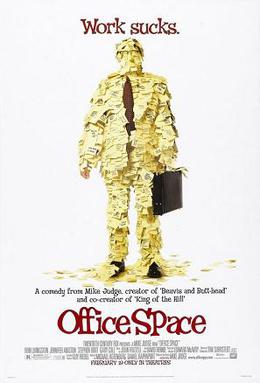
The other night, Erin and I started a new Labor Day weekend tradition of watching the 1999 comedy, Office Space.
As we watched Mike Judge’s first live-action film, it occurred to me that Office Space is a film that unites all of my friends. It doesn’t matter whether they work in an office like Peter (Ron Livingston), Samir (Ajay Naidu), or Michael Bolton (David Herman) or if they work in a restaurant like Joanna (Jennifer Aniston) or even if they’re an independent contractor like Peter’s loud neighbor, Lawrence (Diedrich Bader). It doesn’t matter if they would rather be fishing like Peter or watching reruns of Kung Fu like Joanna. Everyone that I know has said that they can relate to Office Space. Everyone has had to deal with a passive-aggressive jerk of a boss like Bill Lumbergh (Gary Cole). Everyone has known a crazy co-worker like the red stapler-obsessed Milton (Stephen Root). Everyone dreads the arrival of consultants like the Bobs (John C. McGinely and Paul Willson). Everyone resents being told that doing the bare minimum is not enough, whether it’s just sitting in your cubicle or wearing 15 pieces of flair. Everyone dreams of sleeping late and not stressing about TPS reports. Everyone dreams of screwing over their company in a way that’s so clever that they’ll never be caught. (And I think everyone secretly knows that they would screw it up by putting a decimal point in the wrong place.) Everyone wants to destroy the oldest and least reliable piece of equipment at work. Everyone wants to feel like they can just announce that they’re going to quit and spend the rest of their life doing what they would do if they had a million dollars.
Considering the fact that the film has now become universally beloved, it’s interesting that Office Space opened to mixed reviews and middling box office. The studio wasn’t sure how to sell a live action film from the director of Beavis and Butt-Head and King of the Hill and many critics focused on the film’s rather loosely-constructed, episodic narrative and overlooked the fact that the film captured all of the small details that drive people crazy about their work. Audiences, though, discovered the film on video and undoubtedly enjoyed watching it after a long day of dealing with their own annoying boss. The film’s star, Ron Livingston, has said that many people have approached him and told him that he inspired them quit their jobs. “That’s kind of a heavy-load to carry.”
For a film that centers around office workers updating data so that computer systems don’t cash in 2000, Office Space has aged remarkably well. Ron Livingston, David Herman, and Ajay Naidu are an instantly sympathetic and likable trio of nerdy heroes. Stephen Root’s panic as he realizes that he will be the only employee not to get a piece of cake remains both poignant and funny. Gary Cole is still the boss from Hell. I still laugh at John C. McGinley’s rage when his praise of Peter as a “straight-shooter with upper management potential” is dismissed by Peter’s boss. We can all relate to Jennifer Aniston’s dislike of flair and her hatred for Brian (Todd Duffey). The jump to conclusion mat would probably be even more popular today than back in 1999.
Of course, Office Space was not nominated for any Oscars. That’s not really a shock. It’s an episodic comedy that was directed by a Texas filmmaker who was, at the time, best-known for a cartoon about two brain-dead teenagers. Obviously, it wasn’t going to be nominated for anything, even though I think more people have probably watched Office Space over the past few days than have watched American Beauty. Oscars aren’t everything, though. Office Space remains both a great work film and a great Texas film.
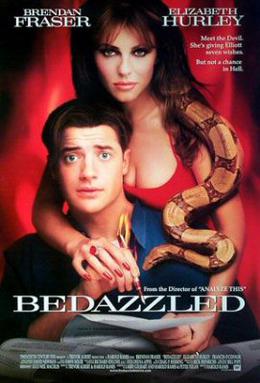 Elliot (Brendan Fraser) has a go-nowhere job at a computer company and an unrequited crush on Alison (Frances O’Connor), a co-worker who doesn’t even know who he is. One night, at a bar afterwork, he’s approached by the Devil (Elizabeth Hurley), who offers Elliot seven wishes in return for his soul. Elliot agrees but then he discovers that the Devil is tricky and his wishes always have an complication. Elliot wants to be powerful so the Devil turns him into a Columbian drug lord. Elliot wants to be sensitive and the Devil turns him into a whiny crybaby. Elliot wants to be president and suddenly, he’s Abraham Lincoln being told to get ready for the theater. Whenever things start to get too dangerous, the Devil brings Elliot back to reality so that she can continue to taunt him.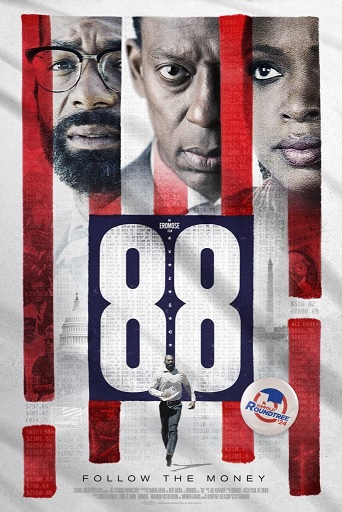
 Through the Shattered Lens