October Hacks: Silent Night, Bloody Night (dir by Theodore Gershuny)


Filmed in 1972 and subsequently released in 1974, Silent Night Bloody Night is a real treat, an atmospheric thriller that has a wonderfully complicated plot that will keep you guessing.

Silent Night Bloody Night opens with attorney John Carter (Patrick O’Neal) arriving in a small town on Christmas Eve.  He’s traveling with his assistant and mistress, Ingrid (Astrid Heeren).  He’s been hired by Jeff Butler (James Patterson) to oversee the sell of his grandfather’s home.  When Carter arrives, he finds that the town is run by a group of elderly eccentrics, including the mute Charlie Towman (John Carradine).  Charlie communicates by ringing a bell and he’s the editor of the town newspaper.  Carter convinces the town council to buy the Butler mansion.  Then, Carter and Ingrid go to the mansion, make love, and are promptly brutally hacked to death by an unseen assailant with an axe.  It’s a shocking moment because, up until their death scene, Carter and Ingrid seemed to be our main characters.  Much as with Marion Crane’s shower in Psycho, their murder leaves an absence at the heart of the film.

That night, our new hero, Jeff Butler (James Patterson) comes to the isolated town to check on how the sale is going.  He finds the mansion locked up and no one willing to talk about John Carter.  With the help of local girl Diane (Mary Woronov), Jeff investigates his grandfather’s death and discovers that the town is full of secrets and people who are willing to kill to maintain them.  As we discover through some wonderfully dream-like flashbacks, Jeff’s grandfather died nearly 40 years ago when he was set on fire in his own home.  Those aren’t the only flashbacks to the film.  In an extended sepia-toned flashback, we learn about the previous inhabitants of the house.  They are all played by former Warhol superstars, including Candy Darling, Ondine, Tally Brown, Charlotte Fairchild, Lewis Love, Harvey Cohen, George Trakas, Susan Rothenberg, and Jack Smith.  (Mary Woronov was, herself, a former member of Warhol’s entourage.)

Silent Night Bloody Night has a terrible reputation.  Mary Woronov, who was married to director Theodore Gershuny at the time she made the film, later described it as being “lousy.”  Personally, I think the film’s reputation has more to do with all of the grainy, bad copies of the film that have turned up in various Mill Creek box sets over the years than the quality of the film itself.  (Silent Night Bloody Night is in public domain.)  The film itself is atmospheric, memorably bloody, and — for those who have the patience to deal with the occasional slow spot — effectively creepy.  Mary Woronov is a likable lead and the Warhol superstars definitely make an impression.  The film plays out at its own deliberate pace and, at its best, it duplicates the feeling of a particularly macabre holiday dream.

Director Theodore Gershuny uses the low budget to his advantage and the sepia-toned flashbacks are truly disturbing and haunting.  Ultimately, Silent Night Bloody Night feels like a dream itself and the mystery’s solution is less important than the journey taken to reach it.
Horror On The Lens: Silent Night, Bloody Night (dir by Theodore Gershuny)


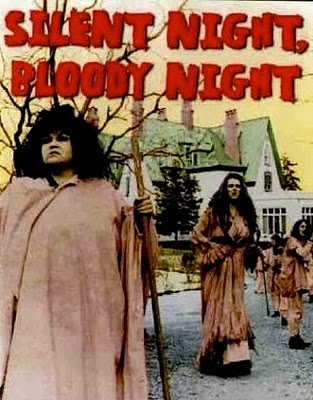
The 1974 film Silent Night, Bloody Night is an oddity.

On the one hand, it’s pretty much a standard slasher film, complete with a menacing mansion, a horrible secret, a twist ending, and John Carradine playing a mute newspaper editor.

On the other hand, director Ted Gershuny directs like he’s making an underground art film and several of the supporting roles are played by actors who were best known for their association with Andy Warhol.

Personally, I like Silent Night, Bloody Night.  It has a terrible reputation and the film’s star, Mary Woronov, has gone on record calling it a “terrible movie” but I like the surreal touches the Gershuny brought to the material and the sepia-toned flashbacks have a nightmarish intensity to them.  The film makes no logical sense, which actually makes it all the more appealing to me.  As the saying goes, your mileage may vary.

Watch and decide for yourself!

Horror On The Lens: Silent Night, Bloody Night (dir by Theodore Gershuny)


The 1974 film Silent Night, Bloody Night is an oddity.

On the one hand, it’s pretty much a standard slasher film, complete with a menacing mansion, a horrible secret, a twist ending, and John Carradine playing a mute newspaper editor.

On the other hand, director Ted Gershuny directs like he’s making an underground art film and several of the supporting roles are played by actors who were best known for their association with Andy Warhol.

Personally, I like Silent Night, Bloody Night.  It has a terrible reputation and the film’s star, Mary Woronov, has gone on record calling it a “terrible movie” but I like the surreal touches the Gershuny brought to the material and the sepia-toned flashbacks have a nightmarish intensity to them.  The film makes no logical sense, which actually makes it all the more appealing to me.  As the saying goes, your mileage may vary.

Watch and decide for yourself!

Horror On The Lens: Silent Night, Bloody Night (dir by Theodore Gershuny)


The 1974 film Silent Night, Bloody Night is an oddity.

On the one hand, it’s pretty much a standard slasher film, complete with a menacing mansion, a horrible secret, a twist ending, and John Carradine playing a mute newspaper editor.

On the other hand, director Ted Gershuny directs like he’s making an underground art film and several of the supporting roles are played by actors who were best known for their association with Andy Warhol.

Personally, I like Silent Night, Bloody Night.  It has a terrible reputation and the film’s star, Mary Woronov, has gone on record calling it a “terrible movie” but I like the surreal touches the Gershuny brought to the material and the sepia-toned flashbacks have a nightmarish intensity to them.  The film makes no logical sense, which actually makes it all the more appealing to me.  As the saying goes, your mileage may vary.

Watch and decide for yourself!

Back To School Part II #2: Vinyl (dir by Andy Warhol)


vinyl1

For my next back to school film, I watched the 1965 underground film, Vinyl!

Now, admittedly, Vinyl does not appear to take place in a high school.  Then again, maybe it does.  All of the action takes place in a cramped corner of a room and we’re never really told, for sure, where the room is located.  All we know is that various characters keep wandering in and out of the static frame while the film’s action unfolds.

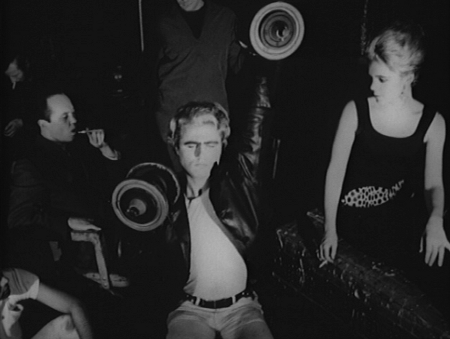
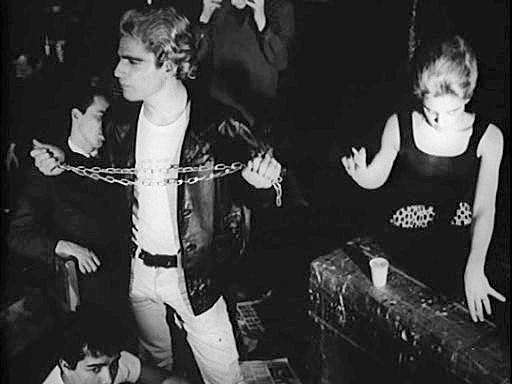
The center of the film is Victor (Gerald Malanga) who appears to be in his late 20s but who insists to us that he’s a “J.D,” which stands for juvenile delinquent.  He does what he wants, whether that means lifting weights or enthusiastically dancing.  Victor may be a murderous teenager with a bad attitude but he truly loves rock music.

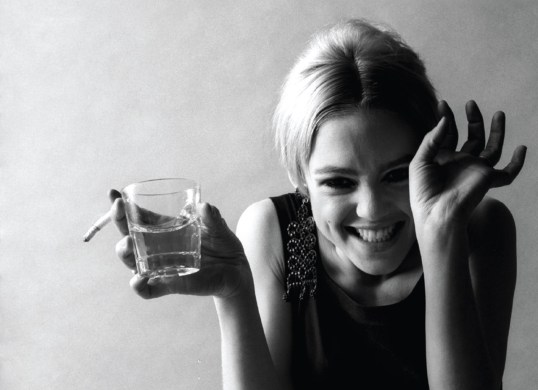
While Victor dances and occasionally stumbles his way through a monologue about being a J.D, there’s an ever-present audience in the background of the scene.  Occasionally, they seem to be interested in what Victor is saying but, just as often, they seem to be bored with the whole thing.  Sitting off to Victor’s right and smoking through nearly the entire film is the iconic and tragic Edie Sedgwick.  Occasionally, she dances but, for the most part, she’s just observes with an enigmatic half-smile on her face.

Eventually, some men who we assume are the police get tired of Victor dancing and boasting about being a delinquent so they grab him, tie him to a chair, and force him to wear bondage gear while they beat him.  It’s a new, government-sanctioned rehabilitation technique and it’s guaranteed to turn Victor is a responsible member of society.  While they torture him, they play vinyl records in the background and Victor, possibly to his horror though, due to Malanga’s out-of-it performance, it’s often difficult to surmise what’s going on in Victor’s head, realizes that his beloved rock music is now being used to torture him.

All the while, Edie watches from the corner of the screen.  She smokes a cigarette.  She dances.  Sometimes, someone will refill her drink.  She holds a candle for a while.  As a viewer who is more than a little obsessed with the tragically short life of Edie Sedgwick and who relates to her on a personal level, it was occasionally difficult for me to watch because, even in a non-speaking role, Edie’s star power was obvious.

Edie!

Edie!

Of course, Edie isn’t the only person watching as Victor is tortured.  Many people wander in and out of the frame.  (Vinyl lasts 70 minutes and features exactly three shots.)  For the most part, the majority of them regard the torture happening in from with a studied detachment.  In fact, they’re very detachment and they’re very refusal to act in any sort of expected way becomes rather fascinating.  Vinyl goes so far out of it’s way to defy our expectations of what a movie should be that it becomes one of the most watchable unwatchable movies ever made.

Vinyl was directed by Andy Warhol.  Reportedly, it was filmed without any rehearsal and without multiple takes.  Hence, when Malanga stumbles over his lines or occasionally turns his back to camera, the moment is preserved.  When Edie Sedgwick breaks character and laughs, the film keeps on rolling.  When another actor accidentally drops his papers and has to spend half a minute picking them up and trying to get them back in order, it’s saved on camera.  And, because it’s in the final cut, Gerald Malanga forgetting his lines becomes as much a cinematic moment as Humphrey Bogart telling Ingrid Bergman to get on that plane or Clark Gable saying that he didn’t give a damn.   There is no editing and, as a result, there is no protection.  Instead, we just get a group of eccentric outsiders in their amateur glory.  Yes, it’s self-indulgent and deliberately alienating but it’s also undeniably fascinating.  (It helps that, while he may not have been a good actor, Gerald Malanga had an absolutely fascinating face.)  When one watches one of Warhol’s underground films, the question always arises as to whether he was a genius or a con artist.  Vinyl would seem to suggest that he was both.

(“What’s the point of all this?” some viewers may ask.  The point is that it was filmed and now you’re watching and, because he’s at the center of a static frame, Gerald Malanga is now a movie star.)

Though you might have a hard time realizing it from just watching the film, Vinyl was also the first cinematic adaptation of Anthony Burgess’s A Clockwork Orange.  Victor was a stand-in for Alex and Alex’s love of Beethoven is replaced by Victor’s love for Motown.  Six years later, Stanley Kubrick would release his better known adaptation of Burgess’s novel but Andy Warhol, Gerald Malange, and Edie Sedgwick all got there first.

ANDY-WARHOL-VINYL-3

10 Unacknowledged Christmas Classics


It’s December and that means that it’s the Christmas season and that can only mean an abundance of Christmas movies both at movie theaters and on television.  This Christmas movie has even become a genre in a way that the Thanksgiving movie or the Bank Holiday movie never has.

I love the Christmas season because 1) it’s one of the few times that there’s half a chance of seeing snow in Texas, 2) it gives me an excuse to bond with family, and 3) I get lots of presents.  And I enjoy Christmas movies so much that I can pretty much quote every line from It’s A Wonderful Life from memory.  I’ve even been known to enjoy the holiday movie marathons that pop up on the Lifetime Movie Network (especially if they feature Jeff Fahey and his bluer than blue eyes).  However, my favorite Christmas movie remains the original Miracle on 34th Street because Natalie Wood was one of my mom’s favorite actresses and Miracle was one of her favorite films.

However, in this post, I want to highlight 10 movies that have either been overlooked in the past or else films that, while properly acknowledged as classics, are rarely mentioned as being Christmas films.

1) In Bruges (2008)  — Two Irish hitman (Colin Farrell and Brendan Gleeson, both wonderful) hide out in Belgium during the Christmas holiday.  I love this film for so many reason but I have to specifically mention the performance of Ralph Fiennes, who plays an English crime boss with a foul mouth, a murderous personality, and a firmly held set of ethics.

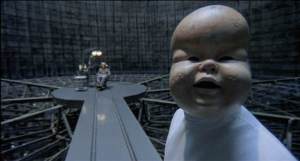
2) Brazil (1985) — One reason why I love Terry Gilliam’s dark satire is because I actually have quite a bit in common with it.  We’re both often misunderstood, we’re both pretty to look at, and we were both released in 1985.  While Brazil is now often acknowledged as one of the best and most imaginative films of the last century, it’s often forgotten that all of this film’s action takes place over the Christmas season.  If you’ve never seen Brazil, see it now.  But be aware that you’ll never look at Michael Palin quite the same way again.

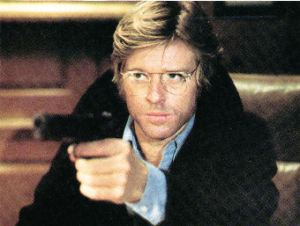
3) Three Days of The Condor (1975) — This espionage thriller (which stars a young, pre-Leatherface Robert Redford) skillfully contrasts cold-blooded violence with the bright outer happiness of the Christmas season.

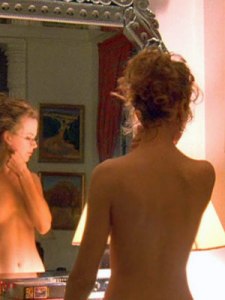
4) Eyes Wide Shut (2000) — Stanley Kubrick’s final film is a tribute to MK-Ultra conspiracy theories and features rich people trying to be kinky during the Christmas season.  Nicole Kidman does redheads proud with her performance here and we get to see Tom Cruise smoke pot.

5) P2 (2007) — Rachel Nichols is trapped in a parking garage on Christmas Eve by a very scary Wes Bentley.  I have to admit that I’ve always had a morbid fear of either dying, getting seriously injured, or disappearing on Christmas Eve and therefore ruining the holiday for my family.  I guess that’s why P2 resonated with me.

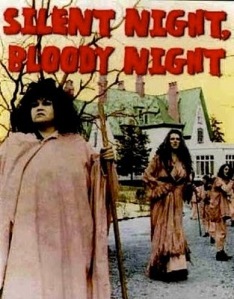
6) Silent Night, Bloody Night (1974) — No, this is not a killer Santa film.  This is the film where a bunch of former Warhol superstars (Ondine and Candy Darling being the most prominent) play a bunch of mental patients who massacre their doctors in a disturbing, sepia-toned sequence.  Years later, on Christmas, another former Warhol superstar — the wonderful Mary Woronov — comes to investigate.  This is actually a fairly good film from director Theodore Gershuny.

7) Christmas Evil (1980) — Now this is a killer Santa film.  Harry is a loser who works in a toy factory but he’s obsessed with Christmas because, when he was a child, he saw mommy humping Santa Claus.  (Isn’t that a song?)  So, one Christmas, Harry dresses up like Santa and goes around killing neglectful parents and others who don’t have the Christmas spirit.  This is an oddly sweet film with an ending that brought very sincere tears to my eyes.

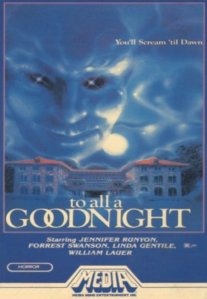
8 ) To All A Good Night (1980) — Okay, this is another killer Santa film and it’s one of those early ’80s slashers where everyone dies because they’re total and complete idiots but two things distinguish this film from other Killer Santa slasher films: 1) it features not one but two psycho Santas and the movie was directed by David Hess, star of Last House On The Left and The House On The Edge of the Park.

9) The Silent Partner (1978) —  However, the greatest of all killer Santas is to be found in this Canadian crime thriller.  Christopher Plummer plays a psycho bank robber who — disguised as Santa — robs a bank.  Elliot Gould plays a lonely bank clerk who uses the robbery as an excuse to steal some cash for himself which leads to Plummer eventually coming after him.  Plummer makes the scariest Saint Nick ever!

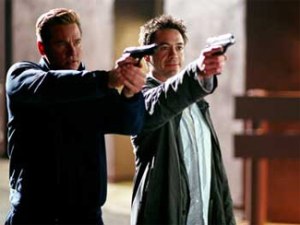
10) Kiss Kiss Bang Bang (2005) — This is pure grindhouse brilliance, a dark comedy and a metafictional satire disguised an action movie.  Robert Downey, Jr. is a small-time criminal who accidentally becomes a film star and ends up investigating a murder with a hard-boiled PI (a surprisingly self-aware performance from Val Kilmer).  And it all takes place during the holidays.