30 Days of Noir #5: The Hoodlum (dir by Max Nosseck)


He’s a bad seed, that Vincent Lubeck!

At the start of the 1951 film, The Hoodlum, Vincent (played by the legendary Lawrence Tierney) is rotting away in prison.  Even though the parole board is considering whether or not to release him, things aren’t looking good for Vincent.  The warden (Gene Roth) has taken it upon himself to attend the parole hearing and remind them of Vincent’s long criminal record.  Vincent’s been in trouble for as long as he’s been alive.  The warden says that allowing Vincent to walk the streets will just make the streets even more unsafe.

However, Vincent’s mother (Lisa Golm) swears that she’ll keep an eye on Vincent.  She will give Vincent a place to live and she’s even arranged for Vincent to get a job at the family gas station, where he’ll be working under his brother, Johnny (played Lawrence’s younger brother, Edward Tienery).  Moved by a mother’s tears, the board grants Vincent parole.

Big mistake.  As soon as Vincent’s out of prison, he starts making plans to return to his old life.  He has no interest in working in a gas station and he resents Johnny’s success.  Vincent is the type of bum that steals his brother’s girlfriend, gets her pregnant, and doesn’t feel the least bit guilty when she jumps off a roof to her death.

Vincent’s also the type who always has a scheme going.  For instance, it turns out that his brother’s gas station is right across the street from both the town mortuary and the bank!  Soon, Vincent is hanging out with his old gang and plotting to rob an armored car.  Vincent’s not going to let anyone stand in his way.  Not the police.  Not his lover.  Not even his own brother.  The only person that Vincent seems to care about is his sickly mother and, even then, Vincent doesn’t actually care enough to stay out of trouble.

The Hoodlum is a low-budget gangster noir.  It’s only an hour long so it doesn’t waste any time.  Instead, it jumps straight into its often sordid story.  From the minute that Vincent gets out of prison, he’s greedily watching that bank and telling off anyone who looks at him funny.  What makes Vincent an especially despicable character is that he’s not even good at what he does.  If Vincent was some sort of criminal mastermind, you could at least get some sort of guilty pleasure out of watching him rob that armored car.  Instead, Vincent’s an idiot who not only messes up everything that he does but who isn’t even smart enough to understand that he’s screwed up.

Fortunately, Vincent is played by Lawrence Tierney.  Tierney was a veteran tough guy, an actor who played killers onscreen and who spent a good deal of his offscreen time sitting in jail.  (Tierney had a bad habit of getting into bar brawls.)  In the role of Vincent, Tierney is a force of pure, uninhibited destructive energy.  When he glares at his brother, you feel the resentment.  When he rushes at a security guard while holding a gun, you never doubt that he’s capable of using it.  Tierney gives such a raw and angry performance that you can’t stop watching him.  Vincent quickly overstays his welcome but Tierney remains a fascinating actor.

The Hoodlum is a short and brutal little movie, one that works best as a showcase for the intimidating talent of Lawrence Tierney.

Lisa Reviews An Oscar Nominee: The Grapes of Wrath (dir by John Ford)


(With the Oscars scheduled to be awarded on March 4th, I have decided to review at least one Oscar-nominated film a day.  These films could be nominees or they could be winners.  They could be from this year’s Oscars or they could be a previous year’s nominee!  We’ll see how things play out.  Today, I take a look at the 1940 best picture nominee, The Grapes of Wrath!)

How dark can one mainstream Hollywood film from 1940 possibly be?

Watch The Grapes of Wrath to find out.

Based on the novel by John Steinbeck and directed by John Ford, The Grapes of Wrath tells the story of the Joad family and their efforts to neither get sent to prison nor starve to death during the Great Depression.  When they lose their farm in Oklahoma, they head for California.  Pa Joad (Russell Simpson) has a flyer that says someone is looking for men and women to work as pickers out west.  The 12 members of the Joad Family load all of their possessions into a dilapidated old truck and they hit the road.  It quickly becomes apparent that they’re not the only family basing all of their hopes on the vague promises offered up by that flyer.  No matter how much Pa may claim different, it’s obvious that California is not going to be the promised land and that not all the members of the family are going to survive the trip.

Tom Joad (Henry Fonda) is the oldest of the Joad sons.  He’s just been released from prison and he’s killed in the past.  Having been in prison during the start of the Great Depression, Tom doesn’t realize how bad things truly are until he arrives home and sees someone he grew up with using a tractor to knock down a house.  (It’s just business, of course.  The owners of the house can’t pay their bills so the house gets destroyed.)  The film’s story is largely told through Tom’s eyes and Henry Fonda gives a sympathetic performance, one the gets the audience to empathize with and relate to a character who is a total outsider.

As for the rest of the Joad Family, Ma (Jane Darwell) is the glue who holds them together and who refuses to allow them to surrender to despair.  (And yet even Ma is forced to make some tough choices when the starving children of one work camp ask her to share her family’s meal with them.)  Rosasharan (Dorris Bowdon) is pregnant while Grandpa (Charley Grapewin) is too sickly for the trip but doesn’t have anywhere else to go.  And then there’s Casy (John Carradine), the former preacher turned labor organizer.  Casy is not blood-related but he soon becomes a member of the family.

The Joads have a healthy distrust of the police and other authority figures and that turns out to be a good thing because there aren’t many good cops to be found between Oklahoma and California.  Instead, the police merely serve to protect the rich from the poor.  Whenever the workers talk about forming a union and demanding more than 5 cents per box for their hard work, the police are there to break heads and arrest any troublemakers on trumped up charges.  Whenever a town decides that they don’t want any “Okies” entering the town and “stealing” jobs, the police are there to block the roads.

The Grapes of Wrath provides a portrait of the rough edges of America, the places and the people who were being ignored in 1940 and who are still too often ignored today.  John Ford may not be the first director that comes to mind when you think of “film noir” but that’s exactly what The Grapes of Wrath feels like.  During the night scenes, desperate faces emerge from the darkness while menacing figures lurk in the shadows.  When the sun does rise, the black-and-white images are so harsh that you almost wish the moon would return.  The same western landscape that Ford celebrated in his westerns emerges as a wasteland in The Grapes of Wrath.  The American frontier is full of distrust, anger, greed, and ultimately starvation.  (Reportedly, the film was often shown in the Soviet Union as a portrait of the failure of America and capitalism.  However, it was discovered that Soviet citizens were amazed that, in America, even a family as poor as the Joads could still afford a car.  The Grapes of Wrath was promptly banned after that.)  John Ford is often thought of as being a sentimental director but there’s little beauty or hope to be found in the images of The Grapes of Wrath.  (Just compare the way The Grapes of Wrath treats poverty to the way Ford portrayed it in How Green Was My Valley.)  Instead, the film’s only hint of optimism comes from the unbreakable familial bond that holds the Joads together.

As dark as it may be, the film is nowhere near as pessimistic as the original novel.  The novel ends with a stillborn baby and a stranger starving to death in a barn.  The film doesn’t go quite that far and, in fact, offers up some deus ex machina in the form of a sympathetic government bureaucrat.  (Apparently, authority figures weren’t bad as long as they worked for the federal government.)  That the book is darker than the movie is not surprising.  John Steinbeck was a socialist while John Ford was a Republican with a weakness for FDR.  That said, even though the film does end on a more hopeful note than the novel, you still never quite buy that things are ever going to get better for anyone in the movie.  You want things to get better but, deep down, you know it’s not going to happen.  Tom says that he’s going to fight for a better world and Fonda’s delivers the line with such passion that you want him to succeed even if you know he probably won’t.  Ma Joad says the people will never be defeated and, again, you briefly believe her even if there’s not much evidence to back her up.

Even when viewed today, The Grapes of Wrath is still a powerful film and I can only guess what it must have been like to see the film in 1940, when the Great Depression was still going on and people like the Joads were still making the journey to California.  Not surprisingly, it was nominated for best picture of 1940, though it lost to Alfred Hitchcock’s Rebecca.

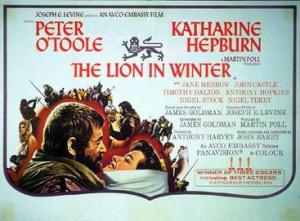
Lisa Reviews An Oscar Nominee: The Lion in Winter (dir by Anthony Harvey)


(With the Oscars scheduled to be awarded on March 4th, I have decided to review at least one Oscar-nominated film a day.  These films could be nominees or they could be winners.  They could be from this year’s Oscars or they could be a previous year’s nominee!  We’ll see how things play out.  Today, I take a look at the 1968 best picture nominee, The Lion in Winter!)

“I don’t much like our children.”

— Eleanor of Aquitaine (Katharine Hepburn)

“Oh God, but I do love being king.”

— King Henry II (Peter O’Toole)

“What family doesn’t have its up and down?”

— Eleanor of Aquitaine

To be honest, it’s tempting to just spend this entire review offering up quotes from this film.  Based on a play by James Goldman and featuring a cast of actors who all specialized in delivering the most snarky of lines with style, The Lion In Winter is a film that is in love with the English language.  As visually impressive as the film and its recreation of the 12th Century is, it’s tempting to close your eyes while watching The Lion In Winter and just listen to the dialogue.

The year is 1183.  England has a king.  His name is Henry II (Peter O’Toole) and he’s held power for a long time, through a combination of willpower and political manipulation.  He’s married to Eleanor of Aquitaine (Katharine Hepburn), though he long since had her imprisoned.  Before marrying Henry, Eleanor was the wife of Louis VII.  Now, Henry’s mistress is Alais (Jane Merrow), the daughter of Louis and his second wife.  In order to get Alais’s dowry, Henry has promised her half-brother, Philip II (Timothy Dalton), that she will be married to the next king of England.  Philip, incidentally, is the son of Louis’s third wife.  To be honest, it’s confusing as Hell to try to keep up with all of it but that’s medieval politics for you.

Of course, everyone knows that Henry II will not be king forever.  He’s already 50 years old, which is quite an advanced age for 1183.  Being king means that everyone, even his own family, is plotting against him.  It also means living in a remarkably dirty and drafty castle.  (If you’re looking for a film that celebrates the splendor of royalty, this is probably not the film to watch.)  Henry has three sons, all of whom feel that he should be the rightful heir.

For instance, there’s Richard (a young Anthony Hopkins).  Richard is Henry and Eleanor’s eldest son.  He is a fierce, outspoken, and judgemental man.  He describes himself as being a legend and a poet.  He looks and acts like a future king.  Of course, he’s also a bit of a pompous ass.  Richard is Eleanor’s pick to be king, though Richard is always quick to equally condemn both of his parents.

And then there’s John (Nigel Terry).  Early on, John is described as being “pimply and smelling of compost.”  For some reason, John is Henry’s favorite.  He’s also a sniveling weakling, the type who is never smart enough to know when his father is being honest or when his father is bluffing.  Halfway through the film, he comes close to accidentally starting a civil war.

And finally, there’s Geoffrey (John Castle).  Geoffrey is the smartest of the princes and the most manipulative.  Of the three princes, he’s the only one who is as smart as both Henry and Eleanor.  However, whereas Henry and Eleanor enjoy their complicated lives and manage to maintain a sense of (very dark) humor about it all, Geoffrey is bitter about his place as the middle child.

Christmas has arrived and Henry has temporarily released Eleanor from prison so that she can spend the holidays with him, his sons, and his mistress.  Also coming over for the holiday is King Phillip II, eager to either take back his sister’s dowry or to attend her wedding to the next King of England.  What follows is a holiday of politics, manipulation, and shouting.  In fact, there’s lots and lots of shouting.

It’s a thoroughly enjoyable film, one that expertly mixes British history with domestic drama and dark comedy.  Obviously, the film’s main appeal comes from watching two screen icons, Peter O’Toole and Katharine Hepburn, exchanging snappy dialogue.  Hepburn deservedly won an Oscar for her performance as Eleanor.  O’Toole should have won an Oscar as well but he lost to Cliff Robertson for Charly.  In fact, O’Toole and Hepburn are so good that they occasionally overshadow the rest of the very talented cast.  Anthony Hopkins and Nigel Terry both make indelible impressions as Richard and John but my favorite princely performance came from John Castle, who is a malicious wonder as Geoffrey.  As easy as it is to dislike Geoffrey, it’s hard not to feel that he does have a point.

(Of course, in real life, both Richard and John would eventually serve as king while Geoffrey would die, under mysterious circumstances, in France.  Reportedly, Philip II was so distraught over Geoffrey’s death that he attempted to jump on the coffin as it was being lowered into the ground.)

The Lion In Winter was nominated for seven Oscars and won three, for Best Actress (Katharine Hepburn), Best Adapted Screenplay (James Goldman), and Best Music Score (John Barry).  It lost best picture to Oliver!

A Movie A Day #328: Panic in Year Zero! (1962, directed by Ray Milland)


The year is 1962.  Lights flash over California and the news on the radio is bad.  What everyone feared has happened.  Atomic war has broken out and the world is about to end.  Refugees clog the highways as a mushroom cloud sprouts over Los Angeles.  This is year zero, the year that humanity will either cease to exist or try to begin again.
Harry Baldwin (Ray Milland) and his family were among the lucky ones.  They were camping in the mountains when the war broke out.  Harry does not hesitate to do what he has to do to make sure that his family survives.  Harry alone understand that this is a brand new world.  When a local storekeeper refuses to allow Harry to take any goods back to his family, Harry takes them by force.  While his wife (Jean Hagen) worries about whether or not her mother has survived in Los Angeles, Harry’s teenage son and daughter (Frankie Avalon and Mary Mitchel) try to adjust to the harshness of their new situation.  Harry may now run his family like a dictator but his instincts are proven correct when the Baldwins find themselves being hunted by three murderous, wannabe gangsters (Richard Bakalyan, Rex Holman, and Neil Nephew).  This is year zero.

As both a director and an actor, Ray Milland does a good job of showing what would be necessary for a family to survive in the wake of a nuclear apocalypse.  Milland doesn’t shy away from showing Harry as being harsh and violent but he also makes a good case that Harry has no other choice.  Everyone who tries to hold on to their humanity is either killed or sold into slavery.  What sets Panic In Year Zero! apart from so many of the other nuclear war films that came out in the 60s is that, instead of focusing on an anti-war message or calling for disarmament, Panic In Year Zero! seems to argue that end of the world is inevitable and only those who prepare ahead of time are going to survive.  Get a gun and make sure you know how to use it before it is too late to learn, the movie seems to be saying.  That the movie is probably correct in its pessimistic view of humanity makes it all the more powerful.  Panic in Year Zero! is a little-known but gritty and effective film about the end of the world


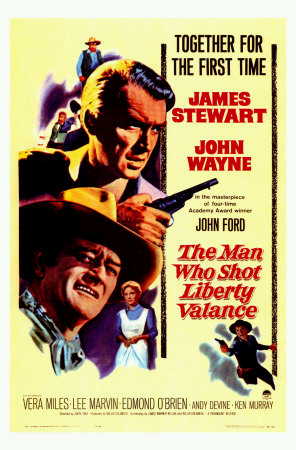
Shattered Politics #18: The Man Who Shot Liberty Valance (dir by John Ford)


The_Man_Who_Shot_Liberty_Valance“When the legend become fact, print the legend.” — Maxwell Scott (Carleton Young) in The Man Who Shot Liberty Valance (1962)

Though I understand and respect their importance in the history of both American and Italian cinema, I have never really been a huge fan of westerns.  Maybe its all the testosterone (“A man’s got to do what a man’s got to do…”) or maybe it’s all the dust but westerns have just never really been my thing.

However, I will always make an exception for The Man Who Shot Liberty Valance, which is not just a great western but a great film period.

But you already knew that.  It’s a little bit intimidating to review a film that everyone already knows is great.  I even opened this review with the exact same quote that everyone uses to open their reviews of The Man Who Shot Liberty Valance.  To a certain extent, I feel like I should have found a quote that everyone hasn’t already heard a thousand times but then again, it’s a great quote from a great film and sometimes, there’s nothing wrong with agreeing with the critical consensus.

The Man Who Shot Liberty Valance opens with a train stopping in the small western town of Shinbone.  The residents of the town — including newspaper editor Maxwell Scott (Carleton Young) — are shocked when Sen. Rance Stoddard (James Stewart) and his wife Hallie (Vera Miles) get off the train.  Sen. Stoddard is considered to be a front-runner to become the next Vice President of the United States.  Scott is even more shocked to discover why the Stoddards are in town.  They’ve come to Shinbone to attend the funeral of an obscure rancher named Tom Doniphon (played, in flashback, by John Wayne).

Sitting in the funeral home with Doniphon’s coffin (and having reprimanded the local mortician for attempting to steal Tom’s boots), Rance tells Scott why he’s come to pay respect to Tom Doniphon.  We see, in flashback, how Rance first came to Shinbone 25 years ago, an idealistic lawyer who — unlike most of the men in the west — refused to carry a gun.  We see how Rance was robbed and assaulted by local outlaw Liberty Valance (a wonderfully intimidating and bullying Lee Marvin), we discover how Rance first met Hallie while working as a dishwasher and how he eventually taught her how to read, and we also see how he first met Tom Doniphon, the only man in town strong enough to intimidate Liberty Valance.

At first, Rance and Doniphon had an uneasy friendship, epitomized by the condescending way Doniphon would call Rance “pilgrim.”  Doniphon was in love with Hallie and, when he attempted to teach Rance how to defend himself, he was largely did so for Hallie.  Rance, meanwhile, was determined to bring law and society to the west.

And, eventually, Rance did just that.  When Shinbone elected two delegates to the statehood convention in the territory’s capitol, Rance attempted to nominate Doniphon for the position but Doniphon refused it and nominated Rance instead, explaining that Rance understood “the law.”  When Liberty Valance attempted to claim the other delegate spot, Rance and Doniphon worked together to make sure that it instead went to newspaper editor Dutton Peabody (Edmond O’Brien).  And when Liberty Valance attempted to gun Rance down in the street, Rance shot him.

Or did he?

That’s the question that’s at the heart of The Man Who Shot Liberty Valance.  However, as a film, The Man Who Shot Liberty Valance is far less interested in gunfights than it is in politics.  Perhaps the most important scene in the film is not when Rance and Liberty meet out on that dark street.  Instead, it’s the scene at the statehood convention where the reformers (represented by Rance) and the cattlemen (represented by John Carradine) battle over who will be the territory’s delegate to Washington.  Between John Carradine orating, the horses riding in and out of the hall, Edmond O’Brien drinking, James Stewart looking humble, and John Wayne glowering in the background, this is one of the best political scenes ever put on film.

When Rance first arrives in the west, there is no political system in place.  With the exception of the ineffectual town marshal (Andy Devine), there is no law.  The peace is kept by men like Tom Doniphon and, oddly enough, by Liberty Valance as well.  (Whether he realizes it or not, Shinbone’s fear of Liberty has caused the town to form into a community.)  What little official law there is doesn’t matter because the majority of the Shinbone’s citizens can’t read.

When Rance arrives, he brings both education and the law.  He makes Shinbone into a town that no longer needs Liberty Valance but, at the same time, it no longer need Tom Doniphon either.  Hence, it’s Rance Stoddard who goes from dishwasher to U.S. Senator while Tom Doniphon dies forgotten.  Rance represents progress and unfortunately, progress often means losing the good along with the bad things of the past.

(It’s no coincidence that when Rance and Hallie return to Shinbone, the first person that they see is the former town marshal, who no longer wears a star and who, we’re told, hasn’t for years.  Time has passed by.)

It’s a bittersweet and beautiful film, one that features four great performances from Stewart, Wayne, Marvin, and Vera Miles.  Personally, I like to think that maybe Sen. Stoddard had a daughter who married a man named Smith and maybe they had a son named Jefferson who later made his way to the Senate as well.

It would be fitting.

Shattered Politics #14: The Last Hurrah (dir by John Ford)


Last_Hurrah

Down here in Dallas, we have a county commissioner named John Wiley Price.  Even if you don’t live in Texas, you might have heard about him.  A few years ago, Price stormed out of a commissioners meeting while shouting, “All of you are white!  Go the Hell!”  It was a popular YouTube video for a while and attracted all of the usual type of comments that you see online.  It even made the national news.

Nobody down here in Dallas was surprised by Price’s outburst.  To us, that was just John Wiley being John Wiley.  For that matter, nobody was particularly surprised when it was reported that he was being investigated by the FBI.  Everyone always took it for granted that John Wiley Price was taking bribes and receiving kickbacks.  That’s just the way that things are done down here in Dallas, by politicians both white and black.  (Of course, most of the white politicians who do it don’t get publicly investigated by the FBI.)

Now, if you ask the majority of people in Dallas county what they think about John Wiley Price and they’ll probably say something negative.  I’ll admit that I would probably be among them.  But the thing is — John Wiley Price’s constituents love him.  John Wiley Price was first elected to the commissioner’s court before I was even born and, as long as he’s on the ballot, he will be reelected.  Even if Price is convicted on corruption charges, he will still be reelected.

I can still remember the night that it was announced that John Wiley Price was on the verge of being arrested by the FBI.  All across his district, emergency meetings were held in churches and ministers stood behind the pulpit and, while the TV cameras rolled, they called upon everyone to pray for John Wiley Price.  In Price’s district, he’s known as “our man downtown,” the idea being that John Wiley Price is standing up to the rich and white Dallas establishment and, if he makes some money for himself in the process, so be it.  As long as he’s doing right for the people who elected him, who cares how he does it?

And, as much as we may want to judge the John Wiley Prices of the world, the fact that of the matter is that he’s a part of a long American political tradition.  That political tradition is also the driving force behind today’s final entry in Shattered Politics.

First released in 1958 and directed by John Ford, The Last Hurrah tells the story of Frank Skeffington (Spencer Tracy), the mayor of an unnamed city in New England that’s obviously meant to be Boston.  Skeffington is the flamboyant head of a large and powerful (but, as the film makes clear, aging) Irish-American political machine.  He’s preparing to run for his fifth term for mayor, a campaign that he says will be his last.

Whether Frank Skeffington is a good mayor or not depends on who you ask.  The poor and the disenfranchised love him.  Skeffington, after all, is the son of Irish immigrants.  He was born poor.  His mother worked as a maid and was even fired by a member of the wealthy and influential Force family.  They know that Skeffington has had to cut corners and that he’s gone out of his way to reward his cronies but they also know that Skeffington is on their side.  Though the phrase is never used in the film, Skeffington is “their man downtown.”

Meanwhile, the wealthy and the upper class see Frank Skeffington as being a crook, a man who has run a corrupt administration and who uses class warfare to keep the city divided against itself and to make himself and his cronies rich.  Newspaper editor Amos Force (John Carradine) has thrown his considerable influence between Skeffington’s opponent, a wealthy but dull man named Kevin McCluskey.

Reporter Adam Caulfield (Jeffrey Hunter) is in an interesting position.  On the one hand, he is Skeffington’s nephew.  On the other hand, as a journalist, he works for Amos Force.  Skeffington invites Adam to follow and record his final campaign for posterity.

It’s interesting to compare The Last Hurrah to films like The Boss or All The King’s Men.  Whereas those two films came down squarely on the sides of the reformers, The Last Hurrah is firmly on the side of Frank Skeffington.  It presents Skeffington as being a sentimental figure, the type of old-fashioned, populist politician who won office by going out and meeting the people face-to-face and personally giving them a reason to vote for him.  As Skeffington himself points out, he’s the type of politician that will soon be made obsolete by television and modern campaigning.

And it’s impossible not to enjoy The Last Hurrah‘s refusal to pass judgment on its lead character.  It helps, of course, that Spencer Tracy plays Skeffington with a twinkle in his eye while all of his opponents are played by villainous and aristocratic character actors like John Carradine and Basil Rathbone.  Yes, the film says, Skeffington may have been corrupt but at least he wasn’t boring!

Finally, I enjoyed the film because all of the “good” guys were Irish Catholic and all of the bad guys most definitely were not.

So, with that last hurrah, we conclude Shattered Politics for today.  We’ll be back tomorrow, when we’ll start to get into the 1960s.

Sláinte!