Today’s song of the day comes from the score to Nicholas Ray’s 1961 Biblical epic, King of Kings.
Since today is Nicholas Ray’s birthday, it seems appropriate to share a scene from Ray’s best-known film, 1955’s Rebel Without A Cause. In this scene, a group of teens who can barely find happiness or peace on their own planet are asked to consider the wonders of the universe.
4 Or More Shots From 4 Or More Films is just what it says it is, 4 shots from 4 of our favorite films. As opposed to the reviews and recaps that we usually post, 4 Shots From 4 Films lets the visuals do the talking!
Director and screenwriter Nicholas Ray was born 114 years ago today, in Galesville, Wisconsin. He would go on to become one of the most influential American directors of all time, making independently-minded films that celebrated rebels and iconoclasts. The directors of the French New Wave loved him and for good reason.
Today, we celebrate the life and legacy of Nicholas Ray with….
4 Shots From 4 Nicholas Ray Films

They Live By Night (1948, dir by Nicholas Ray, DP: George E. Diskant)

In A Lonely Place (1950, dir by Nicholas Ray, DP: Burnett Guffey)

Rebel Without A Cause (1955, dir by Nicholas Ray, DP: Ernest Haller)

Bigger Than Life (1956, dir by Nicholas Ray, DP: Joseph MacDonald)
4 Or More Shots From 4 Or More Films is just what it says it is, 4 shots from 4 of our favorite films. As opposed to the reviews and recaps that we usually post, 4 Shots From 4 Films lets the visuals do the talking!
Today, we pay tribute to a classic year in film. It’s time for….
4 Shots From 4 1950 Films
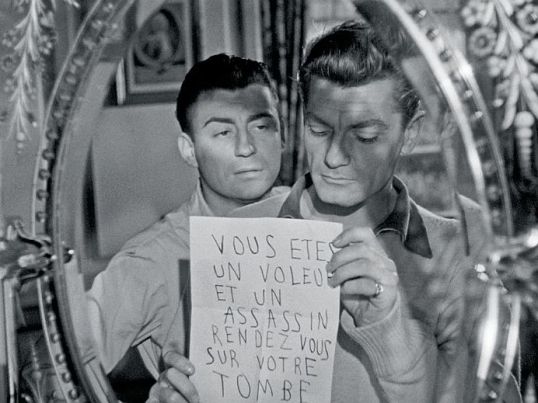
Orpheus (1950, dir by Jean Cocteau, DP: Nicolas Hayer)
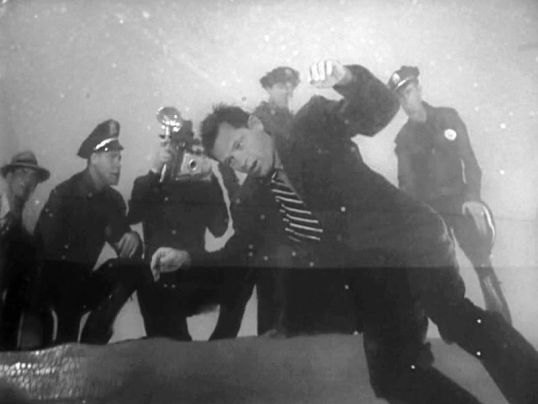
Sunset Boulevard (1950, dir by Billy Wilder, DP; John F. Seitz)
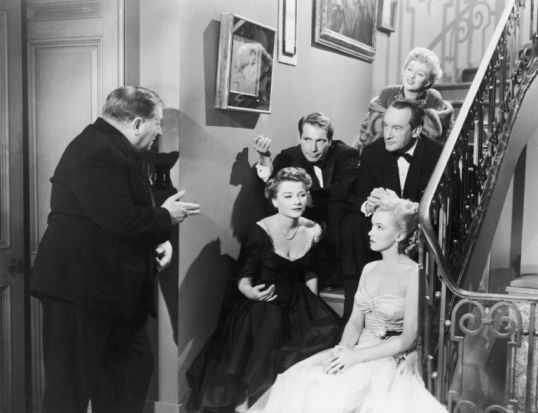
All About Eve (1950, dir by Joseph L. Mankiewicz, DP: Milton R. Krassner)

In A Lonely Place (1950, dir by Nicholas Ray, DP: Burnett Guffey)
4 Or More Shots From 4 Or More Films is just what it says it is, 4 shots from 4 of our favorite films. As opposed to the reviews and recaps that we usually post, 4 Shots From 4 Films lets the visuals do the talking!
Director and screenwriter Nicholas Ray was born 112 years ago today, in Galesville, Wisconsin. He would go on to become one of the most influential American directors of all time, making independently-minded films that celebrated rebels and iconoclasts. The directors of the French New Wave loved him and for good reason.
Today, we celebrate the life and legacy of Nicholas Ray with….
4 Shots From 4 Nicholas Ray Films
They Live By Night (1948, dir by Nicholas Ray, DP: George E. Diskant)
In A Lonely Place (1950, dir by Nicholas Ray, DP: Burnett Guffey)
Rebel Without A Cause (1955, dir by Nicholas Ray, DP: Ernest Haller)
Bigger Than Life (1956, dir by Nicholas Ray, DP: Joseph MacDonald)
4 Or More Shots From 4 Or More Films is just what it says it is, 4 shots from 4 of our favorite films. As opposed to the reviews and recaps that we usually post, 4 Shots From 4 Films lets the visuals do the talking!
Director and screenwriter Nicholas Ray was born 111 years ago today, in Galesville, Wisconsin. He would go on to become one of the most influential American directors of all time, making independently-minded films that celebrated rebels and iconoclasts. The directors of the French New Wave loved him and for good reason.
Today, we celebrate the life and legacy of Nicholas Ray with….
4 Shots From 4 Nicholas Ray Films

In A Lonely Place (1950, dir by Nicholas Ray, DP: Burnett Guffey)

Johnny Guitar (1954, dir by Nicholas Ray, DP: Harry Stradling)

Rebel Without A Cause (1955, dir by Nicholas Ray, DP: Ernest Haller)

Party Girl (1958, dir by Nicholas Ray, DP: Robert J. Bronner)
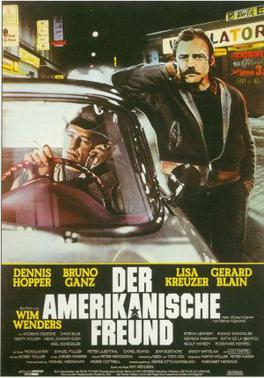
The 1977 German film, The American Friend, tells the story of two men.
Tom Ripley (played by Dennis Hopper) is an American. He’s also a very wealthy criminal. He wears a cowboy hat almost everywhere he goes and always tends to be a little bit too forceful when he talks to people. Because he’s wealthy, he is tolerated by high society but everyone seems to view him with a bit of suspicion. And perhaps they should because Ripley actually has a pretty good scheme going. Working with an artist named Derwatt (director Nicholas Ray), Ripley sells forged paintings. He goes to auctions and bids on these paintings, artificially driving up the price. When Ripley isn’t selling forged paintings, he’s traveling around the world and speaking into his tape recorder. He’s an existential cowboy, one who doesn’t appear to have any morals but who is still capable of exclaiming, “I’m confused!” with real anguish in his voice.
Jonathan Zimmerman (Bruno Ganz) is a German art restorer and picture framer who has a beautiful wife, two children, and a lovely shop. He also has leukemia and is obsessed not only with his impending death but also his fear that he’s going to end his life without really doing anything memorable. When Jonathan meets Ripley at an art auction, he refuses to shake Ripley’s hand because he knows about Ripley’s shady reputation. Ripley is offended but slightly forgiving when he learns, from a mutual acquaintance, that Jonathan has been sick.
Back at his mansion, Ripley receives a message from a French gangster named Minot (Gerard Blain). Minot wants Ripley to murder a rival gangster for him. Ripley, however, tells Minot that he should contact Jonathan and offer him the contract. Ripley then spreads a rumor that Jonathan’s illness has gotten worse and that both his doctor and his family are keeping the truth from him. Now believing that he’s on the verge of dying and desperate to make some money so that his family won’t be helpless after he’s gone, Jonathan is far more open to accepting Minot’s unexpected offer to become a hired gun.
To his shock, Jonathan is able to carry out the murder. However, Minot is not content to just have Jonathan kill one man. Minot is concerned about the activities of an American gangster (played by director Sam Fuller) and he expects Jonathan to keep killing for him. Meanwhile, Ripley, feeling a bit conflicted over his part in Jonathan’s new career, take it upon himself to help Jonathan out in his latest assignment. And so, on odd friendship is born….
The American Friend is based on Patricia Highsmith’s novel Ripley’s Game (which, itself, is a sequel to oft-filmed The Talented Mr. Ripley). In Highsmith’s novels, Ripley was always portrayed as being suave, well-spoken, and never suffering from self-doubt. Dennis Hopper plays Ripley as a cowboy who appears to be in the throes of an existential crisis. It’s quite the opposite of the literary Ripley but it works perfectly in the world created by The American Friend. At times, there’s something almost child-like about Hopper’s Ripley. As played by Hopper, Ripley is an unintentional force of destruction, one who targets Jonathan on an impulse and then, just as impulsively, decides to help him out. It’s one of Hopper’s best and most multi-layered performances.
Dennis Hopper is equally matched by the great Bruno Ganz, who plays Jonathan as being a gentle soul who is as shocked as anyone to discover that he’s capable of murder. Though he is morally offended by Ripley’s reputation, he still can’t help but try to help Ripley out when Ripley unexpectedly shows up at his shop. Even towards the end of the film, Jonathan seems to be so happy to finally be doing something unexpected with his life that his joy is almost infectious. You’re happy for him, even though you know things probably won’t turn out well for him.
As directed by Wim Wenders, The American Friend is a perfect mix of existential angst and film noir homage. While there’s undoubtedly a political subtext to the film — one gets the feeling that Ripley’s destructive friendship with Jonathan is meant to represent the way that America views Europe — The American Friend works best as an homage to the glorious B-movies of the 40s and 50s. (It’s probably not a coincidence that both Nicholas Ray and Samuel Fuller have prominent supporting roles.) There’s a sequence on a train that’s the equal to Hitchcock at his best and the story’s conclusion will stick with you long after the film ends.
Sadly, most of the principle members of the cast are no longer with us. All of them are at their best in The American Friend and Wim Wenders gives them all a terrific showcase in which to display their talent. The American Friend is definitely a film worth tracking down.
The 1961 film, King of Kings, was the final biblical film that I watched on Easter. Like The Greatest Story Ever Told, it tells the story of Jesus from the Nativity to the Ascension. Like The Greatest Story Ever Told, it’s an epic film that was directed by a renowned director. (In this case, Nicholas Ray.) Like The Greatest Story Ever Told, King of Kings also has a huge cast and there’s a few familiar faces to be seen, though it doesn’t really take the all-star approach that George Stevens did with his telling of the story.
Probably the biggest star in King of Kings was Jeffrey Hunter, who played Jesus. Hunter was in his 30s at the time but he still looked young enough that the film was nicknamed I Was A Teenage Jesus. (Some of that also probably had to do with the fact that Nicholas Ray was best known for directing Rebel Without A Cause.) But then again, for a man who had so many followers, Jesus was young. He hadn’t even reached his 40th birthday before he was crucified. As well, his followers were also young while his many opponents were representatives of the establishment and the old way of doing things. It makes perfect sense that Jesus should be played by a young man and Hunter gives a good performance. As opposed to so many of the other actors who have played Jesus in the movies, Jeffrey Hunter is credible as someone who could convince fishermen to throw down their nets and follow him. He’s passionate without being fanatical and serious without being grim. He’s a leader even before he performs his first miracle.
King of Kings is one of the better films that I’ve seen about the life of Jesus. While remaining respectful of its subject, it also feels alive in the way that so many other biblical films don’t. Perhaps not surprisingly, Nicholas Ray focuses on the idea of Jesus as a rebel against the establishment. Ray emphasizes the casual cruelty of the Romans and their collaborators. When John the Baptist (Robert Ryan) is arrested by Herod (Frank Thring), it’s not just so the filmmakers can have an excuse to work Salome (Brigid Bazlen) in the film. It’s also to show what will happen to anyone who dares to challenge the establishment. When Jesus visits John the Baptist in his cell, it’s a summit between two rebels who know that they’re both destined to die for the greater good. When Pilate (Hurd Hatfield) makes his appearance, he’s smug and rather complacent in his power. He’s not the quasi-sympathetic figure who appears in so many other biblical films. Instead, he’s the epitome of establishment arrogance.
As a director, Nicholas Ray keeps things simple. This isn’t Ben-Hur or The Ten Commandments. The emphasis is not on grandeur. Instead, the film is about common people trying to improve the world in which they’re living, while also preparing for the next. Jeffrey Hunter gives an excellent performance as Jesus and, all in all, this is one of the better and more relatable biblical films out there.


4 Shots From 4 Films is just what it says it is, 4 shots from 4 of our favorite films. As opposed to the reviews and recaps that we usually post, 4 Shots From 4 Films lets the visuals do the talking.
On this date, 64 years ago, James Dean was killed in a tragic car accident. At the time of his death, he had already filmed East of Eden, Rebel Without A Cause, and Giant. East of Eden would be the only one of his starring roles that Dean would live to see. Dean went on to be nominated for two posthumous academy awards and, in death, he became an icon that will live forever.
If James Dean were still alive today, he would be 88 years old. Would he still be acting? It’s hard to say, of course. Some actors retire and some don’t. (Robert Duvall, for instance, is 88 and still doing films. For that matter, Norman Lloyd is 104 and apparently still reading scripts.) If Dean were alive today, he wouldn’t be that much older than the stars of The Irishman.
In honor of James Dean’s career and his legacy, here are….
4 Shots From 4 James Dean Films

Hill Number One (1951, dir by Arthur Pierson)

East of Eden (1955, dir by Elia Kazan)

Rebel Without A Cause (1955, dir by Nicholas Ray)

Giant (1956, dir by George Stevens)

The Governor’s Ball, 1958
Continuing our look at good films that were not nominated for best picture, here are 6 films from the 1950s.

The Third Man (1950, dir by Carol Reed)
Now, it should be noted that The Third Man was not ignored by the Academy. It won the Oscar for Best Cinematography and it was nominated for both editing and Carol Reed’s direction. But, even with that in mind, it’s somewhat amazing to consider all of the nominations that it didn’t get. The screenplay went unnominated. So did the famous zither score. No nominations for Joseph Cotten, Alida Valli, Trevor Howard, or even Orson Welles! And finally, no Best Picture nomination. 1950 was a good year for the movies so competition was tight but still, it’s hard to believe that the Academy found room to nominate King Solomon’s Mines but not The Third Man.

Rear Window (1954, dir by Alfred Hitchcock)
Alfred Hitchcock directed some of his best films in the 50s, though few of them really got the recognition that they deserved upon their initial release. Vertigo is often described as being Hitchcock’s masterpiece but, to be honest, I actually prefer Rear Window. This film finds the master of suspense at his most playful and, at the same time, at his most subversive. Casting Jimmy Stewart as a voyeur was a brilliant decision. This film features one of my favorite Grace Kelly performances. Meanwhile, Raymond Burr is the perfect schlubby murderer. Like The Third Man, Rear Window was not ignored by the academy. Hitchcock was nominated and the film also picked up nods for its screenplay, cinematography, and sound design. However, it was not nominated for best picture.

Rebel Without A Cause (1955, dir by Nicholas Ray)
Nicholas Ray’s classic film changed the way that teenagers were portrayed on film and it still remains influential today. James Dean is still pretty much the standard to which most young, male actors are held. Dean was not nominated for his performance here. (He was, however, nominated for East of Eden that same year.) Instead, nominations went to Sal Mineo, Natalie Wood, and the film’s screenplay. Amazingly, in the same year that the forgettable Love Is A Many-Splendored Thing was nominated for best picture, this popular and influential film was not.

Kiss Me Deadly (1955, dir by Robert Aldrich)
It’s unfortunate but not surprising that Kiss Me Deadly was totally ignored by the Academy. In the mid-to-late 50s, the Academy tended to embrace big productions. There was no way they were going to nominate a satirical film noir that featured a psychotic hero and ended with the end of the world. That’s a shame, of course, because Kiss Me Deadly has proven itself to be more memorable and influential than many of the films that were nominated in its place.

Touch of Evil (1958, dir by Orson Welles)
Speaking of underappreciated film noirs, Orson Welles’s Touch of Evil is one of the craftiest and most brilliant films ever made. So, of course, no one appreciated it when it was originally released. This cheerfully sordid film features Welles at his best. Starting with a memorable (and oft-imitated) tracking shot, the film proceeds to take the audience into the darkest and most eccentric corners of a small border town. Everyone in the cast, from the stars to the bit players, is memorably odd. Even the much mocked casting of Charlton Heston as a Mexican pays off wonderfully in the end.

The 400 Blows (1959, dir by Francois Truffaut)
Francois Truffaut’s autobiographical directorial debut was released in the United States in 1959 and it was Oscar-eligible. Unfortunately, it only picked up a screenplay nomination. Of course, in the late 50s, the last thing that the Academy was going to embrace was a French art film from a leftist director. However, The 400 Blows didn’t need a best picture nomination to inspire a generation of new filmmakers.
Up next, in an hour or so, we continue on to the 60s!

 Through the Shattered Lens