Retro Television Review: The American Short Story #9: Soldier’s Home


Welcome to Retro Television Reviews, a feature where we review some of our favorite and least favorite shows of the past!  On Saturdays, I will be reviewing The American Short Story, which ran semi-regularly on PBS in 1974 to 1981.  The entire show can be purchased on Prime and found on YouTube and Tubi.

This week, we have an adaptation of a short story by Ernest Hemingway.

Episode #9 “Soldier’s Home”

(Dir by Robert Young, originally aired in 1977)

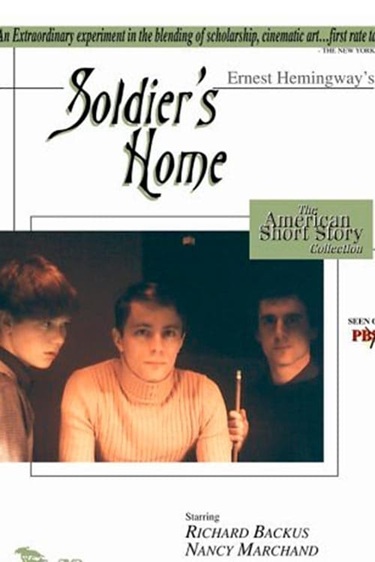
Having gone from attending college to serving in the Army during the Great War, Harold Krebs (Richard Backus) returns home to Oklahoma.  He arrives home later than most of the other soldiers who served.  (He stayed in Europe until 1919.)  As a result, there’s no big parade waiting for him.  Everyone in town seems to have moved beyond the war and they no longer have much of a desire to talk about it.

Harold, who was once a popular and optimistic member of the town’s social set, no longer feels that he fits in.  He feels detached, watching people as they go about their lives but never feeling any desire to join them.  His mother (Nancy Marchand) pushes him to go out and date and have a good time but Harold feels lost, regardless of how much she prays for him.

Ernest Hemingway’s short story was one of the first to realistically deal with the feelings of soldiers returning from combat.  Though Harold doesn’t talk much about his experiences, one can tell that he saw and experienced things that left him scarred.  After surviving the horror of The Great War, there’s no way Harold can just slip back into his normal routine.

The adaptation sticks closely to Hemingway’s story.  Unfortunately, it doesn’t really find the visual style necessary to capture the power of Hemingway’s words.  Hemingway was a deceptively simple storyteller and Robert Young’s film is a fairly straight-forward portrait of a young man who doesn’t want to do anything, one that fails to truly capture the subtext of Hemingway’s story.  Richard Backus’s blank-eyed acting style worked well when he was playing a member of the undead in Deathdream but, in this one, he just makes ennui seem boring and petulant.  Nancy Marchand, not surprisingly, is far stronger in the role of his well-meaning but clueless mother.

As was almost always the case when it came to attempts to adapt Hemingway, it’s best just to read the original.

Retro Television Review: Homicide: Life On The Street 3.8 “All Through The House”


Welcome to Retro Television Reviews, a feature where we review some of our favorite and least favorite shows of the past!  On Sundays, I will be reviewing Homicide: Life On The Street, which aired from 1993 to 1999, on NBC!  It  can be viewed on Peacock.

It’s time to celebrate the holidays!

Episode 3.8 “All Through The House”

(Dir by Peter Medak, originally aired on December 16th, 1994)

It’s Christmas in Baltimore!  Decorations are up.  A heavy snow is falling.  The Homicide Detectives are starting the night shift on Christmas Eve …. there’s no way this is going to be depressing, right?

  • Russert and Lewis (who no longer has a permanent partner because Crosetti committed suicide) investigate the murder of a woman who was set on fire.  The victim’s mother (Nancy Marchand) is in the midst of throwing a Christmas party and refuses to acknowledge the fact that her daughter is dead.  Instead, she obsesses on the amount of red decorations.  It’s a human moment.  How would you react if you found out a member of your family had been murdered on Christmas Eve?
  • Still, this storyline kind of reinforced the fact that it really doesn’t make much sense for Russert to be a regular on the show.  She’s a shift commander but it’s a totally different shift from the one that the rest of the characters work.  She was originally introduced having an affair with Beau but that appears to be over.  Russert really has nothing to do and her choosing to work Christmas Eve didn’t really make much sense.
  • Scheiner, the crusty old medical examiner, shows up wearing a Santa hat.  Assistant State’s Attorney Ed Danvers also makes an appearance.  He mentions that he’s got someone coming to his apartment to celebrate Christmas Eve with him but Kay is working!  Did they break up!?
  • Meanwhile, Bolander and Much investigate the mystery of a dead man dressed as Santa Claus….
  • SERIOUSLY, HOMICIDE!?
  • Much suggests that Santa was killed by angry elves.
  • Okay, Homicide, that made me laugh.
  • Munch thinks that the man is someone who has been ringing the bell for the Salvation Army for decades.  Bolander says that they need to inform the man’s child….
  • STOP IT, HOMICIDE!
  • While Bolander goes to the morgue to try to get a positive ID on the guy, Munch sits in an apartment with a kid who want stop talking about how his father promised to spend Christmas Eve with him….
  • WHY ARE YOU DOING THIS, HOMICIDE!?
  • Munch takes the kid out.  They go bowling.  They hit some baseballs.  The kid’s antagonistic and Munch is miserable.
  • Oh wait!  The kid’s father is alive!  Yay!  It turns out that someone stole his Santa Claus outfit and that person — that thief of holiday joy — is the one who was brutally murdered while dressed as jolly old St. Nick.
  • Uhmm …. that’s still pretty depressing but at least the kid’s not an orphan.
  • Back at headquarters, a disheveled Bayliss tries to get someone to play Hearts with him because he needs to make some quick money.
  • Seriously, what’s happening with Bayliss?  He went from being clean-cut and idealistic to being a somewhat seedy, convenience store-robbing burnout in record time!

Merry Christmas, everyone!  This was a good episode, actually.  Any episode that involves Munch getting frustrated is usually enjoyable and Russert and Lewis made for a good team.  And, in the end, Santa was not dead.  It’s a Christmas miracle!

Film Review: Ladybug Ladybug (dir by Frank Perry)


Long before he played the long-suffering Mr. Feeney on Boy Meets World, William Daniels made his film debut as another school principal in the 1963 film, Ladybug Ladybug.

In Ladybug Ladybug, Daniels plays Mr. Calkins and he’s got a lot more to worry about than just some unstable student with an unhealthy fixation on a girl that he’s gaslighted into loving him.  No, Mr. Calkins has to deal with the very real possibility that a nuclear war might break out at any second.  One day, when an imminent nuclear attack warning signal goes off, no one can be sure whether or not it’s real or if it was an accident.  However, Mr. Calkins takes no chances.  He dismisses school for the day and tells all of the students to go home.

However, there’s a problem.  The school is in a rural area and most of the students live several miles away.  Because it’s early in the day, there aren’t any school buses running.  The children will have to walk home.  To make sure that the kids get to safety, they’re divided into groups.  A teacher is assigned to each group, tasked with keeping the children calm and making sure they reach their houses.

It’s a long walk and the countryside is deathly quiet.  Some of the children talk about what’s going to happen if there really is a war.  Others, being too young to understand the seriousness of the situation, treat it all like a game.  As each child reaches their house, they have to deal with parents who are more concerned about why their child has come home early than the fact that there might be a war about to break out.

Back at the school, Mr. Calkins and a few remains teachers wait.  One teacher tries to clean up her classroom, all the while realizing that there’s a chance that the classroom will never be used again.

And we, the viewers, keep waiting for a bomb to drop or, at the very least, some sort of clarification about what’s really happening.  We wait in vain.  The film’s ending is harrowing but, at the same time, ambiguous.  Is the world ending or are the children going to wake up in the morning and head back to school?  It all depends on how you interpret the film’s final few moments.

Of course, by the time we reach that ending, a group of children has already taken cover in a bomb shelter.  Unfortunately, their self-appointed leader has decided that there’s not room for all the children, which means that one girl ends up getting kicked out.  Wandering around outside, she finds an old refrigerator to hide in.  Your heart sinks as you watch her climb in and close the door behind her….

Ladbybug Ladybug is a grim film.  At times, it runs the risk of being a bit too grim.  The film definitely gets across its point but it’s so relentlessly depressing that it’s a bit difficult to sit through.  Of course, Ladybug Ladybug was filmed around the same time as the Cuban Missile Crisis so, for many viewers in 1963, the film was less an allegory and more just a record of the feelings and fears that they had to deal with every single day.  Towards the end of the film, when one of the children desperately starts to yell, “Stop!  Stop!  STOP!,” he was undoubtedly speaking for an entire generation that grew up under the shadow of mutually assured destruction.

Ladybug Ladybug was one of the many nuclear war-themed films to be released in the early 60s.  One could easily imagine it as being a companion piece to Fail Safe.  While President Henry Fonda is debating whether or not to sacrifice New York, the children are simply trying to get home.

Insomnia File No. 8: From the Hip (dir by Bob Clark)


What’s an Insomnia File? You know how some times you just can’t get any sleep and, at about three in the morning, you’ll find yourself watching whatever you can find on cable? This feature is all about those insomnia-inspired discoveries!

From_the_Hip_(film)

Last night, if you discovered that you couldn’t get any sleep around two in the morning, you could have turned to Showtime and watched the 1987 film, From The Hip.

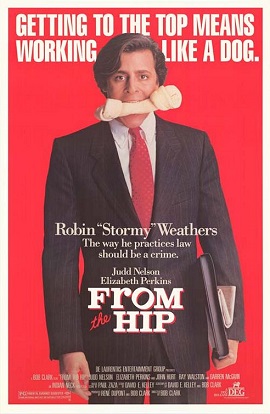
In From the Hip, Judd Nelson plays a character named Robin Weathers.  Of course, his nickname is Stormy.  Robin has just graduated from law school and is working at a prestigious law firm.  He’s ambitious, he’s outspoken, and he’s totally frustrated.  As his co-workers (played, quite well, by David Alan Grier and Dan Monahan) continually remind him, nobody gets to try a case during their first year out of law school.  They advise him to be patient and to wait his turn.

However, a man who is capable of being patient would not be nicknamed Stormy.  It just wouldn’t make any sense.  So, Stormy Weathers schemes his way into the courtroom.  One morning, he intentionally withholds information from the senior partners, going out of his way to keep them from realizing that a trial is scheduled to begin that afternoon.  When senior partner Craig Duncan (Darren McGavin) discovers what Stormy has done, he fires him and makes sure that he never get hired at another law firm … oh wait.  No, he doesn’t because that would make too much sense.  Instead, he allows Stormy to try the case because, at this point, Stormy is the only one who knows anything about it.

The case is a simple assault case that involves two bankers and should be resolved easily but Stormy manages to drag it out for several days and his flamboyant style catches the attention of the media.  The other partners in the law firm — who are all old and boring — want to fire Stormy but Stormy’s client says that, if Stormy is fired, he’ll take his business and his money elsewhere.  Stormy becomes a minor celebrity but — in a rather clever little twist — it turns out that he and the prosecuting attorney are old friends from law school and they conspired to make each other look good.

Anyway, Stormy is now so famous that he gets assigned to defend a college professor, named Benoit (John Hurt), who has been accused of murder.  When it quickly becomes obvious that Benoit is not only guilty but will probably murder again, Stormy is forced to choose between ambition and morality…

When my friend Evelyn and I first started to watch From the Hip last night, I really thought I was going to hate it.  The hot pink neon credits screamed, “Bad 80s movie!” and, because I happen to know quite a few lawyers, I tend to be a 100 times more critical of movies about lawyers than I am when it comes to movies about, say, homicidal fishermen.

And, honestly, From The Hip is a heavily flawed film.  Judd Nelson is miscast and the scenes with his politically conscious girlfriend (Elizabeth Perkins) are painfully shallow and reek of limousine liberalism.  But, if you can get through the weak opening, the film itself is watchable and enjoyable in a dumb sort of way.  John Hurt does a great job as a sociopath and, miscast as he may be, it’s still fun to watch Nelson go insane in court.

From The Hip is not a great film but, in its way, it’s an enjoyable little time capsule.  Believe it or not, there was a time when Judd Nelson starred in a movies that were actually released in theaters.

Previous Insomnia Files:

  1. Story of Mankind
  2. Stag
  3. Love Is A Gun
  4. Nina Takes A Lover
  5. Black Ice
  6. Frogs For Snakes
  7. Fair Game