Never Nominated: 16 Actresses Who Were Never Nominated For An Oscar


The late actress Deborah Kerr was nominated for six Oscars over the course of her distinguished career.  She never won and, in fact, she currently holds the record for the most Best Actress nominations without a victory.

But, at least, Deborah Kerr was nominated!

The 16 actresses below have never been nominated for an Oscar, despite some excellent and compelling performances.  10 of them still have a chance to be nominated.  Sadly, 6 of them are no longer with us.

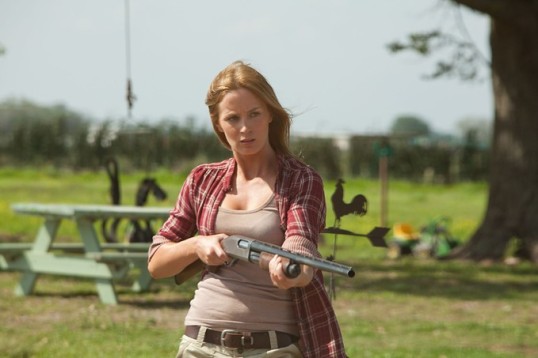
  1. Emily Blunt

Emily Blunt came close this year.  She received a SAG nomination for her performance in Girl On The Train and some of the critics groups also honored her work.  However, when the Oscar nominations were announced, Meryl Streep was nominated for a film nobody saw and Emily Blunt was nowhere to be seen.  This year, she’s in good company, as neither Amy Adams nor Annette Bening picked up expected nominations either.  Personally, I didn’t care much for Girl on the Train.  I would have much rather seen Blunt nominated for Looper, Sicario, or even Edge of Tomorrow.  Blunt will be nominated eventually.

2. Dale Dickey

You may not know Dale Dickey’s name but you’d recognize her if you saw her.  She usually plays characters who are strong, outspoken, and occasionally a little scary.  You never want to get on the bad side of someone played by Dale Dickey.  To date, Dickey’s most award-worthy role was in Winter’s Bone.  She also had a memorable (if small) role in Hell or High Water, playing the bank teller who, when asked if the men who robbed her were black, replies, “Their skin or their souls?”

Melancholia

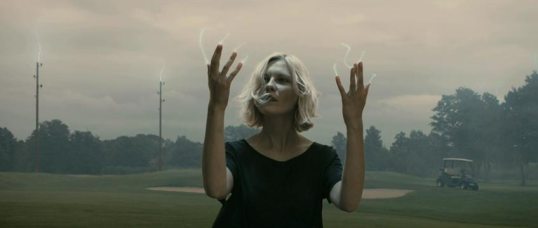
3. Kirsten Dunst

As a result of Bring It On, Dunst is often thought of as being the ideal cheerleader.  But, by far, her most award-worthy turn was in a film that was about as different from Bring It On as possible, Melancholia.  Dunst was just twelve when she was first mentioned, for her performance in Interview With A Vampire, as a potential nominee.  She was also very good in Marie Antoinette and the overlooked Crazy/Beautiful.  Dunst fell off the radar for a while but she’s been quietly making a comeback.

4. Greta Gerwig

Greta Gerwig is my spirit animal.  She deserved a nomination for Francis Ha and for Damsels in Distress before that.  She’ll be nominated some day.

5. Rebecca Hall

Rebecca Hall received some Oscar buzz last year for Christine.  I haven’t seen Christine but I think that her performances in 2008’s Vicky Christina Barcelona and especially 2010’s Please Give were criminally overlooked.

6. Katharine Isabelle

Though Isabelle is best known for Ginger Snaps, I think she deserved a nomination for last year’s underrated 88.  One of the best actresses working today, Isabelle will hopefully get a role worthy of her talents.

Film Review Under the Skin

7. Scarlett Johansson

It’s a bit of a shock that Scarlett Johansson has yet to be nominated.  Her work in Lost in Translation was just as important to that film’s success as Bill Murray’s.  And her performance in Under the Skin remains one of the bravest pieces of acting to ever be put on screen.

8. Ashley Judd

Unfortunately, Ashley Judd now seems to be more concerned with political activism than acting.  It’s been a while since she’s appeared in a really great role (and no, the Divergent movies don’t count).  Judd’s best work came in the 90s, when she gave award-worthy performances in Ruby in Paradise, Heat, and especially Normal Life.

9. Kelly MacDonald

Scottish actress Kelly MacDonald doesn’t make enough movies but it’s still hard not to feel that she’s been overlooked by the Academy.  Not only did she hold her own in Trainspotting but her performance in No County For Old Men provided that otherwise cold film with a much-needed heart.

Kristen Stewart

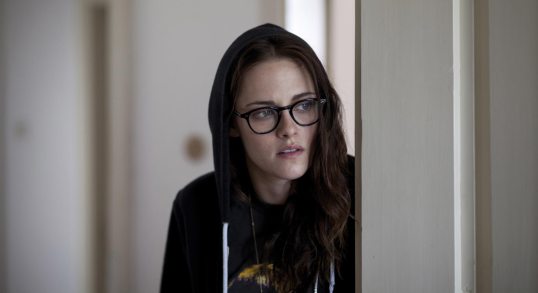
10. Kristen Stewart

Kristen Stewart managed to survive the Twilight films and has emerged as a consistently interesting actress.  Her work in Clouds of Sils Maria won her a Ceasar but was overlooked by the Academy.  Before that, Stewart did excellent work in Into the Wild, Adventureland, Still Alice and Welcome to the Rileys.

Sadly, these six unnominated actresses are no longer with us:

  1. Rita Hayworth

That the wonderful Rita Hayworth was never nominated — not even for Gilda — is nothing less than mind-blowing.

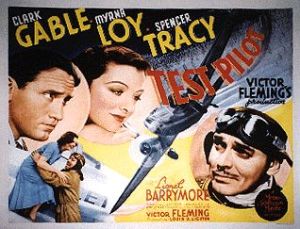
2. Myrna Loy

Myrna Loy was an actress who was such a natural that she made it look easy.  Perhaps that’s why she wasn’t even nominated for The Thin Man.

Marilyn

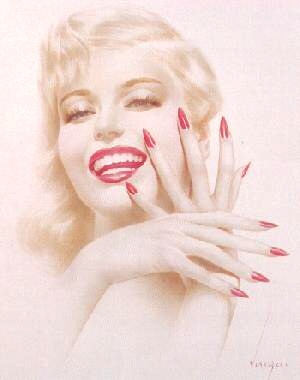
3. Marilyn Monroe

Perhaps one of the most tragic actresses in the history of Hollywood, Monroe was never nominated despite giving some of the most iconic performances in film history.  I would even make the case that she deserved a nomination for her tiny cameo in All About Eve.

4. Maureen O’Hara

Despite great performances in classic films like The Quiet Man and Miracle on 34th Street, Maureen O’Hara was never nominated for the Oscar she deserved.

detour1

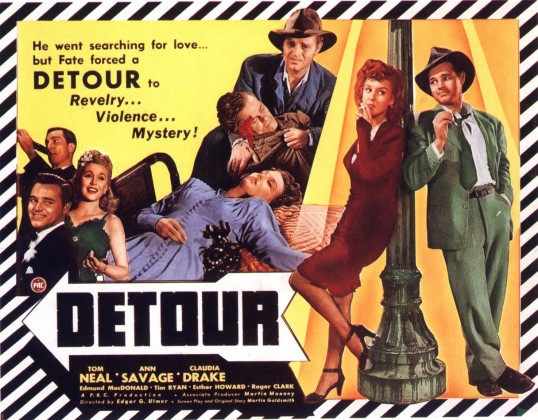
5. Ann Savage

You may not recognize the name but if you’ve ever seen Detour, you know Ann Savage.  Savage largely appeared in low-budget noirs and she always gave performances that were just as fierce as her last name.

Edie!

Edie!

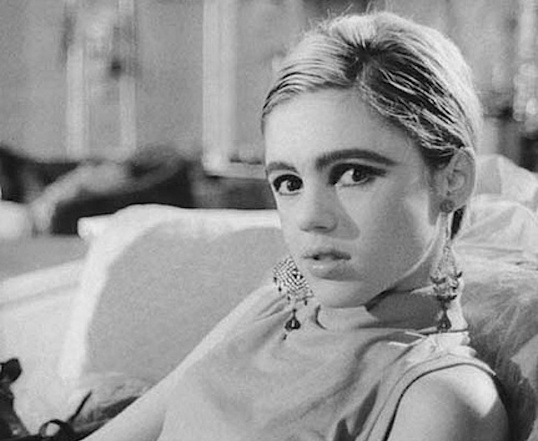
6. Edie Sedgwick

Sadly, Edie never got a chance to play a truly award-worthy role.  Actually, since almost all of her films were underground Andy Warhol movies, it’s debatable whether she ever played a role at all.  During the 1960s, as one of the top models in New York (a so-called “youthquaker”), Edie was best known for being herself.  But, whenever I see Edie in an old Warhol film like Vinyl or even in something like Ciao! Manhattan, I see what a great actress she could have been if she’d only been given the chance.

Edie Sedgwick (1943 -- 1971)

Edie Sedgwick (1943 — 1971)

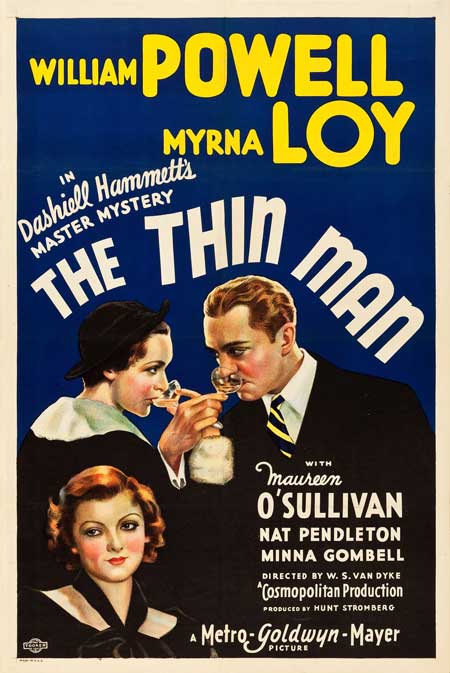
Lisa Reviews An Oscar Nominee: The Thin Man (dir by W.S. Van Dyke)


the_thin_man_1934_poster

Last night, I rewatched the classic 1934 mystery-comedy, The Thin Man.

And you know what?

Nick and Nora Charles should be everyone’s relationship goal.

Technically, The Thin Man is a murder mystery and it’s actually a pretty good one.  While I was rewatching the film, I was surprised to see that the whodunit aspect of the plot held up far better than I remembered.  But, ultimately, the movie is really a portrait of the ideal romance.  Every couple should aspire to be like Nick and Nora.

Nick Charles (William Powell) is a retired private detective, an unflappable gentleman who speaks exclusively in quotable quips.  Nick is the type who can apparently spend every hour of the day drinking without ever getting stupidly drunk.  He has beautiful homes on both coasts and a list of friends that would make anyone jealous.  Whether cop or crook, everyone loves Nick.

Nora Charles (Myrna Loy) is Nick’s wife.  She’s independently wealthy.  She’s beautiful.  She’s always chic.  She is always the smartest and funniest person in the room.  And she’s probably the only person who can outquip Nick.  Nora loves Nick’s lifestyle, whether they’re throwing a party or literally shooting ornaments off of a Christmas tree.  As Nora says at the end of one crowded party, “Oh, Nicky, I love you because you know such lovely people.”

And, of course, there’s Asta.  Asta is their terrier.  If Nick and Nora are the ideal couple, Asta is the ideal pet.  Asta is just as quick to investigate a mystery as Nick and Nora.  Asta may be a playful dog but he’s also remarkably well-behaved.  No insistent yapping.  No accidents on the carpet.  No growling at visitors.  As I’ve mentioned many times on this site, I’m not a dog person but I love Asta.

It’s not just that Nick and Nora are obviously in love and, in this pre-code film, they’re actually allowed to express that love.  And it’s not just that they say things in The Thin Man that they wouldn’t be allowed to get away with in the film’s sequels.  (If you have any doubt that this is a pre-code film, just check out the scene where the police are going through Nora’s dresser.  “What’s that man doing in my drawers?” Nora demands while Nick does a double take.)  It’s that Nick and Nora seem to be having so much fun.  They’re wealthy.  Other than to themselves, they really have no commitments.  (Nick only comes out of retirement because Nora say she thinks a mystery sounds like it would be fun to solve.)  They have no children to worry about.  Even if you don’t want to be either Nora or Nick by the end of this film, you’ll still definitely want to hang out with them.

The Thin Man is a murder mystery.  In fact, it’s probably one of the most enjoyable movies ever made about a double murder.  Dorothy Wynat (Maureen O’Sullivan) asks Nick to help find her father (Edward Ellis), the thin man of the title.  The investigation leads to a rather complicated mystery, one in which everyone that Nick and Nora meets is a suspect.  I have to admit that, with my ADD, I always have a hard time following all of the clues.

Of course, so does Nick.  That truly is part of the appeal of The Thin Man.  Nick is often confused about what it all the clues and evidence add up to but that never seems to upset him.  He and Nora are too busy enjoying themselves to get upset. That’s one reason why, even after you know who the murderer is, The Thin Man is a movie that’s enjoyable to watch over and over again.  The Thin Man is less about the mystery and more about the way Nick and Nora manage to throw the perfect dinner party even as they reveal who the murderer is.

1934 was a good year for comedy.  The Thin Man was nominated for best picture but it lost to another charming little comedy, It Happened One Night.

Horror on the Lens: Panic at Lakewood Manor (dir by Robert Scheerer)


Today’s horror on the lens is a made-for-TV movie from 1977.  This movie has many different names: Panic at Lakewood Manor, It Happened At Lakewood Manor, and Ants.

Panic at Lakewood Manor is a mix of different genres.  It’s a disaster film, a soap opera, and ultimately a revenge-of-nature horror film.  The film begins with our cast gathering at Lakewood Manor, a luxury hotel that’s only partially finished.  In fact, the owners are so determined to complete construction that they ignore the threat posed by …. KILLER ANTS!

Anyway, this is a made-for-TV movie from the 70s so it’s never as graphic as what we’d expect to see today.  That said, I once accidentally stepped on a fire ant mound while I was barefoot and OH MY GOD DID THAT EVER HURT!  AGCK!

If you’re a fan of old movies, you’ll enjoy seeing a lot of familiar faces in this one.  Even Myrna Loy shows up!

(Incidentally, this film was written by Guerdon Trueblood, who directed the brilliant The Candy Snatchers.)

Cleaning Out The DVR #31: Libeled Lady (dir by Jack Conway)


(For those following at home, Lisa is attempting to clean out her DVR by watching and reviewing 38 films by the end of this Friday.  Will she make it?  Keep following the site to find out!)

http://www.youtube.com/watch?v=JI-eY-bU9qg

In the 1936 comedy Libeled Lady, tabloid newspaper editor Warren Haggerty (Spencer Tracy) has a problem.  His newspaper has just published a story accusing wealthy heiress Connie Allenbury (Myrna Loy) of being the other woman in a scandalous divorce.  The problem is that Connie was not the “other woman” and she is now suing the newspaper for $5,000,000.

“5 million dollars!” an astonished Warren declares, “nobody has that type of money!”

(It was 1936, after all.)

However, Warren has a plan and, since this is a screwball comedy, it’s an unneccesarily complicated plan.  He hires a former reporter, the suave Bill Chandler (William Powell, the suavest man alive in the 30s) to meet with Connie.  Warren believes that there’s no way that Connie won’t fall in love with Bill.  (Perhaps Warren had recently seen The Thin Man…)  Once Connie does fall in love, Warren will arrange for Bill’s wife to catch the two of them together.  In order to avoid the scandal, Connie will drop the suit.

The problem is that Bill isn’t married.  However, Warren has a solution for that as well.  Warren arranges for Bill to marry Warren’s fiancée, Gladys (Jean Harlow).  Gladys is not happy about the arrangement but goes along with it because, despite his behavior, she truly loves Warren and Warren promises her that the marriage will only last for 6 weeks.

(When the minister says that he hopes he’ll be invited to the new couple’s silver anniversary, Gladys replies, “It better be in six weeks.”)

And, at first, things go as planned.  Bill meets Connie on a luxury cruise and she quickly falls in love with him.  However, Bill finds himself falling in love with her too.  Soon, he no longer wants to frame her.  However, that’s not the only complication.  Finally fed up with Warren’s behavior, Gladys has started to think that maybe it would be better to be married to Bill.  Soon, she decides that she has no intention of getting a divorce…

Libeled Lady is a minor but enjoyable screwball comedy.  The plot is thoroughly implausible but, fortunately, William Powell was one of those actors who could get you to believe almost anything.  As anyone who has seen any of the Thin Man films can tell you, Powell and Myrna Loy had great chemistry together.  Spencer Tracy seems a little uncomfortable with the role of Warren but Jean Harlow is a lot of fun as Gladys.  She doesn’t have a big role but, at the same time, you can still understand why she was such a huge star and why her tragic death a year later was such a shock.

(At the time the movie was made, Harlow was dating William Powell.  She wanted to play Connie but MGM was determined to repeat the formula of previous William Powell/Myrna Loy comedies and Harlow settled for the secondary role of Gladys.)

As enjoyable as the film is, it still does seem a bit strange that it was nominated for best picture.  It lost the Oscar to The Great Ziegfeld, another MGM film that starred William Powell and Myrna Loy.

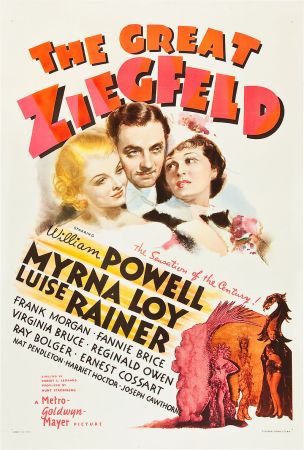
Cleaning Out The DVR #30: The Great Ziegfeld (dir by Robert Z. Leonard)


(For those following at home, Lisa is attempting to clean out her DVR by watching and reviewing 38 films by the end of this Friday.  Will she make it?  Keep following the site to find out!)

Great-Ziegfeld-1936-Poster

Do you know who Florence Ziegfeld was?

Don’t feel bad if you don’t because, until I saw the 1936 film The Great Ziegfeld, I had no idea and history is my number one obsession.  Florence Ziegfeld was a theatrical producer who, in the early days of the 20th Century, produced huge spectacles.  He was a showman who understood the importance of celebrity and gossip.  He produced a show called The Ziegfeld Follies, which was considered quite risqué at the time but which looks remarkably tame today.  Florence Ziegfeld was so famous that he even got his own Oscar-winning biopic.

The Great Ziegfeld features the always smooth William Powell as Ziegfeld.  When we first meet him, he’s promoting a strongman and a belly dancer and nobody takes him seriously.  But through hard work, good luck, and his own instinct for showmanship, he becomes famous and his shows gets bigger and bigger.  The film follows Ziegfeld as he gets married, both times to someone he is grooming to be a star.  His first wife is Anna (Luise Rainer), who loves him but divorces him when it becomes obvious that Ziegfeld’s life will always revolve around his work.  His second wife is Billie Burke and we know that she is Ziegfeld’s true love because she’s played by Myrna Loy.  Whenever you see William Powell and Myrna Loy in the same film, you know that they belong together.

The majority of The Great Ziegfeld is taken up with recreations of Ziegfeld’s stage shows.  In fact, the film almost feels more like a musical variety show than a real biopic.  (Judging from the credits, quite a few of Ziegfeld’s stars played themselves and recreated their acts on the big screen.)  I can understand why this was attractive to audiences in the 1930s.  With no end in sight to The Great Depression and Ziegfeld himself recently deceased, this movie was their only opportunity to see one of his spectacles.  The film made sure that they got their money’s worth.

However, for modern audiences, all of the acts just add to what is already an oppressive running time.  My main impression of The Great Ziegfeld was that it was really, really long.  The movie itself is well-produced and William Powell and Myrna Loy are always fun to watch but the movie just goes on and on.  As well, this biopic is so worshipful of Ziegfeld — the title is meant to be taken literally — that, as a result, he comes across as being one-dimensional.  I did appreciate the film as a historical artifact but otherwise, it didn’t do much for me.

However, it did something for the Academy.  The Great Ziegfeld was named the best picture of 1936!  Luise Rainer won best actress despite only being on-screen for a handful of scenes.  So many people were critical of Rainer’s award that, the very next year, the Academy introduced the award for best supporting actress.

As for why Ziegfeld won that Oscar — well, if you look at its competition and some of the other 1936 films that received nominations, you’re struck by the lack of truly memorable films.  It would appear that, in a weak year, the Academy decided to give the award to the biggest production they could find.

And that was The Great Ziegfeld.

(Incidentally, if Flo Ziegfeld were alive today, he would probably be a reality TV producer.)

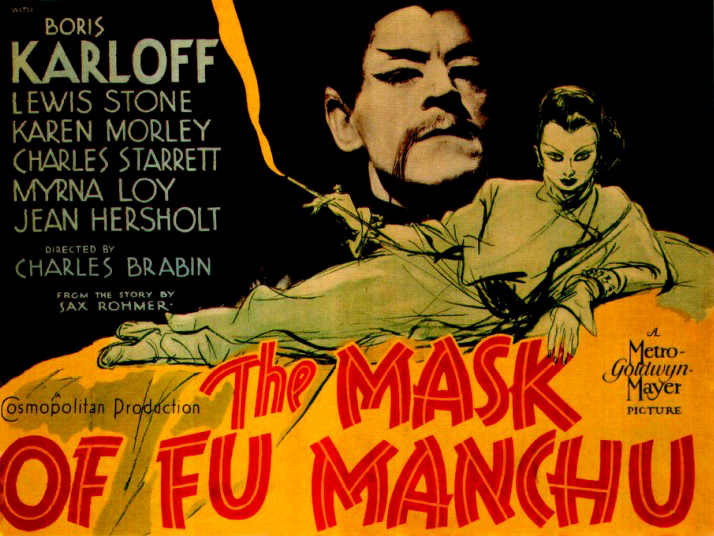
Pre Code Confidential #4: Boris Karloff in THE MASK OF FU MANCHU (MGM 1932)


gary loggins's avatarcracked rear viewer

“Rooted in medieval fears of Genghis Khan and the Mongolian invasions of Europe, the Yellow Peril combines racist terror of alien cultures, sexual anxieties, and the belief that the West will be overpowered and enveloped by the irresistible, dark, occult forces of the East”- Gina Marchetti, Romance and the Yellow Peril: Race, Sex, and Discursive Strategies in Hollywood Fiction (University of California Press, 1994)

fu1

First, a brief history lesson: The Yellow Peril was a particular brand of xenophobia that spread in the late 19th/early 20th century. Named by (of all people) Kaiser Wilhelm II of  Germany, and given credibility during the Boxer Rebellion of 1900, this “fear of the unknown” basically said those “inscrutable” Chinese were going to come over and slaughter all the good white Christians and rape their women. Popular culture of the times played on these fears by depicting villainous Oriental characters as barbaric, opium-smoking deviants who…

View original post 887 more words

Lisa Watches An Oscar Winner: The Best Years Of Our Lives (dir by William Wyler)


The_Best_Years_of_Our_Lives_film_poster

I’ve seen The Best Years Of Our Lives on TCM a few times.  There’s a part of me that always wishes that this film was dull, in the way that many best picture winners can be when watched through modern eyes, or in any other way overrated.  The Best Years Of Our Lives won the Academy Award for Best Picture of 1946 and in doing so, it defeated one of my favorite films of all time, It’s A Wonderful Life.  A part of me would love to be able to say that this was one of the greatest injustices of cinematic history but, honestly, I can’t.    The Best Years Of Our Lives is an excellent film, one that remains more than worthy of every award that it won.

Best_Years_of_Our_Lives_01_bar

The film deals with veterans returning home from World War II and struggling to adjust to life in peacetime.  That’s a topic that’s as relevant today as it was back in 1946.  If there’s anything that remains consistent about human history it’s that there is always a war being fought somewhere and the man and women who fight those wars are often forgotten and abandoned after the final shot has been fired.  The returning veterans in The Best Years Of Our Lives deal with the same issues that our soldiers have to deal with today as they return from serving in Iraq and Afghanistan.

The Best Years Of Our Lives follows three veterans as they return home to Boone City, Ohio.  As they try to adjust to civilian life, their loved ones struggle to adjust to them.

 Teresa Wright and Dana Andrews

Teresa Wright and Dana Andrews

Fred Derry (played by Dana Andrews) is a self-described former soda jerk.  (To be honest, I’m really not sure what a soda jerk was but it doesn’t sound like a very fun job.)  During the war, he was a captain in the air force.  He returns home with several decorations and few marketable skills.  During the war, he was good at bombing cities but there’s not much that can be done with that skill during peacetime.  Nearly penniless, Fred takes a job selling perfume at a department store.  He spends his days trying to control her temper and not give into his frustration.  At night, he’s haunted by nightmares of combat.

Teresa Wright and Virginia Mayo

Teresa Wright and Virginia Mayo

Meanwhile, his wife, Marie (Virginia Mayo), finds herself resenting the fact that Fred has come home.  She married him while he was in flight training and, as quickly becomes obvious, she’s less enamored of Fred now that he’s just another civilian with a low-paying job.  (She continually begs him to wear the uniform that he can’t wait to take off.)  The Best Years Of Our Lives is a film full of great performances but Virginia Mayo really stands out.  I have to admit that, whenever I watch this film, I find myself envious of her ability to both snarl and smile at the same time.

Teresa Wright, Myrna Loy, Fredric March, and Michael Hall

Teresa Wright, Myrna Loy, Fredric March, and Michael Hall

Al Stephenson (Fredric March) was a bank loan officer who served as an infantry sergeant.  (It’s interesting to note that the educated and successful Al was outranked by Fred during the war.)  Al returns home to his loving wife, Milly (Myrna Loy), his daughter Peggy (the beautiful Teresa Wright), and his son, Rob (Michael Hall).  At first, Al struggles to reconnect with his family and he deals with the tension by drinking too much.  Rehired by the bank, he approves a risky loan to a fellow veteran.  After the bank president (Ray Collins, a.k.a. Boss Jim Gettys from Citizen Kane) admonishes Al, Al gives a speech about what America owes to its returning veterans.

Meanwhile, Peggy has fallen in love with Fred.  When Milly and Al remind her that Fred is (unhappily) married, Peggy announces, “I am going to break that marriage up!”  It’s a wonderful line, brilliantly delivered by the great Teresa Wright.

Harold Russell

Harold Russell

Marriage is also on the mind of Homer Parrish (Harold Russell).  A former high school quarterback, Homer was planning on marrying Wilma (Cathy O’Donnell) as soon as he finished serving in the Navy.  During the war, he lost both his hands and now he’s returned home with metal hooks.  Homer locks himself away from the world.  When he finally does talk to Wilma, it’s to show her how difficult life with him will be.  Wilma doesn’t care but Homer does.

Harold Russell won an Academy Award for his performance here.  Russell was not a professional actor.  Instead he was a veteran and a real-life amputee.  Watching his performance today, it’s obvious that Russell was not an experienced actor but the natural charm that enchanted the Academy still shines through.

Harold Russell, Dana Andrews, and Fredric March

Harold Russell, Dana Andrews, and Fredric March

It’s been nearly 70 years since The Best Years Of Our Lives was first released but it remains a powerfully honest and surprisingly dark film.  All three of the veterans deal with very real issues and, somewhat surprisingly, the film refuses to provide any of them with the type of conventional happy ending that we tend to take for granted when it comes to movies made before 1967.  As the film concludes, Fred is still struggling financially.  Homer is still adjusting to life as an amputee.  Al is still drinking.   All three have a long road ahead of them but they’re all making progress.  None of them will ever be the same as they were before the war but, at the same time, they’re all working on making new lives for themselves.  They haven’t given up.  They haven’t surrendered to despair and, the film suggests, that is triumph enough.

The Best Years Of Our Lives is a great film and a great best picture winner.  It’s just a shame that it had to be released the same year as It’s A Wonderful Life.

http://www.youtube.com/watch?v=o_TJuLRjQCM