October True Crime: Ed Kemper (dir by Chad Ferrin)


In 1964, 15 year-old Edmund Kemper murdered his grandparents.  When he was asked why he had killed the two people who basically raised him, Kemper reportedly replied, “I just wanted to see what it was like to kill grandma.”

Kemper spent the next five years imprisoned by the California Youth Authority.  He was discovered to have an IQ of 138.  The psychiatrists who examined him all commented on what a friendly and conscientious prisoner Kemper was.  Kemper never caused trouble.  He always cleaned up after himself.  He seemed to be truly happy while incarcerated.

When Kemper turned 21, he was released back into the world.  He moved in with his domineering mother, who worked as an administrative assistant at the local college.  Because it had been determined that he would probably never reoffend, his juvenile record was expunged.  Kemper went to community college.  He hung out at a local cop bar.  (He applied unsuccessfully to be a police officer.)  He got a job with Departments of Highways.  Because he stood 6’9, everyone knew him as the friendly and somewhat dorky “Big Ed.”

Edmund Kemper went on to kill eight more people, including his mother and her best friend.

Kemper turned himself into the police and confessed to his crimes.  At his trial, his lawyers unsuccessfully went with an insanity defense.  When he was convicted, Kemper requested the death penalty, just to learn that the Supreme Court had (temporarily) outlawed capitol punishment.  Kemper was sent to prison, for life.  And that’s where he is to this day.

What’s odd about Kemper is that, once he was back in prison, he again impressed everyone by being a friendly, polite, and conscientious prisoner.  Unlike most convicted murderers, Kemper admitted his crimes and was even willing to analyze the darkness that drove him to commit them.  In the early days of criminal profiling, Edmund Kemper was frequently interviewed by FBI agent Robert Ressler and his insights into his own mind are still frequently used to profile serial killers to this day.  Both Ressler and profiler John Douglas described Kemper as being a sensitive and likable man with a good sense of humor.  Thomas Harris has said that Kemper was one of the inspirations for Dr. Hannibal Lecter.

Released earlier this year, Ed Kemper stick fairly closely to the facts of the case.  Brandon Kirk may not be as a tall as the real-life Kemper but he’s still convincing as a socially awkward, somewhat nerdy man who seems to be as shocked as anyone by his crimes.  The majority of the film deals with Kemper’s relationship with his mother (Susan Priver), who is portrayed as being a deranged tyrant who alternates between gently teasing Kemper and telling him that he’s destined to be miserable and alone forever.  Gava gives a convincing performance but, at times, the film almost seems as if it’s putting all the blame for Kemper’s crimes on his mother.  In the end, Kemper’s the one who killed those hitchhikers, regardless of how much his mom yelled at him beforehand.

Ed Kemper is a bit of an uneven film.  Brandon Kirk, Susan Priver, and Brinke Stevens (cast as Kemper’s mom’s best friend) all give good performances but some of the other actors are a bit less convincing in their roles.  The film deserves some credit for not shying away from the darkness of Kemper’s crimes but the pacing is also off, with some scenes dragging forever and others ending quickly.  The film’s best scene comes towards the end, when Ed Kemper is interviewed by the FBI and points out that he could kill the agent anytime that he felt like it.  It’s a tense scene that reminds us that even the likable killers are still killers.

(An earlier version of this review mistakenly listed Cassandra Gava as the actress who played Kemper’s mother.  Gava plays Kemper’s grandmother.  Susan Priver played Kemper’s mother.  I regret the error and I apologize to both actresses.)

Horror Song of the Day: The Dead Don’t Die by Sturgill Simpson


Jim Jarmusch’s The Dead Don’t Die still tends to get a mixed response from horror fans and I can certainly understand that.  It’s one of those films where you’re either on its wavelength or you aren’t.

That said, I do like the theme song.  From Sturgill Simpson, here is The Dead Don’t Die.


4 Shots From 4 Horror Films: The 1980s Part 3


This October, I’m going to be doing something a little bit different with my contribution to 4 Shots From 4 Films.  I’m going to be taking a little chronological tour of the history of horror cinema, moving from decade to decade.

Today, we complete the 80s!

4 Shots From 4 Horror Films

The Fly (1986, dir by David Cronenberg)

The Fly (1986, dir by David Cronenberg)

Near Dark (1987, dir by Kathryn Bigelow)

Near Dark (1987, dir by Kathryn Bigelow)

Evil Dead 2 (1987, dir by Sam Raimi)

Evil Dead 2 (1987, dir by Sam Raimi)

The Church (1989, dir by Michele Soavi)

The Church (1989, dir by Michele Soavi)

Horror On The Lens: Not Of This Earth (dir by Roger Corman)


Today’s horror on the lens is the 1957 Roger Corman-directed, sci-fi “epic,” Not of this Earth.

Paul Johnson (Paul Birch) may seems like a strange character, with his stilted way of speaking and his sunglasses and his overdramatic reaction to any and all loud noises.  Paul could us be an eccentric.  Or, he could be …. NOT OF THIS EARTH!  Actually, his habit of draining people of their blood and sending weird, umbrella-like creatures out to attack his enemies would seem to suggest that the latter is probably true.

Listen, it’s not easy being a blood-sucking alien.  I mean, sure, there’s always seems to be people stupid enough to show up at your mansion so that you can drain their bodies.  Paul is lucky that he doesn’t exactly seem to be surrounded by brain surgeons.  But sometimes, things happen.  For instance, someone might show up from your home planet and demand an immediate transfusion!  What is an alien to do?

Watch this low-budget but undeniably entertaining film to find out!  And be sure to especially keep an eye out for the great Dick Miller, who reportedly improvised his role as a vacuum cleaner salesman.  (Before going into acting, Miller actually did sell vacuum cleaners door-to-door.)


October Positivity: Love On The Rock (dir by Matt Shapira)


2021’s Love On The Rock definitely has something going for it.  It was filmed on the island of Malta.

Malta is a beautiful island nation, sitting between Sicily and North Africa.  I spent the summer after I graduated high school in Europe and Malta was one of the many beautiful places that I visited.  Along with its gorgeous architecture and the beaches, Malta is also known for being the island where St. Paul and St. Luke were shipwrecked for three months.  Paul, it’s said, healed every sick person on the island.

Love On The Rock may be a comedic action film with a religious subtext but, far more importantly, it’s a bit of a travelogue as well.  David A.R. White plays Colton Riggs, a former Chicago cop who moved to Malta after the death of his wife.  He has his own boat and he makes his living giving tours.  (He even has a pre-recorded narration that he plays while navigating the boat.)  This allows for several scenes that give us a chance to take in the stunning beauty of the island.  Colton also has a friend named Rev. Yearwood (Jeff Fahey), who oversees a church that overlooks the ocean.  Again, the view is lovely.

As for the plot, it has to do with the search for a serum that can, in theory, cure any and all diseases.  International criminal Claudio Fairbanks (Steven Bauer, who appears to have been dubbed by someone else) wants control of the serum so he sends his associates to raid the Maltese laboratory where it’s being developed.  One technician gets away, carrying a vial of the serum with him.  Wounded during his escape, the dying man secretly hides the vial on Colton’s boat.

Claudio sends his people, led by Halston Hallstrom (Matthew Marsden), to find the serum.  Meanwhile, the head of the CIA (Jon Lovitz …. wait, Jon Lovitz?) sends Josie (Lauriane Gillieron) to Malta to seduce Colton and discover if he knows where the serum is.  Of course, Josie actually does fall in love with Colton and eventually, Colton does find the serum and it all ends with a surprisingly laid back confrontation between the bad guy and the good guys.

The film is also a comedy and it’s got a religious message as well.  (Josie is offended when Colton acts surprised that a spy would also be religious.)  Surprisingly enough, it’s actually pretty adroit when it comes to juggling all of its different genres.  David A.R. White and Laurianne Gillieron make for a cute couple and both of them turn out to have good comedic timing.  For that matter, I also liked the performance of Nathalie Rapti Gomez, who played a trigger-happy mercenary named Plaza and who gave an entertainingly unhinged performance.  In the end, even that stuff that shouldn’t have worked — like casting Jon Lovitz as a spymaster — actually did work.  Maybe Lovitz should be the next James Bond.

Love On The Rock is an entertaining and unpretentious action spoof.  If nothing else, it’s worth seeing for the beauty of Malta.

The TSL Horror Grindhouse: The Fifth Floor (dir by Howard Avedis)


In 1977’s The Fifth Floor, Dianne Hull plays Kelly McIntyre.

Kelly is a college student by day and a disco dancer by night!  Unfortunately, after someone spikes her drink at the discotheque and she suffers an overdose, she becomes a full-time patient at a mental asylum.  Neither the head doctor (Mel Ferrer) nor the head nurse (Julia Adams, who once swam with The Creature From The Black Lagoon)  believes her claim that her drink was spiked.  Judged to be suicidal and delusional, Kelly is sent to the Fifth Floor!

While her boyfriend (John David Carson) tries to convince the authorities that she’s not insane, Kelly adjusts to life on the Fifth Floor.  She befriend Cathy (Patti D’Arbanville).  She encourages her fellow patients to dance and enjoy themselves.  She tries to escape on multiple occasions.  She draws the unwanted attention of a male orderly named Carl (Bo Hopkins, giving a wonderfully sinister performance).  A sadist equipped with down-home country charm, Carl has got all of his co-workers convinced that he’s a great guy.  The patients, though, know that Carl is a petty authoritarian who enjoys showing off his power.  (“I’m just doing my job,” is the excuse whenever he’s challenged.)  Carl takes an obsessive interest in Kelly and soon, Kelly is not only trying to get her life back but also trying to escape from Carl’s cruel intentions.

Most film directories list The Fifth Floor as being a horror film and certainly, there are elements of the horror genre to be found in the film.  The smooth-talking and nonchalantly cruel Carl is certainly a horrific character and Kelly’s attempts to escape from the asylum capture the very primal fear of not having any control over one’s life.  That said, The Fifth Floor owes greater debt to One Flew Over The Cuckoo’s Nest than to the typical slasher film.  Kelly is a rebel who brings the patients in the ward together.  Much as in Cuckoo’s Nest, the nurses and the orderlies use the threat of electro-shock treatment to keep the patients under control.

It’s not a bad film, though it definitely has its slow spots and I do wish the film had embraced its own sordidness with a bit more style.  I’m a history nerd so I appreciated the fact that The Fifth Floor was so obviously a product of its time.  Any film that features the heroine showing off her disco moves before being taken to a mental hospital is going to hold my interest.  That said, the most interesting thing about the film are some of the familiar faces in the cast.  For instance, Earl Boen — who played so many authority figures over the course of his career and appeared as a psychiatrist in the early Terminator films — plays a patient who wears a NASA jacket.  The always intimidating Anthony James plays the most violent patient.  Michael Berryman and Tracey Walter appear as background patients.

And then you’ve got Robert Englund, cast here as Benny.  Benny is the most gentle of the patients, a prankster who befriends Kelly.  It’s always so interesting to see the type of roles that Englund played before he was cast as Freddy Krueger in A Nightmare On Elm Street.  In this film, Englund is so goofy and friendly that you actually find yourself worrying about something happening to him.  Englund’s role is small but his amiable nerdiness definitely makes an impression.

The Fifth Floor opens and ends with a title card telling us that the film is based on a true story.  Sure, it was.

Brad’s Scene of the Day: Jeff Goldblum and Robert Englund attack Charles Bronson in ST. IVES (1976)!


Happy 73rd Birthday, Jeff Goldblum! 🎂🎉

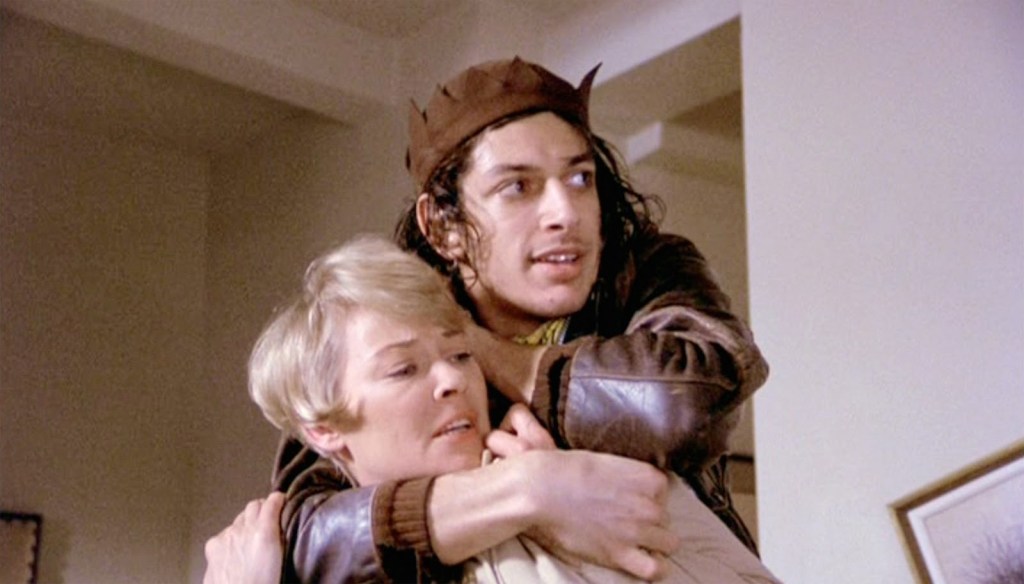
I’ve been a fan of Jeff Goldblum for most of my life. The man has had an amazingly successful career, starring in some of the most financially profitable films ever made, like JURASSIC PARK and INDEPENDENCE DAY!! One of the main reasons that Goldblum is extra special to me, however, is because of his small roles as bad guys in two different Charles Bronson movies in the 1970’s. First, he played one of the thugs who breaks into Paul Kersey’s apartment and assaults his wife and daughter in the original DEATH WISH (1974). Second, he plays a thug who, along with Robert Englund and another less famous guy, tries to rob and assault Raymond St. Ives in the film ST. IVES (1976). I’ve loved telling people about his appearances in these two films for decades, and I don’t see any reason to stop now.

To celebrate Jeff Goldblum’s birthday on the Shattered Lens, I’ve included an “overly edited” video of his appearance in ST. IVES, if nothing else so you could also see the young Robert Englund (Freddy Krueger). I wish I could share the full scene, but this is all I could find on YouTube. Anyway, happy birthday, Jeff! I hope it’s been a great one!

On Stage On The Lens: Sweeney Todd: The Demon Barber of Fleet Street (dir by Lonny Price)


For today’s On Stage On The Lens, we have an excellent 2014 production of a Halloween classic, Sweeney Todd: The Demon Barber of Fleet Street.  This production features not only the New York Philharmonic Orchestra but also Bryn Terfel and Emma Thompson in the lead roles.


Horror Scenes I Love: The Cenobites Make Their First Appearance In The Original Hellraiser


AGCK!

This is from the original 1987 Hellraiser.  The Cenobites were probably never scarier than they were in their very first appearance.  They are all the more horrifying because, rather than being stereotypically good or evil, they’re actually neutral.  They’re doing their job and, if you don’t want to see them, don’t mess around with the puzzle box.  Doug Bradley was brilliant in the role of the head Cenobite (who, of course, would later be known as Pinhead).

October True Crime: The Chase (dir by Paul Wendkos)


When he died in 1988, Phillip Hutchinson was only 24 years old.

Born in Virginia, Phillip Hutchinson served in the U.S. Marines before he was discharged for desertion.  He went on to become a career criminal and a violent one at that.  By the time he was 24, he already had a long criminal record.  In Texas, he was convicted of aggravated assault and ended up with a life sentence.  He escaped from prison by stealing a truck.  (It was his third escape attempt.)  Fleeing Texas, he eventually ended up in Denver.  He is alleged to have robbed four banks in Denver before holding up the Rio Grande Operating Credit Union.  The 18 year-old teller was able to set off a silent alarm and Hutchinson ended up leading police on a chase through Denver.  Following Hutchinson in the air was a news helicopter.  At one point, Hutchinson crashed into an unmarked police car, killing Detective Bob Wallis.

After crashing his own car, Hutchinson continued to run on foot.  Eventually, he reached a trailer park.  He took John Laurienti as a hostage and forced the 73 year-old man to drive him past the police in his pick-up truck.  When the men in the news helicopter realized that the police didn’t realize that Hutchinson was in the truck, they dived down and blocked the truck from moving forward.  The cops, realizing their mistake, surrounded the truck and opened fire, killing Hutchinson while the cameraman in the helicopter continued to film.  John Laurienti escaped from the truck, uninjured.

Phillip Hutchinson really had no one but himself to be blame.  If he hadn’t robbed the credit union, he would have had the cops chasing him to begin with.  If he hadn’t rammed into the unmarked car and killed Bob Wallis, it’s possible that the police would have been more willing to negotiate before opening fire on him.  You can wonder what led to someone, by the age of 24, becoming a hardened criminal and that is something that should always be investigated.  In the end, actions do have consequences.

Phillip Hutchinson is one of those criminals who would probably be forgotten today if not for the fact that his death was not only captured on camera but also broadcast across the television airwaves.  Hutchinson has gone on to have a significant afterlife in various “documentaries.”  Remember World’s Wildest Police Videos?  (I’ve also read that the shoot-out is a popular video on various “forbidden” and “dark” websites but I’m not going to look to find out.)

1991’s The Chase was a made-for-television movie about Phillip Hutchinson and his final ride.  Casey Siemaszko plays Phillip Hutchinson as being a psycho redneck, which is probably not the far from the truth.  Siemaszko gives a good performance as Hutchinson but the majority of the film deals with the people who came into contact with Hutchinson on the final day of his life.  Ricki Lake plays the teller who set off the silent alarm.  Ben Johnson gives a moving performance as the old man who Hutchinson took hostage.  Barry Corbin plays Bob Wallis.  Megan Follows plays a drug addict who narrowly escapes Hutchinson.  Robert Beltran plays the man in the helicopter.  They all give good performances.  At the same time, for a film called The Chase, the Chase itself doesn’t actually start until we’re 70 minutes into the movie and it’s over pretty quickly.  If you’re watching this film for the action, you’ll probably be disappointed.

This film was written by Guerdon Trueblood, who also directed one of my favorite grindhouse films, The Candy Snatchers.  Trueblood’s script follows the standard disaster formula, in that there are a lot of subplots and filler leading up to the big event.  In other words, The Chase isn’t a film for everyone.  I’ll admit, though, that I teared up a little at the end.  Phillip Hutchinson may have been a violent criminal but his death brought a community together.