I don’t know about you but I love watching those old short films from the 50s, 60s, and 70s that were designed to terrify my mom and dad into living a safe, upright, drug-free, patriotic, and community-centric life. These were the short films that were designed to make sure that everyone understood just what exactly the wages of sin were.
What I love about these films is just how melodramatic and judgmental they often were. It wasn’t enough, apparently, to point out that people occasionally made mistakes. No, instead, every mistake had to be accompanied by a very judgmental narrator saying things like, “No, Jimmy didn’t think before ran across that street. And now, he’s dead.”
Seriously, if I had been raised on a steady diet of these films, I would be even more of a fragile, neurotic little thing than I am now!
One of my favorites of these films is presented below. Clocking in at nearly 12 minutes, the classic 1955 scare film Six Murderous Beliefs is designed to make sure that we understand that not only are young people stupid but they’re dangerous as well. The film presents 6 examples of people foolishly believing one of 6 beliefs that are (as the narrator informs us), “wanted for … MURDER!” My personal favorite is the second example just because I’ve had the exact same conversation with my sister Erin.
(I also love how, during the first example, the pilot so clearly despises the jock who doesn’t want to wear a parachute.)
And remember … “One of these beliefs might be about to murder you! So watch carefully…”
Right out of the gate, Men In Black 3 feels dated. Not like something out of the 1960s, which is when most of this film’s story is set, but like something out of the late 90s/early 2000s. Director Barry Sonnenfeld —- who’s had a hell of a time getting other projects off the ground in Hollywood despite helming up two incredibly successful “blockbuster” franchises (MIB and The Addams Family — just in case, like apparently most studio execs, you’d forgotten) — jumps into this thing with so much gusto that you’ll forget within minutes that it’s actually been 10 years since Will Smith’s Agent J and Tommy Lee Jones’ Agent K ran around chasing men from Mars (and even further afield) across the silver screen.
Oh, sure, a lot’s happened in that decade as far as the principals here are concerned — Smith’s been pretty quiet the last few years, for one thing, and Jones has aged pretty visibly and is more or less consigned to supporting roles these days (including here, given that his younger 1960s alter ego, played with impeccable precision by Josh Brolin, actually gets far more screen time than Jones’ present-day version), but it’s pretty clear that when it comes to carrying the load in big-budget brainless summer fare, neither of them has left a step — nor has Sonnenfeld, who puts his foot down on the gas immediately and never once lets up long enough to allow us to do the one thing that’s guaranteed to pulverize the credibility of any glitzy megamiilion-dollar Hollywood FX extravaganza : think.
And ya know what? I wouldn’t have it any other way. Sure, there’s some sappy “bromance”-type crap shoehorned in here, and a love-interest subplot involving the Agent Ks of both the swingin’ Sixties and the present day, but that’s all fine and good too in the limited doses tha Sonnenfeld serves them up. By and large, though, to the shock of absolutely no one, this flick is all about big, flashy, lighthearted, comedic fun, and that’s something that’s sorely been lacking in the midst of all these dour summer movies this year, like Prometheus, for instance, that take themselves just sooooooo seriously.
Men In Black 3, quite clearly, doesn’t, and that’s perhaps its greatest virtue.The plot’s pretty basic time travel stuff — J goes back in time to prevent K from being killed, various hijinks ensue — but this is one of those films that isn’t so much concerned with doing anything new as it is just doing what everybody and their brother (or sister, or cousin) knows it’s there to do and doing it well. Give us a likable cast, some cool eye-candy effects, a couple little nifty quirks like Andy Warhol actually being a “Man In Black” himself, and you know what? You’ve got the recipe for a very familiar, but nonetheless pleasant, little serving of celluloid. It’s not at all filling on an intellectual, or frankly even artistic, level, but come one — does everything absolutely need to be? Sometimes you just want to go out to the movies, shut your brain off, and have a good time. If that’s the kind of mood you’re in, there’s nothing else out there this summer that will satisfy you quite like Men In Black 3.
Last night, I turned over to TCM and I watched the 1968 film Head.
Why Was I Watching It?
Though Head was a notorious box office bomb when it was released in 1968, it has since become notorious as one of the most incomprehensible movies ever made. Every book that I’ve ever read about film or pop culture in the 1960s makes mention of Head. Not only was the film written by a pre-Easy Rider Jack Nicholson, but the film also featured The Monkees literally acting out against their stardom by committing career suicide by appearing the film that was apparently conceived while Nicholson and director Bob Rafelson were tripping on LSD. I’ve read about Head in dozens of books and I’ve seen it described as being “a surreal masterpieces,” “an incomprehensible, pretentious mess,” and “a total head trip of a film.” Having now seen the film, I can say that’s all true.
I do have to admit that before I saw Head, I didn’t know who the Monkees were. Don’t get me wrong — I knew that there was a band in the 60s called The Monkees and I knew that they had their own TV show. Thanks to the fact that The Brady Bunch Movie played on cable for like two months straight earlier this year, I knew which one was Davey Jones. But, that was about it. Even after seeing Head, I’m still not really sure I could tell you which was one was Mickey Dolenz and which one was Peter Tork. I also have to admit that I spent the first half of the film referring to Michael Nesmith as the “Texan with the sideburns.”
Fortunately, I watched Head with two wonderful groups of people on twitter — the TCM Party and the Drive-In Mob. They came together last night and provided a very entertaining live tweet session devoted to the film. Unlike me, they actually knew one Monkee from another and following their tweets helped me survive the film’s rough first half. To all of them, I say “Thank you for the education.”
What’s It About?
That’s not an easy question to answer but I’ll try.
The Monkees jump off a bridge and plunge into the psychedelic waters below but they’re saved from drowning by a bunch of mermaids. This, of course, leads to the four members of the groups finding themselves in scenes from a war film, a boxing film, a western film, and eventually they discover that they’re actually dandruff on the head of actor Victor Mature. Ultimately, they end up wandering around on a studio backlot where they’re menaced by veteran scary actor Timothy Carey and an ominous black box that seems to intent on trapping them. The Monkees react to this by running for their lives, complaining to Jack Nicholson and Bob Rafelson about the script, and telling everyone that they meet that they’re just actors in a film. Eventually, it appears that the Monkees don’t have any options left beyond committing public suicide but Rafelson has other ideas…
What Worked?
If you’re as obsessed with pop cultural history as I am, Head is one of those films that simply you have to see. Even if you find the film to be totally incomprehensible and just a tad bit pretentious, Head is a valuable artifact of its time. Head is a film that could have only been made in the late 60s and it epitomizes everything about the age that produced it. It’s like a cinematic Pompeii.
Now, I have to admit that most of the enjoyment I got out of the first half of the film came more from my own curiosity as a secret history nerd than from the film itself. However, the second half of the film is often times genuinely entertaining. The satire is a bit sharper and the overall theme (i.e., the struggle to maintain your own unique individuality in a world that demands conformity) starts emerge from the film’s mix of surreal images.
For me, the film really picked up with Davy Jones’ performance of Daddy’s Song:
The woman dancing with Davy Jones was Toni Basil, who choreographed all the dance numbers in this film.
Here’s another sequence that I particularly enjoyed. This came towards the end of the film and, as I said on twitter, who doesn’t enjoy a little psychedelic dancing?
What Did Not Work?
While Head had all the virtues of its time, it also had all the flaws. It’s a definite hit-and-miss affair, with the stronger (and occasionally insightful) moments uneasily balanced with plenty of sequences that dragged. As you may have guessed, Head is the type of film that’s brilliant if you’re in the mood for it but it’s rather annoying if you’re not.
“Oh my God! Just like me!” Moments
I would have loved to have been Toni Basil, dancing with Davy Jones in the Daddy’s Song number.
Lessons Learned
Watching Head, I realized that I had discovered this year’s perfect Christmas present. I’m going to get a 100 copies of Head on DVD and give them out to everyone I know. That way, I’ll have an excuse to call everyone up in November and tell them, “Don’t worry, I’m giving you Head for Christmas.” I think, if nothing else, that’ll make me a very popular girl come December.
I have to admit that I’m not a huge fun of Tim Burton’s and I found Dark Shadows to be a bit forgettable but I am looking forward to seeing Frankenweenie. To be honest, I suspect that Burton’s vision is better translated in animated form and, if nothing else, it looks like this film might inspire me to shed more than a few tears.
Here’s the 2nd trailer for Tim Burton’s Frankenweenie.
It’s funny how our expectations going into a film shape our perceptions of it while we’re watching it and, ultimately, our final opinions about it after we’ve seen it. Case in point : yesterday on this very blog I was talking about Snow White And The Huntsman, a movie I frankly expected nothing from, and about how, even though it delivered nothing but a substance-free series of pretty pretty pictures to look at, I wasn’t too pissed off about spending my hard-earned money to see because I wasn’t even sure it would deliver that much (or that little). Today, on the other hand, I’m going to be discussing a flick that I flat-out expected to suck, and that pretty much delivered on those expectations — yet left me feeling pretty well ripped off even though it, too was gorgeous to look at and even though, again, I figured it would be at least as bad as it was, if not worse.
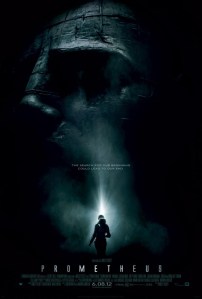
I’m talking, of course, about Prometheus, Ridley Scott’s completely unnecessary Alien prequel. The reasons I went into this with essentially no optimism whatsoever are numerous — Scott hasn’t made a good film since Blade Runner, the script was co-authored by some guy named Jon Spaihts and one of the chief culprits behind the unwatchable, thoroughly confused mess that was TV’s Lost, Damen Lindelof (who’s apparently irked huge segments of the online film geek community with a recent series of over-the-top-in-the-self-serving-department comments), and frankly because any film that set out to “explain” and “demystify” the H.R. Giger-designed evil aliens form the original film series sounded like something with the power to not only be completely pointless (some power), but to actively detract from the impact the first film had by filling in a bunch of blanks that are best left — well, blank.
Of course, there were reasons for optimism, as well — a first-rate cast, sure-fire scrumptious CGI effects, and a promised “return to the Alien series’ roots” after some rather unfortunate side-steps and detours all sounded pretty cool, but I still went into this one prepared for the worst.
I didn’t get that. Instead I got a confused, cliched, every-bit-as-unnecessary-as-I’d-expected mess of a film that, in its defense, at least really does look amazing. Which was enough for me to give Snow White And The Huntsman a pass, admittedly — but hyprocrite that I am I just can’t be as forgiving when it comes to Prometheus. Why not? Because at the end of the day I don’t really give a shit either way about the Snow White legend, but I do care about the Alien franchise. A lot. Scott’s first film rates right up there with John Carpenter’s The Thing on my list of all-time great sci-fi horrors, and I even enjoyed most of the various sequels to one degree or another. So it’s fair to say that, even though I didn’t figure it would be, I still wanted this flick to be good.
So where to begin with the reasons why it wasn’t? Well, how about we start with that stellar cast I mentioned a minute ago. It’s completely wasted. Apart from the film’s “Ripley-lite” protagonist, Dr. Elizabeth Shaw (Noomi Rapace, who turns in a heck of a good performance), none of the characters are developed at all. the very talented Idris Elba is stuck in a one-dimensional role as the titular ship’s captain and can’t even seem to decide what accent he should settle on when he’s speaking. Charlize Theron plays an ice princess — again. Michael Fassbender, at the top of pretty much every current Hollywood “hot” list, turns in a dry, uninvolved turn as the ship’s android that won’t be causing Ian Holm to lose any sleep (although, in Fassbender’s defense, the fact that Spaihts and Lindelof reveal that he’s robotic from the outset doesn’t help matters any). Guy Pearce, as old man Weyland, the expedition’s financier, might as well be replaced with a computer-generated stand-in. There’s even a completely pointless two-second cameo from Patrick Wilson inserted for reasons I can’t even begin to fathom. So much talent with oh so little to actually, you know, do.
Then there’s the script. Dear God, what a disaster. Shoehorning a bunch of unnecessary Chariots Of The Gods-style crap into the Alien “mythos” is about the worst direction these truly Lost writers could have chosen to go. Instead of illuminating anything (not , again, that much “illumination” was really needed — the original story stood on its own just fine), it just muddies the waters. There’s some laughably atrocious dialogue that wouldn’t sound out of place in an Ed Wood film (like when the ship’s geologist, in the midst of a massive freak-out, declares ” I like rocks, right? I really like rocks!”). And the main thrust of the action is essentially a direct carbon copy of the “story arc” from the first film (you know, for instance, who the only survivor is going to be from the outset). It’s like Spaihts and Lindelof can’t decide between trying to do something completely out of left field (albeit thoroughly confusing) or just settling on the same old blueprint so in the end, they go for both — and end up doing each competing narrative impulse a massive disservice.
I keep coming back to the amazing visual prowess Scott’s CGI gurus display here consistently from start to finish, and I suppose it’s worth mentioning one more time just to balance the scales here a bit, but what’s that old saying about lipstick on a pig? Prometheus cakes on the makeup, but underneath, its true face is still that of the victim of a particularly nasty car wreck. And like an accident victim, it’s so disfigured and tragic that you’re almost tempted to feel sorry for it — until you learn that said victim was driving drunk at 150 mph and the person in the other car (I guess that would be the audience in this case — bear with me as I stretch this metaphor way beyond the breaking point) didn’t make it out alive.
It takes an almost Herculean effort to not be as bad as I was fearing Prometheus would be yet still somehow leave me feeling even more cheated and let down than I would have felt had it actually been even worse (if that makes any sense at all) —yet that’s exactly what Scott, Spaihts, and Lindelof have managed to do here. File that under “go figure” and then, to return the already-worn-out accident metaphor, move along, folks — nothing to see here.
Today, Arleigh and Pantsukudasai have left town to attend the Anime Expo and I find myself momentarily alone here at the TSL Bunker, curled up on the couch in my beloved Pirates t-shirt and Hello Kitty panties, and cursing my asthma. As I lay here, it occurs to me that it’s been a while since I’ve shared a “scene that I love” here on the site. So, why not rectify that situation now?
Norman Jewison’s 1972 film version of Jesus Christ Superstar is a film that I’ve been meaning to review for a while but for now, I just want to share my favorite scene from that film, the performance of Simon Zealotes/Poor Jerusalem.
There’s several reasons I love that scene but mostly it just comes down to the fact that it captures the explosive energy that comes from watching a live performance. Larry Marshall (who plays Simon Zealotes) has one of the most fascinating faces that I’ve ever seen in film and when he sings, he sings as if the fate of the entire world depends on it. That said, I’ve never been sold on Ted Neely’s performance as Jesus but Carl Anderson burns with charisma in the role of Judas.
Mostly, however, I just love the choreography and watching the dancers. I guess that’s not that surprising considering just how important dance was (and still is, even if I’m now just dancing for fun) in my life but, to be honest, I’m probably one of the most hyper critical people out there when it comes to dance in film, regarding both the the way that it’s often choreographed and usually filmed. But this scene is probably about as close to perfect in both regards as I’ve ever seen. It goes beyond the fact that the dancers obviously have a lot of energy and enthusiasm and that they all look good while dancing. The great thing about the choreography in this scene is that it all feels so spontaneous. There’s less emphasis on technical perfection and more emphasis on capturing emotion and thought through movement. What I love is that the number is choreographed to make it appear as if not all of the dancers in this scene are on the exact same beat. Some of them appear to come in a second or two late, which is something that would have made a lot of my former teachers and choreographers scream and curse because, far too often, people become so obsessed with technical perfection that they forget that passion is just as important as perfect technique. (I’m biased, of course, because I’ve always been more passionate than perfect.) The dancers in this scene have a lot of passion and it’s thrilling to watch.
Good Morning! It’s Thursday and we all know what that means. The weekend is approaching and that means that all the usual temptations of the weekend are approaching as well. These temptations include drinking, smoking, dancing, premarital sex, prostitution, and near incest.
These are the temptations that are dealt with in the 1934 film The Road To Ruin.
Do you have an hour to spare?
If so, consider watching this film (a personal favorite of mine) and learning from the mistakes of Ann Dixon…
Here’s a few interesting facts about The Road To Ruin:
The Road To Ruin is a prototypical example of the first independent films. Films like this one dealt with “social problems.” Typically, they would be about an “innocent” who would be led astray for 55 minutes before spending the last 10 minutes of the film either repenting or suffering the consequences of their actions.
Since these films were shot outside of the Hollywood establishment, they were also “free” to show things that studio films wouldn’t even hint at. By today’s standards they may seem “tame” but for the 1930s, they were considered to be quite scandalous.
This film is an almost shot-for-shot remake of a silent film that was also called The Road To Ruin. The first Road to Ruin was the top-grossing film of 1928 and was directed by Norton Parker. Helen Foster played the lead role in both versions of the film.
According to the opening credits of the 1934 Road to Ruin, the remake was directed by Melville Shyer and “Mrs. Wallace Reid.” Mrs. Wallace Reid was actually Dorothy Davenport, a former silent film starlet. After her husband — the actor Wallace Reid — died of a drug overdose in 1923, Davenport directed several “social problem” films as Mrs. Wallace Reid.
Despite the fact that this film is, technically, quite primitive, I love it for several reasons. The historian side of me loves that the film basically serves as a time capsule, preserving the society and the attitudes that produced it.
The film lover in me loves just how melodramatic this film is. Seriously, I love how smoking cigarettes and sneaking a drink always serve to pave the road to Hell in films like this one. It’s interesting to contrast a film like this with modern-day anti-drug propaganda.
Finally, as a lover of exploitation films both new and old, I love how this film shows off everything that it’s claiming to condemn.
Having proven yesterday how little I know about all things vampire with my review of Abraham Lincoln : Vampire Hunter, I figured I’d take a crack at another mythic genre, namely the fairy tale — or “folklore,” if you prefer — today. Why stop when you’re on a roll, right?
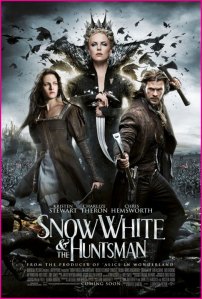
To be honest, though, I guess what we’re here to talk about isn’t even “folklore” per se so much as the modern interpretation of a very popular piece of folklore indeed, since the film under our microscope this evening is first-time director Rupert Sanders’ Snow White And The Huntsman, the second “reimagining” of the Snow White legend to hit the screens this year following hot on the heels of Mirror, Mirror, and definitely the decidedly more “mature” of the two.
There were, frankly, a lot of reasons to be skeptical about this movie going in — Kristen Stewart sure isn’t my idea of perfect casting in the lead, for one thing — but on the whole, I actually walked out of this one pleasantly surprised. Not blown away, by any means — hell, not even bowled over — but it visually arresting enough and well-paced enough to sustain my interest throughout, even though the idea of Snow White as some kind of bad-ass warrior queen seems absurd to a guy like me who basically only knows the Disney version, and remembers it very faintly at that.
Sanders, who I understand got his start in music videos, definitely brings the kind of “these folks have a short attention span, so let’s not let up on the gas” attitude you’d expect from somebody fresh out of that milieu, and while he doesn’t really seem to be much of an actor’s director — Charlize Theron in given free reign to ham it up to the hilt with her interpretation of the evil Queen Ravenna, Chris Hemsworth is essentially just reprising his Thor role as the co-titular Hunstman, and Stewart does what she does “best,” namely look completely lost but somehow project an attitude that we’re supposed to think that’s “sexy,” and that we’re damn lucky she even inhabits the same planet as us mere mortals, as Snow White herself — but when he’s laying out a visual feast this scrumptious, I can live with a few of the ingredients being a bit sour and/or stale.
And what a feast it is! Yeah, there’s definitely a lot of liberal borrowing from the Tim Burton playbook going on here, particularly with little tricks like superimposing the heads of the likes of Bob Hoskins and Ian McShane onto CGI dwarves’ bodies, but Sanders’ overall vision of the fantastic is considerably less color-saturated and joyful than Burton’s, and frankly a little edgier. When Burton goes “dark” or “morbid” he does so with his tongue firmly planted in his cheek, while Sanders really seems to mean it — this shit is supposed be more than just a little bit intimidating.
In that sense, he’s probably closer to the original intent of the Brothers Grimm and their contemporaries than he may even have consciously been aiming for, since “fairy tales” weren’t just designed to keep the young’uns of years gone by entertained, but to scare the shit out of them by illustrating the consequences of what would happen if they didn’t do as they were told, as well. There’s irony, I suppose, in the fact that this film, clearly billed as an “adult” take on the Snow White legend, actually ends up being closer, in tone and spirit, to the original than the decidedly more “family-friendly” Mirror, Mirror, but it’s the kind of irony I can certainly get behind, especially when the end result, while ultimately as disposable as most any other summer blockbuster fare (notice how pretty much all my praise here is aimed solely at the film’s visual sensibility and nothing else — there’s good reason for that, as the story is essentially exactly the kind of hollow, by-the-numbers modern Hollywood take on the proceedings that you’d expect), is this downright fascinating to look at. Beneath the surface, there’s not much of anything going on in Snow White And The Huntsman, to put things as kindly as possible —but the surface is so damn lush, cryptic, and enthralling that you won’t realize, or even care, that you’ve pretty much been had until well after you leave the theater.
I’m not exactly sure what the advertising tagline is for this film — as a matter of fact, near as I can tell it doesn’t seem to actually have one — but I know what it ought to be : “Silver — It’s Not Just For Werewolves Anymore.”
Look, I don’t consider myself to be a scholar of the vampiric arts (or whatever they’re called) by any means — I’ve never seen True Blood or any of the Twilight films, for instance — but I know what kills these guys : wooden stakes through the heart. Garlic. Holy water. Sunlight.
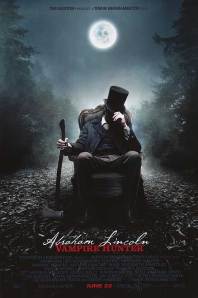
Silver? That’s for lycanthropes. But apparently not anymore. Or, rather, not in the 1800s. Don’t get me wrong — director Timur Bekmambetov’s Abraham Lincoln : Vampire Hunter (based on the novel of the same name by Seth Grahame-Smith, who also wrote the screenplay, and produced by Tim Burton, whatever that’s worth) is a clever enough little piece of throwaway historical revisionism : vampires were responsible for the death of Honest Abe (Benjamin Walker)’s parents and so, concurrent with his rise in politics, he also undertakes a crusade, under the watchful eye of his mysterious mentor, Henry Sturgess (Dominic Cooper) to kill as many of them as he can in his off-hours with this kick-ass silver-bladed trick axe that he’s got. To make matters even worse, these dastardly vampires also control the slave trade (guess it’s too controversial these days to point out that it was other human beings who were responsible for shackling, buying, selling, and ultimately working to death their brethren for generations), and we know how the man in the stove pipe hat felt about that whole dastardly business.
Okay, fair enough — while I’m sure our fellow countrymen and women south of the Mason-Dixon line might take some offense at the idea that their side in the war is depicted here as being controlled by vampires, my honest response to that is one of “tough shit, you’re getting off easy — your real ancestors (not that it’s in any way rational to hold people responsible for the actions of their forefathers) were fighting to keep people enslaved not because they were manipulated by supernatural forces but because they were just plain greedy and racist. Feel better now?,” in point of fact it’s actually a pretty clever pretense. Even clever enough to (almost) sustain an entire film.
But then we come back to this whole goddamn silver thing. Seriously, it’s like vampire Kryptonite in this flick. There’s just no getting around how easy it makes to kill ’em off. And that undermines what otherwise would be a pretty entertaining enough little thrill ride. The performances are perfectly decent on the whole. The costumes, sets, and effects, are all top-notch. The historicity, while complete bullshit, holds together coherently enough. And the whole thing doesn’t take itself too terribly seriously, always something this reviewer in particular appreciates. But the sheer amount of suspension of disbelief required to actually thoroughly (as opposed to in a rather half-hearted and detached “oh, that’s kinda clever” sort of way) enjoy this film becomes a bridge just a tad too far when we throw this annoying new mega- wrinkle into the vampire mythos. I get why they did it, but it grates just the same, and Grahame-Smith’s story relies on it so heavily that it takes what would otherwise be an acceptable enough deus ex machina and turns it into a thick, heavy, lumbering, unyielding crutch. Think of it as the silver straw that breaks the camel’s back.
Last night, I watched yet another “original” movie on the SyFy network. This one was called Arachnoquake.
Why Was I Watching It?
First off, how do you not watch something called Arachnoquake? The title itself is just pure genius in that it not only tells you that the film is about spiders and earthquakes but it also lets you know ahead of time that this is a movie to have fun with.
Also, I was watching because I still have good memories of watching Jersey Shore Shark Attackearlier this month.
What’s It About?
So basically, there’s an earthquake in New Orleans and a bunch of gigantic, extremely venomous albino spiders are released out into the city and the bayou. However, these aren’t just your typical giant albino spiders. No, these are giant albino spiders that can breathe fire and walk on water. It’s kinda like Treme, just with more spiders and less Steve Zahn.
In fact, there’s no Steve Zahn in this film at all! However, there is Edward Furlong, playing a greasy-haired guy who is stuck driving a school bus with a bunch of female softball players on it. Meanwhile, Furlong’s asthmatic wife (Tracey Gold) is stuck on a trolley that’s being driven by a guy played by Bug Hall. And, best of all, there’s also a really badly tempered old guy named Gramps on the trolley as well. Gramps, sad to say, doesn’t stick around for too long but for the first 30 minutes of the film, he was all that we could talk about on twitter…
What Worked?
Listen, if you’re going to bitch and whine about narrative logic, cheap special effects, and silly dialogue while watching a movie like Arachnoquake, you’re kinda missing the whole point of the film. This is a movie that was made to inspire people to talk back to the TV. Arachnoquake doesn’t take itself all that seriously and neither should you. I mean, yes, the spiders looked faintly ludicrous when they showed up in the bayou, chasing after a motorboat. But I suspect that was kind of the point.
Arachnoquake is a film that was made to be viewed as part of a communal experience. I understand that they actually had viewing parties down in New Orleans and I would have loved to have been at one of them! (And I think I could have gotten all sorts of beads tossed at me as well…) However, I settled for live tweeting the film on twitter and that was so much fun! I got to talk to other people who were watching and enjoying the film and even better, the film’s director and some of the performers (especially Megan Adelle) joined in on the live tweet and actually responded to those of us who were talking about their film. Not all of the comments were positive (at one point, director Griff Furst responded to one online critic with, “Blow me.”) but it was still a lot of fun and, if anything, it showed that the filmmakers knew and appreciated their audience. Both the film and the whole communal viewing experience were a lot of fun!
Finally, I think just about everyone on twitter agreed that the highlight of the film was the character of Gramps (played by Grant James). SyFy films are full of cantankerous old men but few are quite as cantankerous as Gramps. We were all a little bit sad to see Gramps die about 30 minutes into the film. Personally, I’m hoping that he returns in a sequel and gets to utter the line, “When you get to Hell, tell ’em Gramps sent you…”
I also hope that the sequel is set during Mardi Gras.
What Did Not Work?
(Spoiler Alert. Seriously, no joke — massive spoiler ahead)
The character played by Tracy Gold spend almost the entire film having an asthma attack and, finally, during the final 15 minutes of the film, she dies as a result. I have to admit that bothered me a lot, both because I actually have asthma but also, and more importantly, because it just felt jarringly out-of-place in what had been, up to that point, a really fun B-movie.
Don’t get me wrong — it wouldn’t have bothered me if Gold had been killed as the result of being wrapped up in a spider web or something. That would have worked well with the tone of the rest of the film. But having her die as a result of not having her inhaler — it just hit too close to home for me and it was just so different in tone from the rest of the film that it briefly made it difficult for me to get back into the right B-movie mindset that’s necessary to truly enjoy a film like Arachnoquake.
“OH MY GOD! Just like me!” Moments
Well, obviously, I related to poor Tracey Gold and her asthma attack. But, beyond that, I could also relate to all the characters in the film because I hate the thought of being in an earthquake and I don’t care much for spider. Especially gigantic albino ones that breathe fire…
Lessons Learned
I will always double-check to make sure I have my inhaler before I leave the house. Also, if I ever find myself stranded in the country with a gigantic albino spider coming towards me, I hope some greasy-haired guy is there to beat it to death with a softball bat while screaming, “Now that’s how you make jambalaya!”