What Lisa And The Snarkalecs Watched Last Night #73: Flying Monkeys (dir by Robert Grasmere)


Last night, the Snarkalecs and I watched a SyFy original movie called Flying Monkeys.

Flying Monkeys

Why Were We Watching It?

Because that’s what we do!  Every Saturday night, the Snarkalecs get on twitter and watch a SyFy movie together.  Add to that, the minute that we saw that the film was called Flying Monkeys, we knew we had to watch it and try to come up with as many bad monkey pun as possible.

What Was It About?

It all takes place in the little town of Gale, Kansas.  (Named, I assume, after Dorothy Gale from The Wizard of Oz.)  Joan (Maika Monroe) is upset because her dad is late to her high school graduation.  So, Dad says sorry by buying her a pet monkey.  He’s a cute little monkey and Joan names him Skippy.

What Joan and her Dad don’t realize is that Skippy is a demon monkey and, whenever the sun goes down, he sprouts wings, flies around the town, and kills people.  Even worse, it turns out that every time somebody shoots Skippy, this causes Skippy to reproduce and multiply.  Since everyone in the town of Gale shoots Skippy at least once or twice, there are soon hundreds of killer flying monkeys all over the place.

Luckily, two demon hunters from China manage to get to Kansas in record time but then … well, let’s just say that, as far as demon hunting is concerned, they were both definitely overrated.

What Worked?

As far as I’m concerned, almost the entire film worked.  Seriously, how can you not enjoy something this ludicrous?  The makers of Flying Monkeys knew exactly what they were doing and it looks like they had a good time doing it.

Plus, Skippy was so cute!

Seriously, how can you not love a film featuring a killer named Skippy?

What Did Not Work?

The film spent a lot of time building up these two demon hunters from China but, once they showed up, they both turned out to be pretty useless.  I understand that was probably the point but still, it felt like the only reason they existed was to pad out the film’s running time.

“OH MY GOD!  Just like me!” Moments

Towards the end of the film, Skippy attempts to attack Sonya (Electa Avellan, best known for being one of the Babysitter Twins in Grindhouse) in the shower and Sonya reacts by literally running all the way to the other side of town while clad only in a towel.  At the time, we all pointed out how gratuitous this whole scene was.

After the movie ended, I took a nice, long, relaxing shower.  It was only after I had stepped out of the shower and turned off the water that I realized 1)  just how hard it was raining outside and 2) that I couldn’t remember if my car windows were open.

The idea of my car getting flooded so panicked me that, despite being clad in only a towel, I ran outside to make sure my windows were up.  Long story short, my windows were closed, I got even more wet, and I learned that, sometimes, you just have to go outside wearing a towel.

Lessons Learned

Don’t mess with Skippy.

Scenes That I Love: The Filibuster Scene From Mr. Smith Goes To Washington


mr-smith-goes-to-washington

Though some might find it hard to believe, I usually try to keep my personal politics separate from my film reviews.

If there’s anything that truly bothers me about critics like Roger Ebert and his kind, it’s that they often seem to be more concerned with promoting their own personal political views than with actually reviewing the film that they’ve just seen.  That’s why you find Ebert throwing a fit over a merely mediocre film like Atlas Shrugged while, at the same time, going out of his way to praise the ludicrous remake of Straw Dogs.  That’s also why you find a website like Awards Daily devoting a month to posts attacking a “documentary” like 2016 while, at the same time, praising the latest piece of propaganda from Michael Moore (often times before either one of the documentaries has even been viewed).

I won’t claim to be totally unbiased in my reviews.  I’ve always been open about the fact that 1) I’m a civil libertarian and 2) I view all politicians (including both our President and the majority of the people who ran against him in 2012) with a certain amount of disdain.  That said, for the most part, I try to set aside my own political beliefs when it comes to talking about the movies.  When I find that I can’t set those beliefs aside, I make it a point to be honest about my bias.

For instance, today’s scene that I love is a great scene from a great film.  But I’d be lying if I said that this selection had nothing to do with Rand Paul’s 13-hour filibuster about why the President (and, by that, I mean any President) does not have the right to blow up American citizens on American soil.  While I would hope that everyone understands that my opinion does not necessarily reflect that opinion of any other contributor to the TSL, I’m still not ashamed to admit that both me and my sister, the one and only Dazzling Erin, found the time to watch at least a few minutes of C-Span 2 yesterday and cheer Rand Paul on.

During Paul’s filibuster, a lot of people on twitter made the comparison between his filibuster and Jimmy Stewart’s filibuster in the classic 1939 film, Mr. Smith Goes To Washington.

However, the genius of Frank Capra’s classic look at one idealist trying to survive in a cynical world is that you can enjoy the filibuster scene regardless of whether you’re a Republican, Democrat, or Independent.  Whether you think that the comparison between Sen. Paul and Sen. Smith is fair or not, you can still appreciate the scene as an iconic moment in American cinema and as a reflection of the idealism that far too few of our current leaders seem to possess.

Without further ado, here’s the filibuster scene from Mr. Smith Goes To Washington…

Incidentally, just for the sake of humor, I also wanted to include the filibuster scene from Mr. Smith’s unnecessary 1977 remake, Billy Jack Goes To Washington.  Unfortunately, the Billy Jack version has not been uploaded to YouTube.  So, here’s the trailer for Billy Jack Goes To Washington.

(Billy Jack Goes To Washington, incidentally, proves just how important Jimmy Stewart was to the success of Mr. Smith Goes To Washington.  The Billy Jack version is an almost shot-for-shot remake but, without Stewart’s likable sincerity, the story comes across as being so heavy-handed and preachy that you actually find yourself rooting for the members of the corrupt political establishment.)

Trailer #2: Iron Man 3


iron-man-3-gwyneth-paltrow-robert_downey-jr-side-by-side-trailer.

A second trailer for Iron Man 3 was released earlier today and watching it, all I can say is that it looks like maybe the film would be better titled Iron Men.

As for me, I’ve never read a comic book (with the exception of a few issues of Strangers in Paradise) but so far, I’ve loved each and every one of the Marvel super hero films.  (And yes, that includes Iron Man 2.)  I was looking forward to Iron Man 3 even before I saw this trailer and now, I’m even more excited about the film.

Seriously, you can’t go wrong with Robert Downey, Jr. acting like a self-absorbed narcissist with a glowing heart of gold.  Nobody does it with as much charm and style as Downey.

Iron Man 3 is set to be released on May 3rd.


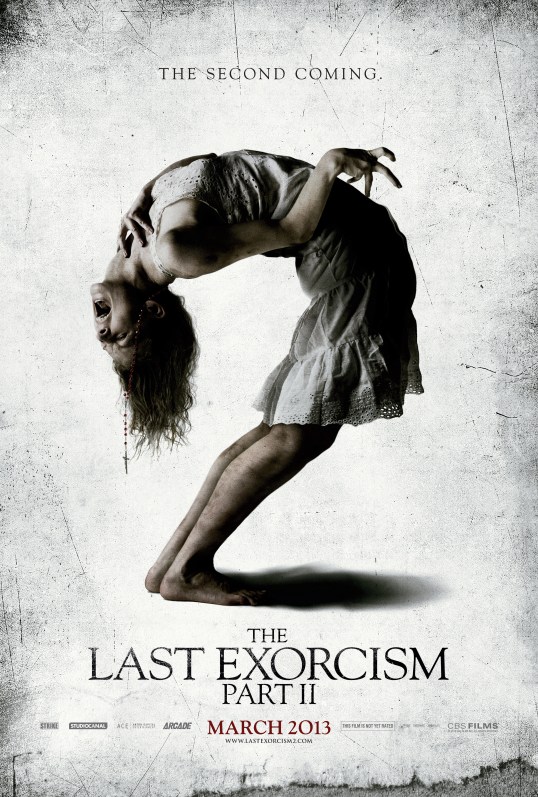
Film Review: The Last Exorcism Part II (dir. by Ed Gass-Donnelly)


Though it was dismissed by a lot of critics and remains underrated to this day, The Last Exorcism is one of the best horror films of the past four years.  Featuring an excellent lead performance from Patrick Fabian and an intelligent, thought-provoking plot, The Last Exorcism was both a very creepy horror movie and a surprisingly effective character study.  It even managed to be effective despite being an example of a “found footage” horror movie.

The Last Exorcism‘s sequel — the unimaginatively titled The Last Exorcism Part II — was released this weekend.  Like a lot of people, I have to admit that I wasn’t expecting much from the sequel.  The first film’s success was such a surprise that I doubted that the sequel could come close to matching it.

To a certain extent, I was right.  The sequel is nowhere near as good as the first film.  However, that said, The Last Exorcism Part II is still an above average horror film.

Ashley Bell

Wisely abandoning the whole found footage format, The Last Exorcism Part II begins with Nell (played, again, by Ashley Bell) as the only survivor from the previous film.  After escaping the cult that previously attempted to sacrifice her, Nell finds herself put into group home in New Orleans.  The group home is run by Frank Merle (Muse Watson), a friendly (if vaguely threatening) man who encourages Nell to try to move on from her traumatic past.  With Frank’s help, Nell starts to recover.  She gets a job working as a motel maid, makes friends with some of the other girls at the home, and she even starts to flirt with shy Chris (Spencer Treat Clark).

Everything seems to going so well for Nell.

Or is it?

Despite her claim that she no longer believes that she was ever possessed, Nell still finds herself being watched by menacing, masked figures who pop up on random street corners.  She still receives mysterious phone calls.  She’s still haunted by visions of her dead father walking through the dark hallways of the group home.  Nell is still having nightmares where she’s seduced by an unseen creature and her roommate and new best friend Gwen (Julia Garner) still seems to be oddly amused by any type of human suffering.

And that’s not even taking into consideration the voodoo priestess who follows Nell up and down the streets of New Orleans…

As opposed to the first film, The Last Exorcism Part II is a pretty conventional horror film.  Whereas the first film kept you constantly wondering whether Nell was actually possessed and made some surprisingly intelligent observations regarding the battle between faith and reason, The Last Exorcism Part II never gives you any reason to doubt that both the demon and the possession are real.  Whereas The Last Exorcism was a horror film that could be appreciated even by people who hated horror films, The Last Exorcism Part II is pretty much a film for horror fans only.

Fortunately, I happen to be a horror fan and I was pleasantly surprised by The Last Exorcism Part II.  While director Ed Gass-Donnelly shows little interest in rewriting the rules of the horror, he also shows that he can effectively work within the conventions of the genre.  He even uses the PG-13 rating to the film’s advantage, making up for the lack of gore by emphasizing the otherworldly atmosphere of New Orleans.

It also helps that Ashley Bell returns in the role of Nell.  As is typical of other possession movies (like the Exorcist, to cite an obvious example), the demon inside Nell can just as easily be taken as a metaphor for Nell’s emerging sexuality.  Ashley Bell gives a performance that walks a perfect line between innocence and carnality.  Much as Patrick Fabian’s performance elevated the first film, Bell’s performance elevates the second.

That said, The Last Exorcism Part II is ultimately the type of film where people tend to spend a lot of time wandering around dark hallways in the middle of the night without ever bothering to turn on a light.  It’s up to each individual  member of the audience to decide whether they’re going to demand to know why nobody turns on the lights or whether they’re simply going to enjoy waiting for the inevitable “jump” scene that we all know is coming.  If the audience is willing to set aside logic and enjoy a movie for what it is, then they are the ideal audience for a film like this one.

Perhaps not surprisingly, The Last Exorcism Part II has not received a lot of critical praise.  The film was not screened for critic prior to release and now that it has been released, it has a 15% overall rating over at Rotten Tomatoes.  However, you could have guessed that without me even telling you.  Everyone knew that the professional critics were going to hate The Last Exorcism Part II.  This is the type of film that most critics feel almost duty-bound to condemn.  This is also the type of film that reminds us of just how little the critical consensus really matters.  When judged on its own (admittedly limited) terms,The Last Exorcism Part II is an effective and creepy film.  It’s the epitome of a fun and occasionally stupid horror film, the type of movie you want to see with a group of friends who enjoy jumping at things that go bump in the night.

the-last-exorcism-part-2-poster

Trailer: The Conjuring


PCAS

When Jeff and I went to see The Last Exorcism, Part II earlier today, we also saw the trailer for the upcoming horror film The Conjuring.  Even if the film itself looks like yet another attempt to rip-off Insidious, the trailer itself is still undeniably creepy.  I’m not ashamed to admit that I jumped a little at that last clap.

A Blast From The Past: Duck and Cover


Let’s face facts.  We live in a scary world and it’s not getting any safer.  However, before we all give up on the future, maybe we should take a look at the past.  With that in mind, it’s my pleasure to share the 1951 educational short film Duck and Cover.  

Seriously, if Bert the Turtle can survive then I think there might be hope for us all…

This is the epitome of one of those things that simply has to be seen to be believed.  That said, if I was a child in the 50s, I think Duck and Cover would have provided me with some comfort.  After all, Bert is just so cute and the Duck and Cover song is kinda catchy.

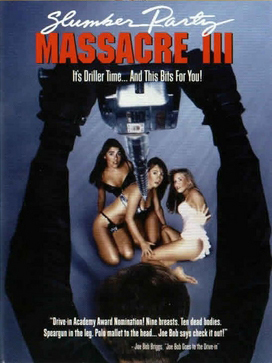
The SPM Trilogy Revisited : “Slumber Party Massacre III”


SLUMBER-PARTY-MASSACRE-III-DVD

What the heck, let’s wrap this up, shall we?

While the appearance of Slumber Party II may have surprised some being that it came five years after the original, it’s safe to say that when Roger Corman unleashed Slumber Party Massacre III  on the direct-to-video market in 1990, nobody was shocked in the least.

Shot primarily at one beach location and one residential home for exteriors, and with all the interiors being filmed at Corman’s Venice, California studio, the third installment in the SPM series cost a grand total of $350,000 and took somewhere in the neighborhood of one week to get “in the can,” as the saying goes, so yeah — it’s cheap , quick stuff we’re talking about here.

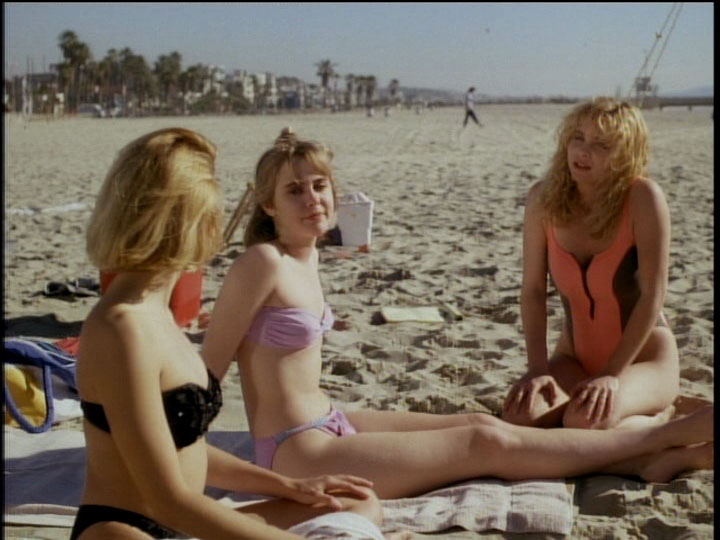
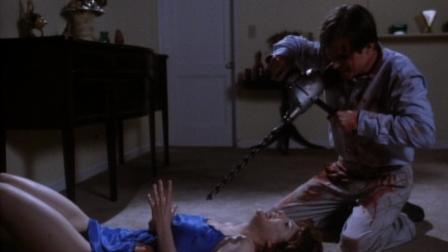
That being said, that certainly doesn’t mean it’s bad. What starts as a pretty bog-standard tale of stereotypical SoCal bimbo Diane (Brandi Burkett) and her friends ( a crew that features a few  young-at-the-time ladies, such as Hope Marie Carlton, Maria Ford, and Keely Christian, whose faces — and other parts — you may recognize from similar early-90s “slasher”/sexploitation fare) playing volleyball at the beach and then returning to Diane’s parents’ place for a weekend slumber party, where they are set upon, in turn, by their prankster-ish boyfriends, a voyeuristic “nosy neighbor” type, a mute Albino creepy dude, and finally a pyscho killer with a power drill, actually morphs somewhere along the way into a flick with a pretty wickedly sadistic, even black-hearted, sense of humor — with a pretty heavy dose of the misogyny you’ve come to expect from these things thrown in, of course.

As a brief case in point, instead of the standard bathtub-electrocution with either a hair dryer or toaster, in SPM III one of the nubile young co-eds is dispatched in the tub by means of a vibrator gone haywire! Nasty stuff, to be sure, but clearly not something that takes itself too terribly seriously while it’s dishing out its feminist-unfriendly — hell, female-unfriendly — goods.

slumberpartymassacre3girls

As with the previous two entries in this series, Corman again opted for an all-female writing and directing team here in order, one would assume, to help deflect any criticism this one might bet from the usual quarters (not that very many people were paying attention by this point), with those duties falling to Catherine Cyran (one of his regular screenwriters at the time) and Sally Mattison (a semi-veteran of Hollywood’s low-budget fringes best known for her work as a producer), respectively, and while it’s fair to say that this film is the most “seems-like-it-coulda-been-directed-by-a-man-ish” of the bunch, given that it ups the ante a bit in terms of its misogyny and plays it much “straighter,” if you will, than its predecessors in terms of sticking to the standard and much-maligned slasher formula, at the end of the day it’s still a pretty tongue-in-cheek affair  that’s just a bit more self-indulgent and gratuitous in terms of the T&A and overall mean-spiritedness.

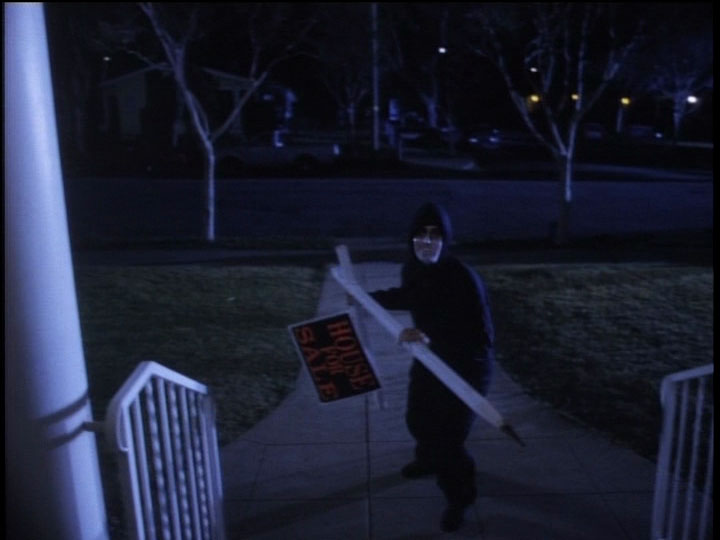
To their absolute, credit, though, Mattison and Cyran, while carrying over the blatant phallo-centrism of the whole power drill thing, at least decide to throw in a bit of “whodunit?”-style mystery into the proceedings vis a vis their killer’s identity. Yes, folks, for the first time in a Slumber Party Massacre movie, the psycho might actually have some motivation for his murder spree here!

Or, ya know, he might turn out to be just some random stranger after all. I guess I won’t “spoil” anything in case you haven’t actually seen it. I will say, however,  that the mystery angle isn’t a particularly involving one — but hell, at least it’s there. We’ve already firmly established that “take what you can get” is the order of business with these things, haven’t we? The same — ahem! — “philosophy” applies here.

spmpt32

All in all,  though, you do get the sense that everyone involved here is giving it their best go on what they’ve got — which admittedly isn’t much in terms of time, talent, and money — but I’d rather watch so-called “D-listers” actually try than “A-listers” sleepwalking through yet another mega-budget production any day of the week. Slumber Party Massacre III may not be particularly ambitious stuff by any stretch, but it’s put together and performed by people who gave an honest day’s effort at the office. That’s worth a little something right there,  and after the absolute clusterfuck of wanna-be “trippy-ness” in the second flick, the “return to roots” sensibility in this one is very welcome indeed.

slumber-party-massacre-iii

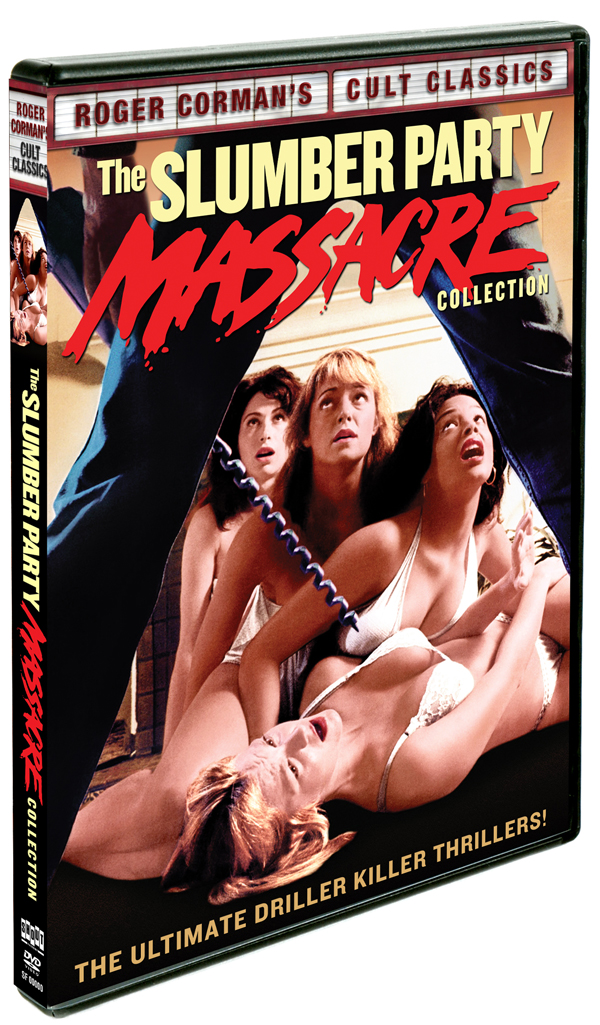
As always, the third and final outing (to date) in the SPM “oeuvre” is available on DVD from Shout! Factory packed together with its older celluloid sisters in a two-disc set under the heading “The Slumber Party Massacre Collection,” part of the “Roger Corman’s Cult Classics” series. It’s presented full-frame with 2.0 stereo sound — and while if there’s been any remastering done with either it’s certainly minimal, the whole thing looks and sounds generally decent enough. Extras include a good little “making-of” featurette, a feature-length commentary with director Mattison, the original trailer, a few trailers for other titles in the Corman series, a poster and still gallery, and a liner notes booklet by Slumber Party Massacre fanatic/filmmaker Jason Paul Collum. A very comprehensive package well worth your time.

slumber082710

Look, who are we kidding? This isn’t a movie out to set the world on fire — hell, it’s not even out to set the DTV slasher world on fire. It’s there to give two distinct parties their money’s worth — Roger Corman and you, the viewer. It manages to deliver on both fronts, even if just barely. That doesn’t mean it’s necessarily worthy of a ton of respect, but it’s not worthy of any sort of scorn, either. Don’t expect too damn much, and you’ll walk away satisfied.

Not, I suppose, that anyone who might be inclined to “expect much” as far as their entertainment choices go  is even watching this in the first place.

Film Review: Mr. Freedom (dir by William Klein)


Mr. Freedom Cover

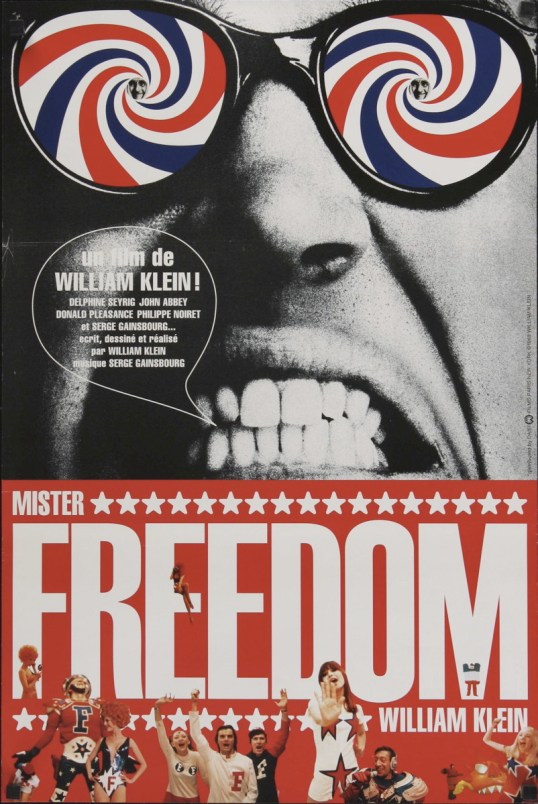
Mr. Freedom, William Klein’s 1968 political satire, is a strange one.

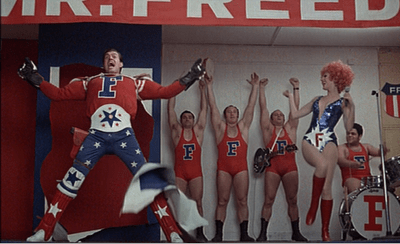
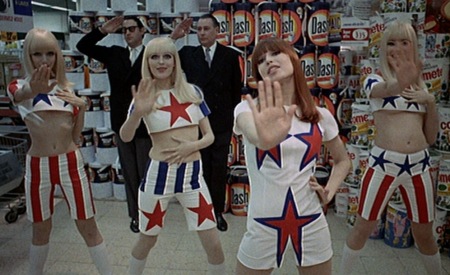
The film opens with a riot in the inner city.  A scowling Southern sheriff (played by John Abbey) goes into his apartment and, when he comes back out, he’s transformed into Mr. Freedom, a patriotic super hero whose is costumed in a red, white, and blue football uniform.  Mr. Freedom proceeds to invade a black household where, while firing two guns, he sings his theme song.

“F-R-Double E-Double D-OM!  FREEDDOM!”

That’s right, he misspelled freedom.

mr_ freedom

It turns out that Mr. Freedom works for Freedom, Inc.  His boss is Dr. Freedom (played by Donald Pleasance) who communicates with Mr. Freedom via a flickering TV screen.  Dr. Freedom is concerned that France is on the verge of turning communist and he sends Mr. Freedom to Paris in order to “win the hearts and minds” of the French.

William Klein, himself, was an American expatriate who lived in France and is best known for being both a fashion photographer and a documentarian.  His view of America is epitomized by the sight of Mr. Freedom (wearing a gigantic cowboy hat) wandering around Paris and assaulting random tourists.  With the help of a prostitute played by Delphine Seyrig, Mr. Freedom attempts to rally the French to the side of freedom and to defeat the schemes of Red China Man.  When the French don’t prove enthusiastic enough, Mr. Freedom responds by making plans to blow the country up.

Mr. FreedomUnlike a lot of left-wing films, which celebrate the American establishment by pretending to attack it, Mr. Freedom is sincere in its politics.  It’s obvious that William Klein set out to make the most anti-American film that he could and he succeeded.  Mr. Freedom is an irredeemable character.  When the film begins, Mr. Freedom is quickly established as being an idiot and, at the end of the film, he has somehow become an even bigger idiot.  Perhaps not surprisingly, a lot of people over at the imdb have compared Mr. Freedom’s quest to conquer France to America’s current policy towards the Middle East.

If you’ve read some of my previous reviews, you would be justified in expecting that this is where I would condemn Mr. Freedom for being heavy-handed and tediously left-wing.  After all, I’m the girl who condemned Avatar for being predictable environmental propaganda.  And yes, I did find Mr. Freedom to be heavy-handed but I actually enjoyed it.

Even if you didn’t know that William Klein was an award-winning photographer both before and after he started making films, you would be able to guess it after taking one look at Mr. Freedom.  The film’s narrative is undeniably uneven but visually, it’s a feast for the eyes.  From the costumes worn by Mr. Freedom and his disciples to the design of Mr. Freedom’s secret headquarters, the screen is full of bold, primary colors and Klein shows a taste and appreciation for the bizarre that makes it easier to deal with the film’s moments of peachiness.  Perhaps my favorite scene in the film involves Mr. Freedom confronting Red China Man.  Red China Man, it turns out, is a gigantic dragon-shaped balloon.

See Mr. Freedom.

There’s nothing else like it.

Red China Man

What Lisa Marie and the Snarkalecs Watched Last Night #71: End of the World (dir by Steven R. Monroe)


Last night, the Snarkalecs and I watched the SyFy original movie, End of the World.  For the next two hours, we literally dominated twitter as we shared our mutual, nearly obsessive love for this film.  Soon, #EndOfTheWorld was a trending topic and, I’m happy to say, that ended up freaking out a lot of paranoid people who weren’t watching SyFy.

All in all, it was a pretty good night.

End of the WorldWhy Were We Watching It?

Because that’s what the Snarkalecs do.  We watch movies on SyFy and we usually get all snarky about them.  However, it was difficult to be snarky about End of the World because the people who made End of The World were obviously very snarky themselves.

What Was It About?

The world’s being bombarded by chunks of electromagnetic space debris.  Or something like that.  Really, the important thing to know is that the world’s about to end and it’s up to two video store clerks (played by two titans of nerdy adorability, Greg Grunberg and Neil Grayston) to save it.  Their solution involves breaking a sci-fi writer named Doc Brown (Brad Dourif) out of a mental asylum and Greg Grunberg working on a nuclear missile with a power drill.

However, to be honest, the plot is just a distraction.  The storyline is mostly used as an excuse to make clever references to nearly ever science fiction movie ever made.  Some of the references are obvious and some of them are a bit more subtle but, ultimately, they are what this movie is truly about.

What Worked?

It all worked.

Seriously, End of the World is the best film that I’ve ever seen on SyFy.  It was a film that was obviously made by genre fans for genre fans and, as a result, it felt like a belated Valentine’s Day present from the SyFy network to its viewers.

As I previously mentioned, the entire film is basically a collection of references and homages to other science fiction films.  While this is a technique that I’ve found cloying when used by other films, End of the World struck exactly the right tone.  The references were appreciative without over going overboard and, even more importantly, they were cleverly deployed throughout the film.   They moved the film forward and seemed to grow organically out of the action onscreen.  As a result, even with all the references, the film itself never felt heavy-handed.

Greg Grunberg is one of those great actors who can perfectly sell both comedy and drama.  His talents were on perfect display last night.  Perhaps the best Grunberg line of the night was, “It’s a monologue!  MONO!”

Brad Dourif didn’t have a lot of screentime but seriously, he  was just adorable.

Really, the whole film was just adorable.

What Did Not Work?

It all worked.

“Oh my God!  Just Like me!” Moments

Much like the character of Selena (Caroline Cave), I think Greg Grunberg’s pretty awesome.

Lessons Learned

The geeks shall inherit the Earth (but only after the Redheads are finished with it).

Film Review: Django Kill (dir. by Giulio Questi)


2228_spoiler_DjangoKill_t588

Released in 1967 and directed by Giulio Questi, Django Kill is one of the essential spaghetti westerns.

The film opens with a man literally clawing his way out of a shallow grave.  Played by Tomas Milian and known as the Stranger, the man is a Mexican outlaw who has been buried out in the middle of the desert.  Two sympathetic Indians discover the Stranger and, while they nurse him back to health, he has several flashbacks that explain how he came to be buried alive.

The Stranger was a member of a gang of thieves who stole a cargo of gold.  However, the Americans in the gang betrayed the Mexicans, gunning them down and fleeing with the gold.  The Indians agree to help the Stranger find the rest of his gang on the condition that the Stranger tell them what it was like to be dead.

The Stranger’s former gang, meanwhile, has arrived at a desolate town known as Unhappy Place.  From the minute that the gang first rides into town, we know that there’s something sinister about Unhappy Place.  A naked child stands in the middle of the street while another is used as a footrest by one of the adults.  A distraught woman watches them from behind a barred window.  A lame hedgehog drags itself across the dusty street.  As soon as the gang stops at the local saloon, the locals see the gold that they’re carrying and, in a shockingly brutal scene, the townspeople lynch the outlaws.

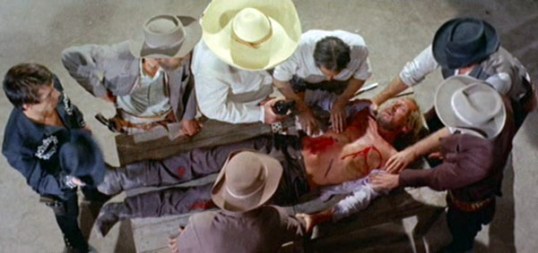
While this is going on, the Stranger rides into town.  Spotting the last living outlaw, the Stranger proceeds to gun him down.  In one of the film’s more infamous scenes, when the townspeople learn that the Stranger is using gold bullets, they proceed to literally rip the outlaw to pieces in an effort to retrieve the golden bullets.

With the outlaws dead, the townspeople claim the gold for themselves.  The Stranger, who was apparently more interested in revenge than getting the gold, stays in town and watches as things get increasingly weird.

How weird?

Well, how about the fact that the Stranger ends up having a romance with a crazy woman who spends her days trapped behind a locked door?

Or how about the fact that the Stranger finds himself in the middle of a power struggle between the townspeople and the flamboyantly homosexual Zorro (played, in grandly villainous fashion, by Roberto Camardiel) who rides into town with a gang of cowboys who are all dressed in black outfits with white embroidery?  In another one of the film’s infamous scenes, Zorro and his cowboys kidnap and gang rape the son of the town’s saloonkeeper.

(A young Ray Lovelock, who would go on to be one of the best actors to regularly work in Italian exploitation plays the son.)

Or how about the scene where Zorro plays with a bunch of Civil War figures while arguing with his pet parrot?  When Zorro offers the parrot a drink, the parrot replies, “I want more!”

Or, how about the fact that the Stranger, at one point, has to deal with several vampire bats while literally hanging from a cross?

Graphically violent and full of bizarre and disturbing imagery, Django Kill is one of the strangest westerns ever made and that strangeness keeps the film interesting even when the story doesn’t make much sense.  While Django Kill may not be the masterpiece that several claim it to (the film runs on a bit long and the dubbing of the English language version was absolutely terrible), it’s still one of the most compulsively watchable films that I’ve ever seen.  Just when you think the film can’t get any stranger, it does.

Django Kill was filmed under the title of If You Live, Shoot!  However, in a move typical of Italian cinema, the film was retitled to take advantage of the popularity of Sergio Corbucci’s Django.  The implication, of course, is that Tomas Milian is playing the same character here that Franco Nero played in Corbucci’s film.  Of course, nothing could be further from the truth.  Even in the crudely dubbed English version of the film, Milian is never referred to by name.  Instead, he’s simply known as the Stranger and, appropriately enough, the film feels more like a surreal take on Sergio Leone’s Dollar trilogy as opposed to being a part of the Django series.

That said, regardless of whether it’s a legitimate Django film or not, Django Kill …. If You Live, Shoot! is more than worth watching.  In fact, it’s essential for anyone who loves Italian exploitation films.

060312-DjangoKill-Post2