 Tom Selleck is Phil Blackwood, a best-selling mystery author who is suffering from writer’s block. Paulina Porizkova in Nina, a beautiful Romanian who has been accused of murder. When Phil sees Nina being arraigned in court, it is love at first sight. He provides her with a false alibi and invites her to stay with him while he writes a book based on her case. At first, Phil thinks that she is innocent but he soon has his doubts, especially after Nina shows off her skills as a knife thrower.
1989 was a strange year for Australian director Bruce Beresford. On the one hand, he directed Driving Miss Daisy, which went on to win the Oscar for the best picture. On the other hand, he also directed Her Alibi, a disjointed comedy that feels like an extended episode of Magnum P.I. (Even Sellecks’ narration feels like a throwback to his star-making role. But if Phil is a best-selling writer, why does his narration sound so clunky and clichéd?) Her Alibi is a predictable film, not really bad but just very bland. It tries to duplicate the style of a classic screwball comedy but it lacks the bite necessary to make much of an impression. On the plus side, the great William Daniels was given a few good lines as Phil’s caustic agent and Paulina Porizkova was absolutely beautiful. The scene where Nina gives Phil a haircut almost makes the movie worth it.
One final note: When watching Her Alibi, be sure to pay attention to the scene where Phil holds up his latest novel. The book is so thin that it looks like it is only 20 pages long, at the most.
 When did your life first start to go downhill?
 In 1987, two weeks into the season, the National Football League Player’s Association went on strike. In the past, player strikes had led to cancelled games and shortened seasons. But in 1987, the owners fought back. Instead of cancelling games, they brought in replacements. Some of the replacements were former college players. Some were players that were recruited from the Canadian leagues or
 Jerry Bolanti (Joe Cortese) is a cocky loud-mouth who has just returned to New Jersey after serving a prison sentence. Jerry needs a work so a mid-level gangster named Tony (Lou Criscuolo) hires Jerry as a debt collector. The problem is that Jerry is just not very good at his job. His attempt to collect money from Bernie Feldshuh (Frank Vincent) leads to Bernie hiring a legendary hitman (Keith Davis) to kill Jerry. Despite working with two experienced enforcers, Joe (Joe Pesci) and Serge (Bobby Alto), Jerry’s next job is just as unsuccessful and leads to even more unnecessary deaths. Tony starts to wonder if maybe he made a mistake giving a job to Jerry and, unfortunately, no one simply gets fired from the Mafia.
 Yesterday, the great character actor Harry Dean Stanton passed away at the age of 91. Cisco Pike is not one of Stanton’s best films but it is a film that highlight why Stanton was such a compelling actor and why his unique presence will be missed.
 Jimmy Dworski (Jim Belushi) is a convicted car thief who only has a few days left in his criminal sentence but still decides to break out of prison so he can go see the Cubs play in the World Series. Spencer Barnes (Charles Grodin) is an uptight ad executive who needs to learn how to relax and have a good time. When Spencer loses his organizer, Jimmy finds it. Before you can say “The prince and the pauper,” Jimmy has access to all of Spencer’s money and the mansion that Spencer is supposed to be staying at over the weekend. While Spencer tries to survive on the streets and track down his organizer, Jimmy is living it up, spending money, impressing a Japanese businessman (Mako), romancing the boss’s daughter, and taking care of business.
 In this filmed version of a hit Broadway musical, four musicians who look like the Beatles from a distance play 3o Lennon/McCartney songs while newspapers headlines scroll over their heads and famous events and figures from the 60s appear on the screen behind them. The camera sometimes follows the musicians backstage as they switch from dark suits to white Magical Mystery Tour tuxedos and later into the uniforms of Sgt. Pepper’s Lonely Hearts Club Band. They also try on a variety of wigs and fake facial hair.
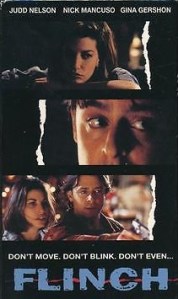 Harry (Judd Nelson) is a law student who has failed the bar exam three times. Daphne (Gina Gershon) is an aspiring actress who has an unfaithful boyfriend. With neither of them making much headway in their chosen careers, they end up working as living mannequins in a department store display window. If they flinch even the least little bit, they will lose their jobs. At first, it does not seem that there is much of a romantic future for Harry and Daphne. But when Daphne breaks up with her boyfriend, Harry invites her to join him in breaking into the store after hours and partying. But while Harry and Daphne are celebrating, they witness a crazed artist (Nick Mancuso) strangling one of his models.

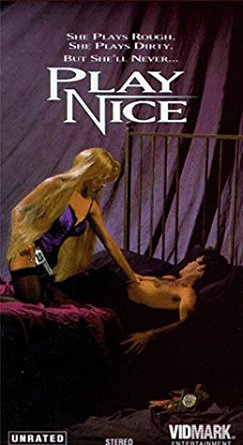 Homicide Detective Jake “Mouth” Penucci (Ed O’Ross) is the most hated man on the police force. His partners hate him. His ex-wife hates him. His daughter will hate him once she is old enough. Penucci is obnoxious, tells terrible jokes, and is haunted by his abusive childhood. The only person that does not hate Penucci is Jill (Robey), who works in the records office. Jill and Penucci are soon an item but it turns out that Jill has some kinky tastes, which make even Penucci nervous. She wants him to beat her during sex and sometimes ask him to pretend that she’s a little girl. At the same time that Penucci is trying to figure out how to have a normal relationship with Jill, he has been assigned to catch Rapunzel, a female serial killer who only targets men who have been accused of sexually abusing their daughters. Could it all be connected?
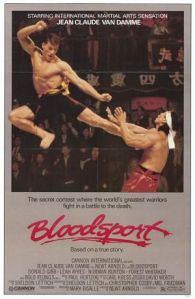 Bloodsport is one of Jean-Claude Van Damme’s earliest films and it is Damme good!
 Through the Shattered Lens