The first official teaser trailer for the third and final installment of Christopher Nolan’s Dark KnightSaga has finally arrived in it’s official form. The teaser had leaked in bootleg form last week. People who went to watch Harry Potter and The Deathly Hallows, Part 2 were able to see the teaser in all it’s glory on the big-screen and from my own experience it was one of the major highlight’s even before the main attraction began.
The teaser trailer plays exactly as it sounds. It teases just enough to begin the buzz and hype which should run a full year before the film’s release. We see glimpses of Tom Hardy in the role of Bane. Most of the teaser has Police Commissioner Jim Gordon in a hospital bed looking like he may have just gone a round or two with Bane. It also brings back the lesson first given to Bruce Wayne by Ra’s al Ghul from the first film about how a man could become a legend. There’s even some Inception-like imagery of crumbling high-rises that could only mean Gotham City itself now under siege.
It’s going to be a long wait til The Dark Knight Rises premieres in the theaters on July 20, 2012.
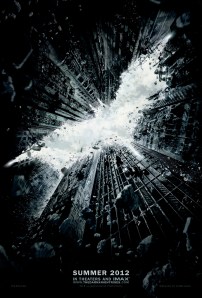
The Official Teaser Poster for The Dark Knight Rises (Copyright 2011 - DC/Warner Bros.)
Just in time for Harry Potter and the Deathly Hallows, Part 2, Warner Bros. has just released the teaser poster for The Dark Knight Rises. It’s a little hard not to get excited about this (I have a Batman Begins poster in my room, so personally, I was waiting for it), but there are a few things I notice:
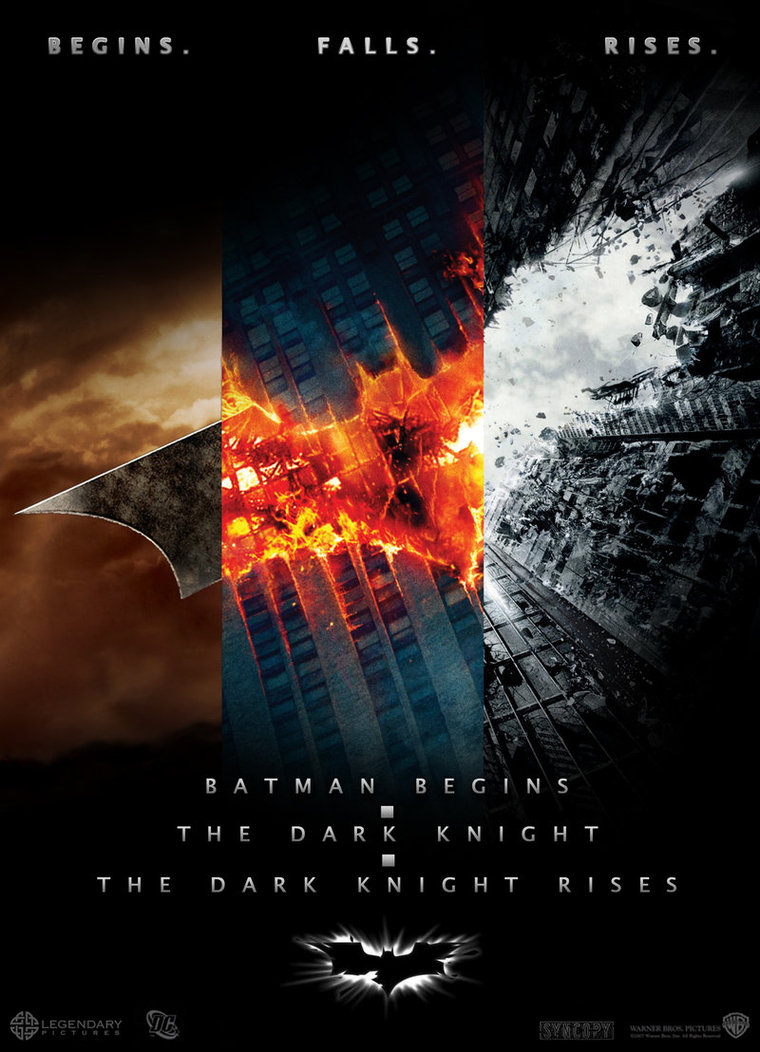
1.) This poster has a mixture of the original Batman Begins Poster with the decay of Limbo in Inception.
2.) It’s thrifty. Maybe they had some old unused Inception concepts out there, and someone said, “Uhh…throw a Bat on it, and we’ll go with that.”
3.) The Dark Knight poster’s elements of fire hinted to the anarchy that the Joker tried to bring in that film. What could this be hinting at? Part of me is hoping for an earthquake, but I’m thinking it may have more to do with Bane’s destructive qualities.
Either way, we’ll all find out some Summer of 2012. Rumor has it that the teaser trailer is due to be tied to the Harry Potter film. If so, that should be interesting.
My weekend was full of sleep, coughing and just vegetating in front of my bedroom tv as I tried to get better from my bout of the cold and flu. For some reason or another AMC channel decided to hold a mini-marathon of David Fincher’s classic neo-noir thriller, Seven, and I must say that I probably saw all three straight showings before sleep finally took over. It surely made for some very unusual, drug-induced dreams.
I’ve always seen Seven as Fincher at his most exploitative best. If there was ever a modern grindhouse exploitation film of the past twenty years I would have to consider Seven as one of them. From start to finish the film just felt grimy and made one feel dirty just for having seen it. Take away all the gloss and veneer afforded Fincher due to modern film technology and techniques this film was grindhouse to its core. No better scene exemplifies and solidifies Seven as a grindhouse exploitation film than it’s shocking, nihilistic ending which bucked traditional Hollywood happy ending (or at least and ambiguous one).
It’s been made famous due to the powerful performances from the three leads who dominate the scene. It is almost played off like a stage play with some gorgeous camera work from cinematographer Darius Khondji switching from Morgan Freeman to Kevin Spacey to Brad Pitt with mathematical precision as the scene unfolds through very strong dialogue by screenwriter Andrew Kevin Walker.
The performances shown by Spacey is both chilling and otherworldly as the sociopathic John Doe urging Pitt’s Det. Mills to become wrath and punish him for his sin of envy. Looking helpless and desperate is Freeman’s Det. Somerset trying to talk some sense and decency to the rapidly unraveling Mills who has just learned that what is inside the box he’s been screaming for is his wife’s head.
The fact that the unfolded and ended the way it did honors the grindhouse sensibilities of past exploitation films where the good guys never always win and even when they do it’s at a very heavy cost to the victor. This climactic ending to Seven is so nihilistic that when the film was first shown in 1995 many walked out grumbling at such a dark and heavy ending. Where was the Hollywood happy ending everyone was so used to. There was no cavalry charging last second to save the day. No deus ex machina intervening to show that Mill’s wife was still alive. No, Fincher and crew knew they had something special in their hands and went full tilt to see it through.
It’s no wonder I still consider Seven to be David Fincher’s best film to date.
Red (which I saw at the dollar theater this previous Monday) is a lot like the boy who took you to Homecoming: likable, occasionally enjoyable, but ultimately rather forgettable. It’s a movie that you enjoy for what it is but, at the same time, it’s hardly a film I could ever imagine watching twice. I never went out with Taylor again after Homecoming either.
Anyway, the movie itself is about a retired CIA agent (Bruce Willis) who spends all of his time flirting on the phone with Sarah (Mary Louise Parker) who works for the company that sends Willis his pension checks. (Willis always rips the checks up so he’ll have an excuse to call Parker.) As the Christmas season approaches, Willis is paid a visit by a bunch of men dressed in black who proceed to blow up his house. Willis escapes death, kidnaps Parker (under the pretense that her life is in danger because of how much they talk but mostly just so he can date her), and sets about getting all of his fellow retired spies (Morgan Freeman, John Malkovich, and Helen Mirren) together. Meanwhile, a determined, young, and hot CIA agent (Karl Urban) has been assigned to track Willis down and kill him.
The plot is really pretty standard but director Robert Schwentke keep things interesting by both playing up and acknowledging just how ludicrous the standard action movie is. If nothing else, this is a film that respect its audience. It undesrstand that we understand that we’re watching an action movie and it assumes that we’ve seen enough action movies that we know how the genre is supposed to work. And while Schwentke pulls off all of the standard action moves like a pro, what makes the movie memorable are the small moments where he plays with and subverts our expectations.
He’s helped by his cast, a solid group of professionals who could play these roles in their sleep but yet, to their credit, still appear to invest themselves in the film. All of the performers make strong individual impressions yet still manage to gel perfectly as an ensemble. As opposed to most films of this sort, you really believe that these characters are old friends and that they do have a shared history. One of the film’s main strengths comes from observing how all the different characters respond to each other — nobody has the exact same reaction. This is kind of what Sylvester Stallone tried to pull off with The Expendables. The difference here, I suppose, is that Red features John Malkovich, Morgan Freeman, Helen Mirren, and Bruce Willis while Stallone had to work with Jason Stathan and Terry Crewes.
Among the cast, Malkovich is probably the real crowd pleaser as a former MK-Ultra experiment. He is convincingly insane in his role and he gets almost all of the film’s best one liners. He also has a scene where he deflects an incoming rocket in a way that made the audience cheer. However, for me, the best part of the film was the unexpected chemistry between Parker and Willis. Through all of the action sequences and self-referential humor, you really do hope they end up together.
That said, there’s still something missing from the film. It never quite goes as far as you would like in embracing the inherent absurdity of the action genre and, after a strong start, the film does have some trouble maintaining its frantic pace. Add to that, Richard Dreyfuss shows up and and throws the whole ensemble out of whack by attempting to chew any piece of scenery he can get his teeth on. Still, for what it is, Red is an enjoyable little movie and sometimes, that’s enough.

 Through the Shattered Lens