Mrs. Claus (Mira Sorvino) has left the North Pole and is living it up in Las Vegas!
Now, don’t panic. The plot of 2012’s Finding Mrs. Claus does not involve the Kringles going to divorce court. Can you imagine how traumatic that would be? It would ruin Christmas for everyone and I have a feeling that Santa probably wouldn’t put much effort into his job afterwards. Or, even worse, the court might award the Workshop to Mrs. Claus and she might let her new boyfriend, Tony the Gigolo, take over the business. If that ever happens, I hope everyone’s okay with their chimneys smelling like Axe body spray on Christmas morning.
Fortunately, Mrs. Claus and Kris (Will Sasso) are still very much in love. It’s just that Mrs. Claus gets upset when she sees how exhausted Kris is at the end of the day. When she comes across a letter from a little girl in Las Vegas who wants her mom to find a new husband for Christmas, Mrs. Claus decides to give her husband a break and take care of it herself. With the help of Calvin the Elf (Geoff Gustafson), she loses his white wig and her old German clothes and she is transformed into …. well, Mira Sorvino. Mrs. Claus heads to Las Vegas, intent on spreading Christmas cheer.
Kris, when he wakes up, is not happy to discover that his wife is missing. Grabbing Calvin, he heads down to Vegas to find her. (He loses the beard on the way to America.) If Kris can’t find Mrs. Claus before Christmas, there’s going to be a lot of disappointed children in the world. While Mrs. Claus tried to find a husband for Noelle (Laura Vandervoort), Kris tries to find his wife.
And yes, as you probably already guessed as soon as I mentioned that this movie takes place in Las Vegas, there is an Elvis impersonator sight gag. It happens quickly but seriously, it’s a Lifetime Christmas film that’s set in Vegas. There has to be an Elvis impersonator somewhere!
What’s that? Do I hear you being cynical out there? Well, stop it! It’s a cute movie! It’s a holiday movie that features Mira Sorvino being glamorous as Mrs. Claus and Will Sasso being cheerfully clueless as Santa. Both Sorvino and Sasso really throw themselves into their roles and the fact that both of them are so well-intentioned but yet so naive about life outside of the North Pole actually make their story a rather sweet one. While Mrs. Claus understood the importance of blending in with Las Vegas, Santa never seemed to get why anyone would doubt him when he explained what he did for a living.
In the end, this is the type of silly, sentimental, and earnest film that works nicely during the holidays. The holiday season is a good time to be reminded that not everything has to be dark and depressing. Towards the end of the film, a character spots a shooting star and makes a wish and it’s hard not to feel that it’s a moment that the film has earned.
1999’s At First Sight tells the story of Amy (Mira Sorvino) and her boyfriend, Virgil (Val Kilmer).
Virgil seems to be just about perfect. He’s intelligent. He’s sensitive. He knows just what to say when Amy’s crying. He’s a masseuse and who doesn’t want to come home to a nice massage? He loves hockey. He’s a great guy to go for a walk with and he’s someone who always has his own individual way of interpreting the world. However, Virgil is blind. He’s been blind since he was three years old. When Amy comes across an article about a doctor named Charles Aaron (Bruce Davison), who has developed an operation that could restore Virgil’s sight, Amy pushes Virgil to get operation. In fact, Amy pushes him maybe just a bit too much. Virgil regains his sight but struggles to adjust to being able to see the world around him.
For instance, he has no idea how to read Amy’s facial expressions. He struggles with his depth perception and, at one point, even walks into a glass door. He’s seeing the world for the first time and a lot of the things that amaze him are things that Amy takes for granted. Virgil getting back his sight totally changes the dynamic of his relationship with Amy and soon, despite their best efforts, the two of them find themselves drifting apart. Amy is even tempted by her ex (Steven Weber). Meanwhile, Dr. Aaron suggests that Virgil talk to a therapist who can help him adjust to his new life. Seize every experience, Phil Webster (Nathan Lane) suggests. Really? That’s the great advice? I could have come up with that!
However, Virgil has a secret that he has been keeping from Amy. There were no guarantees when it came to the operation and now, Virgil’s sight is starting to grow dim. He’s just gained the ability to see the world but now, he’s about to lose it again. Will he make it to one final hockey game before he loses his eyesight? Will he finally discover what “fluffy” thing he was looking at before he went blind at the age of three? And will Amy ever realize that it was kind of wrong for her to push him into getting an experimental operation that he didn’t even want?
At First Sight has its flaws, as you may have guessed. The plot is often predictable. The message of “seizing the day” and “enjoying every moment” has been delivered by countless other films. (The movie seems to think we won’t notice the message is a cliche as long as it’s delivered by Nathan Lane.) As directed by Irwin Winkler (who was better-known as a producer than as a director), the film moves at a slow pace and the two-hour plus running time feels excessive. But it almost doesn’t matter when you’ve got stars as attractive and charismatic as Val Kilmer and Mira Sorvino. Whatever other flaws the film may have, it doesn’t lack chemistry between the two leads and I actually found myself very much caring about these characters and their relationship. When it comes to romance, good chemistry can make up for a lot!
It was hard not to feel a bit sad while watching the film’s stars act opposite each other. After the film was released, Mira Sorvino was blacklisted by Harvey Weinstein and her career has yet to really recover. With his health struggles and his own reputation for being eccentric, Val Kilmer struggled to get good roles during the latter half of his career. It was nice, though, to see them in At First Sight, looking young and happy and hopeful. That’s one wonderful thing about the movies. They save the moment.
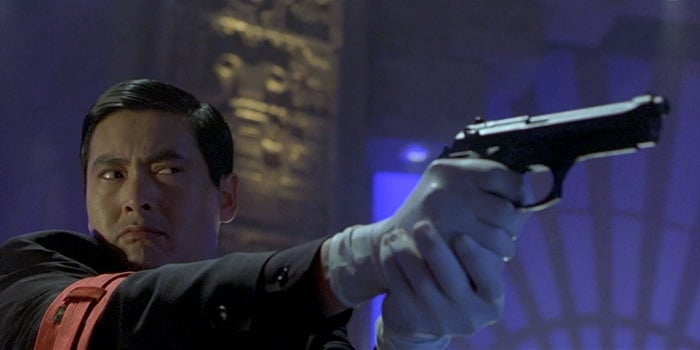
Every Monday night at 9:00 Central Time, my wife Sierra and I host a “Live Movie Tweet” event on X using the hashtag #MondayMuggers. We rotate movie picks each week, and our tastes are quite different. I decided early on that I would only program movies that have meant something to me over the years. Tonight, Monday November 18th, we’re watching THE REPLACEMENT KILLERS starring Chow Yun-fat, Mira Sorvino and Michael Rooker.
So why does THE REPLACEMENT KILLERS mean something to me, you might ask?! The main reason is a matter of timing and its star, Chow Yun-fat. I personally discovered Hong Kong actor Chow Yun-fat in the late spring of 1997 and was in full obsession mode when I read that he was making his American film debut with THE REPLACEMENT KILLERS in early 1998. To say I was pumped about this movie would be quite the understatement, and I was at a theater in Conway, Arkansas the very day of its wide release on February 6, 1998. Director Antoine Fuqua, making his directorial debut, tried to make a stylish film that would appeal to fans of John Woo, who served as Executive Producer on THE REPLACEMENT KILLERS. It worked on me, and over the next few years I purchased the movie in every format imaginable. I’ve owned it on bootleg VHS, regular VHS, DVD, and special edition blu ray. Looking back on the film now, I realize that it’s an exercise in style over substance, but that’s certainly okay. It doesn’t take away the fact that it came out at a time in my life when I was primed for maximum movie impact. You can never go back and replicate those times in your life, but you can celebrate them. Sierra and I will be doing just that tonight on #MondayMuggers at 9:00 CST. THE REPLACEMENT KILLERS is available for streaming on Amazon Prime. Join us if you’d like!
Maria is a 17 year-old high school student in Canada. She goes to a school where everyone wears a uniform, everyone plays hockey, and everyone is looking forward to a prom that is going to be held on an ice skating rink! (Personal injury attorneys love this school!) Everyone is obsessed with living on the ice but Maria can’t even skate. Popular hockey player Mark (John C. MacDonald) taunts Maria for not being able to maintain her balance. Her best friend, Lily (Penelope Mitchell) offers to teach Maria how to skate but Lily turns out to be a cruel and taunting teacher, probably because she knows that Maria has a crush on her boyfriend, Sean (Harrison Gilbertson).
Maria’s life at home isn’t any better. Her mother, Amy (Mira Sorvino), is suffering from crippling depression and often can’t even be bothered to get out of bed or off the couch. Her father, Dan (Jason Isaacs), is a plastic surgeon who is obsessed with the idea that he can fix any flaw through surgery. He’s the type who cruelly critiques his daughter’s looks, despite the fact that Maria is actually a very pretty girl whenever she can find the courage to actually look up from the floor. Dan is also cheating on his wife. Perhaps the only good thing that Dan does is that he encourages Maria to stay home from school, though his reasoning is that she doesn’t look good on that particular day and she needs to get her “beauty sleep.”
Seriously, watching this movie, your heart truly breaks for Maria. It’s as if the whole world has been against her since the day she was born. Everyone gives Maria a hard time for not having more confidence but how can someone be confident when all they hear is about how much of a disappointment they are? Maria’s only friend is her reflection in the mirror.
At first, Maria freaks out when her reflection starts talking back to her. Airam, as Maria’s reflection calls herself, may look like Maria but she initially seems to have a totally different personality. Airam is confident in both her appearance and her sexuality. Airam is willing to strike back at the people that have hurt her. Airam is confident where Maria is insecure. When Maria talks to Airam, she ends up laughing so loudly that Amy actually comes into the bathroom and asks if Maria is smoking weed. After Maria is cruelly humiliated at prom, Maria agrees to switch places with Airam by kissing the mirror. Suddenly, Maria is the one in the mirror and Airam is the one who is in the real world, looking for revenge against everyone who has hurt Maria.
Or is she? Watching the film, I found myself wondering if Maria was just imagining talking to her reflection and perhaps “the switch” was all in Maria’s mind. Perhaps Airam isn’t some malevolent force that’s brought into the world as much as she’s just Maria having been pushed too far by the cruel taunts of her classmates and her father’s refusal to show her the consideration that he shows to his mistress. Airam is soon doing everything that Maria wishes she could do but when people start dying, Maria begs Airam to stop. Is Maria really trapped in the mirror and begging Airam to stop or is she just imagining a conversation with her own conscience? India Eisley’s performance keeps you guessing.
This is an intriguing film, even if is sometimes a bit too ambiguous for its own good. (The final shot is artfully done but it still made me want to throw something at the TV.) The film’s greatest asset is India Eisley, who is convincing whether she’s the mousy Maria or the bold Airam. Jason Isaacs, as well, gives a strong performance, turning his plastic surgeon into one of the all-time bad fathers. Watching Isaacs’s performance as Dan, it’s hard not to understand why Dan’s daughter would want to hide in a mirror.
First released in 1999, Summer of Sam is Spike Lee’s sprawling, frustrating, flawed, occasionally compelling, and ultimately rather intriguing film about the summer of 1977 in New York City.
As one can guess from the title, it was a summer that was dominated by the reign of terror of the serial killer known as the Son of Sam. While New York suffered one of the hottest summers on record, the Son of Sam shot couples while they sat in their cars. Because all of his victims had been women with long, dark hair, women across the city wore blonde wigs. While the police searched for the killer, the city was also caught up in the World Series. Club 57 was the hottest club in New York but a growing number of rebels, inspired by the news that was coming out of the UK, eschewed the glitz of disco for the gritty and deliberately ugly aesthetic of punk and the Mud Club.
Though the film is centered around the murders of the Son of Sam, he remains a largely shadowy figure in the film. Played by Michael Badalucco, David Berkowitz spends most of his time in his filthy home, yelling at the dog across the street and writing cryptic messages on the walls. He only gets a few minutes of screen time because the film is ultimately less about the Son of Sam’s crimes and more about how one Italian-American neighborhood in New York deals with the atmosphere of fear and paranoia created by those crimes. It’s a neighborhood that’s ruled over by the ruthless but benevolent Luigi (Ben Gazzara). When the two detectives (Anthony LaPaglia and Roger Guevener Smith) come to the neighborhood in search of information, they know that Luigi is the man to see.
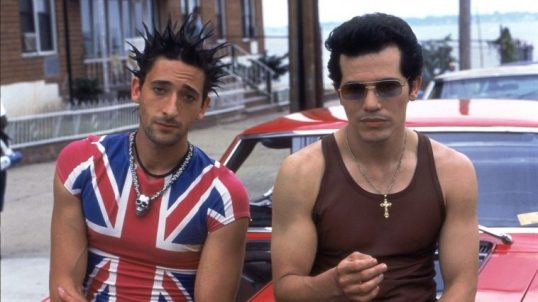
Vinny (John Leguizamo) is one of the neighborhood’s citizens, a hairdresser who hasn’t let his marriage to Dionna (Mira Sorvino) stand in the way of his compulsive womanizing. Vinny is the type who cheats on his wife and then goes to Confession to get forgiveness. He’s the type who gets angry whenever Dionna wants to have sex with the lights on or do anything other than a quick three minutes in the missionary position. When he realizes that the Son of Sam was watching him while he was having sex in a car with Dionna’s cousin and that he could have been one of his victims, Vinny starts to spin out of control. Vinny’s childhood friend is Ritchie (Adrien Brody), who shocks everyone when he spikes his hair, puts on a Union Jack t-shirt, and starts speaking with a fake British accent. Ritchie and his girlfriend, Ruby (Jennifer Esposito), embrace the punk lifestyle and even put one the Son of Sam’s letters to music when they perform at the Mud Club.
It’s an ambitious film but it’s also an overlong film, one where the slow spots can truly test the viewer’s patience. With a 142-minute running time, Summer of Sam finds the time to touch on almost every trope of the late 70s. Vinny and Dionna hit the clubs, where the usually quiet Dionna truly comes to life as she dances. (Vinny’s moves are far less impressive. Tony Manero would have laughed at him.) Ritchie not only embraces punk rock but he also makes his money by performing in live sex shows. When a mysterious man offers to give Vinny and Dionna a ride in his limo, it’s hard not to smile when it’s revealed that he’s taking them to the infamous sex club, Plato’s Retreat. One can respect Lee’s ambition while still finding the film itself to be a bit too self-indulgent for it’s own good.
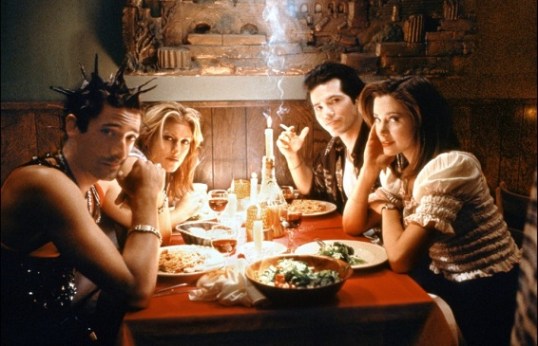
Spike Lee, for all of his other talents, has never been a particularly subtle director. Vinny and his friends spend a lot of time hanging out at the end of street, strategically placed in front of a sign that loudly proclaims, “DEAD END.” At one point, Vinny is inspired to run to his window and start screaming insults at the Son of Sam and Leguizamo’s histrionic delivery of the lines make it impossible to take his anguish seriously. At the same time, there are moments that work brilliantly. I particularly liked the scenes that took place during the blackout of 1977. Luigi automatically knows how to keep control in his neighborhood and he sends his men out with baseball bats, channeling their aggression into a search for the phantom serial killer. For every scene that doesn’t work, there’s a scene like the Baba O’Riley montage or Vinny, Dionna, Ritchie, and Ruby having a candlelit dinner.
“We really dig your vibe.”
John Leguizamo is shrill and miscast as Vinny, though I’m not sure if anyone could have made much of such a one-dimensional characters. I preferred the performances of Mira Sorvino, Adrien Brody, and Jennifer Esposito, who all brought their characters to authentic life. (I especially liked how Brody switched from being tough to being a wounded child at the drop of a hat.) As is so often the case with Lee’s films, it’s the supporting actors who make the strongest impression. I loved Mike Starr’s earthy performance as Ritchie’s father and Ben Gazzara’s sly turn as the neighborhood mobster. Bebe Neuwirth is underused but memorable as Vinny’s boss.
The film is overstuffed and overlong but it effectively portrays a community in the grips of paranoia and anger. In the end, the film is epitomized by a scene in which the neighbor’s dog enter David Berkowtiz’s living room and starts yelling at him in the voice of John Turturro. It’s a scene that’s so ludicrous that it somehow becomes effective. It’s a scene that most directors would have left on the editing room floor but Spike Lee included it. It takes courage to write, film, and keep a scene like that. Summer of Sam is a wreck of a film but it’s also ultimately a compelling portrait of a community coming apart. In the end, just as in real life, Berkowitz is brought to justice and a community is left wondering what to do now.
Summer of Sam features some of Spike Lee’s best work and also some of his worst. The film opens with columnist Jimmy Breslin describing New York as being the city that he both loves and hates and that’s the way that I feel about this film. For all of its flaws, there’s enough strengths to make up for them. It’s a New York story and, appropriately, it’s just as messy as the city that it is about.
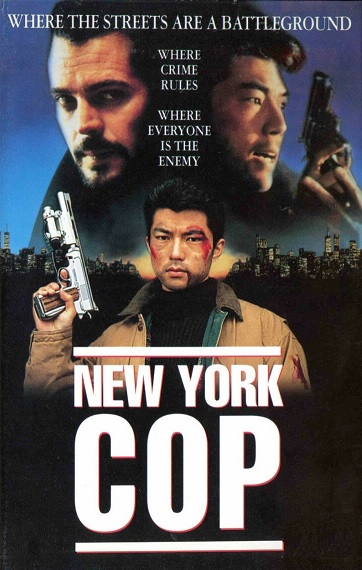
Toshi (Tôru Nakamura) is a tough New York cop who is assigned to work undercover in the East Village because, according to his boss, no one will suspect that a Japanese man is actually a cop. Disguising himself as a homeless gambling addict who has connections with the Tongs, Toshi infiltrates the Brotherhood. He becomes friends with the gang’s leader, Hawk (Chad McQueen), and he even falls in love with Hawk’s sister, Maria (Mira Sorvino!). Hawk is buying guns from a mobster named Mr. C (Tony Sirico!!) and Mr. C’s main assassin, Ferrara (Andreas Kastsulas), is driving around New York in a taxi cab and killing undercovers. Can Toshi take down Mr. C without compromising his relationship with Maria and revealing that he’s actually an undercover cop? The short answer is no.
New York Cop works best when it focuses on action. Tôru Nakamura is convincing in the fight scenes but he’s less convincing whenever he has to show emotion or have a conversation with anyone. The idea that the NYPD would send a Japanese cop undercover to infiltrate a Hispanic gang never makes makes much sense, as Toshi himself points out when the idea is first brought up. Toshi never makes much of an effort to disguise the fact that he is a cop, which makes Hawk look incredibly stupid for not seeing through him. The main appeal for most people will probably be the chance to see Tony Sirico and Mira Sorvino in early roles. Sirico, the former gangster-turned-actor, is convincing as Mr. C and gets all of the film’s best lines. As for Mira Sorvino, this was only her second or third film role and the script doesn’t give her much to work with. There are a few scenes where she gets to bring some genuine New York attitude to her character, telling off both her brother and Toshi. But otherwise, there’s little about her performance that suggests the actress that she would become. Fortunately, films like Barcelona and Sweet Nothing were right around the corner.
As far as New York cops go, nothing has yet to beat the episode of Barney Miller where Christopher Lloyd vandalizes the station house.
The fourth installment in the After franchise, After Ever Happy picks up where After We Fell ended.
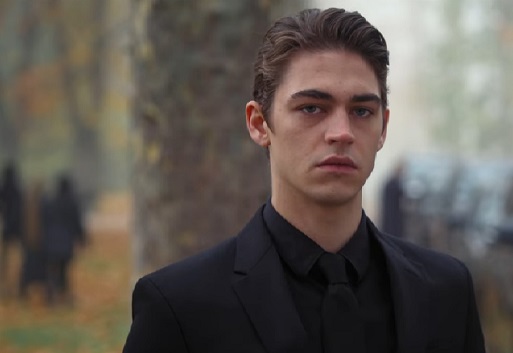
The world’s most boring couple, Tessa Young (Josephine Langford) and Hardin Scott (Hero Fiennes Tiffin), are in London to attend Hardin’s mother’s latest wedding. Unfortunately, Christian Vance (Stephen Moyer) takes this opportunity to reveal that he is actually Hardin’s father which leads to Hardin storming off and grabbing a bottle of whiskey. If you’ve seen the previous three After films, then you know that’s a big problem because Hardin is a recovering alcoholic who turns into an asshole when he’s drunk. Of course, Hardin’s usually an asshole when he’s sober as well.
Because Tessa really doesn’t have any life beyond chasing after Harin and trying to keep him from being self-destructive, Tessa chases after him and tries to keep him from doing anything self-destructive. Unfortunately, since Harden’s already drunk, he decides that he might as well burn down his mother’s house and that’s exactly what Hardin does. In most movies, this would be treated as Hardin going off the deep end and as evidence that Tessa should get a thousand miles away from him. In the After films, every stupid, impulsive, and destructive thing that Hardin does is just an excuse for Tessa to comfort him by having soft-focus sex in a car. In the world of the After films, every toxic relationship is a Dior commercial.
Not now, Natalie!
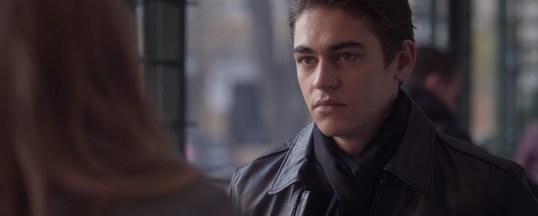
Anyway, After Ever Happy pretty much follows the exact same pattern as the previous three films. After Tessa’s father dies, she moves to New York in order to heal and Hardin loses it. Hardin follows her to New York. Tessa takes him back. Hardin explodes over some trivial issue. Tessa forgives him. Tessa tries to do something for herself. Hardin gets mad. Tessa forgives him. Hardin tries to be a better person, which in this case means that he gives his scarf to an old homeless man whom Tessa has been giving food. (Tessa explains that giving the homeless man food makes her feel better about losing her dad, which is another way of saying that she’s only helping him to make herself feel good. If her Dad was still alive, the homeless man would probably end up freezing to death while Tessa and Hardin debated whether Fitzgerland was a better writer than Hemingway. Maybe one of those schmucks could try to help the old homeless man find shelter or something. That scarf’s only going to do so much.) Hardin turns his journals into a novel, which is somehow published. Tessa is angered that Hardin wrote about her without asking her permission and she leaves him. Hardin’s book is acclaimed, despite the fact that the excerpt we hear sound terrible. Hardin becomes an amateur boxer or something. I’m not really sure what was up with that scene. “To be continued….,” the title card announces, so maybe the next movie will feature more action in the ring.
A few questions sprang to mind as I watched After Ever Happy:
Why, after four movies, does Hardin still only have one facial expression?
See? Just one.
What was going on with Tessa’s hair during the second half of the movie?
Seriously, Tessa’s hair was one of the few things that she had going for her and this movie took that away from her.
Finally, how is it that, after four films, the lead performers still have next to zero romantic chemistry? You would think that, after three years of playing these people, Hero Fiennes Tiffin and Josephine Langford would at least have a little bit of a spark to their interactions but instead, they still come across as being friendly acquaintances as opposed to lovers. There’s nothing about their performances that suggest that they know each other in a way that only two people who are deeply in love could know each other. There’s none of the little details that one immediately spots between people who have shared trauma and found love. Instead, every emotion and thought is on the surface. There’s no depth to the relationship. Hardin is toxic and whiney. Tessa is the doormat that other doormats walk over.
Typically, with a film like this, critics will say that the cast does their best with the material they’ve been given but, in this case, everyone’s just as lousy as the material. Say what you will about the 50 Shades Films, at least Jamie Dornan and Dakota Johnson appeared to be having fun. The cast of After Ever Happy, from the stars on down, just seem to be hoping that it will soon all be over with.
That was certainly the case with me and East of the Mountains, an independent film which came out last September. I have to admit that the film completely slipped past me when it was initially released. In fact, I didn’t even know that the film existed until it was nominated for Best Motion Picture Drama by the Satellite Awards in December. I wasn’t alone in that. I remember when the Satellite nominations were announced, there were a lot of people who looked at the list of nominees and, upon seeing an unfamiliar title mixed in with West Side Story, The Power of the Dog, and Don’t Look Up, said, “East of what?”
Because I’m always on the lookout for an overlooked gem, I rented East of the Mountains on Prime. I watched it yesterday. My initial reaction was that it was a well-made film, featuring both pretty scenery and an excellent lead performance from veteran actor Tom Skerritt. (Skerritt is also credited as being an executive producer on the film.) I appreciated that, in a time when so many film feels as if they’re at least ten minutes too long, East of the Mountains was a remarkably short film. It only needed 79 minutes to tell its simple but effective story and it didn’t waste a single one of them. At the time, I also thought that the film’s direction was perhaps a bit too low-key for the film to really work. I thought it was a good film but I also thought it was one that I would probably forget about in a day or two.
Instead, the opposite has happened. East of the Mountains has stuck with me. Even as I sit here typing, I can still picture the film’s final few scenes in my head. That’s the type of film that East of the Mountains is. It’s a film that sneaks up on its audience, capturing their attention so subtly that it’s not until several hours later that they realize that they’re still thinking about the film.
Based on a novel by David Guterson, East of the Mountains is a character study. Tom Skerritt plays Ben Givens. Ben is a retired doctor and a veteran of the Korean War. He lives in Seattle. His wife has passed away. He’s estranged from his brother. His daughter is busy with a family of her own. Ben’s only companion is his dog, Rex. When he tells his daughter (played by Mira Sorvino) that he’s planning on going bird hunting for the weekend, she’s concerned. She knows that her father has been depressed. She also knows that Ben has recently been diagnosed with cancer. Ben assures her that he just wants to see his “old stomping grounds” one last time but his daughter worries that Ben may be planning on never coming back.
She’s not wrong. Since we’ve already seen Ben pressing the barrel of a rifle against his forehead, we know that she has every reason to be concerned about his plans. Ben is considering ending it all, east of the mountains where he grew up, fell in love, and experienced his happiest moment. However, from the minute that Ben sets off on what he plans to be his final hunting trip, fate seems to be determined to keep him alive. After his SUV breaks down, he’s given a ride by a mountain climbing couple and their love reminds Ben of when he first met the woman who he would eventually marry. After a run-in with a half-crazed mountain man, Ben loses his prized rifle, the one that was given to him by his father and which Ben planned to use to end his own life. After an unexpected dog fights leads to Ben taking Rex to the local animal hospital, he meets a young veterinarian who can tell that Ben needs someone to talk to.
The plot is rather simple but Tom Skerritt’s performance brings the story a certain depth that it might not otherwise possess. It would be easy to sentimentalize a character like Ben or to portray him as being flawless. Instead, Skerritt plays Ben as someone who is genuinely well-meaning and naturally kid but who also can occasionally be a bit self-absorbed. Watching Ben, one can understand why his brother is estranged from him, which makes their eventual, if rather prickly reunion all the more poignant. (Ben’s brother is well-played by an actor named Wally Dalton. He and Skerritt play off of each other with such skill that it’s hard to believe that they actually aren’t brothers.) The viewer hopes that Ben will find what he needs to find in order to achieve some sort of peace for himself, even if Ben himself doesn’t always seem to be quite sure what that possibly mythical thing would be.
Skerritt’s performance here is comparable to Robert Redford’s turn in All Is Lost, with the main difference being that Ben is far more lost than even Reford’s unnamed sailor. However, much like the sailor in All is Lost, it’s impossible to look away from Ben’s journey. It’s also tempting to compare Skerritt’s performance to Rchard Farnsworth’s Oscar-nominated turn in David Lynch’s The Straight Story. (Indeed, the scene between Skerritt and Dalton is comparable to the final scene between Farnsworth and Harry Dean Stanton.) Much like Farnsworth in Lynch’s film, Tom Skerritt may move slowly but the viewer is always aware of his mind working.
East of the Mountains may sound like a depressing or heavy-handed film but actually it’s not. If anything, it’s life-affirming. The audience is right alongside Ben, learning with him that the world is not as terrible a place as he had convinced himself it was. In the end, the viewer cares about Ben and worries about what his ultimate fate will be. The film’s ending sneaks up on you and it stays with you afterwards.
There is one scene involving a dog fight that is difficult to watch but otherwise, East of the Mountains is a simple but poignant film that deserves more attention than it’s received.
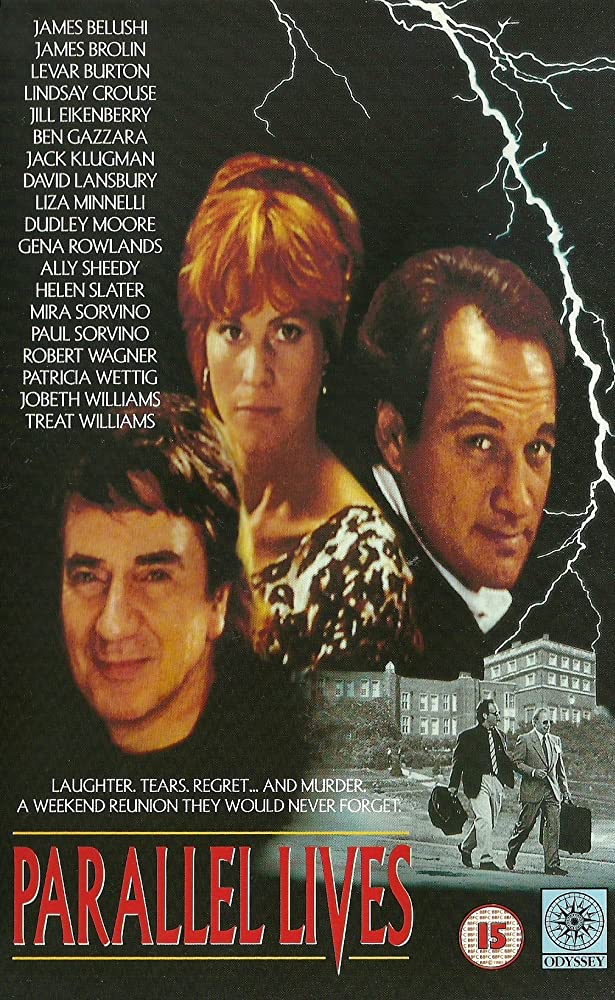
A large group of people gather together one weekend for a fraternity/sorority reunion. Since college, some of them have become rich and powerful. Some of them are now famous. Some of them are now seedy and disreputable. They all have college memories, though there’s such a wide variety of age groups represented that it’s hard to believe that any of them actually went to college together. After the men spend the day playing practical jokes and touch football and the women spend the night talking about their hopes and dreams, they wake up the next morning to discover the someone has murdered Treat Williams. A pony-tailed sheriff (Robert Wagner) shows up to question everyone.
Parallel Lives was made for Showtime with the help of the Sundance Institute. Today, it’s a forgotten film but, for some reason, it was very popular with American Airlines during the summer of 1997. That summer, when I flew to the UK, Parallel Lives was one of the movies that we were shown. (It was the second feature. The first feature was Down Periscope, a submarine comedy starring Kelsey Grammar. Fourteen year-old me enjoyed Down Periscope but, in retrospect, it wasn’t much of a flight.) A month and a half later, when I flew back to the U.S., Parallel Lives was again one of the films shown on the flight! For that reason, I may be the only person on the planet who has not forgotten that a film called Parallel Lives exists.
Parallel Lives, I later learned, was an entirely improvised film. The huge cast were all given their characters and a brief outline of the film’s story and they were then allowed to come up with their own dialogue. Unfortunately, no one did a very good job of it and the men were reduced to bro-ing it up while the women spent most of the movie having extended group therapy. The story doesn’t add up too much and, even when I rewatched it from an adult’s perspective, I wasn’t sure what I was supposed to get out of everyone talking about how different the real world was from college. Technically, the film’s a murder mystery but you can’t improvise a successful murder mystery. This film proves that point.
Of course, it doesn’t help that there are 26 characters, all trying to get a word in at the same time. Some of the roles don’t make much sense. Dudley Moore shows up, playing an imaginary friend. (How do you improvise being a figment of someone’s imagination?) James Brolin introduces himself to everyone as being, “Professor Doctor Spencer Jones” and that appears to be as far as he got with his improv. Ben Gazzara is a gambler and Mira Sorvino is the prostitute that he brings to the reunion while Mira’s father, Paul Sorvino, moons the camera several times. Jack Klugman is a senator with Alzheimer’s and Patricia Wettig is his daughter. The majority of the movie centers around Jim Belushi, playing a reporter and falling in love with JoBeth Williams. Liza Minnelli, Helen Slater, Levar Burton, Lindsay Crouse, Matthew Perry, Ally Sheedy, and Gena Rowlands all have small roles. How did so many talented people come together to make such a forgettable movie and why did American Airlines decide it was the movie to show people on their way to another country? That’s the true mystery of Parallel Lives.
(And by strange, I mean dull and kind of pointless.)
This film premiered on Lifetime last Saturday but, as I watched it, it quickly became obvious that it wasn’t originally produced for Lifetime.
For one thing, the film was shot on location in Louisiana. Instead of letting Montreal or Toronto stand in for a generic American city, this film was actually shot on the streets of New Orleans. (Unfortunately, the film also made New Orleans seem kind of boring.)
Secondly, Indiscretion turned out to be one of those films where the soundtrack would suddenly go silent whenever a character said anything stronger than “damn.” It was odd because you would see a character very obviously saying something like, “Fuck you,” but you wouldn’t be able to hear the voice. I guess that was to protect the gentle sensibilities of the viewer but what about people who read lips?
And finally, Indiscretion didn’t feature any of the usual Lifetime actors. Instead, it starred Mira Sorvino as a frustrated wife and Cary Elwes as her politician husband. Sorvino’s real-life husband, Christoper Backus, played the troubled sculptor who has an affair with Sorvino and then ends up stalking her family.
So, no, Indiscretion was clearly made to, at the very least, be released straight to video. It was not meant for commercial television. And yet, somehow, it ended up making a somewhat awkward premiere on Lifetime.
Anyway, Indiscretion starts out well enough. It doesn’t waste any time arranging for Sorvino and Backus to meet at a fund raiser and for them to end up having a passionate affair. Sorvino, of course, claims that it was just a weekend fling and that she loves her husband. Backus refuses to believe her and soon, he’s worming his way into her family. He befriends her husband and even gets to go on a hunting trip with the governor of Louisiana. He also ends up having an affair with Sorvino’s teenage daughter.
(Or, at the very least, he takes some pictures of her, which Sorvino later discovers. It’s a sign of how haphazardly constructed this film is that you’re never quite sure what’s going on with Backus and Sorvino’s daughter. Backus also uses one of those old Polaroid cameras to take pictures. Apparently, troubled artists don’t use digital cameras.)
The problem is that, after the first, artfully-shot sex scene, the film itself slows down to an interminable crawl. It’s as if the film’s director, editor, screenwriter, and producers all forgot that the audience has already seen a hundred movies just like this one. Nothing surprising happens and, unlike the best Lifetime films, Indiscretion never winks at the audience or indirectly acknowledges the clichéd nature of its narrative. The whole thing is just painfully dull and no amount of mood lighting is going to change that. There is a little twist at the end but most viewers will probably be so bored with it all that they probably won’t even notice. That’s just the type of film this is.
If you want to see an entertainingly over-the-top and pulpy film about people having sex in New Orleans, I would suggest checking to see if Zandaleeis still available on YouTube.






 Through the Shattered Lens