Scenes That I Love: The Conclusion of The Passenger


Today’s scene that I love comes from 1975’s The Passenger, a film directed by Michelangelo Antonioni.  Antonioni was born 113 years ago today, in what was then the “Kingdom of Italy.”

In The Passenger, Jack Nicholson plays a journalist who, because he’s bored with his life, impulsively assumes the identity of a deceased American businessman.  What he discovers is that the businessman was an arms dealer and that the people that the arms dealer were doing business with still expect to get their weapons.  Despite the fact that he knows that it might cost him his life, Nicholson is still drawn to see just how far he can take his new existence.

The film’s enigmatic final scene, in which Nicholson goes to a hotel to wait as both the people who double-crossed and his wife search for him, is Antonioni at his best.

Scenes That I Love: The Conclusion of The Passenger


Today’s scene that I love comes from 1975’s The Passenger, a film directed by Michelangelo Antonioni.  Antonioni was born 110 years ago today, in what was then the “Kingdom of Italy.”

In The Passenger, Jack Nicholson plays a journalist who, because he’s bored with his life, impulsively assumes the identity of a deceased American businessman.  What he discovers is that the businessman was an arms dealer and that the people that the arms dealer were doing business with still expect to get their weapons.  Despite the fact that he knows that it might cost him his life, Nicholson is still drawn to see just how far he can take his new existence.

The film’s enigmatic final scene, in which Nicholson goes to a hotel to wait as both the people who double-crossed and his wife search for him, is Antonioni at his best.

Film Review: The Passenger (dir by Michelangelo Antonioni)


The 1975 film, The Passenger, tells the story of David Locke (Jack Nicholson).

Locke is a television news journalist.  From what we can gather, he’s respected from his colleagues, even though he doesn’t seem to be extremely close to anyone, including his wife (Jenny Runacre).  Everyone thinks that Locke is dead.  They believe that he was found dead in a hotel room in Africa, the victim of a heart attack.  What they don’t know is that Locke is actually alive.  He switched identities with Robertson (Charles Mulvehill), the man who actually was found dead in the hotel room.  After years of reporting on a world that appears to be going insane, Locke has decided that it’s time for a fresh start.  He no longer wants to deal with his marriage, his career, or anything else that used to define David Locke as a person.  He now just wants to be Robertson.

Of course, the problem with this plan is that Robertson had a life before Locke appropriated it.  Locke discovers that Robertson was not only a gun runner but he was also supplying weaponry to the same rebels that Locke, in his previous life, traveled to Africa to do a story on.  Since Locke has Robertson’s appointment book, he decides to keep all of Robertson’s meeting across Europe.

Meanwhile, Locke’s wife is curious to know about her husband’s final moments and, for that reason, she wants to speak with this mysterious Robertson, who was the last person to reportedly see her husband alive.  Locke’s friend, Martin (Ian Hendry) sets out to try to track down Robertson.  Locke, meanwhile, has met an architecture student (Maria Schneider), with whom he embarks on a passionate affair despite not ever learning her name.

The Passenger famously ends with a seven minute tracking shot, one that begins in a hotel room and then moves out into the hotel’s courtyard before then returning to the hotel room.  While the audience is watching the action unfold in the courtyard, something very important happens inside of that hotel room.  In fact, what happens in the hotel room is probably the most important moment of the entire film and yet director Michelangelo Antonioni only shows us the events leading up to the moment and the events immediately afterwards.  Antonioni leaves it up to the audience to determine exactly what happened inside of that hotel room.  It’s a bold move on his part and it’s also the perfect way to end this film.  The Passenger is a film about detachment and it only makes sense that the film would end with the ultimate statement of detachment, with the emphasis being less on what’s happening in the hotel room and more on the fact that life, in all of its random and confusing messiness, will continue regardless of how the story of David Locke turns out.

It’s definitely not a film for everyone.  Those who watch the film excepting a typically explosive Jack Nicholson performance will probably be surprised to discover that Jack plays a rather quiet character in The Passenger, one who is often so introverted that it’s a struggle to figure out what exactly is going on inside of his mind.  Locke thinks that, as a journalist, he understands the world but, when he becomes Robertson, he discovers that there’s a big difference between reporting a story and actually being a part of that story.  It’s an odd experience, watching Jack Nicholson play a character who is essentially in over his head.  And yet, this is is also one of Nicholson’s best performances.  Freed up from his usual tricks, Nicholson gives a vulnerable and ultimately rather sad performance as a man who realizes too late that he’s grown so detached from the world that he no longer really has an identity.

The Passenger‘s a difficult but intriguing film.  It’s a classic of the 70s and features Jack Nicholson at his best.

6 Good Films That Were Not Nominated For Best Picture: The 1960s


Sonny and Cher walk down the 1968 Oscars Red Carpet

Continuing our look at good films that were not nominated for best picture, here are 6 films from the 1960s.

Psycho (1960, dir by Alfred Hitchcock)

The director was nominated.  Janet Leigh was nominated.  Amazingly enough, Anthony Perkins was not nominated for playing the role that would come to define him.  And, in the end, the film itself was not nominated for best picture.  Perhaps it was too sordid for the Academy.  Perhaps they resented no longer feeling safe in the shower.  Regardless, Psycho has gone on to influence every horror thriller made since 1960.  And let’s not even talk about how much we all cried while watching the finale of Bates Motel.

From Russia With Love (1963, dir by Terence Young)

The first great James Bond film should have also been the first Bond film to be nominated for best picture.  Actually, looking over the films that actually were nominated in 1963, From Russia With Love should have been the first Bond film to win best picture.

Blow-Up (1966, dir by Michelangelo Antonioni)

Mimes playing tennis and David Hemmings briefly breaking out of his shell of ennui to investigate a murder that has no solution!  How could the Academy resist?  Somehow, they did.  Michelangelo Antonioni received a nomination but the film was, at the time, considered to be too controversial to nominate.

The Good, The Bad, and the Ugly (1967, dir by Sergio Leone)

Though initial reviews were mixed, Sergio Leone’s Civil War epic has come to be recognized as one of the greatest and most important Westerns of all time.  Perhaps it’s understandable that the Academy of 1967 would be skeptical of an Italian western starring Clint Eastwood, Eli Wallach, and Lee Van Cleef.  Still, it would have been one of the coolest best picture nominees of all time.  (Shockingly, not even Ennio Morricone’s iconic score was nominated.)

Petulia (1968, dir by Richard Lester)

Though Richard Lester will probably always be best known as the man who directed the first two Beatles films, he also directed one of the definitive 60s films, Petulia.  Sadly, in a year when many lackluster films were nominated, the challenging and rather melancholy Petulia was not.

Night of the Living Dead (1968, dir by George Romero)

Again, we really can’t be shocked that the Academy held off an recognizing a low-budget, independent film about zombies  But come on!  A Night of the Living Dead vs. Petulia Oscar race would have bene one for the ages.

Up next, in an hour or so, the 1970s!

Lisa Goes Back To College: Zabriskie Point (dir by Michelangelo Antonioni)


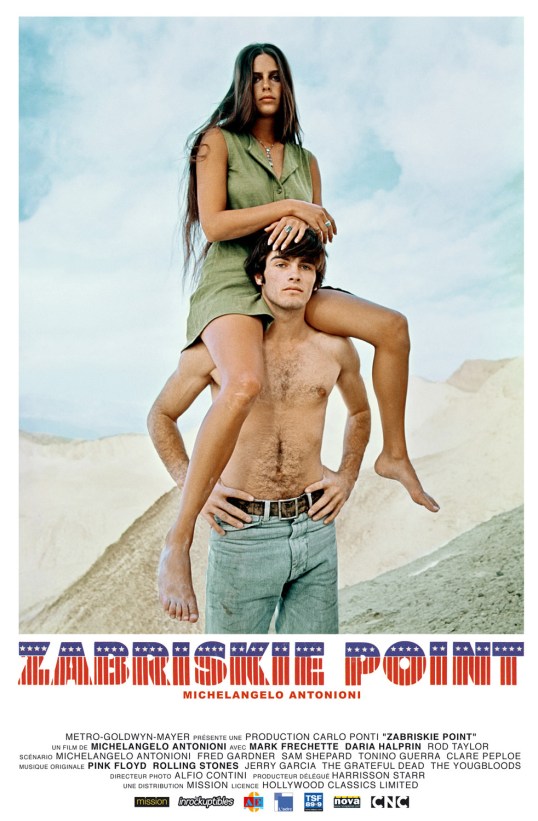
1970_Zabriskie Point_03

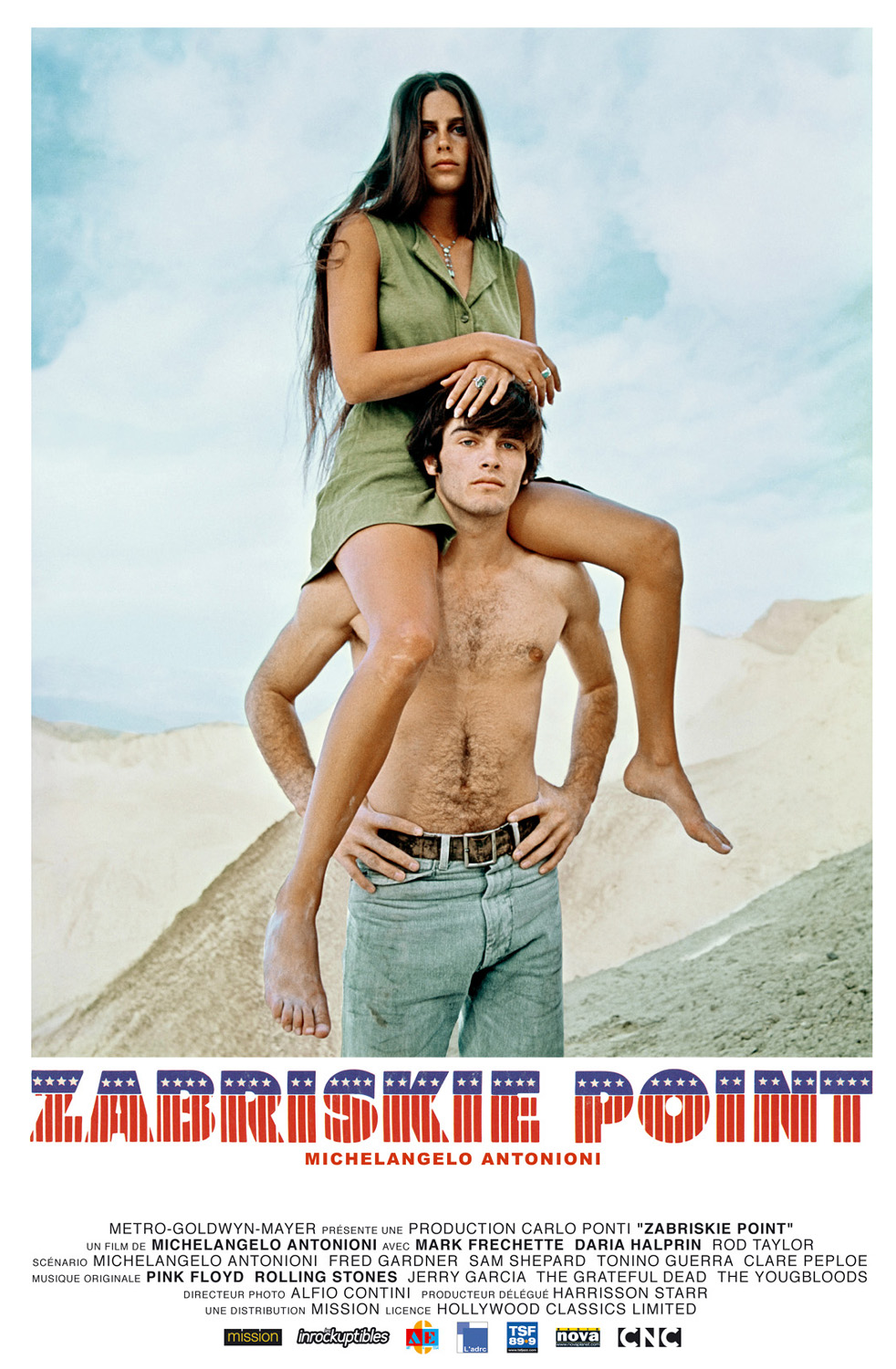
After watching Getting Straight, I decided to watch another student protest film from 1970, Michelangelo Antonioni’s Zabriskie Point.  Much like Otto Preminger’s Hurry Sundown, Zabriskie Point is a film that frequently gets mentioned when film bloggers are trying to list the worst films of all time.  Unlike Hurry Sundown, Zabriskie Point is not quite as terrible as some reviewers seem to think.

It’s probably a mistake to describe Zabriskie Point as being as a college film.  Only one of the main characters — Mark (played by Mark Frechette) — is a college student and he drops out early in the film.  The film’s other main character — Daria (played by Daria Halperin) — is a secretary who may (or may not) be the mistress of venal real estate developer Lee Allen (played by Rod Taylor, the sole professional actor out of the starring cast).  However, the film does start on a college campus, it deals with political protest (which was apparently the only thing happening on campuses back in 1970), and the movie’s message and style was obviously meant to appeal to campus radicals.

Mark Frechette, star of Zabriskie Point

Mark Frechette, star of Zabriskie Point

Zabriskie Point opens with the type of lengthy scene that will be familiar to anyone familiar with counter-culture filmmaking.  A bunch of very serious college students sit in a conference room and have a very long conversation about how to best bring about the revolution.  All of the white, middle class students argue for petitions, manifestos, and civil disobedience.  A black woman with a gigantic afro replies that all of the white students are phonies who aren’t truly committed to the revolution.  Some of the students cheer.  Some of the students boo.  The meeting goes on for an eternity and, for the most part, it served to remind me of why I could never stand hanging out with any of the student activists back at the University of North Texas.

Yet, at the same time, it’s an effective scene because it’s one of the rare moments in the film that feels authentic.  For the most part, Antonioni cast this film with nonactors.  (Though apparently — just like in Getting Straight — a young Harrison Ford can be seen in the background of some of the scenes.)  Watching the opening, I got the feeling that I was experiencing what a political gathering in the 70s was truly like.  And, by the end of it, I was happy to have been born long after the 70s were over.

The scene ends when a student named Mark announces that he’s prepared to die for the revolution and then walks out of the meeting.  Mark proceeds to drop out of school, buy a lot of guns, and set up an apartment safe house.  When he gets arrested at a protest, Mark gives his name as “Karl Marx,” which the booking officer proceeds to spell as “Carl Marx.”  Eventually, Mark ends up shooting a police officer.  (Or maybe he didn’t — the film is deliberately vague about whether Mark actually fired his gun or if the officer was shot by somebody else.)  He then steals an airplane, flies out to the desert, and meets Daria.
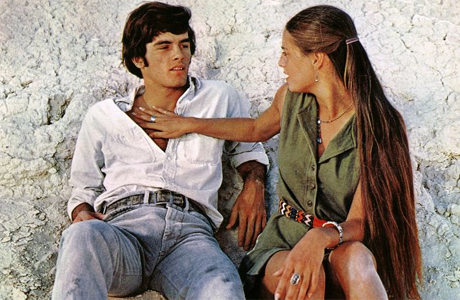
Mark and Daria

Mark and Daria

In the film’s most famous scene, Daria and Mark walk around the desert and talk about — well, nothing in particular.  One of the most frequent criticisms of Zabriskie Point is that neither Mark nor Daria were particularly good actors and that’s certainly true.  However, that’s only a problem if you assume that Antonioni means for you to view these characters as individuals.  As becomes clear during their desert walk, Mark and Daria are meant to be archetypes.  Mark Frechette and Daria Halperin may have been terrible actors but they had the right look and they had the right attitude.  You may not care about them as individuals but Mark and Daria work perfectly as symbols for alienation.  Mark and Daria stand in for everyone who has reached the point where they have to decide whether to join the establishment (represented by Lee Allen and the university) or whether to overthrow it.  In the scenes in the desert, Antonioni presents Mark and Daria less as being people and more as being parts of the American landscape, as permanent as the mountains that surround them.

Mark and Daria end up making love in the middle of the desert and, as they have sex, they are suddenly surrounded by hundreds of other hippie couples having sex and it all becomes one big orgy in the middle of Death Valley.  And yes, this scene is totally over-the-top, pretentious, and ludicrous but yet, how can you condemn something so gloriously silly?
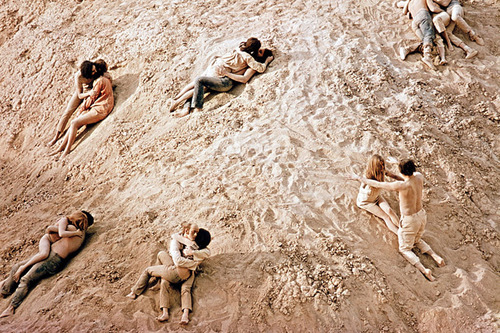
Orgy in the desert

Orgy in the desert

Anyway, after the orgy, Mark and Daria paint his plane and then go their separate ways.  Mark tries to return the plane.  Daria stares at a house in the mountains and imagines it exploding over and over again.

Zabriskie Point is an interesting misfire.  Michelangelo Antonioni (who is best known for directing the classic Blow-Up) originally intended for the film to end with an airplane skywriting “Fuck you, America.”  However, MGM made him cut that from the film.  That Antonioni meant for this film to be an attack on America is pretty obvious.  Antonioni, after all, was a committed Marxist and the film goes out of its way to try to present businessman Lee Allen as being the epitome of capitalist evil.  (Unfortunately, Rod Taylor is such a likable actor that I know, if I had to make a choice between the two, I’d rather spend a day with Lee Allen than Mark Frechette).
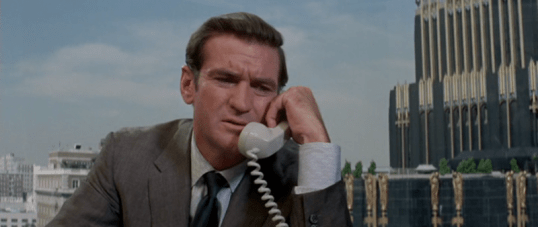
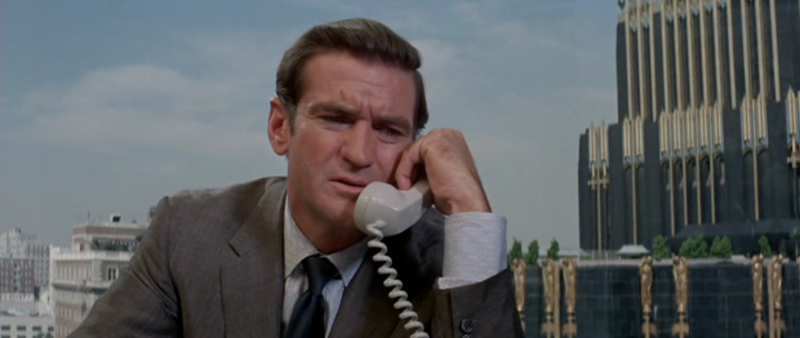
Rod Taylor as Lee Allen

Rod Taylor as Lee Allen

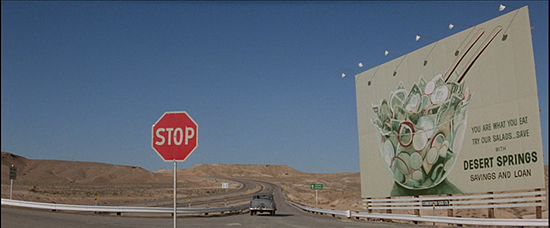
However, at the same time, Antonioni appears to have been fascinated and confused by the material excesses of America as well.  In the first half of the film, as Mark walks through the small town setting, the camera lingers on the billboards that dot the landscape and, as a result, those billboards take on a beauty of their very own.  Even when Daria is walking through Lee Allen’s mansion, the camera can’t help but linger over every opulent detail, almost as if it can’t decide whether it is seeking to condemn or celebrate.  In many ways, Zabriskie Point reminded me of Lars Von Trier’s Dogville.  Both films attempts to condemn America just to end up accidentally celebrating it.
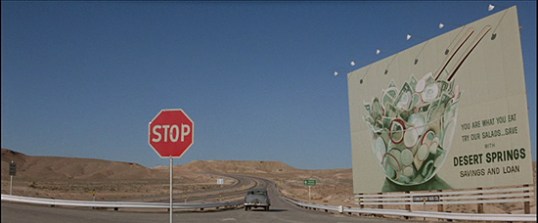
Celebrating America While Condemning It

Celebrating America While Condemning It

Zabriskie Point may not be a good film but it’s an endlessly fascinating and visually beautiful one.  If nothing else, it serves as a record of the time when it was made.  And, as such, it deserves better than to be dismissed as one of the worst.
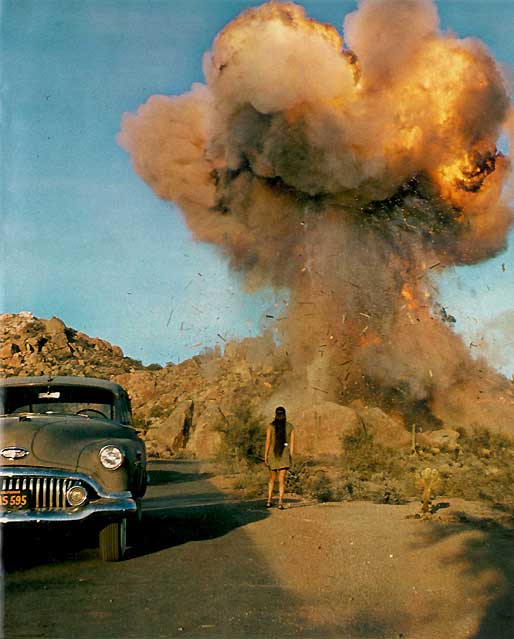
Boom

Boom

Here’s Your Chance To Tell Lisa Marie What To Watch!


So, guess what I did this morning?  That’s right — I put on a blindfold, a stumbled over to my ever-growing Blu-ray, DVD, and even VHS collection and I randomly selected 12 films!

Why did I do this?

I did it so you, the beloved readers of Through the Shattered Lens, could once again have a chance to tell me what to do.  At the end of this post, you’ll find a poll.  Hopefully, between now and next Monday (that’s March 24th), a few of you will take the time to vote for which of these 12 films I should watch and review.  I will then watch the winner on Tuesday and post my review on Wednesday night.  In short, I’m putting the power to dominate in your hands.  Just remember: with great power comes great … well, you know how it goes.

Here are the 12 films that I randomly selected this morning:

The Baader Meinhof Complex (2008) — This German film was nominated for Best Foreign Language Film.  It tells the true life story of the left-wing German terrorist group, The RAF.

The Cat’s Meow (2001) — From director Peter Bogdonavich, this film speculates about the events that led to the shooting of silent film director Thomas H. Ince.  Starring Kirsten Dunst as Marion Davies, Edward Herrmann as William Randolph Hearst, and Eddie Izzard as Charlie Chaplin.

Heavenly Creatures (1994) — The close relationship between two teenage girls (Melanie Lynesky and Kate Winslet) leads to both a vibrant fantasy world and real-life murder.  Directed by Peter Jackson.

In A Lonely Place (1950) — In this film noir from director Nicholas Ray, Humphrey Bogart plays a screenwriter who may (or may not) be a murderer.

Liquid Sky (1983) — In this low-budget, independent science fiction film, an alien lands in New York and soon several members of the city’s underground art scene are vaporized.  Not surprisingly, it all has to do with heroin.

Made in Britain (1983) — A very young Tim Roth makes his debut in this British film.  Roth plays Trevor, a Neo-Nazi who — despite being intelligent and charismatic — also seems to be intent on destroying himself and everything that he sees.

Much Ado About Nothing (2013) — In between The Avengers and Agents of SHIELD, Joss Whedon found the time to direct this adaptation of Shakespeare’s play.

Peyton Place (1957) — In this Oscar-nominated film, the sordid secrets of an outwardly idyllic New England town are exposed.

Pretty Poison (1968) — Having just been released from a mental institution, Dennis (Anthony Perkins) finds himself involved with teenager Sue Anne (Tuesday Weld), who — despite her wholesome appearance — is actually psychotic.

Troll 2 (1990) — A family moves to Nilbog, a small town that is populated by vegetarian goblins.  This movie is widely considered to be one of the worst ever made.

Walkabout (1971) — In this visually stunning Nicolas Roeg film, a teenage girl and her younger brother find themselves stranded and left for dead in the Australian outback.  They try to survive with the help of an Aborigine.

Zabriskie Point (1970) — In this 1970 film, the great Italian director Michelangelo Antonioni takes a look at the 60s counter-culture.  Airplanes are stolen, buildings explode, and orgies magically materialize in the middle of the desert.

The poll will be open until Monday, March 24th.

Happy voting!

Scenes That I Love: The End of Zabriskie Point


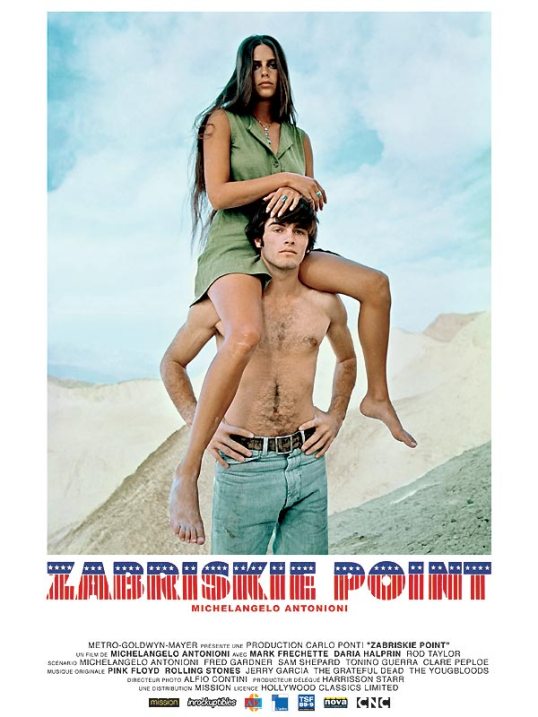
b-zabriskie-point

Released in 1970, Zabriskie Point was the great Italian director Michelangelo Antonioni’s attempt to make the definitive film about both America and the counterculture.  While most critics feel that Antonioni failed on both counts, it is also generally agreed that he captured some beautiful images of an America struggling to definite itself culturally.

The film ends with one of Antonioni’s most iconic images as hippie-turned-revolutionary Daria Halprin watches as her lover’s house explodes.  Is what Daria sees real or is she just fantasizing about the end of capitalism?  Antonioni leaves the answer up to the viewer.