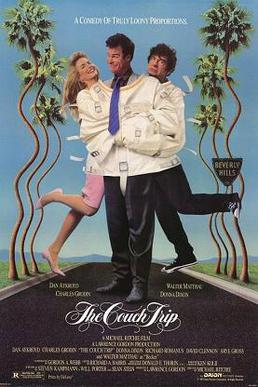
The Couch Trip (1988, directed by Michael Ritchie)


When renowned radio psychiatrist George Matlin (Charles Grodin) has a nervous breakdown, he takes a trip to Europe with his wife (Mary Gross) to both recover and also work on his marriage.  (Matlin’s breakdown was the result of an extramarital affair.)  Needing someone to host Dr. Matlin’s radio show, his producers call Dr. Lawrence Baird (David Clennon), who oversees a mental facility in Chicago.  They assume that Dr. Baird is just dumb enough that they won’t have to worry about him overshadowing Dr. Matlin while he’s guest-hosting.  However, when they call, Dr. Baird is out of his office and the phone is answered by John Burns (Dan Aykroyd), a con artist who has been pretending to be insane so that he can avoid serving time in prison.  Pretending to be Baird, Burns accepts their offer and then escapes from the asylum and heads to Beverly Hills.  The real Dr. Baird, not knowing about the offer, goes on vacation in Europe.  Though Burns had originally only been planning on doing the radio job long enough to get paid enough money to head to Mexico, he soon becomes a celebrity with his non-nonsense, blunt advice.

There’s a lot of talented people in The Couch Trip, including Walter Matthau as a former priest-turned-kleptomaniac and Aykryod’s wife, Donna Dixon, as Matlin’s colleague and Burns’s eventual love interest.  Director Michael Ritchie was responsible for some of the best films of the 70s and radio psychiatry is certainly a ripe subject for satire.  Why, then does, The Couch Trip fall flat?  Some of it is because the movie never seems to know if it wants to be wacky farce or a dramedy about a criminal who finds a new life helping people.  The other big problem is that the talented Dan Aykroyd is miscast as the type of unapologetic smartass that Bill Murray could play in his sleep.  (In a version where Murray played John Burns, Aykroyd would have been perfect casting as George Matlin.)

Aykroyd was one of the most talented members of the original Not Ready For Prime Time Players.  (His impersonations of Nixon and Jimmy Carter were second-to-none.)  Sadly, Hollywood has never figured out what to do with his off-center talent.  The Couch Trip is a prime example of that.


Retro Television Review: Miami Vice 2.7 “Junk Love”


Welcome to Retro Television Reviews, a feature where we review some of our favorite and least favorite shows of the past!  On Mondays, I will be reviewing Miami Vice, which ran on NBC from 1984 to 1989.  The entire show can be purchased on Prime!

This week, Sonny and Rico somehow still manage to work undercover.

Episode 2.7 “Junk Love”

(Dir by Michael O’Herlihy, originally aired on November 8th, 1985)

“What’s a four letter word for dirt?” Switek asks, while on a stakeout.

“Mud,” Zito offers before correcting himself, “I mean …. sand!”

However, according to Switek, the correct answer is Vice!

And indeed, there’s a lot of dirt to be found in this week’s rather sordid episode of Miami Vice.  A raid on a brothel leads the Vice Squad to arrest a notorious smuggler and pimp named Ivory Jones (legendary Jazz musician, Miles Davis) and one of Ivory’s girls, a strung-out junkie named Rosella (Ely Pouget).  When they find out that Rosella is apparently the girlfriend of a notorious dealer named Juan Carlos Silva (Jose Perez), they decide to use her and Ivory to take Silva down.  While Tubbs is convinced that Rosella will say anything get her next fix, Crockett is convinced that Rosella is someone who truly wants to change her life.  Hmmm …. isn’t Crockett usually the cynical one?

Silva is sexually obsessed with Rosella, to the extent that he’ll even kill the members of his own organization if he thinks they’re interested in her.  The episode’s twist comes towards the end, when Gina does some research and discovers that Silva is not only Rosella’s lover but also her …. ick! …. father!  Ewwwww!  As with so many episodes of Miami Vice, Junk Love ends with Sonny watching helplessly as a victimized woman throws away her freedom so that she can shoot her tormenter.  Miami Vice was a show that always managed to be downbeat, even when the bad guys met a deserved end.

This episode felt like an attempt to recreate the emotional drama of the season one episode that featured Bruce Willis as an arms dealer with an abused wife.  Both episodes even feature the same basic ending, just with the setting moved from the courthouse steps to a yacht.  Unfortunately, this episode doesn’t work anywhere half as well as any of the episodes that aired during the first season.  Jose Perez may be playing an evil character but he simply does not have an intimidating enough screen presence to be convincing in the role.  Miles Davis, meanwhile, delivers his lines convincingly enough but his character disappears in such a way that it almost feels as if he left the set before all of his scenes were filmed.

The main thing that I found myself thinking about, as I watched this episode, was how could Sonny Crockett and Rico Tubbs still convincingly go undercover after two years of busting drug kingpin after drug kingpin.  You would think the entire Miami underworld would be on the lookout for them.  Instead, Sonny is still somehow convincing everyone that he’s actually “Sonny Burnett,” aspiring drug dealer.  I’m starting to think the criminals in Miami might not be that smart.

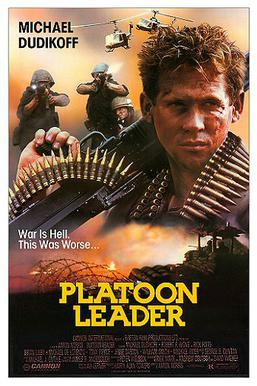
A Movie A Day #306: Platoon Leader (1988, directed by Aaron Norris)


Having just graduated from West Point, Lt. Jeff Knight (Michael Dudikoff, the American Ninja himself) is sent to Vietnam and takes over a battle-weary platoon.  Lt. Knight has got his work cut out for him.  The VC is all around, drug use is rampant, and the cynical members of the platoon have no respect for him.  When Lt. Knight is injured during one of his first patrols, everyone is so convinced that he’ll go back to the U.S. that they loot his quarters.  However, Knight does return, determined to earn the respect of his men and become a true platoon leader!
Though Cannon was best known for making B action movies (many of which starred either Chuck Norris or Charles Bronson), they occasionally tried to improve their image by releasing a prestige film.  Platoon Leader is somewhere in the middle between Cannon’s usual output and their “respectable” films.  It is based on a highly acclaimed memoir and, though the film was made in South Africa, it does a good job of recreating the look of Vietnam.  For instance, Platoon Leader‘s version of Vietnam is more convincing than what Cannon later presented in P.O.W.: The EscapePlatoon Leader also spends some time developing its characters.  Lt. Knight is more than just a stoic action hero, which already distinguishes it from 90% of Cannon’s usual output.  At the same time, Platoon Leader was directed by Chuck Norris’s brother, Aaron, and he doesn’t hold back on the explosions and the gunfire that everyone had come to expect from a Cannon war film.  The end result is an enjoyably hokey film that has a few more layers than the typical Cannon production but not too many.

This film was originally titled Nam but, after the success of Platoon, the title was changed to Platoon Leader.  In typical Cannon fashion, Platoon Leader plays like a more jingoistic and even less subtle version of Stone’s film.  The main difference is that Platoon‘s Lt. Wolfe never won the respect of his men and ended up getting killed with almost everyone else while Lt. Knight beats back the VC and shares a celebratory embrace with his sergeant.

One final note: keep an eye out for genre vet William Smith, who starred in The Losers (a film about a group of bikers who are recruited by the CIA and sent to Vietnam), in the role of Dudikoff’s superior officer.  If Platoon Leader had been made in the 70s, Smith would have played Dudikoff’s role so his appearance here is almost a passing of the B-movie torch.

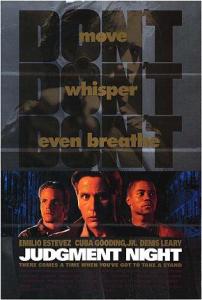
A Movie A Day #231: Judgment Night (1993, directed by Stephen Hopkins)


Four suburbanites (Emilio Estevez, Stephen Dorff, Jeremy Piven, and Cuba Gooding, Jr.) are driving to a boxing match in pricey RV when Piven takes a wrong turn and they end up lost in the wrong side of the city.  Not only are they lost but they also witness Fallon (Denis Leary) and his gang murdering a young man.  Jeremy Piven thinks that he can negotiate with Fallon and get his friends out of the situation by pulling out his wallet and flashing a few bills.  Guess how well that works out for them?  With Fallon chasing them through the city, these formerly smug and complacent yuppies are forced into a battle for survival.
Judgment Night is a deeply stupid but compulsively watchable movie.  From the minute that Piven shows up with that RV and Estevez says goodbye to his wife and newborn child, it is obvious what’s going to happen.  Fortunately, the cast is better than average and Stephen Hopkins does a good job of making the city look menacing and keeping up the pace.  There are a few times that Judgment Night pretends like it has something to say about wealth and society but it never tries too hard to be anything more than an exciting B-movie.  Though it may not have been hard to do considering that his main competition was Emilio Estevez, Denis Leary easily dominates Judgment Night.  Fallon may be a cartoon villain but Judgment Night is a cartoonish movie so it works.

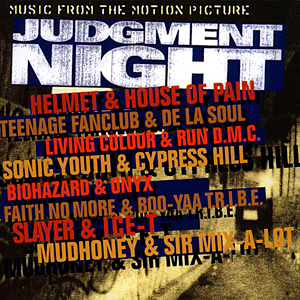
Today, Judgment Night is best remembered for its soundtrack, on which nearly every song was a collaboration between hip hop and metal artists.  The Judgment Night soundtrack may not have invented the genre of rap rock but it was many people’s first exposure to it.  The Teenage Fan Club/De La Soul collaboration Fallin‘ opens the movie on just the right note while Biohazard and Onyx’s Judgment Night is such a strong track that there’s no way the rest of the movie can hope to live up to it.

Judgment Night.  The movie is ok.  The soundtrack is fucking amazing.

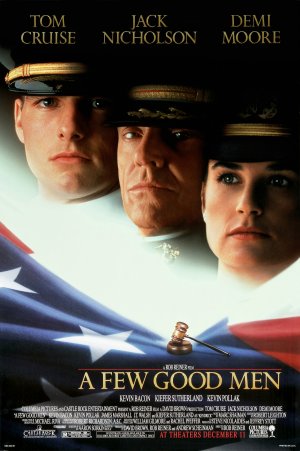
Lisa Watches An Oscar Nominee: A Few Good Men (dir by Rob Reiner)


A_Few_Good_Men_poster

So, late Saturday night, I turned over to TCM’s 31 Days Of Oscar and I was watching the 1992 best picture nominee, A Few Good Men, and I noticed that not only was there only one woman in the entire film but she was also portrayed as being humorless and overwhelmed.  While all of the male characters were allowed to speak in quippy one liners and all had at least one memorable personality trait, Lt. Commander Joanne Galloway (Demi Moore) didn’t get to do much beyond frown and struggle to keep up.

“Hmmmm…” I wondered, “why is it that the only woman in the film is portrayed as basically being a humorless scold?”  Then I remembered that A Few Good Men was written by Aaron Sorkin and it all made sense.  As I’ve discussed on this site before, Aaron Sorkin has no idea how to write woman and that’s certainly evident in A Few Good Men.  Joanne (who goes by the masculine Jo) is the one character who doesn’t get to say anything funny or wise.  Instead, she mostly serves to repeat platitudes and to be ridiculed (both subtly and not-so subtly) by her male colleagues.  You can tell that Sorkin was so busy patting himself on the back for making Jo into a professional that he never actually got around to actually giving her any personality.  As a result, there’s really not much for her to do, other than occasionally scowling and giving Tom Cruise a “that’s not funny” look.

(“C’mon,” Tom says at one point, “that one was pretty good.”  You tell her, Aaron Tom.)

A Few Good Men, of course, is the film where Tom Cruise yells, “I want the truth!” and then Jack Nicholson yells back, “You can’t handle the truth!”  At that point in the film, I was totally on Nicholson’s side and I was kinda hoping that the scene would conclude with Cruise staring down at the floor, struggling to find the perfect come back.  However, this is an Aaron Sorkin script which means that the big bad military guy is never going to have a legitimate point and that the film’s hero is always going to have the perfect comeback.  Fortunately, the scene took place in a courtroom so there was a wise judge present and he was able to let us know that, even if he seemed to be making the better point, Nicholson was still in the wrong.

As for the rest of the film, it’s a courtroom drama.  At Guantanamo Bay, a marine (Michael DeLorenzo) has died as the result of a hazing.  Two other marines (Wolfgang Bodison and James Marshall) have been accused of the murder.  Daniel Kafee (Tom Cruise), Joanne Galloyway (Demi Moore), and Sam Weinberg (Kevin Pollack) have been assigned to defend them.  Jack Ross (Kevin Bacon) is prosecuting them.  Kafee thinks that the hazing was ordered by Col. Nathan Jessup (Jack Nicholson) and Lt. Kendrick (Kiefer Sutherland).

We know that Kendrick’s a bad guy because he speaks in a Southern accent and is religious, which is pretty much the mark of the devil in an Aaron Sorkin script.  We know that Jessup is evil because he’s played by Jack Nicholson.  For that matter, we also know that Kafee is cocky, arrogant, and has father issues.  Why?  Because he’s played by Tom Cruise, of course.  And, while we’re at it, we know that Sam is going to be full of common sense wisdom because he’s played by Kevin Pollack…

What I’m saying here is that there’s absolutely nothing surprising about A Few Good Men.  It may pretend to be about big issues of national security but, ultimately, it’s a very slick and somewhat hollow Hollywood production.  This, after all, is a Rob Reiner film and that, above all else, means that it’s going to be a very conventional and very calculated crowd pleaser.

Which isn’t to say that A Few Good Men wasn’t enjoyable.  I love courtroom dramas and, with the exception of Demi Moore, all of the actors do a good job.  (And, in Demi’s defense, it’s not as if she had much to work with.  It’s not her fault that Sorkin hates women.)  A Few Good Men is entertaining without being particularly memorable.

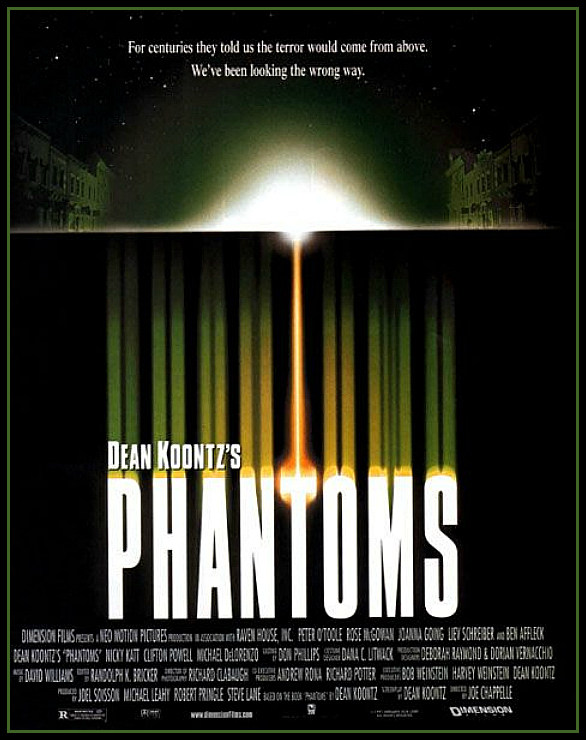
Quickie Review: Phantoms (dir. by Joe Chappelle)


If there was ever an actor in the last twenty years who has suffered ridicule regarding his body of work it would be Ben Affleck. Nevermind the fact that he has actually done very good work as an actor. People tend to view his acting work through some very bad film projects which the online film bloggers (and trolls) have lambasted year after year. One such film which has gained a cult following for all the reasons is the 1998 horror film Phantoms which was adapted from the Dean Koontz horror novel of the same name. This was a film which came out of nowhere and which no one really saw when it first hit the theaters. There’s a reason for this and the main reason for this being that the film was really awful though not without some entertaining bits.

Phantoms starred Ben Affleck in a role that really seemed more suited for an older actor. His Sheriff Hammond in the novel was much older and fit the backstory told in both novel and film that never truly fit Affleck’s youthful appearance and mannerism. He’s joined in this Joe Chappelle production by classically-trained veteran actor Peter O’Toole (who must’ve really needed the money to sign up for this film) in the role of Dr. Exposition dump aka Timothy Flyte who ends up explaining to the surviving cast of characters the very danger facing them in the abandoned town of Snowfield. Rounding out the cast is  Liev Schrieber as the creepy Deputy Stu Wargle who becomes a sort of plot device as the film moves forward. To add to this mix are Joanna Going and Rose McGowan as sisters who first discover that their town has just gone through a terrible event.

The novel this film was based on was pure scifi-horror pulp which stressed one’s suspension of disbelief, but was quite entertaining from beginning to end. Dean Koontz is like the generic fast-food version of Stephen King. This film adaptation borrows heavily from films such as Carpenter’s The Thing and the remake of The Blob. This wouldn’t have been a bad thing since the film’s story does bring into it an interesting concept of an ancient enemy which might or might not have been responsible for unexplained mass disappearances of people and animals throughout history going back to prehistoric times.

What Phantoms ends up doing which ruins the film as a whole was to rush through the narrative it was adapting it. The film pretty much goings through a checklist of all the major scenes in the novel, takes those scenes and truncates them to fit uncomfortably into a 90+ minute film. Some of these scenes could’ve been extended a few more minutes to add to a sense of grandiose to a film that needed it despite it’s B-movie foundation. One such scenes would be the arrival of a special Army unit designed to combat unexplained events, but the film treats this sequence from their arrival right up to their untimely demise in less than 15 minutes. I think in the hands of a much more capable filmmaker these scenes would’ve made the film much more entertaining.

Phantoms was a horror film that could’ve become a 90’s cult-classic if it had been given the proper time and effort from it’s producers, but seeing that it was the Weinsteins of Miramax and Dimension Films this final product was probably the best Joe Chappelle could’ve come up with. Weinsteins during the 1990’s were more concerned of pushing their Oscar-baiting film productions than actually giving time and effort to all their films. If there was any reason to see Phantoms it would be to see just why it kept being mentioned in Kevin Smith’s Jay and Silent Bob Strike Back. Other than that there’s really no reason to see it unless there’s nothing else on.