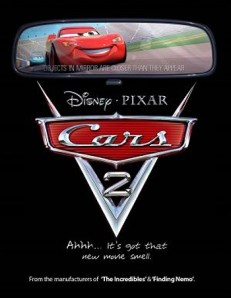
There was once a rumor that the major heads of Pixar – John Lasseter, Pete Docter, Andrew Stanton, and Lee Unkrich (I don’t count Brad Bird because he came later) were afraid to let any of their staff take on directing any of their films. With such an illustrious track record, it’s understandable. Pixar has picked up quite a reputation as being one of the few production companies one can count on to have Supposedly, they felt that the quality wouldn’t be as great.
So, I’m certain that the Pixar Heads are eating their own pie when they realize how Cars 2 turned out. It’s a fun film that the kids will adore, but it really lacks the heart that many of the other Pixar films are known for. Mind you, I’m not blasting the movie and saying it should be avoided. Not at all. It’s just that this is more of a movie for the kids and less of one for the adults. I feel that’s the problem everyone’s having with it. This is a good thing. It reminds Pixar of what they need to do to keep winning Oscars, while still being entertaining for the kids. Hopefully, because one of the head honchos made a mistake, maybe the company may consider letting some of the new kids try a hand at it.
In short, the Kid in me loved Cars 2. The Adult in me felt “Well, at least the Kid enjoyed it.” It suffers from two problems – a great story that would have been better set in the world of The Incredibles and a forced moral to the story. This may be the first Pixar film since A Bug’s Life where I haven’t teared up, this coming from someone who couldn’t make it out of the first 15 minutes of Up without tissues.
Previously on Cars, Lightning McQueen (Owen Wilson) won his very first Piston Cup after a pit stop in the small town of Radiator Springs, where he learned to slow down and relax. He also met up with Tow Mater (Larry the Cable Guy), who may not be the brightest spark plug in the engine, but means well and manages to help when he can. Now, we find that McQueen has earned a number of Piston Cups and is one of the best racers in the world. After returning to Radiator Springs, he finds himself greeted by Mater – who’s been anxiously waiting for his best friend. Mater, being who he is, can’t help but be a little overboard in his fun, which ends up getting McQueen involved in a brand new race that’s sponsored by a clean fuel magnate.
Finn McMissile (Michael Caine) and Holly Shiftwell (Emily Mortimer) are also investigating what could be a dangerous situation. While meeting with one of their American contacts (a great cameo by Bruce Campbell), the contact passes on some special information to Mater. Mater, not realizing what he’s been tagged with, is mistaken for a spy by the duo and brought into the investigation. That’s basically what Cars 2 is. It’s “Mater becomes a Spy”, and for the most part it works, but only if you really like the character. Mater is finally given his time to shine and he pulls it off well. I myself don’t mind Larry the Cable Guy, so it’s okay for me. For the grown ups, it could be a Mater overload. The kids will eat it up. The parents may actually get a little annoyed at how clueless Mater can be at times.
I have to admit that both Michael Caine and John Tuturro (Francesco Bernoulli) were two of the strongest character voices in the film. Owen Wilson’s okay, but the story really is only about him in terms of his relationship to Mater. I really didn’t care too much about Lightning this time around. We know his story, he’s grown about as much as he can in my eyes. More or less, he’s playing second or third fiddle. Seeing Caine in this made me want to watch Harry Brown again, or The Fourth Protocol. The fact that he’s also playing an Aston Martin DB5 type Vehicle is a sweet touch for me. He ’s smooth with his lines and pulls off the British Agent role pretty well. Mortimer is also relaxed in her role. Tuturro’s Bernoulli is as over the top as he was in The Big Lebowski, and he was a treat here as McQueen’s main rival. He may have had more fun than the others working on this, from the way he sounds.
Visually, Cars 2 is as beautiful as the other Pixar films, but doesn’t really seem to break that much new ground. Toyko looks nice, Paris is perfect (right down to the Ratatouille reference, if you catch it) and Italy looks sweet, but we know Pixar can do that. The 3D, however is downright magical, and I’m one who honestly believes the medium is best served with Animated films rather than filmed ones. It’s not exactly How to Train Your Dragon, but it’s still good in it’s own right.
I mentioned earlier that the story could have been better set in the world of The Incredibles. It’s an interesting spy story (the reasoning behind why what’s happening was funny in the sense of cars and the like), but the idea that cars are actually doing all of this action kind of pulls away from the story. At least, the adult in me comes off with this thought. For kids, it’s cars doing cool stuff, and I doubt it’ll come across as boring. The other problem is that the moral of the story – accepting your friends for who they are, despite their quirks (because we all have them) – feels a little forced. It’s like someone concentrated so hard on trying to do it that when it does occur, you go..”Okay, I get it.”, But I didn’t walk away feeling anything. Ratatouille’s Remy had a passion for cooking, one so great that he even made the most wicked food critic believe that “Anyone Can Cook”. In Up, Carl Fredricksen learned to let go of what he was holding on to and found new adventures. Mater undergoes a change, but it isn’t quite a big or a substantial. Actually it doesn’t even last long. It’s just clean fun.
Overall, looking at Cars 2, it’s not the greatest Pixar film they’ve done – far, far from it, but it’s a kid’s film. It’s quite enjoyable, but it sacrifices heart for action, something that Kung Fu Panda 2 managed to hold onto this year. Your kids will love it and you’ll enjoy that they’ll love it, but just don’t bring any tissues. They’re not necessary. You really wont find your heartstrings pulled here too much.
So, last night, I was feeling a bit down for a number of reasons so my BFF Evelyn came over and we had a little slumber party of sorts in my living room. And before everyone does a double take and accuses me of trying to be all like Paris Hilton, let me just explain that when we refer to each other as being “BFFs,” we’re not just being sincere but we’re being postmodernly satiric. It’s kind of the same principle behind why me and my sister Erin tends to casually toss around the word “bitch” whenever we’re having a conversation. Of course, “BFF” doesn’t inspire quite the same reaction from the older folks at the family reunion as “bitch” does but that’s a whole other story.
Anyway, as I informed everyone earlier on twitter, Evelyn and I did all the usual things that you do at a slumber party. We stripped down to our underwear, watched horror movies, ate food that we shouldn’t have eaten, had a violent pillow fight, and swore that we would never reveal the divine secrets of the ya ya sisterhood. I also recruited her to look through all the possible picks for the latest edition of Lisa Marie’s Favorite Grindhouse and Exploitation Film Trailers and help me narrow them down to just 6 trailers.
This, she helped me down without (too much) complaint. Though it may not always be apparent, deciding which 6 trailers to feature each week is actually a pretty long and thorough process and it’s one that can be very tedious if you’re not a fan of these movies. I think a lot of people would have said, “Who cares? Just toss up 6 random trailers and be done with it.” Not Evelyn. Even as I forced her to watch some really odd and kinda disturbing trailers, she stuck with it until we had this week’s 6 trailers. She even put up with me explaining to her why a certain trailer was more grindhouse than another. And that is one of the many reasons why I love Evelyn and why she’ll always be my BFF.
And here’s the 6 trailers that she helped me pick for this week…
Okay, Evelyn and me both literally fell in love with this trailer from the minute we heard that narrator say “The curse that begins with a kiss.” Needless to say, we both jumped to a conclusion as to what that curse was and let’s just say it wasn’t syphilis. But anyway, this appears to be some sort of cross between an old educational short and a blaxploitation film. I haven’t seen this film yet and hadn’t even heard of it until I came across the trailer but now, it has become one of my obsessions. I must see Stigma. I must find out about the curse that begins with a kiss…
2) The Magic Garden of Stanley Sweetheart (1970)
Wow, isn’t that just the most annoying title ever? It just screams “FILM SCHOOL GRADUATE!” at the top of its trust funded lungs. Still, this trailer does have one line that made me laugh out loud and that line was: “Where am I going?” Otherwise, this trailer is also memorable for the horrid “gingerbread” song that plays over the first few clips . Evelyn claims that the song is now stuck in her head, which is pretty bad since the entire song is basically “something something gingerbread something something gingerbread…” Evelyn thinks that Stanley (played by Don Johnson of A Boy and His Dog and The Harrad Experiment) looks hot in this trailer. I think he’s a little bit too much of a pretty boy. Neither one of us can believe that he later grew up to be the redneck in Machete.
Fred Williamson is …. Jesse Crowder! Despite our different feelings concerning the appeal of Stanley Sweetheart, both Evelyn and I agreed that Jesse Crowder would kick his scrawny little ass. That said, I objected to the “I’m going to bruise you up a little” line towards the end of the trailer but Evelyn defended it, making the argument that Crowder would have bruised up a man with a knife as well.
“It could have been … a love story.” Much like Stigma, this is a case of us just falling in love with a overdramatic tag line. Apparently, the film itself appears to be a grindhouse version of Cyrus.
We had to include Zachariah because, as the trailer explains, this was the world’s first electric western. Add to that, Don Johnson looks a bit less fancy here than he did as Stanley Sweetheart.
We saved the best for last. Now, I know that the original Get Carter is such a classic (especially when compared to the Stallone version) that you might wonder if it really belongs here. Well, trust me, it does. Get Carter is pure grindhouse art and this trailer proves it. Plus, both me and Evelyn were surprised and delighted to discover that once upon a time, Michael Caine was quite the sexy beast. When, at the end of the trailer, we were told to “Get Carter before he gets you,” we both responded with, “Carter can have us.”
January 19, 2011 is the first day of the new year when the internet exploded with reactions concerning Warner Brothers’ announcement about two key characters in Christopher Nolan’s upcoming and final film in his Batman trilogy.
According to a Warner Brothers press release Anne Hathaway will take on the iconic role of Selina Kyle. For those who don’t recognize the name it’s the public face of the female foil for Batman. I’m talking about none other than Catwoman herself. While the press release doesn’t mention the name Catwoman anywhere it would be only logical that Hathaway as Selina Kyle will end up as Catwoman before the film ends.
The other character announcement was about who Tom Hardy was going to portray in the film. Speculation since Hardy was cast mostly had him taking on the role of the villain Hugo Strange, but in a curve out of left field it looks like Hardy will be playing villain Bane.
While reaction on Hathaway as Selina Kyle has mostly been positive the one concerning Hardy as Bane has been met with a combination of guarded optimism (much faith and trust has been earned by Nolan from fans) to outright fanboy rage. Both from film bloggers who should know better and just people who want to grab onto anything that they see as the downfall of the Nolan take on the Batman franchise.
Some still remember the catastrophic Bane from Schumacher’s deservedly-panned Batman & Robin thus think this Nolan take on Bane will be just the same. Others just never bought into the ‘roided-out criminal villain when he was first introduced in the “Knightfall” crossover during the 90’s. If Nolan hadn’t earned my trust as a film and comic book fan from his previous Batman films I would react the same way but I won’t.
While the comic book version of Bane did look like a muscle-bound luchador who used a super-soldier serum called “Venom” to roid-out people fail to remember that bane was very close to Batman’s equal when it came to the intellect department. This was the one villain who deduced Batman’s true identity and found a way to mentally and physically break the Bat down before finally breaking his back.
I believe that Nolan will probably dump the luchador mask and outfit and concentrate on Bane as a criminal kingpin who doesn’t just have the physicality to match Batman punch for punch but also the mental acuity equal to the task of breaking Batman. Does this mean that rumors of the character Hugo Strange has been nixed from the film?
I happen to think that either Hugo Strange will be merged with the character of Bane or may actually appear as the true mastermind who turns Bane loose on the Batman. Either way I’m quite interested in finding out how Christopher Nolan plans to adapt the Bane character to his realistic take on the Batman universe. I’d be very surprised if the wrestling mask and outfit remains. The venom injections could easily be adapted to become more believable and as Tom Hardy has shown in the film Bronson he can physically bulk up and look believable as a muscle-bound heavy.
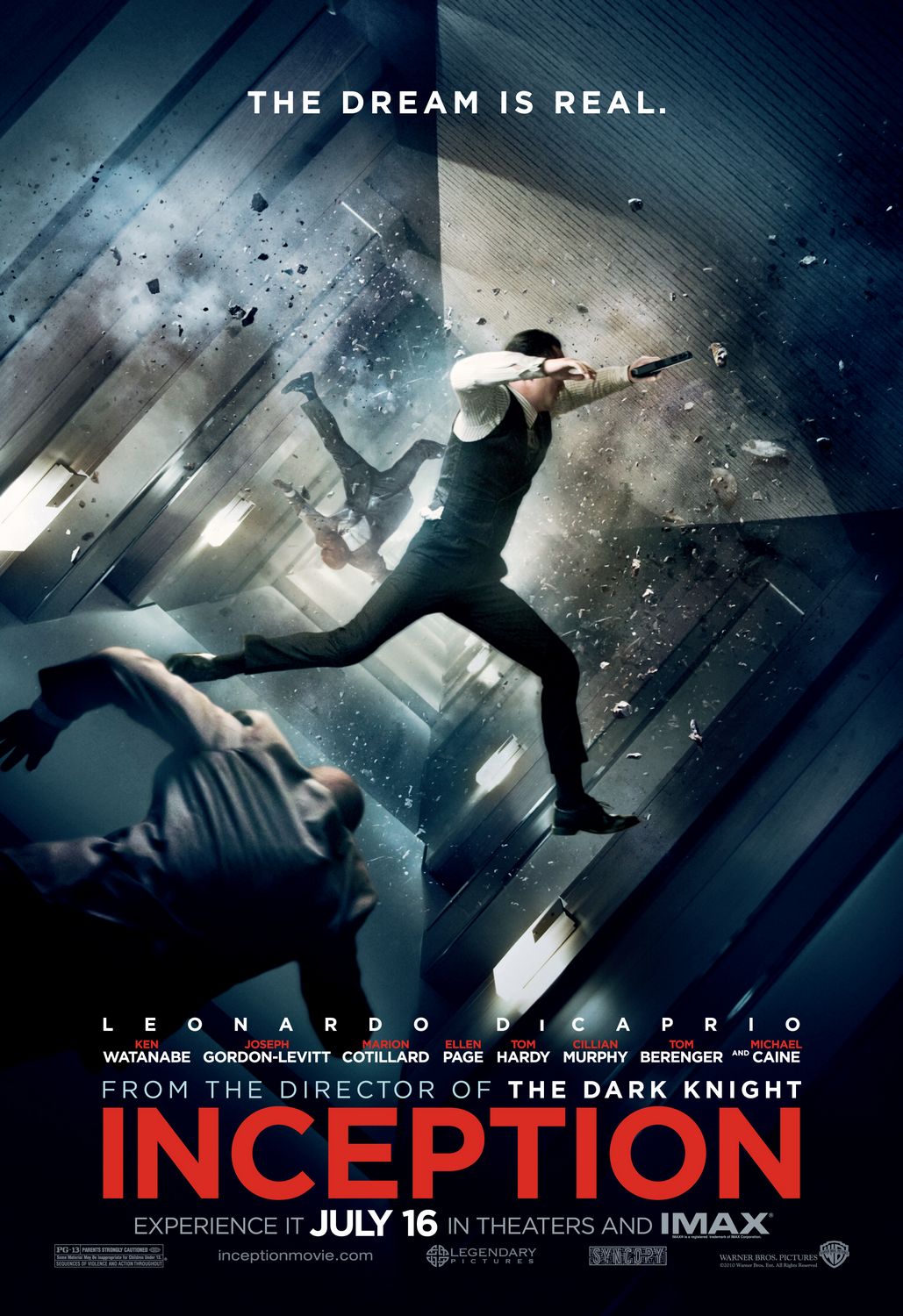
The summer of 2010 has been quite a disappointment. While the films released during this major blockbuster season has been good most have not been able to be that one stand-out which defines a summer season. We’ve had the typical tentpole sequels like Iron Man 2 (good but not great) and Toy Story 3 (also good but not great) to remakes like The Karate Kid to The A-Team. To say that the 2010 summer blockbuster season has been lackluster would be an understatement. Even original films like Splice hasn’t taken in the audience. It now falls to one of the biggest titles for the summer to try and save the season. Whether it will do so financially is still in doubt, but critically the latest from Christopher Nolan may just become the event film of the summer to actually deliver on its hype and the promise of an audience seeing something new, fresh and daring in a sea of mediocrity. Inception comes into the 2010 summer season and delivers on its promises and more than lives up to the hype heaped upon it by critics and fans alike.
A film almost a decade in the making, Christopher Nolan’s epic and sweeping tale of dreams and reality wrapped around a heist film brings the filmmaker one-step closer to becoming the genius filmmaker some of his most ardent followers have dubbed him to be. Nolan as a filmmaker and, more importantly, as a storyteller has always had a fascination with shattered reality and how the subconcious directly affect his protagonists’ sense of the real. We’ve seen this in his film-style of using a disjointed and non-linear structure to his films which goes to creating a sense of confusion in the inattentive viewer. Some have called this style of his as being a gimmick to make a simple story more complex than it really is. I disagree with these individuals and say that Nolan has never done anything to trick an audience with his storytelling style and choices. His films have all the facts laid out before the audience, but in a way that asks the audience to participate in putting the jumbled pieces together. I’ve never seen a red herring used by Nolan in his more personal projects and even in the populist titles he’s done under the rebooted Batman franchise.
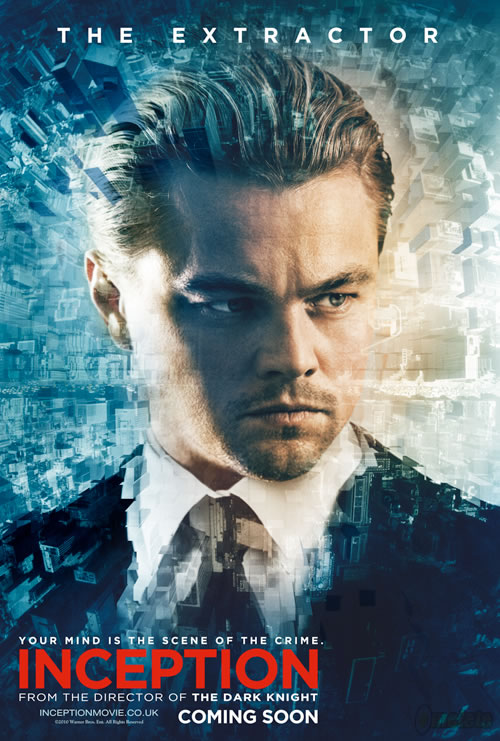
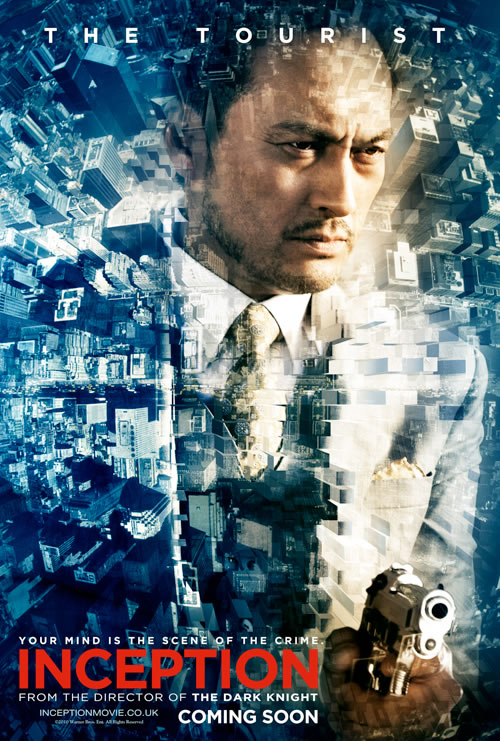
In his latest film, Nolan has refined his non-linear style and used it to successfully create the main setting of the film. Inception is set mostly in the dream world shared by the characters and those they’ve targeted. It is in this shared dream state that the audience learn the rules governing the world of Inception. It is in this dream state that we’re introduced to the first people who would make up an incredible ensemble cast put together by Christopher Nolan and his casting crew. We first meet dream extractor Dom Cobb (played by Leonardo DiCaprio) and his pointman Arthur (Joseph Gordon-Levitt) as they attempt to steal something valuable and important from within the dream of their Japanese-industrialist mark in Saito (Ken Watanabe). We see hints of the rules that will become important for the audience to help them follow the film’s main story as it unfolds. We learn that Saito has already known in advance that he’s in a dream constructed and being shared by Dom and Arthur in their contracted heist by parties unknown. As good as Dom and Arthur are at their job os stealing ideas from a mark through their dreams they have no chance when someone from Dom’s past inserts herself in their plans to sabotage what they’ve worked to accomplish.
It’s in this introductory sequence that we learn of the backstory of Dom and why his latest heist-job didn’t work out too well and has now endangered not just himself but those he has been working with. Saito gives Dom and Arthur a way out of their problems after failing in this job to steal from him by doing a job for him. But unlike previous dream heists Dom and Arthur have done in the past this time Saito doesn’t want something stolen from someone’s mind but to have an idea planted so deep within a mark’s subconscious that the mark believes it to be their very own and not one planted by an outsider. The job doesn’t require Dom to be an extractor of ideas. He’s now to find a way to successfully plant an idea. A job known as “inception” which Arthur and others deem near-impossible to pull off and one quite dangerous not just to the mark but to those involved in the process.
To say anymore about the plot of the film would be to spoil it. Inception works best when as little as possible about the film is known going in. The surprise and awe of the story unfolding is half the fun. It’s like an intricate puzzle or game one tries to solve. It’s ok to know ahead of time how to solve things, but not as fun. While for some people the way Nolan uses non-linear storytelling can be confusing all he asks his audience is to pay attention to the details and clues he’s planting in every scene and piece of dialogue. Let’s be honest this film is not for the inattentive. I won’t say stupid since that implies having low intelligence. It doesn’t take intelligence to pay attention and I’ve known that some of the more intelligent people have a tendency to let their attention wander.
Inception is a film about big ideas and grandiose themes. While the story in of itself when broken down to its simplest common denominator is just a heist film done in a new way, the film allows for layers upon layers of ideas to wrap itself around this simplistic premise. Nolan doesn’t just play with disjointing time for audience. He’s gone and went towards manipulating reality within the subconscious thought to ask the audience a simple question.
Are what we seeing a dream or is it reality?
The film doesn’t trick us using red herrings to make us think one way or another. Everything Nolan has put up on the screen is quite literal and remembering the rules he had set-up in the first hour lays the groundwork for each individual audience to answer that question for themselves. There’s no right or wrong answer to the question, but for some who have seen the film their disappointment seem less to do with the quality of the film, the acting and the direction but more on some of the ambiguous nature of the ending which becomes a dealbreaker for some. Again while I respect their take on this film I find their reasoning for negative criticism to be grounded on thin to non-existent ground. I will get to that ending soon.
While some have called Inception as the anti-Avatar I believe the two filmmaker share similar traits not just in how they create their film, but also in their two latest film. Both Nolan and Cameron are quite known to be very controlling of how their films are made to the point they dabble in every aspect of it. In their latest films they’ve also gone a long way into building a world for their story and characters to inhabit and play around in. While Cameron’s latest was an otherworldly kind in the most literal sense the same could be said for Nolan’s latest but instead inhabits the mind and how anything is possible. From the look of things both film will also share the same sort of near-universal acclaim from the film-going audience with a small, albeit very loud, minority calling Nolan’s film unoriginal, boring and, a word I have loathed for its overuse when something becomes very popular, overrated.
Where the two filmmakers diverge is the way they go about their films. Where Cameron leans heavily in pulling at the emotional strings of the audience through narrative and film sequences in his films, Nolan plies the audiences intellect instead. Cameron for all his technical genius both within the filmmaking sphere and outside of it can be quite the sappy filmmaker and all his films have shown this whether it’s The Terminator or Avatar. For Nolan his films have always felt like an intellectual exercise. An exercise everyone was invited to participate in no matter their level of intellect. He’s been able to marry both his indipendent arthouse sensibilities with the blockbuster the masses seem to crave year in and year out. With Inception he has moved one-step closer to achieving a perfect meshing of the two. This film has all the makings of a great heist and sci-fi thriller wrapped around so many pieces of profound and thoughtprovoking ideas that even after several viewings an audience will find something new to think about. Only one other film I can think of in the last decade or so has accomplished this and that was 1999’s The Matrix by The Wachowski Brothers. While that film was a kick-ass sci-fi action film it also dared to mix in a liberal dose of philosophy both Eastern and Western not to mention subjecting it’s audience to rethink how they see reality.
Christopher Nolan has gone beyond just trying to question the nature of reality. His goal with this film is to deconstruct the nature of the subconscious itself and show how such a thin line separates the dream from the real that at first and, even several glances, one cannot tell the difference. It’s a good thing for the audience watching Inception that Nolan has given them the tools and the rules to follow if they dare. And that’s where I think Nolan will disnguish himself apart from other great directors of his generation and put him up on the level of the true masters in film history. He doesn’t just make films that has worldwide appeal but able to do them while still able to engage his audience to open up their minds to the infinite possibilities his stories offer. While this does make his film a tad cold and distant for some that shouldn’t detract from the high-quality of his work, especially with Inception. The film has heart. It just doesn’t pluck on those particular beats to engage the audience.
I think filmblogger Devin Faraci said it best on his Twitter feed while discussing the film with others. While not exactly verbatim what I got out of it was that he thought it was always easy to engage and/or manipulate the audience through emotional factors, but much harder to engage their intellect. While some have accomplished the former to a great extent and vice versa I think with Inception Nolan has stepped closer than anyone to engage both the heart and the mind of the audience.
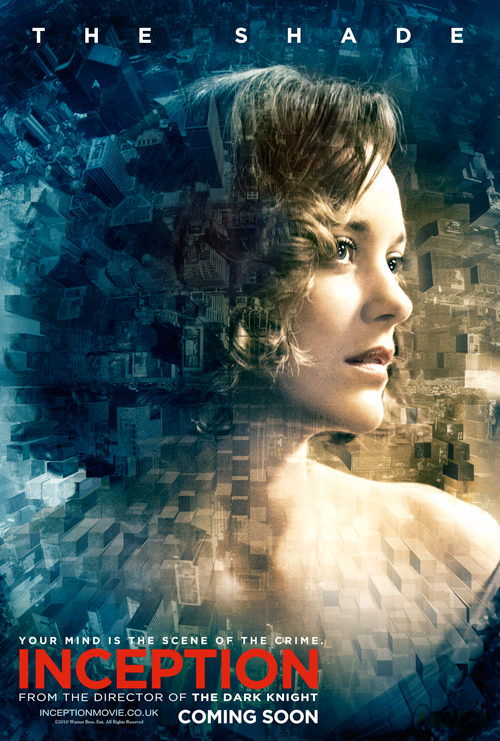
This review cannot be too much of a review if I just spoke about the ideas, themes and the inner workings of Nolan’s mind. The film is actually very good. Good enough to that’s close to being perfect. Pick any aspect of the film and those involved have done some of their best work and grown in their craft. As I stated earlier the film sports one incredible ensemble cast. I’ve already mentioned Leonardo DiCaprio and Joseph Gordon-Levitt who both do very great work in their roles. DiCaprio continues to be the go-to-guy when it comes to playing the tortured individual. Similar to his other role in Scorsese’s Shutter Island, DiCaprio as Cobb was quite believable in his personal-made hell in regards to a past event which involved his wife Mal (played with beautiful elegance and malice by Marion Cotillard). But unlike Scorsese’s film Nolan doesn’t reveal this personal issue through a twist in the plot, but let’s it come out naturally with the help of another cast member providing the impetus for Cobb to come clean. This individual is the team’s new dream architect in the form of Ariadne (Ellen Page in her most mature role to date and one that should go a long way from helping her shed the label of being Juno-esque).
Ariadne becomes the proxy by which the audience learns the in’s and out’s of Cobb’s job as a dream extractor and, very soon, inceptor. Through some inventive use of CGI and practical effects we see throught Ariadne’s eyes how the shared dream-state behaves. How specific rules actually exist within this state no matter how many levels of dreams an individual or group goes down into a mark’s subconscious. Some of these scenes people have seen glimpses of in the trailers and tv spots, but even seeing some of them in advance doesn’t detract from how incredible they look when seen on the bigscreen, especially for those lucky enough to see them on IMAX.
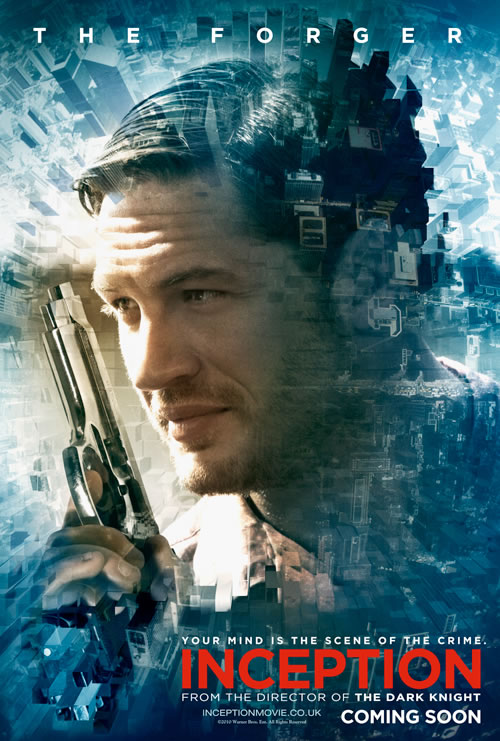
The rest of the cast rounded out by Tom Hardy as Eames the team’s Forger, Dileep Rao as the Chemist in charge of fabricating the compounds needed for the team to enter their mark’s subconscious. Cillian Murphy (starting to become one of Nolan’s regulars) plays Robert Fischer, Jr. their target and mark throughout the film with veteran actors Tom Berenger, Michael Caine and Pete Postlethwaite providing the wise-men roles in the film. It’s Tom Hardy as Eames which stood out in a cast full of extraordinary young and veteran performers. His recent fame as an actor due to his brutal and daring performance in Bronson has made Hardy a hot commodity in Hollywood. His playful character of Eames serves to provide some levity in an otherwise very serious film which allows the audience to come closer to the characters and story instead of remaining distant as Nolan’s detractors like to point out. He nearly pulls off stealing the film from everyone everytime he’s on-screen. It’s a testament to all the actors that he doesn’t as each and everyone have their moments to shine without overshadowing their fellow co-stars.
It would be difficult to review this film without pointing out how beautiful it looks and sounds. The visual part of the film has to go to Walter Pfister who works his magic behind the cameras on this film. Every shot is clear, concise and free of tricks some cinematographers these days have come to rely on too often to make their shots look more dynamic than it really should be. The editing by Lee Smith makes sure that Nolan’s style doesn’t confuse the audience and keeps the non-linear narrative structure easy to comprehend. As for the score one has to look to Hans Zimmer’s growing rapport with Nolan. He’s scored two of Nolan’s film and it looks that Zimmer has tapped into what Nolan wants his film score to sound like. not to dominate or overemphasize particular scenes or beats, but to act as an accompaniment. All three individual do their part as does the actors into making Nolan’s vision of Inception come to life. As great a filmmaker as Nolan is turning out to be these support players have made sure his path towards that goal is done so on smoother ground than not.
Now, there’s going to be some heated and long debates as to the nature of the film because of the final shot. The final shot is of a metal dreidel spinning in the foreground with the camera panning to it. The dreidel is spinning and spinning and looks to keep on doing so. The dreidel is shown earlier in the film as acting as some sort of anchor to tell Cobb whether he is in the real world or in a dream. If it continues to spin and not tip over and fall then he’s still in one. If it spins but ultimately tips over onto its side then he’s out of it. The film ends with the dreidel spinning and for a split second before the film suddenly fades to black we see it wobble.
Many have seen this final shot as being a cop-out by Nolan to play with the audience’s mind. I happen to disagree. I see it as a part of the story itself. nolan has been asking throughout the film what is real and what is a dream. This last shot just emphasizes this question and leaves it up to the audience to decide whether the dreidel continues to spin or eventually tips over. While I lean to the latter in the end it doesn’t detract from the film. The fact that some people have grabbed hold of this scene to negatively criticized the film as a whole tells me just how well-crafted a film Nolan has made that one little sequence lasting no less than 10 seconds becomes a dealbreaker for some when it should stimulate the mind into thinking what it actually means. I see that as the mark of an excellent storyteller.
In the end, Inception has done something this year which most film have so far been unable to do. It has delivered on its high-minded promises of a film that would challenge the audience and not just entertain them. It’s a film which has been overhyped for the last six month but has more than lived up to it and for some surpassed the hype itself. Inception looks to be one of those films which would forever define a filmmaker and this one will definitely define Nolan moving forward no matter what other projects he has in the future. This is a film that dares to appeal not just to the arthouse cineaste crowd but to the general audience who yearn to watch something exciting and original. I won’t say this is Nolan’s best film since he has years upon years to continue making films. Maybe one of those will be his masterpiece, but Inception definitely could be counted as being a nominee for that honor. If nothing else this film has saved what has been a very ordinary and lackluster 2010 summer film season.
This is another film from 2009 that has still to get a release in the United States. A thriller from filmmaker Daniel Barber and starring two-time Academy winner Michael Caine, Harry Brown looks like another in the line of revenge films which all share some similarities with the Charles Bronson 70’s classic Death Wish. The film also stars Emily Mortimer, Liam Cunningham and Iain Glen.
The premise of the film does seem to owe much to Bronson’s Death Wish series with some of the rioting of hoodlums and gang members in the trailer reminiscent of the cult-classic Death Wish 3 where Bronson’s Korean War veteran literally goes to war with the neighborhood gang on the streets. I like Michael Caine as an actor and he always seems to inhabit a role no matter how much, at first glance, it seems like its not a good fit. Caine’s early works has had him play characters with a darkness in them and I think this film will help remind younger viewers to the fact that he was not always Alfred the Butler.
2006 has been a quiet year for event films. The predicted blockbusters this past summer pretty much underperformed despite some being exactly as good as I thought they’d be. Other than Johnny Depp and the gang’s Pirates of the Caribbean: Dead Man’s Chest, every blockbuster didn’t blow the industry out of the water. It’s a very good thing that I had smaller films to tide me over. This year has been a very good ones for some independent-minded and smaller films which came out during the slow first couple months of the year and during the graveyard release months between the end of summer and the start of the late year holidays. I’ve already had the chance to see such very good films like Running Scared from Wayne Kramer and Hard Candy from David Slade to The Proposition from John Hillcoat. I am glad to say that Christopher Nolan’s film adaptation of Christopher Priest’s novel, The Prestige is another non-blockbuster that excites, entertains and, in the end, keeps the audience mystified but not confused.
I’ve read Christopher Priest’s novel about dueling late 19th-century London magicians. It’s a novel written in epistolary format with each chapter and section written as entries into the journal of one of the main characters in the story. The novel itself is pretty straightforward as it tells the story in near chronological order. I was hesistant to embrace this film adaptation when I first heard about it since alot of the mystery of of the story wouldn’t translate so well in film if they followed the strict order of how the story was told in the novel. For Christopher Nolan and his brother, Jonathan, to just adapt the novel straight-out would’ve made for a dull and boring mystery-thriller. I was glad that the Nolan brothers were inventive enough to borrow abit from Christopher Nolan’s first feature film, Memento. Their film adaptation of The Prestige doesn’t go backwards in its narrative, but it does mixes up the chronological order of the story somewhat, but not to the point that Tarantino does in Pulp Fiction and Kill Bill. The two Nolans fudges abit with the timeline to add some backstory filler to help give the characters that Christian Bale and Hugh Jackman portrays with the reason for their pathological obsession with each other.
Christopher and Jonathan Nolan’s screenplay for The Prestige was able to keep the mystery of the story intact, but it also keeps the amount of red herrings in such films to a minimum. Michael Caine’s character, Harry Cutter, opens up the film explaining just exactly what constitutes a magic trick on stage. How it’s divided into three parts. First, there’s “The Pledge” wherein the magician shows the audience something ordinary he or she will use in the trick. Soon, the magician will follow this up with “The Turn” where the abovementioned ordinary object does something extraordinary in front of the audience. The pay-off of the magician’s trick is “The Prestige” where the audience’s astonishment occurs as they fail to deconstruct and figure out the means of the trick. That’s pretty much the film in a nutshell. It’s one big magic trick. The clues are there for the audience to see, gather and extrapolate their answer to the mystery that is the story. The screenplay doesn’t treat the audience as if they need to be hand-held throughout the film. In fact, anyone who pays attention will be able to solve one-half of the mystery by the first hour. I won’t say exactly whose half of the mystery it will be but people will be kicking themselves afterwards if they don’t figure it out right away.
This magic trick of a film does have its many underlying layers of themes to add some complexity, drama and tension to the characters of Alfred Borden (Christian Bale) and Rupert Angier (Hugh Jackman). I’ve already mentioned that throughout the film their mutual obsession about each other is due to a backstory detailing their past. A past where they were initially friends — rivals even — and apprentices to the magician Milton (played by Ricky Jay) and Harry Cutter (excellently played by Michael Caine as the only voice of reason throughout the film) who creates and maintains the devices used in all the stage tricks. Borden and Angier’s obsession is not just in ruining and sabotaging each other’s magic tricks and lives, but also trying to find out each other’s secrets as they both learn magic tricks which amaze and thrill the gentry of London’s stage. From the beginning of the film these two characters begin a journey towards a path of destructive behavior which puts not just each other’s lives at risk, but those who they care about. All of it in the name of humiliating and upstaging the other due to a tragic incident early in their mutual careers. These two individuals were not sympathetic characters and I applaud Christopher Nolan and his brother for not softening up their hard edges.
Most adaptors will try to make a story’s characters more sympathetic and likable. They went the opposite in The Prestige. But even these two dark characters continue to exude the charisma and strong personalities that the audience will root for one or the other. Should they root for the charismatic and born shownman that Hugh Jackman’s Angier character plays or go for the perfectionist Borden character Christian Bale plays. A perfectionist whose technical skills surpasses that of Angier’s but whose introverted and brooding personality makes him little or no stage presence.
Both Jackman and Bale play their characters well. The film wouldn’t be so good if it wasn’t for the work of these two actors. It helps that they’re surrounded by quality supporting character like Michael Caine as the seasoned, veteran mentor to the dueling magicians. Even Scarlett Johansson does very well with the part she’s given. It’s a part that many sees as more of a throwaway character. A piece of very good-looking distraction for both the story and the audience. But she gamely plays the role of pawn for both Angier and Borden. Unlike Michael Caine’s character who remains the singular voice of sanity in the film, even Johansson’s character of Olivia gets pulled into the obsessions and betrayals that’s plagued both Angier and Borden. But in the end, she’s just part of the process of “The Turn” and if people have been watching the film closely right from the beginning then she’s also a clue as to the secret of one of the amazing magic tricks shown by the two magicians.
The Prestige also has a distinct look about it. The 19th-century London just before the start of the new millenium gives it a certain sense of Victorian-era familiarity. Production designer Nathan Crowley shows a London at the height of its Gilded Age, but soon gives way to a certain steampunk look as inventor Nikola Tesla makes an appearance during an integral part of the story. David Bowie portrays Tesla as an eccentric genius whose search for the secrets of the universe will lead to the discovery of what many of that era would consider magic. It’s the ingenius looking technology created for the Tesla sequence which finally gives The Prestige it’s root in fantasy and science-fiction. The film doesn’t dwell on this new development but from that part of the story and until the end, the film takes on a look and feel of a steampunk mystery-thriller. There’s not enough films that tries to mine this new subgenre and I, for one, am glad that Christopher Nolan added this new dimension to the film’s overall look.
In the end, The Prestige really needs to be seen to be appreciated and for people to make up their minds about the film. Some will see it as a thriller with twists and turns that doesn’t insult the intelligence of its audience. Some may see the film as just one large gimmick from start to end. Those people will probably be correct as well. The film at its most basic level is one long magic trick with all three acts. It has “The Pledge” which is then followed up by “The Turn” and then ends with “The Prestige”. It will be up to each individual who sees the film to make the final decision as to whether they’ve bought into all three acts of the magic trick that is The Prestige, or come away having felt like they’ve wasted their time. I’ve not come across many who felt like the latter, even those whose own feelings about the film don’t reach the same level of praise as I have for Christopher Nolan’s latest offering. All I know is that this is a film that delivers on its premise to confound and amaze. It also continues to validate my views that Bruce Wayne and Batman are in very good hands with Christopher Nolan at the wheel. The Prestige was easily one of the best film of 2006.
 There was once a rumor that the major heads of Pixar – John Lasseter, Pete Docter, Andrew Stanton, and Lee Unkrich (I don’t count Brad Bird because he came later) were afraid to let any of their staff take on directing any of their films. With such an illustrious track record, it’s understandable. Pixar has picked up quite a reputation as being one of the few production companies one can count on to have Supposedly, they felt that the quality wouldn’t be as great.








 Through the Shattered Lens