Film Review: The Eagle Has Landed (dir by John Sturges)


The 1976 film, The Eagle Has Landed, takes place during World War II.

The year is 1943 and, with the war turning against Germany, Heinrich Himmler (Donald Pleasence, in a chilling turn) orders Colonel Max Radl (Robert Duvall) to come up with a plan to kidnap Winston Churchill.  When Radl learns that Churchill is scheduled to visit a small, coastal British village, he recruits a cynical member of the IRA, Liam Devlin (Donald Sutherland), to travel to the village and make contact with a Nazi sleeper agent, Joanna Grey (Jean Marsh).  While Devlin sets up the operation in Britain and falls in love with Molly Prior (Jenny Agutter), Radl recruits disillusioned Colonel Kurt Steiner (Michael Caine) to lead the mission to kidnap Churchill.

At first the village is welcoming to Steiner and his men, who are disguised as being Polish paratroopers.  However, it doesn’t take long for the plan to fall apart.  Soon, Steiner and his men are holding the villagers hostage in a church while battling a group of American soldiers led by the incompetent Colonel Clarence Pitts (Larry Hagman) and Captain Harry Clark (Treat Williams).  Meanwhile, in Germany, Radl learns that Hitler did not actually authorize the mission to kidnap Churchill and that he has been set up as the scapegoat in case the mission fails.

The Eagle Has Landed can seem like a bit of an odd film.  For a film that was released in the same year as Network, All The President’s Men, and Taxi Driver, The Eagle Has Landed feels rather old-fashioned and almost quaint in its storytelling.  This was the final film to be directed by John Sturges, a director who started his career in the 1940s and whose best-known films included The Magnificent Seven and The Great Escape.  Sturges’s direction is efficient but not at all flashy.  (It’s a film that feel like its very much a product of the mid-60s as opposed to the mid-70s.)  The story plays out at a deliberate pace, one that leaves no doubt that the film was based on a novel.  In fact, it sometimes feels as if the film itself should have chapter headings.  The film holds your interest but it’s hard not to feel that a film that should have been an epic action film has instead been turned into something far less ambitious.

Sturges works with an ensemble cast, with no one member of the cast really dominating over the other.  (I guess if the film has a main character, it would be Donald Sutherland’s Liam Devlin but, for all the time that’s devoted to him, he actually doesn’t do that much once the action starts.)  The cast is full of good actors, though a few of them are miscast.  Neither Michael Caine nor Robert Duvall make much of attempt to sound German.  As a member of the IRA, Donald Sutherland sounds as Canadian as ever.  Fortunately, Caine, Duvall, and Sutherland are all strong-enough actors that they can make an impression even with somewhat distracting accents.  Treat Williams is a bit bland as the heroic American but Larry Hagman generates a few chuckles as Williams’s amazingly dumb commanding officer.  The important thing is that ensemble is strong enough to hold the viewer’s attention.

The Eagle Has Landed is an old-fashioned but still entertaining film.  The actors are fun to watch, the action scenes are fairly exciting, and it ends with a clever twist, one that was apparently historically accurate.  It’s a well-done historical melodrama, even if it’s never quite as epic as it aspires to be.

Gunshy (1998, directed by Jeff Celentano)


Burned-out writer Jake Bridges (William L. Petersen, a year or two before CSI) comes home one day to discover his wife in bed with another man.  Jake, who is already suffering from an epic case of writer’s block, goes to Atlantic City and tries to drink his troubles away.  When the bitter Jake gets into a bar fight, he’s saved by Frankie (Michael Wincott).  Frankie takes Jake back to his house, where Jake meets Frankie’s girlfriend, Melissa (Diane Lane).  Jake also discovers that Frankie works as a debt collector for a local mob boss, Lange (Michael Byrne).

Frankie and Jake strike up an unexpected friendship.  Jake wants to experience what it’s like to be a real tough guy.  Frankie wants to improve his vocabulary.  Frankie agrees to take Jake with him when he makes his collections on the condition that Jake recommend a book to him.  Soon, Jake is pretending to be a gangster and Frankie is reading Moby Dick.  Frankie shows Jake how to be intimidating.  Jake explains the symbolism of Ahab’s quest to Frankie.  They become good friends, with the only possible complication being that Jake is falling in love with Melissa.

For a low-budget neonoir that, as far as I know, never even got a theatrical release before being released to video, Gunshy is surprisingly good.  The plot may sometimes be predictable but Petersen and especially Wincott give good performances and they both play off of each other well.  Diane Lane is undeniably sexy but also bring a fierce intelligence and a sense of wounded dignity to the role of Melissa.  This is a love triangle where you want things to work out for all three of the people involved.  The rest of the cast is full of familiar faces.  Keep an eye out for everyone from R. Lee Ermey to Meat Loaf.  Director Jeff Celantano keeps the story moving and proves himself to be adept at balancing scenes of violence with scenes where Frankie and Jake simply discuss their differing views of the world.

An unjustly obscure film, Gunshy is a 90s film that deserves to be rediscovered.


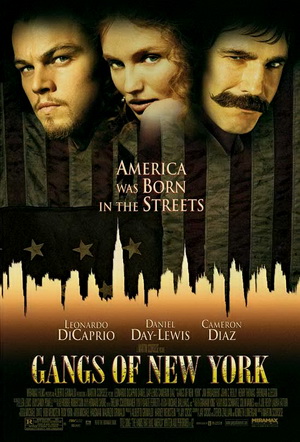
Shattered Politics #71: Gangs of New York (dir by Martin Scorsese)


Gangs_of_New_York_Poster

Despite the fact that it was nominated for best picture and marked the start of his fantastically successful collaboration with actor Leonardo DiCaprio, Martin Scorsese’s 2002 film Gangs of New York does not have the best reputation.  It always seems to be regarded as one of Scorsese’s lesser films and, often times, both The Aviator and The Departed are described as representing a comeback of sorts from Gangs.

To a certain extent, I have to agree.  Gangs of New York is a lesser Scorsese movie but then again, a lesser Scorsese film is still a hundred times better than the greatest films from Brett Ratner or Michael Bay.

The flaws of Gangs of New York are many.  The film, which tells the epic story of how an Irish gang led by Leonard DiCaprio battled a nativist gang led by Daniel Day-Lewis in Civil War-era New York City, runs for nearly 3 hours and yet it somehow still feels rushed and incomplete.  Cameron Diaz is far too contemporary of an actress to be truly believable as a 19th century pickpocket.  For that matter, Leonardo DiCaprio gives one of the worst performances of his career, coming across as being one-note and shrill.  If you only knew DiCaprio from his work in Gangs of New York, you would have a hard time believing that he was capable of doing the type of work that he did in Inception or The Wolf of Wall Street.

And yet, Gangs of New York is one of those flawed films that I can’t help but enjoy.

First off, on a purely personal level, how can I not love a film about how terribly the Irish were treated in the 19th Century?  Seriously, the Irish were regarded as if they were somehow subhuman.  They were attacked for being Catholic.  They were viewed as being criminals.  An entire freaking political party — the American party — was formed specifically to keep the Irish out.  But you know what?  We Irish kept coming, we kept fighting for our rights, and now everyone wishes they could be one of us!

Secondly, and this should not a shock when you consider that the film was directed by Martin Scorsese, the film looks absolutely gorgeous!  Despite the fact that it’s takes place in a 19th century slum and most of the characters are poor, Gangs of New York is a visual feast.  I loved the ornate sets and all the colorful clothes.  I loved the attention to detail that was put into everything.

(My favorite visual from the film: Daniel Day-Lewis and his entourage walking down a street while fireworks explode directly over Day-Lewis’s shoulder.)

Third, there’s Daniel Day-Lewis’s performance as Bill “The Butcher” Cutting.  One reason why DiCaprio’s performance is so noticeably bad is because he’s acting opposite Day-Lewis.  Sporting a handle-bar mustache and speaking in an almost satirically exaggerated New York accent, Day-Lewis turns Bill into one cinema’s greatest villains.

Add to that, the great Italian actor Giovanni Lombardo Radice show up for a few minutes, playing Simon Legree in a theatrical production of Uncle Tom’s Cabin!  Scorsese should make more films with Radice.

But, perhaps the main reason why I enjoy Gangs of New York is because, as I’ve mentioned so many times in the past, I really am a big history nerd.  And Gangs of New York deals with a period in American history that really doesn’t get as much attention as it deserves.  While we all know that the Civil War started when the South seceded from the union, what is often forgotten is that the North was not united in their support of Abraham Lincoln and the Union.  In fact, the Mayor of New York, Fernando Wood, was such a strong supporter of the Confederacy that he, at one point, suggested that New York City should secede from the union as well.  And when Lincoln instituted the draft, NYC — and several other cities in the north — exploded into riots.

Of course, Gangs of New York is not a 100% historically accurate.  For one thing, it compresses the time frame of the draft riots and — as films often do — it downplays the culture of Northern racism and instead portrays racists like Bill Cutting as being the exception to the rule.  But, even with that in mind, Gangs of New York still serves as a good starting point for those who want to learn more about American history than what they’ve been told in school.

My favorite parts of Gangs of New York dealt not with how the gangs fought each other but instead how the gangs were used as political foot soldiers.  One of the major supporting characters in Gangs of New York is William “Boss” Tweed (Jim Broadbent), a real-life politician who was at the center of one of America’s first major political scandals.  When we first meet Tweed, he is using Bill Cutting’s gang to fix elections.  However, as the film progresses, Tweed comes to realize that the political future of New York rests with the Irish.  So, Tweed starts using the Irish gang to fix elections.  For those of us who are into political history, the Boss Tweed scenes are a lot of fun.

Gangs of New York has its flaws.  It’s the type of project that, if it were made today, it would probably be a series on HBO and it would win all sorts of awards.  (Actually, it did kinda.  It was called Boardwalk Empire.)  It’s not perfect, but I like it.