The Unnominated #15: Touch of Evil (dir by Orson Welles)


Though the Academy of Motion Picture Arts and Sciences claim that the Oscars honor the best of the year, we all know that there are always worthy films and performances that end up getting overlooked.  Sometimes, it’s because the competition too fierce.  Sometimes, it’s because the film itself was too controversial.  Often, it’s just a case of a film’s quality not being fully recognized until years after its initial released.  This series of reviews takes a look at the films and performances that should have been nominated but were, for whatever reason, overlooked.  These are the Unnominated.

I come here to defend Charlton Heston.

1994’s Ed Wood is a great film that has one unfortunate line.  Towards the end of the film, director Ed Wood (Johnny Depp) meets his hero, Orson Welles (Vincent D’Onoforio), in a bar.  They talk about the difficulties of directing a film.  Wood talks about the trouble that he’s having with Plan 9 From Outer Space.  Welles says that he can understand what Wood is going through because the studio is forcing him to cast Charlton Heston as a Mexican in his next movie.

And look, I get it.  It is true that Charlton Heston does play a Mexican prosecutor named Mike Vargas in Welles’s 1958 film, Touch of Evil.  And it is true that Heston is not the most convincing Mexican to ever appear in a film.  And I understand that there are people who enjoy taking cheap shots at Charlton Heston because he did have a tendency to come across as being a bit full of himself and he was a conservative in a industry dominated by Leftists. There are people who actually think Michael Moore doesn’t come across like a self-righteous prick when he confronts Heaton in Bowling for Columbine.  I get the joke.

But it’s not true and it’s not fair.  When Touch of Evil was first put into production by Universal, Welles was not hired to direct.  He was hired to play Hank Quinlan, the formerly honest cop with a habit of planting evidence on those who he believed to be guilty.  When Charlton Heston was offered the role of Vargas, he asked who had been hired to direct.  When he was told that a director hadn’t been selected, Heston was the one who suggested Welles be given the job.  When, as often happened with Welles’s film, the studio decided to take the film out of Welles’s hands, Heston argued for Welles’s vision while Welles was off trying to set up his long-dreamed of film of Don Quixote.  Say what you will about Charlton Heston’s career, he fought for Orson Welles, just as he later fought for Sam Peckinpah during the making of Major Dundee.  Heston may not have agreed with either Welles or Peckinpah politically but he fought for them when few people were willing to do so.

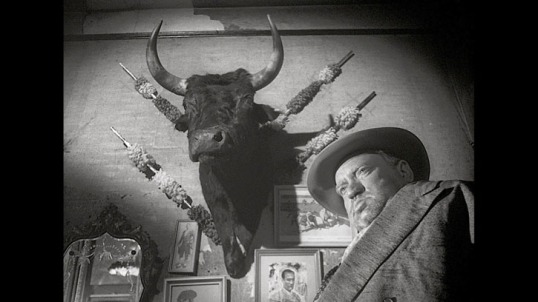
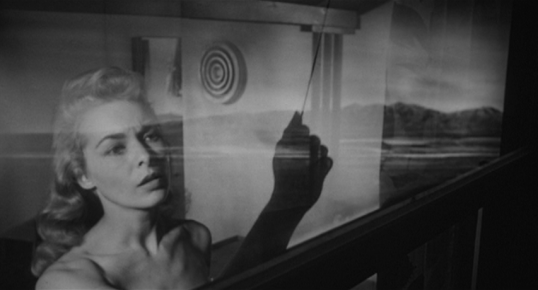
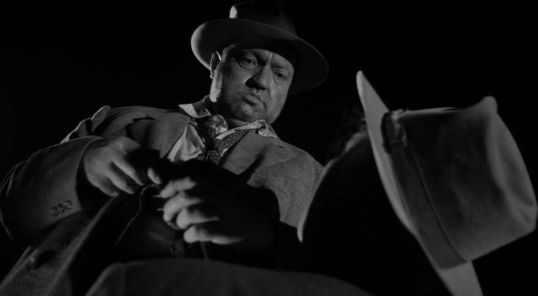
That Touch of Evil is a brilliant film is pretty much entirely due to Welles’s directorial vision.  The story is pure pulp.  While investigating the murder of an American businessman in Mexico, Vargas comes to believe that Quinlan is attempting to frame a young Mexican for the crime.  While Vargas watches Quinlan, his wife Susie (Janet Leigh) is menaced by the crime lord Joe Grandi (Akim Tamiroff), who has his own issues with both Vargas and Quinlan.  The plot may be the stuff of a B-programmer but, as directed by Welles, Touch of Evil plays out like a surreal nightmare, a journey into the heart of darkness that is full of eccentric characters, shadowy images, memorably askew camera angles, and lively dialogue.  Welles and cinematographer Russell Metty create a world that feels alien despite being familiar.  Just as he did with Gregg Toland in Citizen Kane, Welles shapes a film that shows us what’s happening in the shadows that most people try to ignore.

There’s really not a boring character to be found in Touch of Evil and the cast is full of old colleagues and friends of Welles.  Marlene Dietrich shows up as Quinlan’s former lover.  Mercedes McCambridge plays a leather-clad gang leader.  Dennis Weaver is the creepy owner of a remote motel.  (Two years before Psycho, Touch of Evil featured Janet Leigh being menaced in a motel.  Mort Mills, who played Psycho’s frightening highway patrolman, plays a member of law enforcement here as well.)  Zsa Zsa Gabor shows up for a few brief seconds and it makes a strange sort of sense.  Why shouldn’t she be here?  Everyone else is.  Joseph Cotten plays a coroner.  Ray Collins plays a local official.   In the film’s skewered world, Charlton Heston as Mike Vargas works.  His upright performance grounds this film and keeps it from getting buried in its own idiosyncrasies.   Big personalites are everywhere and yet the film is stolen by Joseph Calleia, playing Quinlan’s quiet but observant partner.  Calleia’s performance is the heart of the film.

Touch of Evil was not nominated for a single Oscar and that’s not surprising.  It’s not really the type of film that was noticed by the Academy in the 50s.  It was too pulpy and surreal and, with its story of a crooked cop framing someone who might very well be guilty anyway, it was probably too subversive for the Academy of the 1950s.  It would take a while for Touch of Evil to be recognized for being the noir masterpiece that it is.  In a perfect world, Welles would have been nominated for directing and for his larger-than-life performance as Quinlan.  Joseph Calleia would have been nominated for Supporting Actor and perhaps both Janet Leigh and Marlene Dietrtich would have been mentioned for Supporting Actress.  That didn’t happen but it would have been nice if it had.

Previous entries in The Unnominated:

  1. Auto Focus 
  2. Star 80
  3. Monty Python and The Holy Grail
  4. Johnny Got His Gun
  5. Saint Jack
  6. Office Space
  7. Play Misty For Me
  8. The Long Riders
  9. Mean Streets
  10. The Long Goodbye
  11. The General
  12. Tombstone
  13. Heat
  14. Kansas City Bomber

Who Is The Black Dahlia? (1975, directed by Joseph Pevney)


In 1947 Los Angeles, the body of 22 year-old Elizabeth Short is discovered in an empty lot.  Short, who was nicknamed The Black Dahlia because she always wore black, was an aspiring actress who was violently tortured before being chopped in half.  Her murder remains one of Hollywood’s most infamous unsolved crimes.

In this made-for-television movie, Ronny Cox and Efrem Zimbalist, Jr. play the two detectives who are assigned to investigate Short’s murder.  Though they struggle to find any clues identifying who could have killed Short, they do learn about her life and how she went from being a naïve innocent who came to Hollywood with stars in her eyes to being a hardened and cynical woman who may have been supporting herself through sex work when she was murdered.  The film makes use of frequent flashbacks, in which Elizabeth Short is played by Lucie Arnaz.  Her friends and acquaintances are played by familiar television faces like Henry Jones, Mercedes McCambridge, June Lockhart, Brooke Adams, Donna Mills, and Tom Bosley.  Also be sure to keep an eye out for Sid Haig, playing a tattoo artist.

What Elizabeth Short went through over the course of her short time in Hollywood was probably too graphic to be put on television in the 70s but this movie still does a good job of recounting the basic facts of her life and murder.  Because the film is based on fact, no one is ever arrested for Short’s murder.  The only suspect is a doctor who turns out to have an alibi.  The movie instead focuses on Short trying make it in Hollywood and discovering that it’s a cruel town.  Lucie Arnaz was far better than I was expecting in the role of Elizabeth and brought a lot of vulnerability to the role.  The film ended with a title card, asking anyone who had information about the murder of Elizabeth Short to call the LAPD.  The case remains open to this day.

Embracing The Melodrama #12: Giant (dir by George Stevens)


Giant

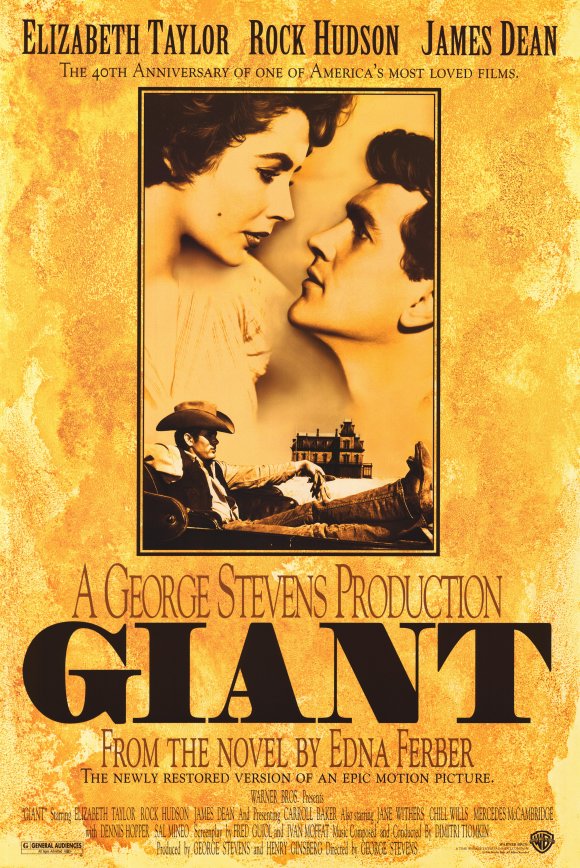
Let’s continue to embrace the melodrama by taking a look at the 1956 best picture nominee, Giant.

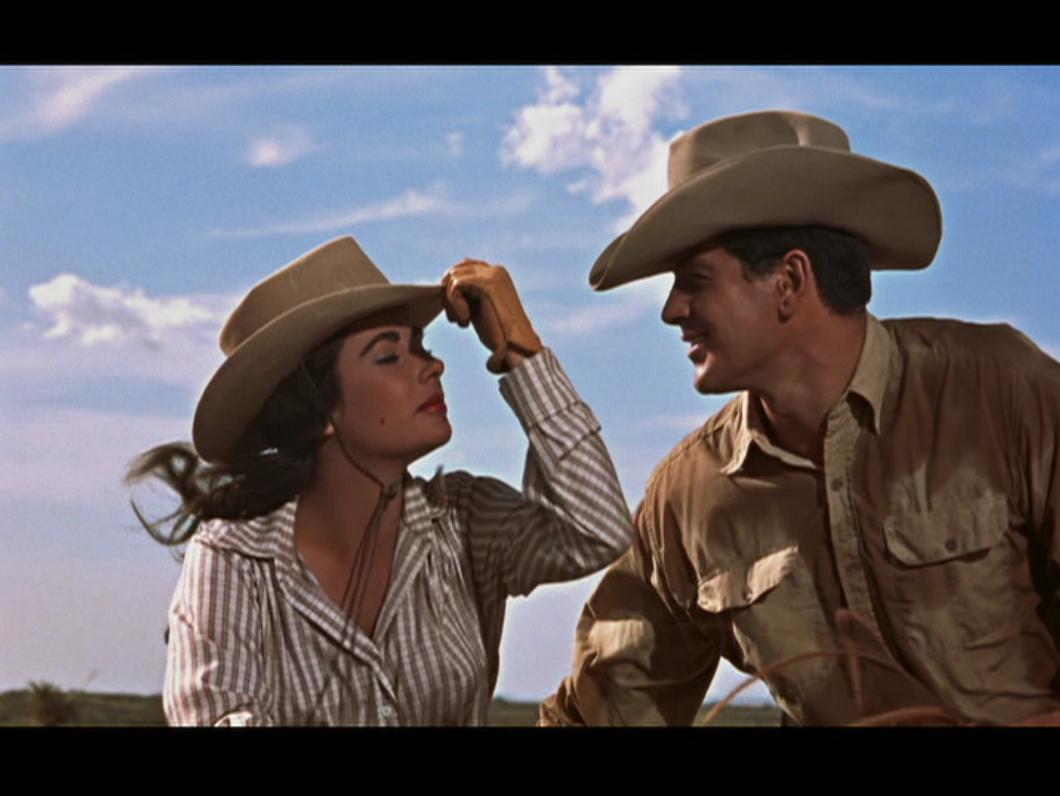
Giant is a film about my home state of Texas.  Texas rancher Bick Benedict (Rock Hudson) goes to Maryland to buy a horse and ends up returning to Texas with a bride, socialite Lesley Lynnton (Elizabeth Taylor).  At first, Lesley struggles to adapt to the harsh and hot Texas landscape.  Bick’s sister, Luz (Mercedes McCambridge) takes an instant dislike to Lesley and Bick is annoyed by Lesley’s concern over the living conditions of the Mexicans that work on Bick’s ranch.  It sometimes seems like the only person who appreciates Lesley is Jett Rink (James Dean), an ambitious ranch hand who secretly loves her and who is planning on becoming a rich man.  That’s exactly what happens when oil is found on the land around Bick’s ranch.  While Bick stubbornly clings to the past, oilman Jett represents both the future of Texas and the nation.  Meanwhile, Bick and Lesley’s son (played by a very young Dennis Hopper) challenges his father’s casual bigotry when he falls in love with a Mexican girl.

Taylor and Hudson

Giant is appropriately named because it is a huge film.  Clocking in at 201 minutes, Giant tells a story that spans several decades and features a big cast that is full of familiar faces, all struggling for their chance to somehow stand out from everyone else around them.  Even the film’s wonderful panoramic shots of the empty Texas landscape only serve to remind us of how big the entire film is.  To a certain extent, the size of Giant‘s production is to be understood.  In the 1950s, Hollywood was having to compete with television and they did this by trying to make every film into a major event.  You watch a movie like Giant and you practically hear the old Hollywood moguls shouting at America, “See!?  You can’t get that on your precious TV, can you!?”

For those of us watching Giant today, the length is both a blessing and a curse.  It’s a curse because the movie really is too damn long.  The opening scenes drag and many of them really do feel superfluous.  It’s hard not to feel that the real story doesn’t really start until about 90 minutes into the movie.  And once the story really does get started,  there’s still way too much of it for it all to be crammed into one sitting.  Oddly enough, you end up feeling as if this extremely long film is still not telling you everything that you need to know.  If Giant were made today, it would probably be a two-part movie on either HBO or Lifetime and it would definitely feature a lot more sex.

However, to be honest, one of the reasons that I did enjoy Giant was because it was as big as it was.  I mean, the film is about Texas so of course it should be a little excessive!  Everything’s bigger in Texas and that includes our movies.  Add to that, Giant may be too long but it uses that length to deals with issues that are still relevant today — oil, immigration, and racial prejudice.  Rock Hudson may not have been a great actor but he is at least convincing as he transitions from bigotry to tolerance.

But really, when it comes to Giant, most people are only interested in James Dean.  And they definitely should be because Dean gives a great and compelling performance here.  Dean brings all of the emotional intensity of the method to material that one would not naturally associate with method acting and the end result is amazing to watch.  Giant was released after Dean had been killed in that infamous car wreck.  I can only imagine what it must have been like to be sitting in a theater in 1956 and to see this compelling and charismatic actor towering above the world on the big screen while aware, all the time, that his life had already been cut short and he would never been seen in another film.

James Dean

Even better, Dean’s new style of acting clashes perfectly with Hudson’s old style of acting, making the conflict between Bick and Jett feel all the more real and intense.  Much as Bick represents old Texas and Jett represents the new Texas, Hudon and Dean represented the two sides of Hollywood: the celebrity and the artist.  Needless to say, Dean wins the battle but, surprisingly, Hudson occasionally manages to hold his own.

I can’t necessarily say that Giant is an essential film.  A lot of people are going to be bored by the excessive length.  But if you’re a fan of James Dean or if you’re from Texas, Giant is a film that you need to see at least once.

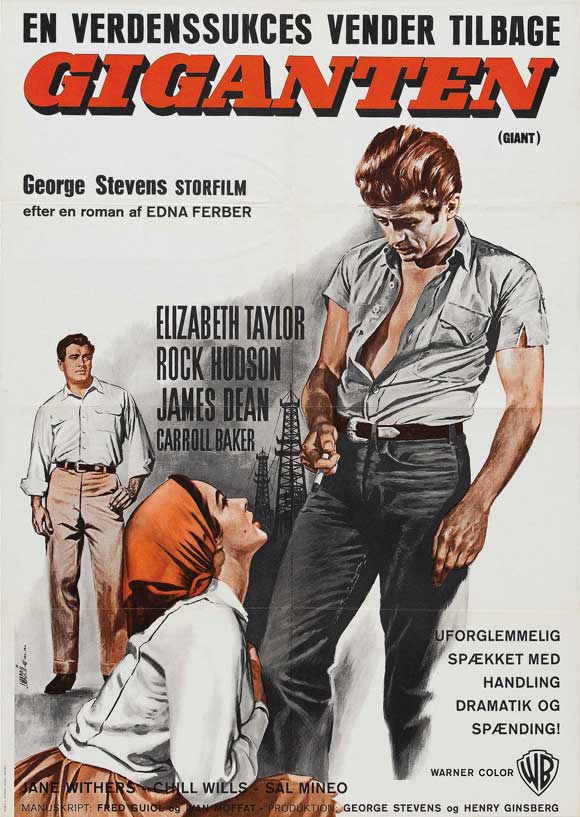
elizabeth_taylor_giant_swedish_movie_poster_2a

Embracing the Melodrama #10: All The King’s Men (dir by Robert Rossen)


All The King's Men

“The people are my study.” — Governor Willie Stark (Broderick Crawford) in All The King’s Men (1949).

We close today’s embrace of melodrama by taking a look at one of the best political films ever made, the 1949 best picture winner All The King’s Men.

All the King’s Men tells the story of a demagogue named Willie Stark (Broderick Crawford, who deservedly won an Oscar for his powerful and intimidating performance here).  When we first meet Willie, he’s a poor farmer and political activist whose attempts to run for a minor office in an unnamed southern state are defeated by the state’s corrupt political machine.  Instead of being intimidated, Willie is instead inspired to go to law school and become a lawyer who fights for the people.  When an elementary school fire escape collapses and kills several children, Willie sues the construction company that built the school.

This also brings Willie to the attention of cynical political operative Sadie Burke (Mercedes McCambridge, who also won a very deserved Oscar for her performance).  Sadie works for the state’s governor, who happens to be locked in a tight election campaign with a political reformer.  Sadie is dispatched to convince Willie to run for governor, with the idea being that Willie will take votes away from the reform candidate and therefore allow the governor to be reelected.

Everyone originally assumes that Willie is just a hick who will be easily manipulated.  And, at first, Willie proves to be an uninspiring campaigner.  It is only after he over hears his aide Jack Burden (John Ireland) talking to Sadie that Willie realizes that he’s being set up.  Willie responds by going to a country fair, dramatically ripping up his prepared speech, and then launching into a spell-binding speech in which he tells the people at the fair that, since they’re all hicks, they’ll only have power once they elect another hick to the governor’s office.  Newly energized and angry, Willie is nearly elected governor.

Four years later, Willie is back and he’s running for governor again.  He’s still giving loud populist speeches but, as Burden notes in his voice over narration, the difference is that Willie is now the establishment candidate.  He may be giving speeches promising hope and chance and attacking the rich but Willie will still take their money and watch out for their interests if that’s what he has to do to get elected.  (Sound like any Presidents that we might know?)

Once Willie is elected governor, he runs his state like a dictator, engaging in blackmail, demagoguery, and maybe even murder to get everything he wants.  He may still claim to be a hick but, as both Burden and Sadie realize, Willie has become exactly what he originally claimed to be against.  However, after Willie’s son (John Derek) kills a girl in a drunk driving accident and Burden discovers that the woman he loves has become Willie’s mistress, it starts to become apparent that Willie’s corruption has created a world that is spinning even out of Willie’s control.

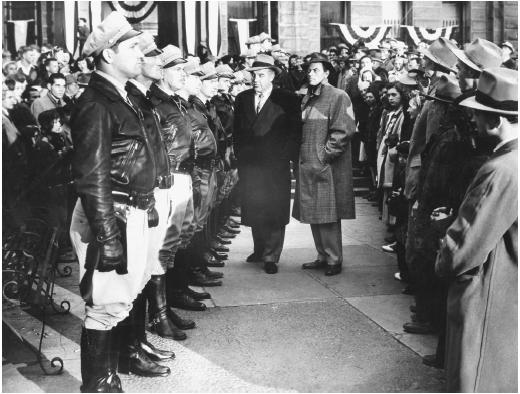
All The King’s Men may be a political film but it feels more like a gangster film, with Willie Stark coming across less as a politician and more like a crime lord.  Director Robert Rossen directs in a style that owes a lot to film noir and the entire film is full of shadowy figures and secret plotting.  Though the film starts out on almost a comical note, with a lot of emphasis being put on Willie Stark’s simple ways, it eventually reveals itself to be a truly disturbing portrait of what happens when one man is overwhelmed by his lust of power.  Rossen is aided by a uniformly excellent cast.  While I already specifically mentioned Crawford and McCambridge, it would be very wrong to review All The King’s Men without mentioning an actor named Walter Burke.  Burke played Willie’s bodyguard.  He said, at most, maybe 3 sentences over the course of the entire film but Burke had such a memorable and intimidating presence that his unsmiling face is one of the defining images of the film.

The short, scary man smoking the cigarette?  That's Walter Burke.

The short, scary man smoking the cigarette? That’s Walter Burke.

Finally, not surprisingly, All the King’s Men remains just as relevant today as when it was first released.  We love our demagogues in America, especially when they pretend to be “just like us.”  (And if anyone doubts that, I suggest they spend a few minutes listening to all of the potential Presidential contenders bragging about how they’ve been dead broke, how they’re known as Average Joe, and how much they hate the very political system that they continue to perpetrate.)   We love to condemn our Willie Starks but, at the same time, we also love to keep electing them.

All The King's Men 2