Film Review: The Doors (dir by Oliver Stone)


I like The Doors.

That can be a dangerous thing to admit, about both the band and Oliver Stone’s 1991 film.  Yes, both the band and the film could be a bit pretentious.  They both tended to go on for a bit longer than necessary.  They were both centered around a guy who wrote the type of poetry that I used to love back in my emo days.  It’s all true.

But, with The Doors as a band, I find that I can’t stop listening to them once I start.  Even if I might roll my eyes at some of the lyrics or if I might privately question whether any blues song really needs an organ solo, I can’t help but love the band.  They had a sound that was uniquely their own, a psychedelic carnival that brought to mind images of people dancing joyfully while the world burned around them.  And say what you will about Jim Morrison as a poet or even a thinker, he had a good voice.  He had the perfect voice for The Doors and their rather portentous style.  From the clips that I’ve seen of him performing, Morrison definitely had a stage presence.  Morrison died young.  He was only 27 and, in the popular imagination, he will always look like he’s 27.  Unlike his contemporaries who managed to survive the 60s, Morrison will always eternally be long-haired and full of life.

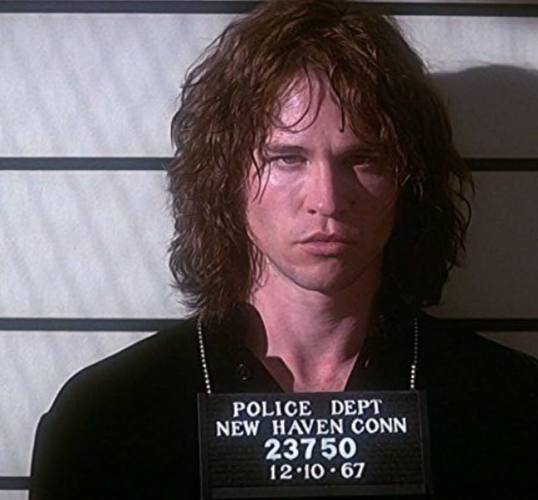
As for The Doors as a movie, it’s definitely an Oliver Stone film.  It’s big.  It’s colorful.  It’s deliberately messy.  Moments of genuinely clever filmmaking and breath-taking visuals are mixed with scenes that are so heavy-handed that you’ll be inspired to roll your eyes as dramatically as you’ve ever rolled them.  Stone loved the music and that love comes through in every performance scene.  Stone also loves using Native Americans as symbols and that can feel a bit cringey at times.  Why would Jim Morrison, whose was of Scottish and Irish ancestry, even have a Native American spirit guide?  At its best The Doors captures the chaos of a world that it’s the middle of being rebuilt.  The 60s were a turbulent time and The Doors is a turbulent movie.  I’ve read many reviews that criticized The Doors for the scene in which Morrison gets involved in a black magic ceremony with a journalist played by Kathleen Quinlan.  I have no idea whether or not that scene happened in real life but the movie is so full of energy and wild imagery that the scene feels like it belongs, regardless of whether it’s true or not.  Stone turns Jim Morrison into the warrior-artist-priest that Morrison apparently believed himself to be and the fact that the film actually succeeds has far more to do with Oliver Stone’s  enthusiastic, no-holds-barred direction and Val Kilmer’s charismatic lead performance than it does with Jim Morrison himself.

The Doors spent several years in development and there were several actors who, at one time or another, wanted to play Morrison.  Everyone from Tom Cruise to John Travolta to Richard Gere to Bono was considered for the role.  (Bono as Jim Morrison, what fresh Hell would that have been?)  Ultimately, Oliver Stone went with Val Kilmer for the role and Kilmer gives a larger-than-life performance as Morrison, capturing the charisma of a rock star but also the troubled and self-destructive soul of someone convinced that he was destined to die young.  Kilmer has so much charisma that you’re willing to put up with all the talk about opening the doors of perception and achieving a higher consciousness.  Kilmer was also smart enough to find the little moments to let the viewer know that Morrison, for all of his flamboyance, was ultimately a human being.  When Kilmer-as-Morrison winks while singing one particularly portentous lyric, it’s a moment of self-awareness that the film very much needs.

(When the news of Kilmer’s death was announced last night, many people online immediately started talking about Tombstone, Top Gun, and Top Secret.  For his part, Kilmer often said he was proudest of his performance as Jim Morrison.)

In the end, The Doors is less about the reality of the 60s and Jim Morrison and more about the way that we like to imagine the 60s and Jim Morrison as being.  It’s a nonstop carnival, full of familiar faces like Kyle MacLachlan, Michael Madsen, Crispin Glover (as Andy Warhol), Frank Whaley, Kevin Dillon, and a seriously miscast Meg Ryan.  It’s a big and sprawling film, one that is sometimes a bit too big for its own good but which is held together by both Stone’s shameless visuals and Val Kilmer’s charisma.  If you didn’t like the band before you watched this movie, you probably still won’t like them.  But, much like the band itself, The Doors is hard to ignore.

Film Review: Top Gun (dir by Tony Scott)


Oh, where to even begin with Top Gun?

First released in 1986, Top Gun is a film that pretty much epitomizes a certain style of filmmaking.  Before I wrote this review, I did a little research and I actually read some of the reviews that were published when Top Gun first came out.  Though it may be a considered a classic today, critics in 1986 didn’t care much for it.  The most common complaint was that the story was trite and predictable.  The film’s reliance on style over substance led to many critics complaining that the film was basically just a two-hour music video.  Some of the more left-wing critics complained that Top Gun was essentially just an expensive commercial for the military industrial complex.  Director Oliver Stone, who released the antiwar Platoon the same year as Top Gun, said in an interview with People magazine that the message of Top Gun was, “If I start a war, I’ll get a girlfriend.”

Oliver Stone was not necessarily wrong about that.  The film, as we all know, stars Tom Cruise as Pete “Maverick” Mitchell, a cocky young Navy flyer who attends the TOPGUN Academy, where he competes with Iceman (Val Kilmer) for the title of Top Gun and where he also spends a lot of time joking around with everyone’s favorite (and most obviously doomed) character, Goose (Anthony Edwards).  Maverick does get a girlfriend, Charlie (Kelly McGillis), but only after he’s had plenty of chances to show both how reckless and how skilled he can be while flying in a fighter plane.  Though the majority of the film is taken up with scenes of training and volleyball, the end of the film does give Maverick a chance to prove himself in combat when he and Iceman end up fighting a group of ill-defined enemies for ill-defined reasons.  It may not be an official war but it’s close enough.

That said, I think Oliver Stone was wrong about one key thing.  Maverick doesn’t get a girlfriend because he started a war.  He gets a girlfriend because he won a war.  Top Gun is all about winning.  Maverick and Iceman are two of the most absurdly competitive characters in film history and, as I watched the film last weekend, it was really hard not to laugh at just how much Cruise and Kilmer got into playing those two roles.  Iceman and Maverick can’t even greet each other without it becoming a competition over who gave the best “hello.”  By the time the two of them are facing each other in a totally savage beach volleyball match, it’s hard to look at either one of them without laughing.  And yet, regardless of how over-the-top it may be, you can’t help but get caught up in their rivalry.  Cruise and Kilmer are both at their most charismatic in Top Gun and watching the two of them when they were both young and fighting to steal each and every scene, it doesn’t matter that both of them would later become somewhat controversial for their off-screen personalities.  What matters, when you watch Top Gun, is that they’re both obviously stars.

“I’ve got the need for speed,” Tom Cruise and Anthony Edwards say as they walk away from their plane.  The same thing could be said about the entire movie.  Top Gun doesn’t waste any time getting to the good stuff.  We know that Maverick is cocky and has father issues because he’s played by Tom Cruise and Tom Cruise always plays cocky characters who have father issues.  We know that Iceman is arrogant because he’s played by Val Kilmer.  We know that Goose is goofy because his nickname is Goose and he’s married to Meg Ryan.  The film doesn’t waste much time on exploring why its characters are the way they are.  Instead, it just accepts them for being the paper-thin characters that they are.  The film understands that the the most important thing is to get them into their jets and sends them into the sky.  Does it matter that it’s sometimes confusing to keep track of who is chasing who?  Not at all.  The planes are sleek and loud.  The men flying them are sexy and dangerous.  The music never stops and the sun never goes down unless the film needs a soulful shot of Maverick deep in thought.  We’ve all got the need for speed.

In so many ways, Top Gun is a silly film but, to its credit, it also doesn’t make any apologies for being silly.  Instead, Top Gun embraces its hyperkinetic and flashy style.  That’s why critics lambasted it in 1986 and that’s why we all love it in 2020.  And if the pilots of Top Gun do start a war — well, it happens.  I mean, it’s Maverick and Iceman!  How can you hold it against them?  When you watch them fly those planes, you know that even if they start World War III, it’ll be worth it.  If the world’s going to end, Maverick’s the one we want to end it.


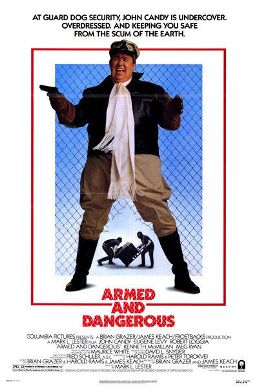
A Movie A Day #224: Armed and Dangerous (1986, directed by Mark L. Lester)


John Candy and Eugene Levy make a great team in the underrated comedy, Armed and Dangerous.
John Candy plays Frank Dooley, a member of the LAPD.  One of the first scenes of the movie is Frank climbing up a tree to save a little boy’s kitten and then getting stuck in the tree himself.  When Frank discovers two corrupt detectives stealing televisions, Frank is framed for the theft and kicked off the force.

Eugene Levy plays Norman Kane, a lawyer whose latest client is a Charles Manson-style cult leader who has a swastika carved into his head.  After being repeatedly threatened with murder, Norman asks for a sidebar and requests that the judge sentence his client to life in prison.  The judge agrees on the condition that Norman, whom he describes as being “the worst attorney to ever appear before me,” find a new line of work.

Frank and Norman end up taking a one day training course to act as security guards and are assigned to work together by their tough by sympathetic supervisor (Meg Ryan!).  Assigned to guard a pharmaceutical warehouse, Frank and Norman stumble across a robbery.  The robbery leads them to corruption inside their own union and, before you can say 80s cop movie, Frank and Norman are ignoring the orders of their supervisors and investigating a crime that nobody wants solved.

Armed and Dangerous was one of the many comedy/cop hybrid films of the 1980s.  Like Beverly Hills Cop, it features Jonathan Banks as a bad guy.  Like the recruits in Police Academy, all of Frank and Norman’s fellow security guards are societal misfits who are distinguished by one or two eccentricities.  There is nothing ground-breaking about Armed and Dangerous but Mark Lester did a good job directing the movie and the team of Candy and Levy (who has previously worked together on SCTV) made me laugh more than a few times.

Armed and Dangerous was originally written to be a vehicle for John Belushi and Dan Aykroyd.  It’s easy to imagine Belushi and Aykroyd in the lead roles but I think the movie actually works better with Candy and Levy, whose comedic style was similar to but far less aggressive than that of Belushi and Aykroyd.  One of the reasons that Armed and Dangerous works is because John Candy and Eugene Levy seem like the two last people to ever find themselves in a shootout or a car chase.  With Belushi and Aykroyd, it would have been expected.  After all, everyone’s seen The Blues Brothers.


And, finally, here’s the trailer for Ithaca!


PCAS

Ithaca is the directorial debut of Meg Ryan, who apparently used to be an actress of some sort.  Ha ha, I’m just kidding!  I know how Meg Ryan was, though it’s easy to forget at times…

Anyway, this appears to be a Tom-Hanks-Wears-Suspenders type of movie.  The whole trailer has Oscar wannabe written all over it but the film is being released in September.  September is technically Oscar season but not at much as November or December.

Anyway, here’s the trailer!  Enjoy it, Middle America!

Embracing the Melodrama Part II #82: Promised Land (dir by Michael Hoffman)


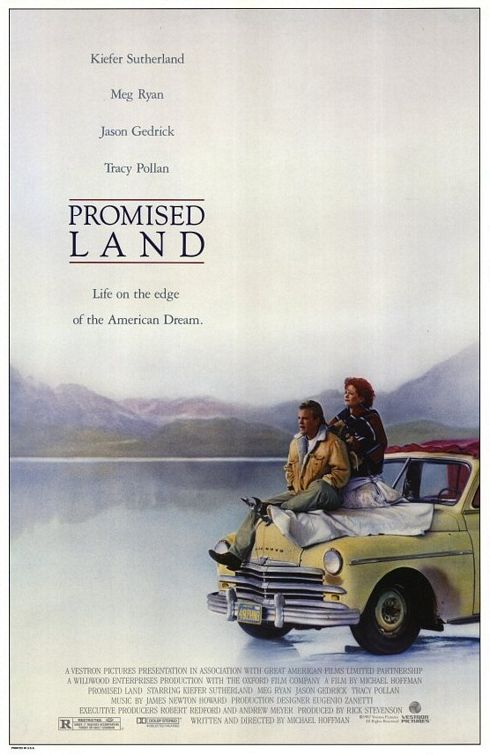
Promised_land_poster_(1987)When I made out my schedule of reviews for Embracing the Melodrama, I did not realize that I was setting myself up for a mini-marathon of Kiefer Sutherland movies but somehow, that’s exactly what happened!  No sooner had I watched and jotted down my impressions of Bright Lights, Big City and 1969, then I started watching a 1988 film called Promised Land (which should not be confused with the recent Matt Damon/Jon Krasinski fracking film).

And guess who stars in this particular film?

That’s right — Kiefer Sutherland!

Now, if Bright Lights, Big City featured Kiefer as a sociopath and 1969 featured Kiefer as a blonde-haired golden boy, Promised Land features Kiefer as a prototypical outsider.

Promised Land opens at a high school basketball game.  Hancock (Jason Gedrick) is the handsome and popular jock who is a star on the court and who is dating a cheerleader named Mary (Tracy Pollan).  Danny (Kiefer Sutherland) is the nerdy kid who gets good grades and who is nicknamed Senator because he wants to enter politics.  He has an obvious crush on Mary but also appears to have one on Hancock as well.  As Hancock runs up and down the court, nobody cheers louder than Danny.  Meanwhile, Hancock barely knows who Danny is.

Three years later and things have changed.  Hancock, having gone to college on an athletic scholarship just to drop out and return home, is now a vaguely fascistic police officer.  Mary has remained in college.  When she returns home for Christmas break, Hancock tries to rekindle their relationship but Mary has moved on.

Meanwhile, Danny has dropped out of school as well.  After spending a few years drifting around, he meets the lively, vivacious, and totally insane Bev (Meg Ryan).  He and Bev get married in Las Vegas and decide to head back to Danny’s hometown for Christmas…

Drama, violence, and tragedy follow!

But you already guessed that, didn’t you?  That’s one of the problems with Promised Land.  From the minute that Bev says that she wants to meet Danny’s family, you can tell exactly how this story is going to end.  And while a predictable plot can sometimes be redeemed by memorable performances, that’s not the case with Promised Land.  Kiefer Sutherland and Meg Ryan both give good and dangerous performances but Jason Gedrick and Tracy Pollan make for a boring couple.

(Interestingly enough, Tracy Pollan was also in Bright Lights, Big City.)

Promised Land does have some historical significance, in that it was the first film to ever be partially funded by the Sundance Institute.  Robert Redford is listed as an executive producer.  But, historical significance aside, there’s really not much about Promised Land to really recommend going to the effort to try to track it down.  It’s not so much bad as just very forgettable.