The Los Angeles film critics weren’t the only ones to vote on their favorites of 2011 today. The Boston Society of Film Critics voted today as well. Now, as I’ve stated quite a few times on this site, I’m a Southern girl and I have a feeling that if I ever went up to Boston, everyone up there would ignore the fact that I’m an Irish Catholic and would probably just make fun of my accent. Eventually, the conversation would turn to politics and I would let slip the fact that not only am I not a Democrat but I didn’t even vote for Barack Obama in 2008. A big fight would follow and I imagine we wouldn’t even get around to talking about our favorite movies…
Sorry, I lost my train of thought there. Anyway, the BSFC voted and here’s what they came up with:
Best Picture: “The Artist”
Runners-up: “Hugo” and “Margaret”
Best Director: Martin Scorsese, “Hugo”
Runner-up: Michel Hazanavicius, “The Artist”
Best Actor: Brad Pitt, “Moneyball”
Runners-up: George Clooney, “The Descendants” and Michael Fassbender, “Shame”
Best Actress: Michelle Williams, “My Week With Marilyn”
Runner-up: Meryl Streep, “The Iron Lady”
Best Supporting Actor: Albert Brooks, “Drive”
Runner-up: Max Von Sydow, “Extremely Loud and Incredibly Close”
Best Supporting Actress: Melissa McCarthy, “Bridesmaids”
Runner-up: Jeannie Berlin, “Margaret”
Best Screenplay: Steven Zaillian, Aaron Sorkin and Stan Chervin, “Moneyball”
Runner-up: Kenneth Lonergan, “Margaret”
(If I was writing for AwardsDaily.com, I guess this is where I would say, NO MOVIE HAD A BETTER SCREENPLAY THAN THE SOCIAL NETWORK)
Best Cinematography: Emmanuel Lubezki, “The Tree of Life”
Runner-up: Robert Richardson, “Hugo”
Best Documentary: “Project Nim”
Runner-up: “Bill Cunningham New York”
Best Foreign-Language Film: “Incendies”
Runners-up: “A Separation” and “Poetry”
Best Animated Film: “Rango”
Best Film Editing: Christian Marclay, “The Clock”
Runner-up: Thelma Schoonmaker, “Hugo”
Best New Filmmaker: Sean Durkin, “Martha Marcy May Marlene”
Runner-up: J.C. Chandor, “Margin Call”
Best Ensemble Cast: “Carnage”
Runner-up: “Margaret”
Best Use of Music in a Film: (tie) “Drive” and “The Artist”
Runner-up: “The Descendants”
Special Commendations:
Ben Fowlie, Sara Archambault and Sean Flynn of DocYard
The Museum of Fine Arts for “The Clock”
The Brattle Film Foundation
Best Rediscoveries:
“The Shooting” at the Harvard Film Achive
“The Makota Sisters” at the Museum of Fine Arts
“Deep End” at the HFA
“Days and Nights in the Forest” at the HFA
“Children of Hiroshima” at the HFA
Obviously, the Boston Film Critics were big fans of Kenneth Lonergan’s film Margaret. Margaret was actually filmed in 2007 but, because of various lawsuits between Longergan and the film’s producers, it was not actually released until September of this year. Unfortunately, it only played down here for about a week and I didn’t get a chance to see it but hopefully, I will in the future. If nothing else, I want to see it so I can have something other than politics to talk about if I ever go up to Boston.
When I first read Arleigh’s idea that we devote October to reviewing horror films, I knew immediately that there was no way I could let the month pass without saying a few words about one of the true classics of the horror genre, the 1973 best picture nominee The Exorcist.
Based on an equally scary novel by William Peter Blatty and directed by William Friedkin, The Exorcist is one of those films that has become so iconic that even people who have never seen it know what the movie is about. Chris McNeil (Ellen Burstyn) is an agnostic actress who is shooting a film about student protestors on a college campus. Her 12 year-old daughter, Regan (played by the future Grindhouse queen Linda Blair), spends her time playing with a Ouija Board and talking to her friend “Capt. Howdy.” Unfortunately, Capt. Howdy is actually a Sumerian demon who proceeds to posses Regan. Soon, Regan is levitating, cursing, and masturbating with a crucifix. After trying (and failing with) all the conventional methods of treatment, Chris desperately turns to the God she doesn’t believe in and tries to convince a troubled priest (Jason Miller) to perform an exorcism on Regan. Unfortunately, this priest has begun to question his faith and he fears that he might not be strong enough to “cure” Regan. An elderly priest (Max Von Sydow) is called in to help with the exorcism and, faster than you can say, “The power of Christ compels you,” the two priests are locked in mortal combat for Regan’s soul.
The ultimate test of any horror films is whether or not it’s still unsettling even after you already know what’s going to happen and when all the evil is going to come jumping out of the shadows. In short, the test is whether or not the film holds up to repeat viewings. This is a test that The Exorcist easily passes. I’ve seen this film enough times that I now know exactly when Linda Blair’s head is going to do that 360 degree turn and I now know exactly when to divert my eyes so I don’t have to see possessed Regan puking on the priests. (For all the terrible physical manifestations of Regan’s possessions, it’s always the vomiting that gets to me.) Most of the film’s “shock” sequences aren’t that scary any more because we’ve all seen far worse. However, watching this film remains, for me, a truly unsettling experience. This is due largely to director William Friedkin. Today’s aspiring filmmakers could learn a lot from Friedkin because, for all the attention the film’s grotesque effects received, Friedkin actually devotes more time to setting up the situation and establishing a palpable atmosphere of doom. This is a film full of grainy, almost gray images, the perfect visual suggestion of a world that has perhaps been abandoned by its God. It takes more than an hour before Ellen Burstyn meets Jason Miller and Max Von Sydow doesn’t show up until the final 30 minutes of the film. At first, it seems as if the movie itself is moving slowly but, by the end of it, you realize that what Friedkin has done is that he’s sucked us into the reality of his film. For all the special effects and metaphysical concerns, The Exorcist almost feels like a documentary. He’s also helped by a talented cast that makes the situation feel real, regardless of how extreme things may get. I’ve read that a lot of people decided they needed to be exorcised after seeing this film and I can understand why.
The Exorcist is a film that benefits from debate and it’s also one that is open to multiple interpretations. Quite a few critics have argued that the Exorcist is actually a very reactionary film in that Regan’s possession can be seen as a metaphor for adolescent rebellion and her exorcism is actually more about the establishment regaining control than any attempt to save her eternal soul. I actually think this interpretation is pretty much spot on correct though I also don’t think the filmmakers were intentionally trying to deliver that message. Instead, I think that the Exorcist — like all great films — is simply filled with the subtext of its time. While the filmmakers may have unintentionally created a document of then-contemporary fears, I think the film is even more interesting as an argument about the origin of sin and evil.
Ultimately, for a horror film to be truly timeless, it has to do more than just scare you. The supernatural and/or otherworldly forces have to serve as more than just a cinematic threat; they have to stand-in for our own universal fears and concerns. The Exorcist attempts to answer one of the most basic questions: why is there evil in the world and why do people sometimes behave in such terrible ways? For all of the film’s notoriety, the answers it provides are surprisingly simple. Evil is because of the devil and people behave the way they do because they’re not individually strong enough to resist the lure of sin. The only way to defeat the world’s demons is through sacrifice, suffering, and martyrdom. You don’t have to come from a Catholic background to “get” the Exorcist but it helps. (To be honest, it probably helps even more to be a “fallen” Catholic like me because wow, this movie really knows how to exploit all that lingering guilt.) Thanks to this film, it sometimes seems the only time that priests (and Catholicism in general) are portrayed positively in the movies is when they’re exorcising someone (which, contrary to popular belief, doesn’t really happen all that much). Fortunately, you don’t have to agree with the answers provided by the Exorcist in order to find both the questions and the film itself to be intriguing.
Conan:“To crush your enemies, see them driven before you, and to hear the lamentations of their women!”
1982 premiered what has to be one of my favorite films ever. It was a film that was year’s in the making and had as one of it’s producers the eccentric and powerful Hollywood icon, Dino De Laurentiis. It also starred who was then a very much unknown Austrian bodybuilder-turned-actor in Arnold Schwarzenneger. To round out this unusual cast of characters producing this film would be the maverick screenwriter-director John Milius not to mention a young writer still fresh from Vietnam, Oliver Stone. During it’s production there were conflicts between producer and director as to the tone of the film right up to who should actually play the lead character. It’s a good thing that Milius was the ringmaster of this group of characters as his personality was able to steer things to what finally ended up as the film legions of fans have known and seen throughout the decades since it’s release. Conan the Barbarian was, and still is, a fantasy film of quality which still remains as action-packed and full of flights of fancy in the beginning of 2011 as it did when it premiered in 11982.
Milius and Stone adapted the stories of Robert E. Howard while adding their own flourishes to the iconic Cimmerian character. While many Howard purists were aghast at how these two writers had turned a character who was muscular but also athletic and lean into the hulking muscle-bound one Schwarzenneger inhabited the final result would silence most of these critics. The film kept the more outlandish backstory of Howard’s writing, but left enough to allow the film’s story and background to remain something out of Earth’s past prehistory. It was a film which was part origin tale for the title character, part coming of age film and part revenge story.
The film begins with a sequence narrated by iconic Asian-actor Mako as he tells of the beginnings of his liege and master Conan and the high adventures which would soon follow. Conan the Barbarian actually has little dialogue in the very beginning outside of that narration and a brief interlude between a young Conan and his father about the meaning of the “riddle of steel”. Most of the film’s beginning is quite silent in terms of dialogue. This didn’t matter as film composer Basil Poledouris’ symphonic score lent an air of the operatic to the first ten to fifteen minutes of the film. It’s here we’re introduced to James Earl Jones’ Atlantean-survivor and warlord in Thulsa Doom whose barband scours the land trying to find the meaning to the “riddle of steel”. The destruction of Conan’s village and people is the impetus which would drive the young Conan to stay alive through years of slavery, pit-fighting and banditry. He would have his revenge on Thulsa Doom and along the way he meets up and befriends two other thieves in Subotai (Gerry Lopez) and Valeria (Sandahl Bergman whose presence almost matches Schwarzenneger’s in intensity and confidence).
The rest of the film sees these three having the very tales of high adventures mentioned of in the film’s beginning narration and how an unfortunate, albeit succcesful robbery of a cult temple, leads Conan to the very thing he desires most and that’s to find Thulsa Doom. It’s here we get veteran actor Max Von Sydow as King Osric in a great scene as he tasks Conan and his companions to find and rescue his bewitched daughter from the clutches of Doom. In King Osric we see a character who may or may not be a glimpse into Conan’s future, but as Conan’s chronicler says later in the film that would be a tale told at another time.
Conan the Barbarian is a film that was able to balance both storytelling and action setpieces quite well that one never really gets distracted by the dialogue that at times came off clunky. Plus, what action setpieces they were to behold. From the initial raid by Doom and his men on Conan’s village right up to the final and climactic “Battle of the Mounds” where Doom and his men square off against Conan and his outnumbered friends in an ancient battlefield full of graveyard mounds. The film is quite bloody, but never truly in a gratuitous manner. Blood almost flows like what one would see in comic books. Conan is shown as an almost primal force of nature in his violence. In the end it’s what made the film such a success when it first premiered and decades since. It was Howard’s character (though changed somewhat in the adaptation) through and through and audiences young and old, male and female, would end up loving the film upon watching it.
This film would generate a sequel that had even more action and piled one even more of the fantastical elements of the Howard creation, but fans of the first film consider it of lesser quality though still somewhat entertaining. The film would become the breakout role for Arnold Schwarzenneger and catapult him into action-hero status that would make him one of the best-known and highest paid actor’s in Hollywood for two decades. It would also catapult him to such popularity that some would say it was one of the stepping stones which would earn him seven years as California’s governor at the turn of the new millenium.
In the end, Conan the Barbarian succeeds in giving it’s audience the very tales of myths and high adventures spoken of by Conan’s chronicler. It’s a testament to the work by Milius and Schwarzenneger couple with one of the most beloved and iconic film scores in film history by Basil Poledouris that Conan the Barbarian continues and remains one of the best films of it’s genre and one which helped spawn off not just a sequel but countless of grindhouse and exploitation copies and imitation both good and bad. The film also is a great in that it helped bring audiences to want to learn more about the character of Conan and as a lover of the written word the impact this film had on Howard’s legacy is the best compliment I can give about this film.
Ok, I was already pretty hyped up for Skyrim even without seeing a second of gameplay video. That is just how big a fan of the Elder Scrolls rpg series I am. To say that I have spent close to near 3000+ hours playing the four games in this series would be an understatement. Yes, that does sound quite pathetic, but I don’t care because it’s awesome in my own personal world how much I’ve played this series.
This new trailer is not just voice-over with a cavern wall carving being panned around by the virtual camera. This new trailer I would consider Skyrim‘s first official cinematic trailer but also one that includes gameplay footage. Gameplay footage which shows off Bethesda’s latest game engine, Creation Engine, which has replaced the Gamebryo Engine that the studio used for Morrowind, Oblivion and the last two Fallout games. While the gameplay footage was all about action it does give some hints about changes to the faces and figures of the NPCs. Gamebryo was ahead of its time in 2001 when Morrowind came out but now it’s antiquated so I’m glad Bethesda listened to the pleas of fans to come up with a new and more advanced game engine.
I like the sound of the theme for the game which combines and remixes the themes from both Morrowind and Oblivion but with a nice male chorus doing something akin to a Norse battle-chant. Music composer Jeremy Soule will return to compose the music for Skyrim and that alone means I shall be acquiring the soundtrack, if and when, Bethesda releases the CD.
The game is set for a 11.11.11 release and I shall be one of the brave few who will pre-order the most expensive edition of this game because it deserves it.
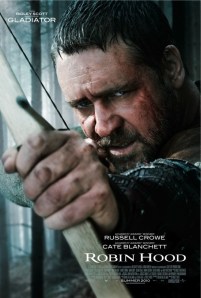
To make things clear, this movie is not really about Robin Hood. It’s about a common archer named Robin Longstride who fights in the Crusades, comes back to England, assumes another man’s identity, is adopted by a blind nobleman, ends fighting the French, and who discovers that his late father apparently wrote out the first draft of what will become the Magna Carta. Finally, at the end of the movie, Robin Longstride is declared an outlaw (or as Oscar Isaac, who plays King John, puts it, “AN OUTLAWWWWWWWWWW!) and it’s mentioned that he goes by the alias of “Robin of Hood.”
So, if you’re expecting a movie about Robin Hood or anything that is usually associated with Robin Hood — green tights, archery competitions, stealing from the rich and giving to the poor, that sort of thing — you’re pretty much out of luck.
On the face of it, this certainly isn’t an unwelcome idea. To be honest, I’ve always found whole idea of Robin Hood and his “merry men” to be a bit silly and rather dull. When it comes to English folklore, I’ve always preferred to read about King Arthur self-destructing. Add to that, it’s hard for me think about Robin Hood without thinking about the Dennis Moore episode of Monty Python’s Flying Circus.
(Remember Dennis Moore’s theme song — “Dennis Moore…Dennis Moore…He steals from the poor and gives to the rich…stupid bitch…”)
So, I really can’t complain about the way that the movie jettisons most of what one would traditionally expect from a film called Robin Hood. However, once the movie abandons tradition, it fails to come up with anything compelling to replace it with.
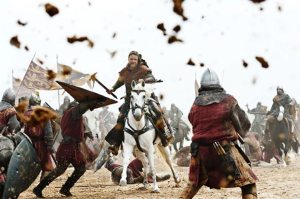
The movie opens with commoner Robin Longstride taking part in the Crusades. He’s a bitter, disillusioned archer who has grown weary of killing. So far so good. If nothing else, Ridley Scott has proven that he knows how to direct action and the early battle scenes are very well done. Robin is played by Russell Crowe and, even though he’s a bit too old for the role, Crowe has always been convincing playing men of action. Of course, this is largely because Crowe is himself a man of action but no matter. Crowe is believable in these scenes in ways that a more universally acclaimed actor like Leonardo DiCaprio never could be. It’s important that the movie convince on from the start that Robin is a master archer and both Scott and Crowe manage to do that. In fact, if the entire movie was just about an archer trying to survive of the chaos of the Crusades, it would have been a good deal better than Robin Hood.
(Speaking of archers, I’m actually quite a bit more skilled at with a bow than you probably think. Just three years ago, while visiting a city known as The Crossing, I used one shortbow and a quiver of 12 arrows to kills over 100 rats at Barana’s Shipyard. Of course, I should probably add that I was playing Dragonrealms at the time. I was a red-haired, Elven moon mage and my name was Cinzia, in honor of the Italian actress Cinzia Monreale. Sad to say, Cinzia was eventually killed by some sort of swamp monster but, while she lived, she was pretty good with a bow and arrow. But back to the movie…)
The movie starts to fall apart once Robin returns to England. In a set of circumstances that are way too tedious to go into now, Robin ends up assuming the identity of Sir Robert of Loxley and returning the crown of the dead King Richard the Lionhearted to London where it is promptly placed on the head of the new King John (Oscar Isaac).
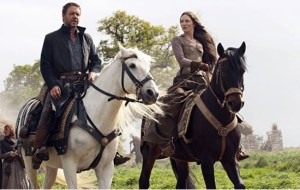
Robin then departs on a personal mission of his own. He goes up to Nottingham to return the dead Sir Robert’s sword to his father, the blind Sir Walter of Loxley (Max Von Sydow, going overboard). In Nottingham, Robin meets Robert’s widow, the maid Marian. Marian is played by Cate Blanchett who, for some odd reason, appears to be recreating his award-winning role as Katharine Hepburn in the aviator for most of her performance. Robin, to his credit, does not pretend to be “Sir Robert” when he first arrives in Nottingham. However, Walter promptly asks him to do so and in return, Walter will tell Robin all about Robin’s father. And so, again, Robin agrees to pretend to be Sir Robert.
Meanwhile, Robin has been accompanied by three friends. One of them — Little John — is played by the same guy who played Martin Keamy on Lost. These three friends — along with Friar Tuck who assures us that he’s “not a churchy-type friar” — will eventually become Robin Hood’s band of merry men though not in this movie. In this movie, they’re just four red herrings that have little to do.
King John, it would seem, is something of a neurotic tyrant so he is easily manipulated by his good friend Sir Godfrey (Mark Strong) into allowing Godfrey and his private army to roam the English countryside and “collect taxes.” What John doesn’t realize, of course, is that Godfrey is actually half-French and all of Godfrey’s soldiers actually are French. How this escape John’s attention is hard to determine as all of Godfrey’s soldiers either speak French or English with a heavy French accent.
(Actually, Sir Godfrey reminded me of another life I experimented with in Dragonrealms, a Gor’Tog Barbarian named Ironcrotch. The less said about Ironcrotch, the better.)
Anyway, Godfrey’s real mission is to be so tyrannical while collecting taxes that the English people will rise up against their king and the whole country will plunge into civil war. While this is going on, the French will then invade England and easily conquer it. As long as it took me to type all of that up and for you to read, it feels even longer when you’re sitting in a theater watching it.
On paper, at least, Ridley Scott would look like the perfect director for this movie but, other than the early battle scenes, his direction here is often rather uninspired. He seems to be bored with the movie and, for that matter, so does Russell Crowe. Crowe gives a surprisingly dull performance. You believe him as a soldier but you never believe him as a leader and that’s unfortunate because, for this movie to work, you have to believe Crowe as a man so charismatic that he could become a beloved criminal. When you consider just how talented Crowe has proven himself to be over the years, his performance here becomes even more distressing and, finally, somewhat infuriating. Once could accept a less-than-brilliant performance from someone like Jason Stathan. But this is Russell-freaking-Crowe, for the love of God!
In fact, the only actor who really seems to truly invested in his role is Oscar Isaac and he’s actually the best thing in the entire film. For over a month, I’ve been mocking the way he’s seen shouting “OUTLAWWWWW!” in the trailer for Robin Hood. Divorced from the rest of his performance, it just seems like a ludicrously over-the-top moment. However, when seen in the context of the character that he creates over the course of the film, it makes perfect sense that King John would randomly shout such things. Isaac makes plays the monarch as a spoiled brat, a hedonist given to cowardice, insecurity, and histrionics. Wisely, he never plays John as evil and, in some scenes, he almost manages to make this historically reviled man into an almost sympathetic figure, While the rest of the movie merely goes through all of the expected paces, Isaac always manages to bring something unexpected to every scene he is in. If there is any redemption to be found in Robin Hood, it is in his performance.
I should also add that, as critical as I’ve been of Robin Hood, I still enjoyed listening to all the anti-taxation, anti-government rhetoric. I only wish the movie had gone even further with the whole idea of Robin Hood as a 12th century libertarian.
In the end, what can you really say about a movie like Robin Hood? It is what it is. It’s a summer movie that’s obviously designed to serve as the launching pad for a bigger film franchise. To criticize it is to almost invite some stranger to accuse you of being a spoilsport. Summer movies are meant to be big and loud and borderline obnoxious. They’re meant to be a collection of trailer-ready scenes that can entice you into paying way too much to sit through them. Summer movies are made to make money and ultimately, the only judgment that carries any weight is the verdict of the box office.
Interestingly enough, the theater where I saw Robin Hood was deserted except for me and my friend. A lot of this, of course, is due to us attending a matinée showing but still, even a matinée will usually manage to bring in a handful of retirees who want to spend their twilight years complaining about how difficult is to hear movies nowadays. But no, on this day, it was just me and my friend.
(This worked out nicely, to be honest, because it allowed me and him to…uhmm…well, yeah, anyway. Back to the review…)
To me, that nearly deserted theater pretty much sums up Robin Hood. It’s the movie that everyone wants to see but that nobody’s going to want to watch twice. It’s the type of movie that you forget even while you’re watching it. Considering all of the talent that was involved in the making of this movie, I think the viewer is justified in expecting something just a little more.


 Through the Shattered Lens