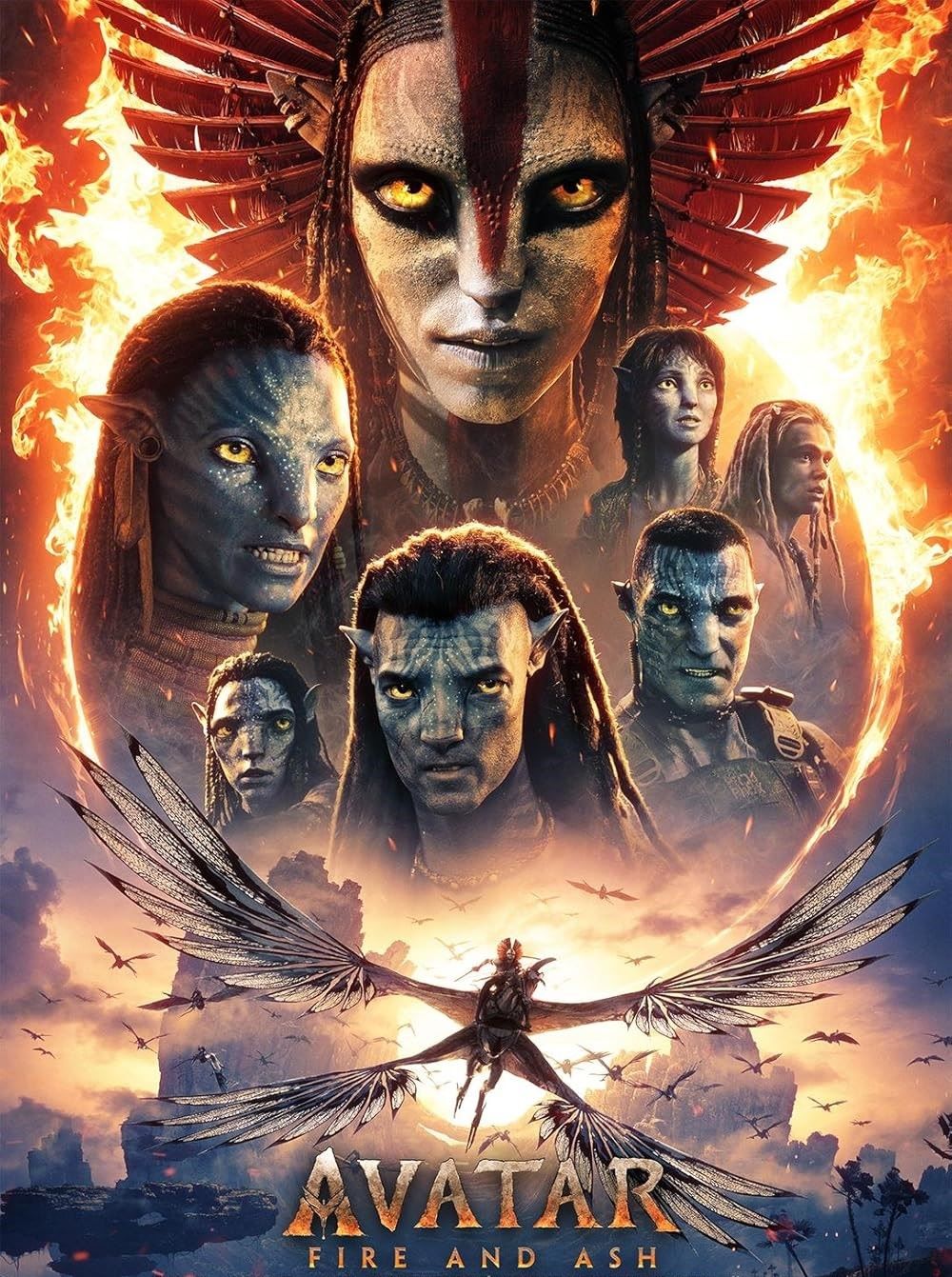
“The fire came from the mountain… Eywa did not come. So I went to the fire, and I learned its way” – Varang
Avatar: Fire and Ash plays like a massive, molten crescendo for Cameron’s Pandora saga—visually overwhelming, emotionally heavier than the last two entries, but also very familiar in ways that will either feel comfortingly mythic or a little déjà vu, depending on your tolerance for repetition. The ash-choked skies, lava rivers, and volcanic Na’vi clans are often more compelling than some of the story beats, and the final stretch delivers the kind of operatic, war-movie scale that makes the three-plus-hour runtime go down easier than it should, even though the film clearly didn’t need to run this long.
This time around, the series leaves behind the cool blues and oceanic calm of the previous chapter for a harsher, volcanic corner of Pandora that feels like a nature documentary shot in a furnace. Jagged black rock, roiling lava, and smoke-stained skies dominate the frame, with creatures and plant life that look as if they evolved to survive heat and ash rather than coral reefs and open water, giving the movie an immediately distinct visual identity even when the story rhythms feel familiar.
At the center of this environment are the Ash People, or Mangkwan clan, a Na’vi group shaped by relentless scarcity and violence. They ride creatures adapted to fire and ash instead of waves, cover themselves in soot-black markings, and fight using a deliberate blend of traditional Na’vi weaponry and repurposed human tech, putting them ideologically at odds not just with the human invaders, but with other Na’vi clans who still cling to older, more spiritual ways of living with Eywa.
The story picks up with Jake and Neytiri’s family still reeling from Neteyam’s death, and the film leans hard into unresolved grief as its emotional baseline. Jake doubles down on his protector persona, treating every decision as a matter of survival, while Neytiri’s pain expresses itself as barely controlled rage, and that emotional weather trickles down to their children, who are increasingly frustrated at being treated like liabilities. The problem is that a lot of this family dysfunction was already unpacked in the second film, so instead of evolving those arcs, the script often feels like it is rehashing earlier conflicts.
The dynamic between Jake and Lo’ak is the clearest example of this repetition. Jake’s exasperation with Lo’ak’s impulsive, run-toward-the-bullets mentality resurfaces again and again, echoing arguments audiences have already seen: the father insisting his son isn’t ready, the son bristling at never being trusted. These moments still have emotional sting, but they circle the same drain so often that entire conversations could have been trimmed or removed without sacrificing character depth, and tightening that thread alone would have shaved a noticeable chunk off the runtime.
Where the film becomes more thematically interesting is in how it reframes Pandora’s conflict. Instead of a simple “Na’vi versus humans” setup, it pits the more traditional Na’vi clans—those still committed to a symbiotic relationship with Eywa—against the Ash People, whose warlike nature and embrace of human weaponry make them ideological outliers. That split plays as a pointed echo of historical events in the Americas, where European colonial powers armed and favored specific Indigenous nations to fight their neighbors, turning native communities into proxies in conflicts that ultimately benefitted outsiders more than the people doing the actual bleeding.
The analogy becomes sharper in how human forces hang back and quietly exploit these new divisions. By giving the Ash People access to superior firepower and nudging them toward confrontation, the outsiders effectively inflame existing grievances and reshape local power dynamics, much like colonial regimes once did by supplying guns and promises to one group while framing another as the enemy. The result is a Pandora that feels more fractured and politically complex, where internal Na’vi conflict is as dangerous as external invasion.
Varang, the leader of the Ash People, is one of the film’s strongest assets. She’s portrayed as a true believer who has taken real suffering and twisted it into a doctrine of purifying destruction, convinced that burning the world is the only way to save it. The character blends zealotry and charisma in a way that makes her both frightening and compelling, and she wields faith, desire, and fear as weapons with unnerving ease, giving the movie a volatile energy whenever she’s on-screen.
Her alliance with Quaritch pushes the story into darker, more uncomfortable territory. What begins as a pragmatic arrangement—a trade of firepower and influence for help tracking Jake—evolves into a twisted, intimate partnership that underlines just how far both are willing to go to achieve their goals. Their connection is meant to feel toxic and predatory, and it succeeds on that front, though some viewers may find the intensity of those scenes off-putting compared with the relatively straightforward romance and family dynamics of earlier entries.
On a craft level, the film is almost absurdly polished. Even if it no longer feels like a quantum leap in visual effects, the execution is meticulous: volcanic vistas glow with molten light, ash storms swirl with tactile grit, and the interplay of fire, smoke, and bioluminescence gives many shots a painterly quality. The action sequences rely on clear geography and patient staging, so even when the screen is full of creatures, machines, and chaos, it remains surprisingly easy to track who is where and what’s at stake.
The final act is where the movie unleashes everything it has: parallel battles on land, in the air, and over volatile seas, stitched together into a long, escalating crescendo. Familiar James Cameron signatures return—heroic last-second saves, nature itself intervening, climaxes that mirror earlier films—but the pacing of these sequences is handled with enough control that they rarely collapse into pure noise. Still, you can’t help but feel that with a leaner, more disciplined buildup, that climax would have hit even harder.
Structurally, the story leans heavily on patterns that loyal viewers will recognize. There is yet another relocation to a new culture, another period of uneasy assimilation, another slow slide into open warfare, and another sacrificial, emotionally charged finale. Whether that comes across as mythic repetition or simple recycling depends on how patient you are with Cameron’s tendency to “rhyme” his narratives rather than reinvent them.
Most of the main character arcs feel like refinements rather than reinventions. Jake remains the guilt-ridden warrior father terrified of losing his children; Lo’ak edges closer to full-on protagonist status as the reckless but big-hearted son; Kiri’s mystical bond with Eywa deepens while remaining intentionally enigmatic; and Quaritch once again fills the role of relentless, personal antagonist. With the same father–son friction repeatedly dragged back into the spotlight, the emotional landscape can feel stuck in place, and a stricter editorial hand might have refocused attention on the fresher elements—like Varang and the Ash People’s worldview.
Tonally, the film pushes into darker territory while still staying within a mainstream rating. The battles feel more brutal, with a greater emphasis on the physical cost of arrows, explosions, and close-quarters fighting, and there’s a persistent sense that no one is truly safe. That harshness extends to the emotional side as well, as the Sully family finds itself cornered into choices where every option exacts a price, reinforcing the idea that survival in this version of Pandora demands constant compromise.
Thematically, Avatar: Fire and Ash weaves together ideas about faith, extremism, and the way trauma can be weaponized. The Ash People act as a distorted mirror of earlier Na’vi cultures: a society that has taken genuine pain and turned it into an excuse for cruelty, abandoning balance in favor of cleansing violence. Layered on top of that is the divide-and-rule dynamic, where more technologically advanced outsiders stoke internal conflicts for their own advantage, mirroring how colonial powers in the Americas encouraged Indigenous groups to fight one another while expanding their control and extracting resources.
Despite all the digital wizardry, the performances still manage to cut through. Jake and Neytiri’s scenes carry the weight of years of loss and sacrifice, and there’s a believable exhaustion in the way they argue and compromise. The younger characters, especially Lo’ak and Kiri, feel more rooted and central than they did before, which helps sell the gradual shift toward a new generation, even if the script keeps dragging them back through conflicts that feel like reruns instead of genuine evolution.
At the same time, the movie sometimes undercuts its best character work in its rush to reach the next big set piece. Quieter moments that might have deepened side characters or given the Ash People’s beliefs more nuance are often compressed or sidelined, while scenes rehashing Jake and Lo’ak’s issues are allowed to run long. If the film had trusted audiences to remember the family dysfunction carried over from the second installment and cut down on repeated arguments, those smaller, richer beats could have had more space—and the whole piece would likely feel tighter and more focused.
For viewers already invested in Pandora, Avatar: Fire and Ash is clearly built for the biggest screen available: the volcanic vistas, layered sound design, and carefully staged action set pieces are all engineered to overwhelm in the best way. It delivers a darker chapter without abandoning the earnest, sometimes corny sincerity that has always defined this series, and as a conclusion to this phase of the story, it feels emotionally full even as it insists on revisiting familiar territory and stretching its narrative longer than necessary.
For more casual viewers or anyone who found the earlier films predictable, this is unlikely to be the conversion point. The structure is recognizable, the dialogue is often workmanlike rather than sharp, and the movie leans so hard into repeating certain family conflicts that it can feel like the story is padding itself instead of evolving. But if you can live with those flaws—the repetition, the length, the occasional heavy hand—the combination of technical craftsmanship, volcanic imagery, heavy emotional stakes, and that quietly pointed commentary on colonial-era divide-and-rule tactics makes Avatar: Fire and Ash a fiery, flawed, but undeniably impressive ride.

 Through the Shattered Lens