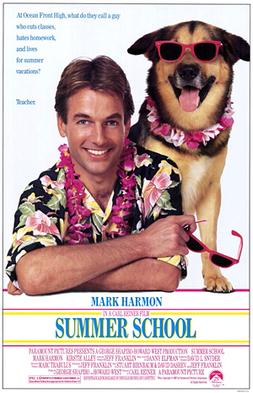
Summer School (1987, directed by Carl Reiner)


Summer School was the movie that made flunking out look like fun.

Freddy Shoop (Mark Harmon) is a relaxed, fun-loving gym teacher who is looking forward to spend his summer in Hawaii until he’s assigned to spend the summer teaching remedial English in summer school.  (His girlfriend goes to Hawaii without him.)  Freddy’s not happy about giving up his summer and he’s prepared to just spend his days taking his students to the beach, the amusement park, and the zoo.  But when he finds out that he’s going to lose his job unless his students pass the big test at the end of the summer, he gets serious and discovers what teaching is supposed to be all about.

When I was growing up, Summer School seemed to be on television all the time.  If it wasn’t on HBO, it was on one of the local stations, usually right before summer began.  The summer school kids seemed to be having too much fun for kids stuck in school.  I don’t think my classmates in Baltimore would have been as happy about losing their summer as the students in this film.  Everyone who has seen this film remembers Dave and Chainsaw (Gary Riley and Dean Cameron) making jokes and showing everyone The Texas Chainsaw Massacre.  They also remember Anna-Maria (Fabiana Udenio), the Italian exchange student who took summer school to work on her English.  They remember Freddy letting one of his students move in with him, which doesn’t seem like a good idea even if she was played by Courtney Thorne-Smith.  Myself, I remember Robin Bishop, the teacher next door, who was played by an extremely sexy Kirstie Alley.  (This was one of the many 80s films in which Kirstie Alley made being uptight seem sexy.)  Of course, Robin was dating the snobbish principal who was trying to get Freddy Shoop fired.

I’m not going to sit here and say that Summer School is a great film.  It’s a dumb comedy with an uplifting message about what a good teacher can accomplish.  However, Summer School is a very likable film, an enjoyable 80s teen romp that suggests summer school was the place to be in the late 80s.  Mark Harmon, Kirstie Alley, and all the students give good performances.  How many future horror nerds were inspired by Dave and Chainsaw?  Legendary nice guy Carl Reiner directed and the movie itself is amiable and amusing enough to be watchable.

Retro Television Review: St. Elsewhere 2.4 “Qui Transtulit Sustinet”


Welcome to Retro Television Reviews, a feature where we review some of our favorite and least favorite shows of the past! On Fridays, I will be reviewing St. Elsewhere, a medical show which ran on NBC from 1982 to 1988.  The show can be found on Hulu and, for purchase, on Prime!
This week. Dr. Craig finally gets to perform his first heart transplant.

Episode 2.4 “Qui Transtulit Sustinet”

(Dir by Victor Lobl, originally aired on November 16th, 1983)

It’s a busy day at St. Eligius.

While Morrison struggles to come to terms with the death of his wife, her heart is transplanted into Eve Leighton.  Morrison tells Westphall that he wants to keep working at the hospital and that he doesn’t need any time off.  Westphall tells Morrison that he’s too distraught to be trusted with patients and that he has to take some time off.  Westphall actually has a point, even if he does come across as being a bit cold when talking to Morrison.  Even Peter White, that drug-addicted sleazebag, tells Morrison that he’s needs to take some time.  Seriously, I think this is the first time that Dr. White’s been correct about anything since this show began.

Dr. Craig finally gets to perform a heart transplant but afterwards,  in a wonderfully-acted scene, he tells Westphall that he feels a bit let down.  After all the anticipation and the preparation, Craig isn’t sure what to do now that he’s actually performed the surgery.  For once, he doesn’t want to talk to the press, regardless of how much the city of Boston expects him to.  It’s a nicely human moment, one that we don’t often get from Dr. Craig.

Nurse Rosenthal attempted to console another breast cancer patient and met with Mark Harmon’s Dr. Caldwell to discuss getting breast reconstruction surgery.  Nurse Rosenthal’s breast cancer storyline has consistently been well-acted and well-written and it has also been consistently difficult for me, as someone who lost her mother to cancer, to watch and write about.  That was certainly the case for me with this episode.

Meanwhile, Fiscus and Luther pool their money to make an investment in silver but, at the last minute, Fiscus pulls out of their investment.  His nerves get the better of him.  Luther makes a lot of money.  Fiscus doesn’t.  Hey, guys — Morrison’s wife is dead.  Show some respect and save the comedy for another episode.

This was an intense episode but it ended on a beautiful note, with Dr. Morrison listening to the sound of his wife’s heart beating in someone else’s body.  A beautiful note but also a very sad one.  I’m worried about Jack Morrison.  I’m worried about the recipient of the heart.  I’m worried about Helen Rosenthal.  I’m worried about the entire hospital!

Here’s hoping for happier days ahead.


Retro Television Review: St. Elsewhere 2.3 “Newheart”


Welcome to Retro Television Reviews, a feature where we review some of our favorite and least favorite shows of the past! On Fridays, I will be reviewing St. Elsewhere, a medical show which ran on NBC from 1982 to 1988.  The show can be found on Hulu and, for purchase, on Prime!

This week, things get dark.

Episode 2.3 “Newheart”

(Dir by Mark Tinker, originally aired on November 9th, 1983)

What a depressing episode!

It doesn’t start out on a particularly depressing note.  It opens with a bachelor part for Dr. Vijay Kochar, who is about marry a woman that he’s never actually met.  (It’s an arranged marriage.)  The bachelor party, which appears to have been held in Fiscus’s apartment, is a bust.  Dr. White shows up with a sex doll.  Victor Ehrlich shows up with a short film called “Sally Takes a Ride,” which turns out to be not the pornography he was expecting but instead, a short film about astronaut Sally Ride.  Vijay mentions that he’s a virgin and soon, with the help Dr. White and Nurse Daniels, the news is all over the hospital.  Kathy Martin decides to give Vijay an early wedding gift by having sex with him.

Since this episode aired in 1983, there’s a random aerobic class being held in the hospital, which leads to a lengthy scene of spandex and dancing.  It’s a bit of a silly scene for what was, for the first half hour, shaping up to be a silly episode.

Fran and Jerry Singleton finally check out of the hospital.  Fran has regained the ability to speak and can stiffly walk.  Jerry has learned to stop being such an overbearing jerk.  Dr. Morrison is not there to say goodbye to the Singletons because….

…. and here’s where things start to get dark….

….his wife is in another hospital!  Jack Morrison’s wife has an offscreen cerebral hemorrhage and, as evidenced by Morrison’s tears at the end of the episode, she does not survive.  At the same time that she’s dying, Dr. Craig gets a call telling him that there is finally a heart available for the transplant.  And, though it wasn’t explicitly stated, it seems pretty obvious that the heart in question belonged to Morrison’s wife.

AGCK!

Seriously, how much more depressing can one episode get?  And for all this to happen to Jack Morrison, who is probably the most decent character on the show, it’s just not fair!  I mean, he was literally the only married intern who had a happy marriage.  He has a newborn son.  And now, he’s going to have to balance being a single father with being a resident.

Poor guy!  I hope next week finds some sort of relief for him.

Retro Television Review: St. Elsewhere 2.2 “Lust Et Veritas”


Welcome to Retro Television Reviews, a feature where we review some of our favorite and least favorite shows of the past! On Fridays, I will be reviewing St. Elsewhere, a medical show which ran on NBC from 1982 to 1988.  The show can be found on Hulu and, for purchase, on Prime!

This week, St. Eligius gets a new plastic surgeon.

Episode 2.2 “Lust Et Veritas”

(Dir by Mark Tinker, originally aired on November 2nd, 1982)

This episode sees the addition of two new doctors to the hospital’s staff and they’re both played by familiar actors.  Elliott Axlerod is played by Stephen Furst.  He’s a new resident and obviously terrified of screwing up in the ER.  He asks Ehrlich and Fiscus for advice.  When told that he’s required to perform a rectal exam on every patient, he asks, “Is it too late to go to law school?”  Ehrlich assures him that it is.

(It’s never too late!)

Secondly, Mark Harmon joins the cast as plastic surgeon Bobby Caldwell and not even a porn star mustache can obscure the fact that young Mark Harmon was amazingly hot.  (Actually, old Mark Harmon isn’t that bad either.  He aged well.)  Bobby, we learn, was brought to St. Eligius by Dr.  Craig.  He’s cocky and confident and it’s obvious that he loves being lusted after by Dr. Armstrong and Nurse Daniels.  However, he already has a secret lover as this episode finds him showering with Joan Halloran, the city hall bureaucrat who spends most of her time arguing with Dr. Craig about whether or not to shut down one of the hospital’s non-profit programs.

Dr. Craig is nervous because he’s waiting for a heart to become available so he can perform his first transplant on Eve Leighton (Marian Mercer), a teacher who wants to get back into her classroom as soon as possible.  Ehrlich is nervous because Craig is taking all of his frustrations. and his nervousness out on him.

Meanwhile, Jerry Singleton (Alan Arkin), the demanding husband of stroke-victim Fran (Piper Laurie), continued to push his wife to recover until finally, at the end of the episode, she yelled that he was pushing her too hard.  It was a heart-breaking moment.  Jerry thinks that he’s helping his wife but, as this episode showed, he’s actually been torturing her with his overbearing demands that she hurry up and get better.

Finally, a former resident named Barry Dorn (Peter Horton) returns to the hospital to try to convince Dr. Cavanero to change her negative evaluation of his job performance.  Everyone acts as if Barry was a character on the show during the previous season, even though he wasn’t.  It’s even revealed that he is Wendy Armstrong’s former boyfriend.  When Cavanero refuses to change her evaluation, Armstrong accuses her of not having any feelings.  (Seriously, Armstrong is the worst!)  Even worse, when Cavanero heads to the doctor’s lounge, she finds Barry waiting for her.  Barry punches her, busting open her lower lip.  Armstrong stitches up the cut and then says that Cavanero is lucky because now, she’ll have an excuse to meet Dr. Caldwell!  Armstrong then offers a half-hearted apology for previously accusing Cavanero of being heartless.  (Again, Armstrong is the worst!!!!)

This wasn’t a bad episode.  Mark Harmon and Stephen Furst seem like they’ll be good additions to the show’s ensemble.  The Barry story felt a bit odd, just because Barry was apparently present but 0ff-camera during the entire first season.  It sounds like Barry went through a lot of the same things that Peter White went through during the first season and Peter was not present in this episode.  There’s a part of me that suspects that Barry was originally meant to be Peter but the show’s producers obviously decided they wanted to keep Peter around for a bit longer.

Next week …. well, I have no idea how things are going to develop.  There’s a lot going on in this hospital.  We’ll see what happens.

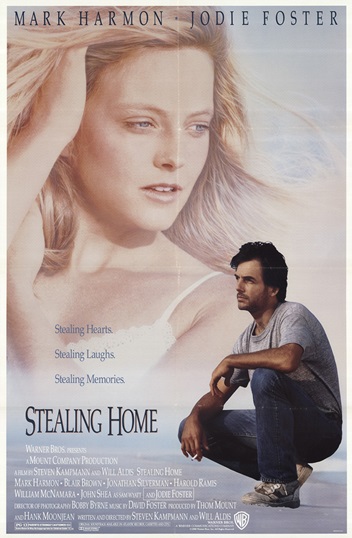
So, I Watched Stealing Home (1988, dir. by William Porter and Steven Kampmann)


Back in December, Lisa agreed to watch a baseball movie with me to make up for making me watch The Catcher in 2023.  The one we picked was Stealing Home, because it starred Mark Harmon and Jodie Foster and it looked like it would be a sweet movie.

Stealing Home opens with Billy Wyatt (Mark Harmon), a minor league baseball player who is getting ready to take the field and who is standing for the National Anthem.  I immediately liked Billy because he was standing for the Anthem and not taking a knee.  I also like aging minor leaguers because they’re still playing the game even though they know they’ve probably missed their window to move up to the majors.  Billy Wyatt loves both the game and his country.

As Billy waits to play ball, he thinks about another type of love, the love that he had for Katie Chandler (Jodie Foster).  Katie was six years older than him and encouraged him to always pursue his dreams, whether it was in baseball or love.  The movie flashes back to Billy living in a motel with a cocktail waitress and getting a phone call from his mother who tells him that Katie has committed suicide and she wants Billy to spread her ashes at a special place.  Billy then flashes back to his childhood and his teen years, in which he’s played by William McNamara who does not look like he could ever grow up to be Mark Harmon.  Billy’s best friend is Alan Appleby, who is played as a teenager by Jonathan Silverman and as an adult by Harold Ramis.  Jonathan Silverman growing up to be Harold Ramis seems even more unlikely than William McNamara becoming Mark Harmon.  Billy remembers losing his virginity to Appleby’s prom date, losing his dad to a car wreck, and a Fourth of July weekend that he spent on the beach with Katie and his mom (Blair Brown).

Only Jodie Foster plays Katie Chandler and we only see Katie thorough Billy’s eyes.  Jodie Foster gives a lively performance as Katie but she always more of a plot device than a fully rounded character.  We never find out why Katie killed herself.  Her father says that Katie was unhappy during her adult life but why?  Even after Billy gets her ashes and tries to figure out where she wanted him to spread them, he never thinks about why she killed herself.  In fact, he hadn’t even talked to her for years.  That really bothered me.

The movie ends with Billy stealing home during a game and proving that he’s still got it as far as baseball goes.  I love baseball but I still felt like Katie’s untold story was probably more interesting than Billy’s.  I liked Mark Harmon’s performance and I really wanted to like Stealing Home more than I did.  I wish the movie had been more about who Katie was instead of being about who Billy thought Katie was.

Lisa Marie’s First Review of 2025: Beyond the Poseidon Adventure (dir by Irwin Allen)


On New Year’s Eve in 1972, a tragedy struck in the Aegean Sea.  Just as the clock hit midnight and its passengers wished each other a happy new year, the cruise ship Poseidon was capsized by a tidal wave.  The majority of the ship’s crew and passengers were killed in the disaster but a small group managed to climb up through the wreckage and make their way to the ship’s hull, where they were rescued.  Gene Hackman sacrificed his life so that Ernest Borgnine, Red Buttons, Jack Albertson, Carol Lynley, and Pamela Sue Martin could all survive.

We all know the story of The Poseidon Adventure and some of us have even been goaded by our sisters into singing There’s Got To Be A Morning After for karaoke night at Grandpa Tony’s.  (Grandpa Tony’s has since shut down but, for a while, it was the best place in Dallas for nachos and karaoke.)  But do you know the story of what happened after that initial group of survivors was rescued from the ship?  Have you gone Beyond The Poseidon Adventure?

First released in 1979, Beyond The Poseidon Adventure picks up directly from where the first film ended.  Mere minutes after the rescue helicopter flies off, a tugboat pulls up alongside the still capsized wreck of the Poseidon.  Needing money to pay off his debts, Captain Mike Turner (Michael Caine) has decided to declare salvage rights and claim all of the cash and jewelry that he can find in the wreckage.  Accompanying him is his mentor Dead Meat (Karl Malden) and his protegee, Annoying and Cutesy (Sally Field).  Actually, Dead Meat is named Wilbur but, as soon as Karl Malden starts to dramatically grab at his chest, viewers will know that he’s destined to heroically sacrifice himself.  Annoying and Cutesy’s real name is Celeste.  Sally Field gives perhaps the worst performance of her career as the almost always perky Celeste.  This movie came out the same year that Sally Field appeared in the film for which she won her first Oscar, Norma Rae.  I have to imagine that Field was happy to win that Oscar because it meant she would never have to do another film like Beyond The Poseidon Adventure.

Before the tugboat crew can begin to explore the Poseidon, another boat shows up.  This boat is captained by Stefan Svevo (Telly Savalas), who claims to be a doctor who is responding to an S.O.S. from the capsized ship.  Svevo and his crew insist on accompanying the tugboat crew into the Poseidon.  It’s obvious from the start that Svevo is not actually a benevolent doctor.  For one thing, the men accompanying him are armed.  For another thing, he’s played by veteran screen villain Telly Savalas.

The two crews finally enter the ship and …. hey, there’s even more people on the boat!  At the end of The Poseidon Adventure, we were told that only six people had survived the disaster but apparently, that was just a damn lie.  The ship is literally crawling with people who still haven’t gotten out.  (Why didn’t the people who rescued the first batch of survivors check to make sure that they had gotten everyone?)  There’s Tex (Slim Pickens), who says he’s from “Big D” and talks about how he owns an oil well (as we all do in Big D).  There’s Frank Mazzetti (Peter Boyle, basically playing the same loudmouth that Ernest Borgnine played in the first film) and his daughter Theresa (Angela Cartwright) and Theresa’s new boyfriend, Larry (Mark Harmon).  There’s a nurse (Shirley Jones) and a blind man (Jack Warden) and his wife (Shirley Knight).  There’s Susanne (Veronica Hamel), the cool femme fatale who has a connection to Svevo.

While Svevo searches for a crate of plutonium (what the Hell was that doing on the Poseidon?), Mike tries to get the survivors to safety.  That means once again climbing up to the hull while the ship shakes and the engines continue to explode.  Both the first film and the sequel feature the exact same footage of the engines exploding.  At this rate, I guess the Poseidon might finally sink sometime this year.

Directed by Irwin Allen (who produced the first film), Beyond The Poseidon Adventure is about as bad as a film could be.  The first film had plenty of silly moments but it also had the entertaining spectacle of Gene Hackman and Ernest Borgnine competing to see who could yell the loudest.  Beyond the Poseidon Adventure has Michael Caine and Telly Savalas both looking bored while Peter Boyle complains, “That was the worst New Year’s Party I’ve ever been to!” and Sally Field says stuff like, “I’ve been to Anzio!  It’s the pits!”  At one point, Slim Pickens says that he’s as phony as a three dollar bill.  The same could be said of this film.  Beyond The Poseidon Adventure looks and feels cheap and generates none of the suspense of the first film.

As Beyond The Poseidon Adventure ended, I found myself worrying that there might be other passengers still stuck on the ship.  I mean, apparently, it’s very easy to not only survive on a capsized cruise ship but also to be overlooked by professional rescue crews.  Unfortunately, there was not another sequel so those folks were just out of luck.

Retro Television Reviews: The Love Boat 3.1 and 3.2 “The Alaskan Wedding Cruise: Carol and Doug’s Story/Peter and Alicia’s Story/Julie’s Story/Buddy and Portia’s Story”


Welcome to Retro Television Reviews, a feature where we review some of our favorite and least favorite shows of the past!  On Wednesdays, I will be reviewing the original Love Boat, which aired on ABC from 1977 to 1986!  The series can be streamed on Paramount Plus!

The Love Boat sets sail for season 3!

Episode 3.1 and 3.2 “The Alaskan Wedding Cruise: Carol and Doug’s Story/Peter and Alicia’s Story/Julie’s Story/Buddy and Portia’s Story”

(Dir by Roger Duchowny, originally aired on September 15th, 1979)

The third season of The Love Boat starts with a special voyage to Alaska and a two-hour running time.  It’s double the guest stars, double the melodrama, double the goofiness, and double the romance!  The opening also features new clips for Doc, Gopher, and Julie.  Whereas the first two seasons introduced Doc listening to his own heartbeat, the third season opening features him laughing while leaning against a railing.  Gopher’s new opening credit features him looking wistfully out at the ocean and it’s a much more mature look for him.  As for Julie, she’s still smiling and perky but she’s let her hair grow out.  If the first two seasons of The Love Boat featured Julie looking like the star of the high school drama department, she looks more like the most popular cheerleader now.  As for the Captain, he continues to salute the camera and Isaac continues to do his signature pointing.

The episode opens in Canada. The boat is docked in Vancouver, where it has been rented out by a huge and wealthy wedding party.  The boat will be sailing to Alaska.  Isaac has been reading everything that he can find about Alaska and he spends most of the episode sharing trivia about the state’s history.  Gopher, preparing for Alaska’s cold weather, buys a gigantic coat.  Meanwhile, Doc Bricker makes jokes about his ex-wives and Capt. Stubing tries to keep everything professional.  (“You’re not going to the North Pole!” he snaps at Gopher when he sees the size of his new fur coat.)

As for Julie, her mind is elsewhere.  Alaska is where Jack (Tony Roberts) lives.  Who is Jack?  During the second season, he was a passenger who fell in love with Julie and who asked Julie to marry him.  She knows that she’s going to see Jack in Alaska and she’s going to give him an answer as far as his proposal is concerned.  (If you don’t remember Jack asking Julie to marry him, don’t feel bad.  I had forgotten about it, too.  Fortunately, the first hour of this episode is full of flashbacks to Jack’s previous episode.)  Is Julie ready to settle down?  While Julie tries to make up her mind, she also has to deal with the romantic intentions of the wedding party’s dorky best man (Donny Most).

As for the wedding party, Carol (Lisa Hartman) and Doug (Mark Harmon, sporting a truly unfortunate haircut) are looking forward to getting married, even though Doug’s ex-girlfriend (Caren Kaye) is also on the boat and determined to win Doug back.  If that means jumping out a cake while wearing a bikini, she’ll do it.  Doug is more concerned about the fact that his estranged, alcoholic father, Peter (Ray Milland) had turned up on the cruise despite having not been invited to or even informed about the wedding.  Peter has stopped drinking and is trying to make peace with his son and his ex-wife, Alicia (Eleanor Parker).  What Doug and Alicia do not know is that Peter is terminally ill.  And what neither Doug nor Peter knows is that Alicia is on the verge of filing for bankruptcy.

Meanwhile, Carol’s plain-spoken grandfather (Lorne Greene) feels uncomfortable with all of the rich folks but then he meets Doug’s equally plain-spoken aunt (Audra Lindley).  Could we be heading for a double wedding?  It is The Love Boat, after all!

There aren’t really any big surprises on this episode but it’s likable nonetheless.  For this episode, the crew and the cast actually sailed to Alaska and all the action was filmed during an actual cruise.  The scenery is gorgeous, even if it’s obvious that the cast was frequently freezing while filming their scenes.  By this point, the show’s regulars had their chemistry down perfectly and all of the 3rd season premiere’s guest stars are well-selected.  I especially liked the performances of Lorne Greene, Audra Lindley, the great Ray Milland, and Tony Roberts.  Julie and Jack’s reunion was far more touching that I think anyone would expect from a show like The Love Boat, with Tony Roberts playing the role of Jack so well that the viewer really did believe that, under different circumstances, he and Julie truly would have had a wonderful life together.  This was a great way to start the third season.

Retro Television Review: After The Promise (dir by David Greene)


Welcome to Retro Television Reviews, a feature where we review some of our favorite and least favorite shows of the past!  On Sundays, I will be reviewing the made-for-television movies that used to be a primetime mainstay.  Today’s film is 1987’s After the Promise!  It  can be viewed on YouTube!

Mark Harmon is, in many ways, the ideal television actor.  He’s handsome in a distinguished but not overwhelming sort of way.  He projects a pleasant personality.  He’s likably low-key.  He’s a talented actor but he’s also a bit of a safe and predictable actor.  It’s been said that the difference between a TV star and a movie star is that a movie star combines charisma with danger whereas a TV star combines a likable screen presence with reliability.  Mark Harmon’s been a reliable TV presence for longer than I’ve been alive.

In 1987’s After the Promise, Harmon plays Elmer Jackson, a carpenter who is just trying to survive day-to-day in Depression-era California.  Though his wife (who is implied to be a Christian Scientist) begs him not to take her to the hospital when she gets ill, Elmer goes against her wishes.  When he gets her to the hospital, he is treated rudely by the staff.  A cop approaches him in the waiting room and brusquely orders him to move his car.  When a doctor finally does approach Elmer, he calmly explains that Elmer’s wife has did of TB and that she should have been brought to the hospital weeks ago.

Now a widower, Elmer is determined to keep the last promise that he made to his wife and give his four sons the best life that he possibly can.  Unfortunately, the government is determined to keep Elmer from doing that.  When Elmer goes to the government to try to get temporary financial assistance, the government reacts by taking his children away from him and forcing them into foster care.  When Elmer, during one of his weekly visits, tries to take the children for a ride, the government bans him from having any contact with his children.  When Elmer’s sons try to escape from the foster home, they’re separated and sent to separate facilities.

Informed that he can only get his children back if he proves that he’s financially stable, Elmer becomes an itinerant worker.  It’s only after he meets and marries Anna (Diana Scarwid) that Elmer finally gets a chance to be reunited with his sons but, after years of abuse, his sons have their own traumas to deal with before they can accept Elmer as being their father.

This is a movie that really pulls at your heartstrings!  There’s nothing subtle about it but, at the same time, its portrait of bureaucrats without empathy is one that feels very real and contemporary.  Over the course of the film, Elmer learns that the rules are not being written to help out a blue collar worker who doesn’t have a lot of money and, watching the film, it’s hard not to consider that the rules haven’t really changed that much over the years.  Elmer isn’t just fighting to reunited his family.  His fighting to save them from a system that is designed to dehumanize.  It’s an ideal role for a television star like Mark Harmon, as Elmer isn’t a terribly complex man but he is a very determined one.  It’s a role that demands a lot of sincerity and Harmon certainly delivers.  For that matter, so does this simple but emotionally resonant film.

Under the Sea: Goliath Awaits (1981, directed by Kevin Connor)


1939.  War is breaking out across Europe.  The British luxury liner Goliath is torpedoed by a German U-boat.  Presumed to be lost with the ship are a swashbuckling film star, Ronald Bentley (John Carradine), and U.S. Senator Oliver Barthowlemew (John McIntire), who may have been carrying a forged letter from Hitler to Roosevelt when the boat went down.

1981.  Oceanographer Peter Cabot (Mark Harmon, with a mustache) comes across the sunken wreck of the Goliath.  When he dives to check out his discovery, he is shocked to hear big band music coming from inside the ship.  He also thinks that he can hear someone tapping out an S.O.S. signal.  When he looks into a porthole, he is stunned to discover a beautiful young woman (Emma Samms) staring back at him.

Under the command of Admiral Sloan (Eddie Albert), who wants to retrieve the forged letter before it does any damage to the NATO alliance, Cabot and Command Jeff Selkirk (Robert Forster) are assigned to head an expedition to explore Goliath.  What they discover is that, for 40 years, the passengers and crew have survived within an air bubble.  Under the leadership of Captain John McKenzie (Christopher Lee), they have created a new, apparently perfect society within the sunken ship.  Cabot discovers that the woman that he saw was McKenzie’s daughter, Lea.

McKenzie is friendly to Cabot and his crew, explaining to them the scientific developments that have allowed the passengers and crew to not only survive but thrive underwater.  The only problems are a group of outcasts — the Bow People — who refuse to follow McKenzie’s orders and Palmer’s Disease, an infection that only seems to infect people who are no longer strong enough to perform the daily tasks necessary to keep McKenzie’s utopia functioning.   Even when people on the boat die, they continue to play their part by being cremated in Goliath’s engine room and helping to power the ship.

Everything seems perfect until Cabot announces that he has come to rescue the survivors of the Goliath.  Even though Goliath is starting to decay and will soon no longer be safe, McKenzie is not ready to give up the perfect society that he’s created.  McKenzie sets out to prevent anyone from escaping the Goliath.

Goliath Awaits is a massive, 3-hour production that was made for television and originally aired over two nights.  (The entire 200-minute production has been uploaded to YouTube.  Avoid the heavily edited, 91-minute version that was released on VHS in the 90s.)  It’s surprisingly good for a made-for-TV movie.  Because a large portion of the film was shot on the RMS Queen Mary, a retired cruise ship that was moored in Long Beach, California, Goliath looks luxurious enough that you understand why some of the passengers might want to stay there instead of returning to the surface.  Beyond that, Goliath Awaits takes the time to fully explore the society that McKenzie has created and what it’s like to live on the ship.  McKenzie may not be as benevolent as he first appears to be but neither is he a one-dimensional villain.

Mark Harmon is a dull lead but Robert Forster is just as cool as always and Christopher Lee is perfect for the role of misguided Capt. McKenzie.  The movie is really stolen by Frank Gorshin, who is coldly sinister as Dan Wesker, the Goliath’s head of security.  McKenzie may by Goliath’s leader but Wesker is the one who does the dirty work necessary to keep the society running.

Goliath Awaits also features several character actors in small roles, with John Carradine, Duncan Regehr, Jean Marsh, John McIntire, Jeanette Nolan, Alex Cord, Emma Samms, and John Ratzenberger all getting to make a good impression.  (Ignore, if you can, a very young Kirk Cameron as one of the children born on the Goliath.)

Goliath Awaits is far better than your average made-for-TV movie from the 80s.  With any luck, it will someday get the home video release that it deserves.


A Movie A Day #217: Wyatt Earp (1994, directed by Lawrence Kasdan)


Once upon a time, there were two movies about the legendary Western lawman (or outlaw, depending on who is telling the story) Wyatt Earp.  One came out in 1993 and the other came out in 1994.

The 1993 movie was called Tombstone.  That is the one that starred Kurt Russell was Wyatt, with Sam Elliott and Bill Paxton in the roles of his brothers and Val Kilmer playing Doc Holliday.  Tombstone deals with the circumstances that led to the Gunfight at the O.K. Corral.  “I’m your huckleberry,” Doc Holliday says right before his gunfight with Michael Biehn’s Johnny Ringo.  Tombstone is the movie that everyone remembers.

The 1994 movies was called Wyatt Earp.  This was a big budget extravaganza that was directed by Lawrence Kasdan and starred Kevin Costner as Wyatt.  Dennis Quaid played Doc Holliday and supporting roles were played by almost everyone who was an active SAG member in 1994.  If they were not in Tombstone, they were probably in Wyatt Earp.  Gene Hackman, Michael Madsen, Tom Sizemore, Jeff Fahey, Mark Harmon, Annabeth Gish, Gene Hackman, Bill Pullman, Isabella Rossellini, JoBeth Williams, Mare Winningham, and many others all appeared as supporting characters in the (very) long story of Wyatt Earp’s life.

Of course, Wyatt Earp features the famous Gunfight at the O.K. Corral but it also deals with every other chapter of Earp’s life, including his multiple marriages, his career as a buffalo hunter, and his time as a gold prospector.  With a three-hour running time, there is little about Wyatt Earp’s life that is not included.  Unfortunately, with the exception of his time in Tomstone, Wyatt Earp’s life was not that interesting.  Neither was Kevin Costner’s performance.  Costner tried to channel Gary Cooper in his performance but Cooper would have known better than to have starred in a slowly paced, three-hour movie.  The film is so centered around Costner and his all-American persona that, with the exception of Dennis Quaid, the impressive cast is wasted in glorified cameos.  Wyatt Earp the movie tries to be an elegy for the old west but neither Wyatt Earp as a character nor Kevin Costner’s performance was strong enough to carry such heavy symbolism.  A good western should never be boring and that is a rule that Wyatt Earp breaks from the minute that Costner delivers his first line.

Costner was originally cast in Tombstone, just to leave the project so he could produce his own Wyatt Earp film.  As a big, Oscar-winnng star, Costner went as far as to try to have production of Tombstone canceled.  Ironically, Tombstone turned out to be the film that everyone remember while Wyatt Earp is the film that most people want to forget.