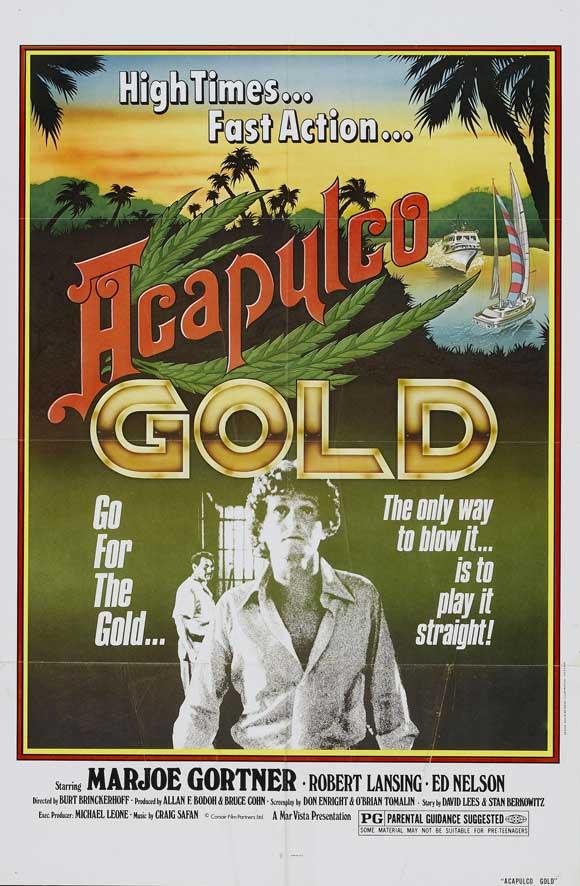
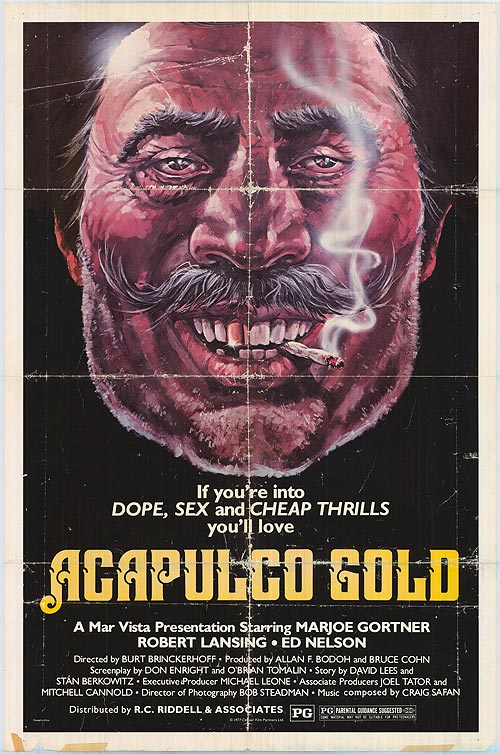
I just finished watching Acapulco Gold, a rather goofy 1976 film about …. well, who knows?
The film starts with some well-shot footage of marijuana farmers checking out their crop but then it abruptly abandons all of that to follow an American insurance salesman named Ralph Hollio (Marjoe Gortner). Ralph is at an airport in Acapulco, waiting to board a flight back to America. He’s approached by a nun who asks him to carry a piñata for her. Ralph says sure but — oh no! — that piñata is actually full of heroin! Ralph’s an unwitting drug mule and not a very good one because it doesn’t take long for him to get himself arrested and sentenced to 40 years in a Mexican prison.
Despite this run of bad luck, Ralph remains surprisingly cheerful. One is tempted to almost describe him as being a Candide-like figure but that would probably be giving this film too much credit. In prison, he meets another prisoner, a boat captain named Carl Solberg (Robert Lansing). Carl is sprung from jail by local businessman, Morgan Frye (John Harkins). Frye wants Carl to sail a boat from Mexico to Hawaii. Carl agrees but he insists that Morgan also pull some strings so that Ralph can serve as his first mate. Morgan, of course, agrees.
The film’s “action” shifts to Hawaii, where it turns out that Ralph and Carl are being used as a part of a much bigger plot. Or something. To be honest, it’s a bit difficult to figure out just what exactly is going on. Acapulco Gold has a make-it-up as you go along feel to it. Occasionally, it’s amusing. Often, it’s frustrating. As soon as you start to get in any way interested in one storyline, it gets abandoned. The film doesn’t have a plot as much as it has a bunch of scenes that we’re left to assume are meant to be somehow connected.
For instance, there’s an elderly couple who keep showing up at inopportune times, providing what I guess is meant to be comedic relief. At one point, it appears that the couple is surely doomed but, several scenes later, they show up at a golf course and they look none the worse for wear. There are lengthy sailing scenes, mixed in with lengthy helicopter scenes. None of them add much to the plot but the Hawaiian scenery is frequently nice to look at. Ralph falls for Morgan’s girlfriend (Randi Oakes) while a Congressman and a corrupt DEA agent use huge, oversized walkie-talkies to communicate with two people who we occasionally see wandering around in the jungle. There’s a golf cart chase, which ends with a labored joke about a two-strike penalty. And, since this is a low-budget 70s film, there’s a day-for-night sequence that is so ineptly lit that we can barely see anyone for several minutes of the movie. (Though his face may not be visible, one can always spot Marjoe Gortner by his hair. 70s Marjoe had a lot of hair.)
At its best, Acapulco Gold is a charmingly incoherent time capsule, a chance to hop in a time machine and go back to 1976. At its worse, it’s a total mess. That said, it’s short enough that it’s never exactly boring and the randomness of it all occasionally lends the film a dream-like atmosphere (albeit one of those dreams that you forget about after you’ve been awake for 87 minutes). As I previously stated the Hawaiian scenery is lovely and some members of the cast — Robert Lansing and Ed Nelson, in particular — do the best that they can with their inconsistently written characters. The whole thing is such a slapdash affair that it becomes oddly fascinating to watch.
As for the film’s star, Marjoe Gortner was a former child evangelist whose claim to fame was being the subject of Marjoe, a documentary in which he admitted that he didn’t believe in anything that he preached and that he was just scamming people out of their money. Perhaps not surprisingly, Gortner was usually best-cast as villains or unpredictable rogues. (His best performance was as a morally ambiguous space pirate in Starcrash.) In Acapulco Gold, Gortner is playing a normal, ordinary guy who finds himself caught up in the drug underworld. Gortner is miscast as a naive innocent and, instead of projecting any sort of shock over anything tht he experiences, Gortner’s laid back performance suggests that there were multiple reasons why this film was called Acapulco Gold.
Acapulco Gold is currently viewable on Prime. It’s not a particularly good film but Hawaii has always looked great.

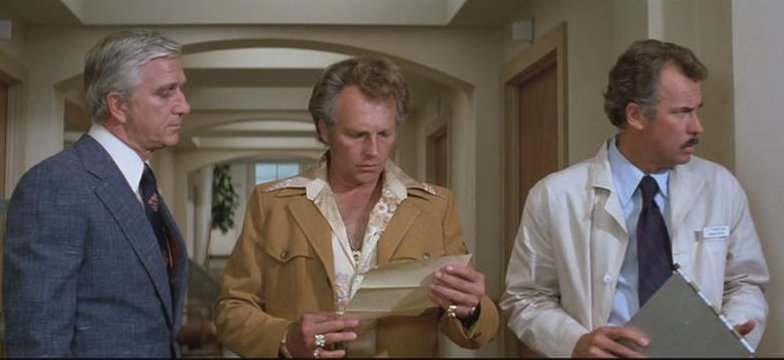
 The year is 1974 and there’s nothing more dangerous than being a hippie in Baja California. That’s because psychotic business Sam Farragutt (played by Andy Griffith!) is on the loose. Sam likes to describe himself as being a hippie himself. “A hippie with money,” Sam puts it as he waves a hundred dollar bill in the face of a hippie without money,

 The year is 1876 and the legendary Wild Bill Hickok (Jeff Bridges) sits in a saloon in Deadwood and thinks about his life (most of which is seen in high-resolution, black-and-white flashbacks). Hickok was a renowned lawman and a sure shot, a man whose exploits made him famous across the west. Thanks to his friend, Buffalo Bill Cody (Keith Carradine), he even appeared on the New York stage and reenacted some of his greatest gun battles. Now, Hickok is aging. He is 39 years old, an old man by the standards of his profession. Though men like Charlie Prince (John Hurt) and California Joe (James Gammon) continue to spread his legend, Hickok is going blind and spends most of his time in a haze of opium and regret.
 Is an American Ninja film still an American Ninja film if it doesn’t feature the American Ninja?













 Through the Shattered Lens