For tonight’s horror on television, we have 1973’s The Night Strangler.
This is the sequel to The Night Stalker and it features journalist Carl Kolchak (Darren McGavin) in Seattle. (After all the stuff that happened during the previous movie, Kolchak was kicked out of Las Vegas.) When Kolchak investigates yet another series of murders, he discovers that paranormal murders don’t just occur in Las Vegas and aren’t just committed by vampires.
I actually prefer this movie to The Night Stalker. The Night Strangler features a truly creepy villain, as well as a trip down to an “underground city.” It’s full of ominous atmosphere and, as always, Darren McGavin is a lot of fun to watch in the role in Kolchak.
Tonight, from 1976, we have The Paul Lynde Halloween Special.
In this special, actor and comedian Paul Lynde celebrates Halloween with Betty White, KISS, Donny and Marie Osmond, Florence Henderson, Billy Barty, Margaret Hamilton (the original Wicked Witch of the West), and I’m going to guess a mountain of cocaine that was probably sitting backstage.
This special is definitely a product of a very certain era in America’s cultural history.
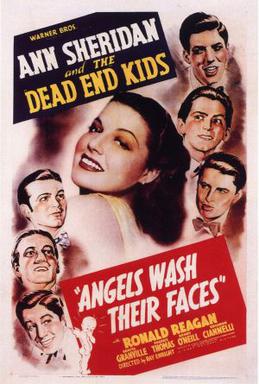
Gangster William Kroner (Bernard Nedell) and his henchman Martino (Eduardo Ciannelli) frame teenager Gabe Ryan (Frankie Thomas) for setting several buildings on fire. Because Gabe has just gotten out of reform school and is a member of a local neighborhood gang, they know that no one will believe him or his sister, Joy (Ann Sheridan).
What Kroner and Martino did not count on were the Dead End Kids (Billy Halop, Bobby Jordan, Leo Gorcey, Gabriel Dell, Huntz Hall, and Benard Punsley). They’re not going to sit by while the adults send their friend to jail. Plus, one of their friends was killed in one of the fires. The kids are out for revenge and sympathetic district attorney Pat Remsen (Ronald Reagan) is on their side.
As a publicity stunt, the city is holding an election for “Kid Mayor.” The Kid Mayor gets to run the city for a week. What could go wrong? Billy Halop decides to run for Kid Mayor so that he can order the arrest of Kroner and then beat a confession out of him.
Angels Wash Their Faces was one of the last of the studio-made Dead End Kid films. After this one, they would be sent down to Poverty Row and their films would be more obviously comedic. Angels Wash Their Faces starts out as a juvenile delinquent drama, with Gabe struggling to rebuild his life and keep on the right track. Then it becomes a goofy comedy, with Billy Halop running for mayor and unleashing vigilante justice on the bad guys. I’m not sure that any city would actually give the “kid mayor” the power to lock people up. Whoever came up with the idea of a kid mayor should be run out of politics.
On the positive side, Ann Sheridan is beautiful. Future president Reagan is his usual friendly self. On the negative side, the movie, overall, lacks the edge that made the first few Dead End Kids films memorable and the Dead End Kids themselves seem to be pretty much interchangeable. Huntz Hall would have made a better mayor.
In 1971’s The Anderson Tapes, Sean Connery stars as Duke Anderson.
Duke is a career criminal, a safecracker who has just spent ten years in prison. He’s released, alongside Pops (Stan Gottlieb), who spent so much time behind bars that he missed two wars and the Great Depression, and the quirky Kid (Christopher Walken, making his film debut). Duke immediately hooks up with his former girlfriend, Ingrid (Dyan Cannon), and decides to rob the luxury apartment building where Ingrid is now living.
Of course, Duke will have to put together a crew. It’s not a heist film without a quirky crew, is it? Duke recruits the Kid and Pops. (The Kid is happy to be in the game but he’s not a fan of violence. Pops, meanwhile, has none of the skills necessary for living in the “modern” world and would much rather return to prison.) Duke also brings in the flamboyant Tommy Haskins (an overacting Martin Balsam) and driver Edward Spencer (Dick Anthony Williams). Duke goes to the mob for backing and Pat Angelo (Alan King) gives it to him on the condition that he take along a sociopathic racist named Socks (Val Avery) and that Duke kills Socks at some point. Duke reluctantly agrees.
So far, this probably sounds like a conventional heist film. Director Sidney Lumet mixes comedy and drama with uneven results but, overall, he does a good job of ratcheting up the tension and TheAndersonTapes is a good example of one of my favorite mini-genres, the “New Yorkers will be rude to anyone” genre. At first glance, Sean Connery seems to be playing yet another super smooth operator, a confident criminal with a plan that cannot fail. Duke seems like a criminal version of James Bond, However, as the film progresses, we start to suspect that things might be getting away from Duke. When Duke has to go the Mafia for support and is told that killing Socks is now a part of the job, we see that Duke isn’t as in-control of the situation as we originally assumed. This is the rare Sean Connery film where he has someone pushing him around.
(Apparently, Connery took this role as a part of his effort to escape being typecast as Bond. Perhaps that explains why Duke seems like almost a deconstruction of the James Bond archetype.)
Of course, what really lets us know that Duke isn’t as in-charge as he assumes is the fact that four different law enforcement agencies are following his every move. From the minute he gets out of prison, Duke is being watched. The apartment is bugged. Security cameras records his every move. Once the heist begins, we’re treated to flash forwards of breathless news reports. TheAndersonTapes is less a heist film and more a portrait of the early days of the modern Surveillance State. Of course, none of the agencies make any moves to stop Duke because doing so would reveal their own existence. The film really does become a portrait of a government that has gotten so big and intrusive that it’s also lost the ability to actually do anything.
The Anderson Tapes is entertaining, even if it’s not really one of Lumet’s best. Connery is, as always, a fascinating screen presence and it’s always entertaining to see a young Christopher Walken, showing early sings of the quirkiness that would become his signature style. TheAndersonTapes is a portrait of a world where you never know who might be listening.
First released in 1970, Brewster McCloud takes place in Houston.
A series of murders have occurred in the city. The victims have all been older authority figures, like decrepit landlord Abraham Wright (Stacy Keach, under a ton of old age makeup) or demanding society matron Daphne Heap (Margaret Hamilton, who decades earlier had played The Wicked Witch in The Wizard Of Oz). The victims all appear to have been killed by strangulation and all of them are covered in bird droppings. Perplexed, the Houston authorities call in Detective Frank Shaft (Michael Murphy) from San Francisco. Shaft only wears turtlenecks and he has piercing blue eyes. He looks like the type of guy you would call to solve a mystery like this one. It’s only later in the film that we discover his blue eyes are due to the contact lenses that he’s wearing. Frank Shaft is someone who very much understands the importance of appearance. As one detective puts it, when it comes to Shaft’s reputation, “The Santa Barbara Strangler turned himself in to him. He must have really trusted him.”
Perhaps the murders are connected to Brewster McCloud (Bud Cort), who lives in a bunker underneath the Astrodome and who seems to be fascinated with birds. Brewster dreams of being able to fly just like a bird and he’s spent quite some time building himself a set of artificial wings. A mysterious woman (Sally Kellerman) who wears only a trenchcoat and who has scars on her shoulder blades that would seem to indicate that she once had wings continually visits Brewster and encourages him to pursue his dream. However, she warns him that he will only be able to fly as long as he remains a virgin. If he ever has sex, he will crash to the ground.
Brewster thinks that he can handle that. Then he meets a tour guide named Suzanne Davis (Shelley Duvall, in her film debut) and things start to change….
Brewster McCloud is a curious film. The story is regularly interrupted by a disheveled lecturer (Rene Auberjonois) who is very much into birds and who, over the course of the film, starts to more and more resemble a bird himself. The film is full of bird-related puns and there are moments when the characters seem to understand that they’re in a movie. Frank Shaft dresses like Steve McQueen in Bullittand his blue contact lenses feel like his attempt to conform to the typical image of a movie hero. (A lengthy car chase also feels like a parody of Bullitt’s famous chase scene.) When the old woman played by Margaret Hamilton dies, the camera reveals that she’s wearing ruby slippers and a snippet of Somewhere Over The Rainbow is heard. As played by Bud Cort, Brewster is the perfect stand-in for the lost youth of middle class America. He knows that he’s rebelling against something but he doesn’t seem to be quite sure what. Brewster, like many idealists, is eventually distracted by his own desires and his once earnest plans come cashing down. Brewster becomes an Icarus figure in perhaps the most literal way possible, even if he doesn’t come anywhere close to reaching the sun. As with many of Altman’s films, Brewster McCloud is occasionally a bit too esoteric for its own good but it’s always watchable and it always engages with the mind of the viewer. One gets the feeling that many of the film’s mysteries are not necessarily meant to be solved. (Altman often said his best films were based on dreams and, as such, used dream logic.) With its mix of plain-spoken establishmentarians and quirky misfits, Brewster McCloud is not only a classic counterculture film but it’s also a portrait of Texas on the crossroads between the cultures of the past and the future.
Though it baffled critics when it was released, Brewster McCloud has gone on to become a cult film. It’s a bit of a like-it-or-hate-it type of film. I like it, even if I find it to be a bit too self-indulgent to truly love. Quentin Tarantino, for his part, hates it. Brewster McCloud was released in 1970, the same year as Altman’s Oscar-nominated M*A*S*H. (Both films have quite a few cast members in common.) Needless to say, the cheerfully and almost defiantly odd Brewster McCloud was pretty much ignored by the Academy.
For today’s horror on the lens, we have 1973’s The Night Strangler.
This is the sequel to The Night Stalker and it features journalist Carl Kolchak (Darren McGavin) in Seattle. (After all the stuff that happened during the previous movie, Kolchak was kicked out of Las Vegas.) When Kolchak investigates yet another series of murders, he discovers that paranormal murders don’t just occur in Las Vegas and aren’t just committed by vampires.
I actually prefer this movie to The Night Stalker. The Night Strangler features a truly creepy villain, as well as a trip down to an “underground city.” It’s full of ominous atmosphere and, as always, Darren McGavin is a lot of fun to watch in the role in Kolchak.
For today’s horror on the lens, we have 1973’s The Night Strangler.
This is the sequel to The Night Stalker and it features journalist Carl Kolchak (Darren McGavin) in Seattle. (After all the stuff that happened during the previous movie, Kolchak was kicked out of Las Vegas.) When Kolchak investigates yet another series of murders, he discovers that paranormal murders don’t just occur in Las Vegas and aren’t just committed by vampires.
I actually prefer this movie to The Night Stalker. The Night Strangler features a truly creepy villain, as well as a trip down to an “underground city.” It’s full of ominous atmosphere and, as always, Darren McGavin is a lot of fun to watch in the role in Kolchak.
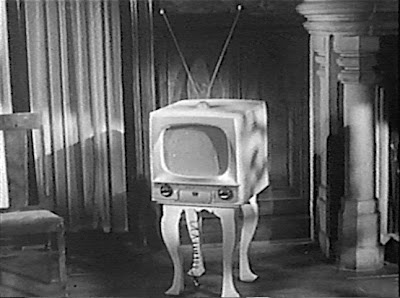
I’ve reviewed twomovies about witches today and I should be posting a review of a movie about Rasputin in a few more hours. Needless to say, all of this witch talk might be disturbing to some. Well, fear not! Today’s scene that I love is for you!
For today’s horror on the lens, we have 1973’s The Night Strangler.
This is the sequel to The Night Stalker and it features journalist Carl Kolchak (Darren McGavin) in Seattle. (After all the stuff that happened during the previous movie, Kolchak was kicked out of Las Vegas.) When Kolchak investigates yet another series of murders, he discovers that paranormal murders don’t just occur in Las Vegas and aren’t just committed by vampires.
I actually prefer this movie to The Night Stalker. The Night Strangler features a truly creepy villain, as well as a trip down to an “underground city.” It’s full of ominous atmosphere and, as always, Darren McGavin is a lot of fun to watch in the role in Kolchak.
Now, William Castle was famous for his gimmicks. For instance, theaters showing The Tingler were wired to give electrical shocks to random patrons. He had a special gimmick for 13 Ghosts, a film about a house haunted by ghosts that you can only see while wearing special goggles. Since I’m a lazy film blogger, I’m going to quote the film’s Wikipedia article on this particular gimmick:
“For 13 Ghosts, audience members were given a choice: the “brave” ones could watch the movie and see the ghosts, while the apprehensive among them would be able to opt out of the horror and watch without the stress of having to see the ghosts. The choice came via the special viewer, supposedly “left by Dr. Zorba.”
In the theatres, most scenes were black and white, but scenes involving ghosts were shown in a “process” dubbed Illusion-O: the filmed elements of the actors and the sets — everything except the ghosts — had a blue filter applied to the footage, while the ghost elements had a red filter and were superimposed over the frame. Audiences received viewers with red and blue cellophane filters. Unlike early 3D glasses where one eye is red and the other is cyan or blue, the Illusion-O viewer required people to look through a single color with both eyes. Choosing to look through the red filter intensified the images of the ghosts, while the blue filter “removed” them. Despite Castle’s claims to the contrary, not many heart failures or nervous breakdowns were averted by the Illusion-O process; although the blue filter did screen out the ghostly images, the ghosts were visible with the naked eye, without the red filter.”
Personally, if I had been alive in 1960, I totally would have watched the whole movie through the red filter. Go ghosts go!
Anyway, 13 Ghosts is actually a lot of fun in a low-budget, 1960s drive-in sort of way. Watch it below and, as always, enjoy!
 Through the Shattered Lens