Back to School Part II #5: A Clockwork Orange (dir by Stanley Kubrick)


It may seem strange, at first, that I am including the 1971 best picture nominee, A Clockwork Orange, in a series of Back to School reviews.  Certainly, Stanley Kubrick’s iconic adaptation of Anthony Burgess’s novel is not usually described as being a film about juvenile delinquency but that’s exactly what it is.

Many viewers tend to forget that Alex (played by Malcolm McDowell, who was nearly 30 at the time) and his three droogs are all meant to be teenagers.  (Only Michael Tarn, who played Pete, was actually a teenager at the time the film was shot.  Warren “Dim” Clarke and James “Georgie” Marcus were both in their late 20s.)  There’s even a lengthy scene in which Alex is interrogated by a social worker, P.R. Deltoid (Aubrey Morris).  Viewers are usually so surprised when Deltoid suddenly grabs Alex’s crotch that they forget that the whole reason Deltoid even came to the flat was to find out why Alex had been skipping school.  (“Pain in my gulliver,” was Alex’s oft-quoted excuse.)

So, make no mistake about it.  Among other things, A Clockwork Orange is a film about both the problem of juvenile delinquency and the continuing debate concerning what the authorities should do about it.  Stylistic and philosophical differences aside, A Clockwork Orange comes from the same cinematic family tree that’s given us everything from Rebel Without A Cause to Bully to Spring Breakers.

Of course, that’s not all that A Clockwork Orange is about.  It’s a Kubrick film, which means that there’s several different layers to work through and multiple interpretations for what we see on-screen.  For those who may not be familiar with the film, it takes place in a recognizable but futuristic England.  (One of my favorite theories is that A Clockwork Orange was about what was happening on Earth while David Bowman was becoming the starchild in 2001: A Space Odyssey.)  It’s a violent world, one where there appears to be significantly fewer people around than in the past.  The streets are deserted and bombed out.  Occasionally, when Alex returns to his home, he passes a mural of idealized working men creating a new world.  This rather banal work of Socialist realism has been defaced by obscene drawings and mocking graffiti.

Teenage Alex spends his nights hanging out with his friends (or, as he calls them, droogs), Pete, Georgie, and Dim.  They drink at the Korova Milk Bar and wear obscenely oversized codpieces, signifying this society’s obsession with outsized masculinity. When they speak (and when Alex narrates the film), they do so in a rhyming slang called Nadsat.  Under Alex’s sociopathic leadership, they spend their nights raping women, beating the homeless, and fighting with other gangs.  When Alex is not with his droogs, he enjoys lying around the house and listening to Beethoven (or “Ludwig Van” as he calls him).

After being betrayed by his droogs (who have tired of Alex’s cockiness), Alex ends up imprisoned for murder.  However, Alex is offered an early release if he’s willing to take part in the Ludovico Treatment.  For two weeks, Alex is drugged and forced to watch violent and sexual films while the music of Beethoven plays in the background.  As a result of the treatment, Alex grows physically ill at the thought of both violence and sex but he can also no longer listen to Beethoven.  Arguably, as a result of being cursed of his anti-social tendencies, he has lost the only non-destructive thing that he enjoyed.

Over the objections of the prison chaplain (who argues that robbing Alex of his free will is not the same as rehabilitating him), Alex is sent back into the real world and he quickly discovers that he now has no place in it.  His parents have rented his room out to a boarder who is now more of a son to them than Alex ever was.  The streets are full of men who were previously tormented by Alex and who now wants revenge.  In perhaps the film’s most brilliant moment, Alex discovers that his former droogs are now members of the police force.  Though they may now be wearing uniforms, Dim and Georgie are still as destructive and dangerous as Alex once was.  The difference is that Alex was caught and cured whereas Dim and Georgie discovered they could do just as much damage as authority figures as they did as juvenile delinquents.

In fact, the only people who now care about Alex are the political dissidents who hope to use Alex to discredit the government.  However, the dissidents aren’t particularly worried about Alex’s well-being either.  He’s just a prop to be used for their own ambitions.  Even worse, for Alex, is the fact that one of the dissidents is Mr. Alexander (Patrick Magee), a writer who lost both his ability to walk and his wife to an earlier assault committed by Alex…

(Interestingly enough, Mr. Alexander’s boyguard is played by David Prowse, who later become the ultimate symbol of government oppression when he was cast as Darth Vader in Star Wars.)

A Clockwork Orange is a brilliant film but it’s one about which I have very mixed feelings.  On the one hand, you can’t deny the power of the film’s imagery.  How many times has just the opening shot — of McDowell staring at us while wearing one fake eyelash — been imitated on TV and in other movies?  How much of the film’s dialogue — from “pain in my gulliver” to “the old in-out” — has lived on long past the movie?  Regardless of how many times I’ve seen A Clockwork Orange, the film’s electronic score (from Wendy Carlos) never ceases to amaze me.  Finally, it’s a film that argues that free will is so important that even a sociopath like Alex must be allowed to have it and that, as the chaplain argues, true goodness comes from within and cannot be manufactured or regulated by a government agency.  (It’s also a film that suggests that the government would be just as quick to use the Ludovico Treatment not just on the evil Alexes on the world but on anyone who dared to dissent from the party line.)  As I’m something of a “Freedom of Choice” absolutist, that’s a message to which I responded.

(At the same time, A Clockwork Orange does not argue that Alex’s actions should be free of consequences.  If anything, the film’s message seems to be that things would have been better for literally everyone if the government had just left Alex in jail, as opposed to trying to “fix” what was wrong with him.)

And yet, I have mixed feelings about A Clockwork Orange.  I guess my main issue is that the film doesn’t always play fair.  Malcolm McDowell is allowed to give a charismatic and well-rounded performance as Alex but nearly everyone else in the film is directed and written as a one-dimensional caricature.  Whereas Anthony Burgess’s novel emphasized the very real damage that Alex did to his victims, the film tends to surround Alex with comedic grotesqueries.  By both making Alex the only fully developed character in the entire film and then casting the energetic and charismatic Malcolm McDowell in the role, the film seems, at times, to come dangerously close to letting Alex off the hook for his worst crimes.  It also leaves the film open to the oft-repeated charge of glamorizing sex and violence.  (According to Roger Lewis’s biography of the author, that was Anthony Burgess’s opinion of the film.)  For the record, I don’t think A Clockwork Orange is an immoral film but I understand why some people disagree.

For that reason, A Clockwork Orange remains a controversial film.  In fact, I’m somewhat surprised that this subversive and deliberately confrontational film was nominated for best picture.  It was only the 2nd (and last) X-rated film to receive a best picture nomination.  Though it lost to The French Connection, A Clockwork Orange continues to be a powerful and controversial film to this day.  Perhaps the biggest indication of A Clockwork Orange‘s success is that it’s still being debated 45 years after it was first released.

Clockwork_orangeA

Horror Scene That I Love: The Leopard Tree Dream from Paul Schrader’s Cat People


Since I just reviewed Paul Schrader’s 1982 version of Cat People, I figured that I’d show a scene from the film that I love.

In this film, Irena (Natassja Kinski) has a dream in which her brother, Paul (Malcolm McDowell) explains the curse under which they both live.  This dream leads directly into the first part of the film’s best sequence, in which Alice (Annette O’Toole) suspects that she’s being followed while out jogging.

Everything about this scene — from the music to the sets to the cinematography — is horror perfection as far as I’m concerned.

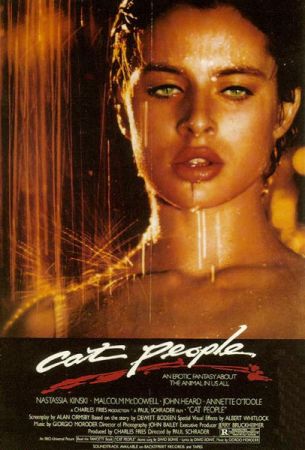
Horror Film Review: Cat People (dir by Paul Schrader)


Cat_People_1982_movie

Before I get around to actually reviewing Paul Schrader’s 1982 reimagining of Cat People, I’m going to suggest that you take a few minutes to watch the film’s opening credits.  Say what you will about Schrader’s Cat People, it has a great opening, one that perfectly sets up the rest of the film.

In this version of Cat People, Irena (Natassja Kinski) is a naive young woman (and virgin) who, after the death of her parents, has spent most of her previous life in foster care.  Irena travels to New Orleans, where she reconnects with her older brother, Paul (Malcolm McDowell).  From the minute that Irena meets her brother and his housekeeper (Ruby Dee), it’s obvious that something is off.  When Paul looks at her, he does so with an unsettling intensity.  At night, while Irena sleeps, Paul wanders the dark streets of New Orleans.

One morning, Irena wakes up to discover that Paul is missing.  Having nothing else to do, Irena wanders around New Orleans.  When she visits the zoo, she feels an immediate connection to a caged panther who stares at her with a familiar intensity.  It turns out that the panther was captured the previous night, after he mysteriously appeared in a sleazy motel and mauled a prostitute.

It’s at the zoo that Irena meets zookeeper Oliver Yates (John Heard).  Oliver gets Irena a job working at the zoo gift shop. where Irena is befriended by Oliver’s co-worker, Alice (Annette O’Toole).  One day, Irena witnesses the panther kill another zookeeper before it then escapes from its cage.

That night, Paul suddenly shows up in Irena’s bedroom.  He explains to her that they are a cursed species.  Having sex causes them to turn into panthers and the only way to avoid the curse is through incest.  A terrified Irena flees her brother and soon finds herself living with and falling in love with the increasingly obsessive Oliver, all the while knowing that giving herself to him physically will lead to her transformation.

From the very first second of the film. Schrader’s Cat People is an exercise in pure style.  If the original Cat People was largely distinguished by its restraint, Schrader’s version is all about excess.  Everything that was merely suggested in the original is made explicit in this version.  As tempting as it may be to try, it’s somewhat pointless to try to compare these two versions.  Though they may both be about a woman who turns into a panther when she has sex, they are two very different films.

Schrader’s Cat People walks a very fine line between moodiness and absurdity, which is perhaps why I enjoyed it.  Making great use of both the sultry New Orleans setting and Giorgio Moroder’s atmospheric score, Cat People is compulsively dream-like and enjoyably over-the-top.  Cat People is often described as being an example of a movie that could have only been made in the coked up 80s  and truly, this is one of those films that’s so excessive that it’s becomes fascinating to watch.

(I think that often we are too quick to assume that excess is necessarily a bad thing.  If you can’t be excessive when you’ve got Malcolm McDowell playing an incest-minded cat person in New Orleans, when can you be excessive?)

Schrader’s Cat People may not have much in common with the original version but the film’s best scene is the only one that is a direct recreation of a scene from the original.  In fact, in recreating the scene where Alice is menaced while swimming in a public pool, Schrader actually improves on the original.  Brilliantly performed by both Annette O’Toole and Natassja Kinski (whose cat-like features made her perfect for the role of Irena), it’s the only scene in the film that can truly be called scary.  Starting with a tracking shock that follows Alice as she jogs, the stalking scene is practically a master class in effective horror cinema.  If nothing else, you should see Cat People for that one scene.

And you should also see it for the wonderful soundtrack!  Let’s end this review with David Bowie’s theme song, which you may also remember from Quentin Tarantino’s Inglourious Basterds.


Embracing the Melodrama Part II #62: Time After Time (dir by Nicholas Meyer)


TimeAfterTime79So, I just gave the 1979 film Home Before Midnight a fairly negative review but I simply cannot end the 70s section of Embracing the Melodrama on such a negative note!  So, before we move on to the 80s, allow me to suggest another film from 1979 that you could watch while you’re not watching Home Before Midnight!

Time After Time opens in London.  The year is 1893.  Writer H.G. Wells (Malcolm McDowell) is having a dinner party so that he can show off his latest invention, a time machine.  Among his guests is a surgeon named John Stevenson (David Warner).  What nobody at the party suspects is that Stevenson also goes by the name Jack the Ripper and that he enjoys killing prostitutes.  When a detective from Scotland Yard shows up at Wells’s home, Stevenson jumps into the time machine and escapes into the future.  Since Stevenson does not have the “non-return key,” the machine returns back to 1893 but Stevenson has apparently escaped.

Wells uses the machine to pursue Stevenson and soon finds himself in 1979 San Francisco.  Wells had expected to find that the future would be a utopia but instead, he discovers the world of 1979 is loud, polluted, violent, angry, and dangerous.  (Kinda like the world of 2015…)  As Wells pursues Stevenson, he struggles to adjust to the world of the “future,” and he also meets a bank clerk, Amy Robbins (Mary Steenburgen).

Time After Time is probably the sweetest movie ever made about Jack the Ripper and that’s largely because of the romance between both Wells and Amy and the two actors who played them.  After watching Time After Time, I was not surprised to learn that McDowell and Steenburgen got married shortly after appearing in this film.  They were so incredibly sweet together!

Add to that, considering the he’s best known for playing villains and other menacing types, it’s interesting to see Malcolm McDowell plays such a gentle and nice character.  Wells’ befuddlement is charming to watch.  There’s a great scene where Amy calls Wells on a landline phone and Wells stares down at the receiver in frightened amazement.

Time After Time is a really good and likable movie.  It’s sweet and it proves that even hunting for Jack the Ripper can be a romantic experience if it’s done with the right person.  Watch it and enjoy!

A Quickie With Lisa Marie: The Artist (dir. by Michel Hazanavicius)


I was concerned before I saw Michel Hazanavicius’s critically acclaimed, silent film The Artist.  This is the film that’s currently being touted as an Oscar front runner and has been acclaimed by critics the world over.  Whenever I see this type of acclaim, I usually end up disappointed in the actual film because hype that positive is very difficult to live up to.  (Case in point: The Descendants.)  However, having seen The Artist, I can now say that this is the rare film that actually is almost as good as the critics say it is.

Starting out in a highly stylized Hollywood in the 1920s, The Artist introduces us to silent film star George Valentin (played Jean Dujardin who shows the same charm and style that he used to ironic effect in the director’s previous OSS 117 films).  Valentin is the biggest star in the world and he is cheerfully dismissive of the idea of “talking” film.  However, once the age of the talkies begins, Valentin finds his star on the descent while his protegé, former extra Peppy Miller (Berenice Bejo), becomes a star in talking films.  Defiantly, Valentin continues to make silent films but is there anybody around still willing to watch them?  Obviously, the storyline of The Artist is a familiar one but the film is more about how Hazanavicius tells this story than the story itself.  The Artist is ultimately a triumph in pure and exuberant style.

At first, I have to admit that I was a little bit dubious about The Artist being a silent film.  It sounded rather ominously like a gimmick and I was worried that The Artist would turn out to be one of those films that I felt obligated to enjoy as opposed to actually enjoying.  Having seen the film, I can say that it is indeed a gimmick but it’s that rare gimmick that actually works extremely and genuinely well.  Director Hazanavicius both pays homage to the conventions of silent cinema while also contrasting them against the harsher reality of loneliness and depression. 

Much like the best of the old silent actors, both Dujardin and Bejo have amazingly expressive faces and they can say as much with their eyes as they could say with dialogue.  Familiar character actors like John Goodman, James Cromwell, and Malcolm McDowell are also perfectly cast and used throughout the film’s narrative.  Ultimately, however, the film is really stolen by Uggie, who plays Dujardin’s little dog and is just about the most talented canine I’ve ever seen on-screen.  Seriously, he was adorable (and I say this as someone who is terrified of dogs both big and small) and he gets a chance to shine in a compelling sequence where he desperately tries to save his master from a fire.  Seriously, Uggie gives such a great performance that I was surprised to discover that he wasn’t actually Andy Serkis under heavy CGI.

Technically, of course, The Artist isn’t really a silent film.  It has a very rich and expressive musical score and there are two scenes in which Hazanavicius allows a few sound effects to be heard.  Only towards the end of the film do we get to hear anybody speak and its truly jarring in the best way possible.  If nothing else, The Artist makes us realize how much we take for granted the blaring soundtracks of most films.  We’re so used to hearing things that we’ve forgotten how to listen.  Luckily, The Artist is here to remind us.

A Quickie Horror Review: The Black Cat (dir. by Lucio Fulci)


For my first horror review of October, I want to tell you about a movie that was directed by one of my favorite Italian filmmakers, Lucio Fulci.  That movie is the unjustly neglected Gato nero, or the Black Cat

In The Black Cat (loosely — and I do mean loosely — based on Edgar Allan Poe’s short story), the great David Warbeck plays a detective who is  sent to a small English village to investigate a series of mysterious deaths.  Corpses are turning up covered in scratches.  A man crashes his car after a black cat suddenly shows up in the passenger’s seat.  A young couple is found dead in a locked-up boathouse.  Evidence suggests that the killer entered through a small air vent.  No human could fit through that vent but…how about a cat?  Warbeck enlists the aid of a visiting American photographer (Mimsy Farmer) to investigate the crimes and he soon comes across a half-crazed medium (Patrick Magee) who just happens to own an adorable, if ill-tempered, black cat…

Fulci is well-known for directing such seminal (and gory) horror films as Zombi 2 and The Beyond trilogy.  The Black Cat was made during the same period of time as his more infamous films but it has never received as much attention.  Perhaps that’s because The Black Cat almost doesn’t feel like a Fulci film.  The gore is played down, the plot is coherent and (for a Fulci film) surprisingly linear, and the film even has a playful sense of humor to it.  Indeed, this often feels more like a minor, if entertaining, Hammer film than a Fulci film.  However, visually, this film is clearly the work of Lucio Fulci.  With his constantly prowling camera following isolated characters through dark streets and passageways, Fulci manages to make a small English village feel just as menacing as the dying Caribbean island from Zombi 2.  For all the attention given to Fulci as a “master of gore,” the true strength of his best films came from Fulci’s ability to create a palpable atmosphere of dread.  Fulci used gore as a tool but not as a crutch and if The Black Cat is a minor Fulci film, it’s still a film that proves that he was a far better director than even many of his fans give him credit for.

The Black Cat is surprisingly well-acted by a cast that’s made up of an appealing  combination of Fulci regulars and English B-movie veterans.  I read an old interview in which Warbeck complained that he felt his performance here was “boring,” but actually he was the perfect lead for this type of film, likable and with enough of a sense of humor to keep you watching.  Al Cliver may not be a household name but he and his blonde mustache seemed to show up in just about every movie Fulci made and he shows up here as well.  This time, he’s playing a local English constable and he’s no more believable here than he was playing a scientist in The Beyond or a boat captain in Zombi 2.  Still, any true Fulci fan will always be happy to see Cliver show up in a Fulci film because — much like familiar but bland wall paper — he lets us know that we’re home.  Patrick Magee is probably best known for his over-the-top performance as Mr. Alexander in A Clockwork Orange.  Magee goes just as much over-the-top here but, just as in A Clockwork Orange, Magee’s performance fits in perfectly with the film he’s appearing in.  Much as Stanley Kubrick contrasted Magee’s performance with Malcolm McDowell’s more subtle work, Fulci contrasts Magee’s theatrical approach with the more relaxed performances of Warbeck and Farmer.  Did I just compare Lucio Fulci to Stanley Kubrick?  Yes, I did and I stand by it.

However, the real star of this film is the black cat.  Trust me, this black cat (or black cats as I imagine several were used) is both adorable and blood-thirsty.  I still say that our cat Doc is the cutest black cat in the world but this film’s murderous feline comes in a very close second.

Doc, the greatest black cat ever!

Poll: Lisa Marie Submits To Your Will


Last year, I gave up control to the reader of the site and you know what?  I kinda liked it in a sneaky, dirty little way.  So I figured, why not do it again?

Of course, I’m sure you’ve already guessed that I’m referring to my What Movie Should Lisa Marie Review poll.  This is the poll that led to me reviewing Anatomy of a Murder. 

Here’s how it works.  Earlier today, I put on a blindfold and then I randomly groped through my DVD collection until I had managed to pull out ten movies.  I then promptly stubbed my big toe on the coffee table, fell down to the floor, and spent about 15 minutes cursing and crying.  Because, seriously, it hurt!  Anyway, I then took off the blindfold and looked over the 10 movies I had randomly selected.  Two of them — Dracula A.D. 1972 and A Blade in the Dark — were movies that I had already reviewed on this site.  So I put them back and I replaced them with two movies of my own choosing — in this case, Eternal Sunshine of the Spotless Mind and The Unbearable Lightness of Being.

Between now and next Sunday (March 27th), people will hopefully vote in this poll.  On Sunday, I will watch and review whichever movie has received the most votes.  Even if that movie turns out to be Incubus. *shudder*  (Have I mentioned how much I love Eternal Sunshine of the Spotless Mind?)

Now, of course, there’s always the possibility that no one will vote in this poll and I’ll end up looking silly.  Those are the risks you take when you set up an online poll.  However, I have a backup plan.  If nobody votes, I will just spend every day next week shopping for purses at Northpark Mall and then blogging about it.  And by that, I mean blogging every single little detail.  So, it’s a win-win for me.

Anyway, here’s the list of the 10 films:

1) Barbarella — From 1968, Jane Fonda plays Barbarella who flies around space while getting molested by …. well, everyone.  Directed by Roger Vadim.

2) Barry Lyndon — From 1975, this best picture nominee is director Stanley Kubrick’s legendary recreation of 18th-century Europe and the rogues who live there.

3) Caligula — Yes, that Caligula.  From 1979, it’s time for decadence, blood, and nudity in the Roman Empire.  Starring Malcolm McDowell, Helen Mirren, Peter O’Toole, John Gielgud, John Steiner, and Theresa Ann Savoy.

4) Eternal Sunshine of the Spotless Mind — Oh my God, I love this movie.  Jim Carrey breaks up with Kate Winslet and deals with the pain by getting his mind erased by Tom Wilkinson, Mark Ruffalo, Kirsten Dunst, and an amazingly creepy Elijah Wood.

5) Incubus — From 1969, this low-budget supernatural thriller not only stars a young William Shatner but it also features the entire cast speaking in Esperanto.  For.  The.  Entire.  Movie.

6) Inland Empire — If you want to give Lisa nightmares, you can vote for David Lynch’s disturbing 3-hour film about lost identity, sexual repression, human trafficking, and talking rabbits.

7) Kiss Me Deadly — From 1955, this Robert Aldrich-directed cult classic features hard-boiled P.I. Mike Hammer and a host of others chasing after a mysterious glowing box and accidentally destroying the world in the process.

8 ) Mandingo — From 1975, this infamous little film is a look at slavery, incest, and rheumatism in the pre-Civil War South.  Starring James Mason, Ken Norton, Perry King, and Susan George.  Supposedly a really offensive movie, one I haven’t sat down and watched yet.

9) Sunset Boulevard — From 1950, hack screenwriter William Holden ends up the kept man of psychotic former screen goddess Gloria Swanson.  Directed by Billy Wilder.

10) The Unbearable Lightness of Being — From 1988, Philip L. Kaufman’s adaptation of Milan Kundera’s classic novel (one of my favorite books, by the way) features Daniel Day-Lewis, Juliette Binoche, and Lena Olin having sex and dealing with ennui.  After I first saw this movie, I insisted on wearing a hat just like Lena Olin did.

Everyone, except for me, is eligible to vote.  Vote as often as you want.  The poll is now open until Sunday, March 27th.

(Edit: Voting is now closed but check below for the results! — Lisa)